The signals are impossible to ignore.
- 60–65% of India’s workforce will need reskilling by 2030. (NASSCOM)
- AI could automate up to 70% of today’s work tasks. (McKinsey)
- AI job postings in India grew 320% year-over-year- outpacing talent supply by 4:1.
This is not a distant shift. It defines the 2026–2030 decade of work.
As AI reshapes how work gets done, organizations are being forced to rethink not just technology- but talent, roles, and workforce strategy itself.
Which puts CHROs at the center of this transformation. Not as support functions, but as drivers of business outcomes in an AI-led world.
This guide breaks down what AI workforce transformation means, why it’s accelerating in India, what’s changing between now and 2030, and how CHROs can lead this shift with clarity, speed, and scale.
What Is AI Workforce Transformation?
AI workforce transformation is the process of integrating AI technologies such as generative and agentic AI into business workflows to improve productivity and decision-making.
It requires organizations to redesign roles, build AI-literate talent, and continuously upskill employees, shifting work toward areas where humans add the most value= judgment, creativity, and collaboration.
Successful AI workforce transformation goes beyond automation, focusing on human–AI collaboration and strategic leadership to drive long-term business outcomes.
Key Aspects of AI Workforce Transformation
| Aspect | What It Means in Practice |
| Augmentation over Replacement | AI acts as a partner- not a substitute. It handles repetitive, data-heavy tasks, allowing humans to focus on decision-making, creativity, and empathy-driven work. |
| Skills-First Strategy | Hiring and workforce planning shift from roles to skills, helping organizations identify gaps faster and adapt to rapidly evolving job requirements. |
| New Roles and Skills | Demand for AI fluency is rising, creating AI demanding skills and new rolesthat combine domain expertise with the ability to work effectively with AI tools. |
| Workforce Redesign | Workflows are restructured to divide tasks between humans and AI, especially as agentic AI takes on more complex, multi-step responsibilities. |
The goal is not to eliminate roles- it is to redesign work so that human potential is amplified, not replaced.
Why India Is at the Center of AI Workforce Transformation
India is not just participating in AI-driven workforce transformation. It is one of the most critical markets shaping its outcome.
The next five years (2026–2030) will determine whether India becomes a global AI talent powerhouse or struggles with a widening skills gap.
To understand why this moment matters, you need to look at two parallel realities.
1. A Massive Talent Advantage Waiting to Be Unlocked
India has all the ingredients to lead the AI workforce revolution, but they need to be activated at scale.
- 65% of the population is under 35– one of the youngest workforces globally
- 3.5 million STEM graduates every year– the largest talent pipeline in the world
- 55% of global GCCs are already in India, making it the hub for global talent operations
- The GCC ecosystem is expected to grow to 2,400 centers by 2030, employing 3 million professionals
- 70% of Fortune 500 companies are expected to expand in India by 2030, accelerating demand for high-skill talent
On paper, India looks like the ideal engine for AI-driven workforce transformation.
| Related Reads | |
| AI Roles in HR: The 3 Critical Positions CHRO Must Build in 2026 | Who is a Chief AI Officer and Why Boards Are Creating This C-Level Role? |
| The Rise of AI in EdTech: What Talent Skills Are Needed Now? A Hiring Guide | AI in HR: A Guide to Implementing Automation in Indian Organizations |
2. A Growing Skills Gap That Cannot Be Ignored
Despite this advantage, there’s a clear disconnect between talent availability and talent readiness.
- Only 50%+ of graduates are job-ready today
- 54% of enterprises report a significant AI skills gap
- Just 4,000–5,000 professionals qualify as true AI specialists in a market that needs tens of thousands
- India ranks 72nd globally in AI readiness, behind several emerging economies
The implication is clear: India doesn’t have a talent shortage- it has a skills translation problem.
| Related Reads | |
| Skill Gaps in Oil & Gas: How Companies Can Prepare for the Future | The Green Talent Gap in India: Why ESG Hiring Fails and What Works Instead |
| The Digital Skills Gap in the Energy Sector: Hiring Challenge for CHROs | Engineering Talent Market 2026: Salary Trends, Skill Gaps & Hiring Insights |
3. The 2026–2030 Window: A Defining Moment
This gap is exactly why the current window is so critical.
In 2026, India joined the Reskilling Revolution initiative in partnership with the World Economic Forum- aiming to equip millions with future-ready skills by 2030.
At the same time:
- India is expected to add 2.9 lakh AI jobs in 2025 alone
- AI job demand is projected to grow 32% further in 2026
This creates a compressed timeline where demand is accelerating faster than workforce readiness.
What This Means for CHROs
For CHROs, this is not just a macro trend- it’s a strategic inflection point.
- The talent exists, but it needs to be reskilled and redeployed
- The demand is rising, but traditional hiring models cannot keep up
- The opportunity is massive, but execution will determine outcomes
In simple terms, the organizations that solve for AI-ready talent fastest will lead the next decade of growth.
To keep pace with AI-driven change, organizations need more than strategy. They need execution at scale: faster hiring, access to specialized talent, and the ability to continuously align skills with evolving roles.
Increasingly, this is where Recruitment Process Outsourcing and talent partners play a critical role helping CHROs translate workforce strategy into real, measurable outcomes.
The CHRO’s Evolved Role: From People Manager to Transformation Architect

If India’s AI workforce transformation opportunity is defined by talent potential vs. talent readiness, then the responsibility to close that gap sits squarely with the CHRO.
“The future CHRO isn’t just a culture steward or operational leader- they are now a transformation driver at the center of business strategy.” — Kathi Enderes, SVP Research, Josh Bersin Company
The role has already changed
The elevation of the CHRO role is measurable:
- 89% of CEOs say CHROs should drive long-term profitable growth
- CEO involvement in AI strategy jumped from 26% to 55%; CHROs are now the connective tissue between the C-suite and the workforce
- Some industry analysts now say: “CHROs are the new CTOs — the next CEOs”
What’s driving this shift?
This evolution is not accidental. It’s being driven by three fundamental changes in how organizations operate in the AI era.
#1 Skills gaps are board-level problems.
The talent challenge is no longer an HR issue. It’s a growth constraint.
Organizations cannot scale AI initiatives without the right skills in place.
Which means CHROs must move beyond hiring support to owning workforce strategy at a business level.
#2 AI Adoption Depends on Workforce Readiness
AI doesn’t fail because of technology- it fails because of people readiness.
Without the right skills, mindset, and change management, even the best AI investments fall short. This puts the CHRO at the center of ensuring adoption, not just implementation.
#3 Workforce Data Is Now Strategic Data
Workforce decisions are no longer operational. They directly impact revenue, productivity, and competitiveness.
With access to AI-powered talent insights, CHROs can now:
- Predict skill gaps before they impact business
- Align hiring with future demand
- Influence strategic decisions at the highest level
In many ways, workforce data is becoming as critical as financial data.
What This Means Going Forward
The CHRO’s role is no longer about managing people- it’s about architecting the future of work.
- Designing how humans and AI collaborate
- Building a workforce that can continuously adapt
- Ensuring talent strategy keeps pace with business transformation
And most importantly- turning workforce transformation from a concept into a scalable, executable reality
The Four Pillars of AI-driven Workforce Transformation
If CHROs are now responsible for driving workforce transformation, the next question is: what does successful execution actually look like?
AI transformation doesn’t succeed through technology alone. It works when organizations align leadership, talent, and execution around a clear strategy.
At the core of this shift are four interconnected pillars.
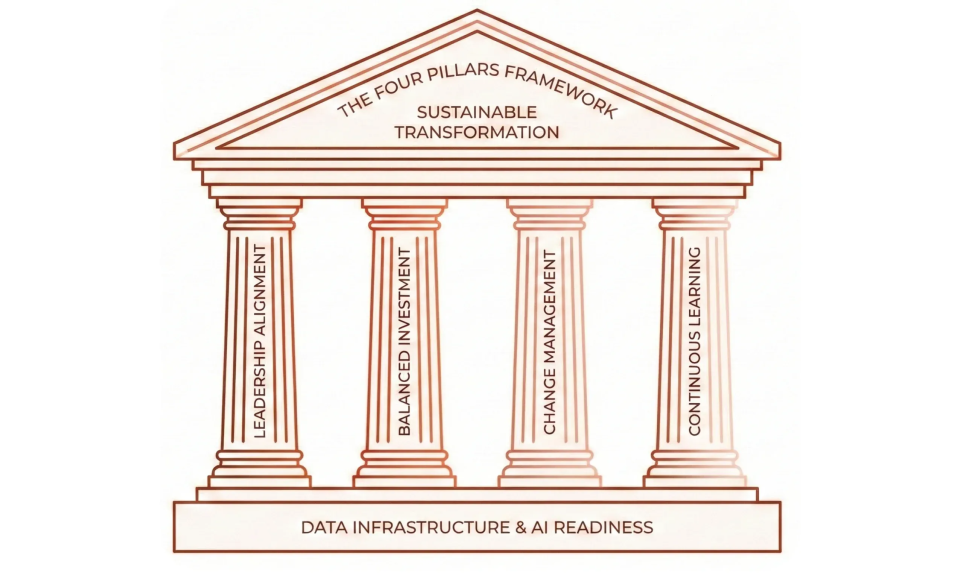
1. C-Suite Alignment
AI is no longer an IT initiative- it’s a boardroom priority.
The most successful organizations operate with a shared leadership model:
- The Chief Executive Officer defines the business vision
- The Chief Technology Officer builds the technology foundation
- The Chief Human Resource Officer prepares, reskills, and transitions the workforce
When these roles are aligned, AI moves faster from pilot projects to enterprise-wide impact.
2. Balanced Investment in Tech and Talent
AI transformation is as much about people as it is about technology.
The opportunity is massive:
- The World Economic Forum estimates 170 million new jobs globally by 2030
- India is expected to capture 15–20% of this growth
But the challenge is equally real:
- AI specialist salaries already range between INR 12–40 lakhs annually
- That’s a 45–60% premium over comparable non-AI roles
This creates a new reality for CHROs: balancing cost discipline with aggressive investment in future-ready talent.
And this is where execution becomes critical. Building vs. buying talent, hiring at scale, and accessing niche AI skill sets require specialized talent strategies and external expertise.
Already, many organizations are leveraging RPO partnerships to bridge this gap- combining workforce planning with faster, data-driven hiring.
3. Proactive Change Management
AI initiatives don’t fail because of poor technology. They fail because of low adoption.
In fact, 43% of AI projects fail due to lack of leadership support.
Successful organizations approach change management as a continuous capability, not a one-time effort.
They focus on four critical areas:
- Trust- building confidence in both AI systems and leadership intent
- Transparency- clearly communicating what AI will (and won’t) change
- Skills- enabling employees with practical AI literacy and tools
- Agility- creating a culture that adapts as technology evolves
The goal is simple: make AI something employees work with, not something they resist.
Read more: AI Adoption in the Workplace: Why Most Transformations Fail
4. Continuous Learning Culture
In the AI era, skills don’t stay relevant for long.
Organizations can no longer rely on one-time training or static career paths.
They need to build a system of continuous learning, reskilling and capability development.
This means:
- Regularly mapping skills to evolving roles
- Investing in ongoing learning programs
- Embedding AI fluency across functions- not just tech teams
The most competitive organizations treat learning not as an HR initiative,
but as a business-critical function tied directly to growth.
What This Means for CHROs
These four pillars are not independent- they reinforce each other.
- Without leadership alignment, transformation lacks direction
- Without talent investment, it lacks capability
- Without change management, it lacks adoption
- Without continuous learning, it lacks sustainability
Together, they determine whether AI workforce transformation remains a strategy-
or becomes a real, scalable advantage
And increasingly, execution at this scale requires new operating models, where internal HR teams are complemented by talent acquisition partners who can accelerate hiring, reskilling, and workforce alignment.
India’s Priority Sectors Where AI Workforce Demand Is Highest
AI-driven workforce transformation is not uniform- it’s sector-led. Some industries are already seeing accelerated demand for AI-skilled talent at scale.
| Sector | What’s Changing | Talent Demand |
| IT & ITeS | AI impacting core service delivery models | 1 million AI jobs by 2027 |
| BFSI | Increased investment in AI-led automation and risk systems | 200,000+ AI-skilled professionals |
| Healthcare | Growth in AI diagnostics and telemedicine | 50,000+ specialized roles |
| Manufacturing | Rapid adoption of Industry 4.0 technologies | 300,000 AI-enabled engineers |
| Agriculture | Expansion of AI-led precision farming | 100,000 agritech specialists |
Source: India Decoding Jobs Report 2026, Taggd
Across sectors, the scale of change is significant. India is expected to require 109 million skilled workers across high-growth industries by 2026.
For CHROs, this reinforces a critical shift: AI workforce transformation is not just about future readiness- it’s about meeting immediate, sector-specific talent demand at scale.
Build vs. Buy: The Talent Decision CHROs Can’t Delay
Build vs. buy refers to whether organizations should upskill existing employees (build) or hire new talent (buy). In AI workforce transformation, a hybrid approach works best- hiring for niche roles while reskilling internal teams for scale.
AI talent demand is moving faster than traditional hiring can support.
The hiring reality:
- Mid-level tech roles take 45–60 days to fill
- AI specialist roles take 90+ days
- External hires see a 30–50% productivity dip in year one
The build advantage:
- Internal upskilling costs: INR 15,000–INR 25,000 per employee annually
- Government subsidies via NSDC partnerships cover 50–75% of recognized program costs
- Skill India Digital, CSR mandates, and PLI scheme incentives make internal development significantly more viable than often assumed
The takeaway is clear: Neither pure hiring nor pure upskilling works. The winning approach is a hybrid model-
- Hire externally for niche AI roles
- Build internally for scale and long-term capability
Read more: Build vs. Buy Talent in the AI Era: What Indian CHROs Must Decide
What AI Workforce Transformation Looks Like in Practice
Leading Indian organizations are already seeing results by combining automation with workforce redeployment.
TCS (ignio™ platform): Automated 60% of routine IT operations tasks. Redeployed 15,000+ employees to client engagement and innovation roles.
HDFC Bank (EVA): AI assistant handles 5M+ customer queries. Freed 3,000+ representatives for complex advisory roles. 80% query resolution rate; 30% improvement in customer satisfaction.
Infosys (Nia platform): Automated 16,000+ business processes. $737M in operational savings. Reskilled 2.2 lakh employees in digital technologies.
The pattern across every case study is consistent: automation of routine tasks → redeployment to higher-value human work → measurable business outcomes.
Measuring AI ROI in Workforce Transformation
Traditional HR metrics are insufficient for AI-era workforce decisions. CHROs need to track outcomes across four areas:
| Metric Area | What to Track |
| Productivity | Task time reduction, automation rate |
| Talent Quality | Quality-of-hire, internal mobility |
| Learning Impact | AI adoption, reskilling effectiveness |
| Business Impact | Revenue per employee, time-to-market |
| Risk | Compliance (DPDPA), AI governance readiness |
Indian companies that invest consistently in workforce transformation are already seeing results: 15% average ROI from AI in 2025, projected to reach 31% within two years
Read more: Measuring ROI of AI in HR: Metrics That Actually Matter
The 2026–2030 Action Agenda for CHROs
The next 3–5 years will define competitive advantage.
The organizations that emerge strongest from this transformation window will be those that act quick. Execution needs to start now.
Here is the priority sequence:
Immediate (0–6 months)
- Conduct a task-level skills audit for critical roles
- Establish an AI literacy baseline
- Identify internal AI champions
Short-Term (6–18 months)
- Launch structured reskilling programs (with subsidy support)
- Redesign key workflows for human–AI collaboration
- Build a workforce data dashboard linked to business outcomes
Strategic (18 months–2030)
- Create a dynamic skills taxonomy (updated regularly)
- Expand into Tier 2/3 talent markets (cost + access advantage)
- Drive vernacular AI adoption to reach non-English workforce segments
The focus shifts from planning to continuous workforce evolution.
India’s Moment: The Stakes Are High
India has every structural advantage to become the world’s premier AI workforce hub:
- A young population
- The world’s largest STEM talent pipeline
- A rapidly expanding GCC ecosystem
- A $500 billion AI opportunity by 2030
But demographic advantage is not self-executing.
The 54% of Indian enterprises reporting a skills gap are at risk of converting demographic dividend into demographic stagnation.
The CHRO is the single most important leader in determining which outcome prevails.
Wrapping Up
AI workforce transformation will not be decided by technology. It will be decided by how fast organizations can build, deploy, and scale talent.
And at the center of that transformation is the CHRO.
The organizations that act now will lead. The ones that delay will struggle to catch up.
FAQs
What is AI workforce transformation?
AI workforce transformation is the integration of AI technologies into business workflows to improve productivity and decision-making. It involves redesigning roles, building AI-ready skills, and enabling human–AI collaboration so organizations can scale efficiently and adapt to changing business needs.
Why is AI workforce transformation important for CHROs?
AI is changing how work gets done, making talent strategy a business priority. CHROs must ensure workforce readiness, close skills gaps, and align hiring with future demand to drive growth and successfully implement AI initiatives.
What are the key pillars of AI workforce transformation?
The four key pillars are:
C-suite alignment
Investment in both technology and talent
Proactive change management
Continuous learning and reskilling
Together, these ensure that AI transformation is scalable, sustainable, and aligned with business outcomes.
How is AI changing workforce planning?
AI enables data-driven workforce planning by predicting skill gaps, automating talent analysis, and improving hiring decisions. It shifts planning from static headcount models to dynamic, skills-based strategies aligned with real-time business needs.
What is a skills-first hiring strategy?
A skills-first strategy focuses on hiring and developing talent based on capabilities rather than job titles or degrees. It helps organizations identify hidden talent, close skill gaps faster, and adapt to rapidly evolving roles in the AI-driven workplace.
How can companies measure ROI of AI in workforce transformation?
Organizations measure AI ROI through productivity gains, quality of hire, reskilling impact, and business outcomes like revenue per employee. Tracking these metrics helps CHROs connect workforce initiatives directly to business performance.
What skills are most important in an AI-driven workforce?
Key skills include AI literacy, data interpretation, prompt engineering, critical thinking, creativity, and collaboration. These skills enable employees to work effectively alongside AI systems and adapt to evolving job roles.
What industries in India are driving AI workforce demand?
Sectors like IT & ITeS, BFSI, healthcare, manufacturing, and agriculture are leading AI adoption. These industries are creating high demand for AI-skilled professionals and driving large-scale workforce transformation.
Download the complete AI-Driven Workforce Transformation Whitepaper(2026–2030) to see how leading organizations are building AI-ready talent, closing skills gaps, and scaling hiring with precision.
What you’ll get:
- A practical four-pillar transformation framework with execution roadmaps
- Clear insights into skills, roles, and workforce readiness
- A step-by-step approach to operationalizing AI- from strategy to execution
- A framework to measure ROI and business impact of workforce transformation
Taggd combines AI-powered talent intelligence with RPO expertise to help you hire faster, smarter, and at scale.