The hiring landscape for product engineers in India isn’t just competitive anymore; it’s a full-blown strategic battlefield. This change is being driven by a perfect storm: the boom of Global Capability Centres (GCCs) demanding senior leadership, the rapid spread of AI, and a startup scene that’s hungrier than ever for innovation. For CHROs, the old playbook of viewing India as a cost-saving destination is obsolete. It’s now a global epicentre for building entire products, from the first sketch to the final launch.
The New Battlefield for India’s Product Engineering Talent

The game has fundamentally changed for hiring product engineers in India. What used to be a numbers game, focused on bringing in lots of junior talent, has become a high-stakes chess match. Here, the most valuable pieces are the experienced, strategic thinkers. It’s no longer about just filling seats; it’s about securing the architects who will design your company’s future growth.
This shift is being fuelled by several powerful forces hitting all at once. For CHROs, understanding these undercurrents is the first step toward building a recruitment strategy that can win in 2026 and beyond.
To help you get a quick sense of the new reality, this table breaks down the most critical shifts shaping the market.
Key Product Engineering Talent Trends in India for 2026 at a Glance
| Emerging Trend | Core Statistic | Immediate Implication for CHROs |
|---|---|---|
| The “Great Senior Shift” | Demand is pivoting from freshers to professionals with 4-10 years of experience. | Your hiring pipeline must be re-engineered to attract, engage, and retain mid-career talent, not just graduates. |
| The GCC & Startup Squeeze | GCCs will create 500,000+ new jobs by 2026; startups now hire 43% experienced talent. | You’re competing with both global giants and agile startups for the same small pool of senior engineers. Compensation and culture need to stand out. |
| Product-Minded Over Code-Focused | The primary demand is for engineers who can think like business owners and drive product outcomes. | Technical skill assessments are not enough. Your interview process must identify commercial acumen and product sense. |
These trends signal a permanent change in how we need to approach talent. Let’s dig deeper into what’s driving this.
The Great Talent Shift from Junior to Senior
One of the biggest trends we’re seeing in product engineering is the move away from mass-hiring fresh graduates. The spotlight has moved directly onto mid-career professionals, people with a proven track record of leading projects, mentoring teams, and getting things done with little hand-holding.
Think of it this way: companies are no longer just hiring labourers for a construction project. They’re in a fierce bidding war for the experienced site foremen who can take a blueprint and execute it perfectly. This has created a massive skills chasm. While India has a huge number of engineering graduates, the demand for seasoned professionals is far greater than the supply, leading to intense competition.
The core challenge for organisations is no longer finding engineers, but finding product-minded engineers with 4-10 years of experience who can translate business goals into technical reality. This is the new bottleneck for innovation.
The GCC and Startup Squeeze
The pressure on the talent market is coming from two sides: the explosive growth of Global Capability Centres (GCCs) and a resurgent startup ecosystem. GCCs are not just back-office support hubs anymore; they are now complete R&D centres driving global product development right here from India. This has massively dialled up the demand for senior technical leaders.
At the same time, startups are hiring aggressively, but with a new strategy. Data shows that while startups increased hiring by 32-40% year-over-year in 2025, they’ve dramatically changed their focus. Hires of freshers dropped from 53% to 41%, while recruitment of experienced talent now makes up 43% of all startup hires.
When you combine that with the fact that GCCs are projected to create over 500,000 new jobs by 2026, it’s clear the competition for experienced engineers has hit a fever pitch. You can find more detail on this in these 2026 job predictions.
How AI Is Rewriting Product Engineering Roles and Skills

Artificial Intelligence is no longer just a specialised field; it’s become the new operating system for modern product engineering. This isn’t a minor update. The rise of AI is fundamentally rewriting job descriptions, blurring old professional lines, and creating entirely new hybrid roles that simply didn’t exist a few years back.
Think of it like the difference between a standard auto mechanic and a Formula 1 race engineer. Both work on engines, but the F1 engineer needs a completely different level of data fluency and real-time analytical skill. In the same way, today’s product engineers are expected to build, deploy, and scale AI-native products, not just maintain old codebases.
This evolution is a major hurdle for CHROs. Your old competency models need an urgent overhaul. AI proficiency isn’t a nice-to-have anymore, it’s the baseline requirement for building any product that can compete.
The New Breed of AI-Powered Engineers
We’ve moved past the need for generalist software developers. The real demand is for specialists who can embed intelligent systems directly into the product lifecycle. These aren’t just data scientists running experiments in a lab; they are engineers who build with AI from day one.
The hottest areas of demand right now are:
- Generative AI Integration: Engineers who can masterfully integrate Large Language Models (LLMs) and diffusion models into user-facing features. This is about creating smarter, more intuitive product experiences.
- MLOps (Machine Learning Operations): These are the professionals who can build and manage a machine learning model’s entire journey, from deployment and monitoring to retraining at scale. It’s a crucial role for reliability.
- Natural Language Processing (NLP): This talent gives products the ability to understand and talk back to humans, powering everything from sophisticated chatbots to sentiment analysis tools.
- Computer Vision: Specialists who build systems that can see, interpret, and act on visual data. This is a game-changer for industries like retail, healthcare, and automotive.
These skills represent a much deeper, more applied form of engineering. Companies aren’t just looking for people who can write code. They’re searching for talent that also grasps the statistical and mathematical principles behind the AI models they’re putting into production.
The most sought-after product engineers today are not just coders; they are architects of intelligence. They build systems that learn, adapt, and create value, making them indispensable in the new product engineering landscape.
India’s AI Talent Paradox
When it comes to AI talent, India is in a truly unique and complicated position. On one hand, the country is a leader in AI talent acquisition, which is completely reshaping how product engineering teams are hired. India boasts the world’s highest annual growth rate in AI hiring at 33%, according to the Stanford AI Index Report 2025. This advantage is especially clear in product engineering, where AI skills penetration is 2.5 times the global average. You can learn more about this and the Indian government’s response by reading the full report on India’s AI workforce strategy.
But here’s the catch. While the numbers look incredible on paper, they hide a serious challenge. India accounts for 16% of the global AI talent pool, which is projected to hit 1.25 million professionals by 2027. Yet, the gap between having a skill and knowing how to apply it effectively in a business setting is still vast. Overall employability has only crept up to 56.35%, pointing to a real shortage of application-ready talent.
This creates a paradox for CHROs: the talent pool seems huge, but finding engineers who can actually translate AI theory into tangible product outcomes is incredibly tough. This scarcity of practical expertise is a major factor driving the competitive product engineering talent trends in India. To win, companies have to look past certifications and zero in on candidates with proven, hands-on experience shipping AI-powered features. To get a head start, check out our guide on the top AI skills in demand right now.
Navigating the Mid-Career Experience Squeeze
The centre of gravity in India’s talent war has shifted. For years, hiring strategies were built around fresh graduates, but the new battleground is for mid-senior professionals with four to ten years of experience. This intense focus has created a real squeeze, where the demand for these seasoned engineers is far outstripping the available supply.
Companies are no longer content with hiring apprentices who need months of training. They’re now prioritising candidates who can step in and make an impact from day one. They need engineers who can own entire product modules, mentor junior team members, and get products to market faster with minimal hand-holding. This is a direct reaction to the rising complexity of product development and the unrelenting pressure for speed and quality.
The Search for Site Foremen, Not Labourers
Think about it like building a massive, complex structure. For a long time, companies were focused on hiring a large crew of labourers (junior engineers). Now, the main bottleneck isn’t the number of workers on site; it’s the shortage of experienced site foremen. These are the mid-level leaders who can read the architect’s blueprints, manage the different crews, and ensure the project gets built correctly and on time.
That’s exactly what’s happening in the Indian product engineering scene today. Organisations are desperately searching for these “foremen” who have that perfect mix of deep technical skill and the maturity to run projects on their own. They are the critical link between high-level strategy and what actually gets built, making them the most valuable players in the market right now.
The fallout from this squeeze is already changing the entire talent ecosystem.
- Hyper-Inflated Salary Expectations: With so much competition for a small pool of talent, pay for mid-career engineers has shot through the roof. Salary hikes of 35-55% aren’t just possible; they’re becoming common for candidates with the right skills.
- Aggressive Counter-Offers: The fight to keep this talent is just as fierce as the one to hire them. Counter-offers are now a standard part of the game, making the hiring environment volatile and tough to predict.
- A Magnified Retention Challenge: Keeping these valuable professionals takes more than just money. They’re looking for meaningful work, a clear path for growth, and a culture that values innovation, which turns retention into a complex, multi-layered problem.
For CHROs, this new reality means that old sourcing methods and rigid salary bands simply won’t work anymore. Relying on generic job posts or traditional recruitment channels is a recipe for disappointment.
The experience squeeze isn’t a temporary blip; it’s a structural shift in the market. The winning organisations will be those that adapt their entire talent strategy, from sourcing and compensation to engagement and retention to cater specifically to this highly sought-after group.
Why This Talent Segment Is So Critical
The value of a mid-career product engineer goes way beyond just writing code. They act as a force multiplier inside an organisation, bringing a unique blend of skills and experience that junior or very senior talent often lacks. They are the true engine room of innovation, able to both build and lead.
This makes them indispensable for growth. Their ability to bridge the gap between junior enthusiasm and senior-level strategy is what allows product roadmaps to become reality. This pivotal role is why the product engineering talent trends in India are now so heavily skewed towards this specific experience bracket. Attracting and engaging them requires a sophisticated approach that understands their unique value and career goals. They are no longer just another hire; they are a strategic investment in your company’s future.
Modern Strategies for Sourcing and Retaining Top Engineers
Let’s be honest. In a market where a staggering 82% of employers report struggling to find qualified engineers, the traditional recruitment playbook is finished. Simply posting on job boards and waiting for applications to roll in is like fishing in an overfished public lake – you might get a few bites, but you’re not landing the big one. For India’s fiercely competitive product engineering sector, you need a completely new game plan.
The following chart paints a clear picture of the talent squeeze companies are facing. It highlights the huge gap between the high demand for mid-to-senior professionals and the actual talent available on the market.
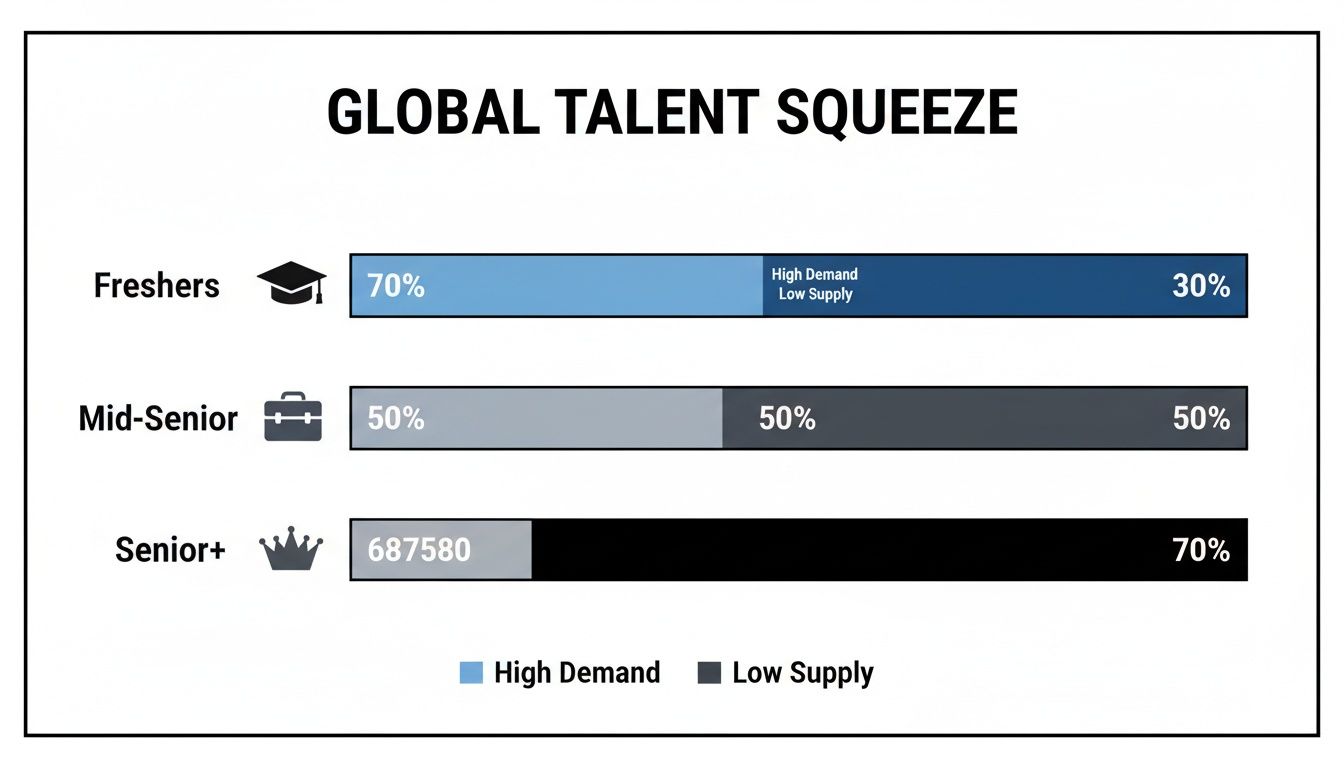
The data tells a stark story: while there’s no shortage of freshers, the real battle is for experienced engineers. This scarcity has created intense competition, making a proactive, targeted sourcing strategy an absolute necessity.
Proactive Sourcing Beyond Job Boards
Winning organisations have stopped waiting for talent to come to them. They’re now actively sourcing from niche channels where top engineers actually spend their time. Think of it as the difference between casting a wide, generic net and using a spear to target the exact fish you need.
So, where are these engineers hiding? Successful sourcing now means exploring:
- GitHub and GitLab Repositories: Looking at an engineer’s public code is the most direct way to see their skills and passion. It’s like reviewing a painter’s portfolio before commissioning a piece of art.
- Kaggle Competitions and Hackathons: These platforms are magnets for top-tier data scientists and ML engineers. Spotting the winners here gives you a direct line to talent that has already proven they can perform under pressure.
- Exclusive Developer Communities: Niche communities on platforms like Discord or Slack are where engineers go to solve tough problems and share what they know. By participating genuinely, you build credibility and connect with passive candidates who aren’t even looking for a job.
The best talent isn’t applying for jobs anymore. You have to go find them where they are building, creating, and learning. That’s the core of modern sourcing.
The channels you use to find talent have a massive impact on your hiring success. Traditional methods are becoming less effective for finding the specialised skills needed in product engineering.
Here’s a quick comparison of how different sourcing channels typically perform.
Effectiveness of Sourcing Channels for Product Engineering Talent
| Sourcing Channel | Success Rate for Niche Skills | Typical Time-to-Hire | Relative Cost-per-Hire |
|---|---|---|---|
| Traditional Job Boards | Low | 45-60+ Days | High (due to volume) |
| Employee Referrals | High | 25-40 Days | Low |
| Professional Networks (e.g., LinkedIn) | Medium | 30-50 Days | Medium |
| Niche Developer Communities | Very High | 20-35 Days | Low to Medium |
| Direct Sourcing (GitHub, Kaggle) | Very High | 20-35 Days | Medium |
As the table shows, investing in direct and community-based sourcing yields a much better return. You not only find higher-quality candidates with the exact skills you need, but you also often hire them faster and more cost-effectively.
Retention as Your Most Powerful Recruitment Tool
While finding talent is hard, keeping it is even harder and arguably more important. A strong retention strategy is your secret weapon in recruitment. It creates a magnetic culture that doesn’t just keep your best people but also attracts others just like them. In the close-knit developer community, a reputation as a great place to work is priceless.
The key is building a compelling employee value proposition (EVP) that goes far beyond a fat paycheque. It’s about creating an environment where talented engineers feel they can do their best work, grow their skills, and build a real career.
Crafting an Irresistible Employee Value Proposition
A winning EVP is built on pillars that address what today’s top engineers truly care about. They aren’t just looking for a salary; they want a stake in the company’s future and control over their own professional growth.
Here’s what a modern EVP must include:
- Transparent Career Paths: Engineers need to see a clear path forward, whether that’s on a management track or as a senior individual contributor. Uncertainty about career growth is a huge red flag that sends top talent running.
- Dedicated Upskilling Budgets: Technology moves fast, and the opportunity to learn is a top priority. Offering a dedicated budget for courses, certifications, and conferences shows you’re invested in their long-term value.
- Access to Modern Tech: Top engineers are driven by solving complex problems with the best tools. Giving them access to the latest tech stacks isn’t just a perk; it’s a signal that your company is serious about innovation.
- A Genuine Culture of Innovation: This means more than putting “innovation” on a slide deck. It means creating psychological safety, empowering teams to experiment (and fail), and celebrating technical excellence.
- Meaningful Flexibility and Equity: A competitive salary is just the starting point. Balancing it with stock options, learning stipends, and genuine flexibility demonstrates trust and gives employees a real sense of ownership in the company’s success.
How a Strategic RPO Partner Solves the Talent Puzzle
For many CHROs, the sheer operational weight of navigating this intense talent market is becoming unsustainable. The daily grind of finding, attracting, and keeping top-tier product engineers leaves very little time for actual high-level strategy. This is exactly where Recruitment Process Outsourcing (RPO) comes in, not just as an operational fix, but as a genuine strategic advantage.
Think of a specialised RPO partner as a deeply embedded part of your own talent acquisition team. They arrive armed with superior market intelligence, dedicated sourcing power, and resources that can scale up or down as you need. Trying to compete in this market with a generalist internal team is like asking a group of all-round developers to build complex enterprise software, they might eventually get it done, but it will be slow and likely won’t meet expert standards.
Partnering with a specialist firm is a completely different ball game. It’s like bringing in a team that lives and breathes your specific technology stack, knows every top player by name, and understands the intricate nuances of the ecosystem.
Beyond Recruitment to Strategic Partnership
A true RPO partner doesn’t just fill your open roles and move on. They become a core part of your strategic workforce planning, offering a level of focus and expertise that internal teams, often stretched thin across many priorities, simply cannot match. Their job is to give you a competitive edge in a market where speed and quality are everything.
This partnership provides real, tangible advantages by zeroing in on key areas:
- Proactive Talent Pipelining: Instead of scrambling when a position opens up, RPO partners are constantly building and nurturing talent pipelines for high-demand skills like AI/ML and cloud-native development. This drastically slashes your hiring timelines.
- Accessing the Passive Market: The best engineers are rarely looking for jobs. RPO specialists are experts at mapping the market, identifying these passive candidates, and engaging them with compelling, personalised outreach that gets their attention.
- Market Intelligence and Benchmarking: They give you real-time data on salary trends, what your competitors are doing, and which skills are gaining traction. This allows you to make data-driven decisions on compensation and benefits, ensuring your offers are always competitive.
This data-backed approach transforms recruitment from a reactive, fire-fighting function into a proactive, strategic operation. It frees up the CHRO and their team to focus on the bigger picture: culture, leadership development, and long-term workforce architecture.
An RPO partner’s value isn’t just in filling jobs faster. It’s in building a sustainable talent engine that fuels business growth, giving you access to expertise you couldn’t build internally without a massive investment of time and resources.
The Tangible Business Outcomes
Working with an RPO provider translates directly into measurable business results. This isn’t just about making hiring metrics look good; it’s about enabling the entire organisation to move faster and more effectively. The focus shifts to achieving concrete outcomes that drive the bottom line.
By integrating a strategic RPO solution, companies can expect to see significant improvements in several key areas. For a deeper dive into the specific ways this works, you might be interested in how Recruitment Process Outsourcing can improve hiring results.
Key outcomes include:
- Accelerated Time-to-Market: By filling critical product engineering roles 40-50% faster, RPO partners help you get products developed and launched on schedule. This has a direct, positive impact on revenue.
- Improved Quality of Hire: With access to a wider, pre-vetted talent pool and sophisticated assessment techniques, the quality and cultural fit of your new hires increase. This naturally leads to better performance and lower attrition.
- Enhanced Employer Branding: A professional and efficient recruitment process leaves a positive impression on every single candidate. This strengthens your employer brand, even with those you don’t end up hiring.
- Cost and Resource Optimisation: An RPO model gives you incredible scalability. You can ramp up hiring for a major project and then scale back down without the overhead of maintaining a large, permanent internal recruitment team. This leads to a much more predictable cost-per-hire.
Ultimately, a strategic RPO partnership solves the complex talent puzzle. It provides the specialised machinery needed to compete for top product engineering talent in India, allowing your business to get back to focusing on what it does best: innovation.
Your Questions Answered on India’s Product Engineering Talent
When it comes to India’s product engineering talent market, leaders have a lot of questions. We get it. Things are moving fast. This FAQ tackles the most common queries we hear from CHROs and hiring managers, offering straight, actionable answers to help you build a winning tech team for 2026 and beyond.
What Is a Realistic Salary for a Mid-Level Product Engineer in India?
This is a tricky one, as benchmarks are a moving target. For a good mid-level product engineer with 4-8 years of experience, especially one with hot skills in AI/ML or cloud-native tech expect them to see salary hikes of 35-55% when they switch jobs. The intense competition from both GCCs and cash-rich startups has pushed the entire median salary range upwards.
While the exact numbers will shift depending on the city (Bengaluru and Hyderabad still pay a premium), a competitive offer for this profile is now landing somewhere between ₹30-50 lakhs per annum. But remember, base pay is only part of the story. The best candidates now expect a full package, including meaningful equity, performance-linked bonuses, and even a dedicated budget for learning and development.
How Can We Compete with GCCs for Talent?
Global Capability Centres (GCCs) definitely have deep pockets, but that doesn’t mean you can’t compete. Instead of getting into a bidding war you can’t win, shift your focus to what you can offer that they can’t: a superior employee value proposition.
Here’s how you can build a compelling alternative:
- True Ownership and Impact: Give engineers the chance to own entire product modules from start to finish. This is a powerful draw compared to working on a tiny, siloed piece of a massive global project, which is common in larger setups.
- A Clearer, Faster Path to Growth: In smaller, more nimble companies, the route to a leadership role is often shorter and more direct. Make it clear that their work will get noticed and that they can grow with the company.
- A Culture That Breathes Innovation: Showcase an environment where people can experiment without fear, where red tape is minimal, and where engineers get to work on genuinely exciting tech they’re passionate about.
Is Remote Work Still a Major Factor for Engineers?
Absolutely. A non-negotiable, full-time return-to-office policy is a major red flag for most senior product engineers in India today. Sticking to it will dramatically shrink your talent pool and put you at a serious disadvantage.
The new normal has settled on a hybrid model. Offering two to three days of remote work each week strikes the perfect balance that top engineers are looking for, it gives them the collaborative energy of the office and the deep-focus time of working from home.
Firms that embrace this flexibility are winning. Those that don’t are finding that their top candidates are simply choosing other employers who will.
What’s the Most Common Mistake Companies Make When Hiring in India?
The single biggest mistake we see is moving too slowly. The market for top-tier product engineering talent is incredibly fast and fiercely competitive. If your interview process drags on for several weeks across multiple stages, you’ve already lost.
The most sought-after engineers are juggling multiple offers at once. To stand a chance, you need a lean, efficient hiring process that allows you to get an offer out the door within 7-10 days of the first conversation. It shows you’re decisive, you value their time, and you’re serious about hiring them.
Making your way through these challenges isn’t easy, it demands a focused, strategic partner who knows the market inside and out. As your embedded RPO partner, Taggd brings the market intelligence and sourcing firepower you need to attract and land the best product engineers. Connect with us and find out how we can help you build your dream team today.