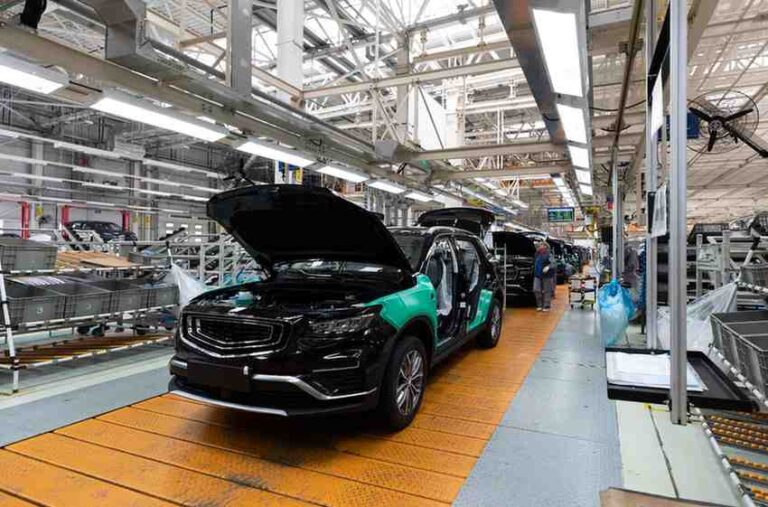
The roar of the internal combustion engine is fading, replaced by the hum of electric motors and the silent processing of trillions of data points. The global automotive sector is undergoing its most profound transformation in a century, driven by electrification, autonomy, connectivity, and digitalisation. This seismic shift isn’t just about changing what vehicles are; it’s fundamentally reshaping who builds, manages, and innovates them. For Chief Human Resource Officers (CHROs), talent leaders, and Recruitment Process Outsourcing (RPO) partners, navigating this new terrain is not just an advantage-it’s a critical necessity for survival and growth.
The skills that defined automotive excellence for decades are now table stakes, and a new portfolio of competencies is required to win the race to the future. The challenge is clear: traditional mechanical engineering prowess must now integrate seamlessly with software development, data science, and user-centric design. This evolution demands a strategic overhaul of talent acquisition, development, and retention strategies.
This comprehensive guide breaks down the top skills in demand in the automotive sector, moving beyond simple definitions to provide a strategic blueprint for human capital management. For each of the 10 critical skill domains, you will find:
- Market Drivers: The core industry trends fuelling the demand for each skill.
- Key Roles: Specific job titles and functions where these skills are paramount.
- Recruitment & Assessment: Actionable strategies for sourcing and validating candidate expertise.
- Upskilling Pathways: Practical recommendations for developing your existing workforce.
- Success Metrics: Tangible KPIs to measure the impact of your talent initiatives.
This listicle is designed as a practical toolkit, equipping CHROs and their RPO partners to build the high-performance teams that will drive the next generation of mobility and secure a competitive edge in a radically new automotive world.
Electric Vehicle (EV) Technology & Battery Systems
The shift from internal combustion engines (ICE) to electric powertrains represents the most significant transformation in the automotive sector in a century. Consequently, expertise in EV technology and battery systems has become one of the top skills in demand in the automotive sector. This specialisation is no longer a niche; it is the new core of automotive engineering and manufacturing.
This skill set encompasses a deep understanding of electric motor design, power electronics, battery chemistry (including lithium-ion and emerging solid-state technologies), and sophisticated Battery Management Systems (BMS). Professionals must also be adept at thermal management to ensure battery safety and longevity, as well as optimising overall vehicle energy efficiency.
Why This Skill is Crucial
The global push for decarbonisation, supported by government mandates and growing consumer demand, is accelerating EV adoption at an unprecedented rate. Projections indicate EVs could constitute over 35% of new vehicle sales by 2030. This rapid transition places immense pressure on original equipment manufacturers (OEMs) and their supply chains to pivot their workforce capabilities. Companies like Volkswagen Group are investing billions and aiming to retrain thousands of engineers, while EV pioneers like Tesla continue to set the pace for innovation, creating a highly competitive talent market.
Actionable Recruitment and Upskilling Strategies
To secure this critical talent, CHROs and RPO partners must adopt a multi-pronged approach:
- Forge Academic Partnerships: Collaborate with technical universities and engineering colleges to create specialised curricula and certification programmes. This builds a direct pipeline of talent trained in the latest EV and battery technologies.
- Implement Targeted Upskilling: Launch comprehensive reskilling programmes for your existing ICE engineers. Focus on foundational electrical engineering principles, BMS software, and high-voltage safety protocols. Mentorship from seasoned EV experts can accelerate this transition.
- Expand Talent Pools: Look beyond traditional automotive hubs. Recruit from the technology, consumer electronics, and energy sectors, as professionals from these fields often possess strong transferable skills in battery technology and power management.
Key Insight: The demand for these roles is rapidly evolving. For a deeper analysis of market trends, explore our guide on the state of EV jobs and the electric vehicle evolution. Building a future-ready workforce requires a proactive, data-driven talent strategy.
Software Development & Vehicle Embedded Systems
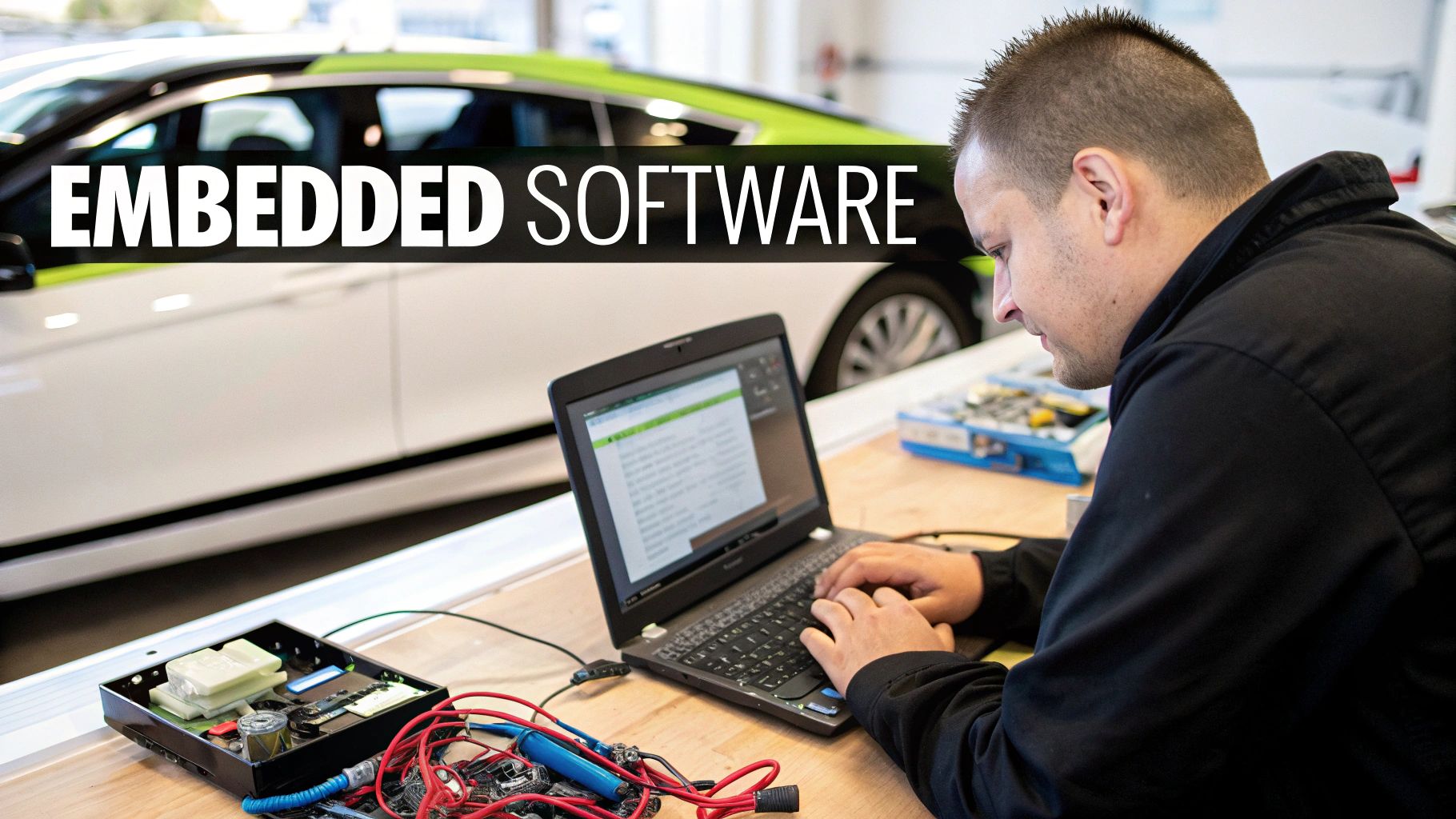
The modern vehicle is evolving from a mechanical machine into a sophisticated, software-defined computer on wheels. This transformation has made software development and vehicle embedded systems one of the most critical and top skills in demand in the automotive sector. This discipline is the brain and nervous system of the vehicle, controlling everything from engine performance and safety features to the user’s infotainment experience.
This skill set involves deep expertise in programming languages like C/C++ and Python, along with proficiency in real-time operating systems (RTOS). Professionals must understand the intricacies of microcontrollers, system-on-chip (SoC) architecture, and communication protocols like CAN bus. The ability to develop, test, and deploy robust software for Advanced Driver-Assistance Systems (ADAS), infotainment platforms, and Over-the-Air (OTA) update mechanisms is now fundamental to automotive innovation.
Why This Skill is Crucial
A vehicle today can contain over 100 million lines of code and more than 100 electronic control units (ECUs), a number set to grow exponentially with autonomous driving. Companies that excel in software create a significant competitive advantage. Tesla’s vertically integrated software stack, for example, allows it to push frequent OTA updates that improve performance and add features, a model now being emulated by rivals like Rivian and legacy OEMs. The rise of integrated digital cockpits, powered by systems like Android Automotive, further intensifies the need for skilled software engineers who can bridge the gap between traditional automotive hardware and consumer-grade user experiences.
Actionable Recruitment and Upskilling Strategies
To build a world-class software engineering team, automotive leaders and their RPO partners must think beyond traditional talent acquisition channels:
- Recruit from Adjacent Industries: Target professionals from the aerospace, medical device, and consumer electronics sectors. These industries demand a similar level of rigour in developing safety-critical embedded systems and offer a rich pool of transferable expertise.
- Adopt Agile Methodologies: Transition engineering teams from rigid, hardware-centric waterfall models to more flexible, software-oriented agile frameworks. This shift accelerates development cycles and fosters a culture of continuous improvement essential for software innovation.
- Create Cross-Functional Pods: Form integrated teams that pair embedded software engineers with hardware, mechanical, and systems engineers. This collaboration breaks down silos and ensures that software and hardware are developed in concert, preventing costly integration issues late in the product lifecycle.
Key Insight: The battle for automotive supremacy is increasingly being fought with code. Investing in a robust software talent pipeline is no longer optional; it is essential for survival and growth in an industry where the vehicle’s value is progressively defined by its digital capabilities.
Data Analytics & Digital Manufacturing (Industry 4.0)
The automotive sector’s evolution extends beyond the vehicle itself and deep into the factory floor. The integration of Industry 4.0 principles, powered by big data and the Internet of Things (IoT), is revolutionising production. This makes Data Analytics & Digital Manufacturing one of the top skills in demand in the automotive sector, transforming traditional assembly lines into interconnected, intelligent ecosystems.
This skill set involves leveraging data from IoT sensors, cloud computing, and AI-driven platforms to enable predictive maintenance, optimise supply chains, and enhance quality control. Professionals with this expertise can create “digital twins” of production lines for simulation and analysis, and use real-time data to make instantaneous, informed decisions that boost efficiency and reduce waste.
Why This Skill is Crucial
In a high-volume, low-margin industry, manufacturing efficiency is paramount. Digital manufacturing allows OEMs to predict equipment failures before they happen, track components with precision across a global supply chain, and ensure every vehicle meets exacting quality standards. Companies like Hyundai are building highly automated smart factories, while Bosch deploys IoT sensors to monitor its manufacturing facilities, demonstrating that data-driven production is the new competitive benchmark. This shift requires a workforce that is as proficient in data science as it is in mechanical engineering.
Actionable Recruitment and Upskilling Strategies
To build a workforce capable of navigating the smart factory, CHROs and RPO partners should focus on integrated talent development:
- Launch Pilot Programmes: Start with smaller, targeted projects, such as implementing predictive maintenance on a single production line, to demonstrate ROI and build internal momentum for broader adoption.
- Invest in Data Literacy: Create foundational training programmes for manufacturing and operational teams. The goal is not to make everyone a data scientist, but to ensure all employees can understand and act on data-driven insights.
- Foster Cross-Functional Collaboration: Implement cross-training initiatives that bring IT and production departments together. This breaks down silos and ensures that digital solutions are practical and effectively integrated into factory workflows.
Key Insight: The convergence of operational technology (OT) and information technology (IT) is the cornerstone of Industry 4.0. For a closer look at this trend, discover more about the role of automation and Industry 4.0 in revolutionising manufacturing. Success hinges on building teams that can bridge the gap between the physical and digital worlds.
Autonomous Driving & ADAS Engineering
The pursuit of fully autonomous vehicles has redefined automotive innovation, making expertise in Advanced Driver Assistance Systems (ADAS) and autonomous driving technology one of the top skills in demand in the automotive sector. This field moves beyond traditional vehicle mechanics into the complex realms of artificial intelligence, robotics, and sensory data processing.
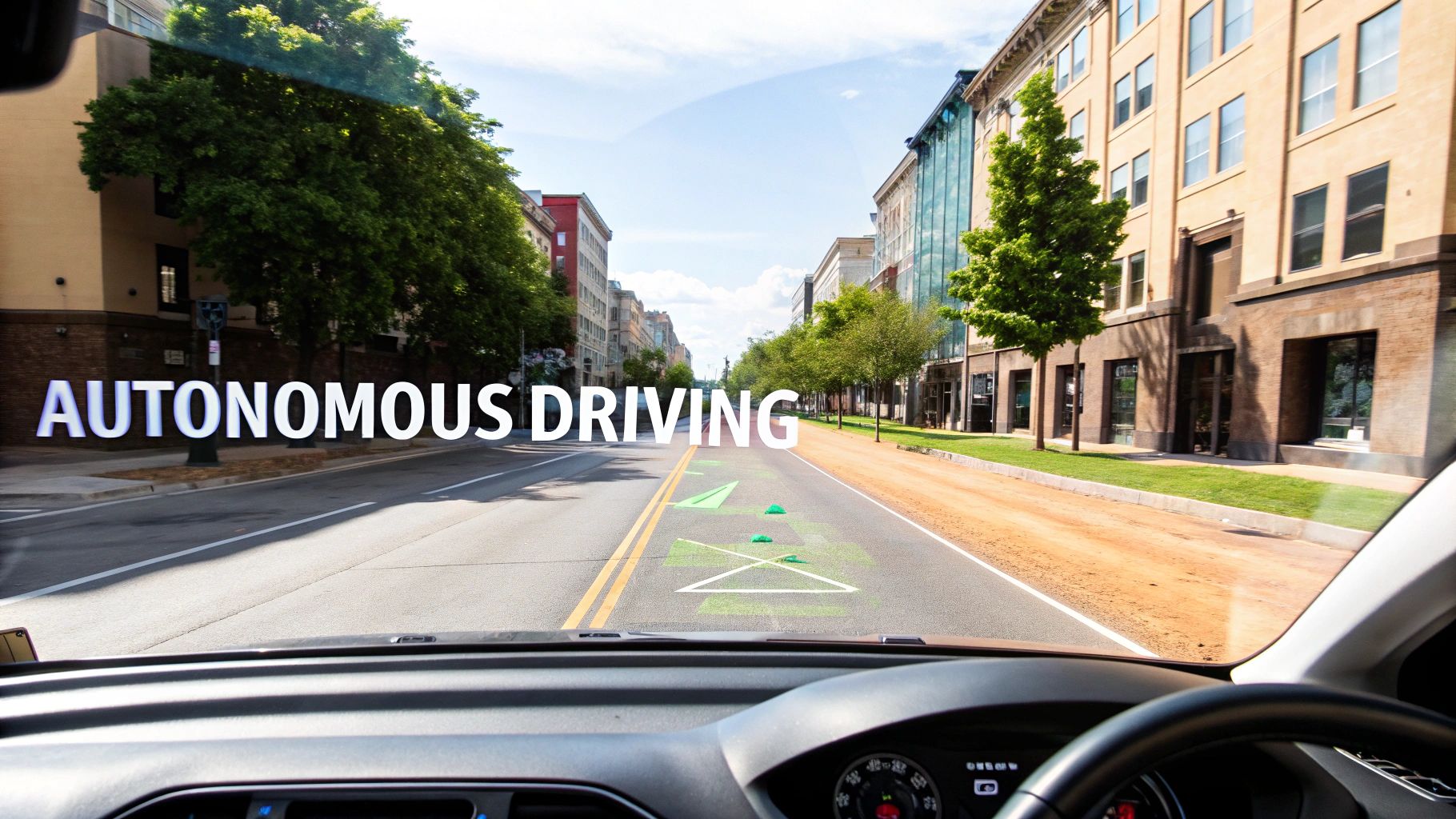
This skill set requires a sophisticated blend of software and hardware knowledge. Professionals must master sensor fusion (combining data from LiDAR, radar, and cameras), develop complex perception algorithms for object detection, and engineer decision-making systems based on machine learning. Critically, it also involves rigorous safety validation and an understanding of the ethical and regulatory frameworks governing self-driving technology.
Why This Skill is Crucial
The journey towards Level 3, 4, and 5 autonomy is a multi-billion-dollar race, transforming mobility and creating immense value. Tech giants and automotive incumbents are locked in a fierce competition for talent. Companies like Google’s Waymo, GM’s Cruise, and Tesla with its Full Self-Driving (FSD) beta program are pushing the boundaries of what is possible, creating a massive demand for engineers who can build and validate these safety-critical systems. This technological arms race has made ADAS and autonomous driving specialists some of the most sought-after and highly compensated professionals in the industry.
Actionable Recruitment and Upskilling Strategies
To attract and nurture talent in this pioneering field, organisations must think beyond traditional recruitment methods:
- Establish University Research Partnerships: Collaborate directly with universities known for their AI, computer vision, and robotics research. Sponsor labs, fund research projects, and create internship programmes to build relationships with the next generation of innovators.
- Create Internal Research Opportunities: Offer sabbaticals or dedicated research roles for top engineers to explore cutting-edge autonomous concepts. This fosters a culture of innovation and helps retain critical talent by providing intellectual stimulation.
- Facilitate Cross-Industry Collaboration: Partner with leading technology firms, such as Nvidia which powers many autonomous platforms, for knowledge transfer sessions and joint projects. This cross-pollination of ideas can accelerate internal capability development.
Key Insight: Attracting talent in autonomous driving requires creating an environment that mirrors a tech R&D lab rather than a traditional automotive factory. Emphasise innovation, agile development, and the opportunity to solve some of the most challenging problems in modern engineering.
Cybersecurity & Connected Vehicle Security
As vehicles transform into sophisticated, software-defined platforms on wheels, their attack surface for cyber threats has expanded exponentially. This has elevated cybersecurity from an IT support function to a mission-critical discipline, making proficiency in cybersecurity and connected vehicle security one of the most vital top skills in demand in the automotive sector. Protecting vehicles from malicious attacks is now paramount to ensuring consumer safety, maintaining brand reputation, and securing sensitive data.
This skill set involves securing the entire vehicle ecosystem, from the electronic control units (ECUs) and in-vehicle networks to the cloud infrastructure and mobile applications that connect to the car. Expertise is required in secure architecture design, threat modelling, penetration testing, intrusion detection systems (IDS), and incident response. Professionals must safeguard against a range of threats, including unauthorised access, data breaches, and remote vehicle control.
Why This Skill is Crucial
The modern vehicle can have over 100 million lines of code and numerous wireless entry points (Bluetooth, Wi-Fi, cellular), making it a prime target for hackers. A single security breach can have catastrophic consequences. Regulatory bodies like the National Highway Traffic Safety Administration (NHTSA) in the US and the UNECE WP.29 regulations globally are mandating stringent cybersecurity standards, compelling OEMs to build robust security capabilities. Companies like BMW Group are establishing dedicated cybersecurity centres, and platforms such as Upstream Security provide automotive-specific threat intelligence, highlighting the industry-wide focus on this domain.
Actionable Recruitment and Upskilling Strategies
To build a formidable automotive cybersecurity team, talent leaders should broaden their search and cultivate internal expertise:
- Recruit from Adjacent Industries: Target professionals from sectors with mature cybersecurity practices, such as defence, banking, and critical infrastructure. Their experience in securing complex, high-stakes systems is directly transferable to the automotive context.
- Establish Bug Bounty Programmes: Proactively identify vulnerabilities by incentivising ethical hackers and security researchers to test your systems. Tesla’s well-known participation in events like Pwn2Own demonstrates the value of this approach in rapidly discovering and patching security flaws.
- Foster a Security-First Culture: Implement mandatory security awareness training for all employees, from engineers to executives. This ensures that security is a shared responsibility and integrated into every stage of the vehicle lifecycle, from design to decommissioning.
Key Insight: Automotive cybersecurity is not just about technology; it’s a continuous process of risk management. Building resilience requires a proactive strategy that combines robust technical defences with a vigilant, security-conscious organisational culture.
Supply Chain Management & Logistics Optimisation
The automotive sector operates on one of the most complex, globalised supply chains in the world. Recent disruptions, from the semiconductor shortage to geopolitical events, have exposed its fragility, elevating supply chain management and logistics optimisation to a critical strategic function. This skill is no longer just about cost reduction; it is now central to resilience, business continuity, and competitive advantage.
This expertise involves managing intricate global procurement networks, ensuring supplier quality and reliability, and leveraging technology for real-time visibility and predictive analytics. Professionals in this domain must master everything from Just-In-Time (JIT) inventory systems, pioneered by Toyota, to developing diversified, multi-source supplier networks that can withstand unforeseen shocks, a strategy now heavily employed by companies like the Volkswagen Group.
Why This Skill is Crucial
The pandemic and subsequent supply chain crises demonstrated that a failure in one small part of the chain can halt multi-billion-dollar production lines. The 2021-2023 semiconductor shortage, for instance, cost the industry hundreds of billions in lost revenue. This has fundamentally shifted the focus from pure efficiency to a balance of efficiency and resilience. Companies like Tesla are mitigating risk through vertical integration, while others like Ford are investing in regional supplier development to shorten supply lines and build stronger local ecosystems.
Actionable Recruitment and Upskilling Strategies
To build a world-class supply chain team, CHROs and RPO partners should implement the following strategies:
- Recruit from Adjacent Industries: Target talent from the fast-moving consumer goods (FMCG), logistics, and large-scale manufacturing sectors. These professionals bring valuable experience in managing high-volume, complex supply networks and are often skilled in modern digital procurement platforms.
- Invest in Supply Chain Visibility Tech: Upskill existing teams by training them on advanced supply chain visibility platforms that utilise IoT, AI, and blockchain. This empowers them to move from reactive problem-solving to proactive risk management.
- Develop Supplier Collaboration Programmes: Train procurement and logistics specialists in strategic partnership and supplier development. The skill is no longer just negotiation but co-innovation and building long-term, resilient relationships with key suppliers.
Key Insight: The modern automotive supply chain is a data-driven ecosystem. Success depends on building teams that can harness technology to predict disruptions, optimise inventory, and create a resilient network that can adapt to global volatility.
User Experience (UX) Design & Human-Machine Interface (HMI)
As vehicles evolve into connected, software-defined platforms, the in-car experience is becoming a primary competitive differentiator. This has elevated expertise in User Experience (UX) and Human-Machine Interface (HMI) design to one of the top skills in demand in the automotive sector. The focus is no longer just on mechanical performance but on creating seamless, intuitive, and engaging digital interactions for the driver and passengers.

This skill set involves designing the entire driver-vehicle interaction, from infotainment systems and digital instrument clusters to voice commands and augmented reality heads-up displays (HUDs). Professionals in this domain must balance creating a rich, consumer-electronics-grade experience with the critical need to minimise driver distraction and ensure safety. This requires a unique blend of user-centred design principles, cognitive psychology, and a deep understanding of automotive regulations and constraints.
Why This Skill is Crucial
The modern consumer expects their vehicle’s interface to be as responsive and intuitive as their smartphone. A clunky or confusing interface can significantly detract from the perceived quality and value of a vehicle. Innovators like Tesla have demonstrated the power of a minimalist, software-first dashboard, setting new industry standards. Similarly, the widespread integration of Apple CarPlay and Android Automotive, alongside sophisticated proprietary systems like Mercedes-Benz MBUX, shows that the digital cabin experience is a key battleground for customer loyalty and brand perception.
Actionable Recruitment and Upskilling Strategies
To build a world-class UX and HMI team, CHROs and RPO partners should think beyond traditional automotive talent pipelines:
- Recruit from Consumer Tech and Gaming: Actively source talent from leading consumer technology companies (like Apple, Google, Samsung) and the gaming industry. These professionals bring deep expertise in creating highly engaging, user-centric digital products and can inject fresh perspectives into vehicle interface design.
- Establish In-house UX Labs: Create dedicated UX research labs equipped with driving simulators and real-world testing environments. This allows teams to prototype, test, and refine HMI concepts under realistic conditions, ensuring usability and safety are prioritised from the outset.
- Implement User-Centred Methodologies: Embed user-centred design methodologies such as design thinking and agile development into your product development cycles. This ensures that user feedback is continuously integrated, leading to more intuitive and desirable in-car experiences.
Key Insight: The battle for the driver’s attention is intensifying. The most successful automotive brands will be those that treat the in-car digital experience not as an add-on, but as a core component of the vehicle’s identity and value proposition. Partnering with design schools and UX bootcamps can create a sustainable talent pipeline.
Manufacturing Engineering & Process Optimisation
As automotive production becomes increasingly complex with the integration of new technologies like EVs and autonomous systems, the ability to design, manage, and refine manufacturing processes is more critical than ever. Expertise in manufacturing engineering and process optimisation has become one of the top skills in demand in the automotive sector, serving as the backbone for quality, efficiency, and cost-competitiveness.
This skill set involves a mastery of methodologies like lean manufacturing, Six Sigma, and continuous improvement (kaizen). Professionals must be proficient in robotics integration, automation, and data-driven process control. Their goal is to streamline production lines, minimise waste, enhance product quality, and implement Industry 4.0 innovations to create smart, agile factories.
Why This Skill is Crucial
In a high-volume, low-margin industry, production efficiency directly impacts profitability. Companies that excel in manufacturing, like Toyota with its world-renowned Production System or Tesla with its innovative “Giga Press” casting, gain a significant competitive advantage. As vehicle platforms become more modular and production lines more flexible, engineers who can optimise these sophisticated systems are essential for maintaining production targets and ensuring consistent quality on a global scale.
Actionable Recruitment and Upskilling Strategies
To build a world-class manufacturing team, HR leaders and RPO partners should focus on a structured talent development plan:
- Broaden Recruitment Horizons: Look for talent in adjacent sectors known for manufacturing excellence, such as aerospace, heavy equipment, and even fast-moving consumer goods (FMCG). These industries often cultivate strong skills in lean principles and process control.
- Prioritise Certifications: Emphasise formal qualifications like Lean and Six Sigma (Green Belt, Black Belt) certifications in job descriptions and during the screening process. This provides a clear benchmark for a candidate’s process improvement capabilities.
- Develop Internal Talent Pipelines: Create dedicated manufacturing engineer development programmes that rotate high-potential employees through different areas of production, quality control, and logistics. Partner with technical colleges to sponsor students and build an early-career talent funnel.
Key Insight: The modern manufacturing engineer is not just a process expert but a digital integrator. For a comprehensive look at how digital skills are reshaping the factory floor, explore our insights on the rise of the digital twin in manufacturing. Investing in talent that can bridge the physical and digital worlds is key to building the factory of the future.
Product Development & Engineering (Lightweight & Sustainable Materials)
The relentless pursuit of greater efficiency and environmental responsibility has made advanced materials science a cornerstone of modern vehicle design. As a result, expertise in product development using lightweight and sustainable materials has become one of the top skills in demand in the automotive sector. This discipline moves beyond traditional steel to embrace a new palette of materials that reduce vehicle mass, enhance performance, and minimise ecological impact.
This skill set requires a deep knowledge of materials science, including carbon fibre composites, aluminium alloys, advanced high-strength steels (AHSS), and emerging bio-based materials. Professionals must excel in design for manufacturing, structural analysis, and joining techniques for dissimilar materials, ensuring that lightweight designs meet stringent safety standards and production feasibility.
Why This Skill is Crucial
Every kilogram shed from a vehicle’s weight directly improves its efficiency. For internal combustion engine (ICE) vehicles, this means better fuel economy and lower emissions. For electric vehicles (EVs), it translates to extended range and reduced battery size, a critical factor for both cost and performance. Stricter global emissions regulations and ambitious sustainability targets are compelling manufacturers to innovate aggressively in this domain. Pioneering examples include BMW’s use of carbon fibre in its i-Series and Tesla’s large-scale aluminium castings, which reduce part counts and overall vehicle weight.
Actionable Recruitment and Upskilling Strategies
To build capability in this specialised area, HR leaders must look beyond traditional automotive talent pools:
- Recruit from Adjacent Industries: Target professionals from the aerospace and defence sectors, where lightweight material engineering is a mature and core competency. Their experience with composites and advanced alloys is directly transferable.
- Establish Research Partnerships: Collaborate with universities and material science research institutions. Sponsoring research or co-developing programmes can create a pipeline of talent with cutting-edge knowledge and provide access to the latest material innovations.
- Invest in Prototyping Capabilities: Create in-house or partner with specialised labs to allow engineers to experiment with new materials and manufacturing processes. Hands-on experience is critical for upskilling and fostering innovation.
Key Insight: The integration of new materials is not just an engineering challenge; it is a supply chain and manufacturing transformation. Building these skills requires a holistic approach that connects design, procurement, and production to successfully bring lightweight, sustainable vehicles to market.
Talent Development, Change Management & Digital Transformation Leadership
As the automotive sector undergoes its most profound transformation, the ability to lead and manage this change has become a critical strategic capability. Consequently, expertise in talent development, change management, and digital transformation leadership is one of the top skills in demand in the automotive sector. This is not a traditional HR function; it is a strategic leadership competency essential for navigating the complex shift towards electrification, autonomy, and software-defined vehicles.
This skill set combines strategic vision with hands-on execution. It involves designing and implementing large-scale upskilling programmes, fostering a culture of continuous learning and innovation, and guiding the workforce through significant operational and cultural shifts. Leaders with this skill can retain top talent during periods of disruption and ensure the entire organisation is aligned with its transformative goals.
Why This Skill is Crucial
The industry-wide pivot requires more than just new technology; it demands a fundamental reorganisation of talent and processes. Companies like Volkswagen Group are investing €180 billion in their EV transition, a move that necessitates a massive reskilling of their existing workforce. Similarly, Ford’s pivot to create facilities like the Rouge Electric Vehicle Center and General Motors’ commitment to an all-electric future depend on leaders who can manage this complex human capital evolution. Without effective change leadership, even the best technological strategies can fail due to workforce resistance, skill gaps, and a lack of organisational agility.
Actionable Recruitment and Upskilling Strategies
To embed this leadership capability within the organisation, CHROs and RPO partners should focus on strategic development and acquisition:
- Recruit from Transformed Sectors: Look beyond automotive for leaders. Executives from the technology, telecommunications, and finance industries who have successfully navigated digital transformations bring invaluable experience and fresh perspectives.
- Create Change Ambassador Networks: Identify and empower influential employees at all levels to act as change champions. These networks help disseminate key messages, gather feedback, and build grassroots support for transformation initiatives.
- Invest in Executive Coaching: Provide targeted coaching for senior leaders to build their resilience, communication, and change leadership skills. This ensures that the vision for transformation is consistently and effectively communicated from the top down.
Key Insight: Successfully navigating the industry’s evolution is as much about people as it is about products. Addressing the talent and skill gaps proactively is non-negotiable. For a closer look at this challenge, explore our insights on revving up talent acquisition and addressing skill gaps in the auto industry.
Top 10 Automotive Skills Comparison
| Skill / Domain | Implementation Complexity | Resource Requirements | Expected Outcomes | Ideal Use Cases 💡 |
|---|---|---|---|---|
| Electric Vehicle (EV) Technology & Battery Systems | High — multidisciplinary, evolving standards, thermal/electrical integration | Very high — battery labs, expensive test rigs, scarce specialists | Improved range/efficiency, safety, long-term competitiveness | EV platform engineering, battery pack design, charging infrastructure |
| Software Development & Vehicle Embedded Systems | High — RTOS, AUTOSAR, ISO 26262 compliance | High — toolchains, realtime test benches, skilled SW engineers | Reliable control systems, OTA delivery, faster feature cycles | ECU software, infotainment, ADAS controllers, OTA platforms |
| Data Analytics & Digital Manufacturing (Industry 4.0) | Medium — data integration, legacy system challenges | High — sensors, cloud/edge infrastructure, ML talent | Predictive maintenance, yield improvements, cost reduction | Production optimization, supply chain forecasting, quality control |
| Autonomous Driving & ADAS Engineering | Very high — AI, sensor fusion, safety validation, regulatory risk | Very high — sensors, simulation fleets, PhD-level talent | Level 3–5 capabilities, new mobility services, strategic differentiation | Robo-taxi programs, high-autonomy R&D, advanced ADAS features |
| Cybersecurity & Connected Vehicle Security | High — evolving threat landscape, compliance needs | Medium-high — security tooling, red teams, continuous monitoring | Reduced breach risk, brand protection, regulatory compliance | OTA security, connected service hardening, threat modeling |
| Supply Chain Management & Logistics Optimization | Medium — geopolitical & risk complexity | Medium — visibility platforms, analytics, supplier networks | Cost savings, resilience, on-time delivery improvements | Global sourcing, procurement optimization, disruption response |
| User Experience (UX) Design & Human‑Machine Interface (HMI) | Medium — safety constraints, long validation cycles | Medium — UX labs, prototyping tools, design talent | Higher user satisfaction, reduced distraction, brand differentiation | Infotainment redesign, voice/gesture UX, driver-centered interfaces |
| Manufacturing Engineering & Process Optimization | Medium — plant-floor constraints, change management | Medium — automation, robotics, skilled process engineers | Improved quality, lower unit costs, higher throughput | Line automation, lean rollouts, quality improvement programs |
| Product Development & Engineering (Lightweight & Sustainable Materials) | High — materials R&D, FEA, manufacturability challenges | High — prototyping facilities, material suppliers, labs | Weight reduction, improved efficiency, regulatory compliance | EV range optimization, performance models, sustainability initiatives |
| Talent Development, Change Management & Digital Transformation Leadership | High — organizational resistance, cross-functional alignment | Medium — L&D programs, coaching, change teams | Successful transformation, retained talent, improved agility | Company-wide EV/autonomy transitions, large reskilling programs |
Building the Automotive Workforce of Tomorrow, Today
The journey through the top skills in demand in the automotive sector reveals a profound and irreversible transformation. The industry is no longer just about horsepower and torque; it’s about processing power, battery chemistry, and user-centric digital experiences. The ten core competencies we’ve explored, from EV technology and software development to cybersecurity and UX design, are not merely isolated specialisations. They are interconnected pillars supporting the new architecture of mobility.
The traditional automotive engineer is giving way to a new breed of professional: a multidisciplinary expert who is part software developer, part data scientist, and part materials innovator. This evolution presents an unprecedented challenge and a remarkable opportunity for Chief Human Resources Officers (CHROs) and their strategic talent partners. The mandate is no longer simply to fill open positions but to architect a dynamic, future-proof workforce.
Synthesising the Shift: From Mechanical to Mechatronic
The most critical takeaway is the convergence of disciplines. The lines between hardware, software, and services have blurred, creating a complex talent ecosystem.
- Software is the New Engine: The prominence of embedded systems, autonomous driving algorithms, and connected car platforms underscores that the modern vehicle is a sophisticated computer on wheels. Talent acquisition strategies must now aggressively compete with the technology sector.
- Data is the New Fuel: From optimising manufacturing lines with Industry 4.0 principles to personalising the in-car experience, the ability to collect, analyse, and act upon data is a fundamental competitive advantage.
- Sustainability is the New Standard: Expertise in lightweight materials, battery lifecycle management, and optimised supply chains is not just a regulatory requirement but a core driver of brand value and consumer preference.
For CHROs, the strategic imperative is to move beyond a reactive recruitment model. The future belongs to organisations that build a culture of perpetual learning, actively reskill their existing workforce, and create compelling employee value propositions that attract diverse, tech-first talent.
Actionable Roadmap for Talent Leaders
Summarising our deep dive, your immediate focus should be on creating a holistic talent strategy that integrates recruitment, development, and retention into a single, cohesive engine for growth. This involves three key actions:
- Redefine Your Talent Pools: Look beyond traditional automotive and manufacturing backgrounds. Actively source candidates from the software, consumer electronics, and data analytics industries. Build academic partnerships that cultivate a pipeline of graduates with these hybrid skills.
- Invest in Proactive Upskilling: Don’t wait for skill gaps to become critical failures. Implement robust internal training programmes, digital learning platforms, and mentorship schemes focused on the ten key areas identified. Empower your current employees to become the experts you need for tomorrow.
- Measure What Matters: Shift your HR metrics from time-to-fill to quality-of-hire, internal mobility rates, and the measurable impact of new skills on project outcomes. Use data to demonstrate the direct correlation between talent investment and business performance.
The automotive revolution is a talent revolution. The companies that will lead this new era will be those that recognise that their most valuable asset is not their machinery or their intellectual property, but the skills, adaptability, and ingenuity of their people. By prioritising the development of these in-demand skills, you are not just preparing for the future; you are actively building it.
Navigating this complex talent landscape requires a strategic partner with deep industry expertise and a modern approach to recruitment. Taggd specialises in connecting India’s leading automotive companies with the niche, high-demand professionals needed to drive innovation. Let us help you build the skilled, agile, and future-ready workforce essential for market leadership in the new era of mobility.