“Workforce transformation” appears everywhere in strategy decks, boardroom conversations, and HR discussions.
But here’s the problem: The workforce transformation meaning is different for different organizations.
For some, it’s a training program. For others, it’s restructuring or automation.
That ambiguity is costly.
Organizations that treat workforce transformation as a synonym for “digital training program” or “headcount restructuring” consistently underperform those that understand what it actually requires.
So, what does workforce transformation really mean in 2026- especially in the age of AI?
What is AI Workforce Transformation
Workforce transformation is the structured process of aligning an organization’s people, skills, roles, and culture with evolving business needs driven by digital and AI-led change.
In the AI era, it involves integrating technologies like generative and agentic AI into business workflows to enhance productivity. This requires organizations to build AI-literate talent, continuously upskill employees, and redesign jobs to focus on human judgment, creativity, and collaboration– not just automation.
It is not:
- A training initiative
- A restructuring program
- A technology deployment
- An HR project
It is all of the above working together, directed toward a defined strategic outcome.
The AI workforce transformation idea is clear- automation is not the transformation. It’s what the organization does with the human capacity that automation creates.
Also Read: Why CHROs Are Rethinking Automotive Workforce Transformation for EV and Software-Led Growth?
What Makes AI-Era Workforce Transformation Different
Workforce transformation is not a new concept. Companies have restructured, reskilled, and reorganized for decades.
What makes the current moment categorically different is the speed, scale, and depth of the change being driven by AI.
| Factor | Traditional Workforce Change | AI-Era Workforce Transformation |
| Pace | Years to play out | 18–36 month role evolution cycles |
| Scope | Targeted functions or layers | Entire organizations simultaneously |
| Skills obsolescence | Gradual | 70% faster than previously predicted |
| Data availability | Limited | Real-time skills and performance data |
| Learning requirement | Periodic training | Continuous capability development |
| Leadership ownership | HR department | C-suite strategic priority |
- McKinsey’s analysis shows that AI could automate tasks comprising up to 70% of employees’ time.
- NASSCOM estimates 60–65% of India’s workforce needs reskilling by 2030.
These are not figures that describe a gradual evolution. They describe a structural transformation.
Also Read: Talent Reskilling in HR: Meaning, Importance, and Strategies for the Future
The Five Core Components of Workforce Transformation
Successful workforce transformation operates across five interconnected areas:
1. Skills Architecture
Organizations must move from static job roles to dynamic skill-based models.
This includes:
- Mapping current skills
- Identifying future capabilities
- Continuously closing gaps
In the AI era, skills frameworks must evolve as fast as technology does.
2. Role and Work Redesign
The focus shifts from jobs to tasks.
Instead of asking “Will AI replace this role?”, organizations must ask: “Which tasks within this role will AI handle, and what does that free the human to do?”
This is the foundation of human–AI collaboration.
IBM’s research confirms that employees prefer AI systems that predict their needs, share their workload, and switch control naturally when human judgment is needed.
Designing those workflows is a core workforce transformation activity.
3. Continuous Learning Infrastructure
Learning is no longer periodic- it’s continuous. Thus, organisations moving from event-based training to continuous learning as an operating model are:
- 92% more likely to innovate
- 37% more productive
- 58% better prepared for future workforce needs
Workforce transformation requires learning to become a core business function, not just an HR initiative.
4. Organizational Culture and Change Management
Technology adoption fails without people readiness. Organizations must build:
- Trust in AI systems
- Openness to change and comfort with continuous change
- A culture of experimentation
Without this, the best technical and skills investments underperform. Transformation succeeds when employees work with AI and not resist it.
5. Data and Analytics Infrastructure
Workforce decisions must be data-driven.
This includes:
- Skills tracking
- Workforce planning models
- AI-powered talent insights
Workforce data is now as critical as financial data.
Traditional HR vs. AI-Driven Workforce Transformation
Most HR functions still operate on what is called the Ulrich model- business partnering, shared services, and centers of excellence. This model was designed for consistency, compliance, and cost control.
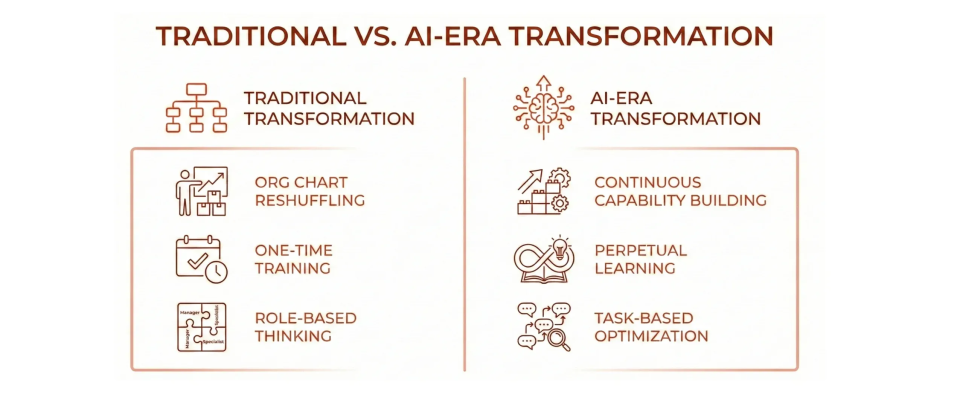
Workforce transformation in the AI era requires something different: an AI-infused operating model built for flexibility, adaptability, and continuous innovation.
The operating model you choose determines the outcomes you get.
| Ulrich/ Traditional HR Model | AI-Era Workforce Transformation Model |
| Standardized processes for all employees | Customized employee experiences |
| Task automation as cost reduction | Human-AI collaboration by design |
| Annual skills assessment | Continuous capability measurement |
| HR as cost center | HR as value creator |
| Reactive to business needs | Proactive workforce shaping |
The distinction matters because the wrong operating model produces the wrong outcomes even with the right investment.
Organizations spending heavily on AI tools and training programs while running a traditional HR operating model consistently underperform on transformation metrics.
Also Read: A Modern CHROs Guide to the TA Transformation Roadmap
What AI Workforce Transformation Looks Like in Indian Organizations
India’s leading organizations are demonstrating what workforce transformation in AI era looks like when executed well:
TCS- ignio™ Platform Automated 60% of routine IT operations tasks. Rather than reducing headcount, TCS redeployed 15,000+ employees to higher-value client engagement and innovation roles. This is workforce transformation: technology adoption plus intentional role redesign plus reskilling.
Infosys- Nia Platform Automated 16,000+ business processes. Achieved $737 million in operational savings. Simultaneously reskilled 2.2 lakh employees in digital technologies. Scale of reskilling matched scale of automation- this is the distinguishing factor.
HDFC Bank- EVA AI Assistant Handles 5+ million customer queries. Freed 3,000+ customer service representatives for complex financial advisory roles. 80% query resolution rate, 30% improvement in customer satisfaction. Technology generated the capacity; people strategy directed where that capacity went.
At Taggd, Agentic AI is being embedded across recruitment stages to support continuous decision-making- leading to reduced screening hours, more structured interview coverage, improved first-time-right hires, faster closures, and higher positions closed per recruiter.
The Human Skills That Will Define the Future
As AI takes over routine tasks, human value shifts. Future-ready workforces will focus on:
- Managing people effectively– judgment, empathy, motivation, conflict resolution
- Applying specialized expertise– deep domain knowledge applied to novel situations
- Communicating and negotiating– nuanced, high-stakes human interaction
- Exercising creativity and logical reasoning– novel problem-solving, strategic thinking, innovation
- Ethical judgment– decisions where context, values, and consequences require human accountability
Tasks where machines outperform humans- predictable physical activities, data processing, pattern recognition in structured data- will become progressively less central to human work.
Workforce transformation is about building strength where AI cannot replace humans.
India’s Workforce Transformation Moment (2026–2030)
India is at a critical inflection point:
- India joined the WEF’s Reskilling Revolution initiative in January 2026– targeting 850 million people with future-ready skills by 2030
- The GCC sector will employ 3 million professionals by 2030– requiring transformation-ready workforce capabilities
- India’s IT sector contributes 7.4% to GDP– with automation potentially impacting 40% of current IT service jobs
- 109 million skilled workers needed across 24 high-growth sectors by 2026
The next 3 to 5 years are not a planning horizon. For competitive organizations, it is a build window- the time available to develop the workforce capabilities that will determine market position for the decade that follows.
Also Read: Why Net-Zero Targets Are Creating New Workforce Planning Pressures for CHROs
Wrapping Up
Workforce transformation is no longer an HR agenda-it’s a business priority.
CHROs must:
- Align talent strategy with business growth
- Enable AI adoption through workforce readiness
- Build scalable systems for hiring and reskilling
And most importantly: Turn strategy into execution at scale
This is where organizations increasingly rely on integrated talent partner and RPO solutions to accelerate hiring, close skill gaps, and operationalize workforce transformation.
FAQs
What is workforce transformation?
Workforce transformation is the process of aligning an organization’s people, skills, roles, and culture with changing business needs. In the AI era, it focuses on integrating technology, enabling continuous reskilling, and redesigning work for human–AI collaboration.
What is digital workforce transformation?
Digital workforce transformation involves using digital tools and technologies to improve how work is performed. This includes automation, data-driven decision-making, and creating more agile, efficient, and tech-enabled workforce models. For example, digital transformation in HR has been driving immense growth in talent acquisition.
How is AI transforming the workforce?
AI is automating repetitive tasks, enabling faster decision-making, and creating demand for new skills. It is shifting work toward human strengths like creativity, judgment, and collaboration, while requiring organizations to redesign roles and invest in continuous learning.
What is the difference between HR transformation and workforce transformation?
HR transformation focuses on improving HR processes and systems. Workforce transformation is broader- it reshapes how work is done across the organization, including roles, skills, and workforce structure, to align with business strategy and technology changes.
What are the key components of workforce transformation?
The key components include skills architecture, role redesign, continuous learning, organizational culture, and workforce data systems. Together, these enable organizations to adapt to change and build future-ready talent.
Why is workforce transformation important in 2026?
Rapid AI adoption, evolving job roles, and increasing skills gaps make workforce transformation essential. Organizations must adapt quickly to stay competitive, improve productivity, and ensure their workforce is aligned with future business needs.
What is a skills-first approach in workforce transformation?
A skills-first approach focuses on hiring and developing talent based on capabilities rather than job titles or degrees. It helps organizations close skill gaps faster and adapt to changing role requirements in an AI-driven environment.
How do companies implement workforce transformation?
Companies start by assessing current skills, identifying future needs, and redesigning roles for AI integration. They invest in reskilling, adopt data-driven workforce planning, and build a culture that supports continuous learning and change.
What skills are needed for an AI-driven workforce?
Key skills include AI literacy, data interpretation, critical thinking, creativity, communication, and collaboration. These skills enable employees to work effectively alongside AI systems and adapt to evolving job roles.
Explore complete details on Workforce Transformation in the AI Era
Our whitepaper- “AI-Driven Workforce Transformation: The CHRO’s Guide to India’s 2026–2030 Window” provides a detailed insights on building an AI-ready workforce, strategies for successful implementation, measuring AI ROI of workforce transformation, and more.
Taggd combines AI-powered talent intelligence with RPO expertise to help you hire faster, smarter, and at scale. Talk to our experts