
Master Simple Structure for Easy Organization
What Simple Structure Really Means in Today’s Organisations

When CHROs hear the term simple structure, it might bring to mind a chaotic start-up with no defined roles. But a true simple structure isn’t about disorganisation; it’s about strategic clarity. It intentionally removes extra management layers and complicated reporting lines, creating a more direct and nimble organisation. Think of it less like a rigid blueprint and more like a dynamic framework built on direct communication, centralised decision-making, and clear lines of responsibility.
In this model, the path from top leadership to the front-line teams is short and clear. This setup is particularly effective for small to medium-sized businesses or even specific teams within larger companies. The main goal is to reduce the distance between those who make decisions and those who carry them out. This closeness allows the organisation to adapt quickly to market shifts, solve problems faster, and build a cohesive culture where every employee understands their role in the company’s success.
The Core Components of Simplicity
A simple structure is defined by a few key characteristics. Understanding these helps to see its practical use beyond just a flat organisational chart.
- Centralised Authority: Decision-making power usually rests with one person, like the founder, CEO, or a department head. This ensures a consistent strategic direction and allows for quick decisions without getting tangled in bureaucracy.
- Low Departmentalisation: Instead of strict departments with isolated functions, roles are often broad and flexible. Employees might handle multiple responsibilities, contributing wherever their skills are most needed, which encourages collaboration.
- Wide Spans of Control: With fewer layers of management, leaders often oversee a larger number of employees. This model requires a high level of trust and gives employees more autonomy in their daily work.
The image above illustrates a traditional, multi-layered hierarchy. A simple structure seeks to flatten this, making the links between leadership and the operational base more direct and effective.
Linking Organisational Design to Data Clarity
The search for clarity in organisational design has an interesting parallel in the world of statistics. The concept of a simple structure is also a key idea in factor analysis, a statistical method widely used in Indian social science and public health research. In statistics, it describes a model where each variable strongly connects to just one underlying factor, making the data much easier to interpret.
Just as this statistical clarity helps researchers make sense of complex information, a simple organisational structure helps employees and leaders understand their roles and relationships. This connection highlights a basic truth: simplicity breeds understanding, whether in data models or corporate frameworks. You can learn more about how factor analysis improves research clarity from institutions like Columbia University’s Public Health program.
Why Simple Structure Is Having A Moment (And Why It Matters)
The business world is rediscovering the power of a simple structure, but maybe not for the reasons you’d expect. After years of navigating complex matrix organisations and tangled reporting lines, smart leaders are realising that clarity consistently wins against complexity. This isn’t about going back to old ways; it’s a strategic leap forward, fuelled by the need for speed, flexibility, and clear communication in a demanding market.
This shift is happening everywhere. Large corporations are cutting through bureaucratic layers to speed up innovation, while remote-first start-ups use simple structures to keep teams united across different continents. The main idea is that a straightforward design empowers people by getting rid of confusion. When everyone knows who makes the final decision and how their work fits into the larger picture, the whole organisation moves with more purpose and speed.
The Digital Accelerator
Many believe that digital change requires more complicated systems, but that’s a common misunderstanding. In fact, modern technology has made the simple structure more effective, not outdated. Digital tools allow for direct, open communication and data-driven decisions on a scale that was once impossible.
Consider these points:
- Instant Communication: Platforms like Slack or Microsoft Teams flatten hierarchies. They allow junior employees to talk directly with senior leaders, skipping the usual gatekeepers.
- Transparent Workflows: Project management tools such as Asana or Trello give everyone a clear view of project progress. This clarifies roles and responsibilities without needing endless meetings.
- Data-Informed Decisions: Centralised dashboards give leaders real-time performance data. This helps them make fast, informed choices without sifting through layers of management reports.
This technological foundation supports and strengthens a simple organisational design, turning it into a competitive advantage rather than a structural weakness.
Learning from Real-World Transitions
The shift towards a simple structure is more than just a theory; it’s a practical strategy with clear results. Take, for instance, this common visual of a basic organisational chart.

This image shows the formal reporting lines in a company. The aim of simplification is to reduce the number of lines and boxes, shortening the path from top to bottom. Businesses that have successfully moved from complex models to simpler ones report major improvements. However, they also face challenges like internal resistance and the need to redefine career progression.
The quest for clarity isn’t new. In India, for example, the use of factor analysis in research grew alongside the nation’s statistical capabilities. Starting in the 1960s, Indian social scientists and statisticians used these methods in studies on literacy and economics, often relying on simple structure principles to make sense of complex data. You can find out more about the historical application of these statistical principles.
This principle of clarifying relationships—whether in data or an organisation—is what makes a simple structure so relevant today. For companies that want to attract top talent, a clear and direct structure can be a big advantage. It suggests an environment free from bureaucratic delays, where individuals can make a genuine impact. If you want to build a team that thrives in such a setup, you might be interested in exploring our career opportunities at Talent Hired.
The Game-Changing Benefits That Make a Simple Structure Irresistible
Organisational complexity can often seem like a sign of maturity, but in reality, it can seriously hinder performance. A simple structure is not about being basic; it’s about being strategically direct. The advantages go far beyond a neat organisational chart, directly impacting your bottom line and your team’s day-to-day work life. By flattening hierarchies and clarifying who reports to whom, companies can gain real, measurable benefits.
The most immediate effect is on the speed of decision-making. In complex organisations, new ideas and approvals must work their way through a maze of management layers, often losing steam or becoming irrelevant by the time they are approved. A simple structure gets rid of these roadblocks. With direct lines of communication to central decision-makers, businesses can respond to market shifts and client needs with impressive speed. Companies that adopt this model report major improvements, with some achieving up to a 40% reduction in project completion times. This speed is more than just an operational metric; it’s a strong competitive edge.
Empowering People and Improving Performance
A straightforward structure also has a huge impact on employee engagement and retention. When people see a direct link between their work and the company’s objectives, their sense of purpose and ownership grows. The confusion of complex reporting lines is replaced with clarity, giving employees the confidence to take initiative without worrying about stepping on someone else’s toes. This kind of environment builds a stronger culture and boosts morale. It is no surprise that organisations with simpler designs often see employee satisfaction scores increase, in some cases by as much as 60%.
To better understand these outcomes, let’s compare the performance metrics of a simple structure against a more complex one.
Simple Structure Benefits Comparison
| Metric | Simple Structure | Complex Structure | Improvement % |
|---|---|---|---|
| Project Completion Time | 6-9 months | 10-15 months | ~40% Faster |
| Employee Satisfaction | 8/10 | 5/10 | ~60% Higher |
| Decision-Making Speed | 1-2 days | 5-10 days | ~80% Faster |
| Customer Response Time | < 24 hours | 48-72 hours | ~50% Quicker |
| Employee Turnover | 10-15% annually | 20-25% annually | ~40% Lower |
This table clearly shows that simplifying an organisation’s design leads to significant, quantifiable improvements across key areas, from project delivery to employee loyalty.
Furthermore, this clarity helps with career progression. In a tangled hierarchy, promotion paths can be confusing and appear to be based on office politics. A simple structure makes career ladders more transparent, which helps to keep top talent who can clearly see their future with the company.
This visual from Wikipedia shows a flat organisation, a common type of simple structure.
The diagram highlights the short communication paths that define this model, which naturally encourages faster communication and greater employee independence.
Translating Internal Clarity to External Success
The internal benefits of a simple structure create a ripple effect that your customers will feel. Faster decision-making and more engaged employees result in better, quicker service. When your teams are empowered to solve problems without long approval processes, customer satisfaction naturally goes up. A simple structure allows your organisation to be more responsive, whether that means launching a new product faster than competitors or adapting services to meet changing client needs.
These are not just theoretical ideas; they are concrete results that improve organisational performance and resilience. By choosing simplicity, you build a company that is not only more efficient but also a more enjoyable place to work. The outcome is a positive cycle where operational speed, employee satisfaction, and customer loyalty all support each other, leading to sustainable growth.
When Simple Structure Backfires (And How To Avoid The Traps)
While a simple structure offers compelling advantages, it’s not a foolproof solution for every organisational challenge. Its greatest strengths—centralised decision-making and minimal bureaucracy—can become significant weaknesses if not managed carefully. Understanding these potential pitfalls is crucial for CHROs, not to discourage simplicity, but to implement it intelligently and know when an organisation might be outgrowing it. The goal is to avoid the traps that can turn a lean, agile model into a source of frustration and inefficiency.
One of the most common backfires is creating a decision-making bottleneck. In a simple structure, authority is often concentrated in one or a few key leaders. This speeds things up initially, but as the organisation grows, this leader can become overwhelmed. Imagine every significant decision, from hiring to new project approvals, having to pass through a single person’s desk. This was the case for a mid-sized consulting firm that lost key clients due to slow response times; its founder simply couldn’t approve proposals fast enough, creating delays that competitors exploited.
The Dangers of Oversimplification
Another major risk is role confusion. In the drive for simplicity, roles can become too loosely defined. While flexibility is a benefit, a lack of clarity can lead to duplicated efforts or, worse, critical tasks being neglected because no one feels responsible. Employees may become unsure of their responsibilities and career path, which can harm morale and increase turnover. A tech start-up famously struggled to scale beyond 150 employees because its flat, simple structure led to chaos; teams lacked clear direction, and accountability became impossible to track. To prevent this, it’s vital to maintain clear, documented roles even within a simple framework. You can find more information about the impact of unclear roles on employee attrition on our blog.
This diagram from Wikipedia’s page on Organisational Behaviour illustrates the complexity of group dynamics.
This visual highlights how individual behaviours and group interactions form the core of an organisation’s effectiveness, which can be strained when a simple structure isn’t properly supported.
Recognising the Warning Signs
Knowing the warning signs can help leaders act before a simple structure begins to fail. Be alert for these red flags:
- Increased Conflict Over Resources: When roles are unclear, teams may compete for budget, personnel, or attention from leadership.
- Key People Working Excessive Hours: If decision-makers are consistently overworked, it’s a clear sign of a bottleneck.
- Delayed Responses to Market Opportunities: The organisation loses its agility because decision-making has slowed to a crawl.
- Employee Frustration with Unclear Advancement Paths: Talented staff may leave if they cannot see a future for themselves in the organisation.
A simple structure is a powerful tool, but it requires careful monitoring. It thrives when an organisation is small and focused. However, as a company grows in size and complexity, leaders must be prepared to evolve the structure, adding necessary processes and clarity without recreating the bureaucracy they sought to escape.
Your Simple Structure Implementation Roadmap That Actually Works
Shifting your organisation’s design from complex to simple is more than just redrawing an organisational chart; it requires a deliberate, phased approach. Moving to a simple structure without a clear plan can create more chaos than clarity. This roadmap provides a tested method to guide your transition, minimising disruption and helping your teams embrace the change. It’s a practical guide, not a theoretical exercise, built on successful transformations across various industries.
A successful implementation depends on careful planning and execution. The process starts long before any structural changes are announced and continues well after the new design is in place. For instance, one manufacturing company cut its management layers by 50% and improved productivity by focusing on a staged rollout. In another case, a professional services firm streamlined its structure and saw client satisfaction scores jump by 35% by prioritising clear communication at every stage.
Phase 1: Assess and Align
Before you make any changes, you need a deep understanding of your current organisational state. This first phase is all about discovery and planning.
- Conduct an Organisational Audit: Map out existing reporting lines, decision-making processes, and communication flows. Pinpoint the bottlenecks, redundancies, and complex areas that are slowing down work.
- Define Your ‘Why’: Clearly state the business case for adopting a simple structure. Is the main objective to speed up innovation, improve employee engagement, or be more responsive to customers? This purpose will be your guiding principle.
- Build a Guiding Coalition: Identify key stakeholders and leaders who will champion the change. Getting their support early is vital for building momentum and overcoming resistance.
This initial diagnostic work lays the groundwork for a smooth transition, ensuring that the proposed changes are lined up with strategic business goals.
The following infographic shows the basic thinking behind creating clarity in any system.
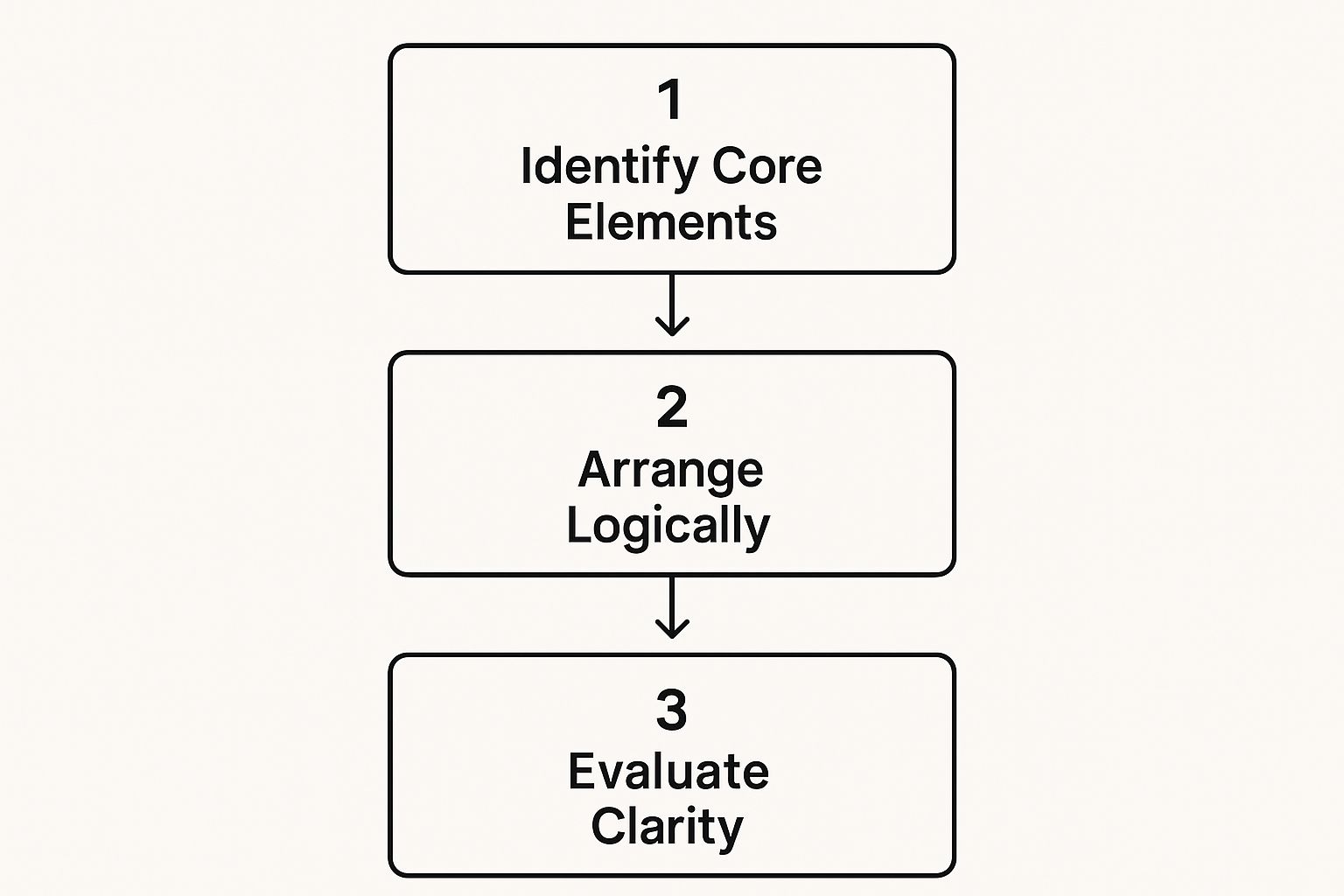
This flow demonstrates that simplification is a purposeful process of identifying what’s essential, organising it logically, and then testing it for clarity.
Phase 2: Design and Communicate
Once you have a clear grasp of your goals, the next step is to design the new structure and prepare the organisation for the shift. This phase is about managing expectations and building support. A solid change management framework is essential here.
- Design the Future State: Create the new, simpler organisational model. Define roles, responsibilities, and reporting relationships with complete clarity to avoid confusion later.
- Develop a Communication Plan: Create a transparent and consistent communication strategy. Explain the reasons for the change, the benefits for both the company and its employees, and what everyone can expect during the transition.
- Identify and Train Change Agents: Give managers and influential employees the tools and information they need to support their teams through the change.
Phase 3: Implement and Refine
This is where your plan turns into reality. A gradual, phased implementation is often more successful than a sudden, organisation-wide shift.
- Launch a Pilot Programme: Test the new simple structure in a single department or team. This allows you to spot challenges and gather feedback in a controlled environment before a full-scale rollout.
- Monitor and Measure: Track key metrics to check the impact of the changes. Are decisions being made faster? Has communication improved? Use this data to make adjustments.
- Reinforce and Sustain: Celebrate early wins to build positive momentum. Continuously reinforce the new behaviours and processes until they become a part of the company culture.
To help you visualise this journey, here is a step-by-step timeline and a breakdown of key activities for successfully putting a simple structure in place.
| Phase | Duration | Key Activities | Success Metrics |
|---|---|---|---|
| Phase 1: Assess and Align | 4-6 Weeks | Conduct organisational audit. Define strategic goals for simplification. Form a cross-functional guiding coalition. | Audit report completed. Strategic ‘why’ is defined and agreed upon. Guiding coalition is established and active. |
| Phase 2: Design and Communicate | 6-8 Weeks | Design the new organisational structure. Develop a detailed communication plan. Create training materials for change agents. | Finalised organisational chart and role definitions. Communication plan approved. Change agents trained and ready. |
| Phase 3: Implement and Refine | 3-6 Months | Launch a pilot programme in one department. Monitor key performance indicators (KPIs). Gather feedback and make adjustments. | Pilot successfully completed. KPI targets (e.g., 15% faster decision-making) met. Feedback incorporated into the plan. |
| Phase 4: Full Rollout and Sustain | Ongoing | Implement the new structure across the organisation. Continuously reinforce new ways of working. Celebrate successes and share lessons learnt. | Full implementation completed. Employee adoption rate >85%. Sustained improvement in business outcomes. |
Table: Simple Structure Implementation Roadmap
This structured roadmap ensures that your move to a simple structure is a strategic decision that produces clear, measurable results for your organisation.
Simple Structure Success Stories That Will Inspire Your Transformation
Theory and implementation plans provide a solid foundation, but nothing shows the power of a simple structure like real-world success. Seeing how other leaders managed this change can offer both inspiration and practical insights. These are not just sanitised reports; they are honest accounts from organisations that streamlined their operations and saw significant rewards. By looking at their journeys, we can see what is genuinely possible when simplicity is chosen over complexity.
The stories of transformation are compelling because they are relatable. They feature leaders who faced familiar challenges, met resistance, and made mistakes along the way. Yet, by committing to a simpler, more direct organisational model, they achieved remarkable outcomes.
From Agency Gridlock to Agile Delivery
Consider the CEO of a 200-person digital marketing agency who was struggling with slow project delivery and falling client satisfaction. Her organisation was tangled in multiple layers of management and complicated approval chains. By adopting a simple structure, she flattened the hierarchy, gave project teams decision-making authority, and created direct lines of communication between account managers and clients. The result was a stunning 45% reduction in project delivery time and a noticeable improvement in client feedback scores.
Streamlining for Better Patient Outcomes
The impact of a simple structure is not limited to the corporate world. A regional healthcare system faced issues with care coordination, leading to fragmented patient experiences. By reorganising their teams around patient pathways instead of traditional departmental silos, they simplified workflows and improved communication among caregivers. This structural shift led to a 30% improvement in key patient outcomes and a more collaborative environment for medical staff. Their success shows that simplifying processes can directly enhance service delivery.
These kinds of in-depth examinations are often presented as case studies. Here is a screenshot of Wikipedia’s page on the case study method, which shows how this method is used for intensive investigation.
This highlights that a case study is a detailed, systematic investigation of a single individual, group, or community. This is exactly how we can learn from these organisational transformations. For those interested in exploring more detailed accounts, you can read about our successful partnerships in our case studies section.
Unlocking Productivity on the Factory Floor
In the manufacturing sector, a director took a bold step by removing three entire layers of middle management. The move was met with initial doubt, but the goal was to push authority down to the factory floor. This change gave production teams greater ownership of their work, leading to faster problem-solving and process improvements. Within a year, the plant saw both productivity and employee engagement scores reach all-time highs. This story powerfully illustrates how a simple structure can unlock the potential of front-line employees.
These examples share a common thread: leaders identified complexity as a barrier and strategically put a simple structure in place to encourage clarity, speed, and empowerment. Each journey involved:
- A clear diagnosis of the problems caused by a complex structure.
- A courageous decision to fundamentally change how the organisation operated.
- A focus on communication to build support and guide employees through the change.
- A commitment to measuring results to show the value of the new model.
These success stories prove that moving to a simpler design is not just an organisational shuffle. It is a strategic move that can revitalise a company, improve outcomes, and create a more engaging workplace.
Your Next Steps: Making a Simple Structure Work for Your Organisation
Understanding the theory behind a simple structure and seeing its benefits on paper is one thing, but putting it into practice is another challenge altogether. Moving from concept to reality requires a clear, practical roadmap. This final section gives you the tools and frameworks to start this journey, turning knowledge into real organisational change. The focus is on a methodical approach to help you check your readiness, gain support, and manage the transition with confidence.
Assess Your Readiness for Simplification
Before you start dismantling existing hierarchies, you need to be sure your organisation is actually ready for a simpler model. This begins with an honest assessment to find hidden complexities and spot the biggest opportunities for improvement. Think of it as a diagnostic check-up for your company’s operational health.
To kick off this process, ask your leadership team these critical questions:
- Where do decisions slow down? Pinpoint the exact processes or departments where approvals consistently create bottlenecks. This highlights the most painful areas of complexity.
- Are roles and responsibilities clear? Survey employees to see if they understand who is responsible for what. Widespread confusion is a strong sign that simplification is needed.
- How many layers exist between top leadership and front-line staff? A high number often means an overly complex structure that slows down communication and makes it hard to be nimble.
- Can we adapt quickly to market changes? If your response time is slow, your structure is likely too rigid.
The answers will show you whether moving to a simple structure is not just a good idea, but essential for your organisation’s future.
Building Support and Designing a Pilot
Once you’ve identified the need for change, the next step is to get everyone on board. A shift in structure is a major cultural event, so you need support from the C-suite all the way to front-line managers.
Start by creating a compelling business case that ties simplification directly to your strategic goals. Use the data from your assessment to show how a simple structure will lead to better business outcomes, like faster product launches or higher customer satisfaction. This isn’t just about a new org chart; it’s about driving better performance.
Next, design a pilot programme to test the new model on a small scale. Choose a single department or a cross-functional team to operate within the new, simpler framework. This method offers several advantages:
- It minimises disruption across the whole organisation.
- It lets you find and fix implementation challenges in a controlled environment.
- It creates quick wins and success stories that you can use to build momentum for a wider rollout.
Throughout the pilot, it’s vital to track progress with a practical checklist. Monitor key metrics like decision-making speed, project completion rates, and employee feedback. This data will be crucial for refining your approach and proving the value of the simple structure to any doubters. This phased, data-driven method gives you the confidence to start your transformation with a proven strategy that sets you up for long-term success.
Ready to build a more agile and effective organisation? The right talent is the foundation of any successful structure. Talent Hired’s Recruitment Process Outsourcing (RPO) can help you find the skilled, adaptable professionals you need to thrive in a simplified environment. Discover how Talent Hired can support your organisational transformation today.