A CHRO Guide to 2026
Introduction: India’s Age-Diverse Workforce Reality
The Multigenerational Challenge Every CHRO Faces
Today’s workplace has never been more age-diverse: Gen Z entering the workforce with digital-first expectations, Millennials dominating middle management, Gen X leading strategic functions, and experienced professionals
staying longer than ever. For the first time, four distinct generations are working side-by-side in the same organisation, each with fundamentally different views on work, career, and success.
Yet most HR policies still assume one model for multigenerational workforce management. What motivates performance, learning, and retention is no longer universal. For CHROs, this isn’t just a culture challenge –
it’s a multigenerational workforce management challenge. From leadership expectations and career paths to feedback, flexibility, and rewards, bridging generations requires intent, data, and clarity.
Chapter 1: India’s Workforce Has Changed
The Numbers Tell the Story
India’s workforce composition has undergone a dramatic transformation. Gen Z is projected to form approximately 27% of India’s workforce by 2028, with the generation numbering 377 million strong – making it India’s largest demographic cohort.
The workplace demographics reveal striking patterns:
- According to Great Place to Work India’s study, Millennials constitute 70% of the workforce in many Indian companies, with over 50% holding managerial roles.
- The India Skills Report 2026 reveals that the highest employability is among the 22-25 age group at 75.7%, continuing to dominate entry-level hiring across sectors.
- Retirement ages are rising across sectors. While the standard retirement age remains 58-60 years in private sector and 60 years for government employees, several states like Andhra Pradesh have increased it to 62 years, with discussions ongoing about further extensions given India’s life expectancy now exceeds 70 years as of 2025.
- Gen X professionals (ages 35-45) are staying in the workforce longer. According to the India Decoding Jobs 2026 Report, mid and senior-level talent with 6-15+ years of experience will comprise 55% of total hires in 2026, up sharply from 39% last year – reflecting the value organisations place on experienced professionals.
This unprecedented age diversity means that for the first time, Indian organisations must manage the expectations, work styles, and career aspirations of people separated by up to 40 years in age – all working together on the same teams.

The Gig Economy and Flexible Workforce Models
Adding to the complexity, the India Skills Report 2026 highlights that gig hiring grew 38% year-over-year, and gigs now form around 16% of all jobs. The gig workforce is projected to reach 23.5 million by 2030, giving workers more flexibility and diversified income streams. Interestingly, around 92.8% of students seek internships or hands-on exposure, especially high in Karnataka, Madhya Pradesh, and Tamil Nadu, reflecting demand for real-world learning and industry projects.
Meanwhile, the India Decoding Jobs 2026 Report notes that permanent roles still constitute 72% of all planned hires, showing long-term confidence in India’s workforce. However, gig and contractual jobs continue to rise, making up nearly a quarter of total opportunities. This dual reality – permanent employment for stability-seeking talent and flexible arrangements for others – requires HR policies that can accommodate both.
Chapter 2: HR Wasn’t Designed for This Mix
The Legacy System Problem
Most HR policies were built when the workforce was more uniform. Traditional policies assumed a standardised career progression, uniform motivators, one size-fits-all learning, and standard work arrangements. Today, expectations differ sharply by age, career stage, and life priorities. These differences are not preferences – they’re deal-breakers for talent acquisition and retention.
What Differs Across Generations in India: Career Velocity and Tenure
Gen Z in India has a 22% attrition rate – the highest of any generation – with an average tenure of just 1.1 years per role, representing a 38% decrease from millennials’ 1.8 years. In India specifically, 37% of Gen Z plan to leave their current organisation within a year, with 14% citing lack of career progression as their strongest exit motivation. This contrasts sharply with Gen X and experienced professionals who value stability and often stay 5-10+ years with the same organisation.

Learning Formats and Development
According to Infeedo’s 2025 study, 78% of Gen Z professionals in India prefer microlearning formats – bite-sized, mobile-first content, with 84% using smartphones to access training content. The India Skills Report 2026 reinforces this finding, noting that around 92.8% of students seek internships or hands-on exposure, reflecting demand for real-world learning and industry projects.
Meanwhile, 91% of Gen Z rank learning opportunities as their top priority when selecting employers, with 80% valuing mentorship and clear growth paths more than salary. Gen X and senior professionals often prefer structured, in-depth programmes and mentorship-based learning.
AI and Technology Adoption
The India Skills Report 2026 reveals striking generational differences in technology adoption. Over 90% of employees in India use Generative AI tools, signaling accelerated digital integration. Additionally, 70% of IT and 50% of BFSI companies have integrated AI into recruitment processes. However, younger generations are significantly more comfortable with these tools, with 55% of Gen Z using AI to problem-solve versus 45% who don’t.
India now commands 16% of global AI talent, projected to reach 1.25 million professionals by 2027. This creates a unique challenge for CHROs: younger talent expects cutting-edge technology in their daily work, while some experienced professionals may need upskilling support.
Flexibility Expectations
The India Decoding Jobs 2026 Report notes that while Tier-1 hubs still dominate at 53%, Tier-2 cities now contribute 32% of hiring, signaling the decentralization of India’s talent story and increased acceptance of distributed work models. This shift reflects changing preferences across generations, with younger talent particularly valuing location flexibility.
Meaning of ‘Stability’
For Gen Z, stability means continuous skill development and career progression rather than tenure with one employer. For Millennials, it’s about work-life integration and purpose-driven work. For Gen X and senior talent,
stability remains tied to job security, retirement benefits, and organisational commitment. The India Decoding Jobs 2026 data supports this: expansion roles will constitute 40% of hires in 2026, up from just 20% last year, while replacement hiring has eased to 60%, reflecting lower attrition and workforce stability among established professionals.
Chapter 3: Where CHROs Feel the Strain
The Data Shows Real Pain Points: Higher Early-Career Attrition in Urban Talent Hubs
India’s overall attrition rate declined to 16.9% in 2024 from 18.7% in 2023. However, this masks significant generational differences. Tech and e-commerce sectors experience attrition rates of up to 28%, driven primarily by younger talent in metros seeking rapid career advancement.
According to Deloitte India’s Talent Outlook Survey 2024, IT sector attrition declined to 15.1% in 2024 from 19.3% in 2023, while the ITeS segment fell to 10.8% from 18.7%. The consumer segment saw attrition increase to 18.4% in 2024 from 17.4% in 2023, reflecting ongoing challenges in retail and consumer-facing industries.
Hiring Intent and Workforce Expansion
Despite attrition challenges, the India Skills Report 2026 reveals strong expansion. Hiring intent for FY 2026-27 rose significantly to 40%, compared to 29% last year, signalling strong expansion across technology, BFSI, healthcare, and renewable sectors. The IT sector leads fresher hiring at 35% (versus 14% cross-industry last year), followed by BFSI, manufacturing, pharma/healthcare, and FMCG.
The India Decoding Jobs 2026 Report shows overall hiring intent projected at 11% for 2026, up from 9.75% in 2025, with BFSI sector leading at 20% hiring intent, followed by core industries including manufacturing and infrastructure at 12%. This represents a significant shift from cautious replacement hiring to active
workforce expansion.
Mid-Level Leadership Fatigue
Mid-level managers – often Millennials themselves – are caught between Gen Z’s rapid-fire expectations and senior leadership’s traditional approach. According to a December 2025 analysis, Gen Z has a 22% attrition rate over the past 12 months, meaning managers are constantly rebuilding and retraining teams.
The strain manifests as:
- Burnout from managing multigenerational teams spanning 10-20+ years in age difference
- Lack of training in multigenerational leadership
- Pressure to deliver with constantly changing team compositions
- Need to balance rapid AI adoption (favored by younger talent) with upskilling initiatives for experienced professionals
Engagement Gaps Across Age Cohorts
Standard employee engagement programmes fail across generations. What engages Gen Z (hackathons, rapid recognition, digital badges) may feel trivial to Gen X. What engages senior talent (formal awards, long-service recognition) feels outdated to younger cohorts. This isn’t anecdotal – it shows up in attrition and productivity data across Indian organisations.
Chapter 4: This Is a Workforce Design Challenge
One performance model. One career path. One leadership style – none of this work anymore for India’s multigenerational talent mix. The challenge isn’t creating separate policies for each generation (which creates silos and resentment). The challenge is designing flexible talent management frameworks that allow for choice, customisation, and clarity across career stages and life priorities.
What Progressive Indian CHROs Are Doing
1. Redesigning Career Paths by Life Stage
Leading IT companies like TCS, Infosys, and Wipro are moving beyond rigid career ladders. As of December 2025, TCS has equipped tens of thousands of its professionals with Microsoft AI solutions. Infosys has developed AI awareness programs for its workforce, while Wipro deployed over 50,000 Copilot licenses and trained more than 25,000 employees in Microsoft Cloud and GitHub technologies.
Progressive organisations offer:
- Multiple career tracks: Individual contributor, management, and specialist paths
- Project-based advancement: Demonstrating capability through deliverables rather than time served
- Returnship programmes: Structured pathways for professionals re-entering after career breaks
2. Customising Learning Journeys
Rather than annual training calendars, leading organisations offer learning ecosystems with:
- Microlearning for Gen Z: 5-10 minute modules, mobile-first, with immediate application
- Blended learning for Millennials: Combining online courses with collaborative projects and peer learning
- Executive programmes for Gen X: Strategic leadership development, industry certifications, and thought leadership platforms

Wipro has trained over 225,000 employees – nearly its entire workforce – to be ready for AI-driven client demands. According to September 2025 data, TCS has trained over 100,000 employees in AI and machine learning, while Infosys set up an NVIDIA Center of Excellence for reskilling employees.
3. Embracing Emerging Employment Models
The India Decoding Jobs 2026 reveals that 44% of organisations have already adopted AI tools in hiring, from resume screening to predictive analytics, marking a clear shift toward smarter, faster, and more unbiased hiring processes. This technology adoption helps manage the complexity of multigenerational recruitment by identifying candidates whose skills and preferences match specific roles regardless of age.
Additionally, organisations are creating hybrid employment models. Permanent employment remains dominant at 72% of the workforce, but gig and third-party roles have grown to 16%. This allows younger talent seeking flexibility to engage through project-based work while maintaining a stable core of experienced professionals in permanent roles.
4. Rethinking Leadership Expectations Across Age Groups
According to SHRM India research from December 2024, progressive organisations hold cross-generational workshops for mutual understanding, implement reverse mentoring where Gen Z teaches digital skills to senior leaders, create flexible work policies allowing different working hours, locations, and styles based on role requirements rather than hierarchy, and tailor workstreams to achieve productivity without letting individual preferences hamper collaboration.
Chapter 5: Managers Are the Pressure Point
Many managers in India now lead multigenerational teams spanning 10-20+ years in age difference. This reality demands new capabilities beyond traditional management training.
Communication Across Preferences
Gen Z and Millennials prefer instant messaging and virtual tools. Gen X and senior professionals value face-to-face interactions and formal emails. According to December 2024 research, poor communication or lack of understanding leads directly to delayed decisions and collaboration breakdowns. Effective managers engage multiple channels – using instant messaging for quick updates, scheduled video calls for alignment, and formal documentation for critical decisions.
Motivation That Resonates
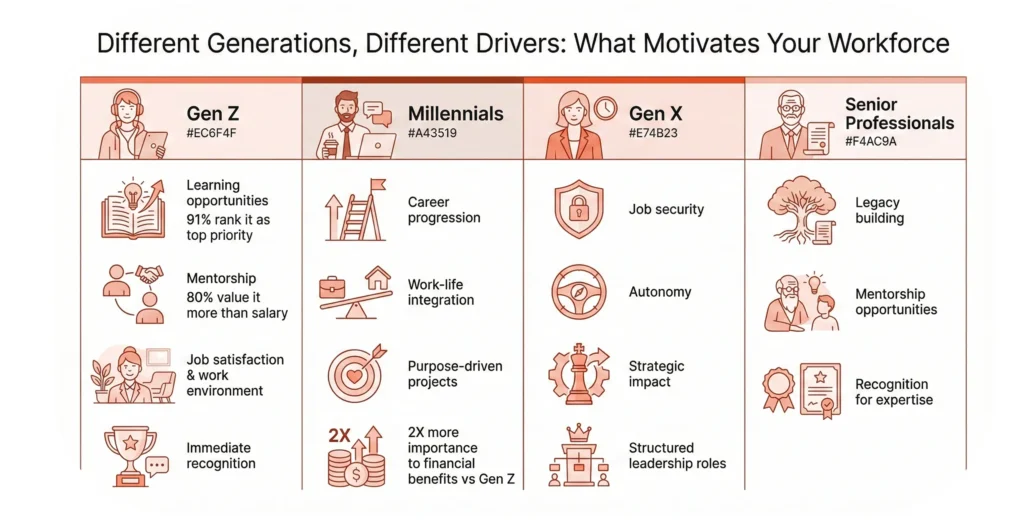
Different generations are inspired by different drivers:
- Gen Z: Meaningful work, rapid skill development, and immediate recognition
- Millennials: Career progression, work-life integration, and purpose-driven projects
- Gen X: Job security, autonomy, and strategic impact
- Senior professionals: Legacy building, mentorship opportunities, and recognition for expertise
Training for Multigenerational
According to ET Edge Insights from December 2025, HR should foster intentional cross-generational collaboration. Left to chance, employees cluster with peers who think like them.
HR can counter this through:
- Cross-generational project teams with clear deliverables
- Meaningful reverse mentoring programmes
- Shared learning forums that normalise asking questions across experience levels
- Leadership visibility for younger employees paired with mentorship roles for senior professionals
Chapter 6: Bridging Generations Is a Leadership Mandate
Alignment doesn’t come from sameness. It comes from clarity, choice, and consistency in multigenerational workforce management.
The Strategic Imperative
When institutional memory meets fresh perspective, deep expertise pairs with digital fluency, and crisis-tested judgement is supported by agile problem-solving, organisations gain an edge no single generation can offer alone. According to April 2024 studies, diverse and inclusive workplaces boast higher employee retention rates, increased employee engagement, accelerated revenue growth, and greater readiness to innovate.
Emerging Workforce Trends
The India Skills Report 2026 provides crucial insights for workforce planning. India’s employability has climbed to 56.35%, up from 54.81% in 2025, indicating more youth are job-ready and aligned with industry needs.
Significantly, according to November 2025 data, women’s employability (54%) has surpassed men’s (51.5%) for the first time. This historic shift is driven by hybrid work models, digital skilling, and inclusive learning access in tier-2 and tier-3 cities. Women now show dominant interest in Legal (96.4%) and Healthcare (85.95%), while men continue to prefer Graphic Design (83.11%) and Engineering Design (64.67%).
Tier-2 and Tier-3 cities such as Lucknow, Kochi, and Chandigarh are emerging as strong employability hubs, narrowing the urban-rural divide. The India Decoding Jobs 2026 reinforces this trend, noting that while Tier-1 hubs still dominate at 53%, Tier-2 cities now contribute 32% of hiring.
Key Actions for CHROs
Make Age Diversity Part of Your DEI Agenda
Age inclusion often remains underdeveloped within broader DEI strategies. According to December 2025 research, age diversity should become a visible part of the DEI agenda with metrics tracking age distribution across levels, bias training specifically addressing age stereotypes, and executive scorecards including multigenerational team effectiveness.
Design Flexible Frameworks, Not Separate Policies
Well-designed talent management policies support employees of all ages without privileging one group over another. Examples include:
- Flexible hours: Benefit Gen Z’s lifestyle preferences, Millennials’ caregiving needs, and Gen X’s health management
- Learning budgets: Allow individuals to choose courses, certifications, or conferences aligned with their career stage
- Career path options: Offer lateral moves, specialist tracks, and leadership development for different aspirations
Invest in Manager Capability
Leadership capability, not policy, decides whether multigenerational teams thrive. CHROs should:
- Train managers in generational awareness without reinforcing stereotypes
- Provide frameworks for individualised motivation and development
- Create peer learning networks for managers facing similar challenges
- Measure and reward multigenerational team effectiveness
Use Data to Drive Decisions
Track employee engagement, attrition, and performance metrics by age cohort to identify:
- Which policies are working and for whom
- Where generational gaps create friction
- What adaptations deliver measurable ROI
Challenge Stereotypes Actively
Generational stereotypes like ‘Boomers are rigid’ or ‘Gen Z is impatient’ oversimplify people and create unnecessary divides. According to April 2024 guidance, it’s crucial to dismiss age-based assumptions and encourage team members to communicate their preferences openly.
India Decoding Jobs 2026 provide comprehensive data that CHROs can use to benchmark their organisations against national trends.
Chapter 7: The Path Forward – India as a Global Talent Hub
India’s multigenerational workforce isn’t a temporary challenge – it’s the new reality and a competitive advantage. By 2028, the workforce will be even more age-diverse, with Gen Z comprising over a quarter of all workers while experienced professionals extend their careers.
India’s Emerging Position in Global Talent
The India Skills Report 2026 projects that global workforce shortage will reach 85 million by 2030, while India is expected to supply a surplus of 45 million skilled professionals, positioning it as the main talent hub at international level.
According to Nirmal Singh, CEO of Wheebox ETS and Chief Convenor of ISR in November 2025, ‘The burgeoning parallel workforce is shape shifting the future of work and it is starting right here from India. India stands at the intersection of scale, skill, and technology. The next decade will cement India’s leadership in global talent mobility through modular, AI-integrated skilling and internationally recognized certifications
Sector-Specific Opportunities
The India Decoding Jobs 2026 reveals sector-specific dynamics that CHROs must understand:
Automotive and Electric Vehicles:
- India’s automotive sector is projected to reach $300 billion by 2026, with India positioned as the world’s largest three-wheeler producer, among the top two for two-wheelers, and within the top four in passenger vehicles
- The sector is expected to lead salary growth for the fifth consecutive year, with an average projected hike of 10.1% in FY26, significantly higher than the India Inc average of 8.8%
- The automotive software market is projected to hit $43 billion by 2027, creating unprecedented demand for software developers, EV engineers, battery technology specialists, and autonomous systems experts
BFSI Sector:
- BFSI hiring trends show that the BFSI and fintech industries are expected to generate 2.5 lakh new jobs by 2030, growing at 8.7% annually
- Commerce graduates’ employability rose to 62.81% (from 55%), driven by BFSI and fintech growth
Manufacturing and Semiconductors:
- According to December 2025 analysis, India’s semiconductor mission could generate 10 lakh jobs by FY2026-27, with nearly 3 lakh roles in fabrication and 2 lakh in ATMP
- Opportunities span VLSI, embedded systems, hardware-AI integration, fabrication engineering, material science, and testing infrastructure
What Success Looks Like
Organisations that successfully navigate multigenerational talent management will:
- Reduce attrition by 20-30% through tailored retention strategies
- Increase innovation by combining fresh perspectives with deep expertise
- Improve productivity through reduced friction and better collaboration
- Build stronger employer brands that attract talent across all age groups
- Create sustainable competitive advantage through workforce adaptability
- Position themselves to tap into India’s projected surplus of 45 million skilled professionals by 2030
Final Thoughts for CHROs
The question isn’t whether to adapt to multigenerational talent management – it’s how quickly you can transform your systems, policies, and leadership capabilities to harness this diversity.
Remember: Generational diversity is not a problem to solve but a powerful asset to harness. The organisations that view it as an opportunity – not an obstacle – will lead India’s next decade of growth.
As India’s multi-generational workforce spans an increasingly wide age spectrum, the future of work will be defined by leaders who put people first and design systems that recognise the value each generation brings. With India positioned to become a global talent hub supplying 45 million skilled professionals to address worldwide workforce shortage by 2030, CHROs who master multi-generational workforce management today will have a decisive competitive advantage tomorrow.
Conclusion
India’s multigenerational workforce represents an unprecedented opportunity for organisations willing to rethink their talent strategies. With Gen Z, Millennials, Gen X, and experienced professionals all contributing their unique strengths, the potential for innovation, productivity, and sustainable growth is immense.
Overall employability has reached 56.35% in 2025, hiring intent has jumped to 40%, and the country is positioned to supply 45 million skilled professionals to address global talent shortages by 2030.
The CHROs who will succeed in this new environment are those who:
- Design flexible frameworks rather than rigid policies
- Invest in manager capability to lead diverse teams
- Use data to drive decisions and measure impact
- Challenge stereotypes and foster genuine inclusion
- Create learning ecosystems that serve all career stages
- Embrace emerging employment models including gig work and hybrid arrangements
- Leverage AI and technology to enable smarter, more inclusive hiring and development
The workforce without age barriers isn’t just possible – it’s essential for competing in India’s dynamic talent market. By embracing multigenerational talent management as a strategic priority, CHROs can build organisations that are more resilient, innovative, and prepared for the future. As the theme of India Decoding
Jobs 2026 declares: ‘Fourth and Forward – Fuelled by Talent,’ India’s emergence as a global talent powerhouse is happening now, and organisations that harness multigenerational diversity will lead the way.