
Let’s be honest, the traditional annual hiring plan is broken. In a market that changes on a dime, rigid, slow-moving recruitment models just can’t keep up with the pace of business. This is where agile talent acquisition comes in, transforming hiring from a static, year-long plan into a dynamic process that adapts in real-time.
Why Annual Hiring Plans No Longer Work

For decades, enterprise HR teams operated like massive cargo ships. They would meticulously chart a course once a year with a fixed hiring plan and stick to it, no matter how the market currents shifted or what storms appeared on the horizon. This model worked on the assumption that you could accurately predict talent needs twelve months out.
Today, that assumption is a massive liability.
Trying to navigate the modern talent market with a rigid annual plan is like trying to steer that same cargo ship through a narrow, winding river. It’s clunky, unresponsive, and almost guaranteed to run aground.
The Wake-Up Call for Indian Enterprises
The urgent need for a more dynamic approach became crystal clear in India between 2020 and 2022. During this period, soaring skill volatility and employee turnover forced enterprises into more agile ways of working. Data from LiveMint shows India’s overall attrition rate shot up from 6% in 2020 to 20.3% in 2022—a shocking threefold increase.
For CHROs, this meant that traditional manpower plans and rigid requisition cycles became unsustainable almost overnight. You can dive deeper into these trends in our detailed guide on workforce planning strategies.
This dramatic shift proved that simply reacting is no longer enough. Organisations that couldn’t adapt quickly found themselves with critical roles sitting vacant for months, putting a handbrake on growth and innovation.
Introducing a Fleet of Speedboats
Agile talent acquisition swaps the single cargo ship for a fleet of nimble speedboats. Think of each speedboat as a small, focused recruitment team—or “pod”—that can change direction in an instant.
Instead of one monolithic plan, this approach uses short, iterative cycles known as “sprints” to tackle the most urgent hiring needs first. This model gives you the adaptability to thrive in uncertainty.
The benefits are immediate:
- Increased Speed: Teams can pivot to a new high-priority role in days, not months.
- Improved Adaptability: Recruitment efforts align with what the business needs right now, not what was forecasted six months ago.
- Enhanced Resilience: The organisation can scale hiring up or down in response to market shifts without breaking the entire talent function.
By embracing this mindset, your talent function stops being a slow administrative centre and becomes a strategic, responsive partner to the business.
Defining The Agile Talent Acquisition Framework
At its heart, agile talent acquisition is about flipping the script on traditional, linear hiring. Forget thinking about each job opening as a separate project with a start and a finish. The agile approach turns recruitment into a continuous, adaptable cycle that’s laser-focused on delivering real value to the business. It takes its cues from the agile software world, where small, collaborative teams work in quick bursts to get things done and adjust on the fly based on what they learn.
Think of old-school recruitment like a factory assembly line. Each step—sourcing, screening, interviewing, offering—must happen in a rigid order. If there’s a holdup at one station, the whole production line stalls. You don’t see the final product until the very end.
Agile talent acquisition, on the other hand, is more like a set of specialised workshops. Small, multi-skilled teams jump on the most critical tasks first. They deliver results in short cycles, constantly refining their approach. This whole model is built for speed, collaboration, and the ability to pivot in a heartbeat.
The Four Pillars of Agile Recruitment
To really get how this works, you need to understand the principles that power it. These concepts are the engine that transforms a recruiting function from a reactive service desk into a proactive, strategic partner.
- Iterative Hiring in Sprints: Instead of chipping away at a long list of jobs over several months, the work is broken down into short, time-boxed periods called “recruitment sprints.” These usually last one to four weeks. Each sprint has a clear, achievable goal—like sourcing 50 qualified candidates for a key tech role or closing three positions in one department.
- Cross-Functional Pods: Silos get torn down. Recruiters, sourcers, hiring managers, and sometimes even people from finance or marketing form small, dedicated teams or “sourcing pods.” This intense, daily collaboration means everyone is on the same page and decisions can be made instantly, without waiting for layers of approval.
- Data-Driven Decisions: Gut feelings are out; real-time data is in. Teams constantly watch metrics like pipeline conversion rates and candidate feedback to see what’s working and what’s not. This lets them tweak their strategy mid-sprint instead of waiting until a search has already failed.
- Continuous Feedback Loops: Feedback is constant and immediate. Quick daily stand-up meetings and review sessions at the end of each sprint keep the recruitment team perfectly synced with the business’s changing needs. The result? The quality of hire gets better with every single cycle.
Agile isn’t about cramming in more work; it’s about getting more value from the work you do. The focus shifts from just closing roles to building a strong talent pipeline that can anticipate what the business needs next.
A well-oiled agile process is a non-negotiable part of any modern talent acquisition strategy, giving organisations the edge they need to stay ahead of the market.
Traditional Vs Agile Talent Acquisition Models
Putting these two approaches side-by-side really highlights the difference. The agile model rethinks everything from roles and processes to how success is measured, creating a far more dynamic and responsive system.
Here’s a breakdown of how they compare:
| Aspect | Traditional Recruitment (The Assembly Line) | Agile Talent Acquisition (The Specialised Workshop) |
|---|---|---|
| Process Flow | Linear and sequential; one step must finish before the next one starts. | Cyclical and iterative; multiple activities happen in parallel within sprints. |
| Planning | Long-term, rigid annual plans based on forecasts made months ago. | Short-term, flexible sprint planning focused on immediate business priorities. |
| Team Structure | Siloed roles (sourcer, recruiter, coordinator) working on their own. | Cross-functional “pods” with shared ownership and daily collaboration. |
| Feedback | Happens at the very beginning and end, with long, quiet gaps in between. | Continuous, daily feedback loops with hiring managers and stakeholders. |
| Key Metric | Primarily focused on time-to-fill and cost-per-hire. | Emphasises quality of hire, hiring manager satisfaction, and sprint velocity. |
As you can see, the shift isn’t just about moving faster. It’s about becoming smarter, more collaborative, and more aligned with the strategic goals of the entire organisation.
Building The Business Case For An Agile Approach
Getting your leadership team on board with an agile approach to talent acquisition means talking their language. It isn’t just about explaining a new HR process; it’s about building a rock-solid business case that connects agility directly to the outcomes they care about most: speed, cost, and business resilience.
This isn’t a conversation about small tweaks. It’s about positioning your talent function as a real competitive weapon.
Let’s start with speed. In today’s market, a slow hiring process is a losing game, especially when you’re hunting for scarce skills. The old-school, sequential way of recruiting—with endless handoffs and approval bottlenecks—can easily drag on for months. This is a huge problem when you consider that 87% of companies are already grappling with significant skills gaps. Every delayed hire hits your project timelines, your product launches, and your revenue goals.
Agile talent acquisition completely flips this script. By creating focused, cross-functional “sourcing pods” and working in short, intense “sprints,” you can smash through those delays. Collaboration between recruiters and hiring managers stops being a weekly scheduled meeting and becomes a daily reality, ensuring everyone is on the same page from the very beginning.
Driving Down Costs While Boosting Quality
There’s a common myth that a faster process must be a more expensive one. Actually, the opposite is true. An agile model systematically brings down your cost-per-hire.
The single biggest saving comes from breaking the dependency on last-minute, high-fee recruitment agencies. When you’re proactively sourcing and building evergreen talent pipelines, you have qualified candidates ready to go before a role even opens up.
An agile model transforms recruitment from a reactive, transactional expense into a proactive, strategic investment. By focusing on efficiency and quality upfront, you reduce the hidden costs of bad hires and prolonged vacancies.
This is where the core principles of agile really come to life and drive those business benefits.
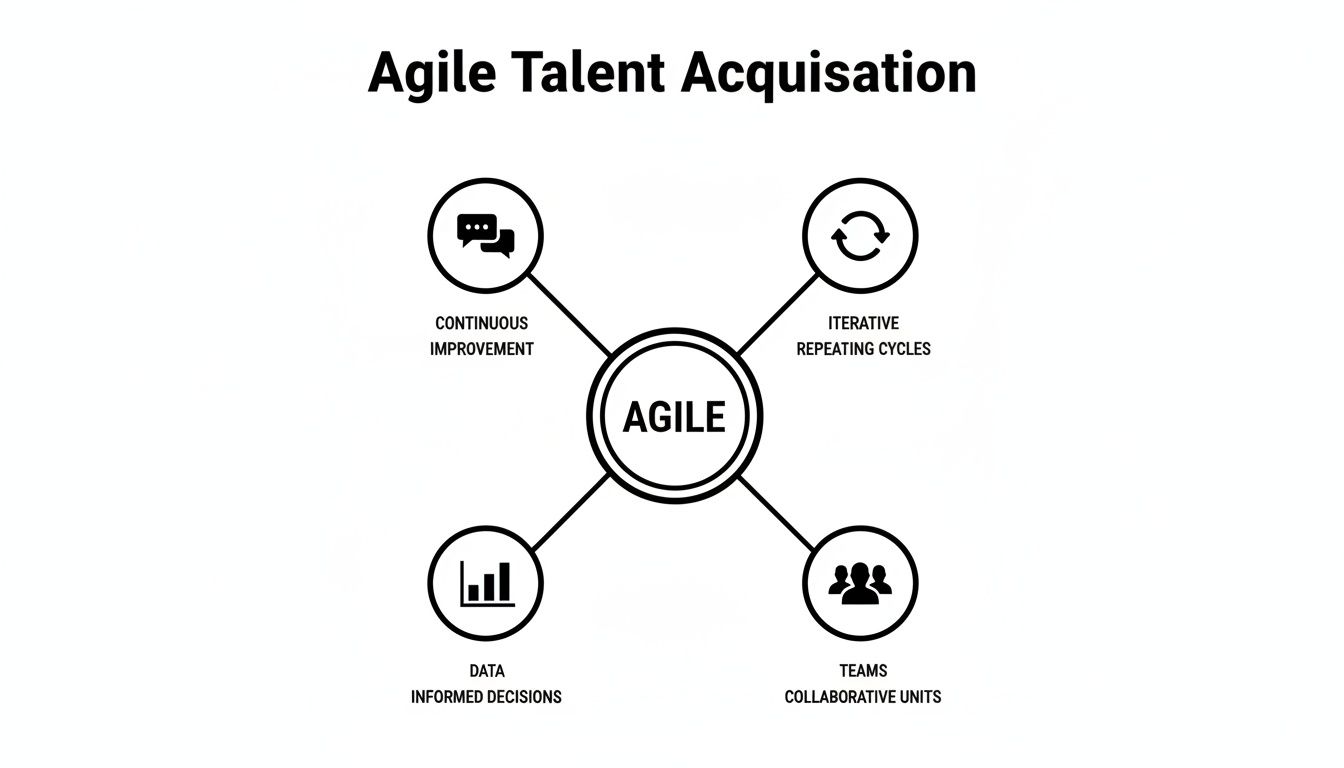
As you can see, the iterative cycles, collaborative teams, data-driven decisions, and continuous feedback loops all work together. Each part strengthens the others, creating a powerful engine for a more responsive and efficient system.
Enhancing Organisational Resilience
Perhaps the most compelling argument you can make to your board is how agile talent acquisition builds overall business resilience. The market is never going to stand still. An agile framework gives your organisation the muscle to absorb shocks and jump on opportunities with genuine confidence.
Just think about these real-world scenarios:
- Sudden Market Opportunity: A new project lands, and you suddenly need 20 specialist engineers within a single quarter. An agile team can spin up a dedicated sprint pod instantly, re-prioritise its work, and deliver without throwing all your other hiring plans into chaos.
- Unexpected Attrition: A key team lead resigns. Instead of scrambling to start from scratch, you dip into the evergreen pipeline you’ve been building. This can slash your time-to-fill from months down to just a few weeks.
- Economic Downturn: If hiring freezes or cutbacks are necessary, the modular design of agile pods lets you scale down gracefully. You can focus your resources on the absolute most critical roles without having to dismantle your entire TA function.
Ultimately, making the business case for agile TA is about showing that it’s a strategic necessity. It’s the key to slashing time-to-fill, boosting hiring manager satisfaction, and building an organisation that can pivot faster than the competition. It’s how you finally stop just filling jobs and start building a truly resilient, future-ready workforce.
Designing Your Agile Operating Model With An RPO Partner
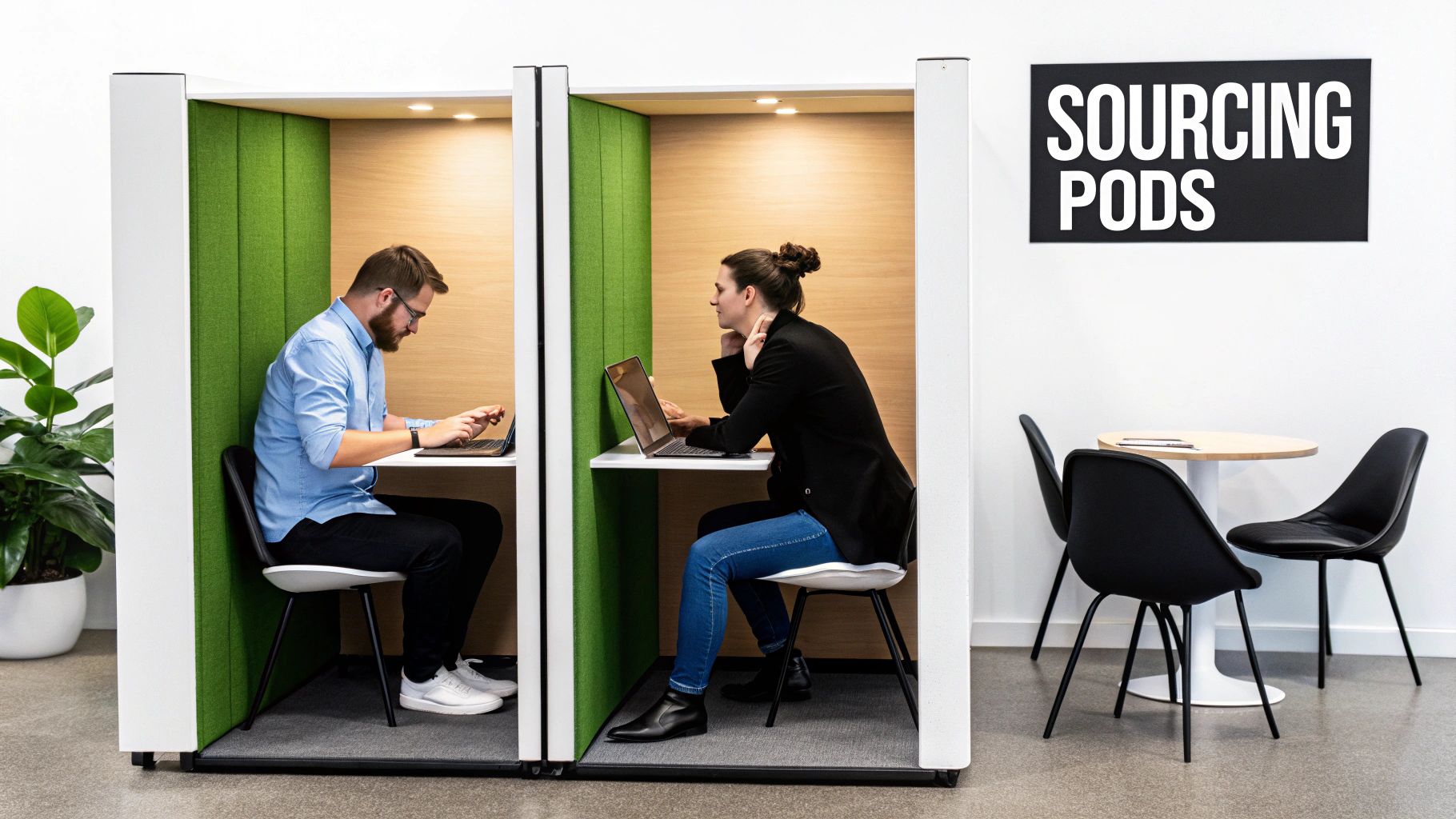
Moving from the idea of agile talent acquisition to making it happen on the ground means designing a practical operating model. This is where you actually build the engine that powers speed, quality, and adaptability in your hiring.
Instead of relying on a single, one-size-fits-all recruitment department, a truly agile model uses specialised teams that can be deployed based on what the business needs most. It’s a shift away from a monolithic structure toward something far more flexible and modular.
Two of the most effective ways to structure this are through dedicated “sourcing pods” and project-based “sprint teams.” While they serve different purposes, both are built on the core agile principles of focus, collaboration, and getting things done quickly.
Introducing Specialised Sourcing Pods
Think of sourcing pods as your permanent, elite commando units within the talent function. Each pod is a small, cross-functional team that lives and breathes a specific, high-demand skill area—like AI/ML, Cloud Engineering, or Digital Marketing.
These teams do more than just fill jobs as they open. They are deeply embedded in their talent markets, focused entirely on building and nurturing evergreen pipelines for the roles that are most critical and hardest to find.
A typical sourcing pod is made up of:
- A Lead Recruiter: Owns the relationship with hiring managers and guides the pod’s strategy.
- Specialist Sourcers: Focus solely on finding and engaging passive talent in their niche.
- A Recruitment Coordinator: Manages all the scheduling and logistics to ensure candidates have a brilliant experience.
With this structure, your recruiters stop being generalists and transform into genuine market experts who can advise the business on talent trends and what’s really happening in the market.
Deploying Project-Based Sprint Teams
While sourcing pods give you continuous coverage for core skills, sprint teams provide on-demand hiring muscle. These are temporary teams that come together to tackle a specific, time-bound hiring challenge and then disband once the mission is complete.
For instance, you might assemble a sprint team to hire 30 sales executives for a new office launch within a single quarter. This team pulls together the right resources, runs a series of focused hiring sprints, and hits the target with concentrated effort. This approach is perfect for handling sudden hiring surges without pulling your strategic sourcing pods off their core mission.
The real power of this dual model lies in its flexibility. You get the stability of continuous sourcing for your most important roles, plus the agility to respond to unexpected business demands whenever they pop up.
The RPO Partner As A Strategic Enabler
Trying to build this kind of agile function from scratch is a massive undertaking. It requires specialised expertise, a flexible tech stack, and a scalable pool of talent—things that are tough for most companies to develop internally. This is where a Recruitment Process Outsourcing (RPO) partner can be a powerful catalyst for change.
A great RPO partner doesn’t just execute your hiring plan; they help you design and run the entire agile operating model. They bring the scalable resources, deep market specialisation, and technology you need to make it work from day one. An RPO can instantly provide pre-built sourcing pods for niche skills, saving you months of painful ramp-up time. For more information, you can explore the key benefits of recruitment process outsourcing.
The need for this kind of agility is more urgent than ever. Zinnov’s benchmarking reveals that 57% of India-based GCC leaders now see skill gaps as their number one workforce challenge. When you consider that niche roles can take up to 3x longer to fill with traditional methods, the case for agile, specialised sourcing becomes impossible to ignore. For a recruitment specialist like Talent Hired, this data reinforces why CHROs are shifting from reactive hiring to always-on, analytics-driven acquisition engines.
By bringing in an RPO, you gain a strategic enabler that helps you manage fluctuating hiring demands and access top-tier talent with the speed and precision the modern market demands.
Unlocking Your Internal Talent Marketplace

While building powerful external sourcing pods is crucial for bringing fresh skills into the business, a truly agile talent function knows its greatest advantage might already be on the payroll. Often, the quickest and most cost-effective way to fill a critical gap is to look inward first.
This is where an internal talent marketplace completely changes the game. Picture it as an internal gig platform. It’s a space where your own people can find new projects, short-term assignments, or even their next permanent role—all based on their skills and career goals. It turns talent from a static resource locked away in one department into a fluid asset you can deploy to the business’s highest priorities.
Shifting from Siloes to Mobility
For too long, internal mobility has been a slow, bureaucratic affair, often blocked by territorial managers and a simple lack of visibility. An agile approach tears down these walls, creating a transparent system where opportunities are open for everyone to see and pursue.
This shift isn’t just a “nice-to-have”; it delivers serious business benefits:
- Drastically Reduced Time-to-Fill: Internal hires get up to speed in a fraction of the time it takes an external candidate.
- Lower Recruitment Costs: You slash expenses on sourcing, agency fees, and extensive background checks.
- Enhanced Employee Retention: Giving people clear paths for growth is one of the best ways to keep your top performers engaged and loyal.
When you treat internal mobility as a core business strategy, you build a more resilient organisation and a culture where people genuinely see a long-term future with the company.
The Retention and Cost-Control Imperative
The need for this internal focus is especially sharp in India. Data from RippleHire reveals a telling statistic: employees in India are still 1.0x more likely to leave an organisation than to even look for an internal move. This points to a massive, untapped opportunity for CHROs.
At the same time, Zinnov reports a staggering 60–73% demand–supply gap for critical roles like Machine Learning Engineers and Data Scientists. You can explore these trends and read the full Zinnov recruitment report for a deeper dive.
The data paints a clear picture. The talent you’re fighting to find externally may already be within your walls, at risk of leaving simply because they don’t see a path forward. An internal marketplace directly addresses this challenge.
An agile approach turns this problem on its head. Instead of losing a skilled employee and then entering a hyper-competitive market to replace them, you redeploy their institutional knowledge to a new challenge. It’s a powerful strategy for both controlling costs and holding onto your best people.
How an RPO Partner Can Help
Bringing a successful internal talent marketplace to life isn’t simple. It requires a sophisticated framework for skills mapping, project management, and clear communication. An RPO partner can be instrumental here.
They can help design the governance model, implement the right technology, and manage the process from end to end. This ensures your internal marketplace runs with the same efficiency and rigour as your external talent pipelines.
Measuring What Matters With Agile KPIs
When you shift your operating model, you have to change how you measure success. Sticking to old-school KPIs like time-to-fill is like trying to measure a speedboat’s performance with a calendar. Sure, it tells you something, but it completely misses the point of agility. To really get a handle on the impact of agile talent acquisition, you need to look beyond simple efficiency numbers and focus on what truly matters: speed, quality, and the happiness of your hiring managers.
Traditional metrics are a bit like looking in the rear-view mirror; they tell you about the final outcome of a long, drawn-out process. Agile KPIs, on the other hand, are your live dashboard. They are designed to give your teams real-time feedback within each hiring sprint, allowing them to see what’s working, adapt their approach on the fly, and get better with every cycle.
This data-first mindset is crucial. It’s how you’ll prove the value of your agile transformation and build a culture of continuous improvement right inside your talent function.
From Lagging Indicators to Leading Metrics
The fundamental change here is moving from measuring just the final output to tracking the inputs and in-sprint progress. Of course, closing a role is the end goal, but an agile approach cares deeply about the health and velocity of the process that gets you there. This means tracking metrics that answer the big questions about your team’s performance while the sprint is happening.
Here are the agile-centric metrics that really move the needle:
- Sprint Velocity: Think of this as the raw output of your recruitment pod. It’s the total number of key results—like hires made, offers accepted, or top candidates pushed to the final stage—that a team delivers in one sprint. It’s a direct measure of their throughput and helps you predict what they can handle in the future.
- Quality of Hire at 90 Days: This takes the guesswork out of hiring success. It involves getting structured feedback from hiring managers on a new employee’s performance, team fit, and productivity after their first quarter. It’s a tangible way to see if your recruiting process is actually delivering top performers.
- Hiring Manager Net Promoter Score (NPS): It’s simple but powerful. After each sprint or hire, ask your hiring managers one question: “On a scale of 0-10, how likely are you to recommend our recruitment process to a colleague?” This gives you instant, actionable feedback on their experience.
- Pipeline Conversion Rates: This is about tracking the health of your funnel. By measuring the percentage of candidates who move from one stage to the next (e.g., Sourced to Screened, Interviewed to Offer), you can immediately spot bottlenecks or weak points in your process that need fixing.
By focusing on these KPIs, you change the entire conversation. It’s no longer just about “How long did it take?” Instead, it becomes “How effective were we, and how can we be even better next week?” That’s the true spirit of continuous improvement in an agile world.
A Practical Toolkit for Agile Measurement
To make these KPIs truly useful, you need to connect them directly to the business questions you’re trying to answer. This isn’t just about collecting data; it’s about turning that data into a practical toolkit your team can use in sprint reviews and when talking with senior leadership.
The table below breaks down these new metrics, showing exactly what they measure and the critical business questions they help you solve. Think of it as your roadmap for measuring success in an agile recruiting world.
Key Performance Indicators For Agile Talent Acquisition
A guide to the new metrics that matter for measuring the impact and efficiency of an agile recruitment function.
| Agile KPI | What It Measures | Business Question It Answers |
|---|---|---|
| Sprint Velocity | The pod’s capacity and output per sprint (e.g., hires, offers). | “Are we becoming more efficient and predictable in our delivery of talent?” |
| Quality of Hire (90 Days) | The long-term success and performance of new hires. | “Are our agile methods leading to better, more successful employees for the business?” |
| Hiring Manager NPS | The level of satisfaction and collaboration with internal stakeholders. | “How effectively are we partnering with the business to meet their needs?” |
| Pipeline Conversion Rates | The health and efficiency of each stage in the recruitment funnel. | “Where are the bottlenecks in our process, and how can we fix them immediately?” |
By embracing these KPIs, you’re not just tracking numbers; you’re building a system that drives accountability, highlights opportunities for improvement, and proves the strategic value of your talent acquisition team to the entire organisation.
Your Questions About Agile Talent Acquisition Answered
Making the move to an agile approach in talent acquisition always sparks a few questions. For any CHRO, getting to grips with the practical side of things is absolutely essential for a successful rollout. Let’s tackle some of the most common queries with straightforward, real-world answers to clear the path forward.
How Does Agile Work For Non-Technical Roles?
It’s a common misconception that agile is just for tech. While its roots are in software development, the principles are surprisingly universal. When it comes to high-volume or non-technical roles, the methodology is just as powerful.
Think of it like this: instead of launching a massive, six-month hiring campaign and hoping for the best, you break it down into short, two-week “sprints.” After each sprint, you look at the data. Which job boards brought in the best candidates? Which interview questions filtered people out effectively? You use those insights to adjust your strategy for the next two weeks. This way, you’re constantly course-correcting based on real-time feedback, not waiting months to realise a campaign isn’t working. An RPO partner can be a game-changer here, giving you the flexible resources to manage these high-volume sprints.
The core idea is simple, no matter the role: swap long, rigid hiring cycles for short, iterative ones. This builds a recruitment engine that learns and adapts to what the market is telling you, right now.
Does This Mean A Complete Overhaul?
Not at all. In fact, a “big bang” approach is rarely the way to go. The most successful transitions start small and build momentum.
The best way forward is usually an iterative one. Start with a pilot programme. Pick one critical business unit or a handful of particularly tough-to-fill roles and apply agile principles there. By creating a specialised “sourcing pod” and delivering clear wins in a controlled setting, you build a powerful case study. This approach minimises disruption, proves the value of agile talent acquisition to sceptical stakeholders, and lets you learn what works before scaling up. An RPO partner is perfect for running this pilot, bringing in the framework and expertise without distracting your core team.
What Is The Biggest Mindset Shift Required?
This is the big one. The most fundamental change is moving away from a linear, almost transactional process to a truly collaborative partnership.
It means hiring managers are no longer just involved at the start and the very end of the process. Instead, they become active, daily participants in sprint planning meetings and feedback sessions. For recruiters, the shift is just as profound. They stop being “requisition fillers” and become genuine “talent advisors,” using data to guide the hiring strategy in real time. This deep, continuous collaboration is the secret sauce that improves both the speed and the quality of every single hire you make.
Ready to build a more responsive and resilient talent function? Taggd specialises in designing and implementing agile RPO solutions that deliver measurable results. Discover how we can help you adapt faster and hire smarter by visiting us at https://taggd.in.