Enterprise Recruitment Process Outsourcing (RPO) is a game-changer for large organisations. It shifts your talent acquisition from a reactive, firefighting cost centre into a proactive engine for business growth.
The big wins? Think significant cost reductions, the ability to scale hiring up or down as needed, and a real, measurable jump in the quality of candidates you bring on board. It’s a strategic move that delivers efficiency and a serious competitive edge.
Why Large Organisations Are Turning to Enterprise RPO
Let’s be honest. For many large companies, in-house recruitment has become a beast of its own. It often feels like you’re managing a messy supply chain with dozens of uncoordinated suppliers—disjointed processes, wildly inconsistent results, and sky-high costs are the norm. This fragmented mess creates massive headaches for HR leaders.

Choosing Enterprise RPO isn’t just about handing off tasks. It’s a strategic decision to embed a specialised talent partner right into the fabric of your company. This partner doesn’t just fill jobs; they get under the hood and optimise the entire recruitment lifecycle, from planning to onboarding.
If you’re new to the concept, our guide on everything you need to know about RPO is a great place to start.
This integrated approach is designed to fix the core pain points that hold back growth in big businesses.
Tackling Core Recruitment Challenges
Large-scale hiring is often plagued by a few critical issues that a solid RPO partnership is built to solve:
- Inconsistent Hiring Quality: Without a central, unified process, different departments and hiring managers follow their own rules. The result is a workforce with mismatched skills and a diluted company culture.
- High and Unpredictable Costs: Relying on a patchwork of external agencies, especially for specialised roles, racks up eye-watering fees. This makes recruitment budgets nearly impossible to forecast and control.
- Slow Recruiting Cycles: Clunky internal processes and overworked HR teams mean your time-to-hire drags on for weeks, or even months. By the time you make an offer, your top candidates have already accepted one from a competitor.
An RPO partner steps in to build one integrated, efficient system, completely transforming the talent function.
An Enterprise RPO partnership shifts talent acquisition from a tactical, reactive function to a strategic, proactive business driver. It’s about building a predictable talent pipeline that aligns directly with long-term corporate objectives and market demands.
This transformation is vital for any large organisation serious about gaining a sustainable advantage. The focus shifts from just filling seats to securing the right talent at the right time to drive innovation and growth.
This strategic alignment ensures every recruitment effort directly contributes to the bottom line. It frees up HR to move beyond admin and become a true strategic partner, using data-driven insights to inform workforce planning and future-proof the organisation against skill gaps.
Driving Down Costs and Improving Financial Efficiency
For any large organisation, keeping a lid on costs is a never-ending priority. Recruitment, in particular, can feel like a financial black hole with its fluctuating demands and reliance on costly third-party agencies. This is where one of the biggest wins of enterprise RPO comes into play: its direct impact on your bottom line.
Think of it this way. Traditional recruiting often operates like a pay-as-you-go mobile plan—full of surprise charges and unpredictable bills from multiple vendors. An enterprise RPO model, on the other hand, is like a fixed, all-inclusive subscription. You get predictable costs, better service, and no nasty surprises, transforming talent acquisition from a volatile cost centre into a managed, operational expense.
This shift gives finance leaders something they rarely get from recruitment: certainty.
Eliminating Expensive Agency Fees
A huge drain on any recruitment budget comes from juggling multiple staffing agencies, each charging a hefty slice of a new hire’s annual salary. When you’re hiring for dozens of specialised or high-volume roles, these fees can quickly spiral out of control, creating a fragmented and incredibly expensive process.
An enterprise RPO partner steps in to replace this chaotic network. By bringing all your recruitment under a single, strategic partnership, you completely do away with these disparate agency fees. Instead of dealing with countless invoices, you have one streamlined cost structure, which translates to immediate and significant savings.
This isn’t just about cutting costs; it’s about gaining a clear, unified view of your recruitment spend, making budgeting and forecasting infinitely easier.
Optimising Recruitment Marketing and Technology Spend
Beyond agency fees, there’s the money poured into job boards, advertising, and a tangled web of recruitment software. Without a central strategy, this spending is often a shot in the dark. Different teams end up paying for overlapping tools or running campaigns that just don’t deliver the right candidates.
RPO providers bring a much sharper, data-led approach. They know exactly which channels work best for which roles, ensuring every rupee of your advertising budget is put to good use. Plus, they bring their own advanced tech stack—like top-tier Applicant Tracking Systems (ATS) and Candidate Relationship Management (CRM) tools—so you don’t have to bear the cost of purchasing and managing these platforms yourself.
The financial efficiency gained through RPO isn’t just about cutting costs; it’s about reallocating resources intelligently. By transforming unpredictable expenses into a managed service, organisations can achieve greater ROI on their entire talent acquisition function.
This strategic management of resources has become a game-changer. According to one industry report, companies using RPO have slashed their recruitment costs by an average of 45%. This comes from cutting out multiple agency fees and using smarter tech for sourcing. For instance, one large IT firm reported saving roughly ₹1.2 crore a year after moving to an end-to-end RPO model. To understand more, check out why Indian businesses are choosing RPO outsourcing on hirefex.com.
Reducing the Internal Administrative Burden
Finally, let’s talk about the hidden costs. Think of the hours your own HR teams and hiring managers spend sifting through endless CVs, scheduling interviews, and chasing down candidate updates. That’s valuable time they could be spending on strategic work that actually grows the business.
An RPO partnership lifts this entire administrative weight off their shoulders. This frees up your internal talent to focus on what they do best: employee engagement, leadership development, and strategic workforce planning. This boost to internal productivity is a powerful, yet often overlooked, financial benefit that improves efficiency across the entire organisation.
Achieving Unmatched Hiring Scalability and Agility
Let’s be honest, for large organisations, hiring is rarely a straight, predictable line. One quarter you might be aggressively expanding into a new market, and the next, you’re hitting the brakes for a strategic pause. This constant yo-yo between peaks and valleys in recruitment demand is a massive headache for a fixed internal HR team.

This is where one of the core benefits of enterprise RPO for large organizations really comes into its own. It gives you an elastic, on-demand recruitment engine that flexes perfectly with your business needs. Suddenly, you have the power to scale your hiring capacity up or down almost instantly, without the financial drag of a large, permanent internal team sitting idle during quieter periods.
Think of it like this: owning a massive fleet of delivery trucks is expensive and inefficient when demand is low. Partnering with a logistics expert, however, gives you the exact capacity you need, right when you need it. That’s RPO for your talent function.
Responding Instantly to Business Demands
In today’s market, the ability to adapt quickly is a huge competitive advantage. An RPO partner gives your organisation the agility to grab market opportunities the moment they appear—something rigid, slow-moving hiring processes simply can’t do.
Just consider these common scenarios for a large enterprise:
- Launching a New Division: You need to hire 50+ sales professionals in a new territory, and you need them last quarter. An RPO partner can deploy a dedicated team immediately to run this high-volume project without pulling your core HR team away from their day-to-day.
- Seasonal Peaks: A retail or e-commerce giant staring down the festive season rush needs to onboard hundreds of temporary staff. An RPO provider can manage this entire large-scale drive efficiently, from sourcing right through to onboarding.
- Post-Project Ramp-Down: After a major product launch, hiring needs might drop off a cliff. With an RPO model, you just scale back the service. No painful, costly downsizing of your internal recruitment team required.
This level of flexibility ensures your talent acquisition is always the right size for your current business goals, preventing overstaffing and wasted resources.
The true value of RPO scalability lies in its ability to transform talent acquisition from a fixed overhead into a variable, strategic asset. This allows the business to remain lean during quiet times and incredibly powerful during periods of growth.
Building a Proactive Talent Pipeline
But this agility isn’t just about reacting to needs; it’s also about being proactive. A key function of a great enterprise RPO partner is to build and nurture talent pipelines for your critical roles before you even have an open position.
By continuously engaging with high-potential candidates in the market, your RPO partner makes sure that when a need does arise, you’ve already got a warm pool of qualified people ready to talk. This dramatically cuts your time-to-hire, allowing you to fill business-critical roles faster than competitors who are just starting their search from scratch. It’s a shift that turns your recruitment function from a reactive order-taker into a strategic, forward-planning unit that truly aligns your talent strategy with your long-term business goals.
Improving Quality of Hire and Reducing Time to Fill
When it comes to the race for talent, speed and quality can feel like a trade-off. Move too fast, and you might make a bad hire. Move too slow, and the perfect candidate is already gone. This is a familiar headache for large organisations, but mastering both of these metrics at once is one of the standout benefits of enterprise RPO for large organizations.
Bringing in an RPO partner isn’t about cutting corners to hire faster; it’s about making the entire process smarter and more efficient. It’s like having a Formula 1 pit crew for your recruitment function. Their incredible speed doesn’t come from rushing—it comes from specialised tools, flawless coordination, and deep expertise that turn a complex job into a high-speed, high-precision operation.
This efficiency stems from a deep grasp of the talent market, access to ready-made candidate networks, and the clever application of technology.
Tapping into a Deeper Talent Pool
One of the biggest game-changers an RPO partner brings is their ability to find exceptional candidates who aren’t even looking for a job. Most in-house teams are stuck fishing in the pond of active job seekers—the people applying through job boards. RPO providers, on the other hand, are constantly cultivating vast talent pools of passive candidates.
These are the high-performers, the ones already succeeding in their roles but potentially open to a conversation about the right opportunity. RPO specialists use a potent mix of market intelligence, AI-powered sourcing tools, and old-fashioned networking to find and engage these hidden gems. This gives you a shot at a much higher calibre of talent than you could ever find on your own.
With this proactive approach, you stop just filling empty seats and start strategically upgrading your entire workforce with the best people out there.
Accelerating the Hiring Timeline with Technology
If you want to speed up hiring without compromising on quality, you have to eliminate the bottlenecks. RPO providers tackle this head-on with a technology-first mindset that smooths out every step of the process, from the first screening to the final offer.
By using advanced Applicant Tracking Systems (ATS) and automation, they can instantly parse thousands of applications and pinpoint the most promising individuals. This frees your recruiters from administrative drudgery so they can focus on what really moves the needle: building relationships and having meaningful conversations with top-tier talent.
The dual benefit of improving hiring quality while reducing time-to-fill creates a powerful competitive advantage. It ensures business-critical roles are filled faster with individuals who perform better and stay with the organisation longer, directly impacting productivity and revenue.
This tech-driven process makes the hiring journey seamless for everyone involved. For instance, a recent NASSCOM survey revealed that over 60% of tech companies using RPO cut their time-to-fill by an average of 60%. One major BFSI player managed to slash its average hiring time from 45 days down to a remarkable 18 after bringing on an RPO partner. You can read more about the evolving landscape of RPO in India at allthingstalent.org.
Boosting Long-Term Retention Through Better Matches
At the end of the day, a quality hire is about more than just skills; it’s about finding someone who clicks with your company’s culture. RPO providers work to become an extension of your own team, acting as true ambassadors for your brand. This deep immersion allows them to assess for cultural fit with a level of accuracy that a typical external agency just can’t replicate.
By focusing on this holistic match, they find candidates who don’t just hit the ground running but are also more likely to stay engaged and committed for the long haul. This focus on quality directly improves employee retention, slashing the heavy costs of high staff turnover and the constant need to backfill roles. It’s about making an investment in talent that pays dividends for years to come.
Enhancing Your Employer Brand and Candidate Experience
In the race for top talent, your employer brand isn’t just a part of the strategy—it’s your most powerful magnet. Every single interaction a candidate has with your company, from the first time they see a job ad to the moment they receive an offer, shapes their view of you as a place to work. For large organisations, keeping that experience positive and professional across thousands of hires is a colossal task.
This is where an enterprise RPO partner truly shines. They step in as dedicated ambassadors for your brand, ensuring every single candidate gets a first-class experience, regardless of the role, department, or geography. They help shift recruitment from a series of disconnected, transactional steps into a single, powerful brand-building engine.
Why does this matter so much? Because a great candidate experience does more than just fill an open position. It builds a stellar reputation in the market that naturally attracts the best people, making all your future recruitment efforts that much easier and more successful.
Creating Consistency at Scale
Let’s be honest: in a large enterprise, the candidate journey can quickly devolve into chaos. You have dozens of hiring managers, all with different communication styles, and a patchwork of processes that lead to a disjointed, and often frustrating, experience for applicants. It’s easy for great candidates to get lost in the shuffle, wait ages for feedback, and eventually just give up and look elsewhere.
An RPO provider brings a much-needed sense of order. They establish and enforce standardised communication protocols, making sure every applicant receives timely updates and professional correspondence. This structured approach creates a seamless and respectful process that reflects positively on your entire organisation.
By standardising the recruitment journey, an RPO partner ensures that your employer brand is communicated consistently and professionally at every touchpoint. This builds trust and positions your company as an employer of choice, even for those who don’t get the job.
Turning Candidates into Advocates
Just think about the sheer number of people who apply to your organisation every year. The vast majority won’t be hired, but every single one of them walks away with an impression. A bad experience can quickly turn into negative online reviews that tarnish your reputation. A positive one, however, can turn an unsuccessful applicant into a future customer, a referral source, or even a brand advocate.
RPO providers are masters of candidate engagement. Their entire focus is on creating a journey that is:
- Respectful: They make sure every candidate’s time is valued through clear, honest communication.
- Efficient: The application and interview stages are smooth and well-managed, without frustrating delays.
- Personable: Candidates feel like they are seen and heard as individuals, not just another resume in a system.
This focus on a superior experience pays off massively. Research consistently shows that candidates who have a positive hiring experience are more than twice as likely to recommend the company to their peers. This strengthens your brand from the ground up, making it easier to attract high-calibre talent. A strong employer brand is non-negotiable, and you can dive deeper into building a talent pipeline through the employer branding effect in our detailed guide.
Ultimately, handing over the reins of your candidate experience to an RPO partner is a direct investment in the long-term health of your employer brand. It’s a strategic decision that helps you hire the best people today while building a powerful reputation that gives you a competitive edge for years to come.
Using Advanced Analytics for Strategic Workforce Planning
In a large organisation, raw recruitment data often feels like noise. You know how many roles you filled and how long it took, but what does that information actually tell you about the future of your business? One of the most powerful benefits of enterprise RPO for large organizations is its ability to turn this noise into clear, actionable business intelligence.
An expert RPO partner moves beyond simple operational metrics. They become your data analytics engine, transforming recruitment numbers into a strategic roadmap for your entire workforce. It’s no longer just about filling today’s open positions; it’s about providing leadership with the insights needed to make smarter, forward-looking talent decisions.
This strategic shift elevates the HR function from a support role to an essential partner in driving long-term business strategy.
From Reactive Metrics to Predictive Insights
Traditionally, talent acquisition tracks metrics in the rearview mirror—how long did it take to hire, or what was the cost-per-hire? An enterprise RPO partner flips the script by focusing on predictive analytics that anticipate future needs and challenges. They don’t just report numbers; they interpret them to answer critical business questions.
This process involves a deep analysis of several key areas:
- Source Effectiveness: They pinpoint exactly which channels deliver the highest quality candidates for specific roles, allowing you to invest your budget more intelligently and stop wasting money on underperforming job boards.
- Diversity and Inclusion Goals: Analytics provide a clear, unbiased picture of your hiring pipeline, identifying where diverse candidates may be dropping off and offering data-backed solutions to improve inclusivity.
- Hiring Manager Satisfaction: By systematically tracking feedback, they can identify process bottlenecks or training needs within your management team, improving collaboration and hiring outcomes.
The right RPO partner doesn’t just fill roles; they actively enhance your reputation in the market. They become custodians of your employer brand, ensuring every candidate interaction reflects the professionalism and consistency you want to be known for.
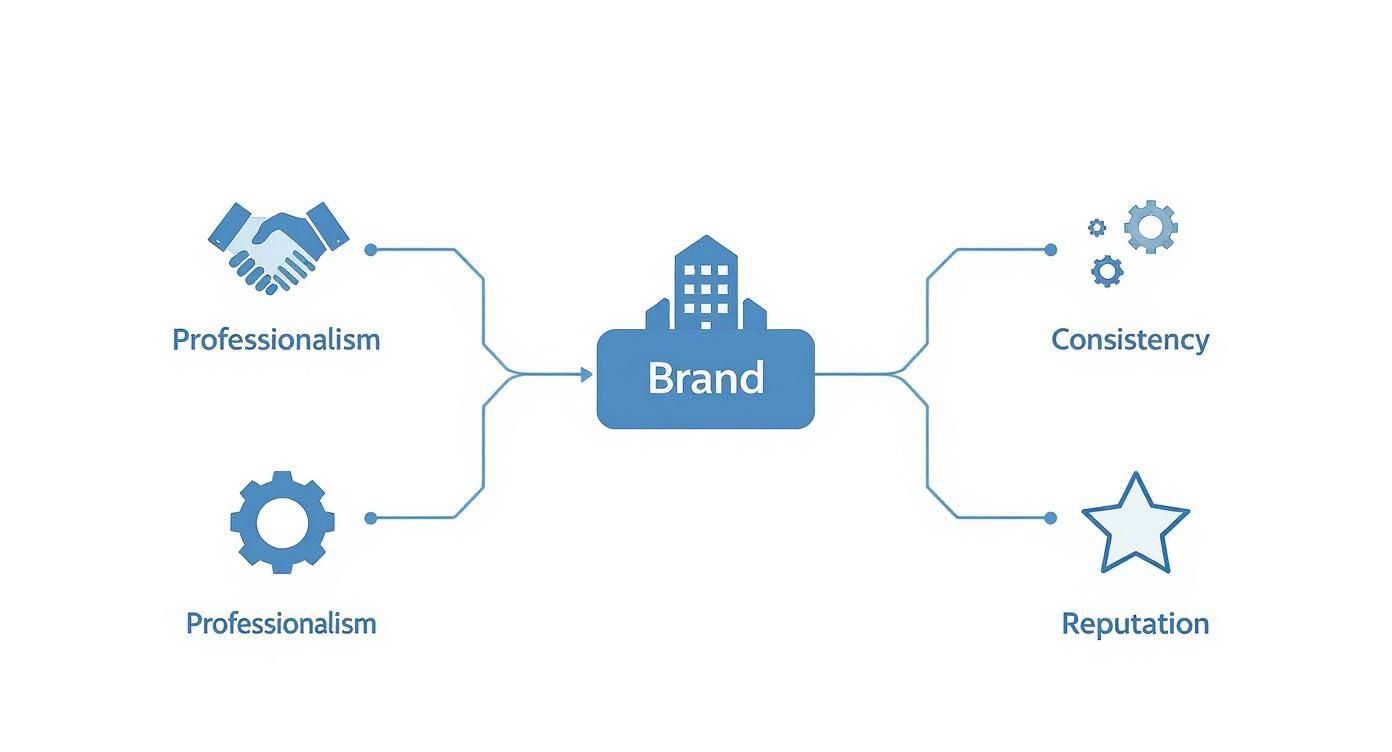
Each element visualised here is measurable, and an RPO partner provides the data to prove and improve your brand’s market perception.
Benchmarking Performance for a Competitive Edge
How does your hiring performance stack up against your direct competitors? Without an external partner, this is nearly impossible to know. RPO providers work across industries and have access to extensive market data, allowing them to provide invaluable benchmarking reports.
This allows you to see if your compensation packages are competitive, if your time-to-fill is lagging behind the industry average, or if your employer brand is attracting top-tier talent. It’s this external perspective that provides the context needed to make truly strategic adjustments.
To explore this further, you can learn more about how RPO providers track and improve recruitment KPIs in our detailed article.
An RPO partnership elevates standard metrics into strategic business insights, as shown below.
Key Performance Indicators Transformed by RPO
| Metric | Traditional Measurement | Strategic Insight from RPO |
|---|---|---|
| Time-to-Fill | Average number of days a role is open. | Identifies specific bottlenecks in the hiring process (e.g., interview stage) and provides market benchmarks for role types. |
| Cost-per-Hire | Total recruitment costs divided by hires. | Analyses channel effectiveness, showing where to invest for better ROI and which sources yield the highest-performing employees. |
| Quality of Hire | Typically measured by first-year performance reviews or retention rates. | Links pre-hire assessment data to on-the-job performance, creating predictive models to identify top candidates from the start. |
| Candidate Satisfaction | Based on post-process surveys (if conducted). | Provides granular feedback at each stage of the candidate journey, highlighting opportunities to improve employer brand. |
This table illustrates the move from simply counting to truly understanding the story behind the numbers.
An RPO partner doesn’t just give you data; they provide a narrative. They connect talent metrics to business outcomes, helping leadership understand how hiring decisions today will impact revenue, innovation, and market position tomorrow.
Ultimately, this data-driven approach empowers CHROs to have more strategic conversations in the boardroom. Instead of just reporting on hiring activity, you can present a clear analysis of future skill gaps, model the workforce needed for a new product launch, and provide a data-backed plan to secure the talent required to win in your market.
Common Questions About Enterprise RPO
Even with all the benefits laid out, it’s completely normal for business leaders to have some very practical questions about how an enterprise RPO partnership actually works. Making the shift from a familiar, in-house model to a deep strategic alliance is a big move. Concerns about control, integration, and what success really looks like are bound to come up.
Let’s tackle these head-on. Answering these common questions is the first step toward building the confidence you need to make the right call for your business.
Will We Lose Control Over Our Hiring Process?
This is easily the number one concern we hear, and the answer is a firm no. A proper Enterprise RPO partnership isn’t about giving up control; it’s about gaining a powerful collaborator. Your organisation is always, without question, in the driver’s seat.
You’re the one setting the high-level talent strategy. You define the cultural fit and what makes a candidate right for your team. And most critically, you always make the final hiring decisions. Your RPO partner’s job is to execute that strategy flawlessly. They bring the specialised tools, proven processes, and expert teams to deliver on your vision—acting as a supercharged extension of your team, not a replacement.
How Is RPO Different from Using Staffing Agencies?
It’s vital to get this distinction right because they operate in completely different worlds. Staffing agencies are transactional, plain and simple. You have an open seat, they fire over some CVs, and you pay a hefty fee if you hire one. It’s a reactive, short-term fix for a single problem.
Enterprise RPO, on the other hand, is a holistic, strategic partnership. Your provider becomes woven into the fabric of your business. They manage the entire recruitment lifecycle with an eye on long-term wins like strengthening your employer brand, upgrading your tech stack, and making every process more efficient. They own the end-to-end journey, not just one hiring transaction.
This strategic depth is what separates a quick fix from a solution that delivers continuous, measurable improvement to your entire talent function.
How Do You Measure the Success of an RPO Partnership?
Success isn’t just a feeling; it’s a set of hard numbers that we agree on from day one. Before any work begins, you and your RPO partner will sit down and hammer out crystal-clear Key Performance Indicators (KPIs) and Service Level Agreements (SLAs).
These aren’t just off-the-shelf metrics. They are tailored specifically to your business goals. Typically, we’re tracking things like:
- Time-to-Fill: How fast are we hiring for critical roles versus standard positions?
- Quality of Hire: This is the big one. We measure it through new hire performance reviews, 90-day and one-year retention rates, and direct feedback from hiring managers.
- Cost-per-Hire: A full analysis to ensure you’re getting maximum value and financial efficiency.
- Hiring Manager and Candidate Satisfaction: Are your internal leaders happy? Are candidates having a great experience? We use regular surveys to keep a pulse on this.
This data-driven approach means you always have transparent, undeniable proof of the value the RPO partnership is bringing to the table.
Ready to transform your talent acquisition from a cost centre into a strategic powerhouse? Taggd provides Enterprise RPO solutions that deliver tangible results in cost, quality, and speed. Discover how we can build a world-class recruitment function for your organisation.