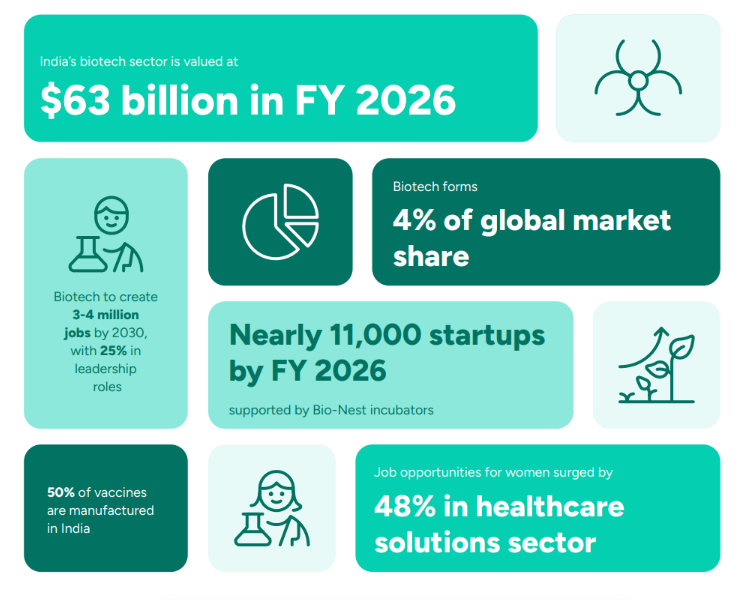
India’s biotechnology sector is entering a high-impact growth phase in FY2026, building strongly on the momentum achieved in FY2025. Valued at nearly US$63 billion, the industry continues to expand steadily, driven by rising contributions to India’s BioEconomy, growing global acceptance of biosimilars, and increased integration of advanced technologies across research and manufacturing. What was once a niche scientific domain has now become a strategic pillar of India’s innovation and employment landscape.
Taggd’s India Decoding Jobs Report 2026 highlights that the hiring momentum in biotechnology is being powered by large-scale investments from industry leaders such as Biocon, expanding international operations, and a vibrant startup ecosystem comprising over 10,000 biotech startups.
Government-backed incubators like Bio-NEST are playing a critical role in nurturing talent, accelerating commercialisation, and bridging the gap between research and industry-ready skills.
As a result, demand is rising not only for core research scientists but also for professionals skilled in regulatory affairs, quality assurance, data analytics, and biomanufacturing.
Geographically, biotech hiring remains concentated in established hubs such as Bengaluru, Hyderabad, and Pune, while Tier 2 cities are rapidly emerging as bio-clusters supported by incubators, academic institutions, and regional innovation policies.
A defining shift in FY2026 is the rise of AI-enabled biotechnology, where organisations are prioritising hybrid roles that combine wet-lab expertise with computational biology, AI-driven drug discovery, and predictive disease analytics.
Supported by initiatives such as the National Biotechnology Development Strategy and targeted incentives for AI integration, India has positioned itself among the top five global biotech innovators, exporting biotech solutions to over 70 countries.
While regulatory evolution and global supply chain volatility present near-term challenges, the sector’s fundamentals remain strong. For talent, investors, and employers alike, India’s biotechnology ecosystem offers sustained, high-value employment opportunities through FY26–27 and beyond. Let’s explore key hiring trends in biotechnology industry.
Region-Wise Biotechnology Ecosystem in India: Major Employers, Clusters & Hiring Challenges
India’s biotechnology industry is expanding through well-defined regional bio-clusters, each contributing uniquely to research, manufacturing, innovation, and employment.
While established hubs continue to dominate biotech jobs in India, emerging regions and government-led initiatives are reshaping the sector’s hiring landscape.

Below is a region-wise breakdown of India’s biotechnology ecosystem:
North India Biotechnology Cluster: Public Health, Biologics & Translational Research
North India plays a strategic role in policy-aligned biotechnology research and public health innovation.
The proximity to central regulatory bodies and national research institutes has driven demand for talent in clinical research, regulatory affairs, translational science, and diagnostics, making the region critical for compliance-heavy biotech roles.
Key Hubs: Delhi NCR, Gurugram (Haryana), Uttar Pradesh
Leading Employers & Institutions: Panacea Biotec, Premas Biotech, Jubilant Life Sciences, NCCS (New Delhi), ICGB
Major Initiatives:
- Translational Health Science & Technology Institute (THSTI)
- NCR Biotech Science Cluster
Core Focus Areas: Diagnostics, biologics, agri-biotech, food biotechnology, stem cell research, public health innovation
South India Biotechnology Hub: Biopharma R&D, Genomics & Start-Up Innovation
South India remains the epicentre of biotech hiring in India, driven by strong R&D infrastructure, startup ecosystems, and global pharmaceutical linkages. Hiring demand is highest for bioprocess engineers, computational biologists, genomics specialists, AI-driven drug discovery experts, and quality professionals.
Key Hubs: Bengaluru, Hyderabad, Chennai
Leading Employers & Institutions: Biocon, Syngene, Bharat Biotech, Dr. Reddy’s, Shantha Biotechnics, MedGenome, IIT Madras Bioincubator
Major Initiatives:
- Bengaluru Bioinnovation Centre (BIC)
- Genome Valley (Hyderabad)
- TICEL Bio Park (Chennai)
- IKP Knowledge Park
Core Focus Areas: Biopharmaceutical R&D, vaccines, genomics, biosimilars, MedTech-Bio convergence, large-scale manufacturing
West India Biotechnology Corridor: Vaccines, Biosimilars & Contract Research
West India is a manufacturing-led biotech powerhouse, supporting India’s global leadership in vaccines and biosimilars. The region offers strong employment opportunities in process development, scale-up manufacturing, quality assurance, regulatory compliance, and supply chain management.
Key Hubs: Mumbai, Pune, Ahmedabad, Vadodara
Leading Employers: Serum Institute of India, Gennova, Reliance Life Sciences, Wockhardt, Zydus Lifesciences
Major Initiatives:
- Pune Biotech Park
- Reliance Life Sciences R&D Campus
- Gujarat Biotech Cluster
Core Focus Areas: Vaccines, biosimilars, fermentation, contract research, bio-agri and food biotechnology
East & Northeast Biotechnology Ecosystem: Industrial Biotech & Talent Incubation
Although smaller in scale, eastern India is emerging as a cost-efficient biotech talent base, particularly for industrial biotechnology, agricultural research, diagnostics, and academic-industry collaboration. Growth here is closely linked to government-led incubation and skill development initiatives.
Key Hubs: Kolkata, Bhubaneswar, Assam
Leading Institutions: Bose Institute, Indian Institute of Chemical Biology (IICB), Assam Biotech Park
Major Initiatives:
- West Bengal Biotech Park
- Assam Biotech Hub
Core Focus Areas: Plant and industrial biotechnology, diagnostics, resource biology, workforce training and incubation
Key Challenges Shaping Biotechnology Hiring in India
Despite strong growth momentum, biotechnology hiring trends in India continue to be shaped by a set of structural and operational challenges. If left unresolved, these issues could limit the creation of high-quality, future-ready biotech jobs, especially beyond established metro clusters.
Below are the key challenges influencing employment across India’s biotechnology sector:
Regulatory complexity and approval delays: Fragmented and time-intensive regulatory processes for GMOs, clinical trials, and bioproduct approvals slow down innovation cycles. This directly delays R&D expansion, manufacturing scale-up, and the creation of new biotech roles.
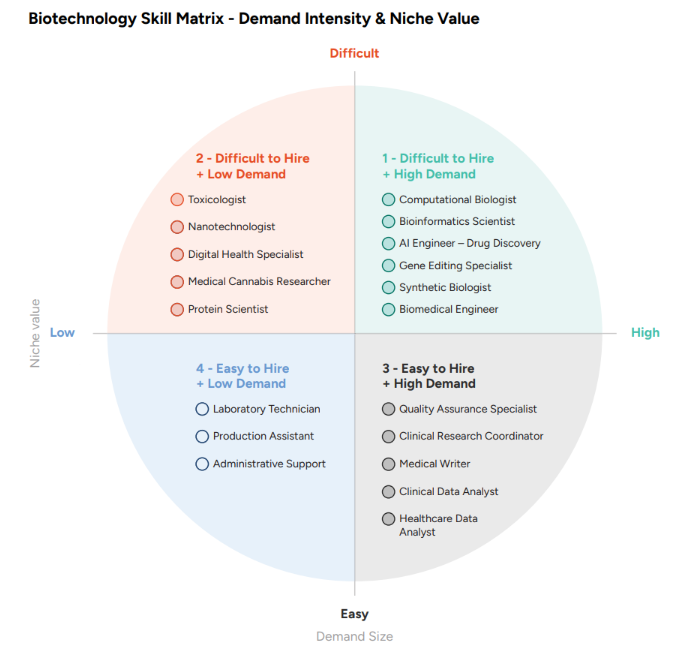
Critical workforce skill gaps: There is a persistent shortage of talent in bioinformatics, synthetic biology, biomanufacturing, regulatory affairs, and AI-enabled biotechnology, restricting hiring for high-value and globally competitive roles.
Regional concentration of biotech jobs: Biotechnology employment remains heavily clustered in states like Karnataka, Telangana, Maharashtra, and Gujarat, limiting inclusive growth and underutilising talent in eastern and northeastern India.
Infrastructure limitations in Tier 2 and Tier 3 cities: The lack of advanced labs, pilot plants, bio-incubators, and digital research infrastructure constrains local hiring and forces companies to centralise talent in major urban hubs.
Global competition and supply chain volatility: Exposure to international competitors and disruptions in global supply chains creates hiring uncertainty, project delays, and fluctuating demand for specialised biotech professionals.
Data management and cybersecurity gaps: As biotech becomes increasingly data-driven, gaps in data integration, IP protection, and cybersecurity impact operational efficiency and drive demand for niche digital-biotech talent that is currently in short supply.
Addressing these challenges through regulatory harmonisation, targeted skill development, regional infrastructure investment, and stronger academia–industry collaboration will be critical to sustaining biotechnology employment growth in India through FY26–27 and beyond. To get deeper insights, download the India Decoding Jobs Report 2026.
Global Biotechnology Hiring Landscape
The global biotechnology industry remains one of the world’s largest knowledge-driven employment engines, even as hiring becomes more selective. By the end of FY2025, the sector employed approximately 13.2 million professionals worldwide, adding nearly 740,000 new jobs during the year.
While this reflects 2.5% annual workforce growth, hiring momentum slowed through 2025 as employers adopted cautious recruitment strategies amid global economic uncertainty.
Global Biotech Employment by the Numbers
- Total global biotech workforce: 13.2 million
- Jobs added in 2025: ~740,000
- Annual employment growth: 2.5%
Despite this moderation, innovation-led biotech sub-sectors continue to drive demand for specialised talent.
High-Growth Biotechnology Segments Driving Global Hiring
While overall hiring has slowed, several high-impact biotech domains are expanding faster than the industry average:
- Precision medicine employs 1.1 million professionals, adding nearly 79,000 jobs in 2025 with a 12.6% growth rate, driven by genomics, targeted therapies, and personalised treatment models.
- Synthetic biology supports around 146,000 workers, growing at 5.2%, with applications across pharmaceuticals, agriculture, and industrial biotech.
- 3D bioprinting, though smaller in scale with 23,200 professionals, recorded the fastest growth at 27.1%, emerging as a frontier in regenerative medicine and advanced biomanufacturing.
These segments are shaping global biotech hiring trends by prioritising niche expertise over volume-based recruitment.
Global Biotech Hiring Hubs and Employer Strategies
Employment remains concentrated in established biotech ecosystems, with the United States, India, the United Kingdom, China, and Germany leading in total workforce strength.
Outside these clusters, job creation slowed markedly in 2025, as many organisations implemented hiring freezes or restricted recruitment to highly specialised roles such as digital bioprocessing and regulatory science.
Global biotech leaders, including Genentech (Roche), Amgen, Novartis, Bayer, and Thermo Fisher Scientific continue to hire selectively for:
- Research & Development
- Clinical operations
- Regulatory affairs
- Digital and automated biomanufacturing
Biotech R&D roles grew by 3.7% in 2025, adding approximately 10,700 jobs, but employers are increasingly cautious about workforce expansion. Notably, remote biotech jobs have declined, with firms preferring talent located near major research and manufacturing clusters to enable collaboration and compliance.
Investment Trends Supporting Biotech Employment
Despite hiring caution, global biotech investment remains strong. Over the past five years, leading investors such as Bayer, ARCH Venture Partners, and OrbiMed have deployed more than US$50 billion into biotech startups and innovation platforms. Key investment-driven hiring themes include:
- AI-driven drug discovery (Exscientia, Insilico Medicine)
- Next-generation vaccines
- Advanced biologics and biomanufacturing
Looking ahead to 2026, global biotech job growth is expected to remain modest but steady, driven by gene therapy, AI-enabled research, and manufacturing scale-up. Expansion will stay regionally concentrated, with hubs like Massachusetts projected to grow up to 32% by 2033.
India’s Biotechnology Workforce: Growth, Scale, and Strategic Gaps
India Decoding Jobs Report 2026 highlights that as of the end of 2025, India’s biotechnology sector employed over 3 lakh professionals, with 15–20% in management and leadership roles.
By 2030, total direct and indirect employment is projected to reach 30–40 lakh jobs, with one in four roles expected to be managerial, signalling a sharp rise in leadership and business-facing positions.
Key Biotech Hiring Markets in India
India’s strongest biotech job markets remain:
- Karnataka (Bengaluru)
- Telangana (Hyderabad)
- Maharashtra (Mumbai–Pune)
- Tamil Nadu (Chennai)
- Delhi NCR
These hubs are supported by biotech parks, favourable state policies, and national initiatives such as BioE3 and the National Biotechnology Development Strategy.
Private Investment Driving Biotech Job Creation in India
Private enterprises continue to anchor biotechnology employment growth:
- Bharat Biotech is investing ₹600 crore in cell and gene therapy expansion, creating specialised R&D and manufacturing roles.
- Shaiva Group and Taranis Capital have committed ₹2,125 crore in Telangana, generating over 5,000 jobs.
- Laurus Labs is setting up a ₹250 crore R&D centre in Hyderabad, expected to employ 800 professionals.
Public institutions and academia continue to support foundational research and training, although workforce expansion remains slower compared to private-sector-led growth.
India’s Global Standing in Biotechnology Talent
By 2025, India ranked as the third-largest biotech ecosystem in Asia and among the top 12 globally, supported by nearly 11,000 biotech startups and contributing 60% of the world’s vaccine supply. While this scale places India ahead of many peers, it still trails Singapore, South Korea, and China in specialised capabilities.
Countries like Singapore and South Korea have accelerated talent development through focused visas, applied research funding, and targeted programmes (e.g., Singapore’s RIE2025 and Korea’s KDDF), particularly in computational biology and gene therapy.
Skill Gaps and the Road Ahead for India
India’s most visible talent shortages persist in:
- Advanced biomanufacturing
- Regulatory affairs
- Bioinformatics and computational biology
These gaps are being addressed through updated university curricula, BIRAC-led incubators, and targeted skilling programmes, but sustained investment and global alignment will be critical.
Within BRICS collaborations, India matches Brazil and China in research output; however, China’s deeper specialist pools and higher capital intensity continue to give it an edge.
What This Means for India: As global biotech hiring standards tighten, India’s opportunity lies in aligning talent quality with international benchmarks, particularly in digital biology, AI-driven research, and regulatory expertise. Done right, this positions India not just as a scale player, but as a global supplier of high-value biotech talent.
Future Hiring Trends in India’s Biotechnology Sector
From FY26 onward, India’s biotechnology employment landscape will enter a more mature and technology-driven phase, shaped primarily by the rise of hybrid skill sets.
The convergence of life sciences, artificial intelligence, automation, and regulatory science will redefine hiring priorities, while policy support and regional expansion will strengthen India’s role in global biotech value chains.
Here are the future hiring trends in India’s biotech market:
Digital and AI-led roles will see accelerated demand. Employers will increasingly hire computational biology engineers, bioinformatics specialists, and AI-driven drug discovery leaders. These professionals will be central to managing large-scale genomics data, building predictive drug-response models, and integrating digital health platforms into R&D workflows. Hands-on expertise in Python, TensorFlow, PyTorch, cloud-based healthcare systems, and automated data pipelines will become critical to delivering speed, accuracy, and scalability in research.
Advanced therapy manufacturing will emerge as a high-growth employment engine. Roles linked to gene therapy, cell therapy, and CRISPR-based innovation are expected to grow faster than traditional biotech functions through FY26–27. Specialists in process development, quality control, and advanced biologics manufacturing will be essential to scaling therapies for both domestic healthcare needs and global clinical trials.
Hybrid scientific–technical profiles will gain strategic importance. Companies will prioritise professionals who combine deep scientific training, such as PhDs in molecular biology or biotechnology with strong IT and software capabilities. Skills in cloud architecture, data integration, and digital workflow optimisation will help bridge laboratory research with real-world, technology-enabled applications.
Regulatory and clinical expertise will remain critical. As next-generation therapies become more complex, hiring will rise in regulatory affairs, clinical trial management, and medical documentation. Professionals who can navigate global compliance frameworks, ensure patient safety, and accelerate approval timelines will play a pivotal role in bringing innovations to market.
Despite strong growth prospects, skill shortages in advanced therapies and digital biotech roles are expected to persist. To address this, organisations are likely to expand investments in structured upskilling programmes, industry–academia collaborations, and continuous learning initiatives, ensuring workforce readiness for the next phase of biotech innovation.
To get deeper insights, data, and projections, download the India Decoding Jobs Report for a comprehensive view of biotech hiring trends, skill demand, and regional growth opportunities shaping FY26–27 and beyond.
Wrapping Up
India’s biotechnology sector is entering a decisive growth phase, where innovation-led hiring, hybrid skills, and global integration will shape workforce demand through FY26–27 and beyond.
While traditional biotech roles remain relevant, the centre of hiring gravity is shifting toward AI-enabled R&D, advanced therapy manufacturing, regulatory science, and digitally fluent scientific talent. Employers that invest early in upskilling, industry–academia partnerships, and regionally balanced hiring will be best positioned to convert sectoral growth into sustainable employment.
With supportive government policies, a strong startup ecosystem, and rising global demand for cost-efficient innovation, India is well placed to emerge as a future-ready biotech talent hub, provided skill gaps and infrastructure disparities are addressed proactively.
FAQs
What are the fastest-growing biotech jobs in India?
The fastest-growing biotech roles in India include computational biologists, bioinformatics specialists, AI-driven drug discovery scientists, regulatory affairs professionals, and advanced therapy manufacturing experts. Jobs linked to gene therapy, cell therapy, and digital bioprocessing are expected to grow faster than traditional biotech roles.
Why are hybrid skills becoming critical in biotech hiring?
Hybrid skills combine life sciences expertise with digital capabilities such as AI, data analytics, and cloud computing. Employers value these profiles because they accelerate R&D, improve operational efficiency, and help translate laboratory research into scalable, real-world solutions.
Which skills will biotech employers prioritise in FY26–27?
Biotech employers will prioritise skills in Python, bioinformatics, machine learning, cloud platforms for healthcare, automation tools, regulatory compliance, and clinical data management, alongside strong scientific foundations in molecular biology and biotechnology.
How is AI influencing biotech recruitment in India?
AI is transforming biotech recruitment by driving demand for roles in AI-led drug discovery, predictive disease modelling, genomics analytics, and automated biomanufacturing. Companies increasingly seek talent that can integrate AI tools into research, manufacturing, and regulatory workflows.
Which regions in India offer the most biotech job opportunities?
Major biotech hiring hubs include Bengaluru, Hyderabad, Pune, Chennai, Mumbai, and Delhi NCR. However, Tier 2 cities are emerging as new talent centres due to biotech parks, incubators, and government-supported innovation clusters.
What are the biggest hiring challenges in India’s biotech sector?
Key hiring challenges include shortages of advanced and digital-ready talent, regulatory complexity, regional imbalance in job creation, infrastructure gaps in smaller cities, and global competition for specialised skills.
What is the long-term outlook for biotech employment in India?
The long-term outlook is strongly positive. India’s biotech workforce is projected to grow significantly by 2030, driven by advanced therapeutics, AI integration, global vaccine and biosimilar demand, and supportive policy frameworks, making biotech one of India’s most future-ready employment sectors.
To get deeper insights into Biotechnology hiring trends, AI-based workforce transformation, and India’s talent demand outlook, download the full India Decoding Jobs 2026 report- complete data, hiring charts, industry forecasts & strategic recommendations.
Download Now- India Decoding Jobs 2026. Explore Taggd for RPO solutions.