Let’s be blunt: the Indian energy sector is experiencing an unprecedented boom. If you’re a CHRO in this space, you’re not just filling jobs you’re assembling the teams that build our nation’s most critical infrastructure. This means blue-collar hiring in energy is no longer a reactive, back-office function. It’s now a core strategic imperative that dictates project success.
Building Your Workforce for Future Energy Demands
Winning in the energy sector means you have to get ahead of the hiring curve. The old model of scrambling to find workers after a contract is signed is a surefire way to invite project delays and eat into your margins. The smartest talent leaders I know have already made the switch to proactive workforce planning, turning what was once a support function into a powerful strategic advantage.
To do this, you have to stop thinking like a traditional recruiter and start thinking like a project strategist. That shift begins by forging direct, open lines of communication with your project and operations managers. Their project pipeline is your hiring roadmap.
From Project Pipelines to People Plans
The real goal here is to translate project specs into a solid staffing model long before a single job requisition is created. This means getting into the weeds and asking the right questions early on.
- For that upcoming solar farm project, what exact skills do we need? Are we talking about technicians certified in module installation, or do we need specialists in inverter maintenance? The difference matters.
- How does the new wind turbine installation affect our current teams? Can we upskill our existing crew, or do we need to hire a completely new team from scratch?
- What’s the projected timeline for each project phase? Knowing this lets you stagger your hiring, so you aren’t paying skilled workers to sit on the bench.
Having these conversations months in advance gives you the foresight to forecast demand for roles like solar technicians, wind turbine operators, and grid maintenance crews. In a market this competitive, that foresight is your single greatest asset.
A proactive workforce plan doesn’t just anticipate demand; it shapes your ability to meet it. It’s the difference between chasing talent and having a pipeline of qualified candidates ready to deploy.
The demand for these blue-collar roles is absolutely surging. A recent study, for instance, found that a staggering 63% of companies in India’s power sector are planning for significant hiring growth, with a heavy focus on the very roles needed to expand our renewable energy infrastructure. This growth is directly tied to India’s ambitious goal of reaching 500 GW of renewable energy capacity by 2030, backed by a massive government investment of Rs. 9.15 lakh crore (US$ 109.50 billion).
Analysing Your Current Skill Matrix
Strategic workforce planning isn’t just about looking outside; it’s about knowing exactly who you have on the inside. Before you even think about posting a job, you need to conduct a thorough skills gap analysis. This is non-negotiable.
Start by mapping out the competencies, certifications, and experience levels of your current blue-collar teams. Compare that internal inventory against the needs of your upcoming projects. Where are the gaps? Maybe you have plenty of general labourers but lack certified high-voltage electricians or welders with specific pipe-fitting experience.
Your workforce model can’t be a one-and-done document. It has to be a living, breathing plan that you adjust as project timelines shift, new technologies emerge, and market conditions change.
This visual breaks down how you move from forecasting to actual workforce modelling.
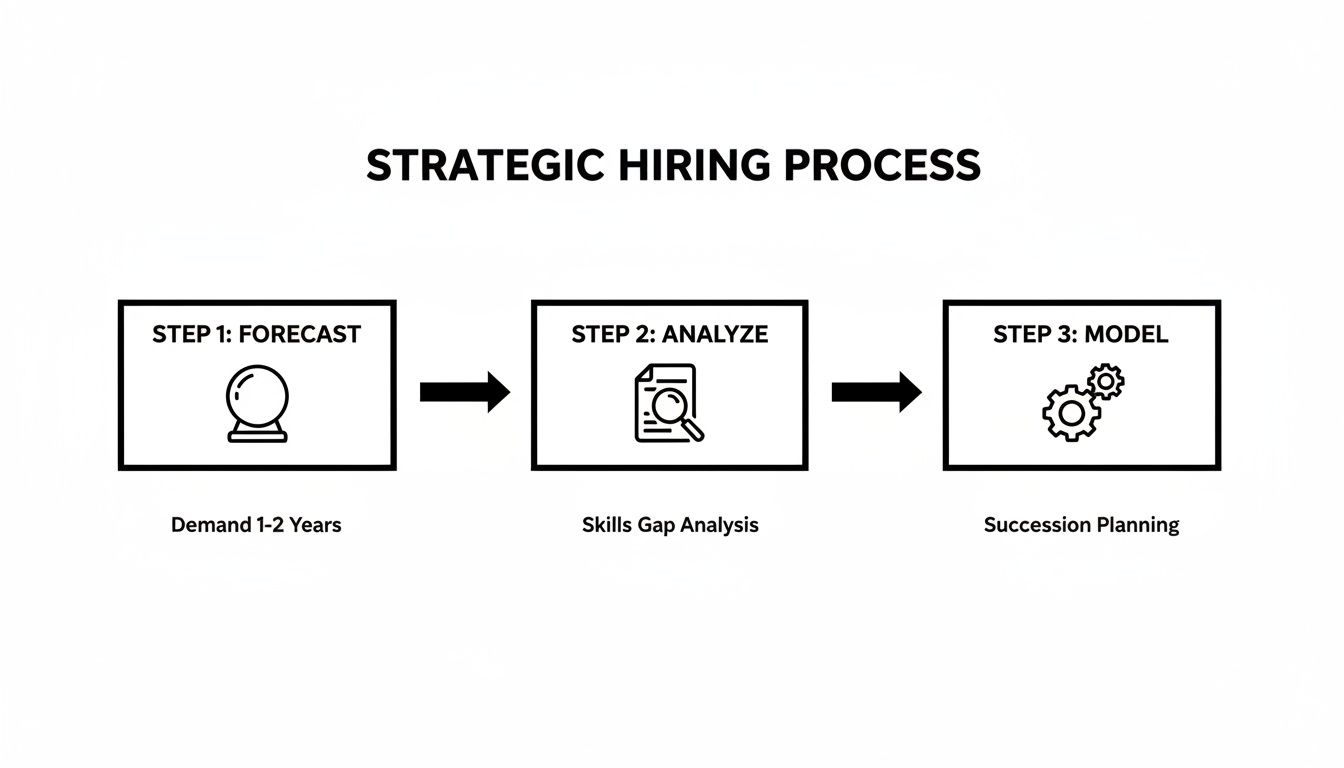
This flow from forecasting demand, to analysing internal skills, and finally modelling your workforce is what allows you to make smart ‘build vs. buy’ decisions. Mastering this playbook transforms talent acquisition from a guessing game into a predictable, scalable engine for growth. You’ll ensure you always have the right people ready for the job not after the project has already started. You can also learn more about the core and energy sector hiring trends to further sharpen your strategy.
Finding and Attracting Top Blue-Collar Talent

In today’s energy sector, simply posting a job on a standard portal and waiting for applications is a losing game. Let’s be honest, every company is fishing from the same over-fished pond. This makes it incredibly difficult to stand out. A reactive approach to blue-collar hiring in energy is a surefire way to end up with project delays and less-than-ideal candidates.
If you want to win, you need a ground-level strategy. This means going where the talent actually is and building relationships long before you even have a job opening. It’s time to move beyond generic sourcing channels and connect directly with skilled tradespeople in their own communities.
Go Beyond Traditional Job Boards
Here’s the reality: your ideal candidates the seasoned welders, electricians, and technicians you desperately need are probably not scrolling through job websites. They find their next gig through their network, local connections, and trusted community sources. Your sourcing strategy has to mirror this.
Instead of pouring your budget into digital ads, focus on building a physical presence and strong local partnerships.
- Forge Alliances with ITIs: Build deep-rooted relationships with Industrial Training Institutes (ITIs) and vocational schools. Don’t just show up for a one-off campus visit. Offer to help shape their curriculum, send your senior technicians as guest lecturers, or donate equipment.
- Engage with Community Groups: In key energy hubs like Vadodara or Jamnagar, local community organisations and panchayats are incredibly influential. Connect with them. These leaders can become powerful advocates for your company, directing talent your way.
- Host Local Hiring Drives: Organise targeted hiring events right near your project sites. These events give you a direct touchpoint with the local workforce, allowing you to assess candidates and build a robust database for future needs.
These proactive steps create a sustainable talent pipeline that is not only qualified but also local, which dramatically cuts down on mobilisation time and costs.
The goal isn’t just to fill a single role; it’s to become the employer of choice within the communities you operate in. When a skilled worker in the area thinks of a great place to work, your company name should be the first one that comes to mind.
Craft Job Descriptions That Sell a Mission
Think of your job description as a marketing document, not a legal one. A dry list of duties and requirements will get you nowhere, especially when you’re competing against manufacturing, construction, and other industries for the same limited talent pool.
Your job descriptions must sell a mission. Instead of saying, “Installs and maintains solar panels,” reframe it as, “Join a team building India’s green future and powering communities with clean energy.” This connects the day-to-day tasks to a larger, more inspiring purpose.
Focus on what makes the job rewarding beyond the paycheque.
- Highlight Career Growth: Can a technician become a site supervisor or a team lead? Show them the path.
- Emphasise Safety: This is a major concern for workers in this field. Detail your commitment to world-class safety protocols and providing the best equipment.
- Showcase Stability: The energy sector can offer long-term career stability that other project-based industries can’t. Make this a key selling point.
This mission-driven approach attracts candidates who are looking for more than just a job, they’re looking for a career they can be passionate about. If you’re tackling many roles at once, you might find our guide on high-volume hiring strategies useful for more ideas.
Turn Your Workforce into Your Best Recruiters
Your most credible and effective recruitment channel? Your current employees. They know the job, they understand the culture, and they know what it takes to succeed. A well-designed employee referral programme can be your secret weapon for finding top-tier blue-collar talent.
For it to work, the programme needs to be simple, transparent, and rewarding.
- Offer Meaningful Incentives: A small bonus just won’t cut it. The reward has to be significant enough to truly motivate participation. Think bigger.
- Make Referrals Easy: Create a dead-simple process for employees to submit referrals. This could be a mobile app, a simple online form, or even just a dedicated contact person.
- Communicate Constantly: Keep your employees in the loop. Acknowledge every single submission and make sure to celebrate successful hires publicly.
By activating your internal network, you tap into a pre-vetted pool of candidates who are far more likely to be a good cultural fit and stay with you for the long haul. This approach effectively turns every employee into a brand ambassador, expanding your reach far beyond what any traditional recruitment team could ever achieve alone.
How to Validate Skills and Ensure On-Site Safety

In the high-stakes world of energy, a bad hire isn’t just about lost productivity, it’s a direct threat to your entire operation. For blue-collar roles, confirming what a candidate says they can do versus what they can actually do safely is the single most critical stage of your hiring process. A polished resume can’t tell you if a technician will panic under pressure or decide to cut corners on a safety check.
This is the point where you must move beyond interviews and into practical, real-world assessments. Your goal is to build a screening process that rigorously tests both technical competence and an unshakeable commitment to safety. This isn’t about ticking boxes; it’s about building a culture of safety from the very first interaction with a potential hire.
Designing Hands-On Skill Assessments
Theoretical knowledge is fine, but performance in the field is everything. Your skill validation needs to mirror the real-world challenges your teams face daily. Think of it as a live dress rehearsal for the job itself.
Instead of a simple Q&A, you need to create practical tests that simulate on-site conditions. These assessments should be specifically designed to evaluate a candidate’s problem-solving skills, technical precision, and adherence to safety protocols, all while under a bit of realistic pressure.
Here are a few ways to bring this to life:
- For an Electrical Technician: Give them a faulty control panel and a wiring diagram. The task? Identify the fault and safely repair it within a set timeframe. This directly tests their diagnostic skills, knowledge of electrical codes, and proper lockout/tagout procedures.
- For a Welder: Require the candidate to perform a specific type of weld common on your projects, like a 6G pipe weld. This gives you a tangible piece of work you can physically inspect for quality, consistency, and integrity.
- For a Wind Turbine Technician: Use a simulator or a ground-level training nacelle to have them walk through a standard maintenance checklist or a simulated fault-clearing procedure.
These hands-on tests provide undeniable proof of capability, something a certification or resume simply can’t offer on its own.
Probing for a True Safety Mindset
A candidate can memorise every safety rule in the manual, but it’s their behaviour under pressure that truly reveals their commitment. You have to dig deeper than asking, “Are you committed to safety?” and use behavioural questions that uncover their actual instincts and attitudes.
These questions force candidates to recall past experiences, offering you a crucial glimpse into their real-world decision-making process.
Try asking questions like these:
- “Tell me about a time you noticed a coworker ignoring a critical safety procedure. What did you do?”
- “Describe a situation where you were under pressure to finish a job quickly, but you felt the conditions were unsafe. How did you handle it?”
- “Walk me through an instance where you had to stop a job due to a safety concern. What was the issue, and what was the outcome?”
The answers you get are incredibly revealing. You aren’t just listening for the “right” answer; you’re looking for a sense of ownership, accountability, and the courage to prioritise safety over speed.
A candidate who boasts about “getting the job done no matter what” is a walking red flag. The ideal hire is the one who can tell you about a time they stopped the job to ensure it was done right and done safely.
Navigating Essential Certifications
While hands-on tests are paramount, formal certifications serve as the foundational layer of compliance and standardised knowledge in India’s energy sector. For many critical roles, they are the non-negotiable entry ticket. Your HR and compliance teams must become experts in this complex web of requirements.
You need to create a clear matrix that maps required certifications to specific job roles. Here is a breakdown of some key blue-collar positions in the energy sector and the most effective methods for assessing their core competencies during the hiring process.
Essential Blue-Collar Roles and Key Skill Validation Methods in Energy
| Blue-Collar Role | Primary Skill Set | Recommended Validation Method |
|---|---|---|
| Solar Panel Technician | Module installation, inverter maintenance, DC/AC wiring | Hands-on test: Correctly wire a small-scale solar array and troubleshoot a simulated inverter fault. |
| Wind Turbine Technician | Mechanical/electrical maintenance, hydraulic systems, working at heights | Simulator test: Fault diagnosis procedure. Practical test: Correct use of fall arrest systems and safety gear. |
| Substation Electrician | High-voltage switching, transformer maintenance, relay testing | Behavioural interview: “Describe your steps before isolating a high-voltage circuit.” Plus, certification verification. |
| Pipeline Welder | API 1104 standard welding, pipe fitting, radiographic test knowledge | Practical test: Perform a 6G position weld on a sample pipe, followed by a visual inspection. |
Verifying these certifications is just the first step. For critical roles, always confirm the legitimacy of the issuing body and check for expiry dates. This diligence in both practical assessment and compliance is the cornerstone of effective blue collar hiring in energy. It’s how you ensure you’re building a workforce that is not only skilled but, above all, safe.
Designing Competitive Pay and Retention Programmes
In the energy sector’s high-stakes game of blue-collar hiring, skilled workers hold the best cards. With demand far outstripping supply, they can afford to be selective. As a talent leader, your job isn’t just about finding these professionals; it’s about giving them a compelling reason to choose you and, even more critically, a reason to stay.
Simply being the highest bidder is a short-term fix, not a sustainable strategy. What you need is a smarter approach one that blends competitive pay with the kind of non-monetary benefits that build a career, not just fill a role for a project or two.
Benchmarking Your Compensation Effectively
First things first: you have to know what the market is actually paying. The landscape for skilled blue-collar talent is shifting constantly. Relying on last year’s salary bands is a surefire way to lose your best candidates to a competitor who’s done their homework.
The data tells a clear story. Across India, blue-collar wages in critical sectors like manufacturing and metals—which are closely tied to energy projects are climbing by a steady 5-6% annually. This is no surprise when you see the projected 10% jump in hiring intent for these roles by 2026.
But here’s the interesting part: only about 2.3% of these jobs pay over Rs 60,000 per month, a figure typically reserved for highly specialised energy technicians. This creates a massive opportunity for companies willing to pay competitively to attract the cream of the crop.
To get your benchmarking right:
- Run regular market analysis: Don’t just do this once a year. Check compensation data every quarter, drilling down into the specific roles and regions where your projects are active.
- Account for skill premiums: A certified high-voltage electrician and a general labourer are not the same. Your pay scales must be granular enough to reflect differences in skills, certifications, and hands-on experience.
- Use project-based incentives smartly: For a critical project with a tight deadline, a performance bonus can work wonders. It’s a powerful motivator that doesn’t permanently inflate your base salary structure.
Beyond the Paycheque: Building a Culture of Retention
While a good salary gets a candidate’s attention, it’s the non-monetary benefits that make them want to build a career with you. For the blue-collar workforce, this often comes down to three things: stability, growth, and safety. They need to see a real future at your company.
A higher salary might attract a worker for a single project, but a clear career path, funded training, and a genuine commitment to their well-being will earn you their loyalty for years to come.
This is where you can truly stand out from the crowd. It’s about creating an environment that proves you are invested in your people’s long-term success, not just their output on the current job. These aren’t just nice-to-haves; they are the bedrock of a retention strategy that actually works.
Tangible Benefits That Truly Matter
To build a value proposition that’s impossible to ignore, weave these practical benefits into your retention programme.
Visible Career Pathways A worker on the ground needs to see a clear line of sight from their current role to a supervisor position and beyond. Map it out for them. Show them what their career could look like in three, five, or even ten years. A formal mentorship programme, where senior technicians guide new hires, makes this path feel tangible and achievable.
Funded Upskilling Opportunities The energy sector never stands still, and neither do the skills required to succeed in it. You should be the one offering and, crucially, paying for your team to get new certifications or train on new technologies. It not only future-proofs your workforce but also sends a powerful message that you believe in their growth.
World-Class Safety Programmes In this line of work, safety is everything. Go far beyond basic compliance. Invest in the absolute best personal protective equipment (PPE), run rigorous and frequent safety training, and build a culture where every single person feels empowered to call a stop to work if they spot a hazard. This shows, through action, that you value their lives above all else.
By designing a holistic programme that combines fair pay with these powerful, non-monetary incentives, you create a workplace that doesn’t just attract the best talent, it keeps them. For a deeper dive into this topic, you might be interested in our comprehensive guide on powerful employee retention strategies.
Getting New Hires Onboarded and Up to Speed
The time between a new hire signing their offer letter and actually becoming a productive employee can feel like a lifetime. For blue-collar jobs in the energy sector, getting onboarding right is about so much more than just handling paperwork and sending a welcome email.
It’s the crucial process that turns a fresh recruit into a confident, safe, and effective team member from their very first day. A shaky onboarding experience doesn’t just delay productivity, it creates confusion, heightens safety risks, and is a major reason for early exits.
A solid onboarding programme is your first real chance to prove that everything you talked about during recruitment was genuine. This is where you demonstrate that your commitment to safety, career development, and employee welfare is more than just words on a poster. It’s how you build loyalty and cut down on attrition from the get-go.
From Tool Belts to Formal Benefits
We’re seeing a massive shift in how blue-collar roles in the energy industry are structured. The move away from informal, cash-in-hand arrangements towards a more organised, formal workforce is picking up serious speed. This isn’t just a fleeting trend; it’s a strategic necessity for any company serious about attracting and keeping top-tier talent.
This formalisation is clear in the wider economic data. India’s energy sector is experiencing a huge surge in formal employment growth, with over 1.29 crore net subscribers added to the Employees’ Provident Fund Organisation (EPFO) in 2025–26.
Think about this: in July 2026 alone, 9.79 lakh new subscribers came on board. A staggering 60% of them were aged 18-25, many of whom are starting their careers in blue-collar roles thanks to new energy projects.
Bringing new hires into the formal economy by enrolling them in provident funds (PF) and Employees’ State Insurance (ESI) is no longer a perk. It’s now a fundamental part of being a responsible, top-tier employer. It sends a clear message that you’re invested in their long-term financial security, which is a massive advantage in today’s competitive job market.
Onboarding is your chance to show, not just tell, new hires that they are joining a company that values their long-term well-being. Seamlessly integrating them into formal benefits like PF and ESI from day one builds immediate trust and loyalty.
Structuring a World-Class Onboarding Experience
A truly effective onboarding plan for blue-collar staff has to be practical, hands-on, and tailored to the specific site. The goal is to build both confidence and competence. A generic corporate presentation just won’t work when the job involves handling high-voltage equipment or working at dangerous heights.
Your plan should focus on practical training that makes new hires feel capable and secure right away.
Day One and Week One Focus:
- Site-Specific Safety Orientation: This needs to be more than a standard safety video. It should be a guided tour of the actual worksite, led by an experienced safety officer. They should point out specific hazards, explain emergency protocols, and show the location of all safety equipment.
- Hands-On Tool and Equipment Training: Never assume prior knowledge. Every single new hire, no matter their experience level, must demonstrate they can safely and proficiently use the exact tools and machinery required for their job. This isn’t about catching them out; it’s about ensuring everyone operates at the same high standard of safety.
- Pairing with a Mentor or “Buddy”: Assign each new hire to a seasoned veteran for their first couple of weeks. This buddy system gives them a trusted person to ask questions, helps them fit into the team culture, and ensures they learn the unwritten rules of the job site in a supportive environment.
This structured, hands-on approach takes the mystery out of the role and the workplace. It dramatically cuts down on the anxiety that so often leads to early mistakes or people quitting.
By turning your onboarding from a simple administrative task into a strategic integration programme, you achieve several critical goals. You reinforce your safety-first culture, get new hires productive faster, and show a real commitment to their careers. This reputation as an employer who invests in their people will become a powerful magnet for the best blue-collar talent, giving you a clear advantage in the competitive energy sector.
Common Questions on Energy Sector Hiring
Even with a solid playbook for blue-collar hiring in energy sector, you’re bound to run into some tough questions. Believe me, you’re not the first to ask them. We see the same challenges pop up time and again with CHROs and talent leaders across India’s booming energy industry.
Let’s cut through the noise and tackle some of the most common queries with direct, practical answers you can put to use right away.
How Do We Compete for Talent Against Other Industries?
You can’t always win on salary alone, especially when competing with the immediate cash appeal of manufacturing or construction. Your winning move is to offer something more meaningful: a clear, compelling mission. These aren’t just jobs; they’re a chance for workers to be on the front lines of building India’s green energy future. This has to be the heart of your employer value proposition (EVP).
Of course, your pay must be competitive. But your real edge comes from showcasing what other sectors can’t match:
- Long-Term Career Stability: The energy sector is expanding rapidly, offering a level of job security that short-term, project-based construction work simply can’t promise.
- Superior Safety Programmes: Go beyond just compliance. Emphasise your deep investment in top-tier safety gear and a culture where every worker’s well-being is genuinely the top priority.
- Clear Upskilling Paths: Don’t just talk about career growth; map it out. Show candidates exactly how a technician today can become a site supervisor in a few years.
When you frame your offer this way, the conversation shifts from a simple wage comparison to a much more powerful discussion about building a sustainable, long-term career.
Should We Hire Experienced Workers or Train New Talent?
This is a classic “buy vs. build” dilemma, but I’ve found it’s a false choice. A truly resilient workforce strategy requires you to do both, simultaneously. You absolutely need to ‘buy’ experienced talent for your immediate, critical needs. This means making aggressive, competitive offers to attract proven professionals who can get your projects running without delay.
At the same time, you must ‘build’ your own talent pipeline. This is your best defence against future skill shortages and the ever-rising cost of labour.
The “buy vs. build” question isn’t an either/or. The only sustainable path is to do both. You have to secure top talent for today while actively cultivating your workforce for tomorrow.
How do you do this? Forge deep, meaningful partnerships with local Industrial Training Institutes (ITIs). Go beyond the annual job fair. Work with them to co-design a curriculum that feeds directly into your project requirements. Then, launch a formal apprenticeship programme where your seasoned veterans mentor new hires on the job. This dual approach secures the skills you need now while creating a loyal, skilled, and cost-effective workforce for the future.
What KPIs Truly Matter for Blue-Collar Hiring?
It’s time to look past standard metrics like ‘time-to-fill’. Speed is a factor, but in the energy sector, the most revealing Key Performance Indicators (KPIs) are the ones tied directly to on-site safety and operational outcomes. These tell you about the quality of your hiring, not just the speed.
We advise our partners to focus their dashboards on these four critical KPIs:
- Safety Incident Rate for New Hires: Track this specifically within their first 90 days. A high rate is a red flag, pointing to potential gaps in your safety screening or onboarding process.
- First-Year Attrition Rate: This is the ultimate test of your retention strategy. If new hires are leaving within a year, it signals a mismatch between what was promised and the reality of the job.
- Skill Validation Pass Rate: How many candidates who pass your initial screening also pass the hands-on skill validation test? A low rate means your sourcing channels are bringing in the wrong people, wasting valuable time and resources.
- Time-to-Productivity: How long does it take for a new hire to become a fully contributing, independent member of the team? A shorter timeframe is a direct reflection of effective onboarding and training.
These performance-focused metrics give you a true, real-time picture of how your recruitment process is impacting safety, quality, and your bottom line.
Ready to build a world-class blue-collar workforce for your next energy project? Taggd specialises in high-volume Recruitment Process Outsourcing (RPO) for the energy sector. We help you find, screen, and onboard the skilled talent you need, faster. Discover how we can help you scale your team at Taggd.