To tackle the talent crunch in compliance and regulation, CHROs need a strategy that hits from all sides. It’s about figuring out exactly which skills you’re missing, growing your own experts through smart upskilling, and getting creative with how you find and attract these hard-to-find professionals. For many, bringing in a specialised recruitment partner like an RPO is the game-changer for building a truly resilient compliance team.
The Real Cost of an Empty Compliance Seat
That empty chair in your compliance department is more than just a hiring headache; it’s a ticking time bomb for the business. As a CHRO, you know an unfilled regulatory role isn’t just an empty desk it’s a potential epicentre for crippling financial penalties, brand damage, and stalled growth. Suddenly, a simple hiring problem morphs into a core operational risk that belongs in the boardroom.
This isn’t just happening in a few companies; it’s a full-blown crisis. A staggering 80% of Indian employers are struggling with serious talent shortages, a number that hasn’t budged for three years. It’s even worse in high-stakes sectors like IT and healthcare where regulatory scrutiny is relentless. For CHROs, this reality creates recruitment bottlenecks that jam up business growth a massive problem when India is seeing a world-leading 53% hiring demand.
These compliance roles, which are critical for navigating the maze of laws from RBI, SEBI, and data privacy acts, are consistently some of the toughest positions to fill.
Framing the Talent Gap as an Operational Risk
When a key compliance role sits empty, the fallout doesn’t stay contained. The ripples spread across the entire organisation:
- Financial Penalties: Let’s be clear, regulatory bodies don’t give you a pass for being short-staffed. One slip-up in reporting or adherence can lead to fines that hit the bottom line hard.
- Reputational Damage: Compliance failures rarely stay private. When they go public, they destroy the trust you’ve built with customers, investors, and partners. Winning that trust back is a long, expensive road.
- Stalled Growth: That new product you’re excited about? The new market you want to enter? Without the right regulatory sign-offs and oversight, those strategic plans can be stuck in neutral indefinitely.
- Increased Workload and Burnout: Your existing team ends up picking up the slack. They’re stretched thin, trying to cover the responsibilities of the vacant roles, which inevitably leads to burnout, lower-quality work, and a higher chance they’ll start looking elsewhere.
The true risk of a compliance talent shortage isn’t just the potential for fines; it’s the opportunity cost. It’s the new market you couldn’t enter, the product you couldn’t launch, and the top talent you couldn’t retain because your foundation wasn’t secure.
This guide is your practical playbook for tackling this challenge head-on. We’ll walk through how to accurately diagnose your skills gap, build a solid internal talent pipeline, modernise your sourcing strategies, and use strategic partnerships to your advantage. For those looking for specialised help, understanding the landscape of legal and compliance recruitment is the perfect place to start. By taking these steps, you can shift your compliance function from a reactive cost centre to a proactive, resilient, and genuinely strategic asset for the business.
Mapping Your True Compliance Talent Deficit
Before you can fix your compliance talent shortage, you first need to get a handle on its actual size and shape. Just looking at headcount shows you the empty seats, but the real risk? It’s buried in the specific, unseen skill gaps within your existing team. It’s not just about who you’re missing, but what critical capabilities you lack.
Moving past a simple headcount means you’ve got to do a deep-dive talent audit. This is all about methodically mapping your current team’s skills against the compliance challenges you know are coming down the line. We have to look past job titles and get to the heart of true competencies.
This flow shows the direct line from a talent shortage to serious operational risk, which really underscores why having a clear strategy isn’t just a nice-to-have.
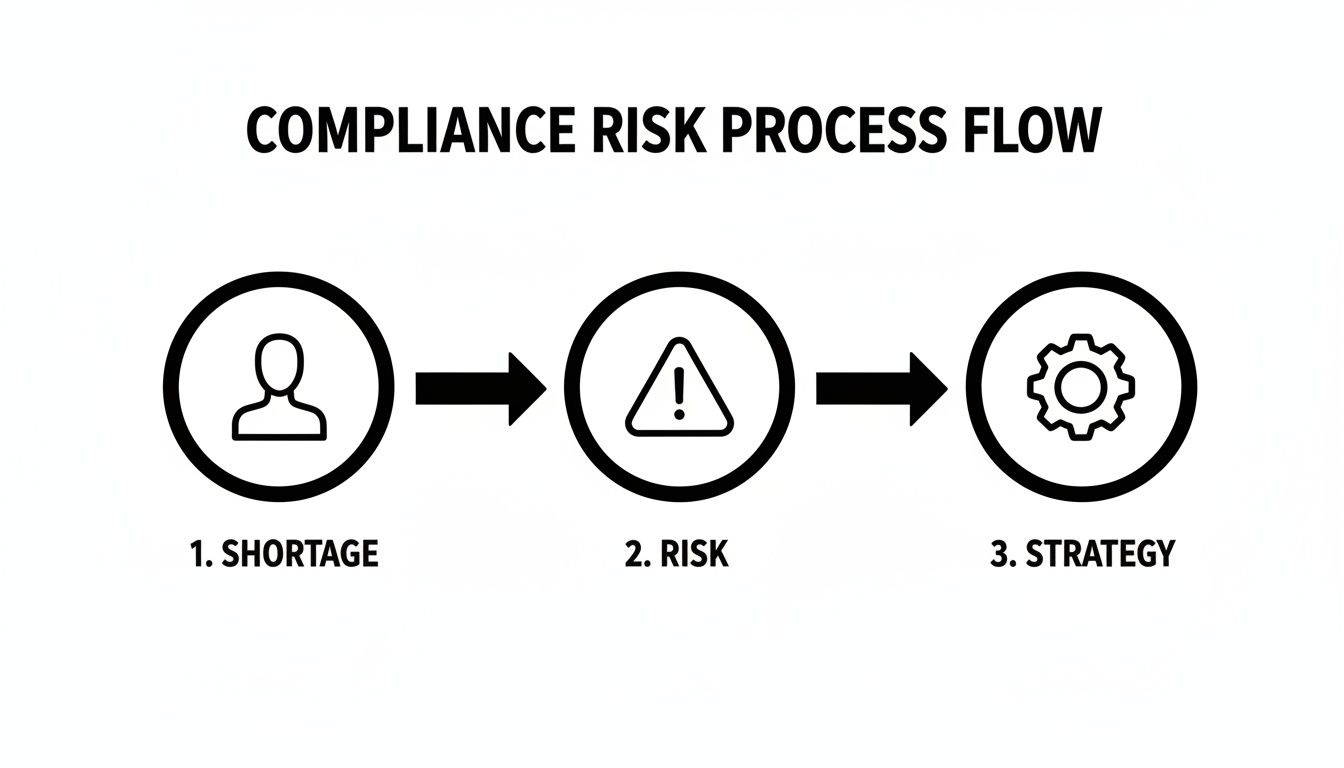
As you can see, failing to address the talent gap directly exposes the organisation to significant threats. A proactive strategy becomes non-negotiable.
Looking Beyond the Obvious Gaps
The most dangerous deficits are often the ones that don’t show up on an org chart. For instance, your team might be fully staffed, but maybe no one has hands-on experience implementing a RegTech platform for automated monitoring. Or perhaps the team is brilliant with domestic regulations, but you lack the cross-border knowledge needed for the company’s planned expansion.
These hidden gaps are where you’re truly vulnerable. Upcoming legislation like the Digital Personal Data Protection Act (DPDPA) or new ESG reporting standards from SEBI demand entirely new skill sets. A team that was perfect for yesterday’s rules might be completely unprepared for the complexities of tomorrow.
A full compliance team doesn’t equal a capable one. The real measure of strength is having the specific skills required to meet future regulatory demands, not just current ones.
To really uncover these deficits, you need a structured approach. A great place to start is by getting in a room with your legal, operations, and business unit leaders to forecast what regulatory pressures are on the horizon. What new markets are we entering? What new products are being developed? The answers will tell you exactly what skills you’re going to need.
Creating Your Compliance Talent Heat Map
To make this audit concrete, a skills matrix is an essential tool. It lets you systematically evaluate each person on your team against a list of critical competencies, both for today and tomorrow. This data-driven process takes the guesswork out of it and shines a light on your most urgent priorities.
You’ll want to build your matrix around a few key competency areas:
- Specific Regulatory Knowledge: Expertise in areas like DPDPA, FEMA, SEBI guidelines, and any industry-specific rules.
- Technological Proficiency: Experience with RegTech, GRC (Governance, Risk, and Compliance) software like SAP GRC, and data analytics tools.
- Cross-Functional Skills: Abilities in project management, stakeholder communication, and conducting internal investigations.
- Strategic Abilities: Skills in risk assessment, policy development, and providing sharp, strategic advice to business leaders.
A skills gap analysis is a fantastic way to structure this. It helps you systematically pinpoint where your team stands today versus where they need to be.
Compliance Skills Gap Analysis Framework
| Regulatory Domain | Current Team Competency (1-5) | Future Importance (1-5) | Identified Skill Gap | Action Priority (High/Med/Low) |
|---|---|---|---|---|
| Digital Personal Data Protection Act (DPDPA) | 2 | 5 | Data privacy law, consent mgt. | High |
| ESG Reporting (SEBI BRSR) | 1 | 5 | Sustainability metrics, reporting frameworks | High |
| Cross-Border FEMA Compliance | 3 | 4 | International transaction regulations | Medium |
| RegTech Platform Implementation | 2 | 4 | System configuration, workflow automation | Medium |
| Anti-Money Laundering (AML) Analytics | 4 | 5 | Advanced data analysis, pattern recognition | Low |
This framework gives you a clear, data-backed view of your most critical needs, turning a vague problem into a prioritised action plan.
Once you’ve gathered this data, you can build a ‘heat map’. This is just a simple visual that highlights where your talent risks are most severe, your “red zones.” For example, if you rate your team’s competency in ESG reporting as a 1 out of 5 but its future importance is a 5, you’ve just identified a critical, high-priority gap.
This heat map becomes your strategic playbook. It gives you a data-backed, prioritised list of roles and skills that need immediate attention. It tells you exactly where to focus your efforts, whether that means targeted upskilling for your current team or kicking off a search for new talent with very specific expertise.
This kind of proactive diagnosis shifts your whole approach from reactive hiring to strategic talent management. You’ll no longer be just filling empty seats; you’ll be building a resilient compliance function that’s ready for whatever comes next.
Building a Resilient Internal Talent Pipeline
The answer to the compliance talent crunch might not be out there in the market. It could be sitting just a few desks away, in your finance, legal, or audit departments.
Instead of getting pulled into a frantic, expensive war for external hires, the most sustainable strategy is to cultivate expertise from within. This isn’t just about offering a few training courses. It’s about building dedicated career paths that turn your high-potential employees into the next generation of compliance leaders.
Shifting your focus inwards isn’t a defensive move; it’s a powerful investment in your people. It builds loyalty, retains critical institutional knowledge, and creates a more resilient compliance function that’s perfectly tailored to your organisation’s unique regulatory landscape.

This ‘grow-your-own’ approach also directly addresses a major market gap. The India Skills Report found that while 54.81% of graduates are considered employable, very few are ready for specialised compliance roles straight out of university.
And we can’t rely on external initiatives alone. With government skilling programmes seeing apprenticeship dropout rates as high as 35%, the responsibility falls to us, the CHROs. This is especially true when you consider that 76% of organisations anticipate shortages in skills like application development, the very foundation of modern RegTech tools. You can get more context on India’s skilling challenges on this page.
Identifying Your Future Compliance Experts
The first move is to scout for talent in adjacent fields. You’re looking for people with the right aptitude and foundational skills, the traits that are much harder to teach than the regulations themselves.
Keep an eye out for these prime candidates for development:
- Analytical Thinkers in Finance: That sharp financial analyst who’s a wizard at dissecting complex data? They’re perfectly positioned to become a fintech or anti-money laundering (AML) compliance expert. Their comfort with numbers and detail-oriented mindset are directly transferable.
- Methodical Auditors: Internal auditors already have a deep understanding of your business processes and controls. They’re naturals at spotting risk and are often just a few steps away from becoming excellent operational compliance managers.
- Detail-Oriented Legal Professionals: Paralegals or junior legal staff bring a strong foundation in legal frameworks and meticulous documentation. With focused training, they can easily pivot into roles specialising in data privacy or contract compliance.
Once you’ve pinpointed these high-potential individuals, map out a clear career path for them. Show them exactly how they can get from their current role into the compliance function. That visibility is everything for getting their buy-in and keeping them motivated.
Crafting Customised Learning and Development Pathways
Generic, off-the-shelf training programmes just won’t cut it for specialised regulatory topics. To truly upskill your internal talent, you need to create bespoke learning modules that speak directly to your industry’s specific challenges.
A powerful learning pathway should blend a few key approaches:
- Technical Skill Modules: Develop focused workshops on complex and emerging topics like ESG reporting standards, the Digital Personal Data Protection Act (DPDPA), or the nuances of cross-border transactions under FEMA.
- Practical Application Projects: Nothing teaches like doing. Assign mentees to shadow senior compliance officers on real projects, whether that’s participating in an internal investigation, helping draft a new policy, or assisting with a regulatory audit.
- Cross-Functional Rotations: Arrange for your developing talent to spend time in different business units. This gives them invaluable context on how compliance policies actually impact daily operations, making them far more effective partners to the business down the line.
Mentorship is the accelerator for internal development. Pairing a senior compliance expert with an emerging talent doesn’t just transfer knowledge; it transfers wisdom, context, and the subtle art of navigating complex organisational politics.
This structured approach ensures you’re not just filling a seat, but building a genuinely capable professional who understands your business from the inside out. It also sparks a positive cycle of growth within the organisation. For a deeper dive, check out our guide on creating effective internal mobility programs.
Think about a mid-sized financial services firm that was struggling to hire a specialist in digital payment compliance. Instead of continuing a fruitless external search, the CHRO identified a bright financial analyst who had shown a real interest in technology.
Here’s the customised development plan they put in place:
- Sponsored Certification: The analyst completed a professional certification in payment compliance.
- Mentorship: They were paired with the Head of Compliance for weekly one-on-one coaching.
- Project Leadership: They were given the lead on a small project to review the compliance framework for a new mobile payment feature.
Within a year, that analyst had successfully transitioned into a full-fledged fintech compliance specialist. The company saved months of recruitment time and the significant cost of an external hire. That’s the power of building your talent from within.
Innovating Your External Sourcing Strategy
When your internal talent pool is tapped out and you absolutely have to hire externally, don’t even think about just posting to a job board. In a market this tight, that’s like whispering into a hurricane. The pool of skilled compliance professionals is incredibly shallow, and your standard-issue job ad will simply get lost in the noise.
To have any chance of success, you need a modern, laser-focused sourcing strategy. This means actively hunting for the experts you need, not just passively waiting for them to find you. You’ve got to move beyond reactive hiring and start building a proactive talent pipeline. The goal here is to be in conversation with top-tier regulatory professionals long before you even have an open job requisition. This shifts recruitment from a last-minute panic into a smooth, continuous strategic function.
Proactively Building Your Talent Pipeline
A proactive pipeline is all about relationships. It’s about identifying and getting involved in the niche professional networks where real compliance experts live and breathe. Forget the massive, generic platforms. You need to be in specific forums, industry-specific webinar series, and specialised legal or audit associations.
The secret is to give before you get. Share genuinely insightful content, jump into discussions about new regulations, and position your company’s leaders as true thought leaders in the ethical and regulatory space. This doesn’t just build brand recognition; it cements your organisation as a place where people who are serious about compliance actually want to work.
The best compliance candidates are almost never actively looking. You won’t find them scrolling through job boards. You’ll find them in conversations, professional groups, and peer networks. Building a pipeline means joining those conversations.
This forward-thinking approach is more critical than ever. The demand for compliance talent is exploding, yet the National Skill Development Corporation (NSDC) reports that nearly 50% of Indian graduates are unemployable in the knowledge economy because of skill deficits. This gap is particularly painful for compliance roles that require a deep understanding of complex laws like the DPDPA.
With a staggering 81% of organisations facing tech skills shortages crucial for RegTech, and India’s tech talent market holding a 16% global share, CHROs must get creative. You have to find those rare professionals who have both the technical chops and the regulatory smarts. You can find more insights on how India is addressing these skills shortages on alp.consulting.
Tapping into Non-Traditional Talent Pools
Think outside the box for a minute. Your next great compliance hire might not have “compliance” in their current job title. If you broaden your search, you can uncover some exceptional candidates with highly transferable skills who are ready for a career change.
Look at these often-overlooked talent sources:
- Law Firm Associates: Junior lawyers and paralegals from corporate law firms come armed with deep regulatory knowledge and a sharp, analytical mindset. Many are looking for a better work-life balance and a chance to have a more direct impact on business strategy, making a move to an in-house role extremely attractive.
- Government Regulators: Imagine hiring someone who used to work inside SEBI or the RBI. These professionals have unparalleled, firsthand experience with the regulatory landscape. They understand the nuances of enforcement and policy from the inside out, offering a perspective you simply can’t buy.
- Big Four Advisory Consultants: Consultants from audit and risk advisory practices are masters at dissecting complex business processes and spotting control weaknesses. Their project-based background makes them incredibly adaptable and skilled at managing stakeholders.
Reaching these people requires a tailored pitch. You can’t just send a generic job description. You need to craft a compelling story about why moving to your organisation is the best next step for their career.
Crafting a Magnetic Employer Brand and Job Descriptions
In a candidate’s market, your employer brand is your most powerful recruiting tool. For compliance professionals, this goes way beyond flashy perks. They’re drawn to organisations that show a genuine, top-down commitment to an ethical culture, transparency, and integrity.
Your recruitment marketing needs to shout about:
- Investment in Growth: Flaunt the training, certifications, and real career development paths you offer.
- A Strong Ethical Culture: Use testimonials from your own team and real-world case studies to prove that compliance is a respected, integral part of your strategy, not just a box-ticking chore.
- Strategic Impact: Make it clear that the compliance team is a partner to the business, enabling growth, not just blocking risk.
This message absolutely must flow into your job descriptions. Ditch the dry, robotic list of tasks. Instead, write a compelling story that focuses on the strategic impact the role will have.
For example, instead of, “Responsible for monitoring regulatory changes,” try something like, “You will be our strategic advisor, translating new regulations into a competitive advantage and guiding our leadership through an ever-changing compliance landscape.” That simple switch transforms the role from a reactive checklist-filler into a proactive, influential leader. That’s the kind of opportunity the A-players you want will actually get excited about.
Bring in the Specialists: Using RPO as Your Strategic Hiring Partner
When your internal talent acquisition team has tapped out and your external sourcing strategies are still leaving critical compliance roles empty, it’s time to bring in a specialist. It’s best to think of Recruitment Process Outsourcing (RPO) less as a simple outsourcing function and more as a genuine strategic partnership.
An RPO partner acts as a true extension of your own team. They come armed with the deep market intelligence, extensive passive candidate networks, and scalable capacity that most in-house teams just can’t maintain on their own.
But for the unique challenge of hiring in compliance, a generic RPO simply won’t cut it. You need a specialised partner whose recruiters live and breathe the regulatory world. They don’t just match keywords on a CV; they understand the subtle but critical differences between AML analytics and fraud detection. They know what it takes to motivate a senior legal counsel to move from a top-tier firm to an in-house role.
This level of specialisation is precisely what unlocks access to a higher calibre of talent.

This kind of partnership allows you, the CHRO, to step back from the tactical grind of sourcing. You can finally focus on the bigger picture of your overall talent strategy, knowing you have a dedicated engine for talent acquisition that’s always running and adapting to the market.
The Business Case for a Specialised RPO
Working with a specialised RPO partner delivers tangible business outcomes that go far beyond just filling seats. The real value is measured in speed, quality, and strategic alignment.
A strong partnership offers several distinct advantages:
- Slash Your Time-to-Hire: The best RPO providers maintain “warm” benches of pre-vetted candidates. When you have an urgent need, they aren’t starting from a standstill; they’re activating an existing network, which can dramatically shorten the hiring cycle.
- Boost Candidate Quality: Niche recruiters can assess technical skills and cultural fit with far greater accuracy. They know the right questions to ask and can spot the red flags a generalist might miss, leading to much better long-term hires.
- Unlock Global Sourcing Capabilities: For organisations with a global footprint or those building out Global Capability Centres (GCCs), an RPO with international reach is invaluable. They can source talent from different regions, seamlessly navigating local labour laws and cultural nuances.
A great RPO partner doesn’t just send you candidates; they provide crucial market intelligence. They can tell you about compensation trends, what your competitors are offering, and why you might be losing talent at the final interview stage. This insight is pure gold for refining your strategy.
This strategic approach genuinely moves the needle on key HR metrics. For a deeper look, it’s worth exploring how Recruitment Process Outsourcing can improve hiring results in more detail. In a tough talent market, the right partner becomes a source of competitive advantage.
In-House Recruitment vs. Specialised RPO for Compliance Roles
Deciding between keeping recruitment in-house and partnering with an RPO requires a clear-eyed look at capabilities and outcomes, especially when it comes to highly specialised roles. While your in-house team is vital, an RPO brings a different set of strengths to the table.
Here’s a straightforward comparison:
In-House Recruitment vs. Specialised RPO for Compliance Roles
| Capability | In-House TA Team | Specialised RPO Partner |
|---|---|---|
| Market Reach | Primarily relies on active job seekers and limited direct outreach. | Deep access to passive candidates and niche professional networks. |
| Scalability | Fixed capacity; struggles with sudden high-volume hiring needs. | Can scale recruitment capacity up or down quickly based on demand. |
| Expertise | Generalist recruiters often handle a wide variety of roles. | Dedicated recruiters with deep knowledge of compliance regulations. |
| Cost Model | Primarily a fixed overhead cost (salaries, tools). | Flexible model, often tied to hiring outcomes, reducing fixed costs. |
| Technology Stack | Limited to the organisation’s existing ATS and sourcing tools. | Access to a wide array of best-in-class recruitment technologies. |
This comparison highlights a key truth: while an in-house team is essential for your culture and core roles, a specialised RPO provides the focused firepower you need to win the war for scarce compliance talent.
Real-World RPO Partnership Scenarios
Let’s move from the theoretical to the practical.
Imagine a fast-growing fintech company needing to build out an entire 15-person compliance team to support a new product launch. Their small, two-person internal team would be completely overwhelmed. An RPO partner could deploy a dedicated team of recruiters, project managers, and sourcers to manage the entire project—from role definition to onboarding, delivering the full team in a fraction of the time.
Or, think about a more targeted challenge: a large manufacturing firm needs to hire its first-ever Chief Compliance Officer with specific experience in ESG reporting. This is a highly strategic and confidential search.
A specialised RPO can conduct a discreet executive search, leveraging its high-level network to identify and engage top-tier candidates who would never respond to a job ad. In this case, the RPO acts as a trusted advisor, managing the entire process with the sensitivity it demands.
In both scenarios, the RPO isn’t just a vendor; it’s an integrated partner solving a critical business problem. They provide the expertise, scale, and focus needed to secure the talent that fuels growth and mitigates risk.
Your Questions on Compliance Talent Answered
When you’re staring down the barrel of a compliance talent shortage, a lot of questions come up. As a CHRO, you can’t afford to guess, you need clear, practical answers to make your next move. We’ve pulled together some of the most common queries we hear and provided straightforward guidance based on the strategies we’ve been discussing.
We’ll get into how to actually measure the return on your upskilling programmes, what that very first step with a recruitment partner looks like, and how smaller companies can realistically compete for top-tier regulatory talent. Each answer is designed to give you a solid starting point you can act on right away.
How Can We Measure the ROI of Upskilling Programs?
To get buy-in and budget for upskilling, you have to prove its value, and that means calculating a real return on investment (ROI). It’s about more than just tracking who completed the training. A strong ROI calculation ties your learning programmes directly to tangible business results.
The best way to do this is to look at a mix of hard numbers and softer, but equally important, benefits.
- The Hard Numbers (Quantitative Metrics):
- Cost Avoidance: This is a big one. Figure out what you didn’t have to spend because you upskilled an internal person instead of hiring externally. You’ll want to factor in recruitment fees (which usually run 15-20% of the first year’s salary), the cost of onboarding a new hire, and the higher salary an external specialist will likely command.
- Time-to-Productivity: How long does it take your newly skilled internal person to get fully up to speed compared to an external hire? That gap is pure value. Shaving weeks or even months off that ramp-up time is a significant win.
- Internal Promotion Rate: Keep an eye on the percentage of compliance roles filled by your own people. A rising number here is a clear sign that you’re building a sustainable talent pipeline and aren’t so reliant on the costly external market.
- The Softer Wins (Qualitative Metrics):
- Better Risk Mitigation: Use surveys and check-ins with business leaders to see if your upskilled people are catching more regulatory risks or handling them more effectively.
- Increased Employee Retention: Your best people will stick around if they see a future with you. Track the retention rates of employees who go through your upskilling programmes. As a 2024 Gallup study noted, employees who believe their employer cares about their well-being are 69% less likely to look for a new job.
The real ROI of upskilling isn’t just about dodging a recruitment fee. It’s about cultivating a more resilient, knowledgeable team that gets your business inside and out. That deeper understanding leads to smarter risk management and a much stronger compliance culture overall.
What Is the First Step to Engage an RPO Partner?
Thinking about bringing in a Recruitment Process Outsourcing (RPO) partner? The most critical first step happens long before you see a contract. You have to do a thorough internal needs analysis. You can’t ask a partner to solve a problem you haven’t fully defined for yourself.
Start by getting crystal clear on what you expect this partnership to deliver.
- Define the Scope: Are you looking for someone to take over all compliance recruiting from start to finish? Or do you just need targeted help for a specific project, like staffing a new data privacy team?
- Pinpoint the Pain: Get specific. Is your time-to-hire dragging? Are you getting ghosted by candidates with niche RegTech skills? Is your internal team just completely underwater?
- Set the Metrics for Success: How will you know if it’s working? Decide on your key performance indicators (KPIs) upfront. Think about things like time-to-fill, cost-per-hire, and the quality of the hires (e.g., first-year retention rate for RPO-sourced talent).
Once you have this clarity, you can go to potential RPO providers with a solid business case. This allows them to propose a solution that actually fits your needs, not just a one-size-fits-all package. It sets the entire partnership up for success from day one.
How Can Smaller Companies Compete for Top Talent?
If you’re a smaller company or a start-up, it’s easy to feel outgunned by the big corporations with their massive salaries and brand recognition. But your size can be your greatest asset if you play it right. You can offer things that larger, more bureaucratic organisations simply can’t.
Your strategy should be built around these key differentiators:
- Impact and Autonomy: In a smaller team, one person can make a huge, immediate impact. Sell that. Talk about the opportunity to build the compliance function from the ground up, to shape processes, and to have a direct line to senior leadership.
- Accelerated Growth and Experience: Frame the role as a chance to do it all. A compliance manager at a start-up might handle everything from policy writing and system implementation to board reporting. That’s a breadth of experience that could take years to get at a bigger company.
- Culture and Flexibility: Make your agile culture a massive selling point. Talk up the better work-life balance, the flexibility, and the collaborative environment where every voice is actually heard. For many top candidates today, these cultural factors are the real deal-breakers.
When you shift the conversation from salary to impact, growth, and culture, you create a powerful value proposition that will attract ambitious professionals who want more than just another big name on their CV.
At Taggd, we specialise in building the expert compliance teams that drive business forward. Our RPO solutions are designed to find the niche talent you need to navigate today’s complex regulatory world. Discover how we can help you build a resilient compliance function by visiting us at https://taggd.in.