Hiring for your legal team used to be a fairly standard HR task. Not anymore. It’s now a high-stakes strategic move to shield your business from serious financial and regulatory blows.
The landscape has shifted dramatically. We’re moving away from hiring generalist lawyers and towards a focused hunt for hyper-specialised legal minds who can navigate today’s complex new laws. This guide is your practical playbook for building a legal team that’s both modern and resilient.
Why Your Next Legal Hire Is a Strategic Priority

The idea of the legal department as a quiet, reactive cost centre is completely outdated. Today, it’s your company’s first line of defence and a key partner in driving business strategy.
For Chief Human Resources Officers (CHROs), truly grasping this shift is the first step in successful corporate counsel recruitment. The right legal hire can unlock new growth opportunities. The wrong one can expose your organisation to crippling risks.
This isn’t just theory, it’s a reality being driven by a wave of complex new regulations in India. The operationalisation of the Bharatiya Nyaya Sanhita (BNS) and the full rollout of the Digital Personal Data Protection (DPDP) Act are creating a pressing need for specialised legal talent. Generalist lawyers are quickly making way for experts in very specific fields.
The New Regulatory Minefield
Today’s business climate demands precise expertise to handle new threats and compliance rules. The DPDP Act, for example, sets out strict rules for handling data and notifying breaches, making it essential to have counsel with deep privacy law experience on your team.
This regulatory overhaul is causing a major reaction in the market. In 2026, corporate India is seeing an 11% increase in aggregate hiring intent for in-house legal teams. A clear example is the scramble to hire privacy counsel to meet the tight 72-hour data breach notification deadline under the DPDP Act. Failure to comply can lead to penalties from the Data Protection Board of up to ₹250 crore.
Shifting Demands for Corporate Counsel
The talent market is scrambling to adapt. The demand for specific skill sets has completely changed what companies are looking for in a legal candidate. A top-tier legal professional is now expected to be a business partner first, and a lawyer second.
“You’re a businessperson first. You provide business solutions. You just happen to have a law degree.” – Joanna Totsky, VP & General Counsel, The Toro Company
This mindset is everything. Modern corporate counsel must have rock-solid business acumen to go with their technical legal knowledge, allowing them to translate complex risks into clear, actionable advice for company leaders.
The table below gives you a snapshot of the key market shifts that are redefining the demand for in-house legal expertise right now.
Shifting Demands for Corporate Counsel in 2026
| Driving Force | Impact on Recruitment | Required Specialisation |
|---|---|---|
| Regulatory Overhaul (BNS, DPDP) | Urgent need for specialised counsel, moving away from generalists. | Data Privacy, Technology Law, Criminal Compliance |
| Increased Business Complexity | Demand for lawyers with strong commercial and strategic acumen. | M&A, Contract Negotiation, Risk Management |
| Cost and Efficiency Pressures | Expansion of hiring into Tier-2 cities to tap into fresh talent pools. | Labour and Employment Law, Litigation Management |
These shifts show that the role has evolved far beyond just legal advice; it’s now about strategic partnership and proactive risk management.
This guide goes beyond the theory, giving you practical strategies to navigate India’s changing legal landscape. By aligning your hiring approach with these new realities, you can secure the talent that will protect and propel your company. To get a better sense of how to tie your recruitment efforts to broader business objectives, you might find it helpful to read up on how RPO aligns hiring to business goals.
Here’s the deal: the biggest mistake I see in corporate counsel recruitment is leaders jumping straight into writing a job description. It’s a classic misstep. You grab a generic template, tweak a few lines, and you’ll get applications, sure. But you won’t attract the strategic legal partner your business actually needs.
Before a single word of that JD is typed, you need to do the real work. This means deep collaboration with your C-suite and General Counsel to build a detailed success blueprint for the role.
This isn’t just about listing duties. We’re talking about creating a comprehensive competency map, a detailed profile of the exact skills and attributes that will make someone successful. Think of it as a powerful filter. It attracts the people who are a genuine fit and, just as importantly, saves everyone time by discouraging those who aren’t.
Building Your Competency Map
A solid competency map stands on two pillars: the non-negotiable technical skills and the essential, business-focused soft skills. Both are critical, but the right balance depends entirely on the specific role you’re hiring for.
The best way to start is by asking the right questions internally. Get your head of legal in a room with leaders from key business units, think finance, technology, sales, and operations.
Ask them things like:
- What are the biggest legal or regulatory storms you see on the horizon for the next 18-24 months?
- Where do you feel the current legal team has blind spots that hinder your goals?
- Describe a time when a lawyer was exceptionally valuable. What did they actually do?
- If you could have one thing from your legal partner, what would it be?
Their answers are the raw material for your map. This ensures the role is designed from day one to solve real, pressing business problems.
Mapping Technical Legal Expertise
Technical skills are the foundation. These are the specific areas of law where your new hire must have proven, hands-on experience. In India’s current regulatory climate, some specialisations are non-negotiable.
For instance, if you’re a high-growth tech company, expertise in the Digital Personal Data Protection (DPDP) Act isn’t a ‘nice-to-have’; it’s table stakes. A candidate needs to show they haven’t just read the Act, but have actually built compliance frameworks and guided a business through data breach response protocols.
Likewise, with the overhaul of labour laws, a manufacturing firm would be wise to prioritise a lawyer with deep expertise in the new Labour Codes. They need someone who can navigate the business through the labyrinth of changes in industrial relations and compliance.
Here’s a common trap: listing too many technical “must-haves.” You’ll scare off great candidates. Instead, focus on the top three to five essential specialisations that map directly to your company’s biggest risks and strategic goals.
Identifying the Soft Skills That Truly Matter
While technical chops get a candidate in the door, it’s the soft skills that determine whether they’ll actually succeed inside your organisation. A lawyer who can’t translate complex legal risk into simple business terms is, frankly, of limited value.
As one General Counsel I know puts it, the best in-house lawyers are “businesspeople first… who just happen to have a law degree.”
These are the soft skills that make all the difference:
- Business Acumen: Can they read a balance sheet? Do they understand the commercial drivers behind a deal? This is about their ability to think like a business leader, not just a lawyer.
- Risk Calibration: Great counsel don’t just say “no.” They assess risk, quantify it, and present intelligent options that allow the business to move forward, not grind to a halt.
- Communication and Influence: Your candidate must be able to explain a complex topic, like liability under the BNS, to non-lawyers in a way that is clear, concise, and persuasive.
- Collaboration: In-house legal teams are almost always lean. The ability to work seamlessly with cross-functional colleagues is absolutely essential for getting anything done efficiently.
When you meticulously define both the technical and soft skills, you create something far more powerful than a job description. You build a strategic profile that becomes the North Star for your entire recruitment process, from sourcing to final assessment. To go deeper on building high-impact legal teams, check out our resources on legal and compliance talent solutions. This foundational work is what makes the difference between filling a role and making a truly strategic hire.
Finding Specialists In A Competitive Market
Let’s be realistic. The best corporate counsel aren’t scrolling through job boards on their lunch break. The truth is, the A-players you want on your team are passive candidates, happily employed, delivering results, and not actively looking for a change.
If you’re relying on a “post and pray” approach, you’re missing out on the top talent. To land these specialists, you need a proactive, multi-channel sourcing strategy that goes out and finds them. This means deciding early on whether to promote from within or search externally. While an internal promotion can be great for morale, it might not bring the niche expertise needed to tackle something like the new DPDP Act. That’s when you have to look outside.
The Shift Towards Law Firm Experience
We’re seeing a major shift in the market: a strong preference for candidates who cut their teeth at top-tier law firms. These lawyers have been battle-tested in high-stakes environments and held to an almost impossibly high standard. They bring a level of rigour and specialised knowledge that’s incredibly difficult to replicate in-house.
The numbers don’t lie. The Indian legal job market is on track for significant growth, with a projected 25% jump in hiring across major law firms and corporations by 2026. With corporates now commanding 38.85% of India’s legal services market, the fight for top talent is getting intense.
For CHROs, this means you’ve got to be prepared to source directly from tier-1 firms like AZB & Partners, Trilegal, and Cyril Amarchand Mangaldas. In fact, 15-20% of middle-management corporate hires are now expected to have this kind of pedigree. You can get more insights on this booming legal job market and what it means for hiring on Lekhanews.in.
This decision tree can help you frame your thinking around the kind of skills you truly need.
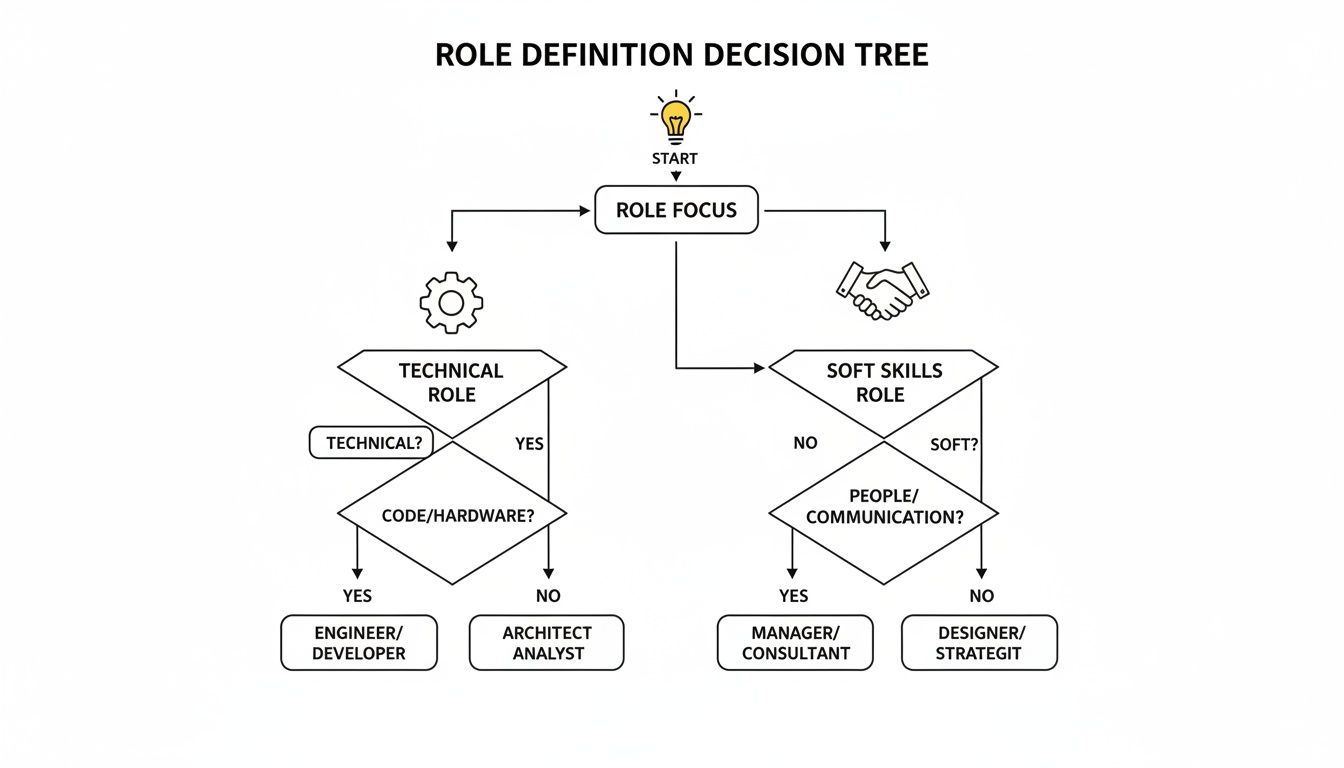
It’s a simple way to separate the non-negotiable technical skills from the crucial soft skills, helping you create a much more precise and realistic candidate profile.
Building Your Sourcing Engine
Relying on a single channel to find these specialists is a recipe for failure. A modern sourcing engine needs to be diverse, blending different approaches to uncover those hidden talent pools.
Your strategy should incorporate a mix of these key channels to find and engage the right people.
| Corporate Counsel Sourcing Channel Comparison |
|---|
| This table breaks down the pros and cons of different channels for sourcing specialised legal talent, helping you decide where to invest your time and resources. |
| Sourcing Channel | Best For | Potential Challenges | RPO Partner Value-Add |
|---|---|---|---|
| Internal Mobility | Filling roles quickly, cultural fit, boosting morale. | Lack of specific external expertise (e.g., new regulations). | Provides external benchmarks to validate internal candidates’ skills. |
| Specialised Agencies | Confidential senior searches, accessing deep niche networks. | Can be transactional; limited scope beyond a single placement. | Manages multiple agency relationships for broader market coverage. |
| Professional Networks | Targeted outreach on platforms like LinkedIn; direct engagement. | Time-intensive; requires building genuine credibility within groups. | Leverages proprietary databases and network intelligence for faster outreach. |
| Recruitment Process Outsourcing (RPO) | Building entire legal teams, multiple specialist hires, strategic workforce planning. | Requires a partnership mindset, not just a vendor transaction. | Acts as an extension of your team, providing market intelligence, scalability, and end-to-end process ownership. |
Different goals demand different tools. A specialised agency might be perfect for a confidential General Counsel search, while an RPO partner is the ideal solution when you need to build out an entire legal team with varied specialisations.
The RPO Advantage In Legal Hiring
When you need to hire multiple legal specialists or build a team from scratch, a Recruitment Process Outsourcing (RPO) partnership gives you a powerful edge. An RPO provider does more than just find candidates; they become an extension of your HR team, arming you with the market intelligence needed to shape your entire strategy.
For instance, a good RPO partner like Taggd can give you real-time data on:
- Compensation Benchmarks: Are your offers truly competitive enough to lure someone away from a top law firm?
- Talent Availability: Where are the IP or M&A specialists you need actually working, and what’s the best way to approach them?
- Competitor Activity: How are other companies structuring their legal teams and what perks are they offering to win talent?
This intelligence-driven approach lets you move faster and with more confidence. It shifts recruitment from a reactive, tactical function to a strategic one. Suddenly, you have access to a much wider pool of passive candidates who would have otherwise remained completely off your radar.
For a deeper dive into sourcing top-tier talent, take a look at our guide on executive search best practices. This is what separates companies that just fill seats from those that build formidable, business-driving legal departments.
You’ve found a few promising candidates on paper. Now comes the moment of truth: can they translate that polished CV into sound, practical advice when the pressure is on? The best recruitment processes for corporate counsel move far beyond standard interview questions. You need to see if a candidate can truly handle the heat, not just recite legal theory.
This is where you design an assessment that probes their strategic thinking, risk appetite, and business-focused problem-solving. This is how you separate the good lawyers from the great business partners.
Moving Beyond Standard Questions
Let’s be honest, standard interview questions tell you about past experiences. Technical case studies, on the other hand, give you a glimpse into their future performance. By throwing a real-world, albeit hypothetical, challenge at them, you get a direct window into their thinking process.
These exercises shouldn’t be generic. They need to be tailored to the specific risks and strategic goals of your company. You’re testing their ability to apply legal knowledge in a commercial context, the absolute cornerstone of an effective in-house counsel.
For instance, you could drop them into a scenario like this:
- The Data Breach Drill: “It’s 4 PM on a Friday. We’ve just discovered a potential data breach affecting customer PII. Under the DPDP Act, what are your immediate first three actions? Draft a brief one-page response plan outlining the key steps for the next 72 hours, including who you need to inform internally and why.”
A test like this isn’t just about their knowledge of the DPDP Act’s strict notification timelines. It reveals their ability to prioritise, communicate clearly, and manage a full-blown crisis.
Designing Strategic Case Studies
The goal here is to create an experience that reveals genuine competence. A well-designed case study will assess multiple skills at once. Think of it less like a legal exam and more like a business simulation.
Consider a scenario built around the new Bharatiya Nyaya Sanhita (BNS):
“Our company is looking at a new joint venture with a smaller, less-established partner. The initial due diligence has flagged some historical issues that could potentially fall under the new organised crime provisions of the BNS. Your task is to analyse the potential liability risks for us. What further questions would you ask the business team, and what initial protective clauses would you recommend for the term sheet?”
This kind of question is powerful because it probes for several key attributes all at once:
- Legal Acumen: Do they correctly pinpoint the relevant risks under the BNS?
- Business Acumen: Do they grasp the commercial desire to get the deal done while still managing the risk effectively?
- Curiosity: What clarifying questions do they ask? A great candidate will dig for more business context, not just legal facts.
- Practicality: Do they offer workable, commercial solutions, or do they just list legal roadblocks that could kill the deal?
Assembling The Right Interview Panel
Getting a 360-degree view of a candidate is crucial. For a corporate counsel role, the interview panel should never be limited to just the legal department. A truly well-rounded evaluation needs input from the very people who will depend on this lawyer’s advice day in and day out.
Your ideal panel should bring together different perspectives:
- The General Counsel (or Head of Legal): Their job is to rigorously test technical legal skills and, just as importantly, assess team and cultural fit.
- A Key Business Leader: This could be a head of sales, operations, or technology. They are there to answer one simple question: Can this lawyer speak our language and give us practical, commercial advice?
- The CHRO or HR Business Partner: This person evaluates cultural alignment, communication style, and whether the candidate’s values resonate with the company’s.
By involving business leaders, you don’t just get a better read on a candidate’s business savvy, you send a powerful message. It shows that you see the legal function as an integral, strategic partner to the business. This collaborative approach sets the right tone from the very first interaction and is a hallmark of successful corporate counsel recruitment.
Securing And Retaining Top Legal Talent

You’ve gone through a gruelling search and assessment process. Getting that top candidate to finally sign the offer letter feels like you’ve crossed the finish line. But really, it’s just the starting gun.
The true test of a successful corporate counsel recruitment strategy isn’t just making the hire; it’s about keeping that high-value talent engaged, productive, and committed for years to come. This is where your investment really starts to pay dividends. A well-built offer, a smart onboarding experience, and a clear path for growth are what turn a great hire into a lasting legal leader.
Crafting A Compelling Compensation Package
In a market where elite legal talent is scarce, a competitive offer isn’t just nice to have, it’s the bare minimum. But ‘competitive’ means so much more than just matching a base salary. You need to build a complete package that shows the candidate how much they’re valued and speaks to their long-term goals.
Start with hard market data. For senior legal roles in India, total compensation can be substantial, with some General Counsel salaries pushing towards ₹87.7 lakhs. Your offer has to be grounded in that reality.
Beyond the base figure, make sure you’re including these crucial pieces:
- Variable Pay: Put together a bonus plan that’s tied to both their individual performance and the company’s bottom line. This makes their success directly part of the business’s success.
- Long-Term Incentives (LTIs): For senior roles, equity or stock options are incredibly powerful retention tools. They give your counsel a real, tangible stake in the company’s future.
- Benefits and Perks: Never underestimate the impact of comprehensive health coverage, generous professional development allowances, and flexible work arrangements.
The offer conversation is your first, and best, chance to show how much you value this person. Be transparent about how the package is put together and where it stands against the market. This builds a foundation of trust from day one.
The First 90 Days: A Strategic Onboarding Plan
Onboarding a corporate counsel has to be more than just the standard HR orientation. The real goal is to get them plugged into the business fast, helping them understand the commercial realities and build the key relationships they’ll need to be effective.
A structured 90-day plan is your best bet for making this happen.
Days 1-30: Focus on Immersion and Relationships Your new hire’s main job in the first month is to listen and learn. They should have deep-dive meetings scheduled with the leaders of every major business unit, sales, finance, operations, technology, and marketing. The goal isn’t to solve problems yet, but to absorb their goals, their pain points, and how they think about risk.
Days 31-60: Focus on Early Wins and Process Mapping Now it’s time to start applying that knowledge. Give them a manageable but high-visibility project, like reviewing a standard contract template or creating a legal FAQ for the sales team. This lets them show their value quickly while getting a feel for your internal processes.
Days 61-90: Focus on Strategic Contribution By now, your counsel should have a solid grip on the business. The focus can shift to more strategic input. They should be ready to present their initial observations to the leadership team, highlighting key legal risks and opportunities, and proposing a high-level roadmap for the legal function for the next six months.
Long-Term Retention Starts With Career Pathing
Great lawyers are ambitious. If they can’t see a future for themselves at your company, they’ll start looking for one somewhere else. Retention really comes down to creating a culture where legal talent can actually grow.
This is especially true as India’s legal market faces a major talent crunch for specialised counsel, with 15-20% of middle-management roles now requiring a law firm background. The best talent expects a clear growth path. You can dig deeper into these legal career trends and what they signal for 2026 on Bettering Results.
You need to build clear career paths within your legal team. Show a junior lawyer what it takes to become a senior counsel, and a senior counsel the route to a leadership role. Offer mentorship, stretch assignments, and funding for specialised training. When you invest in their growth, they’ll invest their loyalty right back in you.
Here’s a rewrite of the section, crafted to sound like it was written by an experienced human expert, following the specific style and formatting instructions provided.
Your Top Questions About Corporate Counsel Recruitment, Answered
Navigating the world of corporate counsel recruitment brings up a lot of tough questions. As a CHRO, you’re not just filling another role. You’re finding a strategic partner who can both protect the business and help it grow. Here are the direct, no-nonsense answers to the most common queries we hear from HR leaders building their legal teams.
How Can We Compete With Law Firms For Top Legal Talent?
This is the classic dilemma. Let’s be honest: trying to win on salary alone against a top-tier law firm is a losing game.
The secret is to stop playing their game and start playing yours. You compete by offering something fundamentally different, a value proposition that big law can’t easily match.
Focus on the pain points of law firm life:
- A Real Work-Life Balance: This isn’t just a talking point; it’s your most powerful lure. The relentless “billable hours” culture of big law is notorious. The promise of a more predictable and sustainable career is incredibly attractive to top lawyers burning out in private practice.
- Direct Business Impact: In-house counsel aren’t on the sidelines; they’re in the centre of the action. They see the immediate results of their advice on business strategy, a kind of satisfaction that often gets lost in a law firm where you’re juggling a dozen different clients.
- A Singular, Deep Focus: Pitch the opportunity to build deep expertise and lasting influence within one organisation. This is a welcome change from the constant context-switching of managing multiple clients with competing demands.
The most compelling offer isn’t just a job; it’s the chance to be a strategic leader, not just a service provider. You’re selling a career defined by influence and integration, where a tangible stake in the company’s success, through equity or long-term incentives, is a real possibility.
What Is The Most Common Mistake In Legal Hiring?
By far, the single biggest mistake we see is kicking off the search with a vague or generic role profile. Too many companies fall into the trap of looking for a “good lawyer” without first defining the specific technical skills, business savvy, and cultural fit their unique environment demands.
This lack of clarity creates a domino effect. It leads to a disorganised search, unfocused interviews, and a high risk of a mishire—someone who is either overqualified and bored or underqualified and completely overwhelmed.
The cornerstone of any successful legal hire is a precise, well-researched competency map that outlines the real-world challenges of the role. This acts as a powerful filter, ensuring you attract candidates who are a genuine fit from the very beginning.
How Can An RPO Partner Specifically Help Hire Niche Legal Roles?
This is where a Recruitment Process Outsourcing (RPO) partner gives you a critical advantage, especially when you’re hunting for talent with highly specialised skills. Their value goes way beyond just sourcing candidates.
An RPO partner gives you an edge in several specific ways:
- Deep Talent Intelligence: They bring real-time data to the table on compensation benchmarks, talent availability in specific legal niches (like data privacy or M&A), and what your direct competitors are offering. This intelligence is crucial for crafting an offer that gets accepted.
- Access to the Passive Market: The best lawyers often aren’t looking for a job. RPO providers maintain vast, pre-vetted networks of these high-performing passive candidates. This dramatically expands your talent pool beyond the usual job boards.
- Specialised Assessment: They bring proven expertise in designing robust assessment frameworks. This means creating technical case studies and behavioural interviews that accurately test for the specific skills you need, identifying the best-fit candidates with much greater accuracy.
Ultimately, this partnership significantly cuts down your time-to-hire, minimises the risk of a bad hire, and frees up your internal team to focus on the final strategic decisions.
Should We Prioritise Technical Skills Or Business Acumen?
The honest answer? You need both. But the balance shifts dramatically depending on the seniority of the role. It’s not an either/or question; it’s a matter of priority and context.
For a junior or mid-level counsel hired to manage specific regulations like the DPDP Act, deep technical expertise is the non-negotiable price of entry. Their primary value comes from that specialised knowledge.
For a General Counsel or a senior legal leader, however, business acumen and strategic thinking are just as important, if not more so. They need to be able to translate complex legal jargon into commercial advice that drives the business forward. They need to have a seat at the leadership table and earn it.
Your best strategy is to set a clear baseline for the required technical skills. Then, design your assessment process to heavily weigh a candidate’s ability to apply that knowledge in a real-world business context, advise leadership, and contribute to the company’s overall strategy.
Finding and securing the right legal talent is one of the most critical hires you can make. It demands a strategic, data-driven approach. If you’re looking to build a world-class legal team and need a partner with deep market intelligence and a proven track record, Taggd can help. Discover how our AI-powered RPO solutions can transform your corporate counsel recruitment process.