Gone are the days when customer support hiring was simply about filling seats. It’s now a core strategic function, one that has a direct line to your revenue and brand loyalty. For Chief Human Resources Officers (CHROs) across India, this shift demands a move away from reactive, transactional recruitment. It’s time for a more proactive and sophisticated talent acquisition model.
The scale of this challenge is huge, and it calls for an entirely new playbook.
Why Customer Support Hiring Became a Strategic Priority
It wasn’t long ago that customer support was seen as a necessary evil—a cost centre focused on resolving issues as cheaply as possible. That mindset is completely obsolete today.
A single great interaction can create a customer for life. On the flip side, one bad experience can cause damage that’s impossible to undo. Research shows that a staggering 86% of customers will walk away from a company after a poor experience. This statistic alone makes the quality of your support team a direct driver of business growth and retention, elevating support hiring from an operational chore to a C-suite priority.

This isn’t just a change in perception; it’s backed by hard economic trends. Between 2020 and 2024, India’s customer support ecosystem became one of the most aggressive hirers in the services economy. We’re looking at a projected 7% annual rise in BPO and call-centre jobs. That translates to roughly 700,000 new positions in a single year, with support roles accounting for nearly half of them.
As you dig into the latest 2026 hiring trends, it becomes crystal clear: this talent category demands a dedicated and robust capacity for sourcing, screening, and onboarding.
The Modern Support Role Demands New Skills
The old image of a support agent as someone just answering phones is hopelessly outdated. Today’s support professionals are tech-savvy problem-solvers. They’re navigating complex CRM systems, juggling conversations across multiple digital channels, and acting as genuine brand ambassadors.
Their role now demands a sophisticated blend of hard and soft skills:
- Empathy and Emotional Intelligence: The ability to genuinely connect with frustrated customers and de-escalate tense situations is absolutely non-negotiable.
- Technical Acumen: You can’t be efficient without being proficient in helpdesk software, CRMs, and various communication platforms.
- Problem-Solving: Agents have to think on their feet and find solutions that go beyond scripted answers. Often, this means anticipating what the customer might need next.
- Adaptability: Business environments are in constant flux. Support teams need to quickly get up to speed on new products, services, and policies.
For CHROs, this means the hiring profile for a customer support agent has fundamentally changed. You are no longer just hiring for communication skills; you are recruiting for complex problem-solvers who can protect and grow company revenue.
This complexity makes a structured, strategic approach to customer support hiring more critical than ever before. Without one, organisations are setting themselves up for high attrition, inconsistent service quality, and a direct hit to the bottom line.
The challenge is clear: build a high-performing team at scale, or get left behind.
Building Your Workforce and Sourcing Blueprint
Before you even think about writing a job description, you need a rock-solid plan for your workforce and sourcing. Architecting a great customer support team means moving beyond simple headcount requests. It’s about building an analytical model for workforce planning so your hiring is proactive, not just a reaction to a crisis.
The first pillar is getting your hiring forecast right. This isn’t just about looking at last year’s attrition numbers; it requires a much deeper analysis.
- Business Growth Projections: Get on the same page with your finance and sales teams. If they’re projecting a 15% growth in the customer base, that number needs to translate directly into your support headcount plan.
- Seasonal Demand Fluctuations: For any e-commerce or travel business, this is a big one. Peak seasons like Diwali or the summer holidays can easily push ticket volumes up by over 50%. You need to plan for temporary staff or flexible contracts months in advance.
- Attrition Patterns: Dig into your exit data. Are agents leaving after just six months? Is one particular team lead seeing a revolving door of talent? This data doesn’t just help you predict vacancies; it points you toward the root causes you need to fix.
Once you have a clear forecast, the next step is to build a diversified sourcing strategy. You need to cast a wide, effective net to catch the best talent.
Moving Beyond Traditional Job Boards
If you’re only posting on traditional job portals, you’re setting yourself up for a slow, saturated pipeline. The talent market has changed, and you need a more dynamic approach to find the best people for your customer support roles.
In India, the supply-demand equation for customer support is being completely rewritten by digital recruitment platforms. The numbers are staggering. One major platform saw total job applications cross 90 million in a single year—a 29% year-on-year jump. Job postings? They only grew by 15%. This means the challenge isn’t finding candidates anymore; it’s about efficiently screening a massive volume of applicants to find the quality needles in the haystack. You can get more insights into India’s hiring market trends and how AI is shaping this new reality.
To build a truly robust pipeline, you need to integrate these modern channels:
- High-Volume Digital Platforms: Tap into platforms known for attracting a huge volume of service professionals, from entry-level to experienced. They are your best bet for creating a consistent flow of applicants.
- Strategic University Partnerships: Build genuine relationships with colleges and vocational schools that have strong communication programmes. Offer internships or run campus recruitment drives to connect with fresh, eager talent.
- Employee Referral Programmes: Let’s be honest, your best agents probably know other great people. A well-designed referral programme with real incentives can quickly become your highest-quality sourcing channel.
One of the biggest mistakes I see is over-relying on a single sourcing channel. A resilient customer support hiring strategy should blend at least three distinct channels. This way, you mitigate risk and keep the talent flowing, no matter how the market shifts.
Strategising Your Geographic Footprint
Another critical piece of the puzzle is deciding where to hire. The choice between Tier 1, 2, and 3 cities has massive implications for your costs, the skills you can find, and how quickly you can scale. Each tier comes with its own set of pros and cons.
Tier 1 Cities (e.g., Mumbai, Bengaluru):
- Pros: You get a large, diverse talent pool with high English proficiency and people who are used to multinational work cultures.
- Cons: Be prepared for higher salary expectations, fierce competition for talent, and higher operational costs all around.
Tier 2 Cities (e.g., Pune, Jaipur):
- Pros: There’s a growing pool of educated talent here, with lower operational costs and often much higher employee loyalty.
- Cons: You might find that skill sets are less specialised, and infrastructure can sometimes be a hurdle.
Tier 3 Cities (e.g., Nashik, Mysore):
- Pros: The costs are significantly lower, and attrition rates are often incredibly low, which helps in building stable, long-term teams.
- Cons: The talent pools are smaller, and you’ll likely need to invest more in intensive training for both technical and soft skills.
Often, a balanced approach works best. Think about a “hub-and-spoke” model. You could have a central hub in a Tier 1 city, supported by satellite offices or remote teams in Tier 2 and 3 locations. This lets you balance costs, tap into a wider talent pool, and build real operational resilience. Getting your geographic strategy right is a powerful lever for scaling customer support hiring effectively.
Designing a High-Volume and High-Quality Selection Process
Getting a flood of applications for your customer support roles feels like a win, but let’s be honest—that’s just the starting line. The real bottleneck in high-volume hiring isn’t finding people; it’s finding the right people, accurately and efficiently. Get this wrong, and you’re looking at sky-high early attrition, inconsistent service, and a tarnished employer brand.
To get ahead, you need a smart, multi-stage selection funnel. The goal is to systematically filter candidates based on the core competencies that actually matter, not just keywords on a resume. This way, by the time a candidate speaks to a human, you already know they have the foundational skills. It’s less about interviewing and more about building an efficient machine that consistently surfaces top talent.
The blueprint below shows how this strategic pipeline comes together, starting well before you even post a job ad.
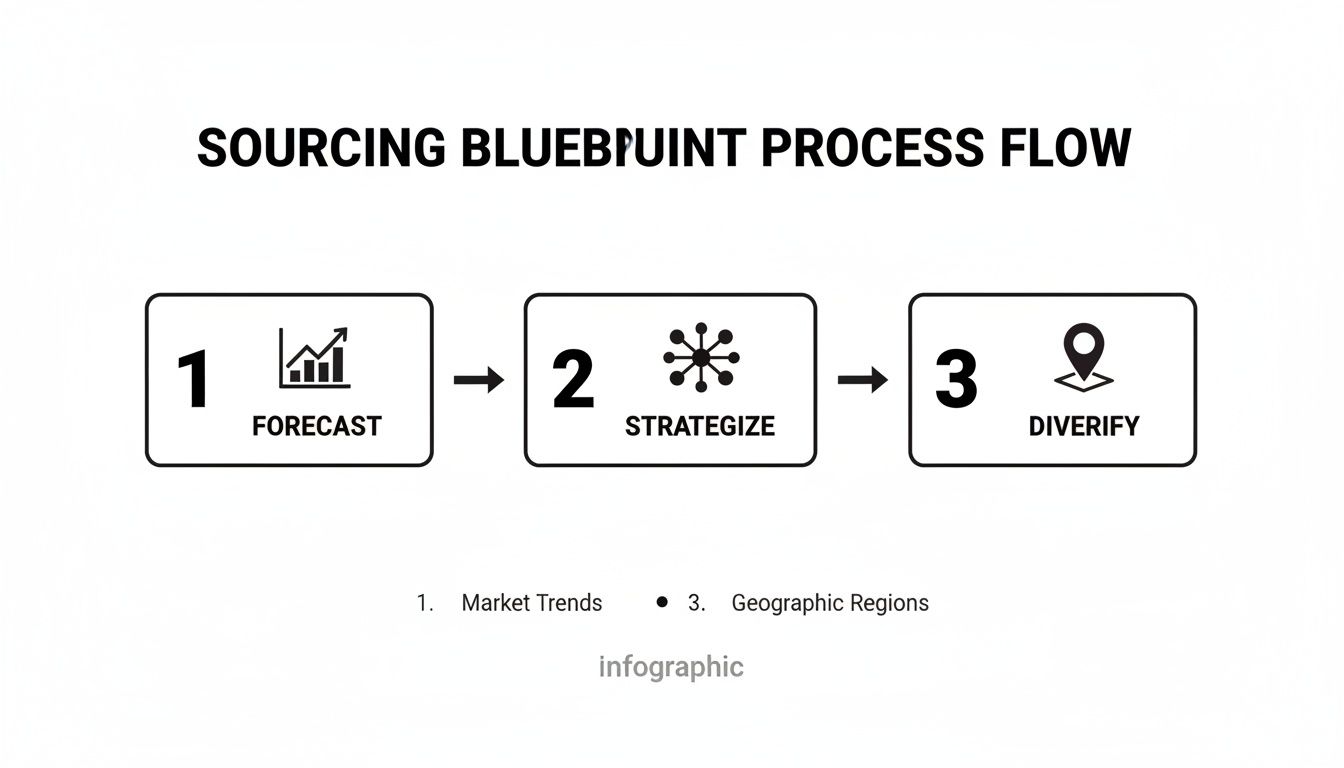
As you can see, successful hiring starts with solid forecasting and strategic sourcing—long before the first interview is ever scheduled.
Building Your Selection Funnel
Your funnel needs to be designed to test different skills at each stage, progressively narrowing the pool to only the most qualified individuals. This approach respects everyone’s time—both the candidates’ and your hiring team’s.
Here’s a practical way to structure it:
- AI-Powered Pre-Screening: This is where you let automation do the heavy lifting. Use AI tools at the top of the funnel to screen applications for basic qualifications and communication clarity. This first pass can weed out up to 60-70% of applicants who don’t meet the bare minimum, freeing your team to focus on candidates with real potential.
- Automated Skills Assessments: Next up are practical tests. Candidates who make it past the initial screen get automated assessments that check for critical skills like typing speed, written communication, and basic technical literacy. Simple, but effective.
- Real-World Scenario Testing: This is where you separate the good from the great. Give candidates realistic customer support scenarios to see how they handle pressure, solve problems, and show empathy.
- Structured Behavioural Interviews: The final stage is a conversation, whether face-to-face or on video. But it’s not just a chat—it’s focused on using past behaviour as a predictor of future performance.
Let’s be clear: a selection funnel isn’t about making it harder to get a job. It’s about making it easier for the right people to prove they’re a great fit. It creates a far more objective and fair process for everyone involved.
Creating Assessments That Actually Predict Performance
Generic skills tests are often a waste of time because they don’t predict on-the-job success. Your assessments have to mirror the actual challenges your support agents face every day. This not only makes your evaluation more accurate but also gives candidates a realistic preview of what the job entails.
For a deeper look into structuring these frameworks, check out this comprehensive guide on the selection process in HRM.
Here are two examples of assessments that work:
- The “Frustrated Customer” Email Simulation: Give a candidate a mock email from an angry customer whose order is delayed. Ask them to draft a response. You’re not just checking for grammar; you’re assessing their ability to show empathy, take ownership of the problem, and clearly explain the next steps for a resolution.
- The CRM Navigation Task: Provide temporary, limited access to a mock CRM environment. Ask them to find a customer’s order history and log a new support ticket based on a script you provide. This directly tests their technical comfort and ability to navigate essential software quickly and correctly.
Using Scorecards for Objective Evaluation
To remove bias and keep evaluations consistent, every candidate must be measured against the same criteria. This is where a competency scorecard becomes your best friend. It provides a structured way to rate candidates on essential skills during interviews and assessments, turning subjective feelings into objective data.
Here’s a sample of what that looks like.
Customer Support Competency Scorecard
This scorecard provides a simple framework for evaluating candidates during interviews and assessments, ensuring you focus on the competencies essential for a modern support role.
| Competency | Definition | Look-Fors (Behavioural Indicators) | Scoring (1-5) |
|---|---|---|---|
| Empathy | The ability to understand and share the feelings of the customer. | Actively listens, validates customer’s feelings, uses phrases like “I understand how frustrating that must be.” | |
| Problem-Solving | The ability to identify issues and find effective solutions. | Asks clarifying questions, thinks beyond the script, proposes logical next steps. | |
| Clarity | The ability to communicate information simply and effectively. | Avoids jargon, confirms understanding, structures responses logically. | |
| Resilience | The ability to remain calm and professional under pressure. | Maintains a positive tone with difficult scenarios, doesn’t get defensive, focuses on solutions. |
By implementing a data-driven selection process like this, your customer support hiring transforms from a game of chance into a predictable system for identifying and securing top-tier talent. It’s the cornerstone of building a support team that truly becomes a competitive advantage.
Connecting Onboarding to Long-Term Performance
Getting top talent to sign on the dotted line is a huge win, but let’s be honest—it’s just the first leg of the race. The real challenge, and where the true value lies, is in turning that promising new hire into a long-term, high-performing team member.
A robust onboarding programme is what bridges that gap. It’s far more than just setting up a laptop and a login. It’s about deeply embedding someone into your company’s culture and giving them every tool they need to succeed from day one.
Those first 90 days? They’re everything. This period needs to be a meticulously planned journey, designed to build confidence, competence, and a genuine understanding of your products and, more importantly, your customers. If you rush this, you’re setting them up for burnout and undoing all the great work your recruitment team just did.

A well-thought-out plan goes way beyond basic product training. It’s about creating a holistic foundation that prepares new agents for the real-world pressures and nuances of their role.
Architecting a 90-Day Onboarding Framework
Think of your onboarding as a phased journey, not a week-long information firehose. Each phase should build on the last, guiding the new hire from foundational knowledge to practical application and, finally, to confident independence.
Here’s what a successful framework often looks like:
- Weeks 1-2: Foundational Training. This is boot camp. You’ll immerse them in your company culture, mission, and values. Then, it’s a deep dive into your products and systems, ensuring they’re comfortable with essential tools like your CRM and helpdesk software.
- Weeks 3-4: Shadowing and Nesting. Time to put theory into practice. New agents “nest” by shadowing experienced mentors and listening in on live calls. They’ll start handling simple queries under close supervision, getting immediate feedback in a low-pressure, supportive setting.
- Weeks 5-12: Gradual Ramp-Up. The training wheels start to come off. New hires take on a progressively larger workload, paired with a dedicated mentor or team lead for regular check-ins and coaching. Performance is monitored, but the goal is development, not just hitting targets.
One of the biggest mistakes I see is measuring a new hire with the same yardstick as a tenured agent within their first three months. Onboarding isn’t about immediate peak performance; it’s about building a sustainable foundation for years of success.
This structured approach gives new agents the support and preparation they need, drastically cutting down on the anxiety that so often leads to early churn.
Establishing Performance Metrics from Day One
If you want to tie your hiring efforts back to tangible business outcomes, you have to define what success looks like from the very beginning. Introduce Key Performance Indicators (KPIs) and Service Level Agreements (SLAs) during onboarding, but frame them as developmental goals, not punitive measures.
Introduce these core metrics early on:
- First Contact Resolution (FCR): Go beyond the number and explain why resolving an issue on the first touchpoint creates a fantastic customer experience.
- Customer Satisfaction (CSAT): Show them the direct line between their actions on a call or chat and the happiness scores that follow.
- Average Handle Time (AHT): Position this as a measure of efficiency that naturally improves with experience, not as a race against the clock.
When you define success from the start, you build a culture of accountability and continuous improvement. Performance management becomes less of a dreaded annual review and more of an ongoing conversation about growth.
Combating Attrition with Clear Career Paths
Let’s face it, high attrition has always been the Achilles’ heel of the customer support world. Even though India has a strong hiring outlook, historical attrition in call centres has been as high as 50%. It’s only recently improved to the 30-35% range as companies get smarter about career pathing.
You can dig deeper into how India’s hiring trends are evolving. Partnering with an RPO for systematic hiring can bring stability, freeing up your internal team to focus on these crucial retention strategies.
One of the most potent weapons against churn is a visible, achievable career path. Your agents need to see a future for themselves that goes beyond their current role. Show them the ladder: from a front-line agent to a Senior Agent, a Team Lead, a Quality Analyst, or even a Trainer. This simple act transforms a “job” into a “career,” giving your best people a powerful reason to stay and grow with you.
Using RPO as a Strategic Growth Lever
When your organisation is hitting a hyper-growth phase, launching a new service, or breaking into a new market, the demand for customer support talent can explode. Suddenly, your internal talent acquisition team is swamped. Trying to manage that kind of volume in-house stretches your resources thin, leading to slower hiring, inconsistent candidate quality, and straight-up recruiter burnout.
This is the moment to stop thinking of recruitment as a fixed internal cost and start seeing it as a flexible, scalable service.
This is exactly where Recruitment Process Outsourcing (RPO) comes in as a powerful strategic lever. A genuine RPO partnership isn’t just about getting a few temporary recruiters to fill seats. It’s about embedding an external team of specialists directly into your hiring function. They take on your brand, work within your systems, and become fully accountable for hitting your hiring goals.
Think of it like this: your internal team are the architects of your talent strategy. They focus on the big picture—culture, retention, and developing your people. The RPO partner is the expert construction crew, bringing the specialised tools and workforce to build your customer support team at the speed and scale you need, without derailing your core operations.
When RPO Delivers Maximum Value
An RPO isn’t a silver bullet for every hiring challenge; it’s a strategic move for specific, high-stakes situations. The decision to bring in a partner usually comes down to a need for scale, speed, or specialised expertise that your current setup just can’t handle. It’s about offloading the high-volume, process-heavy work so your team can breathe and focus on higher-value initiatives.
Look for these trigger points where an RPO delivers the biggest impact:
- Sustained High-Volume Hiring: You need to hire 50+ agents every single month just to keep up with growth and attrition. An RPO brings the dedicated sourcing and screening muscle to manage this constant flow.
- New Centre Launches: Standing up a new support hub in a Tier 2 or Tier 3 city is a massive undertaking. It requires deep local knowledge and a huge initial hiring push. RPO providers often have established talent networks in these exact locations.
- Rapid Scaling for a Product Launch: Your new product is forecast to bring in 20,000 new customers in the first quarter alone, meaning you need 100 new support agents—yesterday. An RPO can build this team in a fraction of the time it would take you to do it internally.
- Improving Quality-of-Hire: If your 90-day attrition rate is through the roof, it’s a clear sign your selection process isn’t working. A specialised RPO partner brings proven assessment models and interviewing techniques to lift candidate quality from day one.
The real power of an RPO in customer support hiring is its ability to build a predictable talent pipeline. It transforms recruitment from a reactive, often chaotic function into a managed service with clear deliverables and performance metrics.
Selecting the Right RPO Partner
Choosing an RPO provider is more like picking a business partner than a vendor. The wrong one can create more headaches than they solve. Your evaluation has to go way beyond the price tag and dig into cultural fit, process expertise, and their specific track record in high-volume customer support hiring.
When you’re vetting potential partners, zero in on these critical areas:
- Industry Specialisation: Have they actually hired for roles like yours before? Ask for case studies specifically about building customer support teams in India. Don’t accept generic examples.
- Scalability and Flexibility: How quickly can they scale their recruitment team up or down as your needs change? Their model has to be agile, not rigid.
- Technology Stack: What tools are they using for sourcing, assessment, and applicant tracking? You need to ensure their tech can play nice with your existing systems.
- Reporting and Analytics: They must be able to provide detailed, transparent reporting on the metrics that matter: time-to-fill, cost-per-hire, and quality-of-hire. If they can’t measure it, they can’t manage it.
Ultimately, a successful RPO engagement gives you the power to scale your most critical customer-facing teams without breaking a sweat. If you’re considering this path, you can dive deeper into the specific benefits of recruitment process outsourcing in our detailed guide. It’s all about using external expertise to build a powerful internal advantage.
Common Questions on Customer Support Hiring
When you’re scaling a customer support team, a lot of practical, on-the-ground questions pop up. As a CHRO, your strategy needs to be sharp enough to handle the real challenges that come with building a high-volume, high-quality recruitment engine.
Let’s cut through the noise and get straight to the answers you need for the most pressing questions about building a world-class support team.
What Are the Most Critical Skills for Modern Customer Support Roles?
Basic communication skills are table stakes. What really separates a top-tier support professional from the rest has changed quite a bit. Yes, fluency is a must, but the deeper, more nuanced abilities are what make an agent truly great.
Today, the skills that matter most are empathy, creative problem-solving, and solid tech-savviness.
Empathy is the absolute foundation of any good customer interaction. It’s what allows an agent to connect with a frustrated customer, de-escalate the situation, and make them feel heard. Problem-solving is about moving beyond the script and finding clever solutions when unique or unexpected issues arise. And let’s be honest, tech-savviness is non-negotiable for juggling CRMs, helpdesk software, and multiple channels like chat, email, and social media without breaking a sweat.
Forget standard interview questions. To really test for these skills, you need to see them in action with scenario-based assessments.
For example, you might ask, ‘Describe a time you assisted a customer who was upset about a company policy you could not change.’ Their answer will tell you far more about their empathy and problem-solving skills than a generic ‘tell me about yourself’ ever could.
How Can We Reduce High Attrition in Customer Support Teams?
High attrition is a constant headache in the customer support world, but it’s a problem you can solve. It all starts with setting realistic expectations during the hiring process, but you secure the win with a strong post-hire employee experience. Just throwing more people at the problem is a short-term fix; building a supportive environment is the real solution.
A few key actions can make a massive difference in your retention rates.
- Create Clear Career Paths: People stick around when they can see a future. Map out a clear progression from a support agent to roles like Team Lead, Quality Analyst, or Trainer.
- Invest in Continuous Training: Stagnation breeds disengagement. Offer ongoing training not just on new products, but also on advanced soft skills and emerging technologies.
- Empower Managers as Coaches: Shift the manager’s role from being a supervisor to a developmental coach who provides regular, constructive feedback.
- Ensure Competitive Compensation and Recognition: Regularly benchmark salaries and build programmes that recognise and reward your top performers.
High attrition is usually just a symptom of a deeper issue. By focusing on creating a positive, growth-oriented employee experience, you’re treating the cause, not just the symptom.
When Is the Right Time to Consider an RPO Partner?
Bringing on a Recruitment Process Outsourcing (RPO) partner is a strategic move, not just an operational one. The right time to think about an RPO is when your hiring needs start to outpace your internal team’s capacity or expertise, putting your business goals at risk.
Keep an eye out for these specific triggers:
- Massive Scale-Up: You need to hire over 100 agents in a single quarter for a new launch or centre opening.
- Persistent Process Gaps: Your time-to-fill is dragging, or the quality-of-hire is all over the place, leading to high early-stage attrition.
- Geographic Expansion: You’re moving into a new region, like a Tier 2 or Tier 3 city, and you don’t have the local market knowledge.
- Specialised Skill Requirements: Your needs have changed, and you now require specialised talent like bilingual agents or technical support experts that are tough to find.
An RPO isn’t just a staffing agency; it’s a strategic partnership designed to build a sustainable, high-quality talent pipeline. This frees up your internal HR team to focus on other critical areas like employee retention and long-term development.
What Metrics Should a CHRO Track for Hiring Success?
To really get a handle on how effective your customer support hiring is, a CHRO needs to track a balanced scorecard of metrics. You need to connect recruitment activities directly to business outcomes. Relying on just one metric will give you a skewed picture.
For a holistic view, you should be monitoring a blend of speed, cost, and quality indicators.
- Time-to-Fill: This tells you how fast and efficient your hiring process is, from opening the job to getting an offer accepted.
- Cost-per-Hire: This tracks the financial investment for each new hire, making sure your process is cost-effective.
- Quality-of-Hire: This is arguably the most important one. You can measure it through 90-day performance reviews, CSAT scores tied to new hires, and first-year retention rates.
- Source-of-Hire Effectiveness: This shows you which channels (referrals, job portals, university partnerships) are bringing in the best-performing and longest-lasting employees.
- Candidate Satisfaction (CSAT): Measured with post-interview surveys, this protects your employer brand and ensures a positive experience for everyone who applies.
Tracking these metrics together gives you a comprehensive dashboard view of your hiring engine’s health, allowing you to make data-driven decisions and constantly fine-tune your strategy.
Ready to scale your customer support teams with a strategic partner who understands the Indian talent landscape? Taggd specialises in building high-performing, scalable support teams through our expert RPO solutions. Discover how we can transform your customer support hiring process by visiting us at https://taggd.in.