Think of end-to-end hiring solutions for enterprises not just as a service, but as a strategic partnership. This is about handing over the entire talent acquisition lifecycle—from the first moment you source a candidate to their final day of onboarding—to a dedicated expert.
The whole point is to shift recruitment from a reactive, fire-fighting function into a proactive engine for business growth. It’s a model built to solve the complex, large-scale hiring headaches that traditional, piecemeal methods just can’t keep up with anymore.
The Modern Enterprise Hiring Challenge

Today’s enterprises are caught in a perfect storm. Ambitious growth targets are crashing head-on into a fiercely competitive talent market, putting immense pressure on Chief Human Resources Officers (CHROs) and their teams. The old playbook of just posting a job and hoping for the best is broken, especially when every competitor is chasing the same small pool of skilled professionals.
This pressure gets worse when you factor in the sheer volume of hiring needed to expand, coupled with high employee turnover. It creates a relentless cycle of sourcing, interviewing, and onboarding that can quickly overwhelm even the sharpest internal teams.
The Widening Skills Gap
One of the biggest hurdles right now is the ever-widening skills gap, particularly in technical roles. This isn’t just a small problem; it’s a full-blown talent acquisition crisis, and it’s especially acute in growth markets like India.
Forecasts suggest that over 70% of Indian enterprises will face significant tech skills shortages by 2025. Add to that the high attrition rates in the IT sector, which hovered between 18–20% in 2024, and you have constant pressure to rehire for the same roles. If you want to dive deeper, you can discover more insights about enterprise hiring challenges from Taggd.in.
This dynamic forces organisations into a constant state of reaction—plugging holes instead of building a sustainable talent pipeline for the future. The damage is real and immediate:
- Delayed Projects: Critical initiatives stall because the right people aren’t in place.
- Missed Opportunities: The inability to scale teams quickly means losing ground to more agile competitors.
- Increased Costs: Relying on multiple external agencies for every hard-to-fill role sends recruitment costs soaring.
From Reactive Function to Strategic Driver
This is where end-to-end hiring solutions completely change the game. Instead of treating recruitment as a series of disconnected tasks, this model reimagines it as a single, integrated process. It’s not about just filling seats. It’s about building a predictable and scalable talent supply chain that directly fuels your long-term business goals.
By outsourcing the entire recruitment process, enterprises can convert their talent acquisition function from a cost centre into a strategic asset. This partnership enables internal HR leaders to focus on core activities like employee development and organisational culture, while the partner manages the complex mechanics of finding and securing top talent.
The table below breaks down the fundamental differences between the old way and the new approach.
Traditional Recruitment vs End-to-End Solutions
| Aspect | Traditional Recruitment | End-to-End Solution |
|---|---|---|
| Focus | Transactional (filling open roles) | Strategic (building a talent pipeline) |
| Process | Disjointed, often siloed | Integrated, from sourcing to onboarding |
| Approach | Reactive (responds to hiring requests) | Proactive (anticipates future talent needs) |
| Ownership | Managed by internal HR/multiple vendors | Managed by a single, accountable partner |
| Metrics | Cost-per-hire, time-to-fill | Quality-of-hire, business impact, scalability |
| Technology | Often fragmented or basic ATS | Integrated tech stack (AI, analytics) |
| Outcome | Seats filled | A sustainable competitive advantage |
As you can see, the shift is from a short-term, tactical function to a long-term, strategic partnership that delivers measurable business value.
Decoding Recruitment Process Outsourcing
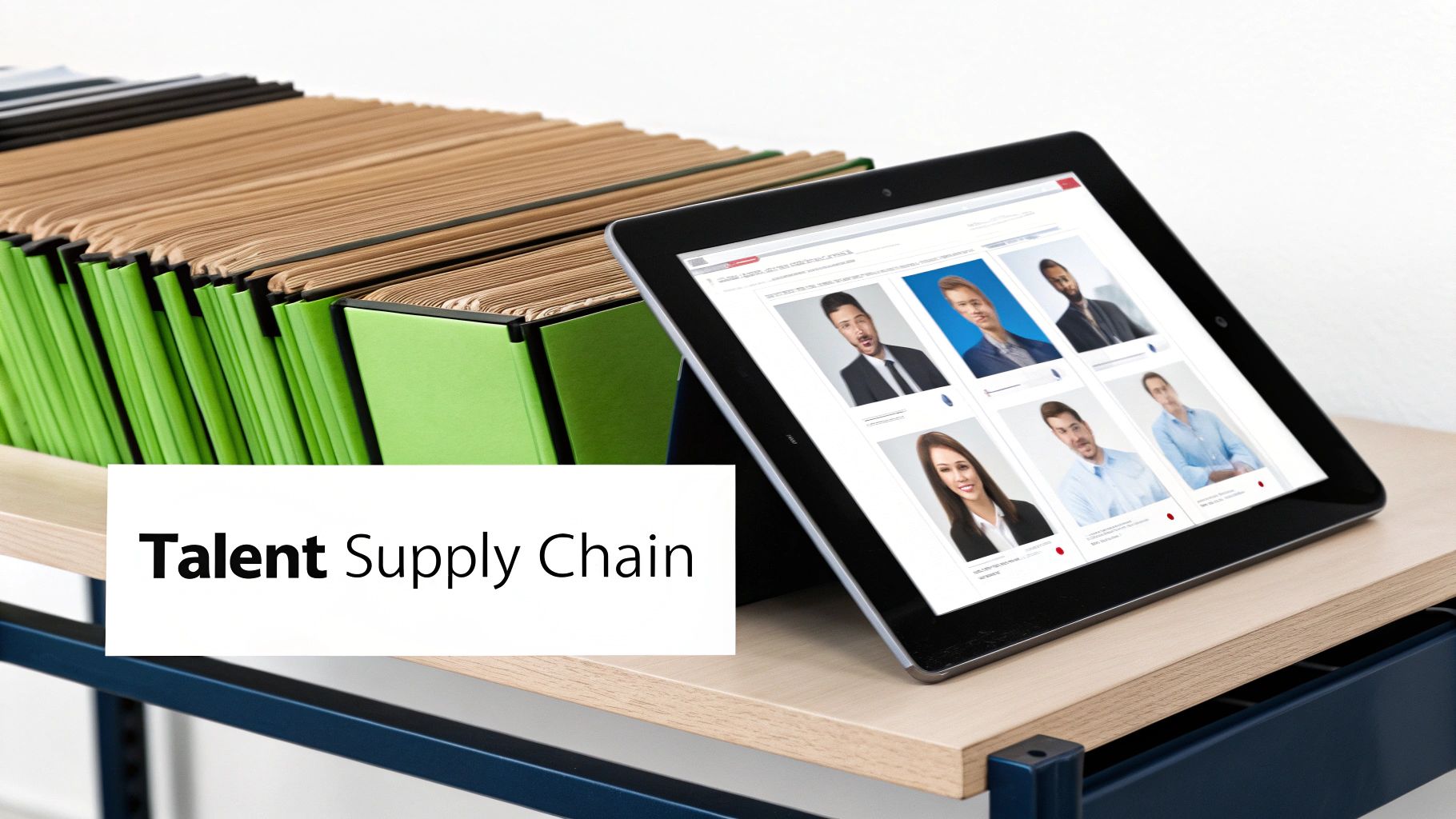
At the heart of most end-to-end hiring solutions for enterprises is a powerful model you’ve likely heard of: Recruitment Process Outsourcing, or RPO. What does that really mean?
Think of it this way: just as a car manufacturer outsources its entire supply chain to a logistics expert to ensure parts arrive exactly when needed, an enterprise partners with an RPO provider to manage its talent supply chain.
This isn’t about just handing off a few hard-to-fill roles to an agency. It’s a true strategic partnership. An external provider becomes a seamless, integrated extension of your internal HR team, managing the entire recruitment journey from the first sourcing call right through to a candidate’s first day on the job.
A genuine RPO partner doesn’t just fill vacancies; they get under the skin of your company’s culture, goals, and values. They become brand ambassadors, making sure every single candidate interaction reflects the quality and professionalism of your organisation.
Different Models for Different Enterprise Needs
RPO is not a one-size-fits-all solution. Its real strength lies in its flexibility, designed to adapt to the specific pressures and objectives your business is facing at any given moment. That kind of adaptability is critical in a dynamic market like India, which continues to show incredibly strong global hiring intentions.
India ranks second among 42 countries in employment outlook, with the IT sector projected to add over 300,000 jobs in 2025 and retail hiring forecasted to grow by a massive 12 percent. To capitalise on this growth, enterprises need hiring models that can bend, not break. You can read the full report on India’s hiring trends for 2025 from India Briefing.
Here are the main RPO models enterprises can adopt:
- On-Demand RPO: This is perfect for those sudden, project-based hiring spikes. Imagine your company unexpectedly wins a major contract that requires you to hire 50 specialised software developers in three months. An on-demand RPO partner can deploy a dedicated team immediately to manage this surge without derailing your day-to-day HR functions.
- Function-Based RPO: This model is ideal when you need to scale a specific business unit. Let’s say your enterprise plans to double its national sales team. A function-based RPO can take full ownership of recruiting, screening, and hiring every single sales professional, ensuring consistency and quality across every region.
- Full-Service RPO: This is the most complete form of partnership, where the RPO provider manages the entire talent acquisition function for your organisation. It’s a big strategic move, best for enterprises looking to completely overhaul their hiring capabilities, drive efficiency, and build a sustainable talent pipeline for long-term growth. If you want to dig deeper into these models, check out our guide on everything you need to know about RPO.
The Partnership Analogy: A Deeper Look
Let’s go back to that supply chain analogy for a moment. A great logistics partner doesn’t just ship boxes. They analyse your operations, suggest more efficient routes, and use technology to predict future demand. They become indispensable.
An RPO partner functions in exactly the same way for your talent needs. They bring specialised expertise, advanced sourcing technologies, and market intelligence that most internal teams simply don’t have the capacity to develop on their own. They don’t just find people; they build the systems that find the right people, consistently and at scale.
This kind of partnership frees your internal HR leaders from the time-consuming mechanics of recruitment. Instead of getting bogged down in sourcing, screening, and scheduling, they can focus on higher-value strategic work like employee development, succession planning, and strengthening organisational culture.
Ultimately, choosing an RPO model is about selecting a partner that aligns with your strategic vision. It’s a commitment to transforming talent acquisition from a back-office task into a powerful driver of business performance, giving you the agility to scale and compete effectively. This strategic shift is what makes RPO a cornerstone of modern end-to-end hiring solutions for enterprises.
The Tangible Business Benefits for Your Enterprise
Switching to an end-to-end hiring solution isn’t just a process tweak; it’s a strategic business decision that hits the bottom line. Let’s move past the operational ‘how’ and dig into the financial and strategic ‘why’—the real-world results that shape your company’s growth.
Think about your enterprise right now. Are your teams caught in long hiring cycles for critical roles? Are costs ballooning from juggling multiple recruitment agencies? Is a patchy candidate experience quietly tarnishing your employer brand?
Now, imagine the flip side. Your time-to-hire is slashed. Recruitment costs become predictable and manageable. Every single candidate, hired or not, walks away with a positive impression of your company. This is what a true recruitment partnership delivers.
Accelerate Hiring and Reduce Costs
One of the first things you’ll notice is a massive boost in hiring speed. A specialised RPO partner brings dedicated sourcing teams and smart tech to the table, often cutting hiring timelines by 42% or more. This isn’t just about filling seats faster; it’s about getting crucial, revenue-generating talent on board sooner, giving your business a direct shot in the arm.
Speed goes hand-in-hand with serious cost savings. When you consolidate all your recruitment under one accountable partner, you stop paying the unpredictable and often sky-high fees of multiple contingency agencies. What you get instead is a predictable cost-per-hire and a much clearer picture of your return on investment.
A streamlined, end-to-end hiring process isn’t just an efficiency gain—it’s a competitive advantage. When you can onboard top talent weeks or even months ahead of your competitors, you seize market opportunities that others miss.
Enhance Talent Quality and Scalability
Of course, speed and cost are only part of the story. The real prize is elevating the quality of every person you hire. Expert RPO partners have access to huge, often hidden, talent pools, including passive candidates who aren’t even looking for a job. They use deep market intelligence and data to pinpoint individuals with the exact skills and cultural fit your business needs.
This unlocks another game-changing advantage: scalability. Business needs can pivot on a dime. An RPO partner gives you the agility to ramp your hiring up or down in an instant, without the massive fixed cost of a large in-house recruitment team.
- Before: A new project needs 50 engineers, triggering internal panic, blown deadlines, and a scramble for expensive last-minute agency help.
- After: You notify your RPO partner. A dedicated project team instantly taps into a pre-built talent pipeline, sourcing and screening candidates at scale to hit your deadline.
This transforms your hiring function from a rigid cost centre into a flexible, on-demand resource that moves in lockstep with your business.
Strengthen Your Employer Brand
Every single touchpoint a candidate has with your company shapes their perception of your brand. A clunky process run by different internal teams and outside vendors often results in mixed messages and a poor experience. That kind of damage to your reputation can make it much harder to attract great people down the road.
An RPO partner ensures every candidate gets a consistent, professional, and positive experience, from the very first contact to the final offer. This systematic approach doesn’t just attract better talent; it turns candidates into advocates for your brand. You can learn more about the strategic benefits of enterprise RPO for large organisations in our detailed guide. A powerful employer brand, built on a world-class candidate journey, is a long-term asset that keeps on giving.
Implementing Your Enterprise Hiring Solution
Moving to an end-to-end hiring solution for enterprises isn’t just about swapping out a vendor; it’s a major strategic overhaul. Success comes down to a rock-solid implementation plan that treats this shift like the core business transformation it is.
By breaking the process into clear, manageable phases, CHROs can guide the initiative from a complex idea into a powerhouse that drives real value for the business. A step-by-step approach makes sure that the technology, processes, and people all click into place from day one.
Phase 1: Internal Assessment and Business Case
Before you even think about talking to a potential partner, you need to look inward. The first move is a serious internal audit to pinpoint exactly where your current recruitment process shines and—more importantly—where it’s falling short.
Are you losing candidates because your time-to-hire for critical tech roles is dragging? Is your cost-per-hire creeping up quarter after quarter? Gathering this data is the foundation for building a business case that gets noticed. You have to clearly state the problems you’re trying to solve and put real numbers behind the expected benefits.
- Analyse Key Metrics: Get a baseline. Document your current performance on things like time-to-fill, quality-of-hire, and even candidate satisfaction scores.
- Engage Stakeholders: Get out there and talk to your hiring managers and business unit leaders. What are their biggest hiring headaches? What do they need to succeed?
- Define Success: What does winning look like? Set clear, measurable goals for what you want to achieve in the next 12 months.
This data-driven groundwork is absolutely essential for getting the C-suite on board and setting expectations that you can actually meet.
Phase 2: Vendor Selection and Due Diligence
With a compelling business case in hand, it’s time to find the right partner. This is about so much more than comparing price lists. You’re searching for a genuine extension of your team—a partner that gets your industry, fits your company culture, and has the tech chops to back up their promises.
This stage demands a deep dive. Check their references, and really dig into their track record with companies of your size and complexity.
A true RPO partner doesn’t just sell a service; they bring a strategic vision to the table. They should be able to challenge your thinking and introduce fresh ideas that elevate your entire talent acquisition function.
The recent hiring surge in India, particularly among large firms, really highlights the need for a partner who can navigate a fiercely competitive market. As hiring activity picked up significantly in 2025, enterprises with agile recruitment engines were the ones who snapped up the best talent.
Phase 3: Solution Design and Integration
Once you’ve chosen your partner, the real collaboration begins. This is where you roll up your sleeves and map out the new, optimised recruitment process from sourcing to onboarding. It’s all about customising workflows, locking in service level agreements (SLAs), and integrating the partner’s technology with your existing systems, like your HRIS.
A detailed implementation timeline is non-negotiable here. Knowing the key milestones and deliverables keeps everyone on the same page and the project moving forward. For a closer look at what this phase entails, our guide on the typical Project RPO timeline and delivery model breaks it all down.
This flow shows the powerful business benefits that a well-executed hiring solution can unlock for an enterprise.
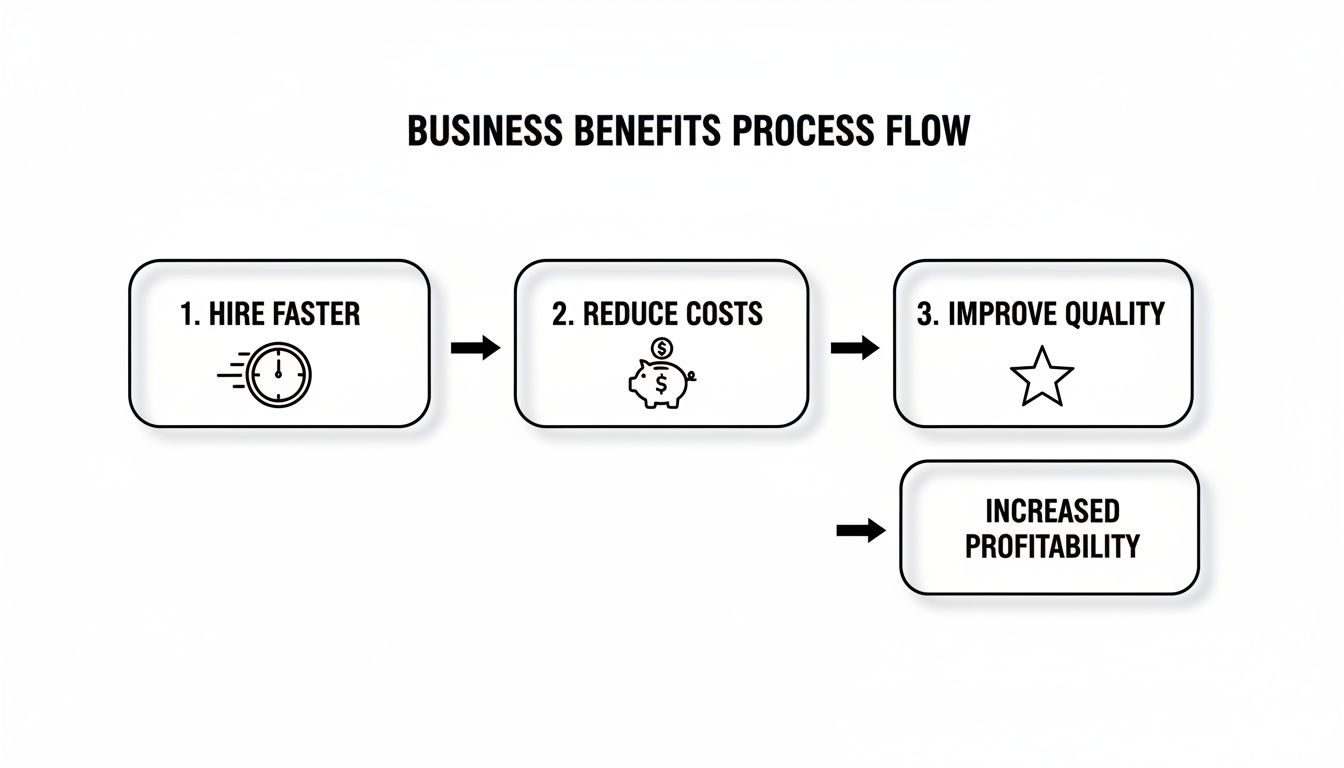
As you can see, it’s designed to create a positive feedback loop: hiring faster at a lower cost leads directly to better talent, which in turn fuels business growth.
Phase 4: Change Management and Go-Live
The final—and arguably most important—phase is all about the people. Change, especially this kind of change, can stir up resistance. Internal teams might worry that their roles are on the line. This is where proactive and transparent communication is everything.
Frame this as an evolution, not a replacement. Your internal talent acquisition team can be freed up to focus on more strategic work, like strengthening your employer brand or building leadership pipelines. A smooth go-live, backed by solid training and open communication, sets the stage for a successful, long-term partnership.
Choosing the Right Strategic Partner

Picking a provider for your end-to-end hiring solutions for enterprises is far more than a simple vendor purchase; it’s a long-term strategic decision. Think of it like choosing a co-pilot for your company’s growth journey. You need someone who not only understands the destination but can also navigate the inevitable turbulence along the way.
This choice will have a profound impact on your ability to attract, hire, and keep the talent you need to win in your market. The right partner becomes a true extension of your team, deeply woven into your business strategy and culture. The wrong one, however, can lead to misaligned goals, a poor candidate experience, and ultimately, a failed investment. A thorough, thoughtful evaluation process is non-negotiable.
Core Technical and Industry Expertise
First things first, you need to look at their hard skills and what they’ve actually accomplished. A potential partner’s track record and deep industry knowledge are the foundation of your decision. You need real assurance that they have successfully navigated the unique challenges of your sector, whether that’s technology, manufacturing, or financial services.
Dig into their expertise in sourcing for roles that are critical to your business. Do they have established talent pipelines for those niche, hard-to-fill positions? A provider with only generic experience will likely struggle to deliver the high-quality candidates you need at scale.
Beyond that, their technology stack is a critical piece of the puzzle. Leading solutions now integrate AI across the hiring lifecycle, which can lead to a 42% improvement in time-to-hire. Your partner must be equipped with modern tools for sourcing, screening, and analytics to drive efficiency and give you actionable insights into the talent market.
Evaluating Cultural Alignment and Partnership Governance
Beyond the technical capabilities, the ‘softer’ side of the partnership is every bit as important. Cultural alignment is the glue that holds the entire relationship together. Remember, your RPO provider’s team will be representing your employer brand to the world. Their values and communication style must be a mirror of your own.
A strong governance model is also essential for any long-term success. This framework needs to clearly define roles, responsibilities, communication protocols, and the metrics you’ll use to measure performance. It ensures everyone is on the same page about what success looks like and how you’ll work together to get there.
A partnership built on transparency and shared goals is resilient. When challenges arise, this foundation allows for collaborative problem-solving rather than finger-pointing, ensuring the focus remains on delivering strategic value to the enterprise.
To really get to the heart of this alignment, you need to ask pointed questions during the selection process. Probing beyond the polished sales pitch will reveal their true partnership philosophy.
- “How will you ensure your recruiters understand and authentically represent our employer brand?” This question tests their actual process for cultural immersion and brand training.
- “Can you walk us through your performance management process for the recruiters assigned to our account?” This gives you a clear insight into their quality control and accountability measures.
- “Describe a time when a client partnership faced a significant challenge. How did you manage it?” This uncovers their approach to conflict resolution and shows their real commitment to a client’s success.
Choosing the right strategic partner is all about finding that perfect balance between proven expertise and genuine cultural synergy. This careful selection process is the first—and most critical—step in unlocking the full potential of an end-to-end hiring solution.
Common Implementation Pitfalls and How to Avoid Them
Making the switch to an end-to-end hiring solution for enterprises can be a game-changer, but let’s be honest—it’s not always a walk in the park. Even the best-laid plans can hit a few bumps. Knowing where the common potholes are is the best way to steer clear of them and make sure your new partnership pays off right from the start.
A smooth rollout really comes down to managing expectations, getting everyone on board, and keeping the lines of communication wide open. If you drop the ball on any of these, you risk creating friction that can derail the whole project before it even gets going.
Misaligned Success Metrics
One of the fastest ways for a new RPO partnership to go sideways is when you and your provider are running toward different finish lines. Imagine your internal team is obsessed with the quality-of-hire, but the provider’s contract incentivises them purely on time-to-fill. That’s a recipe for instant conflict and frustration.
The fix? You need to build a shared definition of success before the contract is even signed. This gets both teams pulling in the same direction.
- Establish Shared Goals: Work together to define what a “win” looks like. This should be a mix of speed, cost, and, most importantly, the calibre of the talent you bring in.
- Regular Performance Reviews: Set up frequent check-ins to see how you’re tracking against these shared goals. Be ready to tweak your strategy if something isn’t working.
When you get this right, your RPO provider stops being just a vendor hitting targets and becomes a genuine partner invested in your business outcomes.
Internal Team Resistance
It’s only natural for your existing talent acquisition (TA) team to feel a bit defensive. They might see an RPO partnership as a threat to their jobs. This anxiety can bubble up as passive resistance, a lack of cooperation, or a hesitation to share critical knowledge about how things really work—all of which can grind the implementation to a halt.
You have to tackle this head-on with open and early communication.
The smartest implementations don’t frame RPO as a replacement, but as an upgrade for the internal team. By handing off the high-volume, admin-heavy tasks, you free up your TA experts to focus on the strategic work that really moves the needle.
Instead of working around your team, bring them into the fold.
- Co-create the Plan: Get their input right from the design phase. They know the current processes, politics, and pain points better than anyone.
- Redefine Internal Roles: Show them what’s next. Work together to map out new, more strategic responsibilities, like focusing on employer branding, succession planning, or internal mobility.
- Highlight the “What’s In It For Me”: Make it clear that this partnership gives them better tools, better data, and more support, empowering them to make a bigger impact.
Poor Communication with Hiring Managers
At the end of the day, hiring managers are the ultimate customers of your recruitment process. If they feel out of the loop with the new RPO model or can’t connect with the external recruiters, the whole system falls apart. A classic complaint is that the RPO recruiters just don’t “get” the specific needs of their team.
You have to build strong lines of communication from day one. Set up formal kickoff meetings between the RPO recruiters and your key hiring managers. The goal is to build a real rapport and a deep understanding of what each team is looking for. This kind of proactive engagement is what ensures your new end-to-end hiring solution for enterprises is truly embraced, not just tolerated.
Answering Your Key Questions
Making the move to a full-scale hiring solution is a big decision, and it’s only natural to have some pressing questions. Before any enterprise leader commits to a partnership like this, they need total clarity. Let’s tackle the most common concerns head-on.
Most of the worries we hear boil down to three things: what this will actually cost, the fear of losing control over a critical part of the business, and the practicalities of fitting an external partner into an already established company culture.
Will We Lose Control Over Our Hiring Process?
This is probably the biggest myth out there—that outsourcing recruitment means you’re just handing over the keys. The truth is, a modern RPO partnership is about gaining a much more strategic kind of control. You aren’t walking away; you’re bringing in a specialist to run the engine while you continue to steer the ship.
You and your leadership team will always own the most important parts of the process:
Final Hiring Decisions: The RPO partner does the heavy lifting, presenting a shortlist of top-tier, fully vetted candidates. But your hiring managers will always, always make the final call.
Cultural Fit and Core Competencies: You define what a successful employee looks like at your organisation. The partner’s entire job is to find people who perfectly match that benchmark.
Headcount and Strategy: Your business goals drive the hiring plan—how many people you need and what kind of roles you’re filling. The partner is there to execute that strategy, not create it.
Think of it this way: you’re shifting from micromanaging tasks to managing outcomes. You gain ultimate control over the results.
How Does an RPO Partner Integrate with Our Team?
Bringing an external team into the fold might seem complicated, but a successful RPO model is built from the ground up for seamless collaboration. The whole point is for the RPO provider to feel like a natural extension of your own HR department, not some disconnected third party.
This is done through a really structured approach that puts communication and shared goals first. The RPO provider’s recruiters get intensively trained on your company culture, your values, and your employer brand. They learn to speak your language so they can represent you authentically in the job market.
They’ll work side-by-side with your hiring managers and internal talent acquisition team, often using the same systems and communication channels to make sure everyone is perfectly aligned.
A partnership like this is designed to augment, not replace, your internal team. By taking on the high-volume, operational work, the RPO frees up your own experts to focus on higher-value activities like succession planning, leadership development, and improving employee retention.
Is This Solution Cost-Effective for an Enterprise?
It’s definitely a significant investment, but a well-executed end-to-end hiring solution for enterprises is designed to deliver a powerful return. The cost-effectiveness really shines through in a few key areas. First, it brings all your recruitment spending under one roof, getting rid of those high, unpredictable fees you’re likely paying to multiple contingency agencies.
Second, the efficiency gains are huge. By optimising the entire process with better technology and specialised recruiters, a good partner can dramatically reduce metrics like time-to-hire. Getting a revenue-generating employee into their role weeks or even months faster has a direct, measurable impact on your bottom line.
This strategic approach transforms recruitment from a reactive cost centre into a predictable, value-driving investment.
Ready to transform your talent acquisition into a strategic powerhouse? Taggd delivers bespoke RPO solutions designed for enterprise scale and success. Discover how we can help you build the teams you need to win your market by visiting us at https://taggd.in.