By 2026, the engineering talent shortage won’t just be another recruitment headache for Chief Human Resources Officers (CHROs); it’s shaping up to be a direct threat to business survival. There’s a massive, widening gap between the soaring demand for specialised skills in areas like AI, cloud, and data, and the actual number of people who have them.
This isn’t just a hiring problem. It’s a supply chain crisis for your company’s most important asset: its people.
The 2026 Engineering Talent Crisis: A Strategic Overview For CHROs
The challenge sitting on the CHRO’s desk is immense. Technology is moving so fast that specialised engineering roles are now the bedrock of innovation, growth, and even just keeping the lights on. The problem is, the talent pipeline hasn’t kept up.
This has created a fierce battle for a tiny pool of qualified candidates, which naturally drives salaries through the roof and puts projects at risk of delays and missed opportunities. For HR leaders, seeing this as just another hiring challenge is a huge strategic mistake. The shockwaves are felt everywhere, from product development timelines to the company’s long-term competitive edge.
Understanding the Scale of the Mismatch
The disconnect between what the industry needs and the talent available is stark, especially in the newest fields. Take India, for instance, where the shortage for AI roles has hit a critical point. It’s estimated there’s only one qualified engineer for every ten generative AI jobs.
This massive imbalance is fuelled by soaring salary inflation and a lack of infrastructure for advanced training. The result? A tiny fraction, just 15-20% of the workforce, has the skills to be considered “AI-ready.” This situation lays bare a fundamental problem: our traditional education systems and corporate training programmes simply can’t produce the right talent, fast enough.
The engineering talent shortage is no longer a “future” problem, it’s here, and it’s messing with strategic planning right now. CHROs have to shift from reactive recruiting to proactive workforce architecture. You have to build the teams you’ll need for tomorrow, today.
Key Dimensions of the 2026 Engineering Talent Shortage
To get a handle on this, CHROs need to understand the core challenges and what they mean for the business right now. The table below breaks down the key dimensions of the crisis. Think of it as your starting point for building a more resilient talent strategy.
| Challenge Area | Primary Driver | Immediate CHRO Implication |
|---|---|---|
| Skill Obsolescence | Rapid technological change (AI, Cloud) | Existing training programmes are outdated; urgent need for upskilling. |
| Supply-Demand Gap | Insufficient graduates in high-demand fields | Intense competition for talent, driving up recruitment costs and timelines. |
| Salary Inflation | Fierce competition for a small talent pool | Budget overruns for compensation and benefits, impacting overall profitability. |
| Geographic Disparity | Talent concentrated in specific tech hubs | Need for robust remote work policies and global sourcing strategies to access talent. |
| Educational Lag | University curricula slow to adapt | New hires require extensive on-the-job training, increasing onboarding costs. |
Getting to grips with these dimensions is the first step toward turning a potential crisis into a lasting competitive advantage. For a deeper analysis of future employment trends, our guide on India’s job market predictions for 2026 offers some valuable insights.
Unpacking the Real Reasons for the Engineering Skill Shortage
To get a handle on the engineering talent crunch, CHROs need to look past the obvious symptom of “not enough candidates”. The issue runs much deeper, fuelled by three powerful forces all hitting at once. Simply throwing more money at recruitment is like trying to fill a leaky bucket; you’re not fixing the holes that are causing the problem in the first place.
Getting to the bottom of these root causes is the first real step towards building a talent strategy that will actually work in 2026 and beyond. Think of it like a doctor diagnosing an illness before writing a prescription. We need to figure out why the skills you desperately need are so hard to find, and it all starts with the breakneck speed of technology itself.
The Blistering Pace of Technology
The biggest driver is, without a doubt, the sheer speed of technological change. Skills that were top-of-the-market just a few years ago are quickly becoming yesterday’s news. The explosion in fields like generative AI, cloud-native development, and machine learning has created a whole new set of demands that the talent market simply wasn’t ready for.
Consider this: a software engineer with ten years of experience in older programming languages might suddenly be less valuable than a fresh graduate who’s an expert in MLOps or containerisation tools like Kubernetes. This isn’t a gentle evolution; it’s a complete shake-up of the entire skills landscape.
The half-life of a technical skill is now pegged at less than two and a half years. That means nearly half of what an engineer knows today will be out of date in under 30 months. Continuous learning isn’t a perk anymore; it’s a basic job requirement.
This rapid skill decay means your current team and the wider talent pool are constantly playing catch-up. It’s a treadmill that’s only getting faster, making proactive upskilling an absolute must for corporate survival.
The Chronic Gap Between Campus and Corporate
The second major issue is the long-standing disconnect between what universities teach and what the industry actually needs. While academic institutions are great at teaching the fundamentals of computer science, they often lag years behind the real-world requirements of a modern tech stack.
Most engineering programmes just aren’t set up to produce graduates who can hit the ground running with the tools and methods businesses use today.
- Practical Skills Gap: Graduates might understand algorithms in theory, but they often lack hands-on experience with CI/CD pipelines, cloud platforms like AWS or Azure, or specific data engineering frameworks.
- Outdated Curricula: It takes so long to get new courses approved at a university that by the time a technology is taught, the industry has often moved on to the next big thing.
- Theory Over Practice: Many programmes still focus heavily on theoretical knowledge, not the practical, agile development practices that are the bread and butter of today’s engineering teams.
This mismatch forces companies to pour time and money into extensive training for new hires, essentially finishing the job the universities started. For a CHRO, that means longer ramp-up times and higher initial costs for every junior engineer you bring on board.
What Top Engineers Really Want Has Changed
Finally, the very idea of what makes a “good job” has completely changed for elite engineers. With talent so scarce, the power has shifted. Top performers are no longer just chasing the biggest paycheque. They’re looking for a total package that goes way beyond salary.
This new mindset means old-school recruitment tactics are losing their punch. Offering more money might win you a candidate for now, but it won’t buy you long-term loyalty or engagement.
Here’s what they’re looking for today:
- Constant Learning and Growth: The best engineers want to tackle tough problems with modern tools. They gravitate towards employers who will invest in their skills to keep them sharp and relevant.
- Work That Matters: They want to see a clear line from their code to the company’s success or a bigger social impact. They need to feel like they’re building something meaningful.
- Flexibility and Trust: The demand for remote or hybrid work isn’t just a “nice-to-have” anymore. For a huge part of the talent pool, it’s a deal-breaker.
If you fail to meet these new expectations, you won’t just struggle to hire. You’ll end up creating a revolving door for the very engineers you can’t afford to lose.
The Real Business Cost of Unfilled Engineering Roles
An empty seat in your engineering department isn’t just an HR problem, it’s a silent drain on your company’s finances and future. The engineering talent shortage is much more than a recruitment headache. Every unfilled position creates a ripple effect that touches every corner of the business, from product development and innovation right through to market share.
For CHROs looking towards 2026, framing this cost in stark business terms is the only way to get the C-suite’s attention and secure the investment needed for smarter talent strategies.
Think of each vacant role as a leaky pipe in your innovation pipeline. With every day that a critical position stays open, a little more pressure is lost. This slowdown isn’t just a concept; it translates directly into delayed product launches, missed feature updates, and a sluggish response to market demands. While your teams are stretched thin, more agile competitors who have managed to secure the right talent are pulling ahead and winning the customers that should have been yours.
From Innovation Lag to Revenue Loss
The most direct hit from unfilled engineering roles is to your organisation’s ability to innovate and deliver. When key projects are understaffed, timelines stretch out and strategic goals get pushed further into the future. This isn’t just an internal frustration; it has serious external consequences.
- Delayed Product Launches: An open Senior Developer role can easily postpone a new product release by months, costing millions in potential revenue and giving competitors a crucial head start.
- Vulnerability to Competitors: A lack of cybersecurity engineering talent leaves your organisation exposed to threats. A shortage of AI specialists means you fall behind in creating the smarter, more predictive products your customers now expect.
- Stifled Innovation: Your existing engineers, already overburdened, are forced to focus on maintenance and keeping the lights on. This leaves no time for the creative, forward-thinking work that drives real, long-term growth.
This innovation deficit is particularly painful in high-growth sectors. India’s AI job market, for example, is booming and projected to hit nearly 380,000 positions in 2026. The catch? The demand for AI professionals could surge to one million by the end of that year, creating a massive gap that leaves businesses scrambling to stay relevant.
The Hidden Financial Fallout
Beyond the obvious opportunity costs, the financial drain is significant and comes from many angles. The direct expenses of recruitment are just the tip of the iceberg. The indirect costs are often far greater and much harder to track.
Every unfilled technical role can cost a company more than its annual salary in lost productivity and opportunity. This isn’t just an HR metric; it’s a direct hit to the bottom line that the CFO and CEO need to understand.
Just look at the compounding financial pressures:
- Soaring Recruitment Costs: In a desperate bid to fill roles, companies are forced to pay premium fees to recruitment agencies, often exceeding 20-30% of the first year’s salary for a single hire.
- Inflated Salary Demands: It’s a candidate’s market. Scarce talent can command significantly higher salaries, leading to wage inflation across the entire engineering department and putting immense strain on compensation budgets.
- Team Burnout and Productivity Loss: Your current engineers are forced to pick up the slack, which leads to burnout, lower-quality work, and an increased risk of costly errors. This overburdened environment also fuels higher employee turnover, creating a vicious cycle of recruitment.
By connecting these dots, CHROs can build a compelling business case that transforms the conversation from “we need to hire more engineers” to “we must invest in our talent strategy to protect our revenue and secure our future.”
How to Build Your 2026 Engineering Workforce
The old playbook of reactive hiring is officially broken. Facing the engineering talent crunch of 2026 means we have to stop waiting for the perfect candidate to fall into our laps and start proactively designing the workforce we need.
CHROs need to shift their mindset from filling jobs to building a resilient talent ecosystem. The most effective way to do this is with a dynamic, three-pronged framework: Build, Buy, and Borrow. This isn’t about picking one lane; it’s about blending all three into a cohesive strategy that can pivot as fast as the market does.
Think of it this way: you might be building your next generation of AI specialists from the ground up, buying a niche cybersecurity expert for a critical new role, and borrowing a team for a short-term cloud migration project. The goal is agility having the right skills in the right place, right when you need them.
The cost of inaction is steep. An empty engineering seat isn’t just a nuisance; it’s a ticking financial time bomb, as this decision tree illustrates.
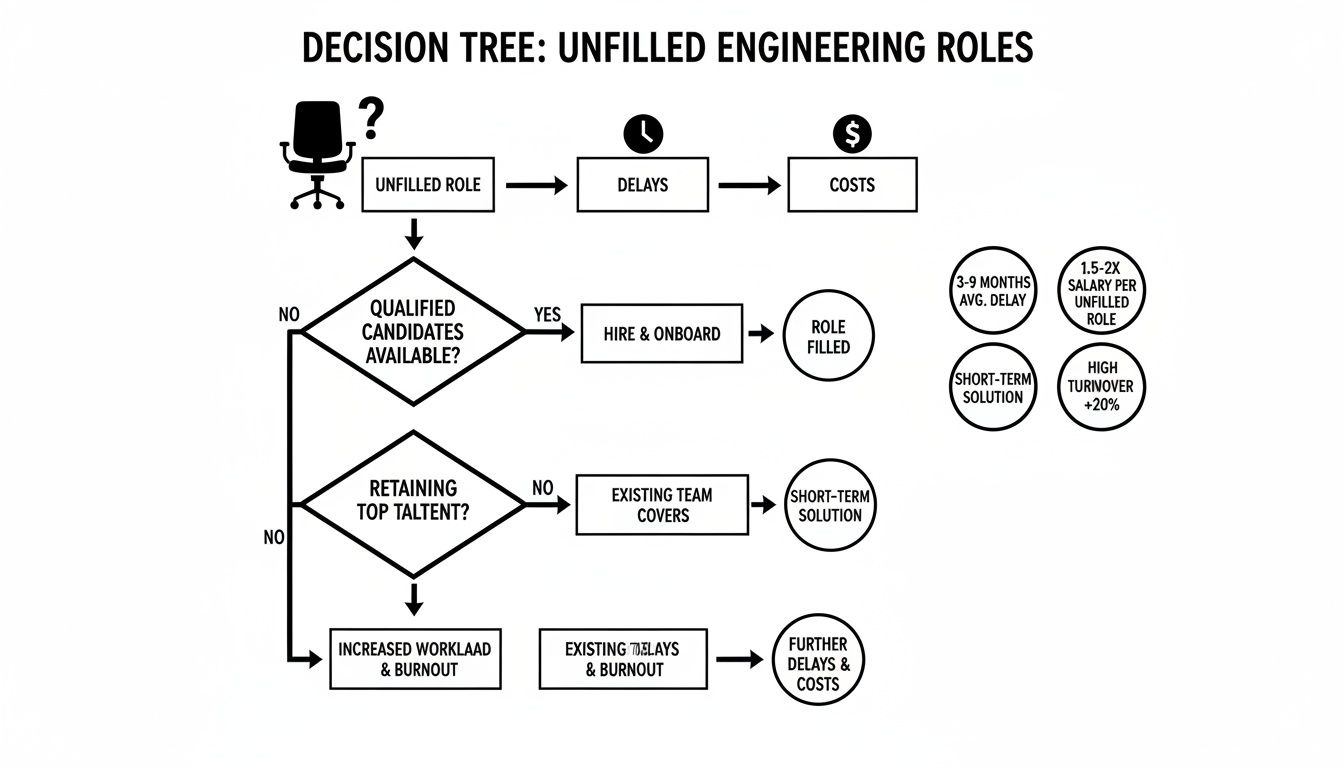
This flowchart shows the direct line from a vacant role to project delays, which inevitably snowball into serious financial consequences for the business.
The Build Strategy: Cultivating Talent from Within
The most sustainable way to close skill gaps is by developing the talent you already have. The “Build” strategy is all about aggressive upskilling and reskilling programmes that transform your current employees into the engineering team you need tomorrow.
This is more than just training; it’s a long-term investment in your people that pays huge dividends in loyalty, capability, and priceless institutional knowledge. It’s how you directly combat skill obsolescence and create a culture where continuous learning is simply how things are done.
Investing in your internal talent is your best defence against a volatile market. It sends a powerful message that you value your people’s potential and are committed to their career growth, which is a massive retention driver.
To get a successful build strategy off the ground, start here:
- Skill Gap Analysis: Use talent intelligence tools to map your current team’s skills against your future strategic needs. Where are the biggest holes? MLOps, data engineering, cloud architecture? Pinpoint them.
- Targeted Training Programmes: Don’t boil the ocean. Partner with specialised training providers or build in-house academies to deliver focused learning on the highest-demand technologies.
- Mentorship and Project-Based Learning: Nothing accelerates development like real-world experience. Pair junior employees with senior engineers and get them working on projects that will stretch their abilities.
The Buy Strategy: Redefining Talent Acquisition
The “Buy” strategy is no longer just about filling open reqs. It’s a strategic hunt for the external talent that will give you a decisive competitive edge. For 2026, this means getting out of the “post and pray” cycle and into proactive sourcing, building talent communities, and using technology to find top performers before they even hit the market.
In India’s current climate, the shortage is especially painful for roles like full stack, frontend, and AI/ML specialists. Demand for modern skills like React, Node.js, and AWS massively outstrips supply, with over 50% of all IT hiring now focused on these niche areas.
To modernise your “Buy” approach, focus on these three areas:
- Proactive Sourcing: Use AI-powered tools to scan professional networks, open-source project contributions, and online communities to find passive candidates with the exact skills you need.
- Building Talent Communities: Don’t just transact; build relationships. Create a network of potential future hires by hosting webinars, sponsoring meetups, and sharing valuable content. Engage with them long-term, so your company is their first choice when they decide to move. For more ideas, check out our guide on how to build an effective talent pipeline.
- Data-Driven Recruitment: Stop guessing. Analyse market data to understand salary benchmarks, competitor hiring patterns, and geographic talent hotspots. This intelligence will help you make smarter, faster hiring decisions.
The Borrow Strategy: Accessing Skills On-Demand
Finally, the “Borrow” strategy is your key to organisational flexibility. This is about strategically bringing in contractors, freelancers, and consultants to fill immediate skill gaps, manage workload peaks, or access hyper-specialised expertise for specific projects.
Think of borrowed talent as your special operations team. You bring them in for a specific mission, like a complex system integration or a rapid app development sprint and they provide an immediate injection of skill and experience. It allows your organisation to stay agile, scaling your engineering capacity up or down as business needs change without the overhead of permanent hires. This is especially powerful for tapping into expertise in emerging fields where finding permanent talent is next to impossible.
Deciding between these three strategies can be tough, as each comes with its own trade-offs in terms of speed, cost, and long-term impact. This table breaks down the core differences to help you make the right call for any given situation.
Build vs. Buy vs. Borrow: A Strategic Comparison for CHROs
| Strategy | Best For | Time to Impact | Cost Implication | Long-Term Value |
|---|---|---|---|---|
| Build | Developing core, long-term capabilities and fostering loyalty. | Slow (6-24 months) | Lower initial cash outlay, high time investment. | High. Creates institutional knowledge and improves retention. |
| Buy | Acquiring critical, hard-to-find skills for immediate impact. | Moderate (2-6 months) | High acquisition costs (fees, salaries). | Moderate. Fills immediate gaps but risks cultural mismatch. |
| Borrow | Short-term projects, specialised expertise, and managing demand peaks. | Fast (Days-Weeks) | High hourly/project rates, low overhead. | Low. Solves immediate problems but knowledge leaves with the talent. |
Ultimately, the strongest workforce plans don’t choose one path. They artfully combine building for the future, buying for today’s critical needs, and borrowing for ultimate flexibility. By mastering this blend, CHROs can ensure their engineering teams are always ready for what’s next.
Rethinking Your Employer Value Proposition to Keep Top Engineers

In the fierce battle for engineering talent, the best offence is a rock-solid defence. While smart recruitment gets people in the door, retention is what truly shields your business from the constant threat of skills gaps. Winning here means going far beyond competitive salaries; it demands a complete overhaul of your Employer Value Proposition (EVP).
Think of your EVP as the promise you make to employees for their expertise and hard work. For top-tier engineers in 2026, that promise needs to be about more than just money. They’re looking for an ecosystem where they can grow, tackle meaningful challenges, and have their skills respected. If your EVP is still dangling outdated perks, you’re already losing.
The best engineers are wired to solve tough problems with cutting-edge tech. An EVP that actually connects with them must be built on pillars they care about: professional growth, work that matters, and a genuine culture of engineering excellence.
Moving Beyond the Paycheque
A fair salary is just the starting point-it’s table stakes now. Today’s engineers size up an opportunity based on its growth potential and the quality of the work environment. They need to know their contributions are making a difference and that they won’t be stuck doing the same thing two years from now.
A powerful EVP acts like a talent magnet. It not only pulls in the right candidates but holds them firmly in place by creating an environment where they can do their best work and see a clear future for themselves.
To build an EVP that makes your best engineers want to stay, zoom in on these three critical areas:
- Clear Career Pathways: Engineers need to see a future that doesn’t force them into management. Create technical leadership tracks that let senior individual contributors grow their influence and salary without ever leaving hands-on work.
- Opportunities for Impactful Work: Draw a straight line from their daily code to the company’s bottom line. Give them ownership over projects that push their skills and deliver real, tangible value to your customers.
- A Culture of Engineering Excellence: This is about investing in the best tools, fostering true collaboration, and slashing the bureaucratic red tape that kills creativity and grinds development cycles to a halt.
The Role of Flexibility and Modern Tooling
By 2026, flexibility isn’t a perk; it’s a core part of any competitive EVP. Remote and hybrid work aren’t just about convenience-they are strategic moves that blow the doors off your talent pool, letting you hire beyond the usual tech hubs. Offering real flexibility gives you access to a global reservoir of skills.
Just as critical is your investment in the developer experience. Handing your engineers the latest tools, powerful hardware, and seamless workflows is a direct investment in their happiness and productivity. Nothing screams “we don’t value our engineers” louder than a slow laptop or a clunky internal system.
Auditing Your Current Engineering EVP
To figure out where to make high-impact changes, you need to conduct an honest audit of what you currently offer. Use this checklist to find your strengths and weaknesses and start turning your company into a place where great engineers come to build their careers.
- Career Growth: Do we have dual career ladders for both management and senior technical roles?
- Learning & Development: Is there a dedicated L&D budget for advanced technical certifications and must-attend conferences?
- Project Impact: Is it obvious how an engineer’s work directly helps customers and achieves company goals?
- Technology & Tools: Are we giving them best-in-class hardware and software, or are we creating friction?
- Work Flexibility: Do our remote/hybrid policies actually work, or do they create a divide between on-site and remote staff?
- Engineering Culture: Is our culture built on trust and autonomy, or is it bogged down by micromanagement and endless meetings?
Answering these questions head-on will expose the gaps in your EVP. More importantly, it will give you a clear roadmap to create an environment that doesn’t just attract the engineering talent you need to succeed, but keeps them for the long haul.
How a Strategic RPO Partner Can Solve Your Talent Puzzle
Trying to solve the persistent engineering talent shortage with only your internal team is like trying to build a skyscraper with a handful of tools. It requires specialised expertise, serious resources, and a focused game plan. For many already-stretched HR teams, a Recruitment Process Outsourcing (RPO) partner can be the game-changer you need, solving the talent puzzle with both precision and scale.
Forget the old idea of a recruitment agency that just flips CVs over the fence. A modern RPO is an embedded extension of your own team. They dive deep into your company’s culture and goals, managing the entire talent journey from the first touchpoint right through to onboarding. This partnership model is purpose-built for the complexities of the 2026 talent market.
Beyond Traditional Recruitment
A strategic RPO partner brings a level of focus and tech-savviness that most in-house teams simply can’t maintain. They are specialists in the art and science of finding scarce talent, moving way beyond just posting a job and hoping for the best.
Their real value is in running a proactive, multi-channel strategy that gets results.
- Advanced Sourcing Technology: RPO providers use sophisticated tools to scan the entire market for passive candidates-those top-tier engineers who aren’t actively job hunting but are open to a great opportunity.
- Proactive Talent Pipelining: They aren’t just filling today’s open roles. RPOs build and nurture entire communities of talent for your future needs, ensuring you have a ready supply of qualified candidates for critical roles like AI specialists or cloud architects.
- Crucial Market Intelligence: An RPO gives you a real-time window into the talent landscape. They provide hard data on salary benchmarks, what your competitors are doing, and emerging skill trends to keep your strategy sharp.
This dedicated focus allows them to connect with high-demand candidates in a way that a busy internal team, juggling multiple priorities, often can’t. You can take a closer look at how Recruitment Process Outsourcing can improve hiring results in our detailed guide.
Freeing Your Team for Strategic Impact
When you entrust the day-to-day grind of recruitment to an RPO, you give your internal HR leaders their time back. This creates the bandwidth they need to focus on bigger, more strategic priorities. While your RPO partner handles the nitty-gritty of sourcing, screening, and scheduling, your team can concentrate on what really matters: workforce planning, improving retention, and developing the next generation of leaders.
An RPO partnership fundamentally shifts your HR function’s role from reactive order-taker to proactive business advisor. It allows you to architect the future workforce while your partner ensures you have the talent to build it.
This strategic division of labour is absolutely essential for navigating the ongoing engineering talent crunch. It ensures the operational demands of hiring don’t push your long-term vision to the back burner. With a dedicated partner handling the complex, time-consuming work, your organisation gains the agility and expertise needed to attract and win the best engineering minds in a fiercely competitive market.
Frequently Asked Questions
When you’re staring down the barrel of the 2026 engineering talent shortage, you need clear answers, not corporate jargon. Here are the questions we hear most often from CHROs and our straight-to-the-point advice.
What Is the Single Biggest Mistake CHROs Make?
The most dangerous mistake is seeing this as just another recruitment challenge. It’s not. It’s a fundamental, long-term shift in the market.
Too many leaders throw money at the problem-bigger recruitment budgets, inflated salaries-thinking they can hire their way out of it. These are just short-term patches on a structural wound. This reactive approach completely misses the real issues: skills are becoming obsolete faster than ever, and what engineers want from a job has changed for good.
The only way forward is a proactive strategy. You need to focus on building the talent you already have and creating an employer brand that actually means something.
The real mistake is believing this is someone else’s problem to solve. CHROs have to own this. It’s not just an HR issue; it’s a core business risk that hits everything from revenue and innovation to your standing in the market.
How Can We Compete with Tech Giants for Talent?
Let’s be honest, you probably can’t win a bidding war with a global tech giant. And you don’t have to. You can win on culture, impact, and genuine growth opportunities. The best engineers are often looking for a place where they can make a real difference, not just be another cog in a massive machine.
Here’s how you can stand out:
- Ownership and Impact: Let your engineers own their projects from start to finish. Make sure they can see exactly how their work moves the needle for the company. That’s a powerful motivator.
- Career Growth: Don’t assume everyone wants to be a manager. Create clear, rewarding technical career paths that let your senior experts continue to grow and be recognised for their mastery.
- Flexibility and Autonomy: Offer real remote or hybrid options. This isn’t about tracking keystrokes; it’s about building a culture of trust and empowering people to do their best work, wherever they are.
Is Upskilling Really More Effective Than Hiring Externally?
Yes. Over the long haul, investing in your own people is almost always the smarter, more cost-effective play.
Going out and “buying” talent might plug a hole today, but it’s expensive. You’re paying high recruitment fees, dealing with long ramp-up times, and always running the risk that the new hire won’t be the right fit for your culture.
When you “build” your talent from within, the benefits multiply. You boost loyalty, you hold onto crucial company knowledge, and you create a culture where everyone is constantly learning and improving. A smart strategy will always use a mix of both, but making your internal talent pipeline the priority is how you build a team that can weather the engineering shortages of 2026 and beyond.
Partner with Taggd to build an engineering workforce that’s ready for the future. Our strategic RPO solutions are built to tackle your toughest talent problems, making sure you have the skills you need to innovate and grow. Learn how we can help you win the war for talent at Taggd.