An enterprise RPO cost isn’t a single, flat fee. It’s a blend of management charges, performance incentives, and technology costs, all customised to what your organisation actually needs to hire. This model shifts your recruitment spend from unpredictable, one-off agency fees to a more strategic, manageable investment. The real magic isn’t just in the numbers, but in understanding how this structure drives efficiency and elevates the quality of your talent over time.
Why RPO Cost Is More Than Just a Price Tag
Getting to grips with an RPO cost structure is about more than just managing expenses; it’s a strategic decision to build a powerful and efficient talent engine for your business.
Too many organisations still see recruitment as a jumble of individual costs—job board subscriptions here, agency fees there, and recruiter salaries somewhere in between. This fragmented approach almost always leads to wasted effort and a serious lack of oversight.
Think of traditional recruiting like having a dozen freelance chefs crashing around a chaotic kitchen. Each one is doing their own thing, leading to inconsistent quality, duplicated work, and costs that are all over the place. There’s no central strategy, making it impossible to control the final outcome or the total bill.
An RPO partnership, on the other hand, is like bringing in an executive chef to orchestrate the entire culinary operation. They manage everything from sourcing the finest ingredients (candidates) to delivering a perfectly executed dish (a top-quality hire). The whole process becomes streamlined, consistent, and strategically aligned with your business goals.
Shifting from a Cost Centre to a Value Driver
The right RPO financial model helps transform recruitment from a reactive cost centre into a proactive, value-driving function. You stop just paying to fill seats and start investing in a system designed to improve critical business metrics. For any Chief Human Resources Officer (CHRO) aiming to secure a competitive talent advantage, this distinction is everything.
To make this leap, leaders must look beyond the initial price tag and focus on the total cost of talent. This means evaluating:
- Cost-per-hire: How an RPO can drive this metric down through sheer economies of scale.
- Time-to-fill: The real business impact of getting critical roles filled faster.
- Quality-of-hire: The long-term value that comes from bringing in top performers who actually stick around.
- Employer branding: The often-overlooked benefit of a consistently professional candidate experience.
By focusing on the entire talent lifecycle, an RPO partner helps organisations move beyond transactional hiring. The goal is to build a sustainable talent pipeline that supports long-term growth and delivers measurable return on investment.
The Global Context of RPO Investment
Adopting RPO isn’t just a local trend; it’s a global strategic shift. Take India’s Recruitment Process Outsourcing market as an example. It’s a major force, projected to hit $420 million by 2027 with a staggering growth rate of 15.5% CAGR. This shows just how central certain regions are becoming in delivering scalable and cost-effective recruitment solutions worldwide.
Ultimately, a deep understanding of the RPO cost structure is non-negotiable for CHROs. It equips them to have a much more sophisticated conversation about balancing hiring cost versus hiring impact and to build a rock-solid business case for leadership.
Decoding Common RPO Pricing Models
To get a real handle on the enterprise RPO cost structure, you first need to understand the different pricing options on the table. Each model is built for a specific business need and hiring rhythm, a bit like choosing a mobile phone plan. Are you looking for a predictable, fixed monthly bill for steady hiring, or do you need a more flexible, pay-as-you-go approach for when demand fluctuates?
Getting to grips with these models is the crucial first step. It’s how you land on a structure that lines up perfectly with your company’s financial realities and strategic goals. Let’s break down the most common frameworks you’ll come across.
This decision tree shows the crossroads many companies face: sticking with a disjointed, traditional recruitment approach or moving to a more strategic, centralised RPO partnership.
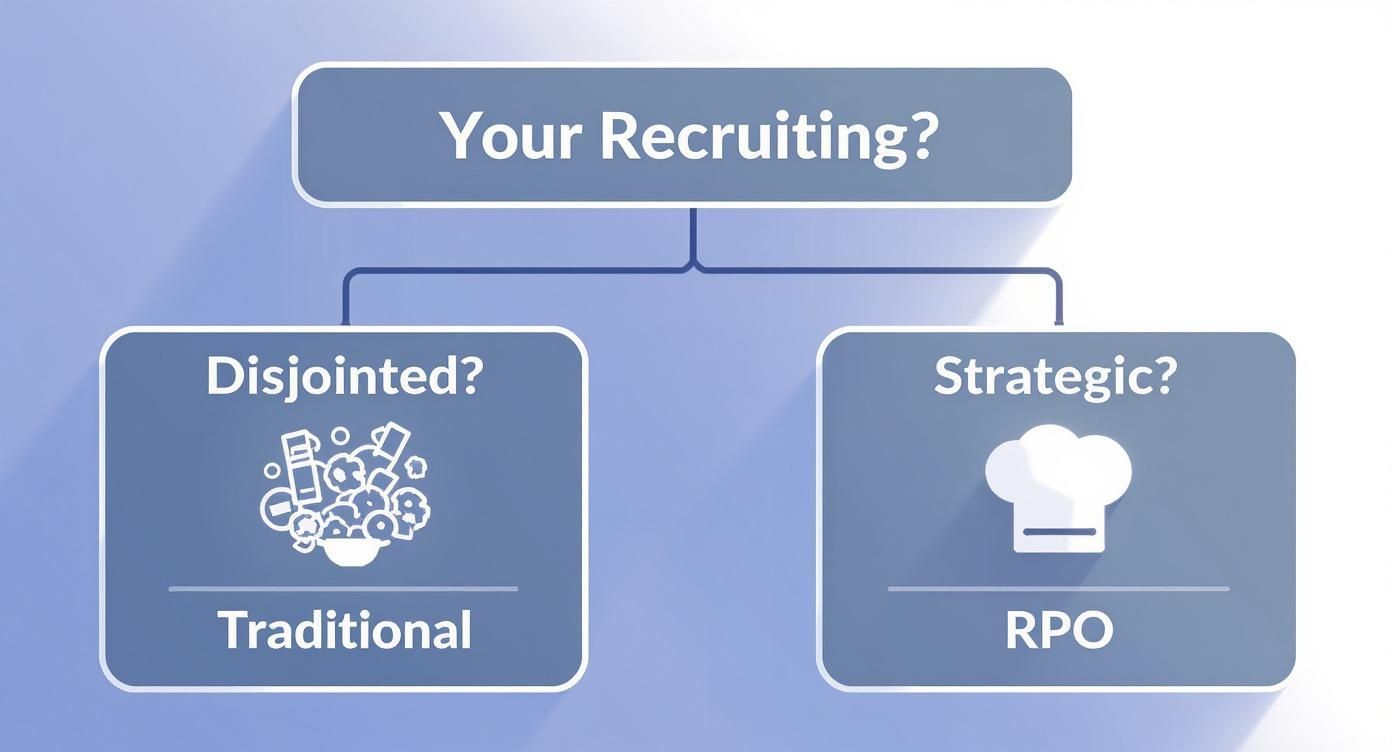
As the graphic shows, a strategic view of talent almost always leads to an RPO model. It offers a structured and managed solution that stands in stark contrast to the often chaotic, traditional methods.
When you start talking to RPO providers, you’ll find that most pricing conversations revolve around four main models. Each one has its place, and understanding the nuances will help you pick the right fit for your organisation.
Comparing Enterprise RPO Pricing Models
| Pricing Model | How It Works | Best For | Key Consideration |
|---|---|---|---|
| Management Fee | You pay a fixed, recurring fee (usually monthly) for a dedicated team and resources. It’s like a subscription for your recruitment function. | Companies with consistent, high-volume hiring needs that require budget predictability. Ideal for steady growth phases. | The scope of work needs to be crystal clear. Any major shifts in hiring volume might mean renegotiating the contract. |
| Cost Per Hire | This is a transactional, pay-for-performance model. You pay a set fee only when a candidate is successfully hired. | Businesses with unpredictable, seasonal, or project-based hiring. It offers maximum flexibility and ties cost directly to results. | Fee per hire can vary based on role complexity. It may be less cost-effective for sustained, high-volume needs. |
| Hybrid | A blend of the two models above. It involves a lower fixed management fee plus a reduced fee for each successful hire. | Organisations looking for a shared-risk partnership. It provides stability for the provider while incentivising performance. | Requires careful calibration of the fixed vs. variable components to ensure the incentives are correctly aligned. |
| Cost Per Slate | You pay the provider to deliver a pre-agreed number of qualified and vetted candidates for a role. Your team handles the final interviews. | Sourcing for niche, hard-to-fill roles where the main challenge is finding top-tier talent, not managing the whole process. | The definition of a “qualified” candidate must be tightly defined to avoid misalignment. The RPO’s job ends at delivery. |
Let’s dive a little deeper into what each of these means in practice.
The Management Fee Model
This is probably the most straightforward and popular model out there. Think of it as a subscription service for your entire recruitment engine. You pay a predictable, recurring fee—usually monthly—for a dedicated team of recruiters, access to technology, and ongoing account management.
This approach gives you fantastic budget predictability, making it perfect for enterprises with consistent, high-volume hiring demands. The fee is typically based on the number of recruiters assigned to your account, the complexity of the roles, and the overall service scope.
- Best for: Organisations that need a stable, long-term recruitment partner and want costs locked in each month. It’s a great fit for companies in a sustained growth phase.
- Key Consideration: The scope has to be nailed down from the start. If your hiring volume suddenly spikes or drops, you’ll likely need to renegotiate the contract to adjust the resources and, of course, the fee.
The Cost Per Hire Model
At the other end of the spectrum is the Cost Per Hire (CPH) model, which is purely transactional. You pay a predetermined fee for each candidate you successfully hire through the RPO provider. This is the ultimate “pay-as-you-go” plan in the RPO world.
This structure gives you maximum flexibility, which is a huge plus for project-based hiring or businesses with lumpy, unpredictable recruitment needs. The fee is often a percentage of the candidate’s annual salary, much like a traditional recruitment agency, but usually at a lower rate because of the partnership’s scale.
This model creates a direct link between cost and outcome. You only pay for successful hires, which perfectly aligns your RPO provider’s financial incentives with your hiring goals. It’s a powerful choice for results-driven engagements.
The Hybrid Model
Why pick one when you can get the best of both? The hybrid model combines the stability of a management fee with the performance-driven focus of a cost-per-hire arrangement.
In a typical hybrid setup, you’ll pay a lower fixed management fee to cover the core team and infrastructure. This is then supplemented by a reduced fee for each successful hire. It’s a balanced approach that offers budget predictability while giving the RPO provider a strong incentive to fill your roles efficiently.
This model is gaining a lot of traction because it feels like a true shared-risk partnership. It ensures the provider has a stable foundation to work from but is still heavily motivated to hit your hiring targets.
The Cost Per Slate Model
A more specialised option, the Cost Per Slate model, is all about sourcing. With this arrangement, you pay the RPO provider for delivering a pre-agreed number of qualified, vetted, and interested candidates for a specific role.
This is fundamentally different from CPH because the RPO’s work is done once they’ve delivered that “slate” of candidates. Your internal team then takes the baton for the final interview and selection process.
- When to Use It: This is a lifesaver for filling those niche, hard-to-fill roles where the biggest headache is just finding top-tier talent. It lets your internal hiring managers focus their valuable time on the most important activity: interviewing a small pool of elite candidates.
- Main Benefit: It dramatically speeds up the top-of-funnel recruitment process, guaranteeing a steady pipeline of quality candidates for critical positions without you needing to commit to a full end-to-end service.
Choosing the right model is a critical decision that will directly shape the success and financial efficiency of your RPO partnership. Your final choice should be a direct reflection of your company’s hiring maturity, recruitment volume, and overarching strategic priorities.
Uncovering the True Value of an RPO Partnership
Judging an RPO contract by its initial quote is like buying a car based only on its paint colour. It completely misses the engineering, performance, and long-term reliability that truly matter. The real financial punch of an RPO partnership isn’t in the upfront numbers; it’s hidden beneath the surface, in strategic gains and savings that a simple cost-benefit sheet will never show.
If you focus too narrowly on a management fee or a cost-per-hire figure, you risk overlooking massive, long-term returns. It’s absolutely critical to look beyond the obvious line items, like lower agency fees, and dig into the more profound financial benefits that a true partner delivers.
The Hidden Costs of an Inefficient Hiring Process
Think about what a long-term vacancy in a critical role really costs your business. Every day that desk sits empty isn’t just a missing teammate. It’s lost productivity, stalled projects, and a mounting burnout risk for the rest of your staff. While studies often point to the direct cost of filling a role, the opportunity cost of that empty chair can be exponentially higher.
Then there’s the painful cost of a bad hire—a massive financial drain. You’re not just out the recruitment expenses. You have to factor in wasted onboarding and training time, not to mention the damage to team morale and output. This is where a strategic RPO partnership starts to prove its real worth.
Moving Beyond Direct Savings to Strategic ROI
A great RPO partner does far more than just fill jobs; they fundamentally optimise your entire approach to talent. This is what unlocks the substantial, yet often underestimated, financial returns.
- Improved Quality of Hire: RPO providers don’t just find candidates; they find the right candidates. They bring sophisticated sourcing tech and rigorous vetting processes to the table, which directly leads to better-quality hires who drive innovation and revenue.
- Reduced Employee Turnover: It’s simple, really. A better hiring process leads to better hires who are a better fit, and they stick around longer. Lowering your attrition rate by even a few percentage points can save a large company millions each year in rehiring and retraining costs.
- Faster Time-to-Fill: RPO partners have dedicated resources and deep talent pools ready to go. They fill roles faster, which means less productivity loss and more stability for your business.
- Strengthened Employer Brand: A professional and positive candidate experience, managed seamlessly by your RPO partner, boosts your reputation in the market. A strong employer brand becomes a magnet for top talent, attracting them organically and reducing your reliance on expensive job ads.
These pieces all fit together, creating a powerful cycle of value. A better brand attracts better people, who become high-quality hires, who stay longer, which in turn drives down your total recruitment spend. The benefits of Recruitment Process Outsourcing go far beyond just cutting costs.
The real business case for RPO isn’t built on what you spend, but on what you gain. It’s about transforming recruitment from a reactive cost centre into a strategic asset that fuels long-term growth.
Quantifying the Financial Impact in Practice
Organisations that get RPO right see these benefits hit their bottom line, hard. In India, for example, enterprise RPO models have delivered incredible cost optimisations. Companies have reported a 40% reduction in direct recruitment costs just by eliminating agency fees and slashing advertising spend.
On top of that, RPO providers often find additional savings of up to 30% by refining internal processes and leveraging economies of scale. This isn’t just theoretical; it’s a proven financial advantage.
By looking at the total picture—from direct savings to the strategic gains from talent quality and retention—you can build a powerful business case that showcases RPO’s true, long-term return on investment.
The Key Drivers That Shape Your RPO Investment
Ever looked at two RPO quotes for seemingly similar needs and wondered why the numbers are worlds apart? The answer isn’t random. It’s a direct reflection of several core variables that shape the entire engagement. Getting a handle on these levers is the key to decoding any proposal and strategically designing a partnership that fits your budget and goals.
Think of it like commissioning a custom-built car. The final price isn’t just about getting four wheels and an engine. It depends on whether you need a high-performance racing engine or a reliable city-driving motor, a basic interior or handcrafted leather seats. The same principle applies directly to your RPO costs.

Let’s break down the primary factors that will dial your overall investment up or down.
Role Complexity and Specialisation
This is arguably the single biggest cost driver. The resources, effort, and expertise required to hire a niche machine learning engineer are fundamentally different from those needed to find a great customer service representative. It’s just not the same game.
- Niche vs. Generalist Roles: Sourcing candidates for highly specialised technical or leadership positions demands senior recruiters with deep industry networks and advanced sourcing tools. This specialised talent on the RPO provider’s side naturally comes at a premium.
- Market Scarcity: If you’re competing for talent in a high-demand, low-supply market—think cybersecurity or data science—the RPO provider has to invest more in sourcing, engagement, and competitive intelligence. That increased effort directly impacts the cost.
For example, an RPO project focused on hiring 50 senior AI developers will carry a significantly higher cost than one for 200 entry-level sales associates, despite the much lower volume.
Hiring Volume and Scalability Needs
The sheer scale of your hiring is a foundational element of your RPO cost structure. Providers build their delivery models around the volume you commit to, assigning dedicated teams and resources to match that commitment.
A higher, more predictable hiring volume often allows for economies of scale, which can lower your cost-per-hire. On the flip side, a project with sporadic, unpredictable hiring bursts might require a more flexible—and sometimes more expensive—staffing model to handle the peaks and troughs without missing a beat.
Scalability is a crucial part of the conversation. If you anticipate rapid growth or seasonal spikes, the RPO provider needs to build a model that can flex up or down without compromising quality. This flexibility is a valuable service component that will be factored into the price.
Scope of Services and Programme Depth
An RPO partnership is not a one-size-fits-all product. The cost is directly tied to how much of the recruitment lifecycle you hand over. A wider scope naturally requires more resources and a higher investment.
Think about the different layers of service you might need:
- Basic Sourcing: The provider focuses only on finding and presenting qualified candidates, leaving your internal team to manage the rest of the process.
- Full-Cycle Recruitment: The provider handles everything from sourcing and screening to interview scheduling, offer management, and negotiation.
- End-to-End Talent Acquisition: This is the most comprehensive scope. It often includes employer branding campaigns, technology management (like your ATS), onboarding coordination, and detailed analytics.
Each additional service layer adds value, but it also adds to the overall cost. It’s vital to clearly define the scope to ensure the pricing aligns perfectly with the services you’re actually getting.
Beyond that, factors like your geographic spread play a role. A programme covering multiple cities or countries requires more complex logistics and localised expertise. Similarly, the need for deep integration with your existing HR technology stack can add implementation and management costs. Understanding these drivers allows you to have a much more informed discussion, ensuring your RPO investment is perfectly aligned with your real business needs.
How to Build a Data-Driven Business Case for RPO
Moving from a good idea to an approved strategy means building a solid, data-backed business case. To get your CFO and leadership team on board, you need to show them the numbers, not just the narrative. It all boils down to comparing the total cost of your current in-house recruitment against what you’d spend with an enterprise RPO partner.
Let’s walk through a realistic scenario. Think of this as a blueprint you can adapt for your own organisation to translate potential value into a clear, compelling financial argument.

Setting the Scene: A Hypothetical Scenario
Imagine your company needs to hire 200 mid-to-senior level tech professionals in the next 12 months. Right now, you’re relying on your internal recruiters and leaning heavily on external agencies for those tricky, hard-to-fill roles. The goal is to figure out what this approach is really costing you and stack it up against a potential RPO partnership.
First things first, you have to get granular with your current recruitment expenses. This isn’t just about recruiter salaries; it’s about capturing every single direct and indirect cost tied to your talent acquisition function.
These costs almost always include:
- Recruiter Salaries & Overhead: Think fully loaded costs, including benefits, bonuses, and even the office space they use.
- Technology & Subscriptions: This covers your Applicant Tracking System (ATS), LinkedIn Recruiter seats, and premium job board subscriptions.
- External Agency Fees: A huge, and often unpredictable, line item on the budget.
- Advertising & Marketing: All the costs for job postings and your employer branding campaigns.
Only by getting a crystal-clear picture of these current expenses can you establish a solid baseline for a fair comparison.
A Side-by-Side Cost Comparison
Now, let’s put some numbers behind it. The table below lays out a sample annual cost breakdown for our scenario, pitting the traditional in-house model against a potential RPO solution. For the RPO model, we’ll assume a hybrid structure with a management fee plus a performance-based cost-per-hire.
Sample Annual Recruitment Cost: In-House vs RPO Model
| Cost Component | In-House Model (Estimated Annual Cost) | RPO Model (Estimated Annual Cost) | Notes |
|---|---|---|---|
| Recruiter Salaries & Overhead | ₹1,20,00,000 | N/A | Based on a team of 6 recruiters. |
| Agency Fees (25% of hires) | ₹1,50,00,000 | N/A | Assuming an average fee of 15% of salary. |
| Tech Stack & Subscriptions | ₹25,00,000 | ₹10,00,000 | RPO provides their own tech, reducing your cost. |
| Job Advertising Spend | ₹15,00,000 | N/A | Typically included in the RPO management fee. |
| RPO Management Fee | N/A | ₹60,00,000 | Covers the dedicated team, tech, and operations. |
| RPO Cost Per Hire | N/A | ₹1,20,00,000 | Based on a lower fee per hire (e.g., 6%). |
| Total Annual Cost | ₹3,10,00,000 | ₹1,90,00,000 | |
| Potential Annual Savings | ₹1,20,00,000 (38.7%) |
As you can see, this direct comparison shows some serious potential savings—in this case, nearly 39%. But a killer business case doesn’t stop with direct costs.
The most compelling business cases combine hard cost savings with the strategic value of improved recruitment metrics. This includes the financial impact of reduced time-to-fill and higher quality of hire.
By improving key performance indicators, a great RPO partner drives value that goes straight to the bottom line. You can learn more about how RPO providers track and improve recruitment KPIs to see how these metrics work in practice. With this kind of data-driven approach, you can build a powerful, undeniable case for transforming your entire talent acquisition strategy.
Negotiating Your RPO Contract for Maximum ROI
Getting the right RPO partnership in place all comes down to the contract. A smartly negotiated agreement is more than just a list of services; it’s your roadmap. It protects your interests, makes sure everyone is pulling in the same direction, and lays the groundwork for a genuine strategic partnership that delivers real value.
For CHROs, the negotiation table is where potential value is either cemented or lost. This isn’t just another vendor transaction. It’s the final, most critical step in shaping how your enterprise RPO cost will work, and it’s your chance to build a framework for long-term, mutual success.
Defining Success with Ironclad SLAs
The heart of any solid RPO contract is its Service Level Agreements (SLAs). Forget vague promises. You need to lock in sharp, measurable targets for the metrics that actually matter to your business. This is non-negotiable if you want real accountability.
Your contract needs to spell out specific KPIs, including:
- Time-to-Fill: Don’t just have one number. Set clear targets for different role levels, functions, and even geographies.
- Quality-of-Hire: How will you know a hire was a good one? Define it. This could be 90-day retention rates or hiring manager satisfaction scores.
- Source-of-Hire: This helps you track which recruitment channels are actually working, so you can double down on what’s effective.
- Candidate Satisfaction: Use simple metrics like a Net Promoter Score (NPS) to make sure every candidate, hired or not, has a positive experience with your brand.
But metrics are useless without consequences. Your contract must specify performance bonuses for smashing targets and penalties or remedies for missing them. This simple mechanism is what keeps your partner laser-focused on delivering exceptional results, month after month.
Scrutinising the Fine Print
Once you’ve nailed down the SLAs, it’s time to dig into the other clauses. This is where hidden risks—and opportunities—often live. Before you sign anything, ask tough questions and get clarity on every detail to sidestep future headaches.
A great RPO contract is a living document. It should be designed with enough flexibility to adapt to your evolving business needs, ensuring the partnership remains relevant and valuable as your company grows or pivots.
Three areas to review with a fine-tooth comb are scalability, technology, and data ownership.
Scalability and Flexibility: What happens if your hiring needs suddenly double, or get cut in half? Your contract has to include clear terms for scaling services up or down, detailing exactly how costs will be adjusted. In today’s dynamic world, this kind of agility is essential.
Technology and Data Ownership: Get crystal clear on the tech stack. Will the RPO provider use your existing Applicant Tracking System (ATS), or are they bringing their own platform to the party? More importantly, the contract must state, without any ambiguity, that you own all candidate and performance data. This is crucial. It ensures you retain control of your valuable talent intelligence, no matter where the partnership goes in the future.
By meticulously negotiating these key areas, you can craft an agreement that does more than just control your RPO cost. You can turn what could be a simple vendor relationship into a powerful strategic alliance.
Common Questions Answered
When you’re digging into the specifics of enterprise RPO costs, a few key questions always seem to pop up. Let’s tackle some of the most common ones we hear from business leaders to clear the air and help you make a smarter decision.
Think of this as your quick-reference guide for the practical concerns that come with evaluating and launching an RPO partnership.
What’s a Realistic Management Fee for an Enterprise RPO in India?
There’s no single sticker price, as the monthly management fee for an enterprise RPO in India really depends on the scale and complexity of your hiring. That said, you can typically expect a range from a few lakh to several lakhs of rupees per month.
This fee isn’t just a number; it usually covers your dedicated recruitment team, access to their tech, and the day-to-day account management that keeps things running smoothly. It’s important to look at this fee in context with any variable costs, like a cost-per-hire, to see the full picture. For a large-scale hiring programme, this fixed cost often proves much more efficient than paying for a big in-house team of senior recruiters and all their associated overheads.
Can We Test the Waters with a Smaller RPO Project First?
Absolutely. In fact, it’s a smart way to start. Most top-tier RPO providers are happy to kick things off with a project-based or pilot programme. This gives you a fantastic opportunity to see their team in action, check if they’re a good cultural fit for your company, and prove their model works on a smaller, more manageable scale.
A pilot project is the perfect trial run. Whether it’s for launching a new business unit or filling a specific batch of critical roles, it gives you the concrete data and internal buy-in you need to confidently make the case for a full-blown, enterprise-wide RPO partnership.
How Are Technology Costs—Like an ATS Licence—Usually Handled?
This is a critical detail that needs to be crystal clear in your negotiations, as it can be structured in a few different ways.
- Provider’s Tech Stack: Many RPO partners bundle access to their own technology, including their Applicant Tracking System (ATS), right into the management fee.
- Managing Your System: If you already have an ATS you love, the RPO provider can often work within your existing system. In this model, you’d continue to cover the direct licence cost yourself.
- A Fresh Start: If a new ATS is needed for the partnership, the cost can either be wrapped into the overall RPO fee or listed as a separate, transparent pass-through expense.
Getting this sorted out in the contract from day one is essential. It prevents any surprise tech bills later on and ensures your enterprise RPO cost structure is completely transparent.
Ready to stop seeing talent acquisition as a cost centre and start treating it like the strategic powerhouse it should be? At Taggd, we design RPO solutions that deliver real ROI and a serious competitive edge. Discover how we can build a cost-effective recruitment engine for your enterprise.