In the high-stakes game of enterprise talent acquisition, the question of the “fastest” hiring model isn’t about a single, rigid process anymore. The real answer lies in a dynamic, AI-powered hybrid approach. This modern framework blends the strategic oversight of an internal talent team with the specialised speed of external partners, all supercharged by intelligent automation to deliver both velocity and quality at scale.
Defining the Fastest Enterprise Hiring Model Today
For any enterprise leader, the pressure to fill critical roles quickly is immense. Slow hiring doesn’t just mean empty chairs; it translates to lost productivity, missed business opportunities, and top candidates getting snapped up by more agile competitors.
The old debate of building an in-house team versus outsourcing recruitment is frankly obsolete. The real question today is how to cleverly blend the best of both worlds to create a hiring engine that’s truly built for speed.
The core challenge has always been balancing three competing priorities: scale, quality, and velocity. A purely internal model is great for brand alignment but often crumbles when faced with rapid scaling for high-volume or specialised hiring pushes. On the flip side, a fully outsourced model brings immediate capacity but can dilute your employer brand and often lacks a deep connection to your company culture. This is precisely where a modern, technology-first strategy makes all the difference.
The Rise of the AI-Powered Hybrid Framework
The fastest and most effective hiring model for today’s enterprise is a hybrid system built on three core pillars:
- A Strategic Internal Core: This is your lean, in-house talent acquisition team. Their job is to focus on the big picture: employer branding, candidate experience, and managing key partner relationships.
- Specialised External Partners: You engage with RPO providers or niche agencies for specific needs—think high-volume hiring drives, rapid expansion, or sourcing those incredibly hard-to-fill roles.
- An Intelligent Technology Layer: This is the engine room. Using AI and automation to handle sourcing, screening, scheduling, and data analysis dramatically cuts down on manual, time-consuming tasks.
This integrated approach creates a remarkably agile system. For instance, recent reports show that enterprise adoption of AI-driven hiring platforms has cut time-to-hire by roughly one-third in India, accelerating recruitment cycles for large organisations. By deploying AI screening and automated scheduling, the average time-to-hire dropped from 45–50 days to a much more competitive 30–35 days. You can discover more insights on how Indian firms are stepping up recruitment on timesofindia.indiatimes.com.
The goal isn’t just to hire faster, but to hire smarter at speed. The hybrid model allows enterprises to tap into specialised talent pools through partners while using AI to ensure every candidate is evaluated quickly and consistently against key performance indicators.
Executive Summary: Key Hiring Models at a Glance
To truly appreciate where the hybrid model fits, it helps to see a high-level comparison of the primary approaches. Each model has a distinct profile when you measure it against the critical enterprise metrics of speed, scalability, and ideal application. This table offers a quick executive summary for decision-makers looking to understand the landscape.
You can explore these different hiring models in more detail in our comprehensive guide.
| Hiring Model | Average Time-to-Fill | Scalability | Typical Use Case |
|---|---|---|---|
| Internal TA Hub | 45-60 Days | Low to Moderate | Strategic leadership roles, maintaining brand consistency. |
| RPO | 30-45 Days | High | High-volume hiring, rapid team expansion, market entry. |
| VMS/MSP | 20-40 Days | Very High | Managing large-scale contingent or temporary workforces. |
| Talent Marketplace | 10-25 Days | Moderate to High | Project-based work, sourcing niche freelance skills quickly. |
This at-a-glance view makes it clear that while each model has its strengths, none individually offers the complete package of speed, quality control, and scalability that modern enterprises demand. This is the gap the AI-powered hybrid model is designed to fill.
A Detailed Comparison of Enterprise Recruitment Models
Choosing the right recruitment model isn’t just an operational task; it’s a strategic decision that echoes through your entire enterprise. The choice you make directly shapes your hiring speed, cost-per-hire, the quality of people you bring in, and how quickly you can pivot to meet new business demands.
While there’s no single “best” model, getting under the hood of how each one works is the first step to building the fastest, most effective hiring engine for your unique challenges. This isn’t just a surface-level breakdown. We’re digging into four core models—Internal Talent Hubs, RPO, VMS/MSP for contingent work, and Talent Marketplaces—across the metrics that CHROs actually care about.
Internal Talent Acquisition Hubs: The Brand Guardians
An internal Talent Acquisition (TA) hub is your in-house team, the engine room for your entire recruitment lifecycle. This model gives you absolute control over your employer brand and the candidate journey, making sure every single touchpoint reflects your company’s culture and values.
Internal hubs are brilliant for hiring those strategic, senior-level roles where a deep understanding of the business is non-negotiable. The team’s close connection to business units often results in a higher quality of hire, especially for leadership and other mission-critical positions.
But here’s the catch: scalability. When a sudden hiring surge hits—maybe a new product launch or a major expansion—internal teams can get swamped. Fast. This bottleneck almost always leads to a longer time-to-fill, which can stretch out to 45-60 days, because they just don’t have the surge capacity that an external partner can provide.
Recruitment Process Outsourcing: The Scalability Engine
Recruitment Process Outsourcing (RPO) means bringing in an external partner to manage some or all of your recruitment. This model is built for one thing above all: scale and speed. It’s a fantastic option for any enterprise that needs to fill a lot of roles, quickly.
An RPO partner brings a whole arsenal to the fight: specialised recruiters, deep talent pools, and the kind of recruitment tech you might not have in-house. This immediate injection of resources can slash your time-to-fill down to a much more manageable 30-45 days. RPOs really shine in bulk hiring situations, like staffing a new service centre or building out an entire sales team from scratch.
The trade-off? If you’re not careful, you can lose some control over your employer brand. A great RPO partnership is a true collaboration, where the provider acts as a seamless extension of your company, not just another vendor. For a deeper look, check out our comparison of enterprise RPO vs. traditional recruitment.
The real value of an RPO isn’t just filling roles faster. It’s the strategic agility it gives you to ramp hiring up or down based on what the business needs, without carrying the fixed overhead of a massive internal team.
VMS and MSP for Contingent Workforces: The Flexibility Framework
A Vendor Management System (VMS) is the software platform you use to manage your non-permanent workers, while a Managed Service Provider (MSP) is the partner who runs that system for you. This entire model is designed for flexibility, helping you manage freelancers, contractors, and temps.
Its biggest advantage is giving you lightning-fast access to specialised skills for specific projects. The time-to-fill here is often the quickest of the lot, typically between 20-40 days, because the focus is squarely on skills, not long-term cultural alignment.
This gives you incredible operational agility, letting you staff up for projects without bloating your permanent headcount. But it’s not built for permanent hiring, and it does little for your employer brand since the relationships are mostly transactional.
This chart really drives home how modern, tech-enabled hiring models are leaving traditional methods in the dust when it comes to pure speed.
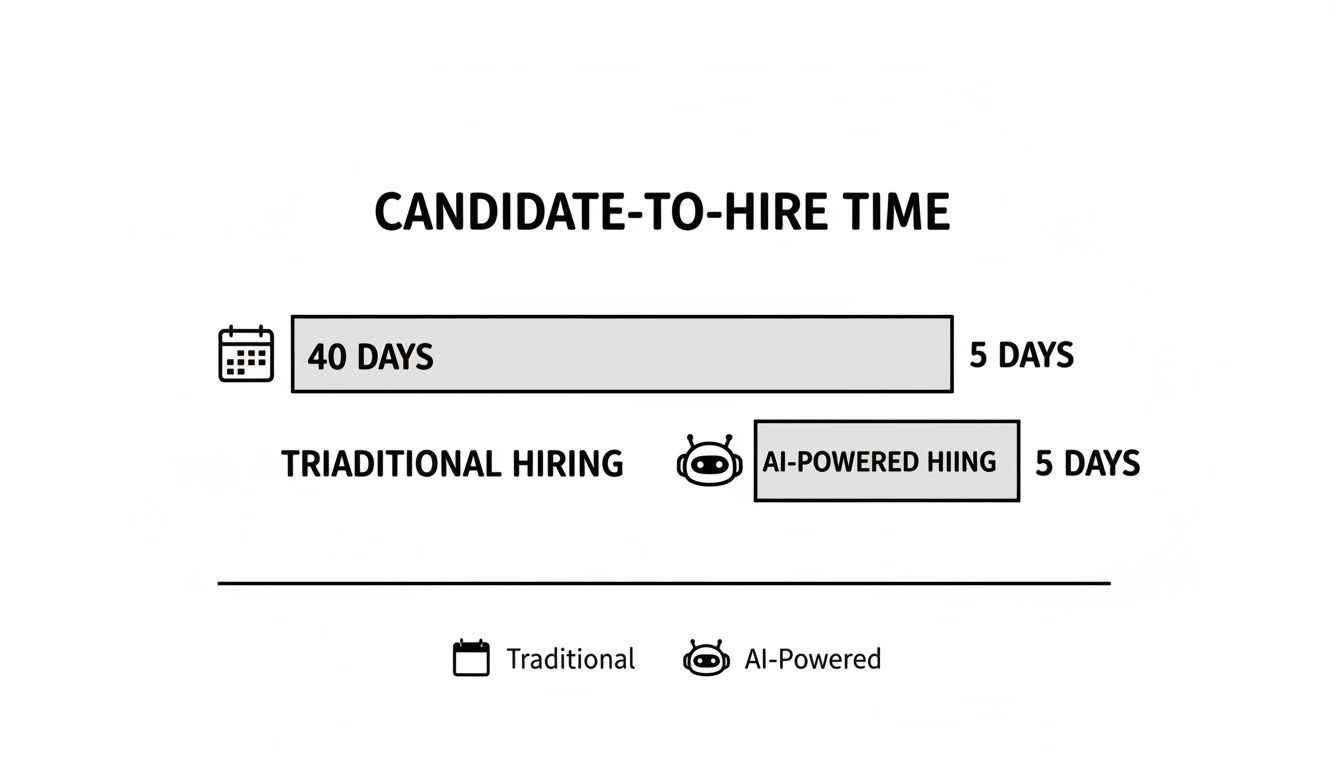
As you can see, the right technology can shrink the hiring timeline from over a month to just a matter of days.
Talent Marketplaces: The On-Demand Solution
Talent marketplaces are the Ubers of recruitment. These digital platforms connect you directly with a global pool of freelancers and independent contractors, ready to go. This is on-demand talent acquisition in its purest form, perfect for sourcing niche skills for short-term gigs.
By giving you direct access to pre-vetted professionals, these platforms can drop the time-to-fill to an incredible 10-25 days. Need a graphic designer for a three-week project or a Python developer to fix a specific bug? This is where you go.
The downside is its purely tactical nature. It’s incredibly fast for plugging skills gaps, but it does nothing to support your permanent hiring needs or help you build a long-term talent pipeline. Think of it as a powerful tool for immediate fixes, not a long-term strategic solution.
Comparative Analysis of Enterprise Hiring Models
Making the right call means looking at these models side-by-side, based on what matters most to your business. This table breaks it all down, helping you see clearly which approach aligns with your organisation’s top priorities.
| Metric | Internal TA Hub | RPO | VMS/MSP | Talent Marketplace |
|---|---|---|---|---|
| Time-to-Fill | Slowest (45-60+ days) | Moderate (30-45 days) | Fast (20-40 days) | Fastest (10-25 days) |
| Scalability | Low | High | Very High | High |
| Cost-per-Hire | High (fixed costs) | Variable (performance-based) | Moderate (agency fees) | Low (project-based) |
| Quality of Hire | High (strong cultural fit) | Variable (depends on partner) | N/A (skills-focused) | Variable (skills-focused) |
| Employer Brand | Highest Control | Moderate Control | Low Control | Minimal Control |
At the end of the day, the fastest hiring model for enterprise recruitment is all about context. If you need to hire at scale and speed, an RPO is a massive accelerator. If you need a specific skill right now, a talent marketplace is unbeatable.
But the most forward-thinking enterprises are realising the true answer lies in a hybrid approach—blending the strengths of each model to create a talent strategy that delivers both speed and quality, consistently.
The AI-Powered Hybrid: The Future of Fast Hiring
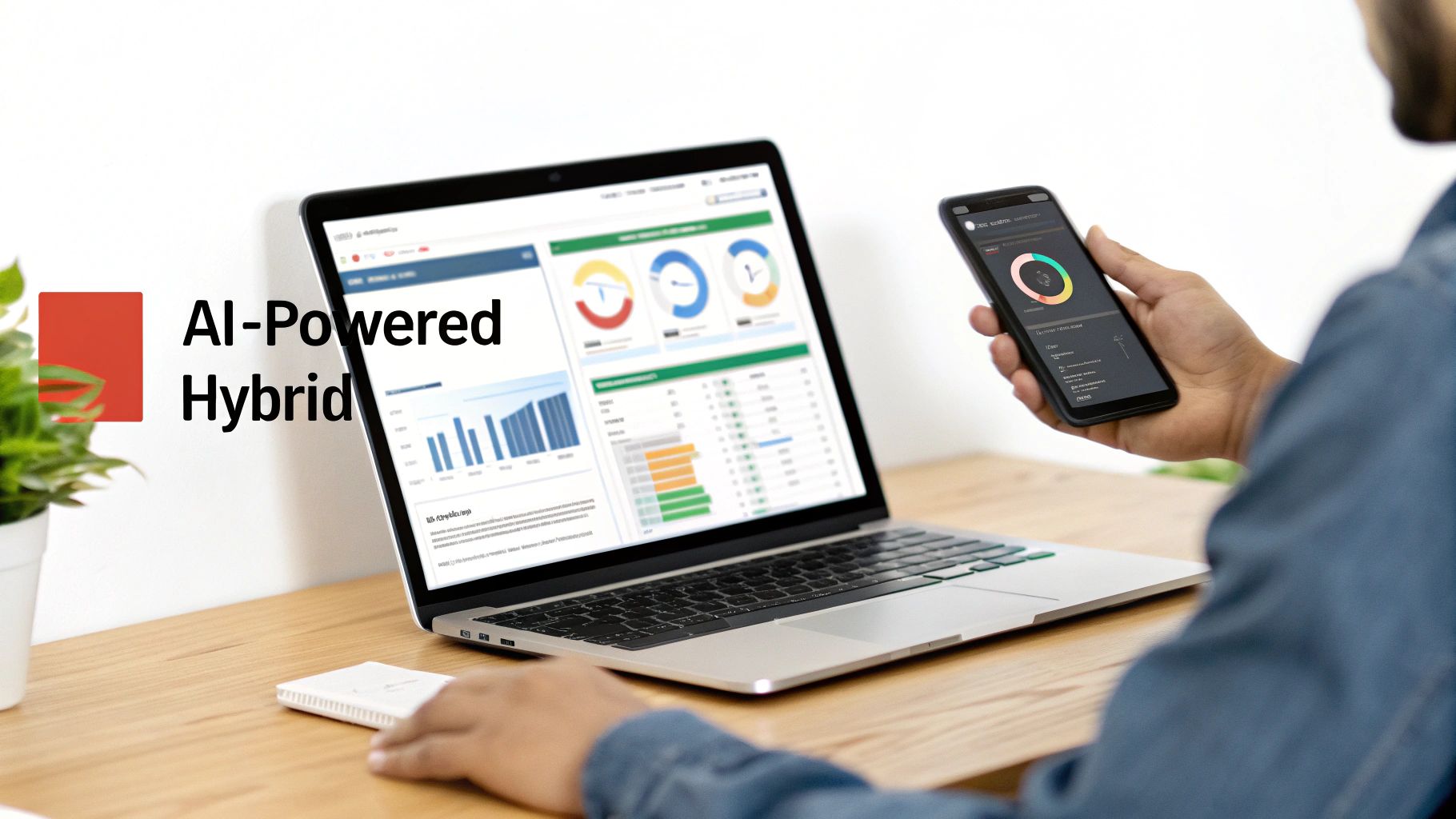
After weighing the strengths and weaknesses of each recruitment model, one thing becomes crystal clear. The old ways of doing things—whether keeping everything in-house or outsourcing the whole lot—just don’t cut it anymore. They can’t keep up. The fastest hiring model for enterprise recruitment isn’t a single, rigid solution; it’s a flexible, intelligent hybrid framework.
This is more than just a new process; it’s a strategic pivot. We’re moving away from monolithic, one-size-fits-all hiring functions towards a nimble ecosystem. This approach smartly blends a lean, strategic internal talent team with powerful AI platforms and specialist external partners, creating something far more effective than any single component could be on its own.
At its heart, this model completely redefines the role of your in-house TA team. Instead of drowning in the high-volume, repetitive work of sourcing and screening, they become the strategic conductors of the entire operation. Their focus shifts to high-value activities: building the employer brand, perfecting the candidate experience, and managing the performance of tech and external partners. This frees them up to operate at a much higher level, directly impacting long-term business goals.
AI as the Intelligent Orchestration Layer
The real game-changer in this hybrid setup is Artificial Intelligence. AI acts as the intelligent nerve centre, connecting your internal team with external resources, automating the grunt work, and serving up data-driven insights that were once impossible to get at scale.
This is where you genuinely unlock speed. AI-powered tools can scan millions of profiles in minutes, spotting best-fit candidates with a speed and accuracy that manual sourcing could never hope to match. This radically shortens the time spent at the top of the recruitment funnel.
On top of that, AI makes the entire workflow smoother. It takes over tedious administrative jobs like scheduling interviews and sending candidate updates, letting human recruiters focus on what they do best: building relationships and engaging top-tier talent. To dig deeper, you can learn more about how to effectively integrate AI in recruitment from our detailed guide.
The synergy is what makes this model so potent. Your internal team provides the strategic vision and cultural guardianship. External partners deliver specialised reach and scalability. And AI provides the speed and intelligence to weave it all into a seamless, high-performance operation.
Blending Internal Strategy with External Execution
The hybrid model gives an enterprise incredible agility. Let’s say a new product launch suddenly requires you to hire 50 specialised software engineers in one quarter. A purely internal team would be completely swamped, causing major project delays.
But with a hybrid model, the process is completely different:
- Strategic Direction: The internal TA team kicks things off by defining the ideal candidate profiles, setting clear hiring targets, and articulating the employer value proposition.
- AI-Powered Sourcing: An AI sourcing platform is then unleashed to scan talent databases, professional networks, and open-source communities, building a qualified pipeline in days, not weeks.
- Specialised Partner Engagement: A niche, tech-focused RPO partner is brought in to handle the high-volume outreach and initial screening, tapping into their deep expertise in the tech talent market.
- Final Selection: The internal team steps back in for the crucial final interviews, ensuring a perfect cultural and technical fit among the best candidates identified.
This distributed approach allows the business to scale its hiring efforts up or down with remarkable flexibility. It lets you respond instantly to business needs without the crushing overhead of a massive internal recruitment division. Ultimately, it turns talent acquisition from a rigid cost centre into a dynamic, on-demand service that’s perfectly aligned with your strategic objectives. This fusion of human strategy and machine efficiency is what defines the fastest hiring model for enterprise recruitment today, delivering both speed and quality without compromise.
When to Deploy Each Hiring Model?
Understanding the different enterprise recruitment models is one thing; knowing precisely when to deploy each is where strategy really hits the ground running. It’s not about finding a single “best” option. It’s about matching the right framework to a specific business challenge. The fastest hiring model is always the one that fits the context of the role, the scale you need, and its strategic importance.
This means we need to move past theoretical pros and cons and look at real-world situations. An approach that’s brilliant for rapid, high-volume hiring will almost certainly stumble when you’re trying to source niche senior leadership. Let’s break down a few common enterprise challenges and map them to the right hiring solution.
Scenario One: Scaling a New Tech Division
Here’s the situation: you have to build a new 50-person technology division in six months to get a critical product out the door. The roles are specialised, the timeline is tight, and your internal team just doesn’t have the network in this specific tech stack.
In this case, a Hybrid Model that blends your internal core team with a tech-focused RPO partner is your strongest bet. Your internal team stays in the driver’s seat—defining the culture, setting the technical bar, and handling final interviews. At the same time, the RPO partner unleashes their established talent pools and specialised recruiters to manage the heavy lifting of high-volume sourcing, screening, and initial vetting.
This dual approach gives you the best of both worlds. You keep control over your brand and cultural fit while tapping into the speed and scale an external expert brings. An RPO partner’s existing infrastructure and candidate network can dramatically slash the time-to-fill for those tough-to-find tech roles, keeping your project on track.
Scenario Two: Bulk Hiring for a Customer Service Centre
Imagine you’re launching a new customer service centre and need to hire 300 agents in one quarter. The roles are pretty similar, the volume is massive, and efficiency is the name of the game. Quality needs to be consistent, but the main goal is getting good people onboarded, fast.
This is a textbook case for a full-scale Recruitment Process Outsourcing (RPO) solution. An experienced RPO provider can parachute in a dedicated project team, roll out AI-powered screening tools, and manage the entire lifecycle from the first application to the final offer. Frankly, their expertise in high-volume campaigns is something most internal teams just can’t match.
By handing this over, you free up your internal TA team from the logistical nightmare of sifting through thousands of applications. They can get back to focusing on high-value strategic work, while the RPO partner delivers a predictable, scalable, and speedy hiring pipeline.
For high-volume hiring, especially from campuses, technology is a massive accelerator. We’ve seen hiring models based on campus blitzes combined with tech-enabled screening deliver 40–60% faster campus-to-offer timelines at major Indian enterprises. By pairing focused campus drives with AI résumé parsing and remote aptitude tests, these companies were able to convert screened students to offers in just 7–14 days. You can find more data on India’s recruitment evolution at recruitmententrepreneur.com.
Scenario Three: Sourcing Niche Senior Leadership
Now, the challenge shifts from sheer volume to pinpoint specificity. You need to hire a new Chief Information Security Officer (CISO)—a role that demands deep, specialised expertise and an incredible amount of trust. Speed is a factor, but quality and discretion are non-negotiable.
Here, the best path is an Internal TA-led model, augmented by a specialised retained executive search firm. Your internal Head of Talent should own the process, managing stakeholders and acting as the guardian of cultural fit. The retained search firm brings the confidential outreach and access to a passive, high-calibre network that simply isn’t available through standard job boards or LinkedIn.
This model might not be the fastest in terms of calendar days, but it is absolutely the fastest way to land the right leader. The focused, dedicated effort of a retained partner means you’re only spending time with the market’s top-tier candidates, which dramatically accelerates the path to a quality hire.
Implementing Your High-Speed Hiring Framework
Making the switch to a faster enterprise hiring model isn’t just about plugging in new tech or signing a vendor contract. It demands a thoughtful, phased rollout that gets your people, processes, and platforms ready for a whole new pace of talent acquisition. Without a solid roadmap, you risk disrupting the business and seeing a poor return on your investment in speed.
This kind of strategic implementation ensures every part of your recruitment engine is fine-tuned for high performance. It all starts with an honest look at where you are today and a crystal-clear definition of what “fast” actually means for your organisation. Getting this foundational work right helps you sidestep common pitfalls like mismatched expectations or pushback from your internal teams.
Auditing Your Current Recruitment Processes
Before you can hit the accelerator, you need to know your current top speed and, more importantly, what’s slowing you down. A deep-dive audit of your talent acquisition workflow is the only place to start. This means mapping out every single step, from the moment a hiring manager raises a requisition to a new hire’s first day on the job.
The real goal here is to find the specific bottlenecks. Are roles gathering dust on hiring managers’ desks for days before they even look at them? Is scheduling interviews a logistical nightmare that stretches the timeline by weeks? Or is your sourcing strategy just not delivering a steady stream of qualified people?
Key areas to put under the microscope include:
- Time-to-Fill by Role Type: Get granular. Analyse how long it takes to hire for different roles (think tech vs. sales, or junior vs. senior). This will quickly show you where the process is really struggling.
- Candidate Drop-Off Rates: Pinpoint the exact stage where you’re losing the most candidates. A huge drop-off after the initial screening could signal slow response times. Losing people after the final interview? That might point to issues with compensation or culture fit.
- Technology Utilisation: Take a hard look at how well your team is actually using your current Applicant Tracking System (ATS) and other tools. You’d be surprised how often powerful automation features are left untouched.
Defining Your Strategic Hiring Goals
Once you have a clear picture of your current state, it’s time to define what success looks like. “Faster hiring” isn’t a one-size-fits-all target. A 15-day time-to-fill might be the gold standard for high-volume customer service roles, but hitting a 45-day timeline for a highly specialised senior engineer could be a massive win.
Sit down with business leaders to set specific, measurable goals for different departments and seniority levels. This makes sure your new framework is solving real business problems, not just chasing arbitrary speed metrics. This clarity is also vital for picking the right partners and tech to get you there.
The most effective implementation roadmaps aren’t just about deploying a new model; they are about re-engineering the organisation’s mindset around talent acquisition. It’s a shift from a reactive, process-driven function to a proactive, data-informed strategic partner to the business.
Evaluating Your Technology Stack
Your tech stack is the engine of any high-speed hiring model. Your ATS, Candidate Relationship Management (CRM) system, and any AI-powered tools need to communicate flawlessly to cut out friction and automate grunt work. A clunky or fragmented tech stack is one of the biggest roadblocks to recruitment velocity.
As you look at your options, keep these points in mind:
- Integration Capabilities: Can new tools plug seamlessly into your existing HRIS and other systems? Bad integrations create data silos and manual work, completely defeating the purpose of automation.
- AI and Automation Features: Look for platforms that offer smart sourcing, automated screening, and simplified interview scheduling. These features are a direct assault on the most time-consuming parts of the hiring cycle.
- Data Security and Compliance: This is non-negotiable. Ensure any potential vendor meets the highest data security standards, especially for a large enterprise handling sensitive candidate information.
Piloting and Managing the Change
Trying to roll out a brand-new hiring framework across the entire company at once is a recipe for disaster. A far smarter and safer bet is to pilot the new model within a single department or for a specific job family. This creates a controlled environment where you can test your new processes, tech, and vendor relationships on a smaller, more manageable scale.
You’ll gather real-world data, uncover unexpected challenges, and be able to tweak your approach before a company-wide launch. This pilot phase is also your secret weapon for getting internal buy-in. Success stories from the pilot team become powerful proof points that help you manage change and get other departments excited for what’s coming.
Finally, don’t forget to upskill your internal TA team. Their jobs are about to change, shifting from tactical, day-to-day recruiting to more strategic oversight. Give them the training they need to manage new technologies, interpret recruitment data, and effectively hold external partners accountable. This investment in your people ensures they can drive your new high-speed framework to its full potential.
Common Questions About High-Speed Hiring
As enterprise leaders explore new ways to hire faster, a few practical questions always come up. Moving to a more agile framework isn’t just a small tweak; it involves shifts in technology, how your teams are structured, and your overall strategy. Here are the answers to the most common queries we hear.
What Technology Really Moves the Needle on Hiring Speed?
Without a doubt, it’s AI-powered sourcing and screening tools. They deliver the biggest punch when it comes to speeding up enterprise hiring. These platforms attack the most time-consuming part of the whole process—finding and sorting candidates right at the top of the funnel.
Think of them as the engine for any truly fast hiring model. By sifting through millions of profiles in seconds, these tools can slash initial screening time by over 60%. This means your recruiters stop drowning in unqualified CVs and start talking to a pre-vetted shortlist of great candidates, which drastically cuts down your time-to-fill.
How Does a Hybrid Model Change the Role of an Internal TA Team?
Adopting a hybrid model really elevates your internal talent acquisition (TA) team. They stop being tactical, day-to-day recruiters and become strategic talent advisors who run the entire hiring ecosystem. For any company serious about high-speed recruitment, this is a non-negotiable shift.
When technology and external partners are handling the high-volume, repetitive work, your internal team can finally focus on the high-value activities that actually drive long-term success.
- Employer Branding: Shaping and promoting why your company is a great place to work.
- Candidate Experience Strategy: Designing a smooth and impressive journey for every single applicant.
- Workforce Planning: Making sure your hiring goals line up with where the business is headed.
- Partner Performance Management: Holding vendors and technology accountable for delivering results.
Their job becomes more consultative, deeply woven into the company’s bigger goals. This makes them a much more critical strategic partner to the leadership team.
In a hybrid framework, the internal TA team stops being a bottleneck and becomes the central intelligence unit. They manage the strategy, own the brand, and use partners and technology to execute with speed and precision, creating a powerful competitive advantage.
Can the Fastest Hiring Model Also Deliver High-Quality Candidates?
Yes, absolutely. The old idea that you have to sacrifice quality for speed is a myth, one that comes from outdated, manual hiring processes. When you use technology the right way, the fastest hiring model for an enterprise often turns out to be the one that delivers the highest quality candidates.
AI-driven models can actually boost quality in a few ways. First, they strip out unconscious human bias from the initial screening, making sure every applicant gets a fair and objective look. Second, they can spot the best-fit candidates by analysing far more data points than any human recruiter could ever hope to process at scale.
This data-driven approach, paired with the sharp judgment of your skilled human interviewers for the final decision, creates a powerful combination. It leads to a consistent, fair evaluation process that almost always results in a measurable jump in the quality of hire and better employee retention down the line.
Ready to implement the fastest hiring model for your enterprise? Taggd provides expert Recruitment Process Outsourcing solutions designed for speed, scale, and quality. Discover how we can transform your talent acquisition at https://taggd.in.