Field sales is back with a vengeance, and as a CHRO, you’re right in the thick of it. The real challenge isn’t just filling seats; it’s about ditching outdated recruitment playbooks for a smarter, data-led strategy that lands you the digitally-savvy pros who can actually win on the ground.
The New Battlefield for Field Sales Talent
If you’re a CHRO, you’re on the front lines of a massive market swing: the powerful return of on-the-ground sales. The game has totally changed. Legacy hiring models are cracking under the pressure of fierce candidate competition and a new breed of sophisticated, tech-fluent sales talent. This isn’t about plugging gaps. It’s about strategically building a formidable sales army to go out and seize market share.
Getting the board on your side means showing them you understand the bigger picture. The market isn’t just limping back; it’s expanding with serious intent. Your ability to adapt your hiring engine will make or break your company’s growth.
Key Market Shifts You Need to Know
The landscape for field sales hiring right now is all about rapid growth and a shifting map. Companies are aggressively planting flags in new territories to chase down fresh opportunities, pushing well beyond the traditional metro-city comfort zones.
This land grab is creating a white-hot talent market where the old recruitment rules just don’t work anymore. For a clearer picture, let’s look at the numbers driving this trend.
Key Field Sales Hiring Statistics for 2026
Here’s a quick summary of the market trends that should be shaping your hiring strategy right now.
| Metric | Statistic |
|---|---|
| Overall Growth | 15% year-on-year surge in field sales hiring (Dec 2025) |
| Sector Leadership | Automotive and BFSI sectors are leading the expansion |
| Geographic Focus | 55% of automotive hiring now happens outside tier-1 cities |
These figures tell a clear story: we’ve moved past cautious recovery and into a phase of deliberate expansion, especially where a physical presence is critical for building relationships and closing deals.
This growth is particularly explosive in a few key areas:
- High-Growth Sectors: The automotive and Banking, Financial Services, and Insurance (BFSI) industries are leading the charge. They’ve realised that for complex products and high-value relationships, nothing beats a direct, in-person conversation.
- The Rise of Tier-2 Cities: The talent war is no longer a big-city-only affair. A huge chunk of this growth, especially in the auto industry, is firing up in tier-2 cities. In fact, a whopping 55% of automotive hiring now occurs outside tier-1 hubs.
For CHROs, this is both a massive challenge and a golden opportunity. The challenge? Fierce competition for a small pool of top-tier talent. The opportunity? Building a proactive sourcing machine that can tap into these booming new markets before your competitors even know what’s happening.
To win, you have to stop being reactive and start building a forward-thinking talent acquisition function. That means truly understanding the unique dynamics of these emerging markets and crafting an employer brand that speaks directly to the best field sales pros out there. For a deeper dive into the latest employment trends, you can read our comprehensive analysis in the India Decoding Jobs 2026 report.
Building a Proactive Sourcing and Screening Engine
The days of “post and pray” recruitment are long gone, especially when you’re trying to hire top-tier field sales talent. If you’re just waiting for applications to trickle in, you’re already falling behind. To win in this competitive space, you need a proactive engine that constantly hunts for and engages A-players—often before they even think about looking for a new role.
This means moving well beyond traditional job boards. It’s about designing a multi-channel sourcing strategy that actively finds high-performing sales reps where they are, not where you hope they’ll find you. You’ll need a smart mix of modern tech and old-school networking to build a pipeline that’s always full of quality candidates.
Crafting a Compelling Employer Brand
Before you even think about sourcing, you need a message that lands. Let’s be honest: high-performing salespeople are drawn to winners. Your employer brand has to scream opportunity, growth, and success. It needs to answer one simple question: “Why should a top rep work for you instead of your competitor?”
Your messaging must be tailored to hit the right notes with sales professionals. Forget the corporate fluff and focus on what they actually care about.
- Uncapped Earning Potential: Don’t be shy. Showcase your competitive commission structures.
- Career Progression: Lay out a clear, tangible path from a field role to team leadership.
- A Winning Culture: Share real stories of top performers and team successes. Make them feel the energy.
- Cutting-Edge Tools: Emphasise the tech you provide to help them close deals and make more money.
This brand story becomes the magnet that pulls passive candidates into your orbit. For a deeper dive, check out our guide on effective passive candidate sourcing strategies.
Expanding Your Sourcing Horizons
With a strong employer brand in place, your sourcing strategy can shift from passive waiting to a targeted hunt. The key here is diversification. Putting all your eggs in one channel—like a single job board—is a massive risk you can’t afford to take.
The most effective sourcing engines are built on a multi-pronged approach. They combine technology to achieve scale and human intelligence to build relationships, ensuring a consistent flow of qualified candidates, regardless of market fluctuations.
It’s time to expand your reach into these critical areas:
- AI-Powered Platforms: Use modern tools to scan professional networks and databases for passive candidates who fit your ideal profile. These platforms are brilliant for identifying talent in specific industries and locations, especially in booming Tier-2 and Tier-3 cities.
- Employee Referral Programmes: Your best people almost always know other great people. A well-structured referral programme with real incentives can easily become your most powerful source of high-quality hires. The data doesn’t lie, referred employees typically have much higher retention rates.
- Strategic Networking: Encourage your sales leaders to get out there and network within the industry. Attending industry-specific events, both in-person and virtual, is a fantastic way to uncover talent that isn’t actively looking for jobs.
This infographic shows just how critical a wider sourcing net has become, highlighting the overall surge in demand and the specific focus on Tier-2 cities.
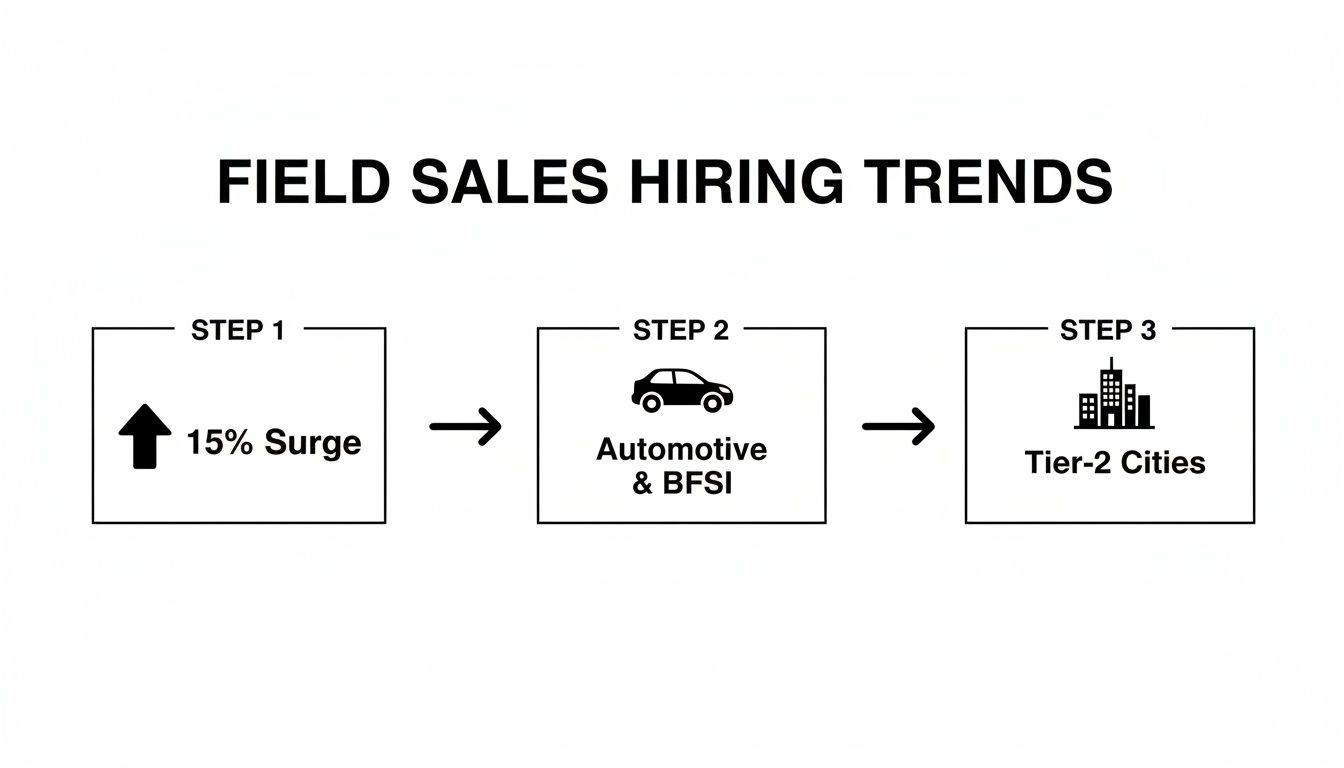
The numbers make it clear: growth is concentrated in specific industries and is rapidly expanding beyond the major metro areas. If you’re not sourcing with this in mind, you’re missing out.
Designing a Smarter Screening Process
Once your sourcing engine starts generating leads, the game shifts to efficient and effective screening. A smart screening process is your best defence against wasted time, quickly separating the high-potential candidates from the rest. It’s all about assessing core competencies, not just scanning a resume for keywords.
Your initial screening should be laser-focused on the non-negotiable traits that define success in field sales. Build out pre-screening questionnaires and initial call scripts that dig into:
- Resilience: Ask about a time they faced constant rejection and how they pushed through it. Their story will reveal their mental fortitude.
- Adaptability: Enquire about a time a sales strategy completely failed and what they did to pivot. This uncovers their true problem-solving skills.
- Digital Fluency: Gauge their comfort level with CRM software and other sales tools. In today’s market, CRM adoption is not optional.
- In-Person Preference: Be direct. Ask about their genuine desire to travel and meet customers face-to-face. While data shows in-person meetings can triple conversion rates, some studies suggest that as many as 73% of B2B meetings are still happening virtually. You need to find the reps who are truly energised by getting out in the field.
This disciplined, front-loaded approach ensures that only the most promising candidates make it to the more intensive interview stages. It respects everyone’s time and dramatically improves your final quality of hire.
How to Interview for Real-World Sales Success

Let’s be honest, traditional interview questions just don’t cut it for field sales. Asking a candidate to “sell me this pen” reveals next to nothing about their ability to manage a complex territory or build the long-term relationships that actually drive revenue.
To really predict on-the-ground performance, you have to move beyond hypotheticals. Your interview process needs to be a structured, competency-based evaluation that simulates the real world. The goal is to stop guessing and start measuring, to see a candidate’s skills in action, not just hear them talk about past glories.
Going Beyond Standard Behavioural Questions
Behavioural questions are a good start, but they have to be sharp and specific to the realities of a field role. A generic question about teamwork won’t tell you if a candidate can handle the isolation and fierce autonomy needed to own a remote territory.
Your questions need to force candidates to pull from specific experiences that showcase core field sales competencies. Instead of asking, “Tell me about a time you closed a difficult deal,” you need to dig deeper.
Try these more targeted questions:
- Territory Management: “Walk me through how you’d plan your first 30 days in a new, underperforming territory. What data would you pull first, and what would your immediate actions be?”
- Negotiation: “Describe a negotiation where the client’s budget was 20% lower than your proposal. How did you defend your value, and what was the final outcome?”
- Resilience: “Tell me about a quarter where you were way behind your target. What specific steps did you take to turn things around, and what did you learn from it?”
See the difference? These questions move from the general to the specific, forcing candidates to unpack their strategic thinking and problem-solving skills in a context that truly matters for a field sales hire.
The Power of Realistic Role-Playing
This is where the rubber meets the road. A well-designed role-play is the single most effective tool for seeing how a candidate actually performs under pressure. It’s a firsthand look at how they think on their feet, handle objections, and navigate a real sales conversation.
The key word here, though, is realism. Don’t invent a fantasy product; use one of your own.
- Set the Stage: Give the candidate a one-page summary of a real customer persona, complete with their business challenges, pain points, and likely objections. Give them about 15-20 minutes to prepare.
- Simulate the Meeting: Have one of your seasoned sales managers play the part of the customer. Their job is to be skeptical but fair, raising the exact objections your team faces every single day.
- Evaluate Core Skills: Assess the candidate not on whether they “close the deal,” but on their ability to ask insightful questions, listen actively, handle pushback, and propose a logical next step.
You’re not looking for a perfect performance. You’re looking for coachability, critical thinking, and the ability to maintain composure. A candidate who asks smart, probing questions is often far more valuable than one who just talks a good game.
This one exercise will quickly separate those who can only talk about selling from those who can actually sell.
Implementing a Multi-Stage Interview Framework
A great hire is about more than just raw skill; it’s about cultural alignment and team dynamics. Relying on a single hiring manager’s gut feeling is a recipe for a bad hire. A structured, multi-stage process that involves different stakeholders gives you a much more holistic and accurate view of a candidate.
Consider this proven framework for your field sales hiring process:
- Stage 1: HR/Recruiter Screen: This is all about culture fit, compensation alignment, and basic qualifications. You need to confirm their genuine interest in a field-based role. While research shows in-person meetings can triple conversion rates, many reps now prefer virtual selling. You have to find the ones who are genuinely energised by being out in the field.
- Stage 2: Hiring Manager Interview: This is the deep dive into their sales history, using the sharp behavioural questions we talked about earlier. The manager’s job is to assess their strategic fit for both the team and the territory.
- Stage 3: Role-Playing Scenario: The practical test. This reveals their real-world sales acumen and problem-solving abilities when the pressure is on.
- Stage 4: Peer Interview: Have the candidate meet with one or two high-performing members of the sales team. This gives them a chance to ask candid questions about the role and helps you evaluate team chemistry. It’s an excellent way to gauge if they’ll truly fit into the existing culture.
By standardising this process with a consistent scorecard for each stage, you eliminate “gut-feel” decisions. Your field sales hiring becomes far more accurate and predictable, ensuring you’re not just filling a role—you’re making a strategic investment in a future top performer.
Crafting an Offer and Onboarding Plan They Can’t Refuse

You’ve made it through the gruelling interview process and found the perfect candidate. It’s a huge relief, but don’t start celebrating just yet. In today’s market, getting a “yes” is only half the battle.
The real work begins now. Crafting a compelling offer and delivering a truly immersive onboarding experience are the final, critical steps that turn a great hire into a top-performing, long-term asset.
Structuring a Motivation-Driven Compensation Package
Landing high-achievers means creating a compensation plan that rewards the exact behaviours that drive growth. A generic, one-size-fits-all package will only ever attract average talent. Top reps are looking for a structure that directly links their hard work to their earning potential.
For CHROs, the stakes are incredibly high. Field sales attrition can easily hit 28%, and with salary increases averaging 10.1%, you simply can’t afford to be uncompetitive. Delays in the final offer stage, which can stretch time-to-hire by 20-25%, only make matters worse. Diving into current hiring statistics on ciiskills.in can offer more context on these trends.
A winning offer needs a strategic blend of these key components:
- A Competitive Base Salary. This is the foundation. It provides the stability reps need to focus on building a strong pipeline, especially during their initial ramp-up.
- Uncapped Commission. This is the ultimate motivator for your top performers. An uncapped structure sends a powerful message: we will never put a ceiling on your success.
- Performance Accelerators. Think about adding kickers for smashing quotas, landing strategic new accounts, or successfully cross-selling products. These are what reward the extra mile that separates the good from the great.
The best compensation plans are simple enough to explain on a napkin. If a rep needs a complex spreadsheet to figure out their commission, your plan is broken. It should be instantly clear how their effort translates into reward.
Don’t forget the psychological impact of a well-timed signing bonus or, for more senior roles, an equity grant. These can be the tipping point that prevents a star candidate from entertaining a counteroffer. And speaking of losing candidates at the final hurdle, it’s crucial to have a plan for reducing the candidate offer dropout rate.
Designing Equitable Sales Territories
You could have the most motivating compensation plan in the industry, but if you assign a new rep a dead-end territory, you’ve already set them up to fail.
Equitable territory design is one of the most overlooked and most critical parts of building a successful field sales team. It’s about giving every single rep a fair and realistic shot at hitting their target.
When you’re carving up territories, you need to look beyond simple geography. Dig into factors like:
- Total Addressable Market (TAM): Does each territory have a roughly equal number of potential customers?
- Historical Performance: Use your sales data to balance mature, high-potential areas with those that need more development.
- Logistics and Drive Time: A geographically massive territory with sparse customers is a recipe for burnout.
Creating fair territories from the start prevents morale-killing arguments down the road and ensures that performance is a true measure of skill, not just the luck of the draw.
The 90-Day Onboarding Gauntlet
Your onboarding programme is your single best opportunity to mould a new hire into a loyal, high-performing employee. A structured 90-day plan is about so much more than just product training, it’s a full immersion into your company’s culture, your sales methodology, and your definition of success.
Think of it as a gauntlet designed to forge exceptional reps. Here’s a battle-tested structure:
- Weeks 1-2: The deep dive. This is all about product knowledge, company culture, and total mastery of your CRM.
- Weeks 3-6: Methodology and practice. Focus on sales process training, intense objection handling, and simulated sales calls.
- Weeks 7-12: Field shadowing. This is the most important phase. Pair the new hire with your absolute best reps your A-players for real-world experience.
This shadowing period is non-negotiable. It allows new reps to see exactly what success looks like in your organisation. They absorb the unwritten rules, listen in on effective sales conversations, and build the confidence they need before going solo. This structured immersion will dramatically shorten their time-to-productivity and is your best defence against early attrition.
When you’re trying to scale a field sales team, speed is everything. But moving too fast often means sacrificing quality, and that’s a trade-off no business can afford. Your internal talent acquisition (TA) team, no matter how good they are, can quickly find themselves buried under the sheer volume of work, especially when you’re in an aggressive growth phase. This is exactly when a strategic Recruitment Process Outsourcing (RPO) partner stops being a vendor and becomes a true extension of your team.
Bringing on an RPO partner isn’t just about outsourcing the grunt work. It’s a strategic decision to inject specialised expertise, powerful technology, and immediate horsepower into your hiring process. A real partner will manage the entire recruitment journey, from surgically targeted sourcing in niche markets to coordinating the final round of interviews. This frees up your internal team to focus on what they do best: crucial initiatives like employee development and retention.
Beyond Cost Savings: The Real Value of an RPO
Sure, cost savings are a nice perk, but the real game-changer with a specialised RPO partner is the impact on speed, quality, and market intelligence. In the dog-eat-dog world of field sales hiring, getting access to a wider, pre-vetted talent pool is a massive advantage. The right partner isn’t just finding people who are actively looking for jobs; they have deep networks of passive candidates who aren’t scrolling through job boards but are ready to make a move for the right opportunity.
This proactive approach delivers results you can actually measure. For instance, a skilled RPO partner can often slash the all-important time-to-hire metric by up to 40%. Think about what that means: getting productive sales reps into their territories faster, generating revenue sooner, and leaving your competition in the dust.
Navigating Market Challenges with Data and Tech
Today’s job market is a bit of a paradox. We’re seeing significant growth, but a stubborn skills gap and sky-high attrition rates make hiring for field sales a constant battle. The Indian job market, for example, is experiencing 40% overall growth, but the field sales sector is a revolving door. With 25-30% attrition, a staggering 60% of all open roles are just backfills. This constant churn drains resources and kills momentum.
An expert RPO partner tackles these challenges head-on using talent analytics and AI-driven platforms. Instead of slogging through manual screening, they use data-driven matching to pinpoint candidates whose skills and experience are a precise fit for your needs. This dramatically boosts hiring accuracy and cuts down the risk of someone leaving in the first few months.
This is especially relevant now that 44% of organisations are using AI in recruitment to get an edge. By teaming up with an RPO like Taggd, which specialises in project-based and high-volume hiring, companies can slice their recruitment costs by 30%. This is possible because they tap into a massive candidate database and use data intelligence to fill key roles, like territory managers, with more speed and precision. You can dive deeper into how the Indian job market is adapting in this insightful article from HR Brew.
A Seamless Extension of Your Team
The best RPO partnerships are the ones where you can’t tell where your team ends and theirs begins. They should work within your existing systems, adopt your employer brand as their own, and act as a seamless representative of your company to every single candidate. This ensures a consistent, positive experience, which is absolutely vital for protecting your brand in a tight talent market.
Think about these practical integration points:
- Technology Integration: Their platform should plug right into your Applicant Tracking System (ATS), giving you a real-time, transparent view of the entire hiring pipeline.
- Cultural Alignment: A great partner invests time upfront to truly understand your company culture. This ensures they’re not just finding people who can do the job, but people who will thrive in your specific environment.
- Reporting and Analytics: You should get regular, detailed reports on key performance indicators (KPIs) like time-to-fill, cost-per-hire, and source effectiveness. This gives you the data you need to make smart, strategic decisions.
At the end of the day, a strategic RPO partner becomes your hiring engine, freeing up your leadership to focus on the big picture. This kind of partnership lets you scale your field sales team on demand, confidently and efficiently, ensuring your business never misses a growth opportunity because of a talent gap.
FAQs
As a CHRO, you’re constantly juggling the complexities of building a modern field sales force. The old playbook just doesn’t cut it anymore, and you’re bound to have some tough questions.
We get it. We hear the same concerns from leaders every day. So, let’s dive into the pressing issues that are probably keeping you up at night and give you some straightforward, experience-backed answers.
What Are the Most Critical KPIs for a New Hire’s First 90 Days?
It’s tempting to fixate on revenue from day one, but that’s a classic mistake. Revenue is a lagging indicator. For a new field sales rep, the first 90 days are all about building the right habits and momentum. You need to track the leading indicators that actually predict future success.
Focus your attention on these core metrics:
- Activity Metrics: This is the ground floor. Track the number of calls made, meetings set, and site visits completed. It’s a raw measure of their initial effort and hustle.
- Pipeline Velocity: How fast are their leads moving through the sales funnel? A quick pipeline velocity tells you the rep is efficient and knows how to qualify an opportunity without wasting time.
- Key Conversion Rates: Zero in on the conversion from a scheduled meeting to a qualified opportunity. This reveals how skilled they are at uncovering real pain points and building a business case in those first crucial conversations.
- CRM Adoption and Data Integrity: This is completely non-negotiable. A rep who diligently updates the CRM gives your sales managers the visibility they need for accurate forecasting and coaching. Poor adoption is a massive red flag.
Tracking these early on gives you instant insight into a rep’s work ethic and skills. It allows your managers to step in with targeted coaching before someone falls too far behind to catch up.
How Can We Reduce High Attrition in Our Field Sales Team?
High attrition in sales, which often hovers around a painful 25-30%, is never a single-point failure. It’s almost always a symptom of deeper, systemic problems. You can’t fix a leaky bucket with retention bonuses alone; you have to plug the holes, and that starts right at the hiring stage.
The cycle of high turnover is a massive drain on resources, morale, and revenue. You can’t solve it with retention bonuses alone. You must address the root causes, which almost always begin with how you hire and who you hire.
To genuinely cut down on churn, you have to commit to a few key things:
- Improve Hiring Accuracy: Ditch the gut feelings and implement the competency-based interviews we’ve discussed. Hire for resilience and a genuine hunger for field sales, not just a polished resume.
- Invest in World-Class Onboarding: A structured 90-day onboarding plan that includes shadowing your top performers is your best defence against early flameout. Don’t just throw them in the deep end.
- Provide Continuous Coaching: Sales managers must be coaches, not just scorekeepers. Regular, constructive feedback is what turns good reps into great ones.
- Ensure Fair Territory and Quota Design: Nothing kills motivation faster than an impossible target or a barren territory. Fairness is the foundation of a sustainable sales culture.
- Foster a Supportive Culture: Recognise the grind, celebrate the wins publicly, and create a strong support system for reps who are often working alone in the field.
Reducing turnover isn’t something you do when people are about to leave. It’s a promise you make during the hiring process and keep throughout their entire career with you.
What Role Does AI Play in Modern Field Sales Hiring?
AI is no longer a futuristic buzzword; it’s fundamentally changing the game. It’s shifting field sales hiring from a reactive, manual slog to a proactive, data-driven strategy. The goal isn’t to replace your recruiters but to supercharge their expertise, making them faster and far more effective.
For sourcing, AI platforms can scan millions of data points across the web to pinpoint passive candidates who are a perfect match for your ideal profile. This is huge for tapping into new talent pools, especially in emerging tier-2 and tier-3 cities where your team might not have a presence.
During the screening phase, AI-powered chatbots can handle initial qualification, freeing up your recruiters to have meaningful conversations with high-potential candidates. In the interview stage, video analytics tools can even provide objective insights into a candidate’s communication style and confidence levels.
Specialist RPO partners like Taggd embed AI into their entire workflow. This allows them to precisely match candidates to your specific needs, which can slash your time-to-hire and improve the quality of every hire. It’s about adding a layer of speed and intelligence that’s simply impossible to achieve manually.
Ready to stop reacting and start proactively building the field sales team that will drive your growth? Taggd leverages AI and deep market intelligence to help you hire top-tier sales talent faster and more effectively. Connect with us and discover how our RPO solutions can transform your hiring outcomes.