In today’s unpredictable market, a rigid hiring process isn’t just inefficient—it’s a liability. For Chief Human Resources Officers (CHROs), this reality hits home when a sudden growth spurt or an unexpected hiring freeze lays bare the limits of a fixed recruitment team. This guide goes beyond basic definitions, offering real-world insights into using flexible Recruitment Process Outsourcing (RPO) models to build a talent function that’s both resilient and competitive.
The Modern CHROs Dilemma of Inflexible Hiring
Picture this: your company lands a huge new project. Suddenly, you need to hire 50 specialised engineers in the next three months. Your in-house talent acquisition team, already running at full steam, is completely swamped.
The pressure builds. Time-to-fill metrics shoot up, and the quality of candidates starts to dip. By the time you get the green light to hire more recruiters, the project timeline is already in jeopardy.

Now, flip the scenario. A market downturn forces a hiring freeze. That same recruitment team is now underutilised, turning a vital operational asset into a significant fixed cost. This boom-and-bust cycle is a constant headache for enterprise HR leaders, creating inefficiencies that hit the bottom line hard.
Moving Beyond a Fixed Structure
This classic problem highlights the fundamental weakness of a static, in-house recruitment model. It simply doesn’t have the elasticity to respond to business demands in real time. The traditional approach often leaves you with two bad options:
- Overstaffing: Keeping a large, permanent recruitment team on standby for peak periods, which becomes a costly overhead during lulls.
- Understaffing: Running a lean team that, while cost-effective day-to-day, creates massive bottlenecks and risks when hiring demand surges.
This is precisely where the strategic power of flexible RPO models comes into play. They offer a third, much more agile way forward.
A flexible RPO partnership transforms recruitment from a fixed operational cost into a variable, strategic investment that mirrors your business’s real-time needs. It’s about having the right recruitment power, at exactly the right time.
This guide will break down how flexible RPO models explained from this perspective can solve these core business challenges. We’ll explore how these solutions act as a strategic lever, allowing you to scale your hiring efforts up or down with precision and control.
You’ll see how to build a responsive talent function that not only fills roles efficiently but also delivers a clear competitive advantage in a constantly changing market. It’s time to stop thinking of RPO as just another outsourcing tactic and start seeing it as an essential tool for business agility.
What Exactly Is a Flexible RPO Model?
Let’s break down what a flexible RPO model really means. Forget the dry, formal definitions for a moment. Instead, picture it as a recruitment volume dial that you can turn up or down based on your immediate needs. It’s a world away from the traditional ‘on/off switch’ of hiring full-time recruiters, which almost always leaves you either overstaffed during lulls or completely swamped during hiring surges.
A conventional, full-scale RPO partnership often means handing over your entire talent acquisition function for the long haul. It’s a complete commitment. A flexible RPO model, on the other hand, is all about precision and agility. It gives you access to top-tier recruitment expertise exactly when and where you need it, without the weight of long-term contracts and fixed overheads.
This could mean bringing in a dedicated team for a specific, high-stakes project, targeting a certain number of specialised roles, or simply beefing up a department’s hiring capacity during its peak season. The core idea is simple: customisation.
The Shift from Fixed Costs to Strategic Investment
The real game-changer here is how you start to view your recruitment spend. Older models treat talent acquisition as a fixed operational cost—a permanent line item on the budget, whether you’re hiring ten people or a hundred. Flexible RPO flips this script entirely.
Flexible RPO transforms recruitment from a fixed operational cost into a variable, strategic investment that mirrors your business’s real-time needs.
This approach ensures your resources are always perfectly aligned with your immediate business goals. You pay for the recruitment muscle you need, precisely when you need it, giving your HR function a new level of financial control and strategic responsiveness. If you’re looking for a refresher on the basics, you can explore everything you need to know about RPO.
How It Works in Practice
Imagine your company decides to launch a new technology hub in another city. Instead of scrambling to build a new recruitment team from the ground up or burying your current team in extra work, you could bring in a project-based RPO partner. They would manage the entire hiring lifecycle for that specific initiative and, once the hub is fully staffed, their engagement ends.
This model is particularly powerful in dynamic markets. In India, for instance, flexible RPO models have truly revolutionised how businesses scale, offering an elasticity that matches the country’s fluctuating business demands. It’s been shown that leading RPO companies in India can slash hiring time by 55% and cut recruitment costs by 20-50% using smart, data-driven strategies. This kind of adaptability is crucial, whether you’re a startup going from 50 to 150 hires or a large enterprise managing over 1,000 roles a year.
Traditional RPO vs Flexible RPO at a Glance
To make the distinction crystal clear, here’s a quick side-by-side comparison. It highlights the fundamental differences and helps you see where each model shines.
| Feature | Traditional RPO | Flexible RPO |
|---|---|---|
| Commitment | Long-term, comprehensive outsourcing | Short-term, project-based, or on-demand |
| Scope | Often covers the entire TA function | Focused on specific projects, roles, or departments |
| Cost Structure | Typically a fixed management fee | Variable, based on project scope or hires |
| Scalability | Less agile; major changes require renegotiation | Highly scalable; can be ramped up or down quickly |
Ultimately, a flexible RPO model is about giving you back control. It’s a partnership that equips you with the specialised resources and scalability needed to tackle any hiring challenge, without locking you into a rigid, one-size-fits-all contract.
Decoding the Different Types of Flexible RPO
Choosing the right flexible RPO model isn’t about finding a one-size-fits-all solution. Think of it more like selecting the right tool for a very specific job. Unlike a full-scale, long-term commitment, these models are designed for surgical precision, giving you the exact recruitment support you need, precisely when you need it.
To make the right call, you need to understand the different flavours of flexible RPO. Each model is built to solve a distinct problem, whether it’s a sudden hiring surge or a highly specialised, time-bound project.
This flowchart can help you visualise that first critical decision point.
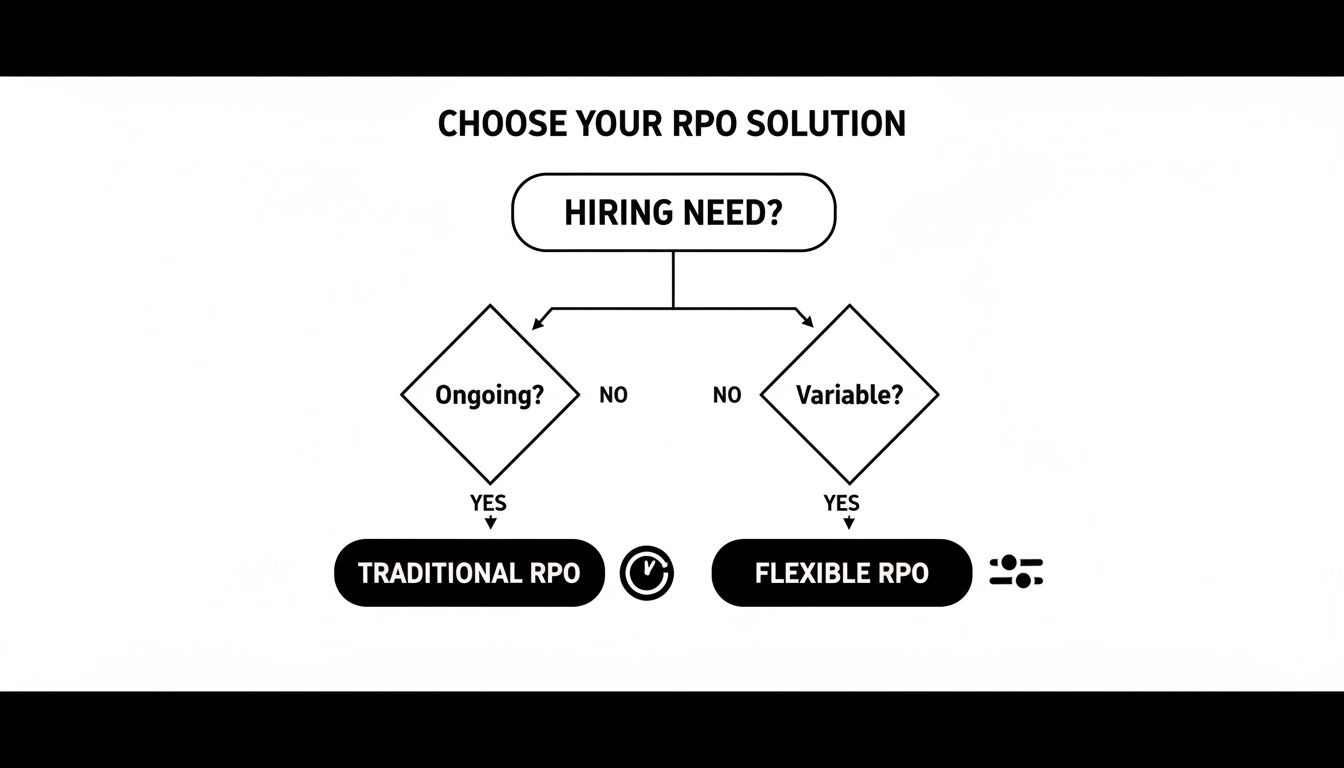
The key takeaway? Flexible RPO is your strategic partner for hiring needs that are variable, unpredictable, or tied to a specific project. Traditional RPO, on the other hand, is the bedrock for steady, ongoing recruitment.
On-Demand RPO for Sudden Hiring Spikes
On-Demand RPO is your rapid response team. This model is perfect for those moments when your business experiences an unexpected surge in hiring that your internal team simply can’t handle without quality or speed taking a nosedive.
Picture this: your company decides to launch a new product line ahead of schedule. Suddenly, you need to hire 30 new sales representatives in a single quarter. On-Demand RPO lets you bring in a dedicated recruitment partner to manage this spike, preventing burnout for your core team and ensuring you don’t miss that critical launch window.
Project-Based RPO for Time-Bound Initiatives
Project-Based RPO is designed for initiatives with a clear start and finish line. It’s the ideal solution for staffing specific, strategic projects that are vital for business growth but fall well outside your normal hiring rhythm.
A classic example is opening a new technology hub or a manufacturing plant. This requires a large volume of specific roles to be filled within a tight timeframe. A project-based RPO provider can take full ownership of the entire initiative, from sourcing right through to onboarding, and then seamlessly disengage once the project is staffed and complete.
For a deeper dive, you might find this comparison of Project RPO vs. Enterprise RPO useful.
Key Takeaway: Project RPO isn’t just about filling roles; it’s a strategic partnership to ensure critical business milestones are met on time by having the right talent in place.
This approach has seen huge traction in India, where customised flexible RPO models have surged to meet niche hiring demands across key sectors like technology and financial services. For instance, a large Indian bank in the BFSI sector partnered with an RPO provider to hire thousands of engineers for a digital transformation project. The result? They cut their time-to-hire by 45% and boosted offer acceptance rates by 20%.
Recruiter on Demand for Team Augmentation
Sometimes, you don’t need a whole new team—just an extra pair of expert hands. That’s where Recruiter on Demand (ROD) comes in. It provides one or more experienced recruiters who embed directly within your existing talent acquisition team.
This model is a lifesaver for situations like:
- Specialised Roles: When you need to hire for a role with a rare skillset, like a data scientist with specific AI expertise, that your current team isn’t equipped to source.
- Peak Seasons: Augmenting your team during seasonal hiring pushes, such as gearing up for the festive season rush in retail.
- Leave Cover: Ensuring recruitment doesn’t grind to a halt when a key member of your team is on maternity or extended leave.
ROD gives you immediate access to specialised expertise without the long-term overhead of a full-time hire.
Exploring Delivery Structures
Beyond the type of engagement, flexible RPO models are also defined by how they are delivered. The choice here often comes down to a balancing act between cost, control, and cultural alignment.
- Onshore: The RPO team is located in the same country as your business. This offers the best cultural fit and smoothest communication, but it typically comes at a higher price point.
- Offshore: Recruitment services are delivered from a different country, often to take advantage of cost efficiencies. It’s a highly cost-effective option, particularly for high-volume roles.
- Hybrid: This model blends both onshore and offshore elements to get the best of both worlds. For instance, you might have a client-facing manager onsite while the sourcing and screening teams operate offshore, giving you cost savings combined with strong local oversight.
Choosing the right structure is crucial. An onshore model might be the clear winner for sensitive executive hiring, while an offshore or hybrid approach could be perfect for scaling your customer support team.
The Business Case for Flexible RPO
Knowing the different flavours of flexible RPO is one thing. Actually justifying the investment in the boardroom? That’s a completely different ball game.
To build a case that sticks, you have to move past the concepts and talk about concrete, measurable value. A great RPO partnership isn’t just about filling roles faster; it’s about delivering tangible returns that impact your finances, operations, and long-term strategy.
When you frame flexible RPO with a clear return on investment (ROI), the conversation shifts. It’s no longer just about cost, but a strategic discussion on how to fuel business growth and build resilience. Let’s break down the key benefits that really get an executive leadership team to listen.
Financial Gains and Cost Optimisation
The most immediate and obvious win from a flexible RPO partnership is the impact on your bottom line. The biggest advantage? You get to turn the fixed, often hefty, cost of a full-time in-house recruitment team into a variable expense.
Simply put, you pay for recruitment muscle only when you need it. This stops the cash drain from an underutilised team during slower hiring periods.
This financial agility shows up in a few key areas:
- Reduced Cost-Per-Hire: Expert RPO providers have the scale, the talent pools, and the fine-tuned processes to significantly bring down the average cost to fill any given role.
- Elimination of Agency Fees: By leaning on a dedicated RPO partner for niche or high-volume hiring, you can slash—or even completely get rid of—expensive fees from multiple staffing agencies.
- Improved Budget Predictability: Project-based and on-demand models come with clear cost structures. This makes forecasting your recruitment spend for specific projects or quarters far more straightforward.
Operational Excellence and Efficiency
Beyond just saving money, flexible RPO injects a serious dose of efficiency and effectiveness into your talent acquisition function. It’s about getting better results, and getting them faster. Think of an expert partner as a high-performance engine for your hiring machine, tuning every component for peak performance.
An RPO partner isn’t just an extra set of hands. They are process optimisation specialists who bring a wealth of cross-industry knowledge to elevate your entire recruitment lifecycle.
This operational lift delivers real, tangible outcomes. A well-executed flexible RPO model drives measurable ROI through better speed, quality, and sourcing. For example, top providers in India have shown they can achieve a 30% faster time-to-hire, boost offer acceptance rates to 79%, and shift 40% of hires to more efficient sourcing channels.
All told, this can improve your overall recruitment ROI by 15-40%. You can find more insights on how RPO delivers measurable ROI from serendi.com.
Gaining a Strategic Advantage
Ultimately, the most compelling argument for flexible RPO is the strategic high ground it gives you. In a tough market, the ability to pounce on opportunities with speed and precision is what separates the leaders from the laggards. A flexible talent function is a non-negotiable part of that agility.
This strategic value plays out in several ways:
- Market Responsiveness: You can quickly scale up to launch a new product, enter a new territory, or staff a major project without being bottlenecked by your internal hiring capacity.
- Enhanced Employer Branding: A professional RPO partner guarantees a consistent, high-quality candidate experience from start to finish. This strengthens your reputation as an employer people genuinely want to work for.
- Data-Driven Workforce Planning: RPO providers come armed with advanced analytics and market intelligence. This helps you make smarter, more informed decisions about your future talent needs and where to find the best people.
By framing the benefits across these three pillars—financial, operational, and strategic—you can build a powerful and persuasive business case. It shows that flexible RPO isn’t just another outsourcing solution; it’s a critical enabler of business success.
Choosing Your Pricing Model and SLA
Once you’ve pinpointed the right flexible RPO model for your business, the next conversation is always about the commercials and performance framework. This is where a partnership truly gels—or doesn’t. A solid contract, built around a fair pricing model and a clear Service Level Agreement (SLA), makes sure everyone is on the same page about expectations, goals, and what success actually looks like.
Think of the pricing model as the engine of your partnership; it dictates how costs are handled and aligns incentives. The SLA, then, is your navigation system. It sets the performance benchmarks and key metrics that steer the entire engagement. Getting these two pieces right is absolutely fundamental to building a transparent, results-driven relationship.
Selecting the Right RPO Pricing Structure
Flexible RPO comes with a few different pricing structures, each designed for different hiring scenarios. The goal is to pick one that matches your hiring volume, predictability, and budget. For a much deeper dive, you can explore our detailed guide on the enterprise RPO cost structure to see how all the components fit together.
Here’s a look at the most common options you’ll encounter:
- Cost-per-Hire: This is a straightforward, pay-as-you-go model where you pay a fixed fee for each person successfully hired. It’s perfect for project-based RPO where you have a specific number of roles to fill, giving you excellent budget control.
- Management Fee Model: This structure uses a fixed monthly fee for the provider’s dedicated team and services, often sweetened with performance bonuses for hitting specific KPIs. It’s a great fit for on-demand or longer-term flexible needs where the scope might change from month to month.
- Recruiter on Demand Fee: When you bring in a Recruiter on Demand (ROD), you typically pay a fixed monthly or weekly fee for that dedicated recruiter who becomes an extension of your team. It’s a smart, cost-effective way to get specialised expertise without the overhead of a permanent hire.
To help you choose the best financial path for your needs, here’s a quick comparison of the most common pricing models.
Choosing Your Flexible RPO Pricing Model
| Pricing Model | Best For | Key Consideration |
|---|---|---|
| Cost-per-Hire | High-volume, clearly defined projects with a set number of hires. | Can be less suitable for complex, hard-to-fill niche roles that require more intensive sourcing. |
| Management Fee | Ongoing, fluctuating hiring needs where predictability is key. | Requires very clear and measurable performance metrics to make bonuses meaningful. |
| ROD Fee | Augmenting your internal team with specific skills for short to mid-term needs. | Highly cost-effective for targeted support without long-term commitment. |
This table should give you a clear starting point for discussions with potential partners, ensuring you select a structure that aligns with both your talent strategy and financial planning.
Establishing a Meaningful Service Level Agreement
An SLA is so much more than a legal document; it’s the blueprint for accountability in your RPO partnership. It elevates the relationship from a simple service transaction to a shared mission focused on real business impact. A strong SLA doesn’t just list tasks—it clearly defines what success looks like and how it will be measured, leaving no room for ambiguity.
A robust SLA transforms your RPO provider from a mere vendor into a strategic partner who is directly accountable for delivering the talent outcomes that drive your business forward.
To craft an SLA that works, you need to focus on metrics that truly matter to your business. Steer clear of vanity metrics and concentrate on KPIs that reflect the quality of hire, operational efficiency, and strategic alignment.
Key metrics to build into your SLA:
- Time-to-Fill: This classic metric measures the speed of your recruitment engine, from the moment a job is opened to when an offer is accepted.
- Quality of Hire: This is the ultimate measure of success, often tracked through hiring manager satisfaction surveys or the performance ratings of new hires after 90 or 180 days.
- Source of Hire: Gives you powerful insight into which channels are bringing in the best candidates, helping you and your partner optimise sourcing spend and effort.
- Candidate Satisfaction Score: A vital metric for protecting your employer brand. In a competitive market, a positive candidate experience is non-negotiable.
- Offer Acceptance Rate: A strong indicator of how attractive your offers are and how effectively your RPO partner is managing the final, crucial stages of the hiring process.
By carefully selecting your pricing model and defining a robust SLA, you create a powerful framework for a successful partnership. This ensures your flexible RPO solution is not just agile, but also perfectly tuned to your strategic business goals.
Your Roadmap for Implementing Flexible RPO

Making the switch to a flexible RPO model isn’t something you do on a whim. It needs a structured, thoughtful game plan to make sure the integration is smooth and delivers value right away. This is about more than just hiring a service provider; it’s about forging a genuine partnership that lines up with your biggest business goals.
Jumping in without a clear map is a recipe for mismatched expectations and disappointment. A defined framework gets everyone on the same page, clarifies the scope, and sets up the partnership for success from day one. Let’s break the process down into manageable stages.
Stage 1: Kickstart with a Thorough Needs Assessment
Before you even think about talking to a potential partner, you need to look inward. A solid internal needs assessment is the bedrock of any successful RPO implementation. This is where you nail down the ‘why’ and the ‘what’ of your move.
Start by getting specific about the pain points in your current talent acquisition function. Are you getting crushed by hiring surges in one department? Do you desperately need specialised tech recruiters for a new project but don’t have them in-house?
Your assessment should clearly outline the scope:
- Identify Problem Areas: Pinpoint which roles, departments, or projects would get the biggest lift from external support.
- Define Clear Objectives: Set real goals, like cutting the time-to-fill for critical roles by 25% or being able to scale hiring for a new product launch without breaking a sweat.
- Analyse Internal Resources: Take an honest look at your in-house team’s current capacity and skills to see exactly where the gaps are.
Stage 2: Select Your Partner and Build the Business Case
With a clear scope defined, you can start the vetting process. You’re looking for an RPO provider who not only knows your industry inside and out but also truly gets the flexible rpo models explained in this guide. The goal is a partner, not just a vendor.
At the same time, you need to build a rock-solid business case to get leadership on board. This document has to be more than just operational fluff; it needs to scream strategic and financial impact.
A strong business case frames flexible RPO not as a cost, but as a strategic investment in business agility and competitive advantage. It connects every recruitment metric back to a broader business outcome.
Your case should highlight the ROI by showing how it will slash agency spend, bring down your cost-per-hire, and quantify the financial upside of filling revenue-generating roles faster.
Stage 3: Finalise the Contract and Manage the Transition
Once you’ve chosen your partner, the focus shifts to the fine print and change management. Work hand-in-hand with your provider to hammer out an SLA that reflects the KPIs you identified back in your needs assessment. This keeps both sides accountable for the results that actually matter to your business.
Just as critical is managing the internal transition. Be open and transparent with your in-house talent acquisition team. Position the RPO partnership as support that will free them up to focus on more strategic work—not as their replacement.
A smooth launch comes down to clear communication and a well-managed transition plan that tackles potential worries head-on and sets a collaborative tone from the start. This proactive approach is your key to a successful partnership, both now and in the long run.
Your Questions on Flexible RPO, Answered
Even after getting to grips with the different models and benefits, some specific questions almost always pop up when HR leaders consider making the switch to flexible RPO. Let’s tackle the most common ones head-on, giving you the practical answers you need to move forward.
How is Flexible RPO Different from a Staffing Agency?
It’s really about partnership versus placement. A staffing agency is transactional; their job is to fill an open seat, and once the candidate is placed, their work is usually done. Think of them as a service you call on for a specific, immediate need.
A flexible RPO partner, however, becomes an extension of your own talent team. They aren’t just filling roles; they’re taking ownership of your recruitment process for a specific project or business unit. This is a far more strategic relationship, covering everything from building your employer brand and sourcing strategy to candidate experience and reporting, all while being completely immersed in your company’s culture.
Can Flexible RPO Models Really Help with Diversity?
Absolutely. This is one of the biggest advantages. A specialist RPO partner brings two things to the table that are hard to replicate in-house: massive, diverse talent networks and the tech to mine them effectively. They know exactly how to reach beyond the usual job boards and connect with underrepresented candidate communities.
But it goes deeper than just sourcing. They help re-engineer your hiring process to root out unconscious bias. This could mean anything from rewriting job descriptions to be more inclusive to rolling out standardised interview scorecards. It’s about building a system that delivers on your D&I goals, not just hoping for the best.
A dedicated RPO partner doesn’t just fill roles. They actively build a recruitment engine designed from the ground up to attract and retain a diverse workforce, turning D&I ambitions into tangible results.
What’s a Realistic Implementation Timeline?
You’d be surprised how quickly a project-based RPO can get going—speed is a key part of its value. While a full-blown, company-wide RPO can take a few months to properly integrate, a focused project engagement is much faster.
Realistically, you can expect to go from signing the contract to having recruiters actively sourcing candidates in about two to four weeks. This timeframe gives the RPO partner enough time to dive deep into the project’s scope, get aligned with your hiring managers, connect with essential systems, and get their team ready to launch.
How Do You Make Sure a Partner Understands Your Company Culture?
This is a huge—and valid—concern. The key is a deep, collaborative onboarding process. Any RPO partner worth their salt will insist on immersion sessions with your key people, from the CHRO right down to the hiring managers they’ll be supporting day-to-day.
They should be asking probing questions to understand your company values, your internal communication style, and the intangible qualities that make someone truly successful at your company. The best way to lock this in is to make cultural fit a major criterion when you’re selecting a partner in the first place, and then bake it into your Service Level Agreement (SLA) as a core KPI.
Ready to build a more agile and responsive talent function? The experts at Taggd specialise in creating flexible RPO solutions that align perfectly with your business goals. Discover how we can help you scale with precision.