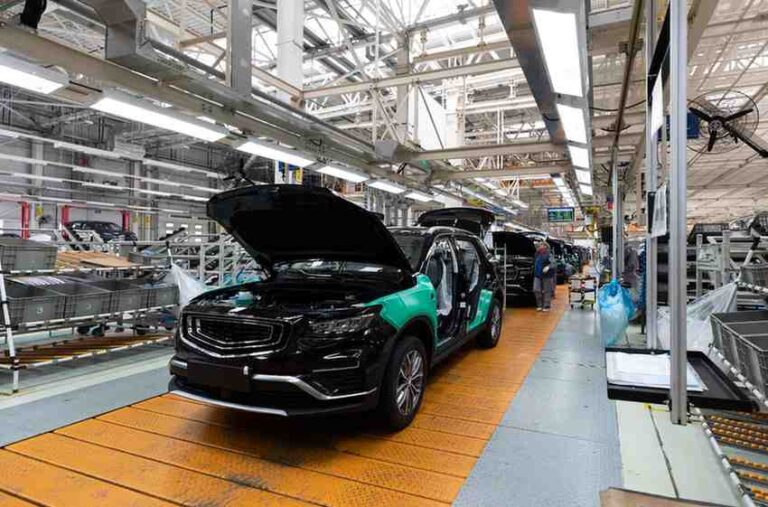
For Chief Human Resources Officers, charting the future of automotive jobs in India means steering through a fundamental industry overhaul. The entire sector is migrating from a mechanical core to a digital one, completely reshaping every role in its path as it accelerates its adoption of electrification and software-defined vehicle technology.
Navigating India’s New Automotive Talent Roadmap
The Indian automotive sector isn’t just evolving; it’s undergoing a complete system reboot. Think of it less like a minor software patch and more like swapping out an old, mechanical operating system for a sophisticated, intelligent one. This leap from traditional manufacturing to a high-tech ecosystem presents both immense challenges and unprecedented opportunities for workforce planning.
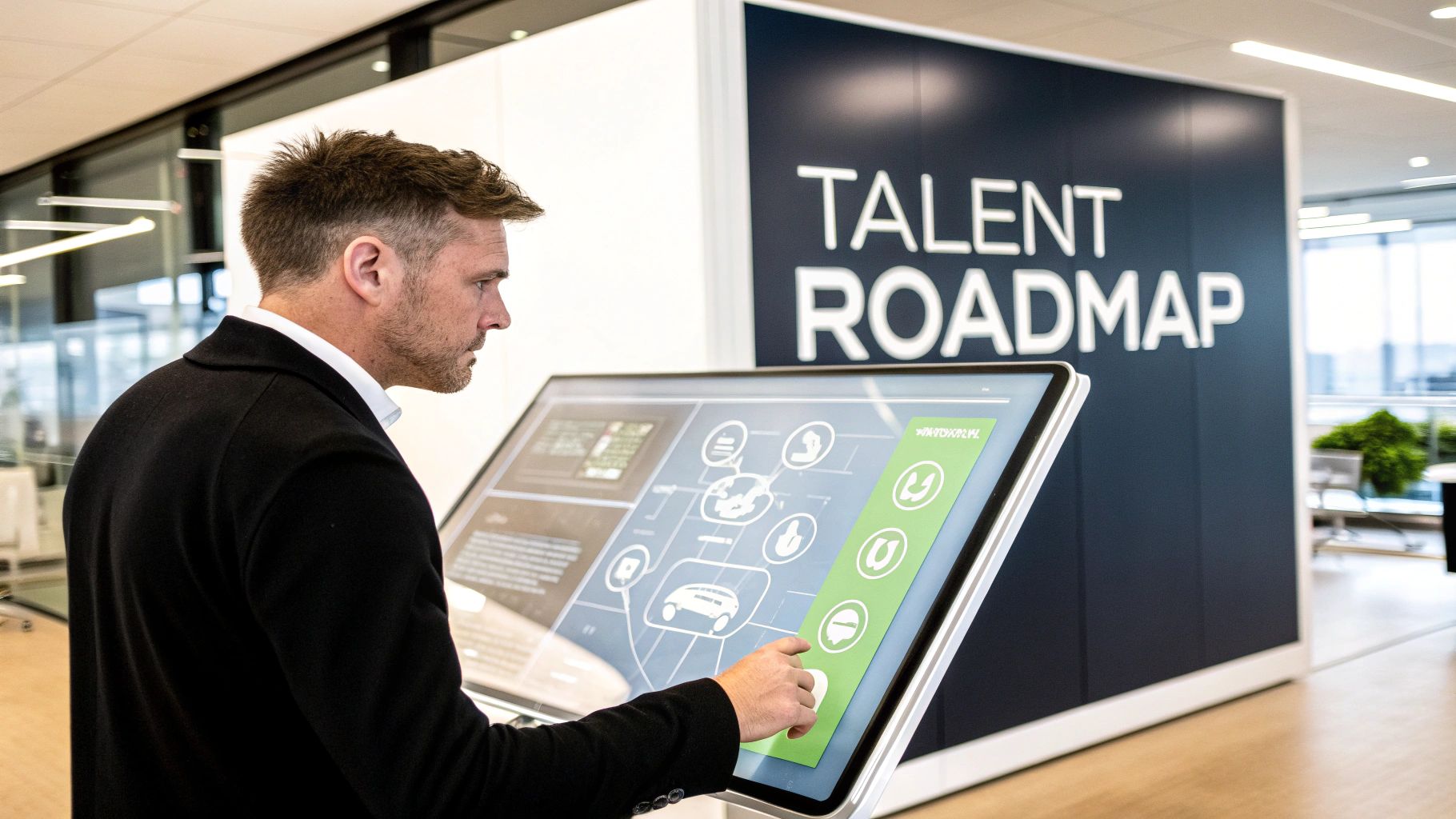
For CHROs, this isn’t some distant forecast—it’s today’s reality. The core challenge is no longer just about filling seats on an assembly line. It’s now about architecting a workforce capable of building, programming, and maintaining the intelligent, connected vehicles of tomorrow. Strategic talent planning has quickly become the most critical component for driving future growth and staying ahead of the curve.
The Strategic Imperative for CHROs
This shift demands a proactive, not reactive, approach to talent management. The entire value chain is being redrawn, impacting everyone from the factory floor technician to the C-suite executive. The new areas of focus must include:
- Anticipating Skill Gaps: Proactively identifying the competencies your current workforce lacks to support electric vehicle (EV) and software-defined vehicle (SDV) production.
- Developing New Career Pathways: Building clear, tangible progression models that guide employees from traditional mechanical roles into emerging, tech-centric positions.
- Fostering a Culture of Learning: Weaving continuous upskilling and reskilling into the very fabric of the organisation to keep pace with lightning-fast technological advancements.
This guide acts as a strategic executive summary for HR leaders. We’ll break down how conventional automotive jobs are changing and what it really takes to build a talent pipeline that can power this new engine of innovation.
The central task for today’s automotive CHRO is to transform the workforce from builders of machines into creators of mobile technology. This requires a bold reimagining of talent acquisition, development, and retention strategies to secure the organisation’s future in a rapidly digitising industry.
Framing the Opportunity
Seeing this transformation only as a disruption is a critical mistake. In reality, it’s a massive opportunity to attract a new generation of talent, ignite innovation, and cement India’s position as a global automotive powerhouse.
Success hinges on the ability to build a robust talent roadmap that aligns perfectly with both technological trends and core business objectives. The future of automotive jobs in India will be defined by the organisations that master this new talent equation, making strategic workforce planning more vital than ever before. This is the moment to lead the charge.
The Twin Engines Driving Workforce Transformation
Two powerful forces are completely reshaping the future of automotive jobs in India, acting as twin engines of change. The first is the unstoppable shift towards Electric Vehicles (EVs), and the second is the emergence of the Software-Defined Vehicle (SDV). For anyone involved in strategic business planning, it’s vital to see these not as separate tech trends, but as intertwined drivers of a complete workforce revolution.
Think of the EV revolution as a complete redesign of the car’s very DNA. The familiar internal combustion engine is making way for a complex ecosystem of batteries, electric motors, and power electronics. This isn’t just a minor tweak; it creates a massive ripple effect across the entire value chain, demanding entirely new skill sets.
This transformation reaches far beyond the assembly line. It calls for deep expertise in battery chemistry, sophisticated thermal management systems to keep power units cool, and the heavy lifting of engineering a robust charging infrastructure. Even the after-sales experience is being rewritten, with technicians needing to master high-voltage systems instead of traditional engine mechanics.
The EV Revolution Reshapes Hardware Roles
The pivot to electrification is creating a surge in demand for specialists who can get to grips with the unique challenges of electric powertrains. The talent requirements are moving away from purely mechanical knowledge to a potent mix of electrical engineering, chemistry, and materials science. This is a ground-up reinvention of automotive engineering, not a subtle evolution.
Key areas seeing huge demand include:
- Battery Systems Engineers: Professionals who can design, test, and squeeze every drop of performance out of the lithium-ion battery packs that are the heart of every EV.
- Thermal Management Experts: Specialists focused on creating the cooling and heating systems that ensure battery longevity and peak performance in India’s diverse and often extreme climate.
- Charging Infrastructure Specialists: The engineers and technicians on the ground, tasked with building out the nationwide network of fast, reliable charging stations.
This profound change is a primary driver behind the industry’s incredible growth. India’s automotive sector is gearing up for explosive expansion, with the market projected to hit $300 billion by 2026. This surge is fuelled by electrification, localisation, and soaring global demand. The EV market alone is tipped to reach $206 billion by 2030, requiring a massive $180 billion in investments for vehicle production and charging infrastructure. As a result, hiring will boom in areas like ADAS development and connected vehicles, with companies offering a stellar 10.1% average salary hike to attract the right people.
Software Redefines the Driving Experience
While EVs change what powers the car, the Software-Defined Vehicle changes how it thinks, behaves, and connects with the world. The modern vehicle is rapidly becoming a powerful computer on wheels, where features, performance, and the entire user experience are dictated by code. This is where the second engine of transformation roars to life, creating a massive appetite for tech talent.
A car is no longer just a mode of transport; it is an integrated digital platform. The value is shifting from horsepower to processing power, and the talent needed to create that value is shifting right along with it.
This means demand for software developers, AI specialists, and cybersecurity experts is exploding within the auto sector. These are the people building the features customers now expect as standard—from advanced driver-assistance systems (ADAS) to seamless in-car infotainment and over-the-air updates that improve the vehicle long after it has left the showroom.
This shift presents a huge opportunity to pull in talent from the tech industry who may have never considered an automotive career before. You can learn more about how EVs are driving this demand for tech talent in our detailed guide on automotive recruitment.
These two forces—electrification and software integration—aren’t working in isolation. They are merging to create a new generation of hybrid roles that demand a deep understanding of both hardware and software. The most valuable people in the future will be those who can bridge the gap between an EV’s physical components and the code that brings it all to life. For any forward-thinking CHRO, understanding this convergence is the first critical step toward building a resilient, future-ready workforce.
Mapping the New Automotive Talent Blueprint
To get a real handle on the future of automotive jobs in India, HR leaders need to do more than just follow high-level trends. They need a concrete talent blueprint that maps out the specific skills and new roles defining this changed landscape. It’s about moving from theory to practice—creating a detailed inventory of the exact competencies needed to build, power, and secure the next generation of vehicles.
This isn’t about throwing out the old blueprint entirely. Think of it as a major evolution. The core job is to spot the critical skills gaps and understand how traditional roles are morphing into their future-ready counterparts. For CHROs, this is the groundwork needed to audit the current team, sharpen recruitment priorities, and build a talent pipeline that actually matches where the industry is heading.
This diagram perfectly illustrates the core transformation, showing how the central automotive hub is being redefined by the twin forces of Electric Vehicles (EVs) and Software-Defined Vehicles (SDVs).
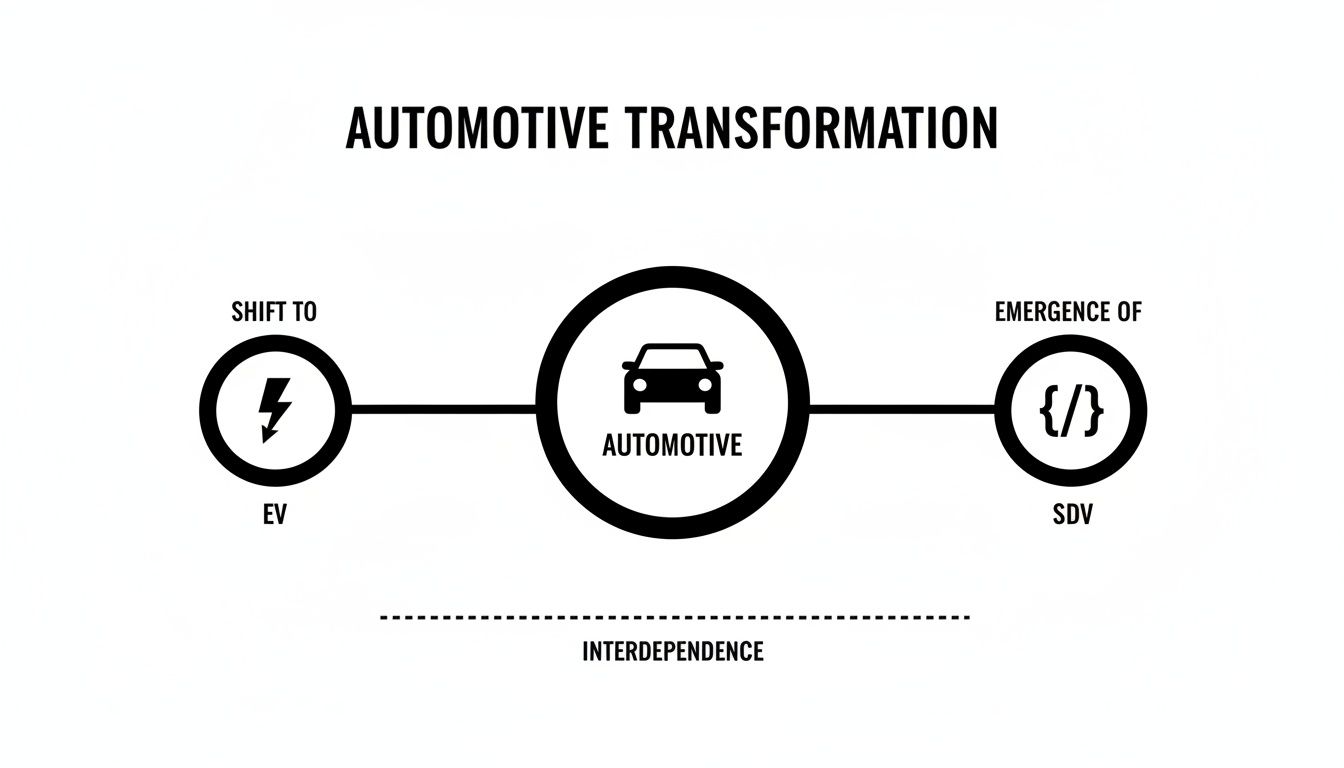
What’s crystal clear is that these aren’t separate paths. They are deeply interconnected forces, fundamentally changing the very nature of skills and roles required for success.
Identifying High-Demand Roles and Skills
The talent demand has pivoted sharply from purely mechanical expertise to a hybrid of hardware and software proficiency. The professionals in hottest demand are those who can operate at the intersection of electrical engineering, software development, and data science. These aren’t just jobs of the future; companies are hiring for them aggressively right now.
Some of the most critical emerging professions include:
- EV Powertrain Engineers: These are the specialists designing and integrating the electric motors, inverters, and gearbox systems that form the very heart of an electric vehicle.
- Battery Systems Technicians: With deep expertise in lithium-ion technology, they handle everything from battery pack assembly and testing to diagnostics and ongoing maintenance.
- Automotive Cybersecurity Analysts: As cars become rolling data centres, these experts are vital for protecting them from digital threats and safeguarding user privacy.
- V2X Connectivity Specialists: These engineers build the vehicle-to-everything (V2X) communication systems that allow cars to “talk” to each other, to infrastructure, and to the cloud.
The new automotive professional is part mechanical engineer, part software developer, and part data scientist. This convergence of skills is creating a talent profile that is fundamentally different from what the industry has traditionally sought.
The Evolution From Traditional to Tech-Driven Roles
To build a workforce plan that works, it’s vital to see how existing jobs are changing. This isn’t just a hiring problem; it’s often a reskilling opportunity. For instance, a mechanical engineer who deeply understands vehicle dynamics is the perfect candidate to upskill into an EV thermal management expert.
This table shows exactly how traditional roles are evolving, highlighting the key skill shift that makes the transformation possible.
Evolution of Automotive Roles From Traditional to Future-Ready
| Traditional Role | Future-Ready Counterpart | Key Skill Shift |
|---|---|---|
| Mechanical Engineer | EV Thermal Management Expert | Thermodynamics, fluid dynamics, battery cooling systems, simulation software. |
| Assembly Line Worker | Robotics and Automation Technician | PLC programming, robot maintenance, mechatronics, data interpretation. |
| Automotive Electrician | High-Voltage Systems Specialist | Battery management systems (BMS), power electronics, electrical safety protocols. |
| Infotainment Engineer | Automotive UI/UX Designer | Human-computer interaction, software development (Android Automotive), user journey mapping. |
This kind of clear mapping is incredibly useful for creating targeted upskilling programmes and defining new, exciting career pathways within your own organisation. For a closer look at what employers are hunting for, you can explore our guide on the top skills driving the automotive sector’s evolution in India.
Closing the Critical Skills Gap
Knowing what these new roles are is just the first step. The real challenge is finding- or creating the talent to fill them. The industry is staring down a significant skills gap, especially in areas that were once considered completely outside the automotive domain.
The most urgent competencies to build right now are:
- Lithium-Ion Battery Technology: A deep understanding of battery chemistry, performance, and safety is absolutely non-negotiable for anyone working in the EV space.
- Embedded Software Development: Writing the code that controls everything from the powertrain to the infotainment screen is now a core skill for the modern vehicle.
- Machine Learning Algorithms: This is essential for developing Advanced Driver-Assistance Systems (ADAS), predictive maintenance, and personalised in-car experiences.
- Advanced Data Analytics: The ability to make sense of the mountains of data generated by connected vehicles is key to improving performance, safety, and customer delight.
For CHROs, this blueprint is the actionable intelligence needed to move forward. It’s a practical guide for auditing your current workforce’s capabilities, pinpointing exactly where to invest in training, and sharpening recruitment strategies to attract the talent that will truly drive the future of automotive jobs in India.
Building a Future-Ready Workforce Strategy
Knowing which skills you need is one thing. Actually building a workforce that has them? That’s a whole different ball game. For CHROs trying to steer their companies through this massive industry shift, sitting back and reacting is a recipe for getting left behind. What’s needed is a proactive, multi-layered workforce strategy that turns all this disruption into a real competitive advantage.
Think of this strategy not as a cost centre, but as a critical investment in your company’s future. It all boils down to three core pillars designed to create a talent pool that’s resilient, adaptable, and seriously skilled.
Pillar 1: Aggressively Reskill Your Current Employees
Your existing workforce is your greatest asset, but only if their skills stay relevant. The smartest move is to start from within, transforming loyal, experienced employees into the experts you need for tomorrow. This is about more than just a few online courses; it means building a proper ecosystem for learning.
Here are a few practical ways to get aggressive with reskilling:
- Create In-House Academies: Develop specialised training centres that are laser-focused on EV technology, battery management, and software development. Imagine a “Battery Technology Centre of Excellence” that can turn your best mechanical engineers into highly sought-after battery systems specialists.
- Forge Strategic Partnerships: Team up with top technical institutes and universities to design custom certification programmes. These collaborations give you direct access to the latest curriculum and expert faculty, making sure your training is both current and credible.
- Build Clear Career Pathways: You have to show people where they can go. Map out exactly how a traditional assembly line technician can progress to become a robotics and automation supervisor, clearly outlining the training and milestones needed to get there.
Pillar 2: Strategically Hire External Experts
While reskilling is your foundation, some specialised roles—especially in brand new fields like AI and automotive cybersecurity—demand expertise you simply can’t build internally overnight. This is where bringing in outside experts becomes crucial for injecting new knowledge and hitting the accelerator on innovation.
But this doesn’t mean bloating your permanent payroll. The key is agility. This is exactly where a specialised Recruitment Process Outsourcing (RPO) partnership proves its worth.
An RPO partner isn’t just a vendor; they become an extension of your own talent team. They have the specialised sourcing power to find and lock down niche experts for critical projects, all without the long-term burden of permanent overhead. In a fast-moving market, that flexibility is priceless.
For example, when you’re kicking off a new ADAS (Advanced Driver-Assistance Systems) project, an RPO partner can rapidly assemble a crack team of machine learning engineers and data scientists on a project basis. You get top-tier talent precisely when you need it, keeping your projects on track without the long-term fixed costs.
Pillar 3: Embed a Culture of Continuous Learning
The pace of change in the auto sector is relentless. A one-and-done training program just won’t cut it. The real goal is to create a culture where learning isn’t an event you schedule, but a core part of how people work every single day.
This means building an environment where curiosity is celebrated, experimentation is encouraged, and upskilling is seen as a shared responsibility. Leaders have to walk the talk, championing this mindset and celebrating employees who pick up new skills.
When these three pillars—reskilling your own, hiring strategically, and building a learning culture—work together, they create a powerful, resilient workforce. This integrated approach ensures you have the right people with the right skills at the right time. It’s the bedrock of a successful strategy for the future of automotive jobs in India, positioning you not just to survive the transformation, but to lead it.
The Economic Engine Fuelling Job Creation
To get the C-suite on board with any ambitious talent strategy, CHROs need to build a business case that’s firmly planted in economic reality. The massive shift happening in the automotive sector isn’t just an industry trend; it’s a central part of India’s national economic game plan. Grasping this powerful macroeconomic picture is key to making the case for the significant investments needed in talent.
India’s automotive industry is much more than a single manufacturing vertical. Think of it as a foundational pillar of the entire national economy—a massive engine that drives growth, creates jobs on an incredible scale, and cements India’s place on the world stage. This perspective helps prove that workforce planning isn’t just an HR task. It’s a strategic response to a massive national opportunity.
A Cornerstone of India’s GDP and Manufacturing
The sheer scale of the industry’s contribution is staggering. The Indian automobile sector is an absolute powerhouse, contributing 7.1% to the country’s GDP and an incredible 49% of its manufacturing GVA. It currently supports over 35 million jobs, both directly and indirectly. With strong policy support, sales are forecasted to jump by 6-8% in 2026.
This level of economic impact makes the automotive industry a national priority. Its health is directly linked to the country’s prosperity, providing a powerful argument for investing in the people who will power its future.
Government Initiatives as a Growth Catalyst
The government clearly sees the sector’s huge potential and is actively creating the perfect environment for investment and innovation. These aren’t just minor incentives; they are strategic programmes designed to kickstart growth, boost domestic manufacturing, and build a self-reliant supply chain. It’s a clear signal that the future of automotive jobs in India is a national focus.
A couple of key schemes are really shaping this favourable landscape:
- Production Linked Incentive (PLI) Scheme: This programme gives a direct financial nudge to companies to ramp up domestic manufacturing of advanced auto-tech components, like EV parts and semiconductors. It takes a lot of the risk out of the investment and encourages companies to build their next-gen capabilities right here in India.
- FAME II (Faster Adoption and Manufacturing of Hybrid & Electric Vehicles) Scheme: This one is aimed squarely at boosting consumer demand for electric vehicles through subsidies. This helps create a more predictable market, giving manufacturers the confidence they need to scale up production and hire the right people.
These government policies act as powerful tailwinds, transforming the business environment from one of simple potential to one of active, incentivised growth. For a CHRO, this means talent strategies are built on the solid foundation of a supportive national economic policy.
India’s Rise as a Global Manufacturing Hub
Beyond just domestic growth, India is quickly cementing its reputation as a global hub for automotive manufacturing and exports. Big international players are increasingly looking at India not just as a market, but as a critical piece of their global production puzzle. This flood of foreign investment and technology transfer only adds more fuel to the job creation fire and increases the demand for highly skilled professionals.
This growing global prominence means the talent you’re building isn’t just competing locally—it’s on a world stage. The pressure is on to develop a workforce that meets international standards for quality, innovation, and efficiency. This macroeconomic backdrop gives you the ultimate justification for making bold investments in talent. It proves that preparing for the future of automotive jobs in India is about getting in lockstep with the nation’s economic trajectory. You can explore more about this alignment by checking out the roadmap for employment generation in India.
Executing Your Talent Acquisition Playbook
Knowing the challenges is one thing; actually solving them is what separates the leaders from the laggards. The road ahead for the future of automotive jobs in India is getting tricky. We’re facing a widening skills gap, technology that changes faster than we can adapt, and everyone’s fighting for the same small pool of specialised talent.
Just posting a job and hoping the right person applies? That strategy is dead. It’s time to get on the offensive with a real talent acquisition playbook.
This means looking beyond the old ways of hiring and adopting a much more strategic mindset. For many, this is the point where a specialised Recruitment Process Outsourcing (RPO) partner stops being a “nice to have” and becomes a critical part of the team, turning recruitment from a reactive chore into a proactive competitive advantage.
Activating Your Strategic Solution
A dedicated RPO partner brings immediate, tangible value to the table, designed specifically to tackle the industry’s toughest hiring problems head-on. They give you the speed and deep expertise needed to win the race for top talent in a market this fierce.
What does that look like in practice?
- Immediate Talent Access: You get a backstage pass to a pre-vetted, global talent pool. Need experts in battery technology or automotive software yesterday? They’re already in the network.
- Enhanced Efficiency: Hiring timelines get shorter and the quality of hires goes up. This happens by swapping out manual processes for optimised, data-driven recruitment.
- Scalable Hiring: You can ramp your recruitment efforts up for a big project or scale them down during a quiet period, all without adding permanent overheads.
This kind of strategic partnership is essential, especially when you consider the numbers. India’s electric vehicle industry is set to become a Rs. 20,00,000 crore (US$ 234 billion) behemoth by 2030, creating something in the neighbourhood of 5 crore (50 million) jobs. This is a massive shift, and you need a talent partner who gets the sheer scale of it and can deliver the people to make it happen. You can discover more insights about India’s automobile industry growth on IBEF.org.
In this new automotive era, think of your talent acquisition function like a high-performance engine. A strategic RPO partner provides the precision engineering, fuel, and horsepower needed to outperform the competition and secure the best minds.
Ultimately, winning in the future requires a proactive talent partner who not only sees the road ahead but can hand you the keys—and the talent—to get there first.
Frequently Asked Questions for CHROs
As a CHRO in the fast-evolving auto sector, you’ve got questions. The ground is shifting under our feet, and you need clear, straightforward advice on talent strategy. Here are some actionable answers to the most common queries we hear about the future of automotive jobs in India, designed to help you plan your next move.
What Are the Top Three Most Critical Roles to Hire for Now?
The top three most critical automotive roles to hire right now are:
- EV Battery & Powertrain Engineers – Driving electrification through advanced battery management, power electronics, and thermal systems as companies like Tata Motors and Tesla accelerate EV production.
- Automotive Software & Embedded Systems Engineers – Powering software-defined vehicles, ADAS, and connected car platforms, with rising demand from firms such as Bosch and Mercedes-Benz.
- EV Manufacturing & Automation Specialists – Scaling smart factories with robotics, Industry 4.0, and high-voltage safety expertise as manufacturers like Maruti Suzuki ramp up next-gen production.
How Can We Effectively Reskill Our Traditional Workforce?
Don’t forget the incredible asset you already have: your existing employees. They hold decades of institutional knowledge. The challenge and the opportunity is to give them a structured path into these new, future-ready roles.
A few training sessions won’t cut it. You need a multi-pronged approach to properly equip your team for EV and software-defined vehicle (SDV) production.
The real goal isn’t just to teach new skills; it’s to build entirely new career trajectories. If you can show a loyal mechanic a clear, tangible path to becoming a tech-focused expert, you’ll unlock a massive amount of potential you never knew you had.
Your reskilling framework should include:
- Structured Internal Training: Set up in-house academies that focus on high-voltage systems, battery tech, and the fundamentals of software.
- Partnerships with Technical Institutes: Work with top engineering colleges and vocational schools to create certified programmes that are tailored to your company’s specific needs.
- Clear Career Pathways: Map it out. Show employees exactly how upskilling can take them from their traditional role to an emerging one, with clear milestones and promotions along the way.
What Is the Biggest Mistake to Avoid in Our Workforce Strategy?
The single biggest mistake is underestimating the sheer speed of this change. It’s tempting to adopt a “wait-and-see” attitude, but that’s a critical error in today’s market.
The skills gap is getting wider every single day, and the fight for niche talent is already brutal. Hesitation means getting left in the dust by more agile competitors who are building their future workforce as we speak. Proactive investment in reskilling and strategic hiring isn’t an optional expense anymore—it’s a basic requirement for survival.
Ready to build a winning talent acquisition playbook for the new automotive era? Taggd provides the specialised RPO solutions you need to secure top-tier talent and stay ahead of the curve. Partner with us to drive your workforce strategy forward.