The future of EdTech workforce is being reshaped at a defining moment for the industry. After years of rapid, pandemic-fuelled digitisation, EdTech is moving out of expansion mode and into a phase focused on sustainability, outcomes, and operational discipline. Growth is no longer about scale alone, but about how effectively teams deliver real learning impact.
India’s EdTech market, valued at US$7.5 billion in 2024 and projected to exceed US$29 billion by 2030, remains one of the world’s most dynamic education ecosystems. But the next wave of growth will not be driven by platforms or funding alone. It will be driven by how thoughtfully EdTech companies design their workforces.
The era of scale-at-speed hiring is over. In its place is a sharper focus on impact, efficiency, and learning outcomes. This shift is redefining not just who EdTech companies hire, but how teams are structured, distributed, and led.
At the centre of this transformation is the rise of hybrid, remote, and tutor-led workforce models, signalling a fundamental rethink of how digital learning organisations are built for the future.
As EdTech companies move from growth-at-all-costs to sustainable scale, workforce decisions are increasingly tied to talent strategy, workforce planning, and capability building rather than short-term hiring targets. The conversation has shifted from “how fast can teams be built” to “what capabilities actually drive learning outcomes and business resilience.”
This is where the future of EdTech workforce begins to take shape, not as a headcount exercise, but as a deliberate redefinition of roles, skills, and operating models.
How the EdTech Workforce Is Being Redefined?
The future of EdTech workforce is marked by a clear departure from large, generalist teams toward high-impact, role-critical talent models. EdTech organisations are no longer optimising for headcount growth. They are optimising for capability density, role clarity, and workforce ROI.
What makes EdTech workforce design uniquely complex is the growing demand for hybrid talent professionals who combine technical skills, pedagogical understanding, and commercial acumen within a single role. These hybrid roles challenge traditional job architecture and competency frameworks, which were designed for narrowly defined responsibilities and linear career paths.
As funding cycles tighten and profitability becomes non-negotiable, workforce planning and talent acquisition strategies are under greater scrutiny. Every role is now expected to deliver measurable impact, whether through learner engagement, retention, or platform scalability. Workforce decisions have shifted from operational hiring actions to strategic talent investments with long-term implications for organisational capability and learning outcomes.
As role definitions evolve and capability density becomes the hiring priority, EdTech companies are also rethinking how these capabilities are organised. The focus is shifting away from fixed team structures toward more adaptive workforce models that balance stability with flexibility.
This shift has accelerated the adoption of hybrid workforce design across the EdTech ecosystem.
The Hybrid Workforce Model: Core Teams + Capability Specialists
The future of EdTech workforce is increasingly hybrid by design. Hybrid workforce models are fast becoming the default as EdTech companies seek to balance workforce agility, cost efficiency, and learning impact.
Instead of building large permanent teams across every function, organisations are investing in lean core teams supported by capability specialists brought in through flexible engagement models. Full-time hiring is concentrated on roles that directly influence learning outcomes, revenue performance, and learner retention, while specialised skills are accessed as needed.
Roles such as product managers, platform engineers, instructional designers, and learner experience leaders now operate as cross-functional integrators, working across product, pedagogy, data, and growth teams. These hybrid roles challenge traditional role-based org structures, but they significantly improve speed, alignment, and execution quality.
From a workforce planning perspective, this model offers a clear advantage. Specialist capabilities whether in AI, curriculum design, assessment strategy, or growth optimisation can be deployed for defined phases without creating long-term fixed costs. This allows EdTech companies to align talent costs with business cycles, reducing hiring risk while maintaining access to high-quality expertise.
Hybrid workforce models are no longer an interim solution. They are emerging as a strategic foundation for building resilient, scalable EdTech organisations.
As hybrid workforce models stabilise how core and specialist talent is organised, the next layer of transformation is unfolding around where this work gets done and who increasingly owns learning outcomes. Location flexibility and human-led delivery are no longer secondary considerations. They are reshaping EdTech workforce economics and role design in fundamental ways.
This is where remote work and tutor-led models begin to redefine the operating reality of EdTech teams.
Remote Work as Both Advantage and Pressure
Remote-first work has permanently reshaped the EdTech workforce, expanding the talent horizon well beyond traditional hiring hubs. Geographic flexibility has enabled companies to access specialised skills across regions, reduce dependency on metro-centric talent pools, and build more diverse teams.
However, this advantage comes with new pressures. Indian EdTech companies now compete directly with global EdTech platforms, international technology firms, and progressive academic institutions for the same professionals. What was once a local hiring market has become a global one.
Insights from India Decoding Jobs 2026 highlight this shift clearly. Remote work has increased candidate optionality, but it has also raised expectations around role clarity, compensation fairness, growth pathways, and impact. Engineers, product leaders, instructional designers, and data professionals increasingly evaluate opportunities on outcome ownership and learning impact, not just flexibility.
From a talent acquisition and workforce ROI perspective, the challenge has changed. Access to talent is no longer the constraint. The real differentiator lies in attracting, assessing, and retaining high-quality talent in a globally competitive market where every hire is expected to deliver measurable value. Remote work has amplified both the opportunity and the cost of hiring decisions.
Tutor-Led Models and the Rise of Learner Experience Roles
As EdTech matures beyond content-led scale, tutor-led and mentor-supported models are regaining strategic relevance. Purely self-paced learning formats, while efficient, have shown clear limitations in learner engagement, completion rates, and outcome consistency.
This has renewed focus on human-led learning interventions, supported and amplified by technology rather than replaced by it. Tutor-led models introduce accountability, contextual support, and adaptive guidance elements that digital platforms alone struggle to replicate.
Data referenced in India Decoding Jobs 2026 indicates a growing demand for roles that sit closer to learner outcomes rather than platform operations. Customer success managers and learner experience leaders have evolved from support functions into core workforce roles. They now own post-enrolment engagement, learning progression, and retention metrics.
These roles represent a deeper shift in workforce thinking. Learning outcomes are no longer the responsibility of educators alone. They are shared across integrated teams spanning pedagogy, product, data, and learner support. This convergence is reshaping job architecture and elevating learner experience roles as critical contributors to long-term EdTech credibility and brand trust.
As hybrid, remote, and tutor-led models reshape how EdTech work gets done, the impact is most visible at the role level. Workforce transformation is no longer abstract. It is showing up in who EdTech companies hire, what they expect these roles to deliver, and how success is measured.
The future of EdTech workforce is being defined less by traditional job titles and more by the convergence of capabilities across learning, technology, and business outcomes.
Roles Shaping the Future EdTech Workforce
The next generation of EdTech teams is being built around interdisciplinary, outcome-oriented roles that sit at the intersection of pedagogy, platform, and performance. Insights reflected in India Decoding Jobs 2026 point to a clear trend: roles that directly influence learner outcomes and unit economics are gaining strategic priority.
Product Managers (EdTech & Learning Platforms)
Product managers in EdTech are evolving into learning-business integrators. They balance learner experience, pedagogical effectiveness, and commercial outcomes, owning metrics such as retention, completion, and skill progression. From a talent strategy perspective, this role anchors alignment between learning intent and platform execution.
Full Stack and Platform Engineers
Engineering roles are shifting toward building scalable, reliable, and learner-centric systems. These professionals influence platform stability, accessibility, and performance, directly impacting learning continuity. As highlighted in India Decoding Jobs, engineers with system design depth and contextual understanding of learning environments remain structurally scarce.
AI and Data Professionals
AI and data roles are moving from experimentation to core capability. These professionals enable personalised learning journeys, adaptive assessments, and predictive engagement models. Their value lies not just in model building, but in translating educational objectives into actionable insights, making them central to capability building and workforce ROI.
Instructional Designers and Curriculum Architects
As EdTech shifts toward outcome-based learning, instructional designer and curriculum designer roles have become a strategic function. These roles design competency-led curricula, assessment frameworks, and adaptive learning paths. They represent the bridge between learning science and digital delivery, a capability cluster identified as high-impact in India Decoding Jobs.
Growth Specialists
Growth roles are no longer focused on volume acquisition. They are increasingly measured on efficiency, retention, and lifetime value. These professionals combine analytics, behavioural insight, and channel strategy to optimise learner journeys, making them critical to sustainable growth models.
Learner Experience Managers
Learner experience roles have emerged as core delivery functions. They own engagement, progression, and completion outcomes post-enrolment, feeding insights back into product and curriculum teams. This role reflects a broader job architecture shift, where learning outcomes are shared responsibilities across integrated teams.
Collectively, these roles signal a fundamental change in EdTech workforce design. Work is becoming less siloed, more cross-functional, and deeply anchored to outcomes. The future EdTech workforce is not defined by scale, but by how effectively these roles collaborate to deliver measurable learning impact.
As EdTech roles become more interdisciplinary and outcome-driven, the complexity of building and sustaining these teams has increased sharply. Designing the future of EdTech workforce is no longer just about identifying the right roles. It is about overcoming systemic constraints that limit talent availability, capability development, and long-term retention.
This is where workforce transformation becomes particularly challenging for EdTech companies.
Why Is Workforce Transformation So Challenging?
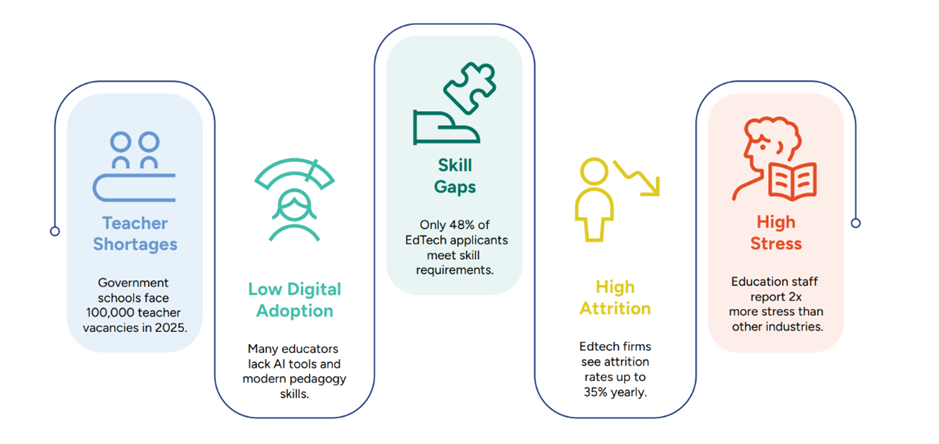
EdTech companies face deep structural challenges in redesigning their workforce at scale. Unlike traditional industries, EdTech operates at the intersection of education, technology, and business, amplifying pressure on talent supply, workforce planning, and capability building.
Teacher and faculty shortages continue to shrink the available talent pool. As highlighted in India Decoding Jobs 2026, this scarcity is especially pronounced in roles that require both subject mastery and digital delivery skills. Only 48% of applicants for EdTech teaching roles currently meet both criteria, creating persistent skills mismatches and extending hiring and onboarding cycles.
Funding volatility has further disrupted long-term workforce planning. Shifts from growth-first to profitability-first models have forced organisations to reassess headcount decisions, often delaying hiring or restructuring teams mid-cycle. In this environment, the margin for error has narrowed significantly.
Attrition remains a critical concern. Annual attrition rates in EdTech reach up to 35%, driven by compensation gaps relative to adjacent tech sectors, limited career pathing, and sustained burnout following intense post-pandemic workloads. Education professionals are also significantly more likely to report workplace stress, directly affecting productivity, engagement, and retention.
Together, these factors elevate workforce design from an HR responsibility to a business-critical issue. Decisions around role design, talent acquisition, and retention now have direct implications for learning outcomes, financial performance, and organisational resilience.
These structural constraints make one thing clear: the future of EdTech workforce cannot be built through incremental fixes or traditional hiring playbooks. To remain resilient across funding cycles, market volatility, and evolving learning models, EdTech companies must adopt workforce strategies that are intentional, flexible, and deeply aligned to outcomes.
This is where leading organisations are beginning to separate themselves from the rest.
Workforce Strategies for the Future EdTech Model
Successful EdTech companies are rethinking workforce strategy as a long-term capability-building exercise, not a short-term recruitment function. The future of the EdTech workforce is being shaped by five strategic shifts in how talent is identified, assessed, and deployed.
Hiring for skill adjacency, not just EdTech experience
Given the limited pool of professionals with direct EdTech backgrounds, leading companies are expanding their talent pools to include candidates from adjacent industries. The focus has moved from prior sector labels to transferable skills, learning agility, and problem-solving ability. This approach strengthens talent supply while reducing dependency on scarce, narrowly defined profiles.
Building role-specific hiring playbooks
Generic hiring processes fail to capture the complexity of EdTech roles. High-performing organisations are designing role-based assessment frameworks that reflect real-world challenges for product leaders, engineers, instructional designers, and growth specialists. Clear success metrics and competency definitions improve hiring accuracy and reduce mis-hire risk.
Investing in proactive talent mapping
Rather than waiting for vacancies to arise, companies are embedding proactive talent mapping into their workforce planning. This involves continuously tracking high-impact talent, understanding career trajectories, and building relationships ahead of demand. Proactive approaches shorten time-to-hire and improve talent quality when hiring windows open.
Strengthening employer branding around educational impact
Employer branding in EdTech is shifting away from growth narratives toward purpose-led value propositions. Organisations that clearly articulate how their work improves learning outcomes, access, and learner success attract candidates who are motivated by impact, not just compensation. This alignment improves engagement and long-term retention.
Balancing full-time teams with flexible talent models
To manage cost and complexity, EdTech companies are increasingly combining core full-time roles with flexible talent models, including contract specialists, project-based contributors, and fractional leadership. From a workforce planning and cost optimisation standpoint, this balance enables access to specialised skills while maintaining organisational agility.
Together, these strategies create a more resilient workforce model. One that can adapt to changing business conditions, support evolving learning formats, and sustain performance across market cycles without compromising learning quality.
As workforce strategies evolve to balance flexibility with capability depth, one factor increasingly determines whether these models succeed or fail: leadership. In distributed, hybrid, and outcome-driven environments, the quality of leadership and the infrastructure supporting hiring decisions becomes the difference between resilience and fragmentation.
This is where EdTech companies are being tested most sharply.
Leadership and Hiring Infrastructure in the Future EdTech Workforce
As EdTech organisations adopt hybrid, remote, and tutor-led workforce models, one reality is becoming unavoidable: workforce design is only as strong as the leadership and hiring infrastructure behind it. Distributed teams amplify both strengths and weaknesses. Without the right leadership and systems, flexibility quickly turns into fragmentation.
In the future of the EdTech workforce, leadership quality has become a decisive differentiator. Leaders are no longer managing teams confined by location or function. They are aligning cross-functional, outcome-driven roles across product, pedagogy, technology, and learner experience.
This requires balancing growth and profitability while safeguarding learning outcomes, often under volatile market conditions. The ability to navigate uncertainty, maintain team morale, and scale responsibly has become as important as domain expertise itself.
This leadership challenge is compounded by the limitations of traditional hiring models. Conventional recruitment approaches were built for stable roles, linear growth, and predictable skill requirements. EdTech offers none of these.
Reactive hiring increases mis-hire risk precisely when roles demand hybrid capabilities. Generic assessments fail to evaluate the blend of pedagogical understanding, technical depth, and commercial impact that modern EdTech roles require. Each hiring cycle starting from scratch creates inconsistency, delays, and lost market learning.
Insights reflected in India Decoding Jobs 2026 reinforce this shift. As EdTech companies move away from growth-at-all-costs models, hiring decisions are under sharper scrutiny. Every role must justify its contribution to learning outcomes, retention, or revenue. In this environment, episodic recruitment is not just inefficient, it is strategically risky.
This is where Edtech RPO led hiring models have emerged as a structural enabler of the future workforce. Rather than treating hiring as a series of isolated events, RPO provides continuous, always-on talent infrastructure aligned to evolving workforce needs.
Pre-built talent pipelines reduce time-to-hire. Specialised role understanding improves assessment quality and long-term fit. Consistent evaluation frameworks preserve hiring standards as teams scale or restructure.
Just as importantly, RPO offers flexibility without long-term overhead. Hiring intensity can scale up or down in line with product launches, funding cycles, or market shifts, supporting workforce resilience without locking organisations into fixed cost structures.
Taken together, leadership capability and hiring infrastructure now operate as a single system. In the future EdTech workforce, strong leaders without the right talent systems will struggle to execute, and strong hiring engines without leadership clarity will fail to deliver impact. Organisations that integrate both will be best positioned to build resilient teams, protect learning quality, and scale sustainably in the years ahead.
How Taggd Helps EdTech Companies Build Future-Ready Teams Through Talent Mapping?
As EdTech workforce models become more hybrid, distributed, and outcome-driven, the biggest risk companies face is not a lack of intent to hire, but a lack of visibility into the talent market itself. Decisions around who to hire, when to hire, and whether to build, buy, or borrow capability are increasingly being made with incomplete information.
This is where most EdTech hiring strategies break down.
Talent scarcity in hybrid roles, leadership transitions, and learner-facing functions cannot be solved through reactive sourcing or generic recruitment playbooks. They require a clear understanding of how talent is distributed across the market, how roles are evolving, and where real capability depth exists.
Taggd’s Talent Mapping capability addresses this gap by acting as a strategic intelligence layer for EdTech workforce planning. Instead of starting with open roles, it starts with market reality. Who holds the capabilities that matter. How those professionals are moving across the ecosystem. What it will realistically take to attract them, engage them, and retain them.
In the context of the future of EdTech workforce, talent mapping enables leaders to shift from short-term hiring decisions to deliberate workforce design. It provides the clarity needed to build resilient teams, reduce mis-hire risk, and align talent strategy with learning outcomes and business priorities before hiring pressure sets in.
Wrapping Up
The future of EdTech workforce will be hybrid by design, remote by default where it makes sense, and human-led where learning outcomes matter most. As the sector moves beyond rapid expansion into a phase defined by accountability and impact, workforce design is emerging as a core strategic capability.
EdTech companies that treat workforce strategy as a long-term investment rather than a short-term hiring fix will be better positioned to navigate funding cycles, talent scarcity, and shifting learning models. This means building the right mix of core teams, flexible specialists, and learner-facing roles, supported by strong leadership and intelligent hiring infrastructure.
Ultimately, the teams EdTech companies build today will shape more than business performance. They will define the credibility, effectiveness, and long-term trustworthiness of digital education itself.
FAQs
What is the future workforce model for EdTech companies?
The future EdTech workforce will combine hybrid roles, remote teams, and tutor-led delivery models. This mix balances flexibility, cost efficiency, and learning outcomes while supporting scalable, resilient growth.
Why are hybrid roles becoming so important in EdTech?
EdTech roles increasingly require a blend of technology, pedagogy, and business impact. Hybrid roles improve capability density and reduce dependency on large, siloed teams.
Are tutor-led models replacing self-paced learning?
Tutor-led models are not replacing self-paced learning, but complementing it. Human-led interventions improve engagement, completion, and accountability where purely digital formats fall short.
What makes EdTech workforce planning more complex than other sectors?
EdTech sits at the intersection of education, technology, and business. Talent shortages, skills mismatches, high attrition, and outcome accountability make workforce decisions more strategic and less forgiving.
How can EdTech companies reduce hiring risk in a volatile market?
By moving from reactive hiring to proactive workforce planning, investing in talent mapping, and aligning hiring decisions closely with learning outcomes and business priorities.
Building a future-ready EdTech workforce requires more than filling open roles. It demands clear visibility into talent markets, role evolution, and capability availability before hiring pressure sets in.
If the goal is to scale learning impact without compromising resilience, it’s time to rethink workforce strategy as a strategic advantage, not an operational afterthought.
Explore how Taggd’s AI-powered EdTech recruitment solutions, talent mapping and leadership hiring capabilities help EdTech companies design smarter workforce models, reduce mis-hire risk, and build teams aligned to the future of digital education.