The GCC’s economic boom is creating a gold rush for talent, with millions of new jobs on the horizon. For CHROs, however, this incredible opportunity is being overshadowed by intense GCC hiring challenges. It’s a high-stakes competition where the old recruitment playbook just doesn’t work anymore.
The Perfect Storm of Opportunity and Scarcity in GCC Hiring

Imagine a market flooded with jobs, yet finding the right people feels next to impossible. This is the paradox facing talent leaders across the Gulf Cooperation Council today. Ambitious economic diversification projects are fuelling a massive demand for skilled professionals, creating a vibrant, yet fiercely competitive, candidate-driven market.
This isn’t just a small uptick; it’s a complete structural shift. The region is seeing an unprecedented hiring surge. The UAE alone reported a remarkable +48% Net Employment Outlook, leaving other major global economies in the dust. Looking ahead, the broader GCC is projected to create over 5 million new private-sector jobs by 2030.
This explosive growth means speed is no longer a luxury it’s a survival tactic. Top organisations now close hires in just 25-35 days. Companies that can’t keep up are watching top candidates walk away before an offer is even on the table.
The Collision of Growth and Scarcity
This rapid expansion has collided head-on with a stark reality: talent is incredibly scarce. The core GCC hiring challenges aren’t isolated problems. They are interconnected forces creating a perfect storm for employers, and reactive, old-school hiring methods are failing fast.
To give you a clearer picture, here’s a quick look at the major hurdles CHROs are navigating daily.
Key GCC Hiring Challenges at a Glance
| Challenge Area | Primary Impact on Business |
|---|---|
| Intense Competition | Fierce battles for a limited talent pool, driving up acquisition costs and extending time-to-fill. |
| Critical Skills Shortages | A major gap between the specialised digital and technical skills needed and what’s available locally. |
| Complex Regulations | Navigating nationalisation policies like Saudisation and Emiratisation adds significant complexity. |
| Retention Battles | High attrition rates mean keeping top performers is just as hard as finding them, hitting stability hard. |
These aren’t just HR problems; they are business-critical issues that directly impact growth, innovation, and the bottom line.
The Urgency for a New Strategy
In a market where speed and insight are everything, a reactive mindset is the fastest way to fall behind. The current landscape demands more than just filling vacancies. It requires a forward-thinking, strategic approach that anticipates market shifts, builds a powerful employer brand, and optimises every single touchpoint in the talent journey.
CHROs must move beyond traditional recruitment and adopt a unified strategy that tackles these challenges head-on. This means truly understanding the deep-seated nature of skills gaps, mastering local labour laws, and building an employer brand that top talent can’t resist.
To get a deeper understanding of these market forces, you can explore our deep dive into the GCC report for 2025 growth trends and talent insights. The following sections will break down each of these critical challenges, giving you the strategic clarity needed to win in this demanding environment.
Why the Regional Skills Gap Is Deeper Than You Think

One of the most stubborn GCC hiring challenges is the skills gap, but if you’re only seeing it as a simple talent shortage, you’re missing the bigger picture. It’s more like drilling for a rare, deeply embedded resource. The surface might look crowded with candidates, but the high-impact skills that actually drive a modern business are buried deep, requiring specialised tools and serious investment to unearth.
This isn’t a temporary dry spell; it’s a fundamental shift in the market’s structure. The breakneck pace of digitalisation across the GCC – from Riyadh’s giga-projects to Dubai’s fintech explosion – has created a ferocious demand for skills that were barely on the radar a few years ago. The result is a gaping chasm between what companies desperately need and what the available talent pool can realistically offer.
This dynamic completely flips the traditional recruitment model. Instead of employers holding all the cards, it’s a small, elite group of professionals with future-ready skills who are now calling the shots.
The Epicentre of Scarcity
This gap is most severe in high-growth, technical fields where expertise isn’t just a “nice-to-have” – it’s non-negotiable. Sticking to conventional sourcing methods, like posting on broad job boards, is like panning for gold in a river that dried up years ago. The real value is hidden much deeper.
Here’s where the talent shortage is hitting hardest:
- Artificial Intelligence and Machine Learning: Professionals who can actually build and deploy AI solutions are in incredibly high demand as organisations scramble to automate and make sense of their data.
- Cybersecurity: With every digital step forward comes new vulnerabilities. This makes cybersecurity experts -the people who can protect critical infrastructure – some of the most sought-after (and expensive) talent in the entire region.
- Advanced Engineering and Clean Energy: Vision 2030 and similar national initiatives are fuelling a colossal need for engineers skilled in sustainable technologies, smart city development, and renewable energy.
- Data Science and Analytics: Companies are sitting on mountains of data, but the specialists who can turn that raw information into a winning business strategy are exceptionally rare.
The uncomfortable truth is that these skills shortages are one of the most acute challenges facing GCC employers today. The talent gap is particularly wide in specialised tech roles, with AI engineering and cybersecurity leading the demand. This imbalance is compounded by the fact that 77% of APAC employers, which includes many GCC firms, report struggling to fill key positions.
The Ripple Effect on Business Operations
This scarcity creates a domino effect that sends shockwaves through the entire organisation, well beyond the HR department. The competition has become so intense that it’s fundamentally changing the financial and operational calculus of hiring.
When a huge number of companies are all chasing the same small pool of experts, the consequences are both predictable and painful.
This fierce competition doesn’t just make hiring harder; it makes it slower and far more expensive. Companies are dragged into reactive bidding wars, inflating salary benchmarks and stretching hiring cycles from weeks into months – all while critical projects are left gathering dust.
This environment is a direct threat to business agility. A six-month search for a lead data scientist means a six-month delay in launching your new analytics platform. Failing to land a cybersecurity architect on time exposes the business to unacceptable risks. These aren’t just minor speed bumps; they are major roadblocks to growth and innovation.
Understanding the true depth of this skills gap is the first step toward building a recruitment strategy that actually works. To get ahead, it’s crucial to understand the top skills currently in demand across the market. In a market where specialised talent is the ultimate competitive edge, relying on outdated tactics is no longer an option.
Mastering Nationalisation and Complex Labour Laws
Go beyond the skills gap, and you’ll find one of the most defining GCC hiring challenges: the tangled web of nationalisation policies and labour laws. For any CHRO on the ground, programs like Saudisation, Emiratisation, and Qatarisation can feel like trying to solve a Rubik’s Cube that keeps changing colours. These aren’t just bureaucratic speed bumps; they’re the very foundation of national economic strategies.
If you’re looking at these policies as just a compliance headache, you’re missing the bigger picture. It’s a dual mandate. You’re being asked to build a strong pipeline of local talent while, at the same time, hunting for elite global experts for roles that the domestic market simply can’t fill yet. This is where your recruitment strategy has to align with a national vision.
The real trick is weaving these localisation targets into your workforce plan without losing the specialist skills you need to stay competitive. It’s not about just hitting quotas. It’s about genuinely developing local talent and strategically sourcing from the rest of the world.
The Strategic Balancing Act
Nailing this balance is the ultimate test for any HR leader in the region. On one side, you have firm, non-negotiable targets for hiring and promoting nationals. On the other, your business units are crying out for specialists in fields like AI or renewable energy, where the local talent pool is still growing.
This sets up a high-stakes decision every single time you hire. Do you bring on a less-experienced local candidate to meet a quota, and risk a delay on a critical project? Or do you hire an expat expert and fall behind on your nationalisation goals?
A reactive, fire-fighting approach just won’t cut it here. The only way forward is with proactive, long-term planning that tackles both sides of the problem.
- Building Local Talent Pipelines: This is about more than just hiring. It means creating meaningful internship programs, striking up partnerships with local universities, and designing clear career paths that make your company a top choice for ambitious national graduates.
- Strategic Global Sourcing: For those roles with undeniable skills gaps, you need a sniper rifle, not a shotgun. It’s not about casting a wide net. It’s about pinpointing and attracting the world’s best specialists who can not only fill a crucial gap but also mentor and upskill your local teams.
Navigating Visas and Labour Mobility
Layered on top of all this are the ever-shifting complexities of visa rules, sponsorship laws, and labour mobility between GCC countries. These regulations aren’t set in stone; they change with economic priorities and can directly slam the brakes on your hiring speed. A sluggish visa process can easily add weeks, even months, to your time-to-hire. In a competitive market, that’s a death sentence.
For instance, simply understanding the subtle differences between free zone and mainland regulations, or knowing the exact paperwork needed for specific nationalities, can be the difference between a successful hire and a lost opportunity. One wrong move doesn’t just mean a delay; it often means a top candidate gets frustrated and accepts another offer while their visa is stuck in limbo.
The administrative friction from complex visa and sponsorship laws acts like a hidden tax on your recruitment efforts. It drains time, frustrates candidates, and puts companies without the right expertise at a serious competitive disadvantage.
This regulatory maze demands deep, specialised knowledge. Your in-house team either needs to become quasi-immigration lawyers for multiple countries, or you need a partner who already has that expertise baked in.
This is exactly where a specialised partner proves its worth. An expert in GCC recruitment can take the entire compliance and visa headache off your plate. They can shield your team from the administrative quicksand and make sure your top candidates have a seamless, professional start. By turning a major bottleneck into a smooth process, you can get back to what you do best: finding and hiring the amazing talent, local or global, that will drive your business forward.
Winning the War for Talent with Your Employer Brand
In the hyper-competitive Gulf market, the tables have turned. Your company isn’t just interviewing candidates anymore they are actively interviewing you. The most intense GCC hiring challenges aren’t just about finding people; they’re about convincing top talent to choose you over a dozen other compelling offers. In this candidate-driven market, a powerful employer brand is your most critical competitive advantage.
Think of it as a talent marketplace. The best professionals aren’t just looking for a job; they’re shopping for a career destination. They browse, compare, and scrutinise opportunities with the same care a savvy consumer would. A high salary might get their attention, but it’s your brand your reputation as an employer – that ultimately seals the deal.
A weak or non-existent employer brand is like trying to sell a premium product in generic, plain packaging. No matter how incredible the contents are, people will walk right past it. It quietly sabotages your recruitment pipeline, making it nearly impossible to attract top-tier talent, no matter how much you invest in sourcing.
Deconstructing Your Employee Value Proposition
Your employer brand is built on a single, powerful promise: your Employee Value Proposition (EVP). This is the core “what’s in it for me” that answers a candidate’s most pressing questions about joining your team. A strong EVP in the GCC has to go far beyond a competitive paycheque and basic benefits.
It must be a compelling, holistic offer that speaks directly to the ambitions of a modern workforce. To truly stand out, your EVP needs to deliver on several key fronts:
- Career Mobility and Growth: Top performers want to see a clear path forward. They’re looking for defined career ladders, real opportunities for internal promotion, and the chance to take on challenging new projects that stretch their skills.
- Continuous Learning and Development: The promise of upskilling is a powerful magnet. Offering access to cutting-edge training, professional certifications, and mentorship programmes shows you’re genuinely invested in their long-term success.
- A Vibrant and Inclusive Corporate Culture: Candidates want to know what it feels like to work for you every day. A positive culture built on collaboration, mutual respect, and psychological safety is a massive differentiator.
- Meaningful Work and Impact: Professionals, especially those in younger generations, need to see how their role contributes to the bigger picture. Connecting their daily tasks to the company’s overarching mission is crucial.
The Non-Negotiable Role of Compensation
While culture and growth opportunities are vital, let’s be crystal clear: you cannot build a great employer brand on a weak compensation strategy. In the GCC’s high-stakes market, aggressive and continuous salary benchmarking isn’t just a good idea – it’s non-negotiable. If your offers aren’t competitive, you’re out of the game before it even starts.
A weak employer brand is a silent killer of recruitment efforts. It creates a constant headwind, forcing you to overspend on sourcing just to get candidates in the door, only to lose them when they discover your culture or compensation doesn’t match their expectations.
This means your HR team must have its finger on the pulse of the market, constantly analysing salary data for high-demand roles. You need to know what your direct competitors are offering and be prepared to meet or exceed those benchmarks for the talent you truly need. Failing to do so sends a clear message that you don’t value top performers, a perception that will cripple your hiring success. Ultimately, a winning strategy harmonises a magnetic brand with an undeniably competitive offer.
How Strategic RPO Solves Your Biggest Hiring Headaches
Trying to navigate the maze of GCC hiring challenges with reactive, one-off fixes just doesn’t cut it anymore. It’s like trying to patch a leaky dam with sticking plasters. For Chief Human Resources Officers (CHROs) feeling the pressure, the real solution requires a fundamental shift moving from an overloaded in-house model to a specialised, strategic partnership. This is where Recruitment Process Outsourcing (RPO) becomes your game-changer.
Think of your in-house HR team as skilled general practitioners. They are brilliant at managing the day-to-day health of the organisation, but they can’t be experts in every complex medical field. When you’re dealing with a persistent, highly specialised problem like sourcing scarce AI talent or untangling intricate visa laws you bring in a specialist. An RPO partner is that specialist for your entire talent acquisition function.
A true RPO provider does more than just fill roles. They embed themselves into your business, becoming a genuine extension of your team to tackle the very challenges holding you back. They bring focused expertise, cutting-edge recruitment technology, and global talent networks that are often beyond the reach of a single company’s HR department.
Dismantling the Skills Gap with Global Reach
One of the most immediate wins with an RPO partnership is its ability to punch through the regional skills gap. While your local team might have an excellent network, an RPO partner operates on a global stage. They have dedicated teams of talent sourcers who spend their days mapping markets across the world, identifying and engaging experts in niche fields like cybersecurity, clean energy, and data science.
This proactive, global sourcing engine flips your hiring process from a reactive, localised search into a strategic international hunt. Instead of posting a job and hoping the right candidates apply, your RPO partner is already building pipelines of passive talent, ready to engage the moment you have a need. This massively cuts down your time-to-hire for those critical, hard-to-fill positions.
Expert Navigation of Localisation and Labour Laws
The sheer complexity of nationalisation programmes and constantly shifting visa regulations can grind any recruitment process to a halt. An experienced RPO provider specialising in the GCC comes with this expertise baked in. They understand the nuances of Saudisation and Emiratisation not just as compliance hurdles, but as strategic workforce planning goals.
They help you architect a balanced hiring strategy that hits your localisation targets without compromising on securing the best global talent for mission-critical roles.
An RPO partner acts as your compliance shield and administrative engine, managing the entire visa and onboarding process seamlessly. This frees up your team from bureaucratic friction and ensures a smooth, professional experience for your new hires, both local and expatriate.
Building a Magnetic Employer Brand
A powerful employer brand is a non-negotiable in today’s market, but building and marketing it takes dedicated, specialised effort. This is another area where an RPO partnership delivers huge value. They bring in recruitment marketing specialists who can help you define and powerfully articulate your Employee Value Proposition (EVP).
The map below shows the core elements of a compelling employer brand, which an RPO partner helps you build and promote.
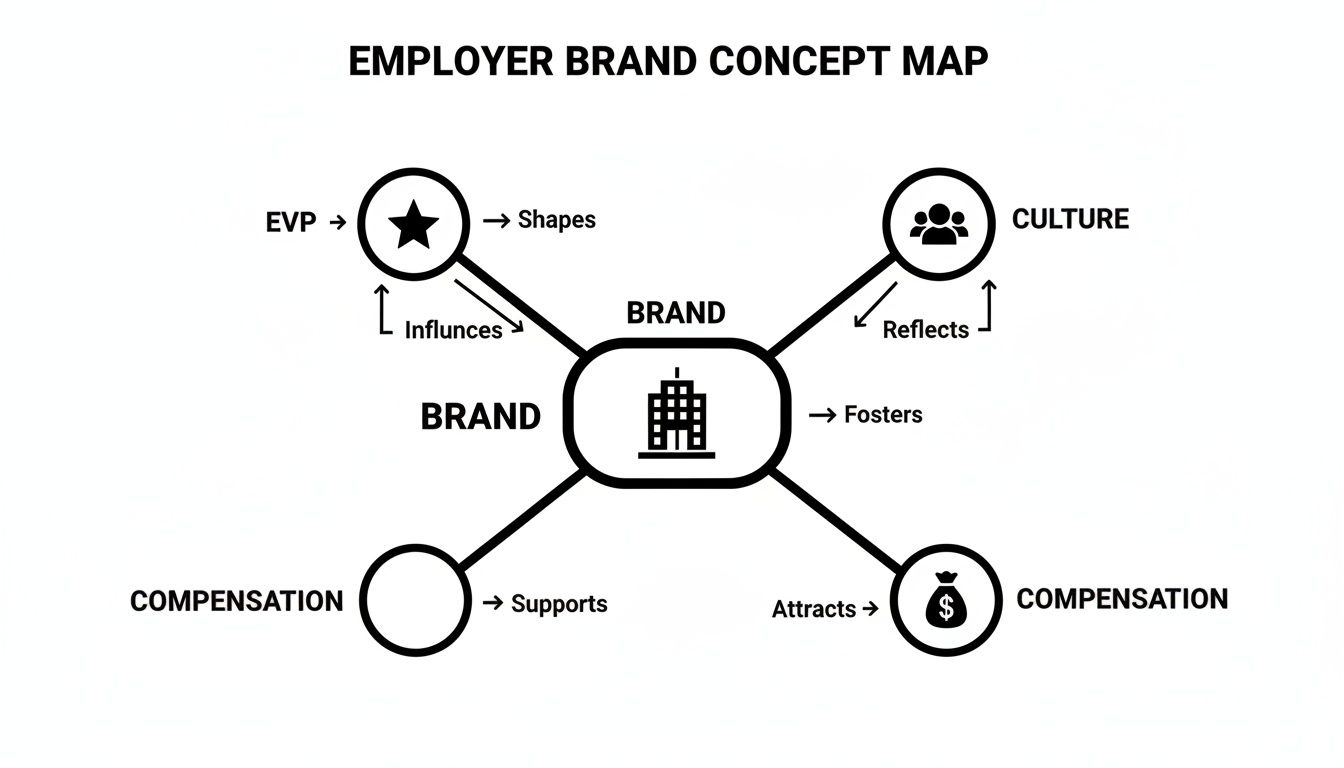
As the visual highlights, a strong brand is an ecosystem of your core values, culture, and competitive compensation all of which an RPO helps you optimise and communicate. They use targeted campaigns and data-driven insights to make sure your story reaches the right people on the right channels, turning your company into a talent magnet. If you’re looking to dive deeper into this model, our guide covers everything you need to know about RPO.
For many CHROs in the GCC, the question is how to make this strategic shift a reality. The table below illustrates the practical difference between a standard in-house approach and what a dedicated RPO partnership brings to the table.
Traditional In-House Recruitment vs Strategic RPO Partnership
| Hiring Challenge | In-House Team Approach | Strategic RPO Solution |
|---|---|---|
| Niche Skills Gaps | Relies on local job boards and existing networks. Struggles to find highly specialised talent. | Deploys global sourcing teams to proactively map and engage passive candidates worldwide. |
| Nationalisation Policies | Focuses on meeting compliance quotas, often reactively. Can struggle to balance local vs. expat hiring. | Develops a strategic, long-term workforce plan that integrates localisation goals with business needs. |
| Complex Visa Rules | Administrative teams are often overwhelmed with paperwork, causing delays and poor candidate experience. | Provides dedicated compliance experts to manage the entire visa and onboarding process efficiently. |
| Employer Branding | Marketing efforts are often ad-hoc and lack a specialised recruitment focus. | Employs recruitment marketing specialists to define the EVP and run targeted branding campaigns. |
| Compensation Competition | Relies on existing salary bands, which may not be competitive for in-demand roles. | Provides real-time market intelligence and compensation benchmarking to ensure offers are competitive. |
| High Attrition Rates | Onboarding can be inconsistent, leading to poor early-stage engagement and retention. | Designs and executes a structured, professional onboarding experience to improve new hire retention. |
By partnering with an RPO, you’re not just outsourcing tasks; you’re insourcing expertise, technology, and global reach. This transforms talent acquisition from a reactive, administrative cost centre into a proactive, strategic driver of business growth, giving you the agility to win the war for talent in one of the world’s most dynamic markets.
Building a Resilient Talent Pipeline for the Future
To truly get a handle on the GCC’s hiring challenges, you need to think beyond just filling today’s empty seats. The real goal is to build a sustainable talent engine that doesn’t just patch holes but actively fuels your long-term growth. It’s about turning insights into a clear, actionable roadmap for the years ahead.
This isn’t a small tweak; it’s a fundamental shift in mindset. You have to move away from constantly firefighting daily recruitment crises and towards architecting a resilient talent pipeline. We’re talking about a system that actually anticipates your needs, attracts top-tier professionals before you even post a job, and grooms future leaders from within. A truly strong strategy is built on a few essential pillars, each designed to tackle a core challenge in the GCC market.
Your approach has to be holistic, weaving together multiple threads into a single, cohesive talent strategy. When these elements work in concert, that’s when you create a real competitive advantage.
Core Pillars of a Future-Proof Strategy
To get out of a reactive hiring cycle, CHROs need to master four critical areas. Think of these not as separate projects, but as interconnected parts of a powerful system built for agility and long-term success in a very demanding market.
- Deep Skills Intelligence: Forget generic job descriptions. You need to invest in proper market analytics to understand which skills are critical now, and more importantly, which ones will be essential in three to five years. This foresight lets you build talent pools before your competitors even realise there’s a gap.
- Proactive Regulatory Mastery: Start treating nationalisation programmes and complex labour laws as strategic opportunities, not just compliance headaches. Build genuine relationships with local universities and create real development pathways for national talent. This turns a regulatory requirement into a source of competitive strength.
- A Magnetic Employer Brand: In this market, your brand is your single most powerful recruitment tool. You have to constantly refine your Employee Value Proposition (EVP) to match what the modern workforce actually wants things like clear career mobility, continuous learning, and a genuinely supportive culture. Your reputation has to precede you.
The Power of a Strategic Partnership
The final, and perhaps most critical, pillar is admitting you can’t do it all alone. The sheer complexity and scale of hiring in the GCC demand specialised expertise and a global reach that very few in-house teams can sustain. This is where a strategic RPO partnership can be a game-changer.
A dedicated RPO partner like Talent Hired isn’t just a vendor; they act as a strategic multiplier, embedding specialised expertise directly into your operations. It’s about transforming your talent function from a cost centre into a proactive, data-driven engine for business growth, ready to capitalise on the GCC’s incredible trajectory.
By bringing these pillars together deep skills intelligence, a smart regulatory strategy, a powerful brand, and a strategic RPO partnership you stop just solving hiring problems. You start building a future-proof workforce that isn’t just ready for today, but is poised to win the opportunities of tomorrow. This proactive stance is the key to unlocking sustainable growth.
Your Top GCC Hiring Questions, Answered
Hiring in the Gulf can feel like navigating a maze, where every turn brings a new question. We get it. To cut through the noise, we’ve put together some straight answers to the most common queries we hear from CHROs and hiring managers grappling with the unique GCC hiring challenges.
Think of this as your quick-reference guide. These are the on-the-ground insights you need to make faster, smarter hiring decisions.
How Can We Benchmark Salaries in Such a Fast-Moving Market?
In the GCC, if you’re only looking at salaries once a year, you’re already falling behind for in-demand roles. The old model of annual reviews is broken. You need to be far more dynamic.
This means plugging into real-time market data, not just flipping through last year’s industry report. Work with specialised salary intelligence platforms and, more importantly, recruitment partners who have a real-time feel for compensation trends. For your most critical hires, you should be checking in on salary bands every quarter. Otherwise, you risk losing out on top talent because your pay scales are stuck in the past.
The biggest mistake we see is companies assuming last year’s compensation data is still relevant. In a market this competitive, a six-month-old salary benchmark for a cybersecurity expert is already obsolete. You’re at a disadvantage before you even make an offer.
What Is the Single Biggest Mistake Companies Make with Nationalisation?
Treating nationalisation as a box-ticking exercise. It’s the most common trap. This reactive approach leads to hiring locals just to meet a quota, creating a revolving door of talent who feel they have no real future in the company.
A much smarter strategy is to weave localisation deep into your workforce plan from day one. The aim isn’t just to fill roles; it’s to build genuine, long-term career paths for national talent.
- Invest in Graduate Programmes: Build structured development tracks that groom promising local graduates into your next generation of leaders.
- Forge University Partnerships: Get proactive. Work with local universities and colleges to create a direct pipeline of talent with the skills you actually need.
- Promote Internal Mobility: Look within your own walls. Actively find, develop, and promote high-potential national employees into more senior positions.
How Important Are Cultural Nuances in the Hiring Process?
They’re not a “nice-to-have”; they’re absolutely essential. In the GCC, cultural intelligence is a core business competency. Misunderstanding local customs, how people communicate, or professional etiquette can completely derail your recruitment efforts. For instance, the concept of ‘Wasta’ (leveraging personal connections) can still play a role, and the direct, get-down-to-business style common in the West can sometimes come across as blunt or disrespectful.
Taking the time to build genuine rapport and showing respect for the local culture during interviews is crucial. It signals to candidates both nationals and expats that you’re truly invested in the region and understand how business gets done here. This alone can dramatically improve your chances of attracting and keeping the right people.
Tackling these challenges demands more than just a good plan; it requires deep local expertise and strategic foresight. Taggd helps shift your talent acquisition from a reactive necessity to a proactive engine for business growth. We provide the market intelligence and operational muscle needed to win the war for talent in the GCC. Find out more about our strategic Recruitment Process Outsourcing solutions at Taggd.