So, what exactly are these high-volume hiring RPO solutions? At its core, it’s a strategic partnership. Your company hands over its large-scale recruitment processes to a specialised provider who lives and breathes this stuff. This isn’t just about filling seats; it’s a model designed to manage massive hiring surges efficiently, making sure you get quality candidates at speed without burning out your internal teams. Think of it as a scalable talent engine, custom-built for growth.
Decoding High-Volume RPO Solutions for Indian Enterprises
Let’s paint a picture. Your company is on the brink of a huge expansion across India. The goal? One thousand new hires in the next quarter. For your in-house talent acquisition team, that’s not just a tall order; it’s a potential crisis.
It’s like asking the kitchen of your favourite local café to suddenly cater a wedding for two thousand guests. They might pull it off, but you can bet the quality, speed, and consistency would take a serious hit under that kind of pressure.

This is precisely where high-volume hiring Recruitment Process Outsourcing (RPO) solutions come into play. Your RPO partner is that professional, industrial-grade catering service for your talent needs. They show up with the specialised tools, the battle-tested processes, and the expert teams designed specifically to handle that scale without ever compromising on the quality of your hires.
For Indian business leaders and CHROs, this guide is your playbook for turning talent acquisition from a reactive, often chaotic function into a real strategic advantage.
The Growing Need for Scalable Hiring
The pressure on talent teams isn’t just a feeling; the numbers back it up. In recent years, India has seen hiring intent jump from 17.7% to 29%, a clear signal of aggressive expansion plans across sectors like IT, financial services, and manufacturing. This explosive growth creates an urgent need for recruitment models that can scale up—and down—at a moment’s notice. You can see the full picture in this in-depth analysis of Indian hiring intent on Statista. With this kind of economic momentum, understanding scalable hiring isn’t just smart; it’s critical.
An RPO partnership is not just about outsourcing recruiters; it’s about embedding a high-performance talent acquisition engine into your organisation, one that is built for speed, quality, and adaptability in a dynamic market.
This guide will give you a clear roadmap for getting the most out of RPO, focusing on:
- Evaluating if RPO is truly the right fit for your business goals.
- Implementing a partnership smoothly and effectively.
- Maximising the return on your investment.
By exploring proven high-volume hiring strategies, you’re not just preparing to fill roles. You’re building the workforce you need to dominate your market tomorrow. We’ll provide actionable frameworks to help you navigate every step of this journey.
How High-Volume RPO Solutions Actually Work

To really get what high-volume hiring RPO solutions are about, you have to look beyond the textbook definitions. This isn’t just about outsourcing a few recruiters when you’re swamped. It’s about embedding a specialised, tech-driven talent acquisition engine right into the heart of your organisation.
Let’s try an analogy. Think of it as ‘Manufacturing as a Service’. When a company needs to produce thousands of identical, high-quality products day in and day out, they don’t just hire a few extra people for the assembly line. They partner with a specialist factory that has perfected the entire production process, from sourcing raw materials to final quality checks.
An RPO partner does exactly that, but for your talent pipeline. They don’t just “find people”; they industrialise the whole system of attracting, screening, and hiring candidates at a massive scale. It’s a partnership built on long-term strategy, not quick, one-off transactions.
The Core Components of the RPO Engine
A well-oiled RPO solution is made up of several key parts, all working in sync to deliver consistent hiring outcomes. Each component is specifically designed to handle massive volume without letting quality slip.
- Dedicated Sourcing Teams: These aren’t your average recruiters. RPO providers bring in teams armed with sophisticated tools and deep market intelligence, proactively hunting for and engaging both active and passive candidates.
- Centralised Screening Processes: Consistency is everything in high-volume hiring. An RPO partner sets up standardised screening protocols and assessment frameworks, making sure every single candidate is measured against the same high bar. This virtually eliminates hiring manager bias.
- Integrated Technology Stack: Your RPO partner comes equipped with a powerful tech toolkit. This often includes Applicant Tracking Systems (ATS), AI-sourcing platforms, and automated chatbots that plug straight into your existing HR systems.
- Employer Brand Amplification: The RPO team becomes a guardian of your employer brand. They ensure every candidate interaction—from the very first email to the final offer letter—is a positive experience that reflects your company’s culture and values.
By industrialising the recruitment process, a high-volume RPO partner transforms talent acquisition from a series of individual sprints into a continuous, predictable, and scalable marathon. It’s about building a system, not just filling requisitions.
RPO vs Traditional Recruitment Agencies
To understand what RPO is, it’s equally important to know what it isn’t. A lot of leaders make the mistake of lumping it in with traditional recruitment agencies, but the two models couldn’t be more different.
A relationship with a traditional agency is purely transactional. You have an open position, they send you a pile of CVs, and you pay a hefty fee if you hire one of their candidates. The entire focus is on that single placement.
An RPO partnership, on the other hand, is strategic and process-oriented. The provider takes ownership of your entire recruitment function, or at least a big chunk of it. Their success isn’t just measured by hires; it’s measured by bigger-picture metrics like time-to-fill, cost-per-hire, and quality of hire across hundreds or even thousands of roles.
Distinguishing RPO from Project-Based Hiring
Another common point of confusion is the line between full-scale RPO and project-based hiring. While both involve outsourcing, their scope and purpose are miles apart.
Project-Based RPO is a targeted, short-term burst of activity. It’s perfect for specific, time-bound needs, like staffing a new manufacturing plant or handling a massive seasonal hiring spike. Think of it as calling in a specialised task force for a single, well-defined mission. In fact, demand for project RPO grew 4X between 2023 and 2024 as companies looked for this kind of flexible support.
Comprehensive High-Volume RPO is a continuous, ongoing partnership. It’s built for organisations that have constant, large-scale hiring needs. In this model, the RPO provider becomes a seamless extension of your talent team, dedicated to building and fine-tuning your long-term talent pipeline. This deep integration is what elevates them from a simple service provider to a true strategic partner.
The Business Case for RPO in the Indian Market
Understanding the mechanics of high-volume RPO is one thing. Seeing how it actually impacts your business is another entirely. For CHROs navigating the fast-paced Indian market, the real ‘why’ behind using high-volume hiring RPO solutions comes down to a powerful combination of benefits that strengthen both the bottom line and your company’s long-term health.
Think of an RPO partnership not just as a way to cut costs, but as a strategic move to build a more agile, high-performing workforce. By handing over the entire recruitment lifecycle to a dedicated partner, you unlock value that an already overstretched in-house team simply can’t deliver on its own.
This shift frees up your core HR professionals from the daily grind of transactional recruiting. Imagine them focusing their expertise on big-picture initiatives: leadership development, succession planning, and boosting employee engagement. These are the activities that truly shape a company’s future.
Driving Down Costs and Driving Up Quality
One of the first things you’ll notice is a significant drop in hiring costs. Because RPO providers operate at scale, they bring down the average cost-per-hire by making every step of the process—from sourcing channels to interview scheduling—more efficient.
But it’s not just about spending less. A true RPO partner is obsessed with improving the quality of hire. They bring sophisticated assessment tools, deep market intelligence, and access to wider, often untapped, talent pools. This means you get candidates who don’t just fit the job description, but who also align with your company culture, leading to better retention and higher productivity. The many benefits of recruitment process outsourcing go far beyond just filling roles; they forge a sustainable talent advantage.
Achieving Unmatched Scalability and Flexibility
The Indian market is dynamic, to say the least. Rapid growth spurts, seasonal hiring peaks, and sudden project demands are just business as usual. An in-house team can find it incredibly difficult to keep pace with these swings, leading to painfully slow hiring during booms and costly overhead during lulls.
High-volume RPO acts like a recruitment thermostat for your organisation. It lets you turn the heat up or down to match your exact hiring needs, without the fixed costs that come with a large internal team.
This kind of agility is a game-changer, especially in sectors like manufacturing. For instance, India’s Production Linked Incentive (PLI) schemes are set to create millions of new jobs, creating predictable, large-scale hiring needs. RPO providers are perfectly built to turn these requirements into efficient, standardised bulk hiring campaigns.
RPO vs. Traditional Models: A Clear Comparison
When you’re weighing your options for talent acquisition, it helps to see how they stack up. High-volume RPO brings something very different to the table compared to keeping everything in-house or relying on a patchwork of contingent agencies.
The table below breaks down the key differences to give you a clear framework for deciding what’s right for your organisation.
Recruitment Model Comparison: In-House vs Contingent vs RPO
| Feature | In-House TA Team | Contingent Staffing | High-Volume RPO |
|---|---|---|---|
| Cost Structure | Fixed overhead (salaries, tools) | High per-hire fees (transactional) | Flexible, often based on volume and SLAs |
| Scalability | Limited; slow to scale up or down | Moderate; good for individual roles | High; designed for rapid, large-scale fluctuation |
| Process Ownership | Full ownership and control | No process ownership; delivers candidates | Takes full ownership of the end-to-end process |
| Strategic Focus | Divided between strategic and transactional tasks | Purely transactional; focused on placements | Strategic partnership focused on long-term goals |
| Technology Access | Limited by internal budget | Uses own, often siloed, tools | Provides access to an integrated, advanced tech stack |
| Quality of Hire | Varies by recruiter and workload | Inconsistent; focused on speed over fit | Consistent; measured and managed via SLAs |
Ultimately, the choice to adopt high-volume hiring RPO solutions comes down to a compelling business case. It’s a clear path to lower costs, better quality talent, and the strategic agility you need to win in India’s competitive landscape.
Your RPO Implementation Roadmap
Making the switch to a high-volume hiring RPO solution is a bit like launching a major project—it needs a clear, structured plan. Just signing on the dotted line and hoping for the best is a surefire way to end up with missed targets and a whole lot of friction. A well-thought-out roadmap, on the other hand, guarantees a smooth, transparent, and effective launch that truly aligns your organisation with its new talent partner.
Think of this journey as more than just a technical handoff; it’s a strategic overhaul of how you attract talent. Treating it with that level of importance, with dedicated phases and crystal-clear objectives, is what builds the foundation for long-term success. It’s how the partnership moves from a theoretical agreement to a high-performance talent engine firing on all cylinders.
The whole point is to move away from high internal costs and frustrating hiring bottlenecks and towards an efficient RPO solution that transforms your entire talent acquisition function.
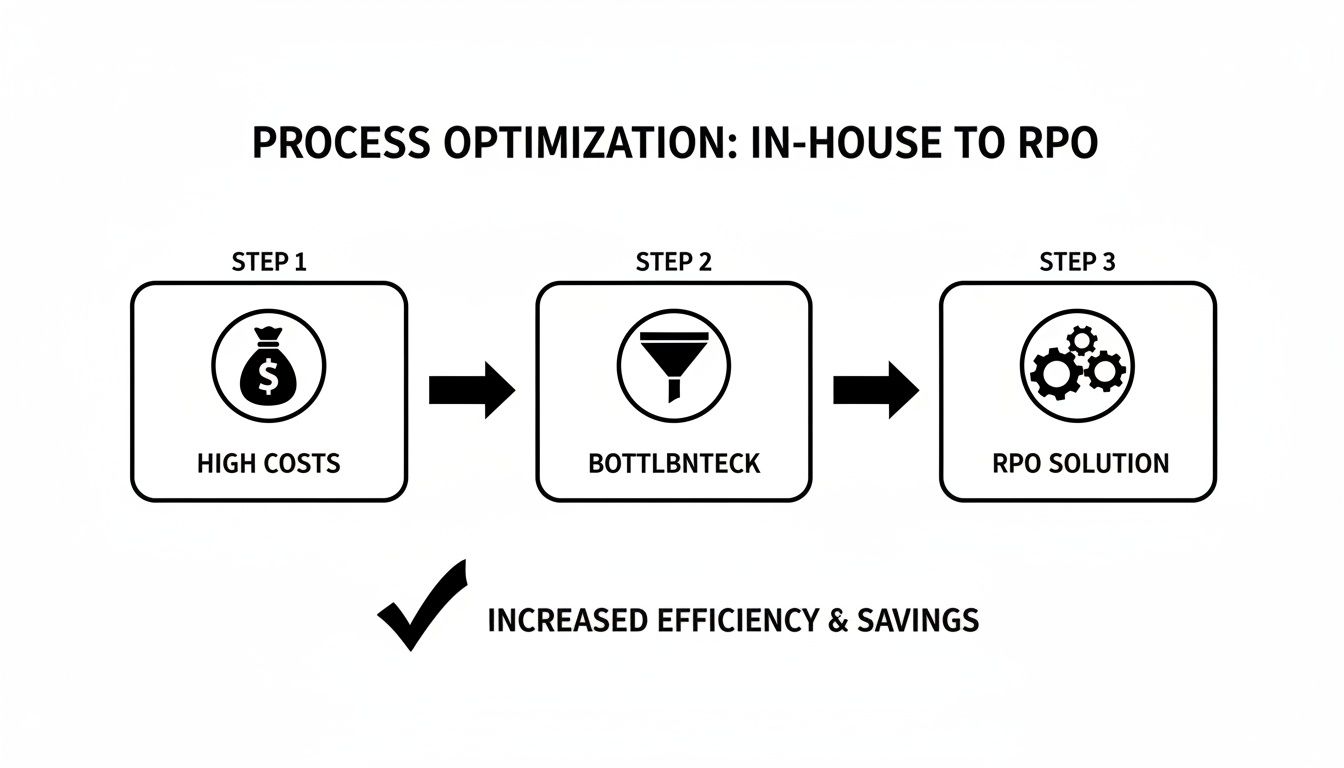
This visual really captures the essence of the problem. High costs and process jams are common pain points for in-house teams, and a streamlined RPO partnership is specifically designed to fix them.
Phase 1: Define Your Needs and Objectives
Before you even start looking at providers, the first step is to look inward. This phase is all about gathering your key stakeholders to define precisely what you need the RPO to accomplish. Vague goals only lead to vague results, so you have to get specific.
- Define Scope: Are you handing over all recruitment, or just certain roles, departments, or even specific regions?
- Establish Volume: What are your hiring numbers, both historically and what you’re projecting? Be ready with clear figures for monthly, quarterly, and annual needs.
- Set Objectives: What’s the main goal here? Are you trying to slash time-to-fill, bring down cost-per-hire, boost the quality of your hires, or simply become more agile? You need to prioritise these.
Doing this homework upfront is absolutely critical. When you have a detailed understanding of your own needs, it becomes so much easier to pick the right partner and draft a meaningful contract down the line.
Phase 2: Select a Partner and Finalise SLAs
With your requirements clearly documented, you can kick off the provider selection process. Use a detailed checklist to size up potential partners, focusing on their track record in your industry, the tech they use, and whether their culture vibes with yours.
Once you’ve made your choice, the next step is finalising the contract and, most importantly, the Service Level Agreements (SLAs). These are the non-negotiable, measurable metrics that define what success looks like and keep your partner accountable.
An SLA is the backbone of any successful RPO partnership. It transforms abstract goals like “better quality” into concrete, measurable targets like “a 90-day retention rate of 95% for all new hires.”
Key SLAs you’ll want to pin down include:
- Time-to-fill for different types of roles
- Cost-per-hire targets
- Candidate satisfaction scores
- Hiring manager satisfaction ratings
- Diversity hiring goals
Phase 3: Manage Change and Integrate Systems
This phase is all about getting your own organisation ready for the shift. Solid change management and clear communication are absolutely essential to get buy-in from your hiring managers and the wider HR team. You need to explain the “why” behind the decision and set clear expectations for how things will work differently.
At the same time, the technical integration kicks off. This involves mapping out your current recruitment workflows and connecting your systems, especially your Applicant Tracking System (ATS), with the RPO provider’s platform. A seamless tech setup is vital for clean data and an efficient process.
Phase 4: Launch with a Pilot and Monitor Performance
Finally, instead of a “big bang” launch, go for a phased rollout. Start with a pilot programme in a single department or for a specific group of roles. This kind of controlled launch lets you test the process, spot any potential bottlenecks, and fine-tune the workflows in a low-risk setting.
Once the pilot is running smoothly, you can systematically expand the RPO solution across the rest of the organisation. Throughout this entire process, you have to be constantly monitoring performance against your SLAs. Regular review meetings with your RPO partner will ensure the partnership stays on track, delivers what it promised, and evolves right alongside your business needs.
The CHRO’s RPO Provider Selection Checklist
Picking a partner for your high-volume hiring RPO solutions is a whole lot more than just ticking boxes on a vendor list. It’s a strategic move that will genuinely shape your company’s growth. The right partner melts into your team, boosting efficiency and talent quality. The wrong one? Well, that just means friction, headaches, and missed goals. As a CHRO, this decision demands a careful, multi-layered look that goes way beyond the glossy sales deck.
This checklist is built to arm you with the right questions. It’s designed to help you zero in on a provider who can actually walk the talk in India’s fast-paced market, focusing on the real factors that make or break a high-volume RPO partnership.
Proven Experience and Local Scale
A provider’s track record is the clearest crystal ball you have, especially when it comes to your specific industry and geography. Don’t let broad claims of success fool you; you need cold, hard proof that they get the unique talent landscape you’re navigating.
- Industry Expertise: “Can you show me case studies of high-volume projects you’ve handled in our sector, right here in India?” Their hands-on experience with similar roles, compliance hurdles, and local talent pools is completely non-negotiable.
- Scalability Proof: “Tell me about a time you had to suddenly ramp up hiring for a client by over 50% in one quarter. What went wrong, what went right, and what was the outcome?” This question really puts their agility and operational muscle to the test.
- Regional Knowledge: “How do you change your sourcing strategies for different parts of India, from Tier-1 metros to smaller Tier-3 towns?” A cookie-cutter approach just won’t cut it in a country as diverse as India.
The recent hiring surge in India only highlights this need for a partner who can scale effectively. Market data shows some large companies grew their teams by 13% to 18%. This kind of growth is only manageable with an RPO model that can centralise sourcing, standardise assessments, and streamline regional onboarding for thousands of new hires without dropping the ball on quality. You can get more details on India’s hiring momentum on Times of India.
Technology and Innovation Engine
Your RPO partner should be your ticket to better recruitment tech, not just a mirror of your current (and possibly outdated) systems. Their tech stack is a huge part of the value they deliver, making things more efficient and giving you the data you need to make smart decisions.
A modern RPO provider doesn’t just use technology; they innovate with it. Their ability to automate processes, leverage AI for better sourcing, and provide real-time analytics is what separates a tactical supplier from a strategic partner.
Get straight to the point and ask them about their tech:
- Automation and AI: How are you using AI and automation to screen candidates, eliminate tedious manual work, and improve the candidate experience when you’re dealing with thousands of applicants?
- System Integration: What’s your game plan for getting your platforms to talk to our existing ATS and HRIS systems without causing chaos?
- Candidate Engagement: What tools are you using to keep a massive pipeline of candidates engaged, informed, and warm throughout the entire hiring journey?
Cultural Fit and Partnership Model
This might be the most important piece of the puzzle, yet it’s the one most often ignored. An RPO provider works shoulder-to-shoulder with your internal teams, so a cultural clash can be a complete disaster. They need to feel like a true partner, not just another vendor.
Their team should feel like an extension of your own. You can gauge this by asking how they approach collaboration and communication. A great place to begin is by looking through a list of the top RPO companies in India to see the different ways providers structure their partnerships.
- Alignment on Values: “How do you make sure your recruiters truly understand and live our company’s employer brand and values in every single interaction they have with a candidate?”
- Communication Cadence: “What does your governance model look like? How often will we connect for big-picture strategic reviews versus the day-to-day operational check-ins?”
- Flexibility: “Describe a time when a client’s hiring needs changed dramatically in the middle of a contract. How did you pivot your services to support them?”
By digging in with these focused questions, you can cut through the sales fluff and find a high-volume RPO partner who is genuinely ready to help fuel your company’s growth.
Building Your Future Workforce with a Strategic RPO Partner
Throughout this guide, we’ve looked beyond the idea of Recruitment Process Outsourcing as a simple operational fix. What’s emerged is a much more powerful picture: a partnership with a high-volume hiring RPO solution is a strategic necessity for any enterprise that’s serious about growth in today’s competitive Indian market.
Think back to the overwhelmed CHRO we met at the beginning, staring down an impossible hiring target. By bringing in a strategic RPO partner, that same leader is no longer just putting out fires. They’re now in a position of power, turning talent acquisition from a reactive bottleneck into a proactive engine for business expansion. This is the real transformation RPO brings to the table.
It all boils down to three core pillars of value.
The Real-World ROI of an RPO Partnership
The benefits aren’t just theoretical; they build a clear business case that resonates all the way up to the board level. A well-chosen RPO partner delivers:
- Unmatched Scalability: The ability to handle sudden hiring surges and market shifts without the financial weight of fixed overhead costs.
- A Leap in Hire Quality: This comes from leveraging expert sourcing techniques, applying consistent assessment standards, and tapping into much deeper, often hidden, talent pools.
- Serious Cost-Efficiency: You’ll see a tangible drop in the average cost-per-hire and, just as importantly, better long-term employee retention.
These aren’t just small improvements on a balance sheet. They represent a fundamental upgrade to your company’s ability to compete and win.
Choosing the right RPO provider isn’t a typical vendor selection. It’s a strategic decision about who you trust to build the very foundation of your company’s future: its people. The right partner becomes a true extension of your own leadership team.
The frameworks and checklists we’ve shared in this guide are your starting point. The very next step is to spark that internal conversation. Use these tools to take a hard look at your current talent acquisition capabilities and decide if an RPO partnership is the right move to hit your long-term business goals. Building your future workforce requires a bold strategy, and a high-volume RPO solution could be your most critical move yet.
Of course. Here is the rewritten section, crafted to sound completely human-written, following the style and tone of the provided examples.
Frequently Asked Questions About RPO
Even when the big-picture strategy makes sense, diving into a high-volume RPO partnership naturally brings up some practical questions. Leaders I speak with often want to get into the nitty-gritty of how it all works—the implementation, the costs, and how an RPO provider will actually mesh with their existing teams. This section tackles those common queries head-on.
Think of these answers as the final pieces of the puzzle, helping you see exactly how a high-volume hiring RPO solution could fit into your company’s growth plans.
How Long Does RPO Implementation Take?
This is probably one of the first questions everyone asks: “How quickly can we get this running?” While every company is different, a well-planned, phased rollout for a large-scale hiring project typically takes anywhere from four to twelve weeks. That’s the sweet spot for a launch that’s both thorough and successful.
We usually break the process down into a few key stages:
- Discovery and Scoping (1-2 weeks): This is where we roll up our sleeves and get to know your world—your current processes, the tech you use, and exactly what you need to achieve.
- Process Design and System Integration (2-4 weeks): With a clear picture, we then map out the new workflows and get our tech talking to your existing ATS and HRIS platforms. It has to be seamless.
- Team Training and Change Management (1-3 weeks): This step is absolutely critical. We work with your internal hiring managers, getting them comfortable with the new way of working and communicating the changes across the business.
- Pilot Launch and Go-Live (1-3 weeks): We don’t just flip a switch. The solution is usually launched in a controlled way, maybe with one department, to iron out any kinks before we go big.
Trying to rush this is a classic mistake. A deliberate, well-paced implementation is what lays the groundwork for a smooth transition and, ultimately, long-term success.
What Is the Typical Cost Structure?
Forget the simple per-hire fee you get with traditional recruitment agencies. RPO pricing is far more strategic and flexible, designed to make sure your provider’s success is tied directly to your business outcomes.
The financial model of an RPO partnership is not a simple transaction; it’s an investment in a scalable talent infrastructure. Costs are typically structured to reflect the scope, volume, and complexity of the hiring required, offering predictability and value.
Here are a few common ways these partnerships are structured:
- Management Fee plus Cost-per-Hire: You pay a fixed monthly fee to cover the core team and infrastructure, plus a smaller fee for each person successfully hired. This model is popular because it gives you stability while still incentivising performance.
- Cost-per-Slate: In this model, you pay a fee for a pre-agreed number of qualified, shortlisted candidates that are ready for interview for a specific role.
- Cost-per-Hire: This is the most straightforward approach, where you pay a flat fee for every candidate who accepts an offer and joins the company.
The right model really depends on how predictable your hiring needs are. A good RPO partner will sit down with you and customise a structure that makes complete financial sense for what you’re trying to achieve.
How Does RPO Integrate with Our HR Team?
A common worry for CHROs is that bringing in an RPO partner will sideline their internal HR team. In my experience, a great RPO partnership does the exact opposite—it elevates your HR function. The RPO provider effectively takes on the heavy lifting of high-volume, transactional recruiting.
This frees up your internal HR experts to focus on the bigger, more strategic work that truly drives the business forward, like:
- Workforce planning and long-term talent strategy
- Developing your next generation of leaders
- Boosting employee engagement and retention
- Shaping the company culture through change
Think of the RPO team as the powerful execution engine, while your HR team acts as the strategic brain, setting the direction for the entire talent function. It’s a symbiotic relationship that dramatically increases the capacity and impact of your people operations.
Ready to transform your talent acquisition from a cost centre into a strategic growth driver? Taggd provides high-volume hiring RPO solutions designed to build the skilled workforce you need to win in today’s market. Discover how we can help you scale with confidence.