To effectively hire finance professionals in India, CHROs have to get a real grip on what’s happening in the market right now. The entire landscape is shifting under our feet. We’re moving away from the cautious, replacement-only hiring of the past few years and into a phase of aggressive workforce expansion. This is especially true in the BFSI sector, and it demands a proactive, data-driven strategy to win the best talent.
Navigating the 2026 Financial Talent Landscape

The game has completely changed for finance recruitment. We’re watching a seismic shift from the careful, one-in-one-out hiring of previous years to a much more confident, expansion-focused approach. This isn’t just about filling seats; it’s a strategic turning point for every Chief Human Resources Officer in India.
This acceleration is most obvious in the Banking, Financial Services, and Insurance (BFSI) industry. India’s overall hiring intent is projected to hit 11 percent in 2026, a solid jump from 9.75 percent in 2025. That 1.25 percentage point increase signals a real improvement in employment sentiment, and the BFSI sector is right at the front, making it the most optimistic arena to hire finance professionals.
If your hiring process is still reactive, you’re setting yourself up for failure in this market. To win, you have to get ahead of the curve, understand the underlying trends, and build a proactive strategy that anticipates your talent needs long before they become gaping vacancies.
Key Market Shifts You Must Understand
This new landscape is defined by a few critical trends. As a CHRO, mastering these isn’t optional anymore if you want to build a resilient finance team. The market is just moving too fast for outdated playbooks.
One of the biggest game-changers is the explosive growth of fintech, which has completely blurred the lines between finance and technology. This has created intense demand for a new kind of ‘hybrid’ professional, someone who blends deep financial acumen with practical tech skills like data analysis, programming, or even AI integration.
The geography of talent is also changing. While traditional financial hubs like Mumbai and Delhi NCR are still dominant, we’re seeing a clear diversification of talent pools. Smart companies are now looking towards Tier-2 and Tier-3 cities, which are quickly becoming viable centres for finance operations. For a much deeper dive into these evolving dynamics, you can check out the insights in our India Decoding Jobs 2026 report.
To give you a clearer picture, here’s a breakdown of the market dynamics every CHRO needs to master.
Key Shifts in the 2026 Finance Hiring Market
| Trend | Impact on Hiring Strategy | Action for CHROs |
|---|---|---|
| BFSI-Led Growth | Increased competition for talent within the sector; rising salary expectations. | Develop a strong employer brand and a compelling employee value proposition (EVP) specific to finance roles. |
| Fintech-Driven Demand | Need for ‘hybrid’ talent with both finance and technology skills (e.g., Python, SQL, AI). | Redefine job roles to attract candidates with blended skill sets; partner with ed-tech platforms for upskilling. |
| Talent Diversification | Opportunity to source talent from emerging Tier-2 and Tier-3 city hubs. | Expand sourcing channels beyond traditional metros; implement remote or hybrid work models to attract a wider pool. |
| Proactive Expansion | Shift from reactive replacement hiring to strategic workforce planning for growth. | Use workforce analytics to forecast future skill needs; build talent pipelines for critical roles before they are vacant. |
These shifts create both challenges and opportunities, but understanding them allows you to get ahead of the competition. You’ll be able to:
- Anticipate skills gaps before they start hurting business operations.
- Source top talent from a much wider, more diverse geographical area.
- Craft compelling job roles that genuinely attract ambitious, future-focused candidates.
The core challenge is crystal clear: yesterday’s methods won’t attract tomorrow’s talent. Adapting your strategy to these new realities is the first, most crucial step toward securing the high-calibre finance professionals your organisation needs to thrive. This guide will give you the actionable playbook to do just that.
Are your job descriptions attracting yesterday’s talent? If you want to successfully hire finance professionals today, you have to look beyond the old, comfortable role definitions. The lines between finance, data, and technology have completely blurred, and that creates an urgent need for a whole new kind of professional.
The old model of siloed expertise just doesn’t work anymore. A classic Financial Planning & Analysis (FP&A) specialist is certainly valuable. But one who can also build predictive models in Python or bring data to life in Power BI? That’s a genuine strategic asset. Your role definitions have to reflect this new reality.
This isn’t about just tacking a few tech skills onto a wish list. It’s a fundamental rethink of what a finance role actually contributes to the business. We’re seeing the rise of the ‘hybrid professional’, the finance analyst who codes, the auditor who gets data engineering, and the compliance expert who’s fluent in AI applications.
Moving Beyond Traditional Job Descriptions
Start by running a skills gap analysis, but give it a modern twist. Your goal isn’t just to map what you have versus what you need. It’s to separate skills into three core competency buckets:
- Core Finance Acumen: This is your foundation. Think accounting principles, financial modelling, statutory compliance, and corporate finance. These are the absolute non-negotiables.
- Business Partnership Skills: This is about turning data into influence. It covers strategic thinking, communication, and the ability to tell a compelling business story to non-finance leaders using financial data.
- Digital and Tech Competencies: This is the newest and most critical layer. We’re talking about real proficiency with tools like SQL, Python, R, and Power BI, plus a solid grasp of data architecture and machine learning concepts.
This shift is especially dramatic in India’s booming fintech space. The country’s ecosystem is home to over 7,500 active fintech companies, with a market value projected to shoot past $90 billion by 2026. This explosive growth is fuelling massive demand for hybrid talent. Finance analysts who can code are now commanding premium salaries and seeing the hottest hiring action. You can dig deeper into India’s fintech hiring trends on BillCut.com.
Real-World Scenario: Redefining a Credit Analyst
Let’s make this practical. Imagine you need to hire for a role in your lending division. In the past, you would have just put out an ad for a ‘Credit Analyst’.
The Old Role: Credit Analyst A traditional job description would have focused on tasks like:
- Reviewing loan applications and financial statements.
- Assessing creditworthiness using established scoring models.
- Preparing credit approval reports for management.
- Monitoring existing loan portfolios for signs of default.
This role is reactive and process-driven. It attracts candidates who are great at following the rules but might not have the skills to innovate or adapt to new kinds of data.
The New Role: Digital Lending Specialist Now, let’s redefine this role for today’s market. We’ll call it a ‘Digital Lending Specialist’. The focus shifts dramatically from manual assessment to data-driven strategy.
- Responsibilities:
- Develop and refine automated credit scoring algorithms using statistical tools.
- Analyse alternative data sets (e.g., digital footprints, transaction history) to improve risk prediction.
- Collaborate with data engineering teams to build and maintain data pipelines for real-time risk assessment.
- Use data visualisation tools to present portfolio performance and risk trends to leadership.
The ‘Digital Lending Specialist’ is not just analysing credit; they are building the systems that analyse credit. This shift in focus is what attracts ambitious, forward-thinking candidates who want a growth trajectory, not just a job.
This new role requires a blend of credit risk fundamentals, statistical knowledge, and real proficiency in tools like SQL and Python. Your job description must spell out these skills and frame the role as a chance to shape the future of lending at your company. When you do this, you appeal to a completely different calibre of applicant, one who is proactive, deeply analytical, and ready for what’s next in finance.
Remember, when you hire finance professionals, you aren’t just filling a vacancy. You are investing in a skill set that will drive your company’s financial strategy for years to come. Make sure your job descriptions reflect the future you want to build.
Building Your Talent Sourcing Engine
Let’s be honest, the old “post and pray” method is dead. You can’t just throw a job ad out there and hope the perfect finance professional stumbles upon it. In a market where the best candidates aren’t even looking, you need to build a proactive, multi-channel sourcing engine that finds talent before a role even opens up.
This is all about shifting your mindset from reactive to proactive. It means getting away from the big, generic job boards and building a system that taps into niche communities, leans on high-trust referrals, and creates a pipeline of qualified people who are ready when you are. The real goal is to engage passive talent, those high-performers who are excelling in their current roles and aren’t scrolling through job sites.
It all starts long before you even think about posting a job. The process of attracting top-tier talent really begins with a deep analysis and a crystal-clear definition of the role itself.
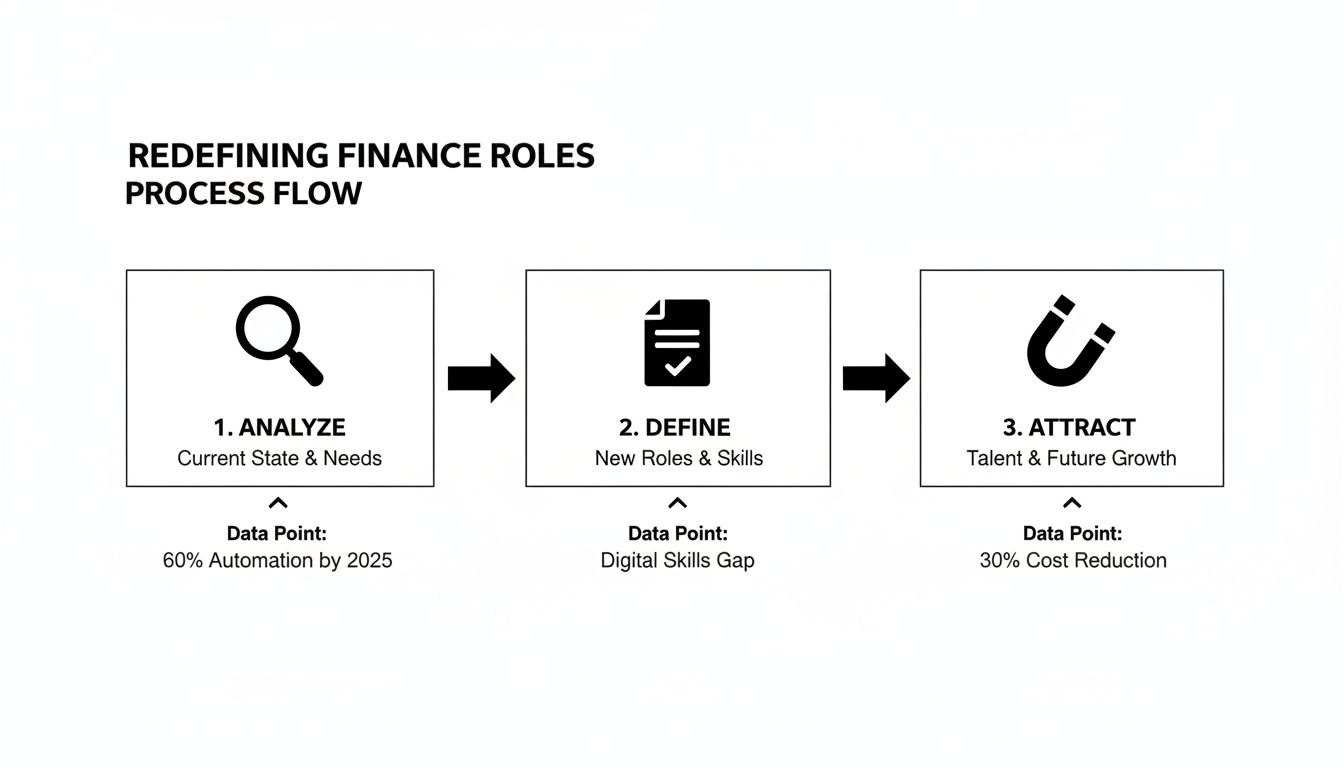
When you truly understand the skills you need for the future and define the position in a forward-thinking way, you create a powerful magnet for the right kind of candidates.
Go Beyond LinkedIn
Look, LinkedIn is a must-have tool, but it’s also incredibly crowded. Every single recruiter is on there, which means your outreach can easily get drowned out in the noise. To find the real hidden gems, you’ve got to expand your search to the channels where your ideal candidates are actually learning, networking, and talking shop.
Here are a few places I’ve seen deliver amazing results:
- Industry-Specific Forums: Think about the online communities dedicated to specific finance disciplines. Forums focused on Chartered Accountants, CFA charterholders, or financial modelling experts are absolute goldmines for targeted sourcing.
- Niche Slack and Discord Channels: Many of today’s sharpest finance professionals gather in private or public groups to chew over market trends, new tech, and complex problems. Finding and joining these conversations is key.
- Professional Association Databases: Organisations like the Indian Association of Investment Professionals often have member directories that can be a fantastic source for identifying high-calibre individuals.
The trick is to meet candidates in their world, not force them into yours. This approach doesn’t just widen your talent pool; it shows you genuinely understand their professional landscape.
Harness the Power of Employee Referrals
Your current employees are, without a doubt, your most powerful sourcing channel. Referrals consistently bring in high-quality hires who tend to stick around longer and fit the culture better. In fact, referred employees can be up to 25% more profitable than people hired through other means.
But a passive referral program, one that just sits there waiting for submissions, isn’t going to move the needle. You need to build a proactive system grounded in trust.
Don’t just ask for referrals when a job is open. Proactively ask your top finance performers, “Who are the three sharpest finance minds you’ve ever worked with?” This single question can unlock a list of A-list passive talent.
Once you have those names, your outreach is no longer cold. It’s a warm introduction, which dramatically boosts your chances of getting a response. Your message can lead with something like, “Your former colleague, [Employee Name], mentioned you as one of the most strategic analysts they’ve ever had the chance to work with…” That immediately builds credibility and sets you apart.
Master Personalised Outreach
When you finally do reach out, generic, copy-pasted messages are a complete waste of everyone’s time. Top-tier candidates, especially in high-demand fields like risk analytics or investment banking, are buried under recruiter spam. Your message has to cut through the noise by being hyper-personalised and value-driven.
Before you even think about hitting ‘send’, do your homework.
- Reference Their Work: Did they publish an article, speak at a conference, or get a mention in a trade publication? Acknowledge it. A simple, “I was impressed by your analysis on regulatory changes in your recent article on…” shows you’ve done your research.
- Connect to Their Experience: Look at their career path. Try something like, “I see you’ve built a strong career in M&A within the pharma sector. We’re currently scaling our corporate development team with a focus on that exact area.”
- Offer Value, Not Just a Job: Frame the outreach as a peer-to-peer conversation, not a sales pitch. Instead of the tired “I have a job for you,” shift to, “Given your background in fintech, I’d value your perspective on a new initiative we’re launching.”
Effective outreach is a make-or-break skill. For anyone looking to seriously level up their game, it’s worth digging into expert guidance on how to master passive candidate sourcing. This kind of strategic approach is what turns you from just another recruiter into a valuable industry contact they actually want to talk to.
A CV can tell you what a candidate has done, but it can’t tell you how they think under pressure, collaborate when things get tense, or adapt when the market shifts unexpectedly. Getting this right means moving beyond tired, generic tests and building an assessment framework that gets to the heart of both technical skill and human behaviour.
The goal is to design challenges that are a mirror image of the real work. Instead of a simple Excel quiz, think about a case study that genuinely tests the competencies you need. This approach gives you a much richer, more reliable view of who you’re really hiring.
Designing Assessments That Reflect Reality
A truly effective assessment should feel like a day on the job. It needs to be challenging, relevant, and give candidates a real chance to show you how they think, not just what they know. This is where so many companies stumble, falling back on outdated methods that simply don’t predict on-the-job performance.
Let’s look at how to modernise your approach when you hire finance professionals.
Example Scenario: Hiring a Financial Analyst
- The Old Way: A timed Excel test asking them to perform VLOOKUPs, create pivot tables, and format a spreadsheet. This tests isolated skills but tells you nothing about their analytical mind.
- The Better Way: A business case study. Give them a messy, real-world data set from a fictional company. Ask the candidate to clean the data, build a financial model to forecast revenue, identify three key business risks from their analysis, and prepare a short presentation summarising their findings.
This single, integrated assessment tests their technical skills (Excel/modelling), analytical ability (spotting risks), and communication skills (the presentation) all at once. You get a complete picture of their potential.
The best assessments are diagnostic, not just pass/fail. They reveal a candidate’s strengths, weaknesses, and thought processes, giving you invaluable data for the hiring decision and for their future onboarding.
To better illustrate this shift, think about how you evaluate different financial competencies. It’s time to evolve your techniques to identify people who are ready for the future of finance, not just the past.
Modern vs Traditional Finance Assessment Methods
| Assessment Area | Traditional Method (Less Effective) | Modern Method (More Effective) |
|---|---|---|
| Financial Modelling | A pre-built template with gaps to fill in. Tests formula knowledge. | A raw, messy data set. Candidate must build a model from scratch to solve a business problem. |
| Analytical Thinking | Multiple-choice questions on financial theories or accounting principles. | A case study requiring them to analyse a P&L and identify three strategic growth opportunities. |
| Communication Skills | A generic “Why should we hire you?” question at the end of the interview. | A short presentation of their case study findings to a panel (simulating a stakeholder meeting). |
| Data Proficiency | A simple SQL query test with a clean, structured database. | A business problem that requires them to use tools like Tableau or Power BI to visualise and interpret complex data. |
| Adaptability | Asking hypothetical questions like, “How would you handle change?” | During the case study, introduce a sudden change (e.g., “A new competitor just entered the market”). Ask them how they’d adjust their model. |
By adopting these modern methods, you stop testing for rote memorisation and start evaluating the practical, real-world skills that actually drive business results.
Uncovering Soft Skills with Behavioural Questions
Technical skills might get a candidate through the door, but it’s the soft skills that determine their long-term success. Things like problem-solving, ethical backbone, and adaptability are non-negotiable in the world of finance.
The best way to dig into these is with behaviour-based interview questions, which force candidates to give you specific examples from their past.
Here are a few targeted questions you can adapt:
- For Problem-Solving: “Tell me about a time you found an error in a financial report that others had missed. What was your process for identifying and correcting it, and how did you communicate the issue?”
- For Ethical Judgement: “Describe a situation where you were asked to do something that made you feel ethically uncomfortable. What did you do, and what was the outcome?”
- For Adaptability: “Walk me through a time a major business assumption changed mid-project like a new regulation or a market shift. How did you adjust your financial model or analysis?”
These questions demand real stories, giving you concrete evidence of how they act, not just how they think they would act.
From Cultural Fit to Cultural Contribution
Let’s be honest, the old idea of “cultural fit” is broken. Too often, it’s a recipe for groupthink, leading to homogenous teams where everyone thinks, acts, and looks the same. That’s a killer for innovation.
Instead, you need to be assessing for cultural contribution. The question shifts from “Will they fit in?” to “What new perspective, skill, or way of thinking can this person bring to our team?”
To get at this, focus your questions on:
- Curiosity: Do they ask sharp, insightful questions about the business, not just the role?
- Resilience: How do they talk about past failures or setbacks? Do they own them?
- Collaboration Style: How do they describe working with people from other departments, like marketing or engineering?
By making this small but powerful shift from “fit” to “contribution,” you intentionally build a more diverse, resilient, and high-performing finance team. You hire people who not only meet today’s demands but have the potential to shape your company’s future.
Crafting Offers That Secure Top Talent

In a tight market, getting your top candidate to the offer stage is only half the battle. The final hurdle, making an offer they genuinely can’t refuse, is where so many great hiring processes stumble and fall. To successfully hire finance professionals, your offer can’t just be a number. It has to be a strategic package combining competitive pay, real long-term incentives, and a compelling vision for their career with you.
This means you have to stop guessing and start using data. Generic salary bands are useless. You need real-time market intelligence on what your direct competitors are paying for the exact same roles, in the same city, for the same skills. Without this data, you’re flying blind in a negotiation. You’ll either overpay or, worse, lose your dream candidate to a company that did its homework.
Look Beyond the Base Salary
Let’s be clear: ambitious finance professionals aren’t just looking for a paycheque. They’re sizing up the entire rewards package. A strong base salary gets their attention, but it’s the other components that truly close the deal. Your offer needs to tell a story about the candidate’s future value at your organisation.
When you’re putting the package together, think about these crucial elements:
- Performance Bonuses: Don’t be vague. Tie annual or quarterly bonuses to specific, measurable KPIs. This creates a crystal-clear link between their work, the team’s success, and their financial rewards.
- Equity and ESOPs: For senior hires or in high-growth companies, equity is your most powerful tool. It transforms an employee into an owner, aligning their long-term financial interests directly with the company’s success.
- Professional Development Budget: A dedicated fund for certifications like a CFA or FRM, industry conferences, or executive education is a massive motivator. It shows you’re not just hiring them for a job; you’re investing in their entire career.
Think of the total package as a compelling narrative. The base salary is just the first chapter. The real plot twists that get a candidate hooked are the bonuses, equity, and growth opportunities you put on the table.
Geography and Skills Dictate the Numbers
Compensation is never one-size-fits-all, especially in a market as diverse as India. Location and specific technical skills create massive swings in salary expectations. It’s no surprise that major financial hubs come with a significant price premium over smaller cities.
Our data shows that Delhi NCR and Mumbai have cemented their status as the core hubs for financial services hiring. Because of this, you can expect roles in Delhi NCR to command a 10 to 20 percent salary premium compared to similar jobs in Tier 2 cities. For freshers, a Financial Analyst role can swing wildly from ₹4 to ₹11 LPA. Skills are the great differentiator here; basic Excel skills will land a candidate at the lower end (₹4-6 LPA), while real proficiency in financial modelling or Python can push compensation toward the top of that range (₹8-11 LPA). You can discover more insights about finance job compensation on The Wall Street School.
When a candidate gets a counter-offer, it’s rarely just about the money. It’s often a panic move from their current employer who suddenly woke up and realised their value. Your response shouldn’t be to just match the numbers. It should be to reinforce that you recognised their value from the very beginning, focusing on the career growth and opportunities their current role simply can’t offer.
Navigating Negotiations and Counter-Offers
The offer stage is a conversation, not a command. Present your offer with genuine enthusiasm, and take the time to walk the candidate through every single component of the total rewards package. Don’t be afraid of negotiations, in fact, you should expect them. A candidate who negotiates often knows their worth, and that’s exactly the kind of person you want on your team.
If a counter-offer comes into play, your first move is to listen. Understand what their current employer has put on the table, but more importantly, find out why the candidate is still engaging with you. This is your cue to double down on the unique, non-monetary value of your offer: the impact they’ll have in the role, the team culture you’ve built, and the clear career path ahead. If you need to sweeten the financial pot, do it decisively. But always bring the conversation back to the long-term value and opportunity that you provide. For more detailed insights, you might also find our guide on crafting customised compensation strategies useful.
Frequently Asked Questions
Getting your finance hiring right can feel like navigating a minefield, especially in today’s tight market. As a CHRO, you’re facing tough questions daily. This section tackles some of the most common queries we hear, with straight-talking answers to help you make smarter, faster decisions.
How Can We Attract Finance Professionals to Non-Metro Locations?
Trying to pull top-tier finance talent from Mumbai or Delhi to a Tier-2 or Tier-3 city is a tough sell if you’re just posting a standard job ad. You can’t compete on the big-city buzz, so you have to change the game. The key is to build a compelling narrative that goes way beyond the salary.
You need to sell the lifestyle. We’re talking about a genuine work-life balance, a significantly lower cost of living, and the chance for a professional to make a much bigger, more visible impact in a smaller team. These aren’t just minor perks; they are massive draws that big urban centres struggle to offer.
Here’s how you can make that happen:
- Show Them the Ladder: Don’t let them think a regional office is a career dead-end. Map out clear growth paths. Show them this is an accelerator, a place where they can get their hands on broader responsibilities much faster than they would in a massive corporate headquarters.
- Invest in the Right Tools: Nothing says “we’re serious” like investing in top-notch remote work infrastructure and continuous professional training. It shows you’re committed to their growth and integration, no matter where they’re based.
- Sweeten the Deal: A competitive, location-adjusted salary is just the starting point. The real clincher is often a well-structured relocation package that helps a candidate and their family feel secure about making the move.
What Is the Most Common Mistake When Hiring for Senior Finance Roles?
The biggest trap when hiring for senior roles like a CFO or Finance Director is getting fixated on technical skills while completely overlooking leadership and strategic communication. You can find a candidate who is a financial modelling genius, but if they can’t translate that complex data into a clear, compelling story for the board, their value is cut in half.
At a senior level, finance is about influence and strategy, not just crunching the numbers. They need to be able to inspire confidence in investors, guide their executive peers, and mentor their own team.
Don’t assume a great analyst will automatically become a great leader. The skills are fundamentally different. Your assessment process must be intentionally designed to evaluate leadership potential with the same rigour you apply to technical skills.
To sidestep this common error, make sure your interviews dig deeper with:
- Behavioural Questions: Probe into their past leadership challenges, how they’ve handled conflict, and their track record of making tough strategic calls.
- Presentation Scenarios: Ask them to present a strategic financial plan to a panel acting as the executive board. This is a brilliant way to test their ability to simplify complexity and communicate with influence under pressure.
Should We Prioritise Tech Skills or Core Finance Aptitude?
This is the million-rupee question right now. The answer hinges on the role’s seniority, but the golden rule should always be to prioritise core finance aptitude and a proven ability to learn.
Sure, specific tech skills like Python or advanced proficiency in tools like Power BI are great to have, but technology changes fast. The must-have software of today could be obsolete in five years. What never goes out of style is sharp financial intuition.
For junior roles, a candidate’s agility and eagerness to learn are everything. Look for people with strong analytical and problem-solving fundamentals who are genuinely curious and have a history of picking up new skills. A bright, adaptable analyst can learn a new software platform far more easily than someone with niche tech skills can develop deep financial acumen.
For senior roles, the focus shifts even more towards strategic thinking. A CFO’s ability to read market trends and shape business strategy is far more critical than their fluency in any single tool. They need to understand the why behind the data, not just how to pull the report.
How Is AI Affecting Finance Hiring?
Artificial intelligence is definitely changing the finance world, but maybe not in the way you think. The common fear is that AI will replace jobs, but our own research and what we’re seeing in the market tells a different story. Firms that invest in AI are actually more likely to hire, not fire.
The real impact is on the kind of skills that are in demand. Companies are now hiring professionals who can build, manage, and interpret the outputs of AI systems. This means roles are shifting away from manual data entry and towards higher-value activities like:
- Strategic Analysis: Using AI-powered insights to make smarter business decisions.
- Process Innovation: Designing AI-driven workflows for everything from forecasting to compliance.
- Data Governance: Ensuring the data fuelling AI models is clean, accurate, and secure.
For your hiring strategy, this means you need to be screening for candidates who are comfortable working alongside automated systems and have a strategic mindset. The narrative of AI leading to massive layoffs in finance just hasn’t played out. Instead, it’s creating demand for a more tech-savvy and strategically-minded finance professional.
Finding and securing the right finance talent is one of the most critical challenges for any growing organisation. Taggd‘s RPO solutions combine deep industry expertise with an AI-powered platform to help you build a world-class finance team faster and more efficiently. We act as your strategic partner, managing the entire recruitment lifecycle so you can focus on what matters most, driving your business forward.