The world of engineering recruitment is changing, and fast. Automation isn’t just a buzzword anymore; it’s fundamentally reshaping what it means to be an engineer. For Chief Human Resources Officers, getting to grips with these hiring trends in engineering automation is no longer just a good idea, it’s critical for building a workforce that can compete. This guide is your map to the new demands, the essential skills, and the workforce planning you’ll need to master.
The New Blueprint for Engineering Talent
For CHROs, the ground is shifting beneath your feet. The engineering talent you’ve always hired is not the talent you’ll need for tomorrow, and intelligent automation is the driving force. This isn’t just another tech trend to watch; it’s a complete rewrite of the rulebook for how you find and develop people.
Imagine your talent pipeline as a modern ‘digital assembly line’. In this new factory, AI and automation are the core machinery, handling tasks that used to be manual, repetitive, or even highly complex. To run this new operation, you need a totally different kind of engineer to design, maintain, and innovate it.
Redefining the Modern Engineer
The days of just needing someone who can write clean code are fading. What organisations really need now is a new breed of engineer who can design, build, and orchestrate these complex automated systems.
These professionals are part architect, part strategist, and part problem-solver. They don’t just build a piece of the puzzle; they see how AI fits into the entire business process. This shift is one of the most important hiring trends in engineering today, as automation moves from a side project to a core business skill.
Think of this guide as your strategic roadmap for navigating this new, complex environment. It’s built to address the biggest challenge facing talent leaders right now: how to find highly specialised professionals in a market where everyone is competing for the same people. We’ll break down what you need to master, including:
- The explosion in AI-specific skills: We’ll explore why capabilities like machine learning, prompt engineering, and LLM orchestration are now the price of entry.
- The need for agile workforce planning: It’s time to move beyond filling roles as they open up and start building a proactive strategy that predicts your future talent gaps.
- Turning challenges into opportunities: We’ll show you how to use automation not as a threat, but as a catalyst for stronger talent leadership and business growth.
The single biggest takeaway for every CHRO is this: your old recruitment methods won’t work in this new era. Success now depends on a deep understanding of how skills are evolving and a commitment to a more dynamic, data-driven approach to finding talent.
A Strategic Imperative for CHROs
At the end of the day, the hiring trends in engineering automation aren’t just an operational headache for your hiring managers. They represent a strategic imperative that belongs in the C-suite.
As your company leans more heavily on intelligent systems to boost efficiency, spark innovation, and gain a competitive edge, your ability to attract and keep the right engineering talent becomes the single biggest factor in your success. This guide gives you the blueprint to build that future-ready engineering team, ensuring your organisation is ready to win in the age of automation.
Why Is Automation Fuelling an Unprecedented Hiring Spree?
The intense demand for automation engineers is no longer a niche trend tucked away in Silicon Valley. It’s exploded into the mainstream, completely reshaping the hiring landscape in industries we never used to think of as “tech.” Sectors like finance, healthcare, and manufacturing are now scrambling for the same specialised engineering talent, creating a need that’s growing by the day.
So, what’s behind this surge? It’s simple: automation and AI have graduated from the R&D lab to the C-suite. They’re no longer just neat tools for tweaking processes; they’re now the engine for operational efficiency, innovation, and staying ahead of the competition. This jump from experiment to essential business function is exactly why we’re in the middle of a hiring frenzy.
As organisations weave intelligent systems into their daily operations, the need for engineers who can build, manage, and scale these systems has gone through the roof. This isn’t about adding a few developers to the payroll. It’s about a fundamental rethink of the engineering muscle a modern business needs to survive.
From Tech Hubs to Global Capability Centres
This shift has also turned the map of where this high-stakes automation work gets done on its head. Global Capability Centres (GCCs) in places like India are no longer just back-office support hubs. They’ve become innovation epicentres, handling complex automation projects that are absolutely critical to global business strategy.
This concentration of advanced work in GCCs creates a powerful vortex of demand for specialised talent. It’s a key factor in the hiring trends in engineering automation, as companies worldwide compete for skilled professionals within these dense talent pools. For any CHRO, getting a handle on this geographic shift is step one in building a winning global talent strategy.
The bottom line is that automation is no longer a nice-to-have IT project. It has become a C-suite-level strategic imperative, directly tied to growing revenue, slashing costs, and leading the market. The pressure is on to build teams that can actually deliver.
To help CHROs grasp the business context behind this recruitment demand, we’ve broken down the primary forces compelling organisations to hire automation-focused engineering talent.
Key Drivers of Automation-Led Engineering Hiring
| Driving Force | Impact on Engineering Roles | Key Sectors Affected |
|---|---|---|
| Operational Efficiency & Cost Reduction | Demand for Robotic Process Automation (RPA) developers and process automation specialists to streamline back-office tasks. | Banking, Financial Services, and Insurance (BFSI), Manufacturing, Logistics |
| Enhanced Customer Experience | Need for AI/ML engineers to build personalised recommendation engines and AI-powered chatbots. | E-commerce, Retail, Healthcare, Telecom |
| Product & Service Innovation | Roles for embedded systems engineers and IoT specialists to create smart, connected products. | Automotive, Consumer Electronics, Industrial Manufacturing |
| Data-Driven Decision Making | Surge in demand for Data Engineers and Data Scientists to build pipelines and models that turn raw data into actionable insights. | Virtually all sectors, with a heavy focus on Finance, Tech, and Healthcare |
| Competitive Pressure & Market Agility | Need for DevOps and Cloud Automation engineers to accelerate software development and deployment cycles. | Software-as-a-Service (SaaS), Fintech, Media & Entertainment |
Understanding these drivers makes it clear that the demand for automation talent isn’t just a trend, it’s a direct response to core business challenges and opportunities across the entire economy.
Connecting Digital Transformation to Your Recruitment Pipeline
Every major digital transformation initiative directly feeds the challenges in your recruitment pipeline. When your company decides to automate its supply chain, roll out an AI-driven customer service bot, or use machine learning for financial forecasting, it instantly creates a shopping list of specific engineering roles.
The demand is especially fierce for professionals skilled in AI, data engineering, and cybersecurity. These are the architects, builders, and guardians of the automated enterprise. As more companies move their AI projects out of theory and into production, the hunt for these roles is becoming exponentially more competitive.
The numbers tell a stark story. In 2026, tech hiring in India is expected to jump by 12-15%, which translates to nearly 1,25,000 new jobs. What’s really telling is that a massive 38% of this tech-driven hiring now comes from non-tech industries like BFSI, healthcare, and manufacturing. Demand for AI-focused roles has shot up by 51% as 40% of large enterprises push generative AI into active operations. You can dig deeper into this market-defining shift by reading the full report.
This data highlights a critical reality for CHROs: sitting on the sidelines is no longer an option. The war for talent is real, and organisations that can’t attract and keep skilled automation engineers will inevitably fall behind. The challenge isn’t just about filling seats; it’s about building a workforce that can thrive in an increasingly automated world.
The Skillset Evolution from Coder to AI Architect
The days when an engineer’s job was mostly about writing and debugging code are quickly fading. Automation isn’t just giving engineers a few new tools to play with; it’s completely redrawing the boundaries of the profession. For CHROs, this means looking past old job titles and getting a real grip on the new skills needed to build a team that’s ready for the future.
Think of it like this. You have a classic car mechanic who is a master of combustion engines. Then you have an aerospace engineer designing the autonomous systems for a Mars rover. Both are experts with complex machines, but the latter needs a profoundly different understanding of physics, materials science, and intelligent systems. That’s the kind of jump we’re seeing in engineering right now.
We’re moving away from a world that just needed coders and into one that demands AI architects. These are the professionals who can design, orchestrate, and weave intelligent systems into the very fabric of the business. It’s not about knowing a single programming language anymore; it’s about deep ‘AI fluency’.
The New Language of Engineering Talent
To really partner with technical hiring managers and spot top-tier talent, CHROs need to get comfortable with the new vocabulary of engineering. Job descriptions are being torn up and rewritten, and the skills everyone is chasing are more specialised than ever before.
Here are the practical skills that draw a clear line between a traditional developer and a modern AI architect:
- Prompt Engineering: This is the art of crafting incredibly precise instructions to get large language models (LLMs) to produce exactly what you need. It’s less about traditional coding and more about having a strategic conversation with an AI.
- LLM Orchestration: This is about managing multiple AI models and data sources, getting them to work in harmony. Picture a conductor leading an orchestra, but with different AI instruments instead of violins and cellos.
- Vector Databases: These aren’t your standard databases. They’re built specifically to handle the complex, multi-dimensional data that AI models thrive on. Knowing your way around them is non-negotiable for building smart applications that can search and retrieve information with real intelligence.
The diagram below shows how fundamental business goals, efficiency, core operations, and innovation, are the real forces driving the demand for these new skills.
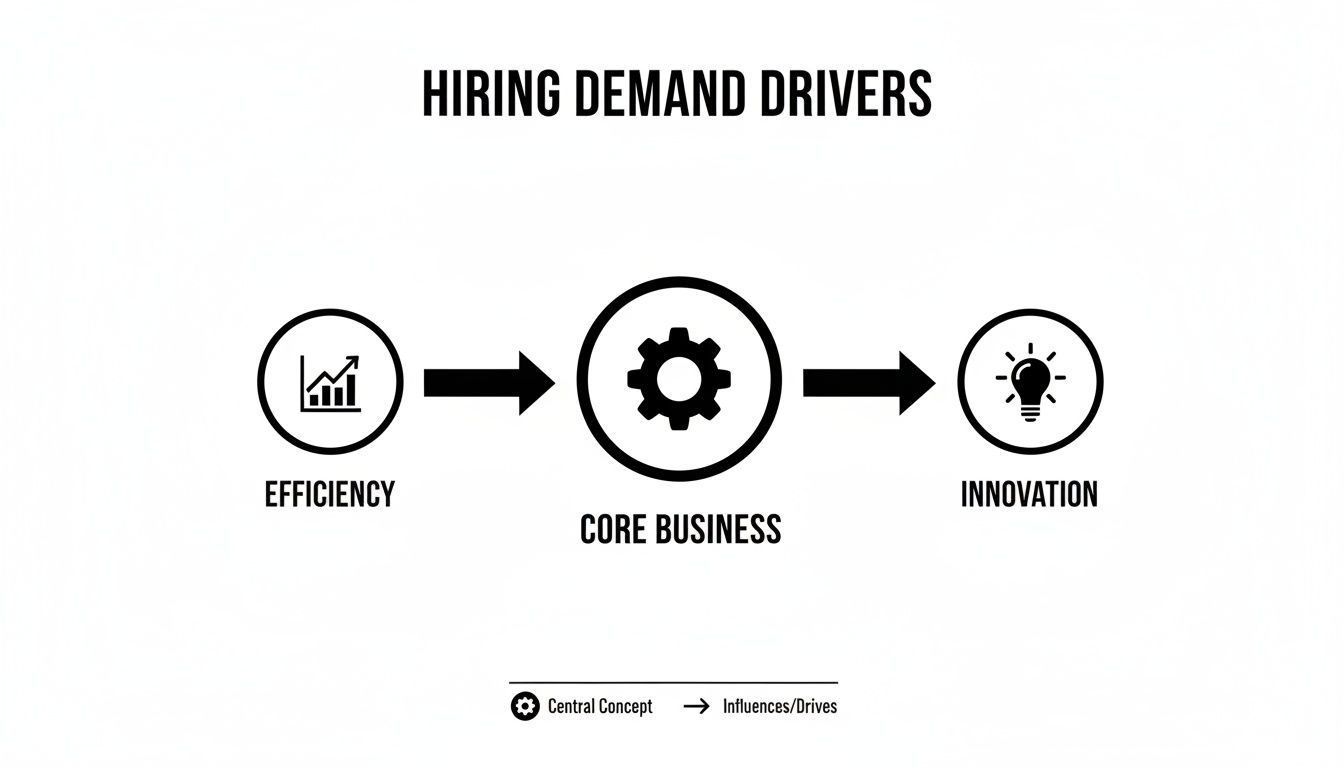
It’s clear the push for automation-focused roles isn’t just about chasing new tech; it’s a direct response to core business needs.
From Theory to Practice: The Data Behind the Shift
This isn’t just talk; the hiring market data tells the same story. Companies are re-architecting their teams, choosing to make fewer but much sharper hires, people who can integrate intelligent systems at scale. This intense focus on high-impact talent is one of the biggest hiring trends in engineering automation today.
By 2026, a massive 16-20% of AI job postings in India will require advanced automation skills like prompt engineering, model evaluation, or Reinforcement Learning from Human Feedback (RLHF). This is a huge signal that AI-fluent engineering is becoming the norm across IT services, GCCs, and the BFSI sector.
On top of that, 18-22% of data engineering roles now explicitly mention vector databases and GenAI pipelines, while over 16% of cloud engineering positions demand GPU orchestration and experience with LLM stacks.
For talent leaders, the key takeaway is this: proficiency in AI is no longer a niche specialisation. It’s rapidly becoming the baseline for senior and influential engineering roles, redefining what it means to be a top technical professional.
Building the AI-Fluent Engineering Team
Seeing this shift is one thing. Acting on it is what will give your organisation an edge. Your recruitment strategy has to be redesigned to actively screen for these next-generation skills. That means updating job descriptions, overhauling interview processes, and training your hiring managers to recognise what genuine AI fluency looks like.
The goal is to build a team that doesn’t just use AI tools, but thinks in terms of automated systems and intelligent workflows. These are the engineers who won’t just keep the lights on; they’ll be the ones architecting your company’s future. To get a better sense of what these capabilities look like in practice, you can learn more about the AI skills in demand right now. This knowledge is your foundation for building a truly competitive engineering workforce.
Building a Strategic Workforce Plan for the Automation Age

Knowing about the dramatic skill shifts in engineering is one thing. Actually doing something about it is what separates the market leaders from the laggards.
The era of reactive hiring, where you wait for a vacancy and then scramble to fill it, is officially over. In the age of automation, your company’s success now hinges on a proactive, architectural approach to talent. A strategic workforce plan isn’t some “nice-to-have” HR initiative anymore; it’s a core business imperative for growth and survival.
This means you have to move past simple headcount predictions. It demands a deep, honest look at your current team’s capabilities, a clear-eyed forecast of your future needs, and a flexible plan to bridge the gap. Waiting for skill gaps to become full-blown operational risks is a surefire way to fall behind competitors who are already building their future teams.
The goal? To design your workforce with the same precision and foresight that your engineers apply to building new automated systems.
Choosing Your Talent Strategy: Build, Buy, or Borrow
At the heart of any modern workforce plan, you’ll find the “build, buy, or borrow” decision. This simple framework gives you a structured way to tackle your talent needs, making sure you put your resources where they’ll have the most impact. Each path has its own distinct advantages and is suited for different scenarios you’ll face.
1. Build Your Internal Talent
This is all about upskilling and reskilling the people you already have. It’s hands-down the best way to cultivate institutional knowledge and build loyalty. For instance, training a senior software engineer in machine learning fundamentals is often far faster and more cost-effective than trying to hire a top-tier ML expert from the open market.
- When to use it: When you have a solid engineering foundation and just need to evolve existing skills to meet new automation demands.
- Key benefit: Boosts employee engagement and retention while keeping valuable, company-specific knowledge in-house.
2. Buy New Talent from the Market
“Buying” simply means hiring people from outside who already have the specialised skills you’re missing. This is your go-to move when you need to inject new, niche expertise into your organisation fast, like hiring a prompt engineer who already knows how to fine-tune large language models.
- When to use it: When you’re facing an urgent skill gap or entering a new tech domain where you have zero internal expertise.
- Key benefit: Gives you immediate access to critical, market-ready skills that can get projects moving much quicker.
3. Borrow Expertise Through Partners
This strategy involves bringing in external help, consultants, contractors, or specialised firms (like an RPO partner), for specific projects or functions. It offers maximum flexibility without the long-term cost of a full-time hire, making it perfect for projects with a clear start and end date.
- When to use it: For short-term projects, specialised initiatives, or when you need to scale your team up or down on short notice.
- Key benefit: Delivers access to elite, on-demand talent and keeps your fixed overheads down.
The most resilient organisations don’t just pick one strategy; they create a blended talent ecosystem. They build their core, buy for innovation, and borrow for agility, creating a workforce that can adapt to any challenge.
Redesigning Teams for Maximum Impact
A real strategic workforce plan also looks at your organisational structure. The traditional, siloed model, where engineering, data science, and business units barely talk to each other, is completely inefficient in an automated world. The smartest companies are tearing down these walls to create agile, cross-functional teams.
For a deeper dive into structuring your talent acquisition, read our guide on strategic workforce planning.
Imagine a “pod” dedicated to automating a specific business process. This team would have an automation engineer, a data scientist, a product manager, and a business analyst all working together. By collaborating from day one, they ensure the solutions they build aren’t just technically brilliant but are also directly tied to business goals, delivering real value much faster. This integrated approach is non-negotiable if you want to truly capitalise on the opportunities automation brings.
Gaining a Competitive Edge with Specialised RPO
In a market where every company is chasing the same elite automation and AI engineers, a reactive hiring process just won’t cut it. Your in-house talent team might be fantastic at general recruitment, but hunting for these highly specialised professionals is a different ball game entirely. It requires a level of precision and expertise that goes beyond the norm.
This is where a specialised Recruitment Process Outsourcing (RPO) partner stops being a simple support function and becomes a strategic necessity.
Think of it this way: your internal team is like a skilled general practitioner, perfectly capable of handling a wide range of common needs. But when you’re facing a complex, high-stakes operation, you call in a specialist surgeon. A specialised RPO acts as that expert surgeon for your most critical automation roles, bringing deep knowledge, advanced tools, and established networks to find talent that others simply can’t.
The Strategic Value of a Niche RPO Partner
Bringing on a specialised RPO isn’t about handing over your entire HR department; it’s about surgically targeting your biggest talent bottleneck. This kind of partnership offers immediate, real-world advantages that directly tackle the headaches of hiring in the automation space. By embedding themselves in your organisation, they become a true extension of your team, aligned with your culture and business goals.
The main benefits are clear:
- Immediate Access to a Vetted Global Talent Pool: A specialised RPO partner isn’t starting from zero. They already have a curated, pre-vetted network of top-tier automation experts, including passive candidates who aren’t even looking for a new job but are open to the perfect opportunity.
- Significantly Improved Speed-to-Hire: With an active talent pipeline and deep market knowledge, an RPO can slash your hiring timelines. This speed is a huge competitive advantage when a project’s success hinges on getting the right engineers on board, fast.
- Scalability for Rapid Growth: As your automation projects grow, your hiring needs can swing wildly. An RPO gives you the flexibility to scale your recruitment muscle up or down as needed, without the fixed costs of hiring more internal recruiters.
A partnership with a specialised RPO lets CHROs shift their focus from day-to-day recruiting fires to high-level workforce strategy, confident that their engineering talent pipeline is both strong and future-ready. It’s a strategic move that empowers you to build the organisational muscle needed for the automation age.
Accelerating Your Hiring with Market Intelligence
Beyond just finding candidates, a true RPO partner like Talent Hired brings invaluable market intelligence to the table. They provide data-driven insights on what you should be paying people, which skills are in high demand, and what your competitors are doing to attract talent. This information is critical for creating compelling offers that actually land the best people in a fierce market.
The market dynamics make this expertise essential. In India, the IT sector’s hiring intent is projected to hit around 59% in the first half of 2025, fuelled by intense demand in AI, cloud, and cybersecurity. This trend is expected to create 1.26 lakh net new jobs in FY26 as automation continues to reshape engineering roles. Prioritising AI-native skills like generative AI is no longer a choice, and an RPO’s expertise is key to building these future-ready teams.
This level of insight turns your hiring process from a guessing game into a data-backed strategic function.
How RPO Drives Tangible Business Outcomes
Ultimately, the decision to partner with an RPO is about driving measurable business results. By ensuring a steady flow of high-quality engineering talent, an RPO directly helps you complete projects faster, accelerate innovation, and strengthen your competitive position. For a deeper look, you might be interested in our guide on the five ways RPO can improve hiring results.
This partnership ensures your most critical business projects aren’t stalled by a lack of specialised talent. It’s a proactive investment in your company’s ability to execute its automation strategy, turning your talent acquisition function into a powerful engine for growth.
Frequently Asked Questions About Engineering Automation Hiring
Trying to hire for engineering automation roles can feel like you’re aiming at a moving target. As a Chief Human Resources Officer, you’re probably grappling with a whole new set of questions and challenges. This section cuts through the noise to give you clear, practical answers to the most common queries we hear, building on the strategies we’ve already discussed to help you build an engineering team that’s ready for anything.
We’ll tackle the big concerns: validating niche skills, finding talent where no one else is looking, the future of junior roles, and how you can stay ahead in a ridiculously competitive market.
How Can We Accurately Assess Niche Automation Skills During Interviews?
Validating super-specialised skills like LLM orchestration or vector database management is a real headache. Your traditional interview playbook, the one full of theory questions and standard coding problems, just won’t cut it anymore. It’s not enough to tell you if someone truly gets these advanced concepts.
To get a true feel for a candidate’s abilities, your entire assessment process has to change. The big shift is moving from asking what they know to seeing what they can do. You need to create interview situations that look and feel like the actual problems they’ll be paid to solve.
Here are a few ways to beef up your technical assessments:
- Set Practical, Project-Based Challenges: Ditch the generic coding test. Instead, give them a small-scale, real-world automation problem. For instance, hand over a sample dataset and ask them to build a simple retrieval-augmented generation (RAG) pipeline. This tests how they connect different pieces, not just their knowledge of one algorithm.
- Use Paired Programming with Your Senior Engineers: Get candidates to work side-by-side with one of your top engineers to solve a problem in real time. This isn’t just a tech test; it’s a window into their problem-solving process, how they communicate, and whether they can collaborate when the pressure is on.
- Lean into System Design Questions: Ask them to map out a solution for a complex automation scenario. Something like, “Design a system to automate customer support ticket routing using an LLM.” This is where you see their high-level thinking and whether they can juggle scalability, cost, and integration, the real hallmarks of a top-tier AI architect.
The best way to see if someone can do the job is to have them do a small part of the job. By focusing on practical application and big-picture thinking, you can easily tell who just knows the buzzwords and who can actually create business value.
Where Should We Look for Top Automation Talent Beyond Standard Job Boards?
Let’s be honest: the best automation engineers aren’t scrolling through job sites. They’re too busy doing interesting work. If you’re only posting on traditional job boards, you’re fishing in a tiny, overcrowded pond and fighting with every other company for the same active candidates.
To find the real experts, you have to go where they are. This means getting proactive and hunting across multiple channels, focusing on the communities where these engineers gather, share, and build their reputations.
- Get Active in Niche Online Communities: Platforms like GitHub, Kaggle, and specialised Discord or Slack channels are the modern-day workshops for top engineers. They’re sharing code, debating new methods, and making a name for themselves. If you show up and participate authentically, you can start building relationships long before you have a role to fill.
- Sponsor and Attend Specialised Conferences: Both virtual and in-person events focused on AI and machine learning are prime recruiting grounds. Sponsoring an event or having your senior engineers give a talk can put your employer brand on the map for this very exclusive audience.
- Work with a Specialised RPO Partner: An RPO partner like Taggd already has a curated network of pre-vetted automation specialists. This gives you a direct line to passive candidates you’d likely never find on your own, massively speeding up your search.
Is Automation Eliminating Entry-Level Engineering Roles?
The rise of AI coding assistants and automated workflows is definitely changing what it means to be a junior engineer. Many of the routine coding and bug-fixing tasks that used to be the bread and butter of an entry-level role are now being handled by AI. The data backs this up; there’s been a sharp drop in new graduate hiring at major tech companies, with entry-level openings falling by over 50% from a few years ago.
But this doesn’t mean junior roles are vanishing. It means the expectations for those roles are shifting dramatically.
Companies are now looking for junior engineers who can act as “AI augmenters.” They need people who can expertly use AI tools to speed up their work, debug code generated by machines, and spend their time on higher-level problem-solving. The focus has shifted from writing code from scratch to directing and refining the output of automated systems. This makes adaptability and a solid grasp of the AI-driven development lifecycle essential skills for the next generation.
For you as a CHRO, this means it’s time to rethink your graduate hiring and training programmes entirely. You need to be cultivating skills that work with automation, like critical thinking, system design, and the ability to collaborate effectively with AI.
How Can We Compete for Talent Against Large Tech Companies with Deeper Pockets?
Going head-to-head with the massive salaries and brand power of Big Tech can feel like an uphill battle, but it’s one you can win. While money matters, the very best engineers are often driven by things a fat payslip can’t buy. Your edge lies in creating a compelling value proposition that larger, slower-moving organisations simply can’t match.
Make sure you’re highlighting these differentiators:
- Impact and Autonomy: Make it clear that engineers at your company will own projects from start to finish. They’ll see the direct impact of their work on the business, a level of ownership that’s often impossible to find inside a tech giant.
- Interesting Problems: Show off the unique, tough technical challenges your team is tackling. Top engineers are drawn to complexity and the chance to work on something new that will push them to their limits.
- Culture and Flexibility: Promote a culture that celebrates curiosity, teamwork, and a genuine work-life balance. Real flexibility in how and where people work can be a massive draw for talent burned out by rigid corporate rules.
- Growth and Learning: Position your company as a place where they can fast-track their career. On a leaner team, engineers get their hands on a wider range of technologies and responsibilities, helping them grow their skills much faster than they would in a siloed role at a bigger company.
By focusing on these non-monetary perks, you can build an employer brand that pulls in the kind of innovative thinkers who will drive your automation strategy forward.
Ready to build a world-class engineering team that can master the challenges of automation? Taggd provides specialised RPO solutions to help you find, attract, and retain the elite technical talent you need to succeed. Learn how we can accelerate your hiring and give you a competitive edge.