Enterprise RPO doesn’t just fill jobs; it elevates your entire talent acquisition game. It’s about moving away from a reactive, transactional hiring process to a proactive, strategic partnership. This is done through expert sourcing, rigorous assessments, and smart, data-driven decisions, making sure every new hire is a perfect fit for your long-term vision.
The Strategic Shift to Elevating Talent Quality
For many companies, hiring is a constant fire drill. A position opens up, the team scrambles, and the cycle repeats. This approach often puts speed ahead of substance, leading to inconsistent hires and the high cost of getting it wrong. Enterprise Recruitment Process Outsourcing (RPO) flips this script entirely. An RPO provider isn’t just a recruiter; they become the architect of your talent strategy.
This kind of partnership is focused on building a sustainable pipeline of great people, not just ticking off a list of open roles. An RPO provider dives deep into your business—they learn your culture, your goals, and what truly makes someone successful on your teams. They operate as a genuine extension of your organisation, with a single-minded focus on raising the calibre of every single person you bring on board.
Core Mechanisms for Quality Improvement
So, how does an RPO partner actually deliver this upgrade in talent? It all comes down to a few key pillars that work together to drive better results:
- Proactive and Specialised Sourcing: They go far beyond just posting on job boards. They actively map the market, build talent communities, and engage with top performers who aren’t even looking for a new job yet—the passive candidates who are often the best hires.
- Scientific and Objective Assessment: Gut feelings and instinct have their place, but they’re replaced here with structured, multi-stage evaluations. This means using behavioural interviews, technical skill tests, and psychometric assessments to get a complete, unbiased picture of each candidate.
- Enhanced Employer Branding: Your RPO partner becomes a guardian of your employer brand. They ensure every interaction a candidate has—from the first email to the final offer—is positive and reflects your company’s values, positioning you as an employer of choice.
The diagram below clearly shows how these core functions—Sourcing, Assessment, and Branding—are at the heart of how an enterprise RPO improves hiring quality.
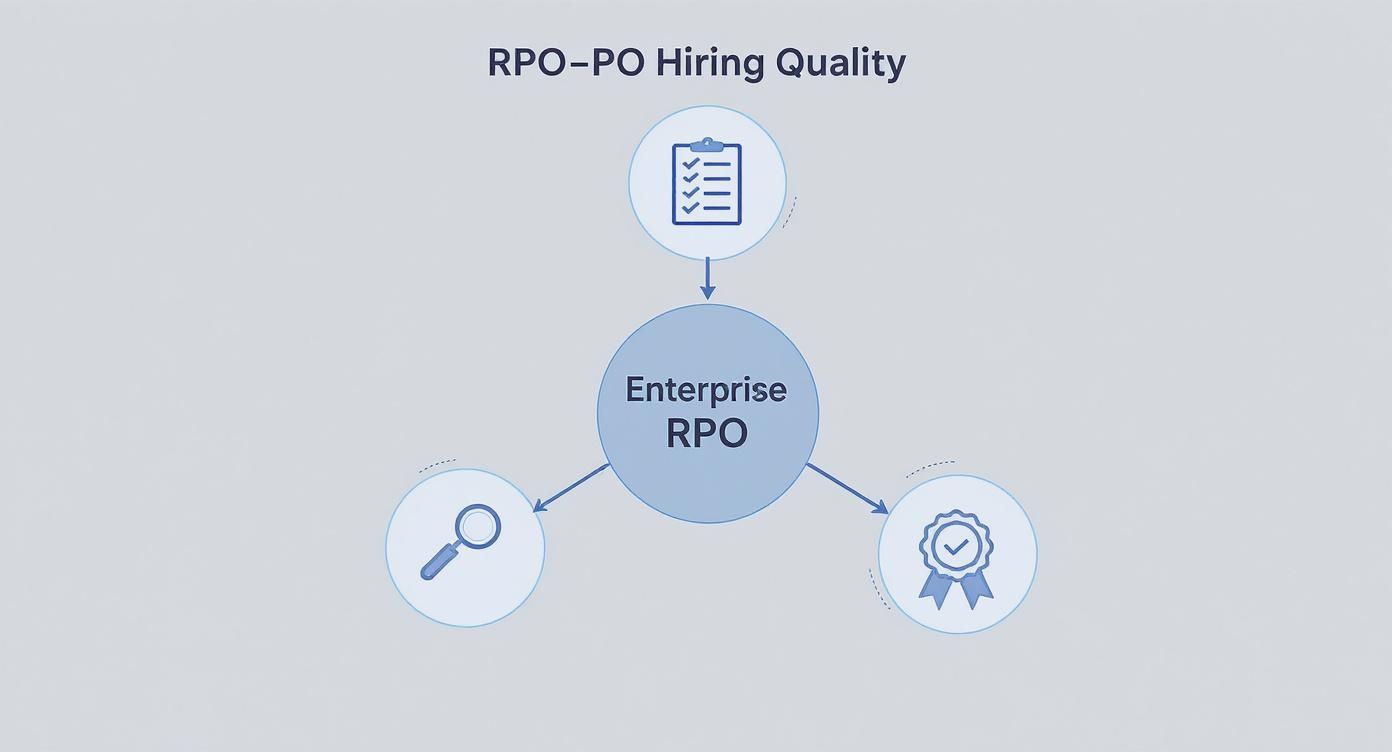
This visual makes it clear: by mastering these three areas, an RPO partner builds a powerful, integrated system for attracting and selecting top-tier talent. It’s a major step up from traditional recruiting methods. For those wanting to dig deeper, you can explore the full range of recruitment process outsourcing benefits in our detailed guide.
Enterprise RPO vs In-House Recruiting: A Quality Focus
To truly understand the difference, it helps to see a direct comparison. Here’s how a strategic Enterprise RPO partnership stacks up against a traditional in-house model when it comes to quality.
| Recruitment Aspect | Traditional In-House Team | Enterprise RPO Partner |
|---|---|---|
| Sourcing Strategy | Primarily reactive; relies on active job seekers and inbound applications. | Proactive and multi-channel; engages passive talent and builds dedicated talent pools. |
| Assessment Methods | Often relies on standard interviews and hiring manager “gut feel.” | Uses validated, scientific assessments, behavioural interviews, and consistent scoring. |
| Talent Pools | Limited to the team’s immediate network and inbound applications. | Access to extensive, global talent networks and proprietary candidate databases. |
| Technology Stack | May use a basic ATS, but often lacks advanced analytics and sourcing tools. | Leverages a sophisticated tech stack for sourcing, assessment, and predictive analytics. |
| Employer Branding | Candidate experience can be inconsistent across different departments and roles. | Manages the entire candidate journey to ensure a consistent, positive brand experience. |
| Data & Analytics | Basic reporting on time-to-fill and cost-per-hire. | Provides deep analytics on quality of hire, source effectiveness, and performance data. |
| Hiring Manager Support | Acts as an administrative support function for scheduling and screening. | Acts as a strategic advisor, providing market intelligence and talent consultation. |
Ultimately, while an in-house team is essential for culture and day-to-day HR, an RPO partner brings a specialised focus, advanced tools, and a broader market reach specifically designed to elevate the quality of every single hire.
Sourcing Beyond the Usual Suspects
Most in-house talent acquisition teams are masters of reactive recruitment. A job goes live, applications roll in, and the team starts sifting through candidates who are actively looking for a change. It’s a tried-and-tested method, but it’s a bit like fishing in a small, crowded pond—you’re competing with every other company for the same visible talent.
An enterprise RPO partner changes the game entirely. They don’t just fish in the pond; they navigate the entire ocean. Their focus shifts to the vast, untapped market of passive candidates. These are the high-performing individuals who are excelling in their current roles, not actively job hunting, but would be open to the perfect opportunity if it came knocking.
This proactive approach fundamentally elevates the quality of your talent pipeline. You’re no longer limited to hiring the best person available right now. You start hiring the absolute best person for the role, period.

Building Proactive Talent Communities
So, where do RPO providers find these hidden gems? They don’t just search; they build and nurture proprietary talent communities. This is a long-term strategy, and it’s one that pays massive dividends in hiring quality. Think of it as creating an exclusive, invitation-only network for top professionals in your industry.
These communities are far more than static databases. They are living ecosystems where RPO specialists engage with potential candidates over months, sometimes even years. This isn’t about spamming them with job ads. It’s about:
- Sharing valuable industry insights and content that genuinely helps them.
- Keeping them in the loop about your company’s growth and successes.
- Building authentic relationships based on trust and professional respect.
When a critical role opens up, the RPO partner isn’t starting from a standstill. They’re tapping into a warm network of pre-vetted, engaged professionals who already have a positive impression of your brand. This continuous cultivation is a core reason how enterprise RPO improves hiring quality so dramatically. For a deeper look, check out our guide on successful passive candidate sourcing.
Using Intelligence to Map the Market
Beyond building communities, expert RPO providers use sophisticated techniques like talent mapping and competitive intelligence. This is where recruitment stops being just an art and becomes a science.
Talent mapping is the process of identifying, profiling, and understanding the key talent within a specific market or at competitor organisations. It gives you a strategic blueprint of where the best people are and what it would take to bring them on board.
This process involves digging deep into market intelligence. A great RPO partner can tell you which competitors have the strongest teams, where certain skill sets are concentrated geographically, and even what compensation and benefits packages will be needed to turn heads.
This intelligence-led approach gives you a powerful competitive edge. Instead of guessing, you’re making data-backed decisions about where to find top talent and how to engage them effectively. Your RPO partner essentially becomes your talent market expert, providing insights that go far beyond what a typical in-house team has the bandwidth to gather.
This shift from reactive application screening to proactive talent hunting is profound. It ensures your talent pipeline is consistently filled with high-calibre individuals, ready to be engaged when the right opportunity arises. Not only does this proactive stance significantly reduce time-to-hire for critical roles, but it also boosts the quality of candidates in your final selection stages. The result? A more resilient, high-performing workforce built on a foundation of superior talent from the very start.
Moving from Gut Feel to Scientific Selection
Let’s be honest, traditional hiring often comes down to intuition. A hiring manager gets a “good feeling” about someone after a chat, and suddenly, that feeling outweighs everything on their resume. While experience is important, this gut-feel approach is notoriously unreliable and riddled with unconscious bias, leading to hit-or-miss hiring quality.
Enterprise RPO systematically swaps this subjectivity for a structured, scientific, and objective process. Think of it as the difference between a casual test drive and a comprehensive, multi-point vehicle inspection. The aim is to measure every single candidate against a consistent, pre-agreed set of criteria that genuinely predicts success on the job.
This methodical approach means everyone is measured with the same yardstick, which dramatically boosts the chances of finding someone who will not only succeed but also thrive in your culture.
Building a Multi-Layered Assessment Framework
An RPO partner does much more than just screen resumes. They engineer a multi-layered assessment strategy built around your company’s unique competency models. This framework is designed to go beyond verifying skills; it’s built to predict future performance.
This detailed evaluation usually involves a mix of different tools and methods:
- Psychometric Assessments: These tests dig into cognitive abilities, personality traits, and behavioural styles. They help answer crucial questions like, “Will this person thrive in our fast-paced environment?” or “Do they have the resilience for a high-pressure sales role?”
- Technical and Skills-Based Testing: For roles that demand specific hard skills, RPO providers use validated technical tests. This could be anything from live coding challenges for developers to complex case study analyses for business consultants, giving you concrete proof of what a candidate can do.
- Structured Behavioural Interviews: Forget casual chats. These interviews use a consistent set of questions for every candidate. Interviewers are trained to probe for real-world examples of past behaviour because it’s one of the strongest indicators of future performance.
By weaving these elements together, RPO providers build a complete picture of each candidate, moving far beyond the surface-level details on a CV. This scientific discipline is central to how enterprise RPO improves hiring quality.
Customising Frameworks for Your Competency Models
A generic assessment process won’t get you very far. The real magic of an RPO partnership is the ability to customise these scientific frameworks to perfectly match what “good” looks like inside your organisation.
A top-tier RPO partner will work shoulder-to-shoulder with your leadership to define your core competencies—that unique blend of skills, behaviours, and mindsets that fuels success in your company. This customised model then becomes the blueprint for every assessment and interview.
This makes sure you aren’t just hiring skilled people; you’re hiring the right people who have the exact attributes needed to excel in your specific world. For instance, if “collaborative innovation” is a core company value, the interview will be carefully structured to uncover candidates who have demonstrated this trait through their past actions.
This tailored approach seriously cuts down the risk of making a bad hire and helps new employees get up to speed and contribute to business goals much faster.
The Impact of Scientific Selection in Practice
The results of this data-driven process are clear and measurable. When you remove bias and focus on predictive indicators of success, you see a significant improvement in both new hire performance and retention. This is especially true in a competitive market like India, where getting both speed and quality right is non-negotiable.
For example, RPO providers in India have shown a remarkable knack for boosting hiring quality with data-centric methods. A major European bank with a large Global Capability Centre in India tasked an RPO partner with managing 6,000 hires, including 2,700 technical roles. The RPO team of 100 experts was up and running in under three months, immediately tackling 1,500 open requisitions. They delivered 225 technology hires per month with a time-to-offer of just 44 days and a phenomenal 82% offer-to-start ratio. It’s a perfect example of how a structured process can deliver both speed and quality. You can read more about the success of RPO models in India.
This shift from subjective feelings to objective evidence is what elevates talent acquisition from a back-office function to a strategic driver of your business.
Building an Employer Brand That Attracts Top Talent
Let’s be honest: finding skilled people is only half the battle. You have to attract them first. Your employer brand is simply your reputation in the talent market. A great one is a magnet for high-performers. A weak one? It repels them, leaving you with a smaller, less-qualified applicant pool to choose from.
An enterprise RPO partner steps in to become both a guardian and an amplifier of this brand. They understand that every single touchpoint—from the first sourcing email to the final interview—shapes how a candidate sees your company. Their job is to make sure that perception is consistently positive and, frankly, compelling.
This is much more than just managing a few job postings. A great RPO provider acts like a dedicated marketing agency for your talent brand. The goal isn’t just to get more applicants, but to attract the right applicants who are already bought into what you’re trying to achieve.
Conducting a Brand Perception Audit
Before you can build anything, you need to know where you stand. An RPO partner’s first move is often a deep dive into your market perception—think of it as a “health check” for your employer brand.
They go out and find the answers to the tough questions that directly impact who you hire:
- What do top professionals in your industry really think about working for you?
- How do you stack up against your direct talent competitors?
- Are your career site, job descriptions, and social media telling a consistent, attractive story?
- Why are candidates saying “yes” to your offers? More importantly, why are they saying “no”?
This initial diagnostic phase gives you a clear, data-backed baseline. It shows you what’s working and what’s not, forming the foundation for a branding strategy that will actually move the needle.
Refining Your Employee Value Proposition
Once they understand how the market sees you, the RPO provider gets to work sharpening your Employee Value Proposition (EVP). The EVP is the promise you make to your people for their hard work. It’s the simple answer to every candidate’s most important question: “What’s in it for me?”
An RPO partner helps crystallise your EVP by focusing on the unique mix of culture, career opportunities, compensation, and benefits that makes your organisation a brilliant place to work. They make sure this message isn’t just aspirational—it has to be authentic and believable.
A vague, generic EVP won’t cut it with elite talent. Your RPO partner helps you craft a powerful story that resonates with the specific people you want to hire. They use data to understand what motivates top performers in your sector and tailor your messaging to match. This clarity is a core component of how enterprise RPO improves hiring quality, because it ensures you’re attracting people who are genuinely aligned with your values from the get-go.
Activating the Brand at Every Touchpoint
A strategy is useless without execution. The final step is making sure your newly polished employer brand is communicated consistently and effectively at every single point of contact with a candidate. This is where the brand comes to life.
Your RPO partner will orchestrate a cohesive campaign that could include:
- Content Creation: Developing compelling blog posts, real employee testimonials, and behind-the-scenes videos that show off your company culture and growth opportunities.
- Targeted Campaigns: Running data-driven social media and email campaigns to get your EVP directly in front of your ideal candidate profiles.
- Candidate Experience Optimisation: Ensuring every stage of the hiring process—from the application to the first day—is smooth, professional, and reflects your brand values.
This consistent execution turns your employer brand from a static concept into a powerful recruiting engine. It means that by the time a top candidate gets to an interview, they’re already excited and informed, leading to higher offer acceptance rates and a much better long-term cultural fit.
Using Data to Measure and Prove Hiring Quality

We’ve all heard the old saying: “what gets measured gets managed.” For too long, though, hiring quality has been discussed in terms of gut feelings and anecdotal feedback. An enterprise RPO partnership flips that script entirely, moving your recruitment function from one based on opinion to one grounded in hard, undeniable data.
This data-first approach is exactly what empowers a Chief Human Resources Officer (CHRO) to have credible, fact-based conversations with the rest of the C-suite. Imagine walking into a board meeting. Instead of just saying, “we’re hiring better people,” you can present a dashboard showing a direct line between your talent strategy and positive business outcomes. This is how you prove the direct return on investment (ROI) of your hiring efforts.
Defining and Tracking Quality of Hire
At the heart of measuring recruitment success is the Quality of Hire (QoH) metric. It’s arguably the single most important Key Performance Indicator (KPI) because it cuts through the noise to assess the long-term value a new employee brings to your company. A great RPO partner collaborates with you to define what QoH truly means for your business, then builds a robust system to track it.
This isn’t just one number; it’s a composite score, blending several critical inputs to paint a complete picture:
- New Hire Performance Ratings: How is the new hire actually performing in their first review cycle, say at the 6 or 12-month mark? This is usually the most heavily weighted piece of the puzzle.
- 360-Degree Feedback: What are their peers, managers, and direct reports saying? This gives you a well-rounded view of their integration and impact beyond their direct output.
- Hiring Manager Satisfaction Scores: A straightforward but powerful pulse check. Is the new hire meeting or beating the manager’s initial expectations?
- Time to Productivity: How quickly does a new employee get up to speed and start contributing at full capacity? This is a key signal of a successful match and a smooth onboarding process.
Consistently tracking these elements is one of the most powerful ways how enterprise RPO improves hiring quality. It creates an invaluable feedback loop, allowing you to continually refine sourcing and assessment strategies based on what actually works.
Key KPIs That Demonstrate RPO Impact
Beyond the all-encompassing QoH metric, your RPO partner will track a whole suite of KPIs to give you a granular view of their impact. These metrics go far beyond traditional figures like time-to-fill and focus squarely on quality. To get a deeper understanding, check out our detailed guide on the most important recruitment KPIs RPO providers track.
Here’s a look at some of the most critical metrics that show how an RPO partnership is elevating your hiring quality.
Key KPIs for Measuring RPO Impact on Hiring Quality
| Metric | What It Measures | Why It Matters for Quality |
|---|---|---|
| First-Year Attrition Rate | The percentage of new hires who leave within their first 12 months. | A high attrition rate is a massive red flag for a poor role fit or cultural mismatch. A low rate proves the RPO’s selection process is getting it right. |
| Source of Quality Hire | Which sourcing channels (e.g., referrals, direct sourcing, job boards) produce the highest-performing employees. | This data allows the RPO to double down on the channels that deliver genuine top talent, optimising your budget and effort for maximum quality. |
| Offer Acceptance Rate | The percentage of candidates who accept a formal job offer. | A high rate points to a strong employer brand, a positive candidate experience, and competitive offers—all areas managed and improved by the RPO. |
| Interview-to-Hire Ratio | The number of interviews needed to make one successful hire. | A lower ratio is a great sign. It means the candidates being presented are of a higher calibre from the start, saving your hiring managers precious time. |
By focusing on these KPIs, the conversation shifts from speed and cost to long-term value and business impact.
The Power of Analytics in Niche Sectors
This data-driven approach becomes absolutely vital in specialised sectors where talent is notoriously scarce. The quality improvement in enterprise hiring through Indian RPO services is especially clear in these high-stakes areas.
Take, for instance, a U.K.-based healthtech firm that struggled for months to find data science talent on its own. After partnering with an RPO provider in India, they filled critical roles in under 30 days by tapping into deep global sourcing networks. This isn’t a fluke. It’s possible because India’s Global Capability Centres employ up to 70% of the world’s GCC headcount, creating an unparalleled infrastructure for sourcing specialised professionals around the globe. This powerful combination of a massive talent ecosystem and sophisticated recruitment methodologies results in a much better candidate-to-role fit and, ultimately, superior retention.
By leveraging advanced talent analytics platforms, RPO partners provide CHROs with real-time dashboards and predictive insights. This transforms talent acquisition from a reactive cost centre into a strategic business function that can forecast hiring needs, identify potential skill gaps, and prove its value with concrete numbers.
Frequently Asked Questions
Even after seeing how it all works, CHROs and business leaders still have some pointed questions. It’s one thing to understand the model, but another to see how it translates to real-world results. Let’s tackle some of the most common ones head-on.
How Does RPO Really Improve Quality Compared to My In-House Team?
This is the big one, isn’t it? Your in-house team is the heart of your company culture and indispensable for day-to-day HR. But an RPO partner brings a completely different arsenal to the fight for talent.
Think of it this way: your internal team is like a skilled general practitioner. They have to be good at everything from employee relations to benefits. An RPO provider is a specialist surgeon, bringing deep expertise, advanced tools, and a laser focus to one critical discipline: acquiring top talent.
They boost quality through:
Undivided Attention: An RPO’s only job is to recruit. They’re not getting pulled into payroll questions or planning the company picnic. 100% of their energy is dedicated to finding, vetting, and engaging the best possible candidates for you.
A Bigger Pond to Fish In: RPO providers operate vast, pre-existing talent networks. They’re constantly mapping the market and nurturing relationships with passive candidates—the high-performers who aren’t actively looking but are open to the right opportunity.
Specialised Tech: They come armed with a sophisticated tech stack—think advanced sourcing AI, analytics platforms, and CRM systems—that would be hard to justify for an internal team alone.
It’s not about replacing your team. It’s about giving them a specialist to call on for the most critical procedures.
Can an External Partner Truly Understand Our Unique Company Culture?
Absolutely. In fact, if they can’t, the partnership is doomed from the start. A top-tier RPO provider doesn’t just work for you; they embed themselves in your business to become a seamless extension of your brand.
The first step in any quality RPO engagement is a deep-dive discovery process. This isn’t just a phone call; it’s total immersion.
Listening Tour: They’ll interview key leaders, hiring managers, and even some of your star employees to decode what makes someone successful in your specific environment.
Cultural Immersion: The best providers will spend time on-site, absorbing the atmosphere, communication styles, and the unwritten rules of your workplace.
Building the Blueprint: They work with you to build a custom competency model. This becomes the guidepost for every single candidate assessment, ensuring everyone is measured against what truly matters to you.
A great RPO provider gets that a skills match is just table stakes. They put in the work upfront to become a true cultural ambassador, filtering for people who won’t just do the job, but will actually thrive in your organisation.
This is how they ensure every candidate who reaches a hiring manager isn’t just qualified, but is also a genuine cultural fit.
Is Enterprise RPO Only for High-Volume Hiring?
Not at all. While RPO is a powerhouse for large-scale hiring, its quality-boosting benefits are just as potent for niche, strategic, and lower-volume roles. The “enterprise” part refers to the comprehensive, end-to-end nature of the solution, not the sheer number of hires.
Many companies use an RPO partner to manage all their recruitment, which could be a dynamic mix of:
High-Volume Roles: Like building out a customer support or sales team.
Niche Technical Positions: Think cybersecurity experts or machine learning engineers, where talent is notoriously scarce.
Executive & Leadership Hires: Where the cost of a bad hire is astronomical.
The core methods—proactive sourcing, rigorous assessment, and disciplined brand management—elevate quality across the board. A good RPO model is built to scale, flexing to meet your needs whether you’re hiring 500 people for a new office or 10 highly specialised leaders.
How Quickly Can We Expect to See an Improvement in Hiring Quality?
You’ll see some changes almost immediately, but the real, game-changing improvements build over time. It’s a progressive journey, not an overnight fix.
Here’s what a realistic timeline looks like:
First 90 Days (Laying the Foundation): The initial impact is on process. Hiring managers get better-vetted shortlists, candidates have a slicker experience, and the administrative headache shrinks. The groundwork for quality is being laid.
6 to 12 Months (Seeing the Proof): Now, the data starts talking. You’ll begin to see measurable shifts in key metrics like first-year retention, offer acceptance rates, and hiring manager satisfaction scores.
12+ Months (Realising the Strategic Value): By the end of year one and beyond, the impact on Quality of Hire becomes undeniable. Performance reviews will show that RPO-sourced employees are hitting their goals faster and outperforming historical benchmarks. This is where you see the true ROI.
Think of it as a strategic investment. The returns compound over time, fundamentally upgrading your organisation’s talent base.
What Happens if Our Hiring Needs Suddenly Change?
Business is never predictable. A new product takes off, a market shifts, a project gets fast-tracked. Built-in flexibility is one of the biggest advantages of an Enterprise RPO model.
If you suddenly need to ramp up hiring, your RPO partner can deploy more recruiters and sourcers almost instantly. You get the expertise you need without the months-long process of finding, hiring, and training new internal staff.
On the flip side, if things slow down, the RPO can scale their team down just as quickly. This elasticity saves you from carrying the heavy fixed costs of a large in-house team during leaner times. Your talent acquisition function is always perfectly sized for your current business needs.
At Taggd, we build strategic RPO partnerships designed to deliver a measurable lift in hiring quality. Our goal is to connect you with the talent that will drive your business forward for years to come. Discover how our customised RPO solutions can elevate your talent strategy.