The world of Fast-Moving Consumer Goods (FMCG) is changing at a breakneck pace, and its talent needs are changing right along with it. For Chief Human Resources Officers (CHROs), the game has moved on. It’s no longer just about filling roles as they appear; it’s about strategically building a workforce that’s agile, digitally sharp, and ready for whatever comes next. The old playbook for hiring and retention just doesn’t cut it anymore.
The New Rules of FMCG Talent Management
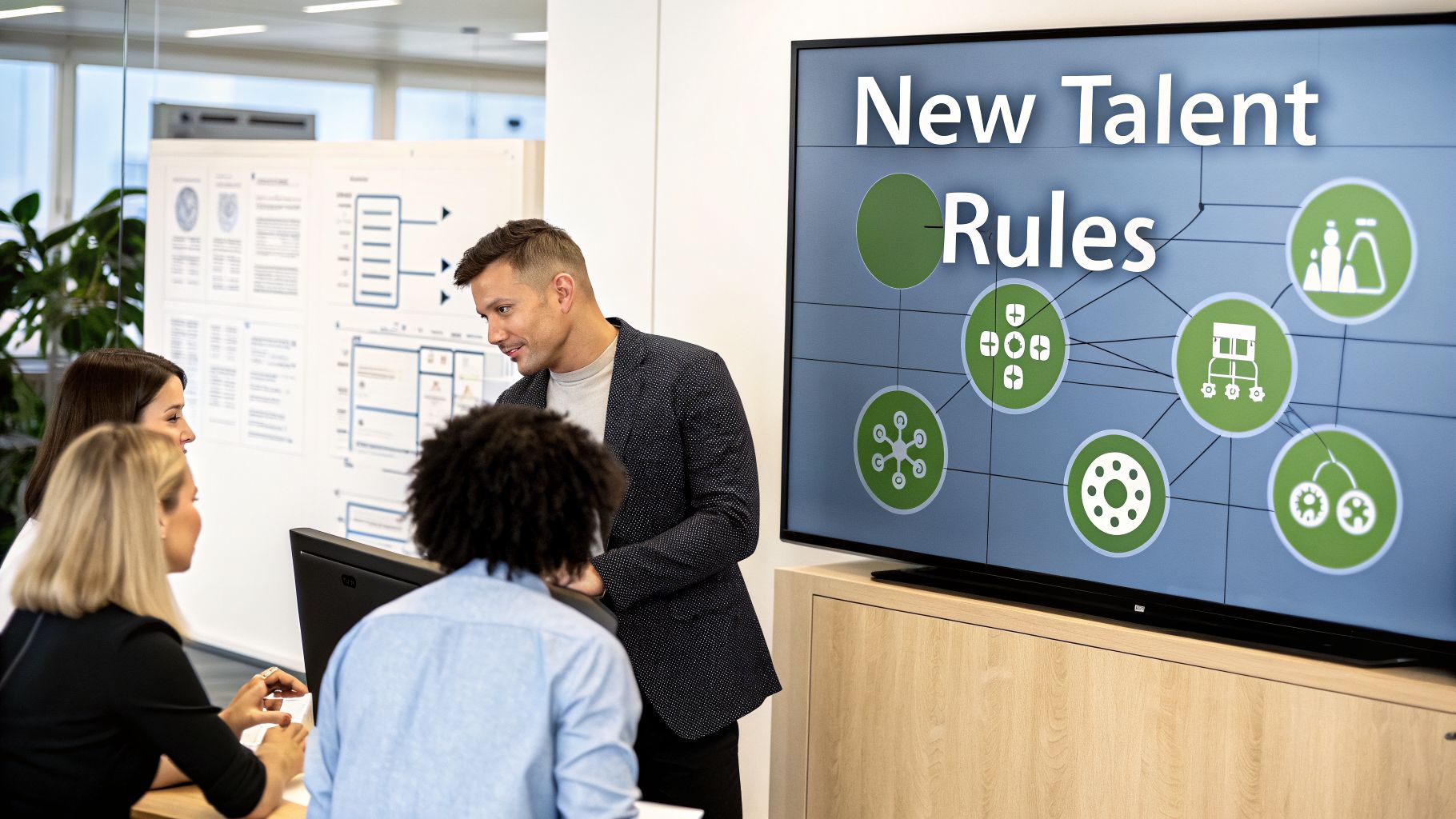
Think of it like this: the ground beneath the entire FMCG industry is shifting, thanks to massive changes in how people shop, the technology we use, and how markets behave. The pipelines that once reliably fed companies skilled people are now struggling to keep up. CHROs have to become the architects of a completely new kind of workforce.
This isn’t just about playing catch-up; it’s about getting ahead of the curve. The explosion of e-commerce, the absolute necessity for data-driven supply chains, and the consumer demand for personalised experiences have created a massive need for new skills. Jobs that were once straightforward now demand a sophisticated mix of abilities.
The question for today’s CHRO has evolved. It’s no longer, “Who can we hire?” but rather, “What capabilities do we need to build, buy, or borrow to win in the future?” This marks a major move from reactive recruiting to proactive talent architecture.
The Forces Reshaping Talent Needs
A few key drivers are rewriting the talent rulebook in the FMCG sector. Getting a handle on these is the first step for any CHRO who wants to build a future-ready organisation. These changes are impacting everyone, from entry-level staff to the C-suite.
Here’s what’s behind the shift:
- Digital Acceleration: The massive growth of online retail and direct-to-consumer (D2C) channels demands people who are experts in performance marketing, e-commerce management, and digital analytics.
- Data-Centric Operations: Companies are using big data for everything, from predicting sales to optimising logistics. This requires talent who can not just read complex data but turn those insights into real action.
- Evolving Consumer Expectations: Today’s shoppers want a seamless experience whether they’re online or in a store. They also want brands that align with their personal values, which ramps up the need for skills in customer experience (CX) and brand purpose.
To get a clearer picture of this evolution, the table below summarises the key changes and the strategic responses required.
FMCG Talent Evolution At a Glance
| Key Talent Shift | Outdated Approach | Modern CHRO Strategy |
|---|---|---|
| Skill Demand | Hiring for static, well-defined roles based on past needs. | Building dynamic capabilities in data analytics, e-commerce, and CX. |
| Workforce Model | Relying solely on a permanent, full-time workforce. | Embracing a blended model with gig workers, freelancers, and full-time staff. |
| Digital Integration | Viewing digital as a separate function or add-on. | Embedding digital skills and a data-first mindset across all departments. |
| Retention Focus | Offering traditional perks and linear career paths. | Focusing on continuous learning, career mobility, and a strong sense of purpose. |
| Employer Brand | Promoting stability and a corporate legacy. | Highlighting innovation, flexibility, and a commitment to employee well-being. |
| DE&I Efforts | Treating DE&I as a compliance or HR-led initiative. | Integrating DE&I into the core business strategy to drive innovation and market reach. |
This table highlights a clear departure from old methods. The modern CHRO must be a strategist who anticipates future needs and builds the organisational muscle to meet them.
The CHRO’s Strategic Response
In this new environment, the CHRO’s role has grown from being a functional leader to a core strategic business partner. The focus has to move from simply managing people to actively shaping the workforce to drive real business results. In fact, research shows that 70% of CEOs now expect their HR leaders to have a deep understanding of market positioning and what drives revenue.
This guide will unpack how FMCG talent needs are changing and what you, as a CHRO, should know to lead through this new reality. As you explore the latest FMCG hiring trends, you’ll find practical strategies for building a workforce that’s both competitive and agile. We’ll cover the essential digital skills your team needs, how to build a more flexible workforce, and the steps to creating an employer brand that top talent can’t resist.
The Essential Digital Skills Your Team Needs
Success in FMCG used to be won on the physical store shelf. Now, it’s increasingly decided by algorithms, consumer data, and intelligent supply chains. For CHROs, this means looking past the buzzword ‘digital transformation’ and getting specific about the exact skills that drive modern commerce.
It’s like upgrading an old-school kitchen to one that’s state-of-the-art. Your core business fundamentals the recipes are still vital. But now, they’re perfected using advanced tech. These new digital skills are the smart appliances that deliver better, data-backed results at every single step.
And this isn’t just an IT problem. Roles from brand management and marketing to logistics and finance all need a deep layer of digital fluency. Grasping this is fundamental to understanding how FMCG talent needs are changing and what CHROs should know to build a winning team.
Mastering the Digital Shelf
The modern storefront is often a complex algorithm. Winning on this ‘digital shelf’ demands a completely new kind of commercial talent. Your teams need to be skilled in more than just traditional merchandising; they need expertise that directly impacts online visibility and sales.
Key competencies for e-commerce excellence include:
- E-commerce Strategy and Channel Management: This is the ability to create and run strategies for platforms like Amazon, Flipkart, and your own Direct-to-Consumer (D2C) channels. It involves everything from optimising product listings to managing online promotions and decoding platform-specific algorithms.
- Performance Marketing Analytics: Your marketing team must be able to dig into the data from paid search, social media ads, and email campaigns. They need to live and breathe metrics like Return on Ad Spend (ROAS) and Customer Acquisition Cost (CAC) to make sure every marketing rupee is working hard.
- Digital Merchandising: This is all about using data to perfect the online customer journey, from the moment they search to the final click at checkout. It’s about showing the right products to the right people at exactly the right time.
The Power of Predictive Insights
In the FMCG world, data has quickly become the most precious commodity. The ability to collect, interpret, and, most importantly, act on consumer data is what now separates market leaders from the laggards. This means embedding data science skills right across your organisation.
Today, a brand manager’s intuition must be validated by data. A supply chain planner’s forecast needs to be powered by predictive models. This fusion of human expertise and machine intelligence is where the real competitive advantage lies.
This shift towards data-driven decisions means you have to prioritise hiring or upskilling talent in these areas:
- Data Science and Analytics: You need professionals who can build predictive models to forecast consumer demand, spot emerging trends before they go mainstream, and personalise marketing efforts.
- Business Intelligence (BI): These are the people who can turn mountains of complex data into clear, actionable dashboards and reports that your leadership team can use to make smarter decisions, faster.
AI and Automation Fluency
As Artificial Intelligence becomes a standard part of the toolkit, your entire workforce needs to be ready. This doesn’t mean everyone must become a coder. It’s about building a foundational understanding of how AI tools can enhance their roles, boost efficiency, and spark innovation.
Exploring the growing list of AI skills in demand can give you a clear roadmap for your training programmes. This forward-thinking approach ensures your organisation is an active participant in technological change, not just a bystander.
Building a More Flexible and Agile Workforce
The old playbook of a rigid, 9-to-5, entirely in-house workforce just isn’t cutting it anymore. The FMCG market moves far too quickly. To stay competitive, CHROs need to champion a more dynamic way of thinking, blending permanent staff with a flexible talent pool. This isn’t just a trend; it’s a fundamental shift in building a resilient organisation.
Imagine your talent strategy less like a fixed structure and more like a modular architecture. Instead of being locked into a single model of full-time employees, you can plug in different skills and expertise exactly when and where you need them. This gives you the power to scale up for a product launch or down during a quiet period, all without the long-term overhead.
Strategically Blending Your Talent Mix
A truly agile workforce is more than just hiring a few temps. It’s about being deliberate and strategic in how you deploy different kinds of talent to solve specific business problems. It requires a sharp understanding of which type of worker adds the most value, and when.
This blended model makes your talent management far more responsive and cost-effective. For example:
- Gig Workers for Seasonal Peaks: FMCG companies know all about predictable demand surges during festival seasons or big sporting events. Using gig workers for in-store merchandising, last-mile delivery, or promotions gives you the extra hands you need, without carrying that headcount all year round.
- Freelancers for Specialised Projects: Got a new product launch on the horizon? You might need a world-class creative director or a social media guru for just a few months. Freelancers give you on-demand access to niche skills, allowing you to bring in top-tier experts for high-impact, short-term work.
- Expert Consultants for Strategic Initiatives: For big, high-stakes projects like overhauling your supply chain or breaking into a new market, seasoned consultants provide the deep expertise and unbiased perspective needed to get it right the first time.
The rise of the “gig economy” makes strategic HR partnerships vital. Companies are increasingly hiring project-based professionals, so HR leaders must create strategies to manage this flexible workforce while keeping company culture strong and consistent.
By blending your talent this way, your organisation becomes incredibly adaptive. You can jump on market opportunities or fend off competitors with much greater speed simply by deploying the right skills at the right moment.
The Benefits of Workforce Agility
Embracing a flexible talent model brings some serious competitive advantages that go way beyond just saving money. It fundamentally changes how you acquire and use expertise, making your entire organisation more resilient and ready for whatever the market throws at it.
Here are the key benefits we see for FMCG companies:
- Improved Cost-Efficiency: You transform fixed labour costs into variable ones. Suddenly, you’re paying for specialised skills only when you need them, a massive advantage in an industry defined by fluctuating demand.
- On-Demand Access to Niche Skills: The hunt for talent is fierce, especially for people in digital marketing and data science. A flexible model lets you tap into a global pool of experts without getting into bidding wars for a small number of full-time hires.
- Greater Market Adaptability: When a new consumer trend pops up, you can quickly bring in specialists to figure out a response. This agility allows you to innovate and pivot much faster than rivals who are stuck with a rigid, internal-only talent structure.
Overcoming the Integration Challenge
Of course, this isn’t without its challenges. The biggest question CHROs face is how to maintain a cohesive culture and ensure brand consistency when your team is a mix of permanent and temporary staff.
The key is to consciously create a unified, “one-team” experience. This means investing in crystal-clear communication, standardised onboarding for everyone (not just full-timers), and technology that makes collaboration seamless. By intentionally folding your flexible talent into the team, you get the best of their expertise while protecting the cultural core of your organisation.
Creating an Employer Brand Top Talent Wants
In a market this competitive, a strong employer brand isn’t a ‘nice-to-have’; it’s your most critical asset for attracting talent. Gone are the days when a high salary and a few standard perks were enough. Today’s candidates, especially from Millennial and Gen Z cohorts, are asking for more. They want to see their own values reflected in the company they work for and a real opportunity to do meaningful work.
This is where your Employer Value Proposition (EVP) enters the picture. Think of it as your company’s core promise to its people. A powerful EVP goes way beyond the paycheque to spell out what makes your organisation a uniquely rewarding place to build a career. It’s the story that makes top talent choose you over the competition.
Let’s break down the blueprint for building an EVP that actually connects with people. The modern brand stands on three pillars: purpose, growth, and inclusion.
Building on Purpose and Impact
Modern professionals are driven by purpose. They’re actively looking for companies that are making a positive difference, and this is especially true in FMCG, where consumers and employees alike are focused on sustainability and ethical practices. In fact, companies with strong, purpose-driven cultures see an incredible 85% boost in net profit over five years.
Your Corporate Social Responsibility (CSR) and sustainability initiatives are no longer just for the annual report or PR team; they are powerful recruitment tools. When you showcase your commitment to the environment, your community, and ethical sourcing, you connect with candidates on a much deeper level.
A strong employer brand doesn’t just attract talent; it attracts the right talent. When your brand genuinely reflects your values, you bring in people who are already on board with your mission. This leads to a better cultural fit, higher engagement, and people who stick around.
For a CHRO, this means partnering up with your marketing and sustainability leads. Your job is to help weave these impact stories into every part of your recruitment process from social media posts and employee testimonials to the content on your careers page.
Showcasing Growth and Development
The best people want to know they have a future with you, not just a job. A transparent career path is one of the most effective retention tools you have. If your employees can’t see where they’re headed, they’ll start looking for a map somewhere else.
Your employer brand needs to paint a vivid picture of these growth opportunities. This means getting specific about:
- Transparent Career Lattices: Ditch the old, rigid career ladder. Show people how they can move across different functions, picking up diverse skills and experiences without having to leave the company.
- Succession Planning Visibility: You can’t promise everyone the corner office, but you can build confidence by showing you have solid succession plans and a commitment to promoting from within. Nothing does this better than sharing the stories of leaders who started in entry-level roles.
- Learning and Development: Be loud and proud about your investment in upskilling and reskilling. Detail the training programmes, mentorship opportunities, and any support you offer for further education.
The infographic below shows how these modern values come together to build a powerful talent attraction process.
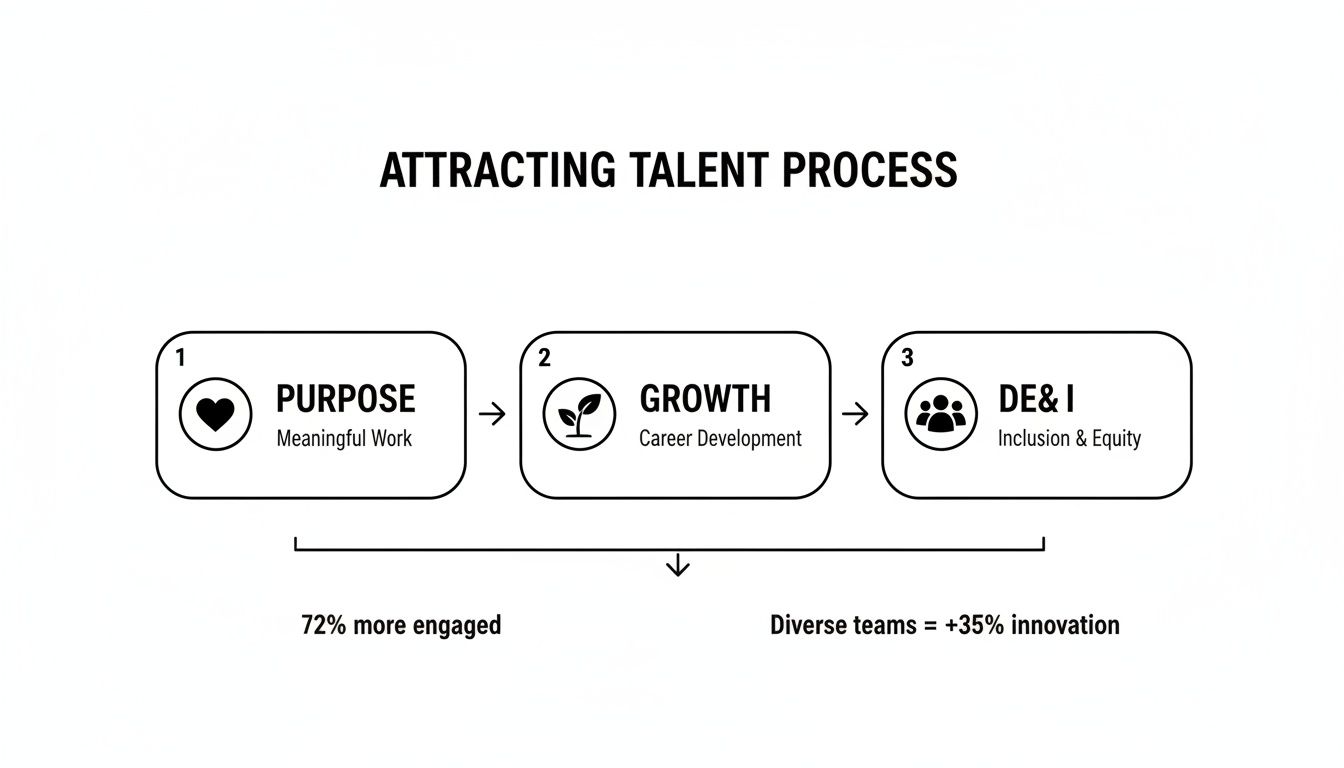
This simple flow demonstrates how a focus on Purpose, Growth, and DE&I creates a virtuous cycle, attracting high-calibre candidates who, in turn, fuel business innovation. You might be interested in exploring more about building effective employee branding strategies to put these ideas into practice. By turning your current employees into your most trusted brand ambassadors, you create an authentic recruitment engine that consistently attracts the talent you need to win.
Your Strategic Playbook for Talent Transformation
Knowing what’s changing in the world of FMCG talent is one thing; actually doing something about it is another. For CHROs, this is where the theory ends and the real work begins. Let’s translate these insights into a practical playbook, focusing on how you can build up your internal team and lean on strategic partners to win the war for talent.
The heart of your strategy should be built around a simple, yet powerful, idea: you can’t just hire your way out of a skills gap. What you really need is a talent ecosystem, one that lets you build, buy, and borrow the skills your business demands at any given moment. This means getting ahead of the curve with skills analysis, creating robust internal development programmes, and being smart about how you use recruitment technology.
A modern talent strategy is not a rigid blueprint but an agile system. It’s about creating an organisation that can learn and adapt, continuously recalibrating its skills to meet market demands. For CHROs, this is the shift from being a talent manager to a talent architect.
Conduct a Forward-Looking Skills Gap Analysis
Before you can build the workforce of tomorrow, you have to get a real handle on the one you have today. A typical skills gap analysis just looks at your current roles and what’s missing. A forward-looking analysis, on the other hand, maps your team’s existing skills against your business goals for the next three to five years.
This forces you to ask the tough questions that connect your people directly to business results:
- Future Capabilities: With our D2C growth targets, what specific e-commerce and performance marketing skills do we absolutely need in the next 24 months?
- Technological Impact: As we bring more automation into our supply chain, which roles are going to change the most, and what reskilling pathways should we be creating right now?
- Competitive Edge: What unique digital or analytical capabilities do our competitors have that we’re currently missing?
Getting clear answers here gives you a data-backed picture of your most urgent talent priorities. This insight is exactly what you need to understand how FMCG talent needs are changing and what CHROs should know to stay a step ahead.
Design Effective Reskilling and Upskilling Programmes
Once you have a clear map of your skills gaps, the next move is to start closing them from the inside. Your most powerful and cost-effective tool is internal mobility. In fact, research shows that nearly half of all employees will need some form of reskilling by 2025 simply because of technology’s rapid advance.
Your programmes can’t be generic; they have to be targeted and practical. Focus on building learning pathways that directly tackle the gaps you’ve found. Maybe that’s a “Data Analytics for Marketers” module or an “E-commerce Fundamentals” course for your traditional sales team. Not only does this build mission-critical skills, but it also sends a clear message to your employees that you’re invested in their growth, which is a massive boost for retention.
Partner with a Recruitment Process Outsourcing Provider
While building talent from within is your foundation, you’ll always have to “buy” certain specialised skills from the market. This is where partnering with a Recruitment Process Outsourcing (RPO) provider moves from a simple transaction to a strategic masterstroke. A true RPO partner isn’t just another vendor; they become an extension of your own HR team.
Think of an RPO as your own specialised talent acquisition unit, one that comes fully equipped with the market intelligence, tech, and scale to find niche talent far more efficiently than you could alone. This is particularly vital when you’re hunting for professionals in high-demand digital fields where your internal team might not have the deep networks or expertise.
An RPO partnership brings several key advantages to the table in today’s FMCG world:
- Access to Niche Talent: Good RPO providers live and breathe specialised markets like data science and performance marketing. They give you a direct line to candidates you’d likely never find on your own.
- Scalability for Flexible Workforces: They can ramp recruitment up or down at a moment’s notice, helping you manage hiring for the gig workers, freelancers, and contract staff you need for seasonal peaks or special projects.
- Market Intelligence: RPOs give you real-time data on everything from salary trends and competitor hiring patterns to talent availability, helping you craft smarter, more competitive offers.
To get the most out of a partnership, you first need to consider which RPO model is the right fit for your organisation’s unique challenges.
Choosing the Right RPO Model for Your FMCG Needs
Not all RPO partnerships are created equal. The right one for you depends entirely on what problem you’re trying to solve. Are you looking for a complete overhaul, or just a quick injection of hiring power for a specific project? This table breaks down the main options.
| RPO Model | Ideal for a CHRO Who Needs… | Key Benefits in an FMCG Context |
|---|---|---|
| End-to-End RPO | A complete overhaul of their entire recruitment function for long-term strategic alignment. | Transforms the entire talent acquisition process to build a sustainable, future-ready workforce. |
| Project-Based RPO | To quickly hire for a new product launch, a new market entry, or a specific digital transformation initiative. | Provides rapid access to specialised talent for time-sensitive, high-impact business goals. |
| On-Demand RPO | Flexibility to manage fluctuating hiring volumes, such as seasonal hiring surges or unexpected vacancies. | Offers a cost-effective way to access expert recruitment support exactly when it’s needed, without a long-term commitment. |
Ultimately, there is no single silver bullet. But this strategic playbook which smartly combines internal development with savvy external partnerships gives you the framework to build a workforce that is resilient, agile, and ready for whatever the future of FMCG throws at you.
Using Future-Ready Metrics to Measure Success
As your talent strategies evolve, your scorecards have to keep up. The old HR dashboard, full of operational KPIs like time-to-fill and cost-per-hire, just doesn’t cut it anymore. While those numbers are still useful for keeping an eye on efficiency, they don’t tell the whole story. They certainly don’t capture the strategic value your talent initiatives are pumping back into the business.
To prove HR’s impact in a language the C-suite not only understands but respects, you need a fresh set of future-ready metrics. Think of it like upgrading your car’s dashboard. The speedometer and fuel gauge are still essential, of course. But now, you also need a GPS showing your strategic route and sensors warning you about roadblocks long before you see them.
This isn’t just a minor tweak; it’s a fundamental shift in focus. We’re moving away from measuring purely operational efficiency and towards demonstrating the real, tangible business value your people strategies create. It’s all about answering the big question: “How are our talent initiatives directly driving revenue, innovation, and our ability to pivot in the market?”
Adopting a Strategic Scorecard
A strategic scorecard looks beyond simply tracking HR activities; it starts measuring business outcomes. It draws a straight line from your people-focused efforts to the company’s bottom line. For an FMCG organisation navigating today’s whirlwind of change, these new metrics offer a crucial health check on your workforce’s readiness for what’s next.
Here are a few future-ready metrics every CHRO should be adding to their dashboard:
- Digital Skill Adoption Rate: This isn’t just about who completed a course. It measures how quickly and effectively your people are actually applying new digital skills in their day-to-day roles. You can track this by seeing what percentage of employees use new software or apply digital training to their projects.
- Internal Mobility Effectiveness: Don’t just count the number of internal promotions. Instead, measure the performance and retention of employees after they’ve moved into a new role. This tells you if your internal mobility programme is genuinely developing and keeping your best people, or just shuffling them around.
- Flexible Talent Contribution Index: This metric puts a number on the value your non-permanent workforce brings to the table. It could be a composite score that factors in project success rates, the cost savings compared to full-time hires, and how quickly freelancers or consultants filled a critical skill gap.
Shifting your measurement focus is central to solidifying HR’s role as a strategic partner. When you can demonstrate that a 15% increase in digital skill adoption led to a 5% uplift in online sales, you are speaking the language of business results.
Measuring What Truly Matters
Putting these metrics into practice requires a change in both mindset and technology. You need systems that can talk to each other, connecting your talent data with the company’s business performance data. For instance, linking your learning management system (LMS) data with sales figures can directly prove the ROI of your training programmes.
Let’s look at a few more vital metrics for your new scorecard:
- Innovation Contribution Rate: Start tracking where the great ideas are coming from. This could be the number of new product suggestions, process improvements, or cost-saving initiatives that originate from different teams. It helps you see which parts of the organisation are really driving innovation and whether your culture is set up to support them.
- Leadership Bench Strength: Move beyond simple succession planning checkboxes. Measure the actual readiness of potential successors for key roles and assess the diversity of your leadership pipeline. A strong bench strength score is a clear indicator of your organisation’s long-term resilience.
- Employee Experience (EX) to Customer Experience (CX) Correlation: This is a powerful one. By mapping employee net promoter scores (eNPS) against customer satisfaction (CSAT) scores for specific regions or business units, you can draw a clear, data-backed line between a happy, engaged workforce and satisfied customers.
By tracking these advanced metrics, you gain a far richer, more nuanced understanding of your talent landscape. This data-driven approach is fundamental to understanding how FMCG talent needs are changing and what CHROs should know to navigate this new environment. It empowers you to fine-tune your strategies on the fly, prove HR’s financial return, and secure your seat at the table as an indispensable partner in moving the business forward.
Frequently Asked Questions for FMCG CHROs
As the FMCG world keeps changing, so do the questions keeping talent leaders up at night. We’re here to give you straightforward, practical answers to the most common challenges CHROs are tackling right now.
How Can We Upskill Our Team for Digital Roles with a Limited Budget?
Upskilling on a tight budget isn’t about doing everything at once. It’s about being smart and surgical with your training. Instead of pouring money into broad, expensive programmes, you need to focus on high-impact skills that will move the needle for your business today.
Start by pinpointing the one or two digital skills that would make the biggest immediate difference. This could be anything from performance marketing analytics to e-commerce channel management. Once you know what you need, you can use some really cost-effective methods:
- Peer-to-Peer Learning: You likely have experts already on your team. Empower them to run short, practical workshops for their colleagues.
- Micro-Learning Platforms: Look into online platforms that offer bite-sized courses on specific digital tools and techniques, which are often more affordable and easier to digest.
- Project-Based Learning: The best way to learn is by doing. Assign people to cross-functional projects where they have no choice but to pick up and apply new digital skills in a real-world scenario.
The trick is to weave learning into the daily workflow, making it a continuous habit rather than a one-off event. This builds momentum and gets you real results without a huge upfront investment.
What Is the Best First Step for Creating a Flexible Workforce?
The single best first step is to start small with a pilot project. Before you try to reinvent your entire workforce model, test the concept with a focused, well-defined initiative. This approach lets you learn, adapt, and build a solid business case backed by actual data.
Begin by identifying a recurring business challenge that external talent could solve. A great example is managing seasonal in-store merchandising surges or handling a specialised digital marketing campaign. This contained experiment keeps risk low and gives you clear metrics for success.
Bring on a small group of freelancers or gig workers for this specific project. Your focus should be on setting up clear communication channels, a simple onboarding process, and precise performance goals from day one. When this pilot project succeeds, it proves the value of a flexible model to other leaders and gives your HR team real, hands-on experience managing a blended workforce.
How Can We Move DE&I from Discussion to Action?
Making Diversity, Equity, and Inclusion (DE&I) more than just a conversation means tying it directly to leadership accountability and real-world results. In short, you have to treat DE&I with the same rigour as any other strategic business goal.
This means getting past awareness campaigns and setting goals you can actually measure. For instance, you could tie a portion of leadership bonuses to specific DE&I metrics, like improving the diversity of your leadership pipeline or closing representation gaps in critical departments.
It’s also crucial to empower your employee resource groups (ERGs). Give them budgets and a direct line to senior leadership. This ensures that DE&I initiatives aren’t just top-down orders but are shaped by the lived experiences of your employees, which makes them far more authentic and powerful.
At Taggd, we specialise in building agile, future-ready workforces for the FMCG industry. Our Recruitment Process Outsourcing (RPO) solutions are designed to help you attract, hire, and integrate the specialised talent you need to thrive. Connect with us and discover how we can transform your talent strategy.