To attract top-tier tech talent without breaking the bank, Global Capability Centres (GCCs) need to craft an irresistible value proposition. It’s got to be built on more than just money, think career growth, cutting-edge work, and a magnetic culture.
Simply throwing money at the problem is a short-sighted strategy that just fuels salary wars. The real win lies in building a powerful employer brand and using smart talent intelligence to focus on what elite professionals truly value beyond the paycheque. This guide is your playbook for doing exactly that.
Navigating the GCC Talent Paradox in India

The hiring landscape for GCCs in India is a real head-scratcher. On one hand, you have a massive pool of engineering graduates. On the other, there’s a fierce, and often costly, battle for a tiny fraction of elite professionals with specialised skills in high-demand fields like AI, machine learning, and data science.
This intense competition often corners GCCs, making them feel like they have to offer eye-watering salaries just to get the right people in the door.
But this reactive approach is an unwinnable race. Constantly inflating salaries not only bloats your operational costs but also fosters a transactional work culture where loyalty is paper-thin. The second a competitor dangles a bigger carrot, your expensive new hire is gone. This cycle makes it nearly impossible to build the stable, high-performing teams you need for long-term strategic advantage.
Let’s break down the core of this challenge.
The GCC Hiring Dilemma: A Snapshot
The disconnect between market demand and talent supply creates a difficult situation for hiring managers. Here’s a quick look at the reality on the ground.
| Challenge | Market Reality (2026) | Conventional (and Flawed) Response |
|---|---|---|
| Intense Competition for Niche Skills | An 82% AI skills shortage is projected, with demand far exceeding supply. | Engaging in bidding wars and overpaying for a small pool of known experts. |
| High Talent Attrition | Talent moves for marginal salary hikes, creating a transactional culture. | Offering counter-offers and retention bonuses that only delay the problem. |
| Inflated Operational Costs | 2.3 million new AI jobs by 2027 will drive salary expectations even higher. | Increasing hiring budgets reactively, without a sustainable strategy. |
| Building Long-Term Capability | Not enough job-ready talent is available to build stable, future-proof teams. | Focusing solely on acquiring external talent instead of upskilling internal teams. |
This table paints a clear picture: the old way of hiring simply won’t work anymore. A strategic shift is necessary to stay competitive.
The Real Challenge: A Deep Skills Mismatch
The heart of the problem isn’t a lack of people; it’s a severe shortage of job-ready skills. Recent data is stark: India’s talent shortage for AI skills is projected to hit a staggering 82% by 2026, blowing past the global average. That means over eight out of every ten employers are scrambling to find qualified professionals.
While demand for AI-related roles is exploding with projections of 2.3 million jobs by 2027 the supply of skilled talent is lagging far behind.
The winning strategy isn’t to overpay for the few available experts, but to get smarter about how you attract, assess, and develop talent. It’s about shifting the focus from simply buying skills to building a talent ecosystem.
This guide will show you how to break free from this expensive cycle. Instead of asking, “How much do we have to pay?” the better question is, “What can we offer that our competitors can’t?” The answer lies in crafting a powerful Employer Value Proposition (EVP) that speaks to the deeper motivations of top engineers.
To get this right, GCCs must understand what truly drives top-tier talent. It often comes down to these key elements:
- Impactful Work: The chance to work on complex, globally significant projects that solve real-world problems.
- Career Trajectory: A clear path for growth and skill development that goes beyond a simple promotion ladder.
- A Modern Culture: An environment that champions autonomy, encourages innovation, and fosters genuine collaboration.
By zeroing in on these factors, you attract professionals searching for a career-defining opportunity, not just a salary bump. This approach transforms your GCC from just another offshore delivery centre into a true innovation hub.
For a deeper dive into the strategic evolution of GCCs, check out our comprehensive GCC report on growth trends and talent strategies. The following sections will give you the actionable steps to build this competitive edge.
Building an EVP That Wins Over Tech Talent

While a competitive salary gets you in the game, it’s your Employer Value Proposition (EVP) that truly wins over top tech talent. Think of your EVP as the promise you make to an employee in exchange for their skills and dedication. For Global Capability Centres (GCCs), a powerful EVP is the single most effective tool for attracting incredible professionals without getting trapped in endless salary wars.
You have to answer one critical question: “Why should a brilliant engineer build their career with us instead of a hot product company or a well-funded startup?” The answer isn’t just about the money. It’s about weaving a compelling story of opportunity, real impact, and professional growth.
Time for an Honest Look in the Mirror
Before you can build a killer EVP, you need a brutally honest assessment of what you’re actually offering today. Your EVP isn’t a marketing tagline; it’s the day-to-day reality for your team. Start by auditing your current employee experience.
Get your team together and ask the tough questions:
- The Work Itself: Are engineers stuck on legacy maintenance, or are they building new, exciting products? Can they draw a straight line from their code to global business success?
- The Career Path: Do you offer clear, well-defined routes for advancement? This includes paths for both managers and those who want to stay deeply technical as individual contributors.
- Learning & Growth: Are you just ticking a box with generic training, or are you offering funded, dedicated time for deep-skilling in the technologies that matter?
- Culture & Freedom: Is your environment choked by red tape, or do you cultivate a product-first mindset with empowered, autonomous teams?
- The Workplace: Does your office (physical or virtual) actually help people collaborate, do deep work, and maintain their well-being?
This internal audit will quickly show you the gaps between the EVP you think you have and the one your employees are actually living. Closing these gaps is your first real step toward building a proposition that resonates.
Crafting a Story of Impact and Growth
With your audit done, you can start shaping a narrative that plays to your unique strengths. The best engineers are driven by solving complex puzzles and seeing their work make a real-world difference. This is a massive differentiator that GCCs can, and absolutely should, promote.
For example, many GCCs in India are evolving from back-office support centres into end-to-end delivery powerhouses. Teams in Bengaluru or Hyderabad are now owning entire global product lines, cutting the reliance on expensive overseas contractors. Frame this as a chance for talent to take full ownership of projects with global significance.
Your EVP must scream that joining your GCC isn’t just a job, it’s a career-defining move. It’s a chance to get global exposure, own business-critical projects, and build skills that are in high demand everywhere.
This message completely changes the perception of your GCC. You’re no longer a cost centre; you’re an innovation hub where ambitious technologists can do the best work of their careers.
High-Impact Moves That Won’t Break the Bank
Strengthening your EVP doesn’t always demand a huge budget. In my experience, some of the highest-impact initiatives are relatively low-cost and send a powerful signal that you’re serious about talent development. These programmes become fantastic proof points for your recruitment marketing.
Consider rolling out a few of these strategies:
- Rotational “Tour of Duty” Programmes: Let engineers spend time in different teams or even different business units. This gives them broad exposure and helps them find new passions and skills right within your organisation.
- Dedicated Innovation Labs: Team up with local universities to create innovation labs. Your senior engineers can mentor students on real-world projects, creating a direct pipeline of talent who already know your work and culture.
- Internal “Train-the-Trainer” Programmes: Find your internal subject matter experts and give them the platform to become trainers. This not only scales your learning programs but also helps your top people build their leadership skills.
- Shadowing and Global Mobility: Offer high-performers short-term assignments to shadow colleagues at global headquarters. They come back as internal champions, transferring knowledge and strengthening the bond between local and global teams.
These aren’t just perks; they are tangible investments in your people’s future. When a candidate sees a clear path to upskilling and career growth, the conversation shifts from the size of their salary to the scale of the opportunity. This is how you win.
Sourcing and Pipelining From Untapped Talent Pools
To land top-tier tech talent without getting into a bidding war, you have to look where your competitors aren’t. It’s no secret that the talent markets in Tier-1 cities like Bengaluru and Hyderabad are overheated and completely saturated. The real opportunity? The vast, untapped pools of skilled professionals scattered across India’s Tier-2 and Tier-3 cities.
Shifting your focus to these areas isn’t just an option anymore; it’s a core strategic move. The biggest mistake most GCCs make is fishing in the same small, expensive pond as everyone else. The truth is, incredible engineering talent isn’t confined to a few postcodes. Moving your sourcing efforts beyond the major metros helps you build a proactive talent pipeline, giving you access to high-potential individuals before they even hit the open market.
Thinking Beyond the Obvious Talent Hubs
The data paints a pretty stark picture. While 82% of employers are struggling to fill high-tech roles, a staggering 57% of Indian graduates face unemployment. This isn’t just a numbers game; it’s a massive skills disconnect. A recent analysis of graduate employability challenges projects that only 42.6% of graduates will have the skills employers actually need by 2026.
This gap is a golden opportunity. It’s not just about finding cheaper talent; it’s about discovering hidden gems. Many graduates and experienced pros in cities like Jaipur, Coimbatore, Indore, and Vadodara have immense raw technical ability but might lack the polished CV of their Tier-1 counterparts. Your job is to spot that potential early.
Engaging With Regional Academic Institutions
One of the most powerful strategies is to build deep, meaningful relationships with regional engineering colleges and universities. This goes way beyond just showing up at a career fair once a year. It’s about becoming a genuine partner in their ecosystem.
For instance, think about setting up dedicated innovation labs right on campus. A GCC can provide the infrastructure and, more importantly, mentorship from senior engineers who can present real-world business problems for students to tackle. This model works on two levels:
- It gives students hands-on experience with the exact technologies and challenges they’d face at your company.
- It lets your team identify the brightest, most motivated students long before they graduate, creating a direct pipeline of talent who are already familiar with your work and culture.
Don’t just sponsor an event; embed your organisation into the academic fabric. By offering guest lectures, curriculum advice, and mentorship, you build brand affinity and get first access to emerging talent.
These collaborations transform recruitment from a reactive scramble into a strategic, long-term talent cultivation programme. For a deeper dive, you can explore our guide on how campus collaborations can aid recruitment efforts for GCCs in India.
Using Technology to Uncover Hidden Talent
Beyond the campus gates, technology can help you systematically find high-potential individuals who are flying under everyone else’s radar. Instead of just relying on the usual job boards, use talent intelligence platforms to find developers contributing to open-source projects, leading discussions in coding communities, or winning virtual hackathons.
Here are a few practical ways to put this into action:
- Targeted Virtual Hackathons: Host online hackathons focused on a specific, real-world problem your GCC is trying to solve. This is a magnet for self-motivated problem-solvers and gives you a direct look at their practical skills.
- Community Engagement: Get active in developer forums and online communities. Have your senior engineers answer questions and jump into technical discussions. This builds credibility and helps you spot sharp thinkers.
- Skills-Based Sourcing: Use tools that let you search for talent based on proven skills demonstrated on platforms like GitHub or Kaggle, not just keywords on a resume.
By actively nurturing these untapped talent pools, you completely change your hiring dynamic. You’re no longer just competing on salary. Instead, you’re offering a unique opportunity for growth and impact, attracting ambitious professionals who are eager to build their careers with an organisation that invests in them from the very start.
Implementing a Skills-First Hiring Process
Let’s be blunt: the traditional way of hiring tech talent is fundamentally broken. Relying on CV screening is like trying to judge a chef by their recipe book instead of tasting their food. A degree from a prestigious college or a past job at a big-name company says very little about whether a candidate can actually code, design a scalable system, or solve the complex problems you’re facing.
This is where GCCs have a massive opportunity to outsmart the competition. The secret is to shift to a skills-first hiring process.
This whole approach is about answering one simple question: “Can this person do the job, and do it well?” By putting practical, hands-on assessments at the centre of your process, you don’t just find real top performers. You also create an equitable and engaging interview experience that the best engineers genuinely respect.
Moving Beyond the Resume
A CV is an outdated proxy for skill. It often screens out brilliant, high-potential talent from diverse backgrounds, especially those from Tier-2 and Tier-3 cities who might have exceptional raw ability but lack a polished resume.
A skills-first framework completely flips that model on its head. Instead of using a resume to guess a candidate’s competence, you use practical assessments to directly measure it. This immediately levels the playing field and widens your talent pool, helping you find those hidden gems your competitors are completely missing.
By focusing on what candidates can do rather than where they’ve been, you uncover true ability and build a more capable, diverse team. This is a core strategy for how GCCs can attract top-tech talent without overpaying.
This shift isn’t just about fairness; it’s about effectiveness. When top engineers see you have a rigorous, skill-based interview process, it sends a powerful signal that you value true technical excellence. They appreciate being properly challenged and are far more likely to accept an offer from an organisation that has thoroughly vetted their abilities.
Designing Effective Technical Assessments
The key here is to design assessments that actually mirror the work a candidate will be doing. Generic whiteboard problems or abstract brain teasers are notoriously poor predictors of on-the-job success. You need to focus on practical evaluations that test relevant, real-world skills.
Here are three types of assessments that work exceptionally well:
- Live Coding Challenges: Pair the candidate with one of your senior engineers to tackle a real-world coding problem together. This isn’t about finding a perfect solution under pressure. It’s about seeing their thought process, how they communicate technical ideas, how they take feedback, and their overall approach to problem-solving.
- System Design Interviews: For more senior roles, this is non-negotiable. Ask candidates to architect a system, like a simplified e-commerce platform or a data processing pipeline. This reveals their ability to think at scale, weigh trade-offs, and make sound architectural decisions, all critical skills for roles that come with significant ownership.
- Take-Home Case Studies: Give them a well-defined project that simulates a task they’d handle in their first few months. For instance, provide a small dataset and ask them to build a simple API or analyse it for insights. This gives candidates the space to produce their best work without the “on the spot” pressure of a live interview.
A Practical Implementation Example
Let’s say you’re hiring a Senior Backend Engineer. Here’s a side-by-side look at how a skills-first loop completely changes the game compared to the old, resume-heavy approach:
| Traditional Process | Skills-First Process |
|---|---|
| Initial Screen: HR call based on CV keywords. | Initial Screen: Short automated coding test. |
| Round 1: Hiring manager behavioural chat. | Round 1: Live coding session with an engineer. |
| Round 2: Technical deep dive on past projects. | Round 2: System design interview. |
| Round 3: Final “culture fit” interview. | Round 3: Chat with hiring manager and team. |
This revised process puts technical validation right at the front, making sure only genuinely qualified candidates move forward. It respects everyone’s time yours and theirs and gives you a much richer signal of a candidate’s true capabilities.
When you build your hiring engine around proven skills, you create a powerful magnet for the exact talent you need to drive real innovation.
Designing a Smarter Total Rewards Strategy
The conversation around attracting top tech talent almost always circles back to salary. But let’s be clear: winning this game isn’t just about having the deepest pockets. It’s about building a smarter, more complete total rewards strategy. For Global Capability Centres, the real goal is to shift the candidate’s focus from a simple paycheque to a compelling package that speaks to what engineers genuinely value.
Instead of getting into a bidding war with every competitor, a data-backed approach lets you be competitive without being reckless. This is how you attract top-tier talent without overpaying. You create a package that simply feels more valuable than a higher salary somewhere else.
Benchmarking for Value, Not Just Cost
Your first move should be precise market benchmarking. But the objective isn’t to lead the market on base salary for every single role. That’s a quick way to burn through your budget.
A far more sustainable approach is to aim for the 50th to 75th percentile of the market salary band for most of your positions. This ensures you’re offering a competitive wage that gets you in the door and keeps you in the conversation.
You can then save your top-of-market offers anything above the 75th percentile for those truly critical, high-impact, or niche-skill roles. These are the positions where one exceptional hire can create an outsized impact. This targeted strategy stops salary inflation across the board while giving you the firepower to land a game-changer when it really counts.
A skills-first hiring process, like the one shown below, is the foundation for these compensation decisions. It ensures your top rewards are going to candidates with proven, demonstrated abilities, not just a polished CV.
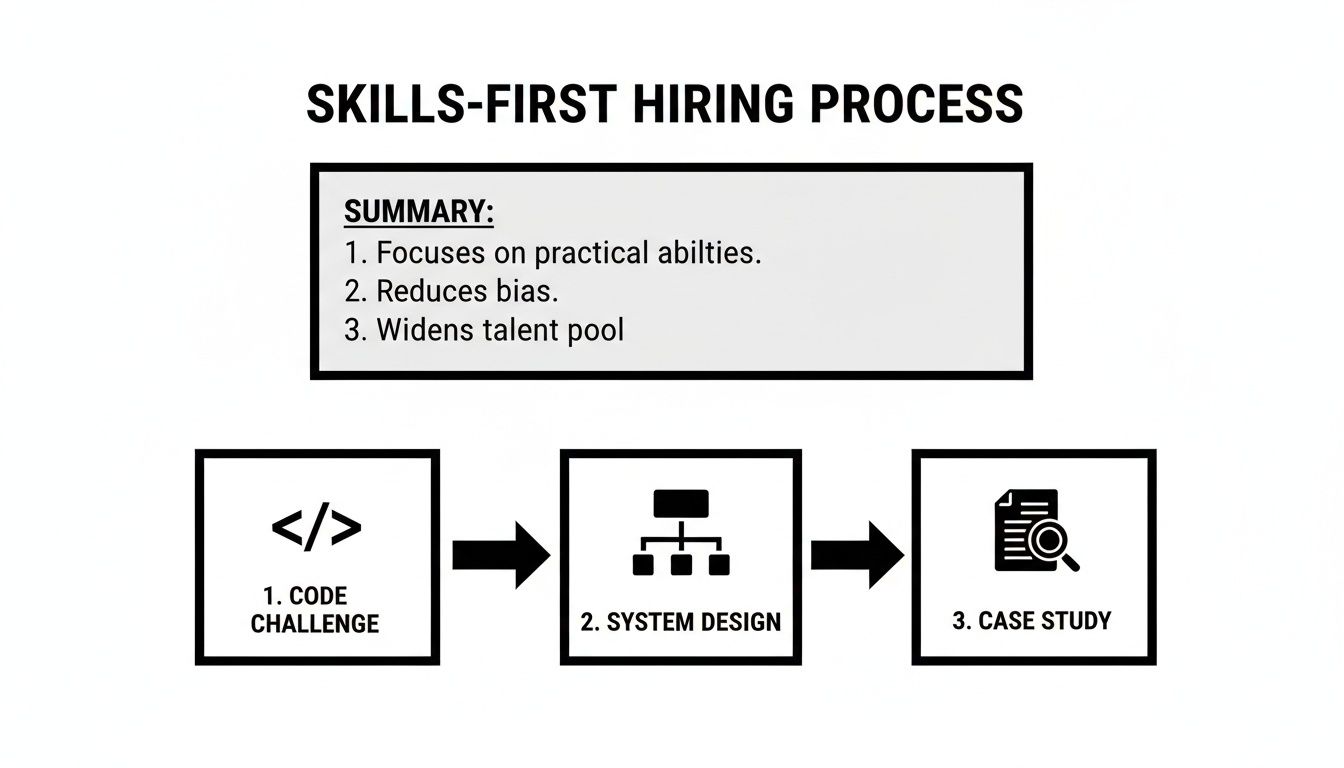
This visual shows how focusing on practical skill demonstration justifies making a strategic investment in the candidates who truly excel.
The Power of Long-Term Incentives and Growth
Once you’ve established a competitive base salary, the real differentiation begins. This is where you can truly stand out by offering benefits that signal a long-term commitment to an employee’s career and financial success.
Top engineers are often playing the long game. They’re motivated by genuine wealth creation and continuous professional development, not just the monthly salary credit.
Here’s how to build a package that resonates:
- Restricted Stock Units (RSUs): Offering equity is one of the most powerful tools you have. RSUs directly tie an employee’s financial success to the company’s performance, fostering a true ownership mindset and encouraging long-term loyalty.
- Targeted Performance Bonuses: Move beyond the standard annual bonus. Instead, link significant bonuses to the successful delivery of specific projects or achieving key product milestones. This makes the compensation feel earned and directly connected to personal impact.
- A Substantial Learning Budget: Offer a generous, dedicated budget for conferences, certifications, and advanced courses. For an ambitious engineer, this direct investment in their skill set is often more valuable than a small bump in salary.
A well-structured total rewards package tells a story. It says, “We aren’t just hiring you for a job; we’re investing in your career and want you to build it with us.”
To see how this works in practice, look at how a strategic package stacks up against a standard high-salary offer.
Total Rewards Package Comparison
| Reward Component | Standard High-Salary Offer | Strategic GCC Total Rewards Offer |
|---|---|---|
| Base Salary | Top 90th percentile (Very High) | Competitive 75th percentile (Strong) |
| Annual Bonus | Standard 10-15% | Targeted project-based bonuses (up to 25%+) |
| Equity (RSUs) | Minimal or none | Meaningful RSU grant vesting over 4 years |
| Learning & Dev. | Standard company-wide training | ₹1,50,000+ dedicated annual learning budget |
| Career Path | Vague promises of growth | Clear internal mobility pathways defined |
| Impact & Work | Standard project work | Ownership of critical, high-impact projects |
As the table shows, the strategic offer creates a more compelling long-term value proposition. It shifts the conversation from “How much will I make this year?” to “How much can I grow and build here over the next five years?”
Look Inward First: The Ultimate Cost-Saver
Perhaps the most overlooked, and most cost-effective talent strategy is to foster internal mobility. Think about it: the cost of upskilling and promoting an existing employee is dramatically lower than hiring someone externally.
An internal move completely eliminates recruitment fees, slashes onboarding time, and retains valuable institutional knowledge that an external hire would take months to acquire.
When your people see clear, tangible pathways for advancement and opportunities to tackle new challenges without leaving the company, it powerfully reinforces the Employer Value Proposition you’ve worked so hard to build. It’s definitive proof that your promises of career growth are real. This creates a virtuous cycle: you retain your best talent, they become more skilled and valuable, and your need for expensive external hiring goes down.
This is the real secret to attracting and keeping top talent without constantly feeling the pressure to overpay.
Leveraging RPO for a Strategic Hiring Advantage
Let’s be realistic. Putting all the strategies we’ve talked about into action from crafting a magnetic EVP to hunting in untapped talent pools, takes serious time, specialised know-how, and resources. For many Global Capability Centres, especially those with ambitious growth targets or a lean in-house talent acquisition (TA) team, it can feel like trying to boil the ocean.
This is exactly where bringing in a Recruitment Process Outsourcing (RPO) partner can be a game-changer. An RPO partnership isn’t just about offloading tasks; it’s about gaining a strategic ally. A modern RPO becomes a true extension of your team, armed with the specialist recruiters, tech stack, and live market data needed to make your hiring strategy a reality. This frees up your internal team to focus on what they do best: core HR functions and nurturing the employee experience.
When to Consider an RPO Partnership
The decision to team up with an RPO is usually driven by clear business pain points. If you’re staring down aggressive growth goals, like needing to hire hundreds of engineers in a matter of months, an RPO brings the immediate scale and recruiting firepower you just don’t have internally.
Other tell-tale signs include:
- You’re Struggling to Find Niche Skills: When you can’t seem to find professionals in hot areas like AI/ML or cybersecurity, a specialised RPO brings a ready-made network and deep market knowledge to the table.
- Your Internal TA Team Is Drowning: If your recruiters are so buried in admin that they can’t do any strategic sourcing or candidate engagement, an RPO can lift that entire burden.
- Your Time-to-Fill Is Sky-High: Slow hiring means lost candidates and delayed projects. An RPO is focused on streamlining your process to get the right people in the door, faster.
A well-chosen RPO partner doesn’t just fill roles. They embed themselves in your culture, get to grips with your business goals, and help you build the talent pipeline you need for long-term success.
They provide the operational muscle to turn your talent attraction strategy into reality. This collaboration is crucial for GCCs that want to attract top-tech talent without overpaying, as it brings in external expertise focused on efficiency and value. You can learn more about how a recruiting process outsourcing partnership can improve hiring results in our detailed guide.
Ultimately, an RPO gives you far greater cost control and predictability in your hiring. By tapping into their economies of scale and specialised expertise, you can secure the best talent on the market without blowing your budget, ensuring your GCC keeps its competitive edge sharp.
FAQs
Hiring managers and CHROs often ask us the tough questions about attracting top tech talent in India without blowing the budget. It’s a make-or-break challenge for any Global Capability Centre that’s serious about sustainable growth. Here are some of the most common ones we hear.
Should We Always Aim to Pay Above Market Rate?
Absolutely not. The goal is to be competitive, not to start a salary war that you can’t possibly win. It’s just not sustainable.
For most tech roles, you should aim to benchmark your compensation packages right within the 50th to 75th percentile of the market. This keeps you in the running for great talent without completely inflating your cost structure.
Save your top-of-market offers, anything above that 75th percentile for those truly strategic, high-impact roles. These are the positions where one exceptional individual can genuinely change the game for your entire operation. This targeted approach is how you land the best people without overpaying across the board.
Is Focusing on Tier-2 Cities Really a Viable Strategy?
Yes, and honestly, it’s one of the most effective ways to find high-potential talent that your competitors are completely overlooking.
It does require a different playbook. You might need to build strong partnerships with regional universities or host virtual hackathons to find them. But the payoff is significant. You get access to a far less saturated talent pool at a much more reasonable cost.
The talent in cities like Jaipur, Coimbatore, or Indore often possesses incredible technical skills but might not have a perfectly polished CV. A skills-first hiring process is what allows you to uncover these hidden gems.
How Can We Convince Top Talent to Join a GCC Over a Product Company?
You have to shift the narrative. Stop talking about “working for a GCC” and start talking about “owning global projects.” It’s all about highlighting the unique value you bring to the table:
- Global Impact: Emphasise that your teams are building and managing critical, front-line systems with a worldwide reach, not just handling back-office support.
- Career Growth: Don’t just mention it, showcase clear internal mobility paths and substantial learning and development budgets that prove you invest in your people.
- Ownership: Frame the role as a chance to take end-to-end responsibility for a product line or a critical function. That’s an opportunity many larger product companies can’t offer until much later in a career.
This approach repositions your GCC as what it truly is: an innovation hub, not just a cost centre.
Ready to build a winning talent strategy? Taggd combines AI-powered tools with deep market intelligence to help you hire top tech talent faster and more efficiently. Discover how we can become your strategic hiring partner.