When you think of Recruitment Process Outsourcing (RPO), it’s easy to picture a service that simply fills open roles. But that’s a limited view. True RPO aligns hiring directly with your business goals, moving recruitment from a reactive, tactical function to a proactive, strategic one.
Instead of just filling seats, a genuine RPO partner gets woven into the fabric of your organisation’s long-term vision. They use data, market intelligence, and deep industry knowledge to see what’s coming next—anticipating talent needs, supporting market expansion, and building a workforce that actively drives your most critical objectives. This transforms hiring from a transactional necessity into a core business driver.
Why RPO Is a Strategic Business Partner, Not Just a Recruiter?
It’s a common misconception to see RPO as just an external service for hiring faster. While efficiency is certainly a benefit, that perspective misses the entire strategic layer. The real alignment happens when an RPO provider stops acting like a vendor taking orders and starts operating as an embedded partner.

This partnership elevates talent acquisition from a cost centre to a value-creating function. Let’s take a real-world scenario: your company plans to launch a new fintech product line in 18 months. A traditional recruiter waits for you to post job descriptions for developers and product managers. A strategic RPO partner, on the other hand, is in the room with you from day one, mapping out the entire talent roadmap needed to make that launch a success.
To really understand this shift, let’s compare the two approaches.
Traditional Recruiting vs Strategic RPO Partnership
| Attribute | Traditional Recruitment | Strategic RPO Partnership |
|---|---|---|
| Focus | Filling immediate, open requisitions (tactical). | Achieving long-term business goals (strategic). |
| Time Horizon | Short-term, reactive. | Long-term, proactive (12-24 months ahead). |
| Relationship | Transactional, vendor-client. | Collaborative, embedded partner. |
| Metrics | Cost-per-hire, time-to-fill. | Quality of hire, business impact, talent pipeline strength. |
| Process | Waits for job descriptions to be posted. | Actively involved in workforce planning and forecasting. |
| Market Insight | Limited to active candidates for a specific role. | Provides broad market intelligence and competitor analysis. |
| Value Proposition | Fills vacancies. | Builds a sustainable competitive advantage through talent. |
This table highlights the fundamental difference: one is about executing tasks, while the other is about driving outcomes. A strategic partner is invested in your success, not just their placement fees.
From Tactical Execution to Strategic Foresight
The game-changer here is foresight. A strategic RPO provider doesn’t just ask who you need to hire; they dig deeper to understand why. They make a direct connection between your hiring activities and your P&L, your market share ambitions, and your innovation pipeline.
This involves a few key shifts in how talent is approached:
- Proactive Workforce Planning: Instead of reacting to employee turnover, the RPO partner analyses your business plans to predict hiring needs 12-24 months in advance. They get to work building talent pipelines long before the roles even officially open.
- Actionable Market Intelligence: They bring crucial data to the table. Think competitor hiring trends, real-time salary benchmarks, and skill availability in key markets like Bengaluru or Pune. This intel directly informs your expansion strategy.
- Employer Brand Enhancement: They don’t just use your brand; they help build it. By strengthening your employer value proposition, they make it easier to attract top-tier passive candidates—the ones who aren’t looking for a job but are open to the right opportunity.
A truly aligned RPO partnership means your talent acquisition strategy is no longer playing catch-up with your business strategy—it’s actively enabling it. The focus shifts from cost-per-hire to the long-term value and productivity of each new employee.
An Essential Model for the Indian Market
In India’s dynamic and fast-growing tech sector, this strategic approach has become indispensable for companies looking to scale. With a significant talent crunch in IT and engineering, it’s no surprise that a NASSCOM survey found that over 60% of Indian tech companies are either using or exploring RPO solutions.
This isn’t just a trend; it’s a reflection of a new reality for CHROs. Winning in today’s market demands more than just filling vacancies. It requires embedding critical strategic expertise into your talent function to build a workforce that can execute ambitious business goals.
For a more comprehensive look at the mechanics, you can explore our complete guide on everything you need to know about RPO. This strategic integration is precisely how RPO makes sure your people strategy becomes your biggest competitive advantage.
Turning Business Goals into a Real Hiring Blueprint
A lofty business objective like “increase market share by 15%” looks great in an annual report, but let’s be honest—it’s not a hiring plan. That number doesn’t tell your talent team who to hire, what skills to look for, or when these people need to be at their desks. This is where the real work begins: turning big ambitions into a detailed, actionable recruitment blueprint.
This translation process is where a strategic RPO partnership really proves its worth. It’s not about just sitting back and waiting for job requisitions to come in. It’s about collaboratively pulling apart that big goal to figure out exactly what kind of people you need to make it happen. A great RPO provider helps you ask the right questions to build this plan from the ground up.
From Vague Goals to Concrete Talent Needs
First things first, you have to map your strategic goals to specific talent requirements. This means breaking down a big objective into the actual work that needs to be done. For instance, hitting that 15% market share increase isn’t a single action. It’s likely a mix of things, like launching a new product, pushing into a new region, or making your existing customers happier so they stick around.
Each of these smaller goals demands a completely different set of skills and roles. An RPO partner is crucial here, working alongside your department heads to forecast headcount and pinpoint the exact competencies you’ll need to win.
- Launching a new product? You’ll probably need product managers with deep domain expertise, a couple of senior full-stack developers, and a dedicated marketing team to create buzz.
- Expanding into a new region? That means finding a sharp regional sales director, local business development managers who know the turf, and operations staff who understand the new market.
- Boosting customer retention? You’ll need to bring in more customer success managers, data analysts to figure out what users are doing, and sharp support engineers.
By breaking it down this way, you get a clear, multi-faceted hiring plan instead of one vague directive. This clarity is the bedrock of how a good RPO aligns its hiring efforts with your actual business goals.
The Power of Collaborative Stakeholder Workshops
One of the biggest mistakes we see is companies trying to create a hiring plan in an HR silo. It just doesn’t work. The best blueprints are built together, with your key business leaders and your RPO partner at the table. Running dedicated stakeholder workshops is the most practical way to get everyone aligned and pull out those essential insights.
The agenda for these workshops is simple: turn business strategy into people strategy. Get your heads of product, sales, technology, and operations in the room. Your RPO partner can act as the facilitator, steering the conversation to define what a “success profile” really looks like for each critical role you’ve identified.
This isn’t just about ticking off skills on a job description. It’s about digging deep to define the behaviours, experiences, and cultural fit that will allow a new hire to start adding real value from their first day.
Think of a fintech firm in Mumbai that wants to build out its AI division. In a workshop, the CTO, the Head of Data Science, and the RPO lead would get together. They’d quickly figure out that the “increase market share” goal demands a phased hiring plan: first, hire two senior data scientists with experience in predictive modelling. Then, in the next quarter, bring in three mid-level ML engineers. This kind of detailed, time-bound plan is exactly what a well-run workshop should produce.
Data-Driven Forecasting and Timelines
Finally, any good hiring blueprint has to be rooted in solid data and realistic timelines. This is where your RPO partner brings incredible value, offering market intelligence on things like talent availability, salary benchmarks, and the average time it takes to hire for specific roles in the Indian market.
This data is a reality check. It stops you from building a plan based on wishful thinking. For instance, if your plan calls for hiring 20 specialised AI engineers in Bengaluru within three months, market data might scream that this is impossible due to fierce competition. Your RPO partner can then advise a more practical, phased approach or even suggest looking at other talent hubs.
This data-first collaboration is changing how Indian companies connect recruitment to strategy, particularly in high-demand sectors like BFSI and manufacturing. While 85% of global enterprises see a better quality of hire with RPO, here in India, that translates into real business wins. It’s backed by a 26% year-over-year jump in offshoring leasing volume. You can find more insights on the impact of RPO on business objectives.
When you translate broad objectives into a detailed, data-informed blueprint, recruitment stops being a reactive support function. It becomes a proactive driver of your company’s most important goals.
Measuring What Matters with Outcome-Driven KPIs
True strategic alignment isn’t found in counting CVs screened or interviews held. Those are activity metrics, not impact metrics. If you really want to see how RPO connects hiring to business goals, you have to stop chasing vanity metrics and start focusing on outcome-driven Key Performance Indicators (KPIs).
This is all about measuring what actually moves the needle for the business. Instead of obsessing over speed, we need to obsess over quality, productivity, and retention. It’s a fundamental shift in perspective that changes the conversation with your RPO partner from “How fast can you fill this role?” to “How will this hire accelerate our business objectives?”
This simple flowchart shows how business goals get translated into tangible hires through a strategic blueprint.
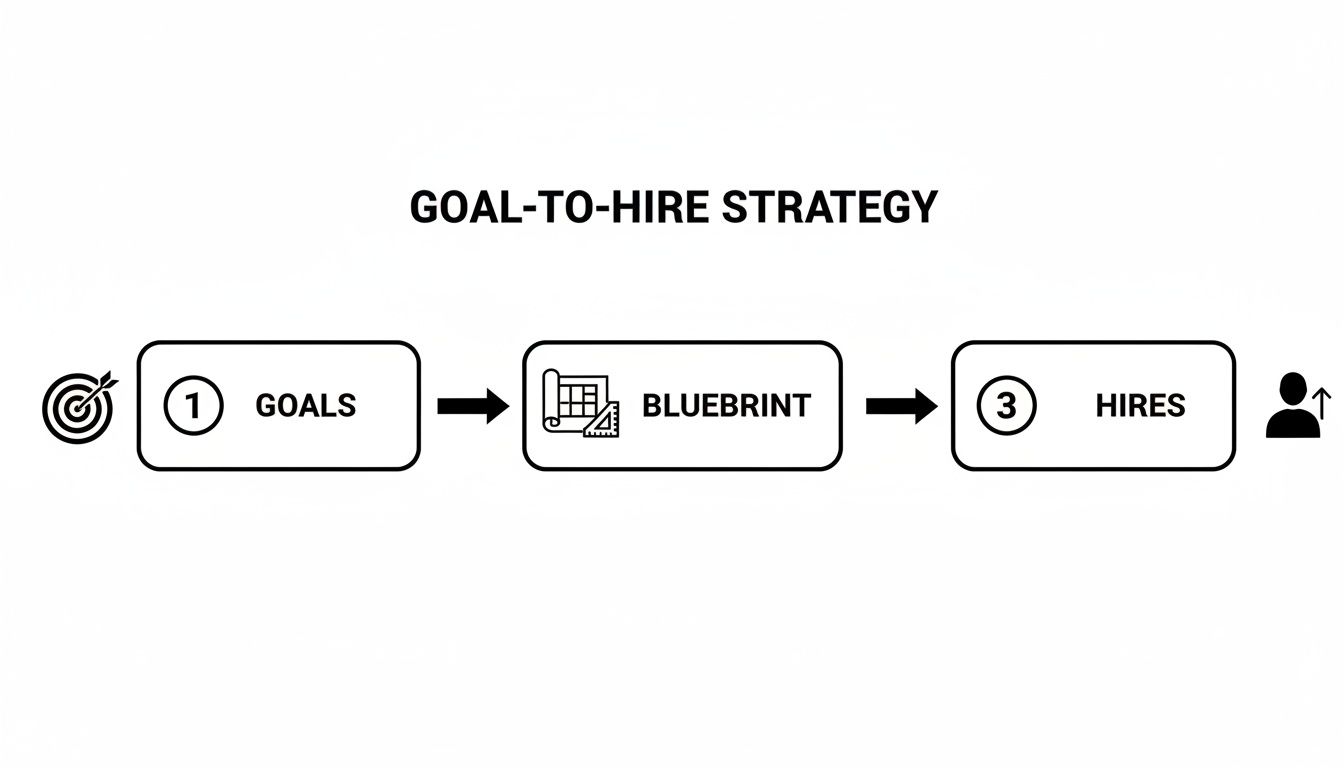
The visualisation makes it clear: successful hiring isn’t a standalone activity. It’s the direct result of a carefully planned blueprint that flows directly from your biggest business goals.
Adopting Strategic KPIs Over Traditional Metrics
Let’s get practical. A classic metric like time-to-fill is useful, but it’s an incomplete story. While a solid 60% of organisations report faster hiring with an RPO, speed without quality is an empty victory. The real value is in tracking metrics that show a new hire’s long-term contribution.
Think about these powerful, outcome-focused KPIs instead:
- New Hire Performance Ratings: What are the performance review scores for RPO-sourced hires at the six-month or one-year mark? This directly measures the quality of the hire.
- Time-to-Productivity: How long does it take for a new employee to become fully productive? A shorter ramp-up time means a faster return on your hiring investment.
- Retention in Critical Roles: What’s the one-year and two-year retention rate for talent placed in mission-critical positions? High retention in key areas is a huge indicator of a successful match.
- Hiring Manager Satisfaction: How satisfied are your internal leaders with the candidate quality and the process? This qualitative metric is a crucial health check for the partnership.
When you start focusing on these KPIs, your RPO partner is incentivised to find people who won’t just fill a seat, but will actively drive business success.
Crafting SLAs That Enforce Business Impact
Beyond KPIs, your Service Level Agreements (SLAs) have to be tied to business outcomes. An SLA shouldn’t just mandate that 90% of roles are filled within 45 days. It should connect the recruitment effort directly to a strategic project’s success.
Imagine your company is launching a new Global Capability Centre (GCC) in Hyderabad. A strategic SLA would link your RPO partner’s success directly to the on-time staffing of that centre. Their performance isn’t measured by individual hires but by their ability to deliver the entire team needed for the GCC to go live on schedule.
This approach completely changes the dynamic. The RPO provider becomes accountable for enabling a critical business milestone, not just for recruitment activities. For a deeper dive, you can learn more about how RPO providers track, report, and improve recruitment KPIs, which provides a great framework for setting these up.
To make this crystal clear, here’s how you can reframe your measurement strategy.
Outcome-Driven RPO Metrics Framework
This table illustrates the shift from tracking transactional activities to measuring genuine business impact. It’s a practical guide for ensuring your recruitment efforts are directly contributing to the bottom line.
| Business Goal | Traditional Metric (To Avoid) | Strategic RPO KPI (To Adopt) | Example Measurement |
|---|---|---|---|
| Increase Market Share by Launching a New Product | Time-to-fill for sales & marketing roles | Revenue generated by new hires in the first 12 months | Track the sales pipeline and closed deals attributed to the new team members. |
| Improve Customer Satisfaction by 15% | Number of customer service agents hired | Improvement in Net Promoter Score (NPS) for accounts managed by new hires | Measure the change in NPS scores for the customer segment handled by the new agents after 6 months. |
| Reduce Operational Costs by 10% in Manufacturing | Cost-per-hire for production line staff | Reduction in production downtime or waste attributed to new skilled hires | Monitor production line efficiency and waste reports pre- and post-hiring for the specific shifts or teams. |
| Accelerate Digital Transformation | Speed of hiring for tech roles | Percentage of project milestones met on schedule for key digital initiatives | Link hiring success to the project management dashboard, ensuring tech teams are fully staffed to meet deadlines. |
By adopting this mindset, you’re not just hiring people; you’re acquiring the specific talent needed to solve your most pressing business challenges. This makes recruitment a true driver of strategic success.
The Governance Playbook for Seamless Collaboration
A brilliant recruitment strategy is one thing, but without a solid governance framework, it can all fall apart. Even with the best KPIs and a detailed hiring plan, if communication breaks down and roles get blurry, the partnership will stall. This is your playbook for building a strong, collaborative relationship with your RPO provider so everyone stays aligned and focused on the big picture.
The key is to see your RPO provider as an extension of your own team, not just a distant vendor. This requires a structured way to handle communication and decision-making, ensuring that the day-to-day work and the long-term strategy are always in sync. The goal is to create a seamless operational rhythm that keeps your entire talent acquisition function moving in lockstep with business priorities.
Establishing a Joint Steering Committee
The cornerstone of good governance is a joint steering committee. This isn’t just another meeting to add to the calendar; it’s the central nervous system of the RPO partnership. This committee should have key players from both sides—your internal HR leadership, crucial hiring managers from different business units, and the senior leadership from your RPO partner.
This group is responsible for the strategic direction. Their job is to oversee the partnership’s goals, review performance against those big-picture business KPIs, and make high-level decisions to clear any roadblocks. When you bring business leaders into this group, you guarantee that recruitment efforts are always tied to the real-world needs of the company.
A common mistake is to keep the RPO relationship siloed within the HR department. When business unit leaders are part of the governance structure, they see firsthand how hiring impacts their goals. This creates much stronger buy-in and a more collaborative spirit across the organisation.
Defining Roles and Communication Cadence
Once you have the strategic oversight sorted, the next step is to map out a clear communication rhythm for daily operations and regular check-ins. Ambiguity is the enemy of efficiency, so having a well-defined schedule is non-negotiable.
Here’s a practical structure that works for many successful partnerships:
- Weekly Tactical Huddles: These are quick, operational catch-ups between your talent acquisition team and the RPO delivery team. The focus is purely on progress with open roles, tackling immediate challenges, and coordinating short-term actions.
- Monthly Performance Reviews: This meeting involves a slightly bigger group, including key hiring managers. Here, you’ll dig into the data—reviewing metrics like time-to-fill, quality of hire, and how you’re tracking against monthly hiring targets.
- Quarterly Strategic Business Reviews (QBRs): This is where the joint steering committee comes together again. The QBR is a high-level review focused on strategic alignment. You’ll discuss performance against the outcome-driven KPIs we talked about earlier, look at market intelligence from your RPO partner, and tweak the hiring plan to reflect any business shifts for the next quarter.
This multi-layered approach ensures information flows smoothly, from the recruiters on the ground all the way up to senior leadership.
A Real-World Governance Scenario
Picture a large manufacturing company in Pune that needs to staff a new production plant. The timeline is tight. Any hiring delays will push back the plant’s launch date, costing the company millions.
They set up a joint steering committee with the Plant Head, the Head of Operations, their CHRO, and the RPO Account Director. This group met quarterly to make sure the hiring plan was perfectly aligned with the plant’s construction and equipment installation schedule.
On a day-to-day level, the RPO team held weekly huddles with the plant’s hiring managers to review candidate pipelines for critical engineering and technician roles. This clear governance model proved invaluable. When a supply chain issue delayed a piece of machinery, the operations team immediately flagged it in the monthly review. The RPO team pivoted instantly, pausing recruitment for one set of roles and speeding up hiring for another, ensuring the workforce was ready exactly when it needed to be.
This is exactly how a strong governance structure helps RPO align hiring with dynamic business goals. It turns a simple service agreement into a truly agile partnership. It’s critical to define this structure from the very beginning, ideally when finalising the Request for Proposal (RFP) with potential partners.
How a European Bank Scaled Its India GCC with RPO
Frameworks are great on paper, but nothing beats seeing a strategy succeed in the real world. Let’s look at how a major European bank turned its talent acquisition challenges into a strategic win while scaling its Global Capability Centre (GCC) in India.
This is a perfect example of moving from recruitment chaos to a streamlined, goal-oriented powerhouse.

The bank was facing a perfect storm. Their business goals were aggressive: rapidly scale the India GCC to bolster global operations. But their in-house talent acquisition team was drowning, creating huge hiring backlogs and forcing a costly over-reliance on a patchwork of staffing agencies.
This put them in direct conflict with their own objectives. The hiring delays were stalling critical projects, ramping up operational risk, and defeating the entire purpose of the GCC. And all this was happening under the watchful eye of the financial services sector’s strict regulatory environment.
The Strategic Intervention
This is where an RPO partnership changed the game. The provider didn’t just jump in to fill jobs; they started by diagnosing the core issues. What they found was a fragmented process, an inconsistent candidate experience, and a total lack of data to drive decisions.
The first order of business was to redesign the entire talent acquisition function from the ground up. It wasn’t just about speed; it was about building a smarter process that met the bank’s non-negotiable standards for compliance and quality.
Key changes included:
- Centralising Recruitment: The RPO partner became the single point of accountability, immediately cutting the cost and chaos of managing dozens of agencies.
- Implementing a Technology Stack: A modern applicant tracking system was introduced to organise workflows, improve communication, and generate the real-time data needed for smart decisions.
- Building a Dedicated Sourcing Engine: A specialised team was formed to proactively build talent pipelines for critical skills, especially in technology. This shifted their approach from reactive to proactive.
The core shift was from transactional recruiting to a managed service focused on outcomes. The goal wasn’t just to make hires, but to build a scalable, compliant, and predictable talent supply chain that directly supported the GCC’s operational stability and growth targets.
The Staggering Results of Alignment
The results speak for themselves. The engagement delivered a staggering 6,000 hires, including 2,700 highly sought-after technology professionals, all within a compressed timeline of just 10 weeks. This meant an average of 225 tech placements every single month.
If you’re interested in the broader trends shaping these kinds of projects, you can explore this global RPO market outlook.
But it’s the efficiency and quality metrics that truly show the strategic impact:
- Time-to-Offer: This was slashed to a lean 44 days. In a competitive market where top candidates have multiple offers, speed is everything.
- Offer-to-Start Ratio: An impressive 82% of candidates who received an offer accepted and joined, a clear indicator of strong candidate quality and a great hiring experience.
- Reduced Agency Dependency: The bank drastically cut its reliance on external agencies, leading to massive cost savings and regaining control over its hiring process.
This wasn’t just a recruitment success story; it was a business triumph. By solving the talent problem, the RPO partnership enabled the bank to hit its GCC scaling targets on time and on budget. It solidified operational stability, ensured regulatory compliance, and created the scalable growth engine the business desperately needed. It’s a powerful reminder that a well-executed RPO strategy is one of the best tools a CHRO has for driving bottom-line business outcomes.
Dodging the Common Pitfalls in Your RPO Partnership
Even the most carefully planned RPO strategy can hit a few bumps in the road. Knowing what to look out for is half the battle, and it’s key to building a resilient partnership that actually delivers on your business goals. A successful engagement often comes down to sidestepping a few critical, yet surprisingly common, mistakes right from the start.
One of the most frequent errors we see is treating the RPO provider like a simple vendor instead of the strategic partner they are meant to be. This mindset creates a transactional relationship. You keep them at arm’s length, just firing over job descriptions instead of pulling them into critical workforce planning conversations. This communication gap is a near-certain recipe for misaligned hiring.
Sidestepping the Vendor Trap
The second you start seeing your RPO provider as just another supplier, you forfeit their most valuable asset: strategic insight. They have a bird’s-eye view of the talent market, what your competitors are doing, and what it really takes to attract the skills you need. To avoid this, you have to embed them deep into your strategic rhythm.
An RPO partnership thrives on shared context and mutual accountability. When your provider understands the ‘why’ behind a hiring push—like a new product launch or regional expansion—they can proactively build talent pipelines that are perfectly aligned with those business milestones.
Think about it this way: instead of just sending over a request for ten new sales executives, invite your RPO lead to the quarterly sales strategy meeting. Let them hear the challenges and growth targets directly from the sales director. This single act transforms their role from an order-taker to a proactive talent advisor who can find candidates that don’t just fill a seat, but drive real revenue.
Securing Hiring Manager Buy-In Early
Another huge pitfall is failing to get your internal hiring managers on board from day one. If they feel this new RPO partnership has been forced on them, they can become a major source of friction, slowing everything down and sabotaging its effectiveness. This resistance usually comes from a fear of losing control or a belief that no external partner could possibly understand their team’s unique needs.
To head this off, involve your key hiring managers in the RPO selection and onboarding process. Their participation isn’t just a courtesy; it’s a non-negotiable part of a successful rollout.
- Involve Them in Selection: Let influential managers sit in on the final presentations from potential RPO partners. Their gut feeling and feedback are invaluable for choosing a provider whose team will click with your internal culture.
- Co-Create Success Profiles: During the setup phase, run workshops where hiring managers and the RPO team work side-by-side. Together, they can define what a “great” candidate really looks like, moving beyond a simple skills checklist to include cultural fit and essential soft skills.
- Establish Clear Communication Channels: Make sure every hiring manager knows exactly who their point of contact is on the RPO team. Set up regular, brief check-ins to build that crucial rapport and trust.
When your managers feel like they are part of the solution, they become champions for the partnership. This collaboration is absolutely fundamental to how RPO aligns hiring to business goals, as it ensures the talent being brought in truly fits the needs of the teams driving those objectives forward.
Burning Questions About Strategic RPO
When leaders in India start exploring Recruitment Process Outsourcing (RPO), plenty of questions come up. It’s not just about outsourcing hiring; it’s about creating a true strategic partnership. Here are some of the most common queries we get when discussing how to link RPO directly to business outcomes.
How Can We Be Sure an RPO Partner Really ‘Gets’ Our Company Culture?
This is a big one, and rightly so. The answer is deep, upfront immersion. Real alignment doesn’t begin with the first job opening; it starts much earlier.
During the selection process itself, bring your potential RPO partner into the fold. Let them sit in on strategy sessions with your executive team and key department heads. Share your strategic roadmap, your financial goals, and what makes your culture tick. The best partners act more like consultants, asking sharp questions to understand what truly drives your organisation. It’s also crucial to define ‘cultural fit’ with concrete, observable behaviours and build these directly into how candidates are assessed. A solid governance model with regular strategic reviews is the final piece, ensuring your RPO partner stays in lockstep with you as your business evolves.
Is RPO Only for High-Volume Hiring, or Can It Handle Niche Roles Too?
While RPO earned its reputation for mastering high-volume recruitment, today’s solutions are far more adaptable. Many top-tier providers now offer specialised models, like ‘Project RPO’ for a specific business initiative or blended approaches that use on-demand recruiters for those hard-to-find niche roles alongside a core team for volume hiring.
The secret is choosing a partner with proven expertise in your industry and the specific talent markets you’re targeting. For specialised roles, an RPO’s real power comes from its dedicated sourcing tech, market intelligence, and its ability to build proactive talent pipelines. This is often a world away from the reactive, ad-hoc searches of traditional recruitment.
What Does a Typical RPO Cost Structure Look Like Compared to Agency Fees?
RPO pricing models are built for flexibility, but they often revolve around a management fee (a fixed monthly cost for running the programme) and a cost-per-hire fee. This combination gives you something traditional agencies can’t: predictable hiring costs.
Traditional recruitment agencies typically charge 15-25% of a candidate’s yearly salary for every placement, which can be unpredictable and expensive. RPO is almost always more cost-effective when you’re hiring at scale, as the cost-per-hire is significantly lower.
Plus, that management fee often covers strategic extras like boosting your employer brand and providing advanced talent analytics. This holistic approach delivers far more value, with potential savings hitting up to 30% through sheer process efficiency. You end up investing in a long-term talent strategy, not just filling an empty seat.
At Taggd, we don’t just fill roles; we build RPO solutions that are woven into the fabric of your business strategy, ensuring every hire helps you achieve your most ambitious goals. Discover how our strategic approach can transform your talent acquisition.