Unjamming your hiring pipeline isn’t about quick fixes. It’s a deliberate, three-part strategy: first, you diagnose the real problems with data; then, you redesign your internal processes for speed and quality; and finally, you strategically bring in partners like a Recruitment Process Outsourcing (RPO) firm to get you there faster. This approach moves you from constantly fighting fires to building a talent function that can actually keep up with the business.
Your Strategic Response to Costly Hiring Delays
Let’s be honest. Hiring delays are much more than a headache for HR. They’re a direct threat to growth, innovation, and your competitive footing. Every single day a key role sits empty, projects grind to a halt, team morale takes a hit, and you’re leaving money on the table. As a CHRO, your job is to elevate this conversation from an operational gripe to a C-suite-level business problem that demands a strategic response.
This guide is designed to give you that actionable framework. We’ll cut through the usual complaints and give you a structured way to not just see the gridlock in your talent pipeline but to decisively break it.
Moving Beyond Symptom Management
Too often, the reaction to a hiring bottleneck is to treat the symptom. We placate a frustrated hiring manager or buy a shiny new sourcing tool, all while ignoring the systemic flaws causing the problem in the first place. A real solution has to go deeper.
If you want to build a hiring engine that truly delivers, you need to:
- Get serious about data. Stop guessing. The truth is sitting right there in your Applicant Tracking System (ATS) and other HR systems. It’s time to use it.
- Be ready to break things. You have to be willing to challenge—and completely dismantle—old workflows that are no longer fit for purpose. If it’s slow, it has to go.
- Know when to ask for help. Recognise when your team’s capacity or capability is the main roadblock. Sometimes, the smartest move is to look outside for the expertise you need to bridge the gap.
This change in thinking is becoming non-negotiable. Between 2020 and 2023, a huge number of large Indian enterprises realised their internal teams just couldn’t scale with the pace of growth, leading to major hiring delays. This has triggered a massive shift toward external expertise. The Indian human resource outsourcing (HRO) market hit USD 8.6 billion in 2024 and is expected to rocket to USD 13.9 billion by 2033. This isn’t a trend; it’s a direct response to process failures. You can see the full story in the IMARC Group’s market analysis.
A slow hiring process is a silent killer of growth. It doesn’t just cost you the best candidates—who are accepting other offers while you’re still scheduling interviews—it sends a clear message to the market that your organisation is indecisive and inefficient.
To help you get started, here’s a quick look at the most common bottlenecks we see and the high-impact solutions that actually work. Think of this as your cheat sheet before we dive into the detailed strategies that will put you in control of this critical business function.
Common Hiring Bottlenecks and High-Impact Solutions
This table is a quick-reference guide to help you map the recruitment chokepoints you’re facing to their most effective strategic solutions. It’s designed to give you immediate ideas and a long-term fix for each problem.
| Common Bottleneck | Immediate Impact | Strategic Solution |
|---|---|---|
| Vague Job Descriptions | Attracts unqualified applicants, wastes screener time. | Develop standardised, outcome-focused job profiles with hiring managers. |
| Slow Screening Process | Top candidates drop out or accept other offers. | Implement AI-powered screening tools; set a 24-hour SLA for initial resume review. |
| Interview Scheduling Delays | Creates a poor candidate experience and prolongs time-to-fill. | Use automated scheduling tools; empower recruiters to book interviews directly. |
| Delayed Hiring Manager Feedback | The pipeline stalls, and good candidates are lost. | Establish clear feedback SLAs (e.g., 48 hours post-interview) and automate reminders. |
| Manual Offer Letter Generation | Introduces errors and delays at the final, critical stage. | Automate offer creation and delivery through your ATS or HRIS. |
By using this table, you can quickly pinpoint your most pressing issues and start formulating a plan that addresses both the immediate pain and the underlying cause. Now, let’s get into the specifics of how to implement these changes.
Diagnosing the Choke Points in Your Talent Funnel
Before you can fix anything, you have to know exactly what’s broken. Vague complaints about a “slow process” are common, but they don’t lead to solutions. To get from frustration to a fix, you need to be methodical and treat your recruitment pipeline like any other critical business process: audit it with data.
Your Applicant Tracking System (ATS) is more than just a candidate database; it’s ground zero for your investigation. The goal here is to map the entire candidate journey, from the moment a role is approved to the day an offer is signed. By tracking how many candidates move between stages and, crucially, how long each step takes, you can pinpoint precisely where things are grinding to a halt.
This whole approach can be broken down into three core phases: diagnose, redesign, and then leverage what you’ve built.
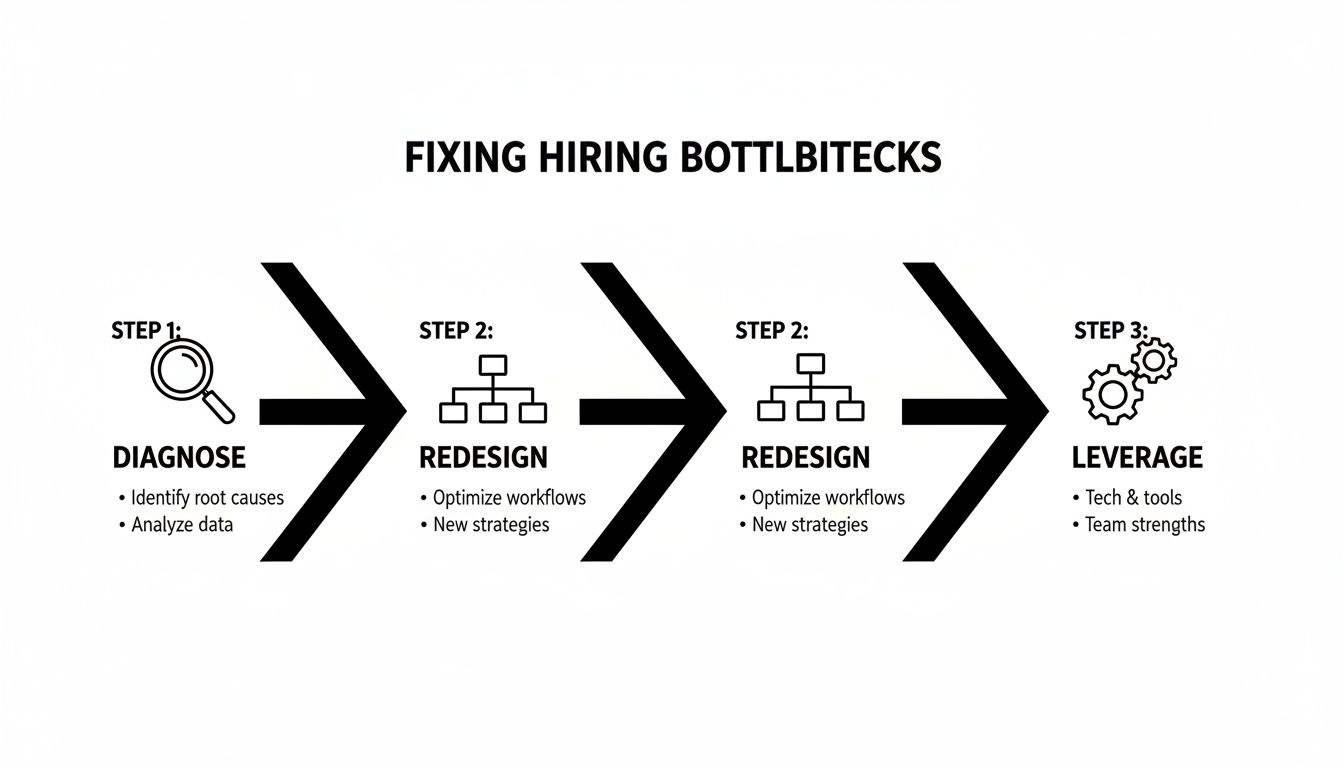
It all starts with a thorough diagnosis. Only then can you move on to a targeted process redesign and the smart use of tech or partnerships.
Starting with a Full Process Map
First things first, get a complete picture of your current state. Don’t just assume you know every step—document it meticulously.
You need a detailed outline of your entire recruitment process, mapping every single touchpoint and decision gate.
- Sourcing: Where are your candidates actually coming from? Job boards, employee referrals, agencies? List them all out.
- Application & Screening: What’s the very first thing that happens when a candidate applies? Who does that initial review?
- Interviewing: How many rounds do you really have? Be honest. And who is involved in each one?
- Selection & Offer: What’s the official (and unofficial) process for making a final call and getting an offer out the door? How many signatures are required?
For every single stage, write down the tools used, the team members involved, and the average time it takes to move on. This map is the foundation for everything that comes next.
Uncovering the Truth with Key Metrics
With your process map in hand, you can start applying data to find the weak links. Forget vague feelings; you need specific, stage-by-stage metrics that reveal the health and speed of your talent funnel. For a much deeper dive, you can learn more about how to measure recruitment funnel effectiveness in our detailed guide.
Vague feelings about a slow hiring process are a starting point, not a diagnosis. The real story is always in the data. A high drop-off rate after the first interview, for instance, isn’t just a number—it’s a clear signal that either your job descriptions are misleading or your candidate experience is failing at a critical moment.
The table below breaks down the essential metrics you’ll need for this diagnostic phase. Use it as a blueprint to build a dashboard in your ATS that turns raw numbers into actionable intelligence.
Key Metrics for Diagnosing Recruitment Bottlenecks
| Metric | What It Measures | Warning Sign | Potential Root Cause |
|---|---|---|---|
| Time-per-Stage | The average number of days candidates spend in each phase (e.g., Screening, Interview 1, Final Interview). | Any stage taking significantly longer than others (e.g., >7 days for hiring manager review). | Disengaged hiring managers, scheduling conflicts, inefficient review processes. |
| Pass-Through Rate | The percentage of candidates who advance from one stage to the next. | A sharp drop-off at a specific stage (e.g., only 10% move past the technical assessment). | Misaligned expectations, poor job description, overly difficult assessment. |
| Candidate Drop-Off Rate | The percentage of candidates who voluntarily withdraw from the process at each stage. | High withdrawal rates after the initial interview or during scheduling. | Poor communication, negative candidate experience, slow feedback loops. |
| Offer Acceptance Rate | The percentage of candidates who accept a formal job offer. | An acceptance rate below industry benchmarks (typically 80-90%). | Uncompetitive compensation, slow offer process, poor employer branding. |
This table isn’t just a list; it’s your diagnostic toolkit. Consistently tracking these KPIs will shift your team from reactive problem-solving to proactive talent strategy.
From Data to Diagnosis
Once you start pulling this data, the patterns will jump out at you. You might discover your sourcing is lightning fast, but candidates then languish for weeks waiting for a hiring manager to review their CV. Or maybe your interview process is a well-oiled machine, but your offer approval workflow has too many sign-offs, causing delays that let your top candidates walk away.
This data-driven approach removes all the emotion and guesswork from the equation. It lets you walk into a meeting with stakeholders and present a clear, evidence-based case for change.
Suddenly, you can confidently say, “We are losing 30% of our qualified candidates because the average time from final interview to offer is 12 days.” That’s a powerful statement that demands action. And that’s how you truly start to fix hiring bottlenecks—by first proving exactly where they are.
Redesigning Your Recruitment Workflow for Speed and Quality
Once your data has pointed you to the exact logjams in your hiring process, the next step is to engineer them out of existence. This is more than just minor tweaks; it’s about fundamentally redesigning your recruitment workflow. The aim is to build a process that’s deliberately structured for both speed and quality, ensuring you don’t have to sacrifice one for the other.

Moving from analysis to action means making real, structural changes. This is where you have to challenge those long-held assumptions about “how we’ve always done things” and replace them with a more agile, responsive hiring engine. It’s about empowering your team and making everyone accountable for their part in the talent acquisition journey.
Introduce Service Level Agreements for Accountability
One of the most common bottlenecks I see is the ‘black hole’ of delayed feedback from hiring managers. To sort this out, you have to treat internal stakeholders with the same urgency you’d expect from an external partner. The most effective way to do this is by establishing clear Service Level Agreements (SLAs).
An SLA is a formal commitment that sets a clear turnaround time for key actions in the hiring process. It turns vague hopes into concrete, measurable targets.
- CV Review: A 48-hour SLA for hiring managers to look at shortlisted CVs and give a straight “yes” or “no”.
- Interview Feedback: A 24-hour SLA for all interviewers to submit their completed scorecards after they’ve met a candidate.
- Final Decision: A 72-hour SLA from the final interview to a definitive hiring decision.
Putting SLAs in place isn’t about pointing fingers. It’s about creating a shared understanding of pace. When everyone knows the timeline, it becomes a collective responsibility to keep things moving and secure top talent before your competitors do.
Standardise the Interview Process with Structured Kits
Inconsistent interviews are a massive source of both delays and poor hiring decisions. When every interviewer asks different questions and judges candidates on subjective feelings, comparing people becomes almost impossible, leading to endless debates.
The fix is to create structured interview kits for each role. These aren’t rigid scripts but frameworks to ensure every candidate is assessed consistently and fairly.
A solid interview kit should have:
- Core Competency Questions: Pre-defined questions designed to test the key skills and behaviours needed for the role.
- Behavioural Scenarios: Specific “tell me about a time when…” questions that dig into past performance.
- A Standardised Scorecard: A simple rating scale (e.g., 1-5) for each competency, with clear descriptions of what each rating means.
This approach dramatically cuts down on bias and forces a more objective evaluation. It also speeds up decision-making because you’re comparing candidates based on the same set of data points, not just a gut feeling.
The real power of a redesign is in compressing your timeline without compromising on quality. A sequential, multi-week interview process signals indecisiveness to top candidates. A consolidated, high-energy interview day, on the other hand, shows you are serious, organised, and respectful of their time.
Case Study: Compressing the Timeline with ‘Super Days’
Think about a common scenario at a fast-growing tech company. Their process for senior engineering roles involved five separate interviews, scheduled one after the other over three weeks. Their data showed a huge 40% candidate drop-off rate after the third interview—top talent was simply taking other offers while they waited.
Their redesign was radical but incredibly effective. They replaced the long, drawn-out sequence with a single, consolidated ‘Super Day’.
- The Old Way: Five one-hour interviews spread across 15-20 business days.
- The New Way: A single four-hour block where the candidate met all five stakeholders back-to-back, including a team lunch.
The results were immediate. The time-to-hire for these critical roles was slashed by over 40%. What’s more, their offer acceptance rate shot up because candidates were impressed by the organised, decisive, and respectful process. This model works especially well for high-priority or hard-to-fill roles where speed is a real competitive advantage.
Empower Recruiters and Align Incentives
Your recruiters are often the most underused asset when it comes to fixing hiring bottlenecks. If they’re treated just as schedulers, you create an instant chokepoint. The key is to empower them with more autonomy and align their incentives with the right outcomes.
Give your recruiters the authority to make initial screening decisions without needing multiple layers of approval. If a candidate’s profile matches 80% of the core requirements, the recruiter should be empowered to move them to the next stage immediately.
Also, take a hard look at how you measure their success. If recruiters are only incentivised on the volume of hires, they might prioritise quantity over quality, leading to performance issues down the line. A balanced incentive structure should reward a mix of metrics.
Incentive Alignment Examples
| Metric Focus | Old Incentive | Redesigned Incentive |
|---|---|---|
| Speed | Bonus per hire, regardless of time | Tiered bonus for hitting time-to-fill targets |
| Quality | Not measured | Bonus tied to the 90-day retention rate of new hires |
| Efficiency | Number of interviews scheduled | Bonus for achieving a high interview-to-offer ratio |
By making these structural changes—instituting SLAs, standardising interviews, compressing schedules, and empowering your team—you actively redesign your workflow. You’ll move from a reactive process plagued by delays to a proactive, streamlined engine built to attract and secure the best talent in the market.
Leveraging Technology and Automation to Break Logjams
Let’s be honest: manual, repetitive tasks are the very soul of hiring bottlenecks. When your best recruiters are bogged down chasing interview schedules or manually sifting through hundreds of CVs, they aren’t doing what they do best—engaging top talent. The answer isn’t to work harder; it’s to work smarter by bringing in technology to automate the most time-consuming parts of the hiring cycle.
This isn’t about replacing your team with robots. It’s about augmenting their expertise and freeing them up to focus on the human-centric activities that actually convince great candidates to sign on the dotted line. By automating the right things, you create a hiring engine that’s more efficient, responsive, and far less prone to human error.
Modernising Your Applicant Tracking System
Your Applicant Tracking System (ATS) should be the command centre of your recruitment operation, not just a digital filing cabinet. A modern ATS can automate critical communication points, ensuring no candidate ever feels like they’ve vanished into a black hole.
Think about the simple power of an automated status update. When a candidate’s application moves from “Received” to “Under Review,” an automatic email can go out, keeping them in the loop without a single click from your team. This small gesture builds incredible goodwill and stops the endless “any updates?” emails from flooding recruiter inboxes.
A well-configured ATS can also take on the headache of interview scheduling. By integrating with hiring managers’ calendars, it can show candidates available slots, find a time that works for everyone, and send out confirmations. This alone can eliminate the frustrating email tennis that often delays the process by days.
Adopting AI for Sourcing and Screening
The biggest time-drain in recruiting often happens right at the top of the funnel: sourcing and screening. This is where AI-powered tools can turn a manual slog into a smart, automated workflow.
- AI Sourcing Tools: These platforms don’t just wait for applications. They proactively build pipelines of passive candidates by scanning professional networks, databases, and social media for profiles matching your ideal criteria. This means when a role opens up, you’re not starting from zero; you have a pre-vetted talent pool ready to go.
- Intelligent Screening: Forget manually reading every single CV. AI can parse applications for the key skills, experience, and qualifications you need. It can then rank candidates based on how well they match the job description, allowing your team to focus their energy on the most promising people first.
Using technology here doesn’t just make you faster. It widens your talent pool and helps reduce the risk of unconscious bias creeping into the initial screening phase.
Technology’s role in fixing hiring bottlenecks is not to remove human judgment but to eliminate the administrative drag that prevents your team from exercising it effectively. Every hour saved on scheduling is an hour that can be spent building a relationship with a high-potential candidate.
Overcoming Delays with New Interview Formats
Scheduling conflicts are a classic bottleneck, especially when you’re trying to align the calendars of multiple senior leaders. Asynchronous video interviews are a fantastic way to cut through this chaos. You simply send candidates a set of questions, and they record their answers on their own time.
This approach has some clear advantages:
- It Eliminates Scheduling: The need to coordinate calendars for initial screening calls completely disappears.
- It Improves Consistency: Every single candidate gets the exact same questions, leading to a fairer and more standardised assessment.
- It Facilitates Collaboration: Hiring managers can review the recordings whenever it suits them, adding their comments and ratings right in the platform.
This one small change can easily shave a week or more off your time-to-hire. For a closer look at the tools that make this possible, check out our guide on recruitment automation software.
This strategic embrace of technology is reflected in wider market trends. India’s dedicated Recruitment Process Outsourcing (RPO) market is growing fast as CHROs look to external experts to break these very bottlenecks. These partners often bring the tech and process discipline that in-house teams are struggling to build. The India RPO market is projected to grow from USD 8.9 billion in 2025 to a staggering USD 18.6 billion by 2031, a clear signal that automation and process redesign are top priorities for today’s business leaders. You can learn more about these market dynamics from Mobility Foresights.
When to Use RPO Partnerships as an Accelerator
Sometimes, the smartest way to fix your hiring bottlenecks isn’t by making more internal tweaks, but by bringing in a strategic partner. For a growing number of organisations, a Recruitment Process Outsourcing (RPO) engagement is the quickest route to inject expertise, technology, and sheer hiring power directly where you need it most.
This isn’t just about outsourcing requisitions to a vendor. A modern RPO partnership is about embedding a specialised team that operates as a genuine extension of your own. They don’t just fill jobs; they bring a pre-built, battle-tested engine of proven processes and a dedicated tech stack that can be deployed almost instantly to tackle your most stubborn challenges.
Think of it like calling in a specialist surgeon. Your in-house team is great at managing day-to-day health, but an RPO provider has the specific tools and deep experience for a high-stakes procedure—like scaling a tech team by 200 people in six months—with surgical precision and speed.
Identifying the Right Triggers for RPO
The decision to explore an RPO partnership usually comes after hitting certain trigger points—moments where your internal capabilities are constantly stretched thin. It’s a strategic move you make when the cost of slow hiring becomes too painful to ignore.
Key signals that it might be time to bring in an RPO partner include:
- Persistent High Volume: Your team is drowning in open roles, leading to burnout and a noticeable drop in the quality of hires.
- Niche Skill Scarcity: You’re in a constant battle to find and attract candidates with specialised skills, like AI developers or cybersecurity experts.
- Lack of Scalability: Your hiring needs swing wildly, and your internal team can’t expand or contract fast enough to keep up with business demands.
- Technological Gaps: You’re working with an outdated ATS or lack the modern sourcing and analytics tools needed to compete for top-tier talent.
When these issues shift from being occasional headaches to chronic problems, an RPO partnership can be a powerful accelerator.
Choosing the Right RPO Model for Your Needs
RPO isn’t a one-size-fits-all fix. The great thing about the mature RPO market today is the variety of models available. You can pick the precise level of support you need to solve your specific hiring bottlenecks.
Comparing RPO Engagement Models
| RPO Model | Best For | Key Outcome |
|---|---|---|
| End-to-End RPO | Organisations that need a complete transformation of their talent acquisition function. | A fully managed recruitment service handling everything from sourcing to onboarding. |
| Project-Based RPO | Companies launching a new division, expanding into a new market, or needing to fill a large number of similar roles fast. | Rapidly achieving a specific, time-bound hiring goal without a long-term commitment. |
| Selective RPO | Businesses with a strong internal team that struggles with a specific part of the process, like sourcing or screening. | Augmenting your team’s capabilities by outsourcing the most difficult or time-consuming stages. |
For instance, a fast-growing fintech company might use Project-Based RPO to hire 50 software engineers for a new product launch. In contrast, a large manufacturing firm might opt for Selective RPO to handle the initial high-volume screening for its factory roles, freeing its internal team to focus on final interviews and offers. You can explore the full spectrum of benefits that recruitment process outsourcing offers to see how it aligns with your goals.
An RPO partner shouldn’t just be a pair of hands; they should be a strategic brain. They bring market intelligence, benchmarking data, and process excellence that can fundamentally elevate your entire talent acquisition ecosystem.
This strategic shift is gaining serious momentum, especially in high-growth sectors where talent is the main roadblock to expansion. Global data shows why Indian CHROs are turning to RPO to solve chronic hiring delays in demanding fields like IT and BFSI. The global recruitment outsourcing market, valued at USD 10.3 billion in 2024, is projected to surge to USD 25.8 billion by 2034. A huge chunk of this demand—around 52%—comes from the IT, telecommunications, and BFSI sectors, where India is a critical talent hub. By partnering with an RPO, CHROs can benchmark their internal metrics against global standards, getting a clear, data-backed view of where their bottlenecks truly lie. You can find more insights on this growing market at GM Insights.
Ultimately, engaging an RPO provider is a proactive decision to get ahead of your talent needs. It’s an acknowledgement that you can’t do everything alone and a firm step toward building a hiring function that is as agile and scalable as the business it supports.
Answering Your Toughest Questions on Hiring Bottlenecks
As a talent leader, you’re on the front lines, constantly tackling complex hiring puzzles. When it comes to bottlenecks, the same questions pop up time and again. Here are some straight answers to the queries we hear most from HR executives, designed to give you clear, actionable ways forward.
We Think We Have a Bottleneck. Where on Earth Do We Start?
Before you change a single thing, start with your data—not your gut feeling. The first and most crucial metric to dig into is time-per-stage. Jump into your Applicant Tracking System (ATS) and figure out the average number of days it takes for candidates to move from one step to the next.
Specifically, you need to track the time from:
- Requisition approval to the moment sourcing actually begins.
- The initial screen to the first formal interview.
- The final interview to the moment a written offer goes out.
This simple analysis will shine a bright light on your slowest phase. It’s easy to blame sourcing, but you might discover the real issue is a two-week lag between the final interview and the offer. That points to a sluggish internal approval chain, not a lack of available talent. This data-first approach is the only way to be sure you’re solving the right problem.
How Can We Get Our Hiring Managers to Move Faster?
This is a classic challenge. The trick is to stop framing it as an HR process and start framing it as a shared business goal: winning the best talent. To get them on board, you need to make it easy for them to act and show them exactly what’s at stake when they don’t.
Start by setting clear expectations with Service Level Agreements (SLAs), like a 48-hour turnaround for reviewing CVs. Then, make their lives easier. Give them structured interview scorecards and punchy candidate summaries so they can make quick, objective decisions.
The single most effective way to change a hiring manager’s behaviour is with hard data. Show them a simple chart that proves a one-week delay in feedback directly led to your top three candidates accepting offers from competitors. When they see the real-world impact on their own team, they become allies, not obstacles.
Suddenly, it’s not about HR chasing them for updates. It’s about working together to build a winning team.
When Should We Seriously Consider an RPO Partnership?
You should start thinking about Recruitment Process Outsourcing (RPO) when your hiring problems are systemic and chronic, not just a one-off headache. An RPO is a strategic move for when your internal team is constantly stretched thin or simply doesn’t have the capability to meet the business’s demands.
A few key triggers should set off alarm bells:
- Your internal recruiters are always at full capacity just trying to keep up with high hiring volumes.
- You consistently find it difficult to fill specialised or niche roles in a reasonable timeframe.
- Your time-to-fill numbers are regularly missing targets and holding up important projects.
- You’re falling behind because you don’t have the modern recruitment tech needed to compete for talent.
Bringing in an RPO partner isn’t just about managing a temporary surge in hiring. It’s a strategic decision to embed specialised expertise, better technology, and proven processes into your talent function to get predictable, scalable, and top-quality results.
At Taggd, our specialty is dismantling these exact bottlenecks. Our RPO solutions are built to integrate seamlessly with your team, bringing the expertise and technology you need to speed up your hiring and secure the people who will drive your growth. Discover how we can transform your talent acquisition at https://taggd.in.