Hiring the right HR generalist isn’t just an operational task; it’s a strategic move that can define your organisation’s success. Think of them as the critical link between your people strategy and your actual business outcomes. For any Chief Human Resources Officer (CHRO) in India today, this role has become the absolute linchpin for tackling everything from talent retention to building a resilient company culture.
Why Strategic HR Generalist Hiring Is Non-Negotiable
In the past, the HR generalist role was often viewed through a purely administrative lens—someone who handled payroll, ensured compliance, and provided basic employee support. Let’s be clear: that perception is dangerously outdated.
Today, a skilled generalist is a strategic partner. They are the ones on the ground, directly influencing your company’s agility, employee morale, and, yes, the bottom line. They translate high-level business goals into tangible, everyday people practices.
Whether it’s navigating a tricky employee relations issue, championing a new wellness initiative, or making sure the onboarding for a hybrid team is seamless, their impact is felt in every corner of the business. This makes the HR generalist hiring process one of the most high-stakes activities a CHRO will oversee. Get it right, and you’re building a more cohesive, productive, and engaged workforce.
The Indian Market Context
The pressure to hire effectively is amplified by the unique dynamics of the Indian business landscape. The HR sector here is set for over 15% annual growth, a surge driven by tech shifts, the rise of the gig economy, and the new realities of hybrid work.
But this growth comes with a serious challenge. Recent data reveals that workforce engagement in India has dropped to a mere 19%—the steepest decline seen anywhere in the world. This puts immense pressure on companies to find HR generalists who can genuinely build a sense of belonging and keep talent from walking out the door. You can explore more on this engagement crisis and what it means from ADP’s research.
This is where the dots connect between market trends, employee engagement, and the urgent need for strategic hiring.
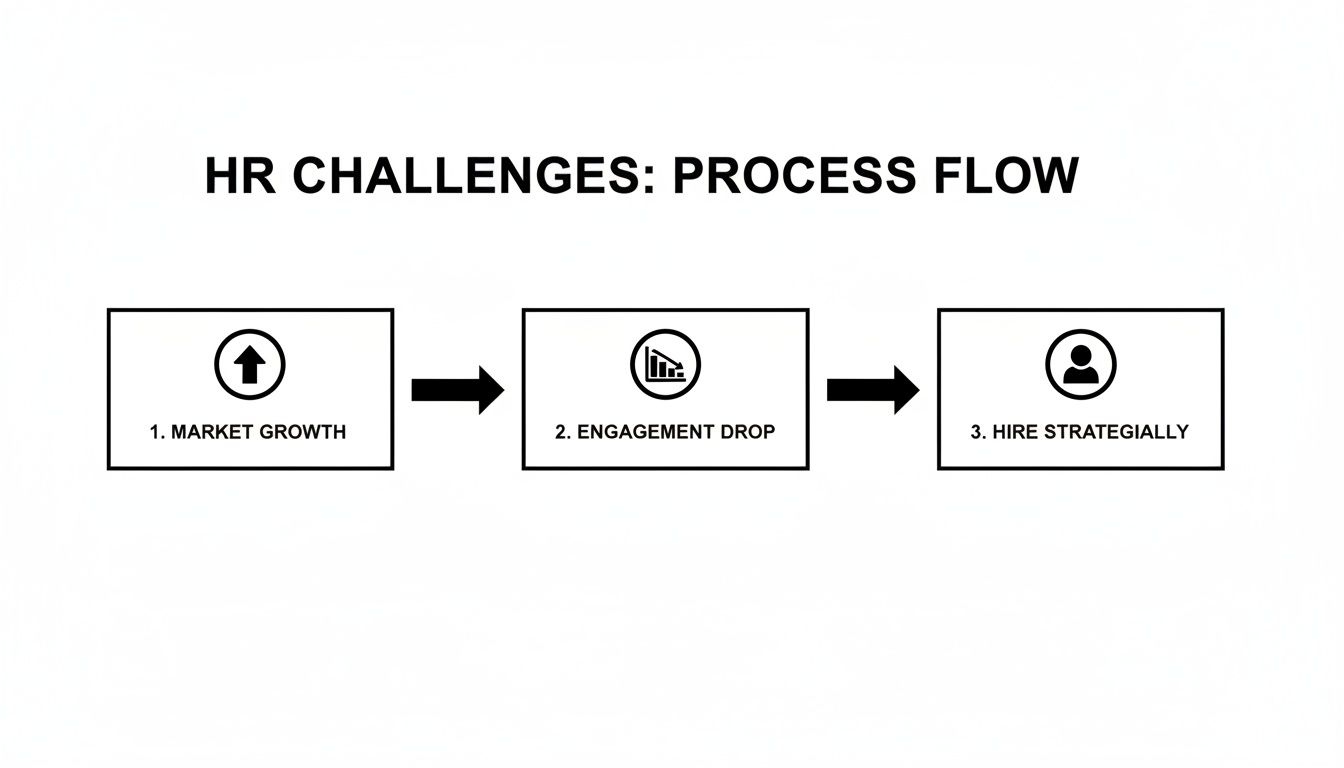
As the visual shows, market growth coupled with a sharp drop in engagement creates an immediate need for a strategic hiring response to stabilise and strengthen your workforce.
For a CHRO, every hire is an investment. But hiring an HR generalist is an investment in the very fabric of your organisation—its culture, its compliance, and its capacity to grow.
This guide is designed to move beyond generic advice. We’re offering a concrete, playbook-driven approach that reframes the hiring process from a simple task to a critical strategic function, ensuring you secure the talent you need not just to survive, but to thrive.
Defining The Modern HR Generalist Profile

Before your talent acquisition team even thinks about sourcing, everyone needs to be on the same page about who you’re looking for. A vague job description is a recipe for disaster—it attracts generic candidates and almost guarantees a mismatched hire down the line.
The very first step in any successful HR generalist hiring process isn’t writing the JD; it’s stepping back to define what an exceptional performer looks like in your organisation, right now.
This means asking some tough questions that tie the role directly to business outcomes. Is this person’s main job to scale up recruitment for a new business vertical? Or is their biggest challenge going to be navigating complex employee relations issues in a manufacturing unit? The answers completely change the shape of your ideal candidate.
From Job Duties To Business Impact
One of the most common traps I see is the “laundry list” job description. It covers every possible HR task under the sun but fails to signal what actually matters. This approach is lazy and ineffective. Instead, think in terms of a role scorecard that prioritises outcomes over mere activities.
For instance, instead of just listing “Manage employee onboarding,” frame it as a business goal: “Reduce new hire time-to-productivity by 15% within the first six months by redesigning the onboarding programme.” This small change reframes the entire responsibility. It attracts strategic thinkers, not just task-doers.
Getting this clarity at the start is absolutely foundational. Without it, every other stage of your hiring process will be less effective.
The goal is not just to hire an HR generalist. It’s to hire your HR generalist—someone whose skills are a perfect match for your immediate challenges and your long-term vision.
This alignment starts by clearly separating the foundational, must-have skills from the evolving competencies that make a candidate truly future-ready. A great starting point for this exercise is understanding the full spectrum of modern HR generalist roles and responsibilities.
Crafting A Competency Matrix
A competency matrix is a simple but powerful tool. It gets everyone—from the CHRO to the line managers involved in hiring—evaluating candidates against the exact same yardstick. It forces a balanced view, mapping out both the technical HR expertise and the crucial soft skills. This is how you avoid getting wowed by a candidate’s technical knowledge while missing a critical lack of business acumen or empathy.
Here’s a practical way to think about the core, non-negotiable responsibilities versus the skills that will set a candidate apart as a true game-changer in today’s world.
Core Vs Evolving Competencies For The HR Generalist
This table helps distinguish between the foundational duties every HR Generalist must handle and the new-age skills that define a truly strategic partner for the business.
| Competency Area | Core Responsibilities (The Must-Haves) | Evolving Skills (The Game-Changers) |
|---|---|---|
| Talent Management | Executes full-cycle recruitment, onboarding, and exit formalities efficiently. | Develops data-driven retention strategies and builds internal talent pipelines. |
| Employee Relations | Manages grievances, conducts disciplinary actions, and ensures fair treatment. | Proactively coaches managers on building psychological safety and high-performing teams. |
| Compliance & Admin | Ensures adherence to Indian labour laws, maintains accurate records, and manages payroll inputs. | Interprets HR data to provide insights on workforce trends and potential compliance risks. |
| Business Acumen | Understands basic departmental functions and organisational structure. | Aligns HR initiatives with specific business unit goals and understands financial drivers. |
| Technology Use | Proficient with standard HRIS and ATS platforms for routine tasks. | Leverages HR analytics tools to inform decision-making and automates HR processes. |
Think of this matrix as more than just a hiring tool. It becomes a blueprint for performance management and career development long after you’ve made the hire.
By defining these competencies upfront, you’re creating a clear, objective framework for the entire hiring journey. This kind of meticulous preparation ensures you aren’t just filling a vacancy, but making a strategic investment in your company’s human capital.
How To Attract Top-Tier HR Talent

In a market this tight, simply posting a job advert and hoping for the best is a recipe for failure. The days of passive recruitment are long gone, especially for a role as foundational as the HR generalist. Attracting high-calibre HR talent demands a proactive, multi-pronged sourcing plan.
The competition is fierce. Hiring for HR & Admin roles in India recently shot up by a staggering 33% year-on-year. And the most sought-after candidates? Those with 7-10 years of experience—the exact profile of a seasoned generalist. For CHROs, this isn’t just a number; it’s a clear signal that to win, you have to actively hunt for talent across multiple channels. You can get more details on these trends from foundit’s insightful report.
This reality calls for a strategic shift from a reactive to a proactive mindset, blending internal and external strategies to build a talent pipeline that’s always full.
Look Inward First: The Power of Internal Mobility
Before you even think about casting your net wide, take a look around. Your next great HR generalist might already be within your own organisation.
Promoting from within is a powerful retention tool. It also sends an incredibly strong message to your entire team about career progression. Think about that sharp HR coordinator who shows exceptional problem-solving skills, or a junior specialist with a real knack for employee relations. These individuals already live and breathe your company culture, understand the processes, and know the people.
Investing in their development for a generalist role is one of the smartest bets you can make. It not only fills the position faster but also boosts morale right across the HR department.
A strong internal mobility programme is your first line of defence in the war for talent. It turns your organisation into a place where careers are built, not just jobs are done.
Crafting A Job Description That Attracts Achievers
The job description (JD) is often the first real conversation a candidate has with your company. It needs to do more than just list responsibilities; it has to sell the opportunity and the impact the person in that role can make.
Ditch the generic “laundry list” of duties. Instead, focus on outcomes and growth.
- Instead of: “Manage employee onboarding.”
- Try this: “Lead the redesign of our onboarding experience to reduce new hire time-to-productivity by 20%.”
- Instead of: “Handle employee grievances.”
- Try this: “Serve as a trusted advisor to line managers, coaching them to proactively resolve team conflicts and foster a positive work environment.”
See the difference? This small shift in language attracts candidates who think strategically about their contribution. It appeals to ambitious professionals who want to make a tangible difference, not just tick boxes.
Expand Your Reach With External Sourcing Channels
While your internal talent should always be a priority, external sourcing is crucial for bringing in fresh perspectives. But if you’re only relying on traditional job boards, you’re limiting your pool to active job seekers, and that’s a mistake.
To find the absolute best, you need a multi-channel strategy that specifically targets passive candidates—those top performers who are doing well in their current roles but are open to a better opportunity if it comes along.
Essential External Sourcing Channels:
- Professional Networks: Platforms like LinkedIn are indispensable. Push your TA team to go beyond just posting jobs. They should be actively engaging in HR groups, sharing insightful content, and building relationships with potential candidates before an opening even exists.
- Employee Referrals: Your current employees are your best advocates. A formalised referral programme with clear, attractive incentives can easily become one of your most effective sourcing engines. Referred candidates are almost always a better culture fit and have higher retention rates.
- Employer Branding: What do potential candidates see when they search for your company? A strong employer brand is a magnet for passive talent. Your career page, social media presence, and employee testimonials all need to tell a compelling story about why your company is a genuinely great place to work. You can explore how to build an effective employer branding strategy in our detailed guide.
The Strategic Advantage of Recruitment Process Outsourcing
Let’s be realistic. For many CHROs, managing an exhaustive, multi-channel sourcing strategy in-house can be a massive drain on time and resources. This is where partnering with a specialist Recruitment Process Outsourcing (RPO) provider becomes a game-changer for HR generalist hiring.
An RPO partner acts as a true extension of your team. They bring deep market knowledge, established talent networks, and sophisticated sourcing technologies to the table. They can tap into a wider, pre-vetted pool of passive candidates that your internal team might struggle to reach. This not only slashes your time-to-hire but also significantly improves the quality of candidates you see, letting your team focus on high-value strategic evaluation rather than administrative legwork.
Designing A Fair And Effective Interview Process

Getting great candidates in the door is only half the battle. If your evaluation process is all over the place or relies too heavily on a hiring manager’s “gut feeling,” you’re going to lose top talent and make biased calls. A well-designed interview process is your quality filter, making sure you can accurately spot the candidates who truly have the skills your organisation needs.
The Indian hiring market is buzzing. White-collar recruitment saw a 13% year-on-year jump, which has kicked the demand for HR Generalists into high gear. Sectors like insurance (34% growth) and hospitality (29% growth) are booming. With entry-level HR roles up 18% and senior positions rising by 27%, companies desperately need versatile HR pros to manage the entire talent lifecycle. This just goes to show how critical a rigorous, fair screening process is to find the right people. You can find more insights into India’s hiring landscape on economictimes.com.
Moving Beyond The Resume Scan
A CV tells you what a candidate has done, but it hardly ever tells you how they did it. To get a real sense of their problem-solving skills, you have to move beyond a simple resume scan and bring in practical, real-world assessments.
Forget generic brain teasers. Your assessments need to mirror the actual challenges the HR generalist will face in their day-to-day role at your company. This gives you a much clearer signal of their potential than any resume ever could.
Practical Assessment Examples:
- Case Study: Give them a one-page, anonymised scenario about an employee whose performance is slipping. Ask them to outline a basic Performance Improvement Plan (PIP).
- Prioritisation Task: Hand them a list of ten typical HR tasks—an urgent grievance, a payroll data request, scheduling final interviews—and ask them to rank them by priority, explaining why.
- Communication Draft: Ask them to write a quick, company-wide email announcing a minor change in an HR policy. This is a great test of their clarity, tone, and communication style.
These tasks are designed to be short (think 30-45 minutes) but offer huge insights into a candidate’s practical skills and how they think.
The Power Of Structured Interviews
If you make only one change to your hiring process, make it this: implement structured interviews. It’s a game-changer for HR generalist hiring. This simply means every candidate for the role gets asked the same set of predetermined questions, in the same order.
This approach forces a consistent evaluation and dramatically reduces the impact of unconscious bias. When interviewers can’t go off on random tangents, they have to assess each person against the same criteria, which leads to much fairer and more objective decisions.
A structured interview process isn’t about being rigid; it’s about being fair. It ensures you’re comparing apples to apples, evaluating every candidate on their merit and alignment with the role’s core competencies, not on how well they built rapport with the interviewer.
For this to work, you need a clear scorecard. For every question, define what a poor, average, and great answer looks like. This gives your interview panel a shared language for evaluation and makes those post-interview debriefs way more productive. You can explore more interview techniques to end hiring headaches in our detailed guide.
Asking The Right Behavioural Questions
Behavioural questions are the backbone of a great structured interview. They operate on a simple principle: past behaviour is the best predictor of future performance. Instead of asking “what would you do if,” you ask for specific examples from their actual experience.
Make sure you map your questions directly to the core competencies you defined right at the start of this process.
Sample Questions Mapped to Competencies:
| Competency | Behavioural Question Example | What to Look For in a Great Answer |
|---|---|---|
| Employee Relations | “Tell me about a time you had to mediate a conflict between an employee and their direct manager. What was your approach?” | A structured response (like the STAR method), proof of active listening, impartiality, and a clear focus on getting to a resolution. |
| Business Acumen | “Describe a situation where you had to align an HR initiative with a specific departmental goal. How did you ensure it supported the business?” | A clear grasp of business objectives, using data to make their case, and showing they can collaborate with people outside of HR. |
| Adaptability | “Walk me through a time when a major organisational change impacted your team. How did you adapt and help others through the transition?” | Acknowledging the difficulties, proactive communication, resilience, and a focus on supporting the team’s emotional and practical needs. |
This systematic approach transforms your interview from a friendly chat into a reliable assessment tool. It ensures that when you finally make that hiring decision, it’s based on solid evidence, not just a feeling.
You’re at the finish line. The interviews are done, the scorecards are in, and you’ve found your person. But this final leg of the race is often the trickiest. It’s where all your hard work pays off with a brilliant hire or unravels right at the end. Getting your chosen HR generalist over the line comes down to two things: a compelling offer and a stellar onboarding experience that makes them glad they said yes.
It all starts with a phone call. The hiring manager—not just an HR admin—should be the one to extend the verbal offer. This isn’t just a formality; it’s your chance to share your genuine excitement and remind them exactly why they stood out. This personal touch transforms a purely transactional moment into a relationship-building one, and it dramatically improves your chances of getting that “yes”.
Crafting An Irresistible Offer Package
In today’s competitive Indian market for HR talent, the offer has to be more than just a salary figure. Top candidates are weighing up the entire package, the whole story. To get it right, your offer needs to be grounded in solid market data and a real understanding of what professionals in this role actually care about.
Think of your compensation package as a complete value proposition:
- Competitive Base Salary: Don’t just guess. Benchmark your offer against recent industry and city-specific data for similar roles. You don’t want to just meet the market; you want to be competitive enough to attract and keep the best people.
- Performance Bonuses: Be crystal clear about the metrics and earning potential. This isn’t just about money; it shows you’re committed to rewarding great work and connects their efforts directly to the company’s success.
- Comprehensive Benefits: Look beyond the statutory minimums. Are you highlighting wellness programmes, flexible leave policies, or comprehensive health insurance that covers their family? These things matter.
- Growth Opportunities: For many ambitious candidates, this is the real clincher. Talk specifically about professional development budgets, mentorship opportunities, and the potential career paths they can follow within your organisation.
When you send the written offer, don’t just email it and hope for the best. Take the time to walk them through it, explaining how each part adds up to a compelling career move.
The best offers aren’t just about money; they’re about opportunity. They communicate that you’re not just filling a role, but investing in a person’s long-term career and well-being. This perspective is vital in the final stages of the HR generalist hiring process.
Designing A Memorable Onboarding Experience
That quiet period between offer acceptance and their first day is more important than you think. Keep the communication lines open and positive. This maintains their excitement and wards off any last-minute doubts. A simple welcome message from the team on WhatsApp or an invite to a casual virtual coffee can make a huge difference.
The goal of onboarding isn’t to drown them in paperwork. It’s to get them plugged into your culture and set them up to make an impact, fast. A structured plan is non-negotiable here.
Your 30-60-90 Day Onboarding Blueprint
A 30-60-90 day plan is the perfect way to provide a clear roadmap. It breaks down the challenge of starting a new role into a series of manageable, bite-sized goals.
- First 30 Days: Learn and Immerse
- Focus: Getting a feel for the company culture, meeting key people, understanding current HR processes, and getting up to speed on immediate priorities.
- Activities: Set up meet-and-greets with all department heads. Have them shadow key HR team members, review existing policies, and maybe handle a few low-risk initial tasks.
- Goal: To build relationships and get a solid foundational knowledge of the business.
- Next 30 Days: Contribute and Align
- Focus: Shifting from learning to doing. They should start taking ownership of specific responsibilities and contributing to ongoing projects.
- Activities: This could be managing their first employee relations case, helping out with a recruitment cycle, or contributing to an HR policy update.
- Goal: To start applying their skills and spotting early opportunities for process improvements.
- Final 30 Days: Own and Innovate
- Focus: Moving towards greater independence, driving their own initiatives, and confidently suggesting improvements.
- Activities: Maybe they propose a small improvement to the onboarding process itself, lead a short training session, or analyse some HR data to present back to the team.
- Goal: To demonstrate proactive ownership and begin delivering real, tangible value.
This structured approach ensures your new HR generalist never feels lost or unsure of what’s next. It fast-tracks their journey from being the “new person” to becoming a fully integrated, productive member of your team, making your hiring effort a true strategic win.
Measuring Success and Continuously Improving Your Hiring
Hiring an HR generalist isn’t the finish line. For a CHRO, it’s just the starting gun. The real strategic work begins after the offer is accepted—measuring the hire’s impact and constantly refining your playbook for the next time around.
This means getting past “gut feelings” and really digging into the data. A great hiring plan isn’t static; it’s a living document that gets smarter with every hire. It’s fed by key performance indicators (KPIs) that tell you what’s working and, more importantly, what’s not. If you skip this feedback loop, you’re essentially flying blind and probably making the same costly mistakes with each new vacancy.
Key Metrics For Your Hiring Scorecard
To get a true picture of how well your hiring process is performing, you don’t need a million metrics. Just focus on a few vital ones that give you a balanced view of efficiency, quality, and the long-term value of your hire.
- Quality of Hire: This is the big one. How is the new generalist actually performing? Track their performance ratings, get feedback from their manager, and look at their contributions to team goals at both the six- and twelve-month marks.
- Time to Fill: How many days pass from the moment you post the job to the candidate’s first day? A lengthy cycle is a huge risk. You’ll lose top talent to faster-moving competitors and it points to bottlenecks somewhere in your process.
- New Hire Retention Rate: What percentage of your new HR generalists are still with you after a year? A low number here is a massive red flag. It tells you there’s a disconnect, either in who you’re hiring or how you’re onboarding them.
When you start analysing this data, the weak spots in your process become obvious. For instance, a high time-to-fill might show you that your screening stage is dragging its feet. Poor retention could mean your interviews aren’t properly assessing cultural alignment.
A data-driven hiring process transforms recruitment from a subjective art into a strategic science. It empowers you to make smarter, more predictable decisions that directly strengthen your organisation.
The Role Of RPO In Driving Improvement
Let’s be realistic: consistently tracking and making sense of these metrics is a huge lift. This is another area where a Recruitment Process Outsourcing (RPO) partner can be a game-changer.
A good RPO provider doesn’t just fill roles; they bring advanced analytics and detailed reporting that gives you a clear view of your entire talent funnel. This frees up your internal team from the heavy lifting of data analysis, letting them focus on bigger people-initiatives. By tapping into an RPO’s expertise, you get deeper insights and a clear path to continuously improving your organisation’s health and success.
Common Questions About HR Generalist Hiring
When you’re in the trenches of hiring for HR Generalist roles, a few questions always seem to pop up. Let’s tackle some of the most common ones we hear from CHROs, especially those navigating the Indian business landscape.
What Is The Ideal HR Generalist to Employee Ratio?
There’s no single magic number here, but a solid benchmark for growing companies in India is about 1 HR professional for every 100 employees (1:100). Think of this as a starting point, not a hard-and-fast rule.
For a fast-scaling startup trying to build its HR foundation from scratch, you might see that ratio closer to 1:50. On the flip side, large, established organisations with robust HR tech and shared service models can often manage a ratio of 1:150 or even higher. The real answer lies in your company’s unique complexity, industry, and growth plans.
How Can I Assess Sensitive Employee Relations Skills?
Forget the hypothetical questions. The best way to gauge this crucial skill is to get real. Use scenario-based or behavioural interview questions drawn from actual, anonymised situations your company has faced.
Instead of asking, “How would you handle a conflict?” try something more specific.
For example: “Tell me about a time you had to mediate a sensitive issue between a manager and their direct report. Walk me through the steps you took, the conversations you had, and how you reached a resolution.”
This approach forces the candidate to demonstrate their thought process, empathy, and practical problem-solving skills, which tells you far more than a textbook answer ever could.
Should I Prioritise Industry-Specific Experience?
This really depends on how complex your industry is. For sectors like manufacturing, pharmaceuticals, or ITES, having someone who already understands the specific labour laws, compliance headaches, and union dynamics can be a massive advantage. They can hit the ground running.
However, don’t underestimate the power of core HR competencies. Skills like great communication, emotional intelligence, and talent management are transferable across any industry. A sharp generalist from a different background can bring a fresh perspective and adapt quickly.
Here’s a good way to decide: take stock of your current team. If you’re light on industry-specific knowledge, then yes, make it a priority. If your team is already strong in that area, you might get more long-term value by focusing on finding someone with exceptional core competencies and a fantastic cultural fit.
Ready to stop searching and start securing top-tier HR talent? Taggd specialises in connecting you with the strategic HR professionals who will drive your business forward. Discover how our RPO solutions can refine your hiring process at https://taggd.in.