When we talk about strategic HR hiring solutions, we’re not just talking about filling jobs faster. We’re talking about a complete overhaul of your talent function—blending the right tech, specialised services, and smarter processes to attract, engage, and keep the very best people. This is how recruitment stops being a reactive task and starts driving real business growth, building a workforce that’s not just skilled, but resilient.
Rethinking Talent Acquisition in a New Era

For today’s Chief Human Resources Officer, talent acquisition has moved far beyond simply filling open roles. In a market where skilled professionals are the ultimate currency, a passive “post and pray” approach is a surefire way to fall behind the competition.
To win, you need a proactive game plan. It means moving past traditional methods and orchestrating a powerful mix of technology, expert partners, and streamlined workflows that work together seamlessly.
Building a Modern Recruitment Engine
Think about building your talent function like assembling a high-performance engine. Every single component has to work in perfect harmony to generate power and speed. Just bolting on more parts without a clear strategy only creates inefficiency and friction, not better results.
Modern HR hiring solutions are the specialised components you need to build this engine. The real key is understanding which tool solves which specific problem. This guide will give you a clear roadmap for picking and implementing the right solutions to hit your most critical business goals.
We’ll focus on the foundational pillars of this new approach:
- Recruitment Process Outsourcing (RPO) for scaling your permanent hiring.
- Managed Service Provider (MSP) for getting a handle on your contingent workforce.
- Applicant Tracking System (ATS) as the central nervous system for all your talent activities.
The Urgency of Strategic Hiring in a Growing Market
The need for a sophisticated talent strategy is more urgent than ever, especially given the current economic climate. India’s hiring landscape is buzzing with optimism, recently ranking 2nd globally among 42 nations for employer hiring intent. Sectors like energy and utilities reported an impressive 18% year-on-year increase in hiring plans, while communication services shot up by a massive 33%. To capture this growth, your recruitment function must be both agile and strategic. You can dig deeper into these numbers in this analysis of India’s hiring trends.
A truly effective talent acquisition strategy doesn’t just fill roles; it builds organisational capability. It anticipates future needs, cultivates talent pipelines, and strengthens the employer brand, creating a sustainable competitive advantage.
By taking a more structured approach, you can transform your talent function from a cost centre into a genuine strategic asset. This guide will give you the insights you need to make that happen.
Understanding the Spectrum of HR Hiring Solutions
Trying to figure out which HR hiring solution is right for you can feel a bit like shopping for a vehicle without knowing where you’re going. Do you need a nippy speedboat for quick, targeted journeys, or an industrial cargo ship for a long-haul, heavy-lifting operation? Each solution is built to solve a very specific business problem, and getting to grips with what they do is the first step to building a truly powerful talent strategy.
The easiest way to make sense of the options is to think of them on a spectrum of engagement and control. At one end, you have foundational technology that gives your in-house team superpowers. At the other, you have fully managed services where an external partner takes the wheel and owns a complete recruitment function.
Which blend is right for you? That comes down to your company’s immediate needs, scale, and long-term goals.
Foundational Technology: The Applicant Tracking System
Every modern recruitment function is built on one core piece of tech: the Applicant Tracking System (ATS). An ATS is the digital backbone of your entire hiring process. It’s a centralised database that manages your job postings, keeps candidate information organised, and tracks every applicant as they move through the hiring funnel.
Think of it as the central nervous system for your talent acquisition team. It makes sure information flows smoothly, tasks are organised, and you stay compliant. Without a decent ATS, trying to manage even a moderate number of applications turns into a chaotic mess of spreadsheets and lost emails.
But remember, an ATS is fundamentally a tool. It makes your existing team more effective, but it doesn’t add any new recruiting horsepower on its own. It’s the essential software, but you still need skilled people to drive it.
Managed Services for Your Contingent Workforce
Moving further along the spectrum, we find the Managed Service Provider (MSP). An MSP is a specialised solution designed to bring order to the chaos of your contingent workforce—the world of contractors, freelancers, and temporary staff. As the gig economy continues to grow, managing this non-permanent talent has become a huge strategic headache for many companies.
An MSP steps in as a neutral third party to manage all of your staffing agency relationships, standardise contracts, and handle everything from onboarding to invoicing. This streamlines the whole process, giving you much-needed visibility and control over a part of the workforce that’s often fragmented and poorly tracked.
The main job of an MSP is to provide governance and efficiency. It centralises how you manage your temporary staff, slashes the administrative burden, and ensures compliance, giving you a clear, single view of your contingent labour spend and performance.
This solution is a perfect fit for companies that lean heavily on temporary workers and are struggling with the complexity of juggling multiple vendors and inconsistent processes.
Fully Outsourced Strategic Partnership: RPO
At the far end of the engagement spectrum is Recruitment Process Outsourcing (RPO). An RPO is a full-blown partnership where an external provider becomes a genuine extension of your company, taking complete ownership of your permanent hiring process. This is the most deeply integrated of all the HR hiring solutions.
Don’t think of an RPO provider as just another supplier. They are a strategic partner, completely invested in hitting your talent goals. They don’t just fill open roles; they embed themselves in your business to improve the entire recruitment lifecycle. This includes:
- Process Optimisation: Redesigning your hiring workflows to make them faster and more effective.
- Technology Management: Bringing their own tech stack to the table or optimising the one you already have.
- Employer Branding: Actively marketing your company to attract the best talent out there.
- Data Analytics: Providing deep insights from hiring metrics to drive constant improvement.
An RPO is best for organisations facing challenges like high-volume hiring, scaling up quickly, or breaking into new markets where they don’t have an established talent network. It turns recruitment from a fixed overhead into a variable cost that flexes with your business, freeing up your internal HR team to focus on the bigger picture.
Comparing Key HR Hiring Solutions
To help clarify the distinct roles these solutions play, here’s a simple side-by-side comparison.
| Solution Type | Primary Function | Best For | Ownership Model |
|---|---|---|---|
| Applicant Tracking System (ATS) | Centralises and automates recruitment administration. | All organisations seeking to organise and track their hiring process. | In-house team owns and operates the technology. |
| Managed Service Provider (MSP) | Governs and streamlines the contingent workforce. | Companies with significant temporary staff and multiple staffing vendors. | Outsourced partner manages vendor relationships. |
| Recruitment Process Outsourcing (RPO) | Manages the end-to-end permanent recruitment process. | Businesses needing to scale hiring, improve quality, or reduce time-to-fill. | Outsourced partner acts as an extension of the HR team. |
In the end, the goal isn’t to pick just one. It’s about understanding how these different pieces can work together to create a cohesive strategy. You might use an ATS as your core platform, bring in an MSP to get your contractors in order, and partner with an RPO to power your ambitious growth plans.
Calculating the Strategic ROI of Outsourced Recruitment
Definitions are one thing, but the real test of any strategic investment is its return. For a CHRO, getting buy-in for a partnership like Recruitment Process Outsourcing (RPO) means drawing a clear line from the investment to the bottom line. Calculating the ROI of HR hiring solutions isn’t just about spotting simple cost savings; it’s about measuring the broad, strategic ripples across the entire organisation.
An RPO partnership fundamentally changes how you account for recruitment. It shifts your talent acquisition function from a fixed, often lumpy capital expenditure to a much more flexible, variable operational expense. This pivot allows you to scale recruitment capacity up or down based on real-time business demand, ensuring you’re never over-invested in a downturn or under-resourced during a growth spurt.
Beyond Cost-Per-Hire Reductions
While trimming the average cost-per-hire is an immediate win, the true value of RPO runs much deeper. A genuine strategic partner unlocks efficiencies that cascade through the business, touching everything from team productivity to your pace of innovation.
The most significant gains almost always come from improving the quality of hire. A specialised partner brings a wider network, deeper talent pools, and more sophisticated sourcing methods to the table. This means you’re not just filling empty seats; you’re filling them with top-tier talent who get up to speed faster, perform better, and stay longer. That directly impacts team performance and chips away at long-term attrition costs.
This hierarchy shows how different HR solutions fit together, with managed services like RPO sitting at the top, supported by your internal team and foundational technology.
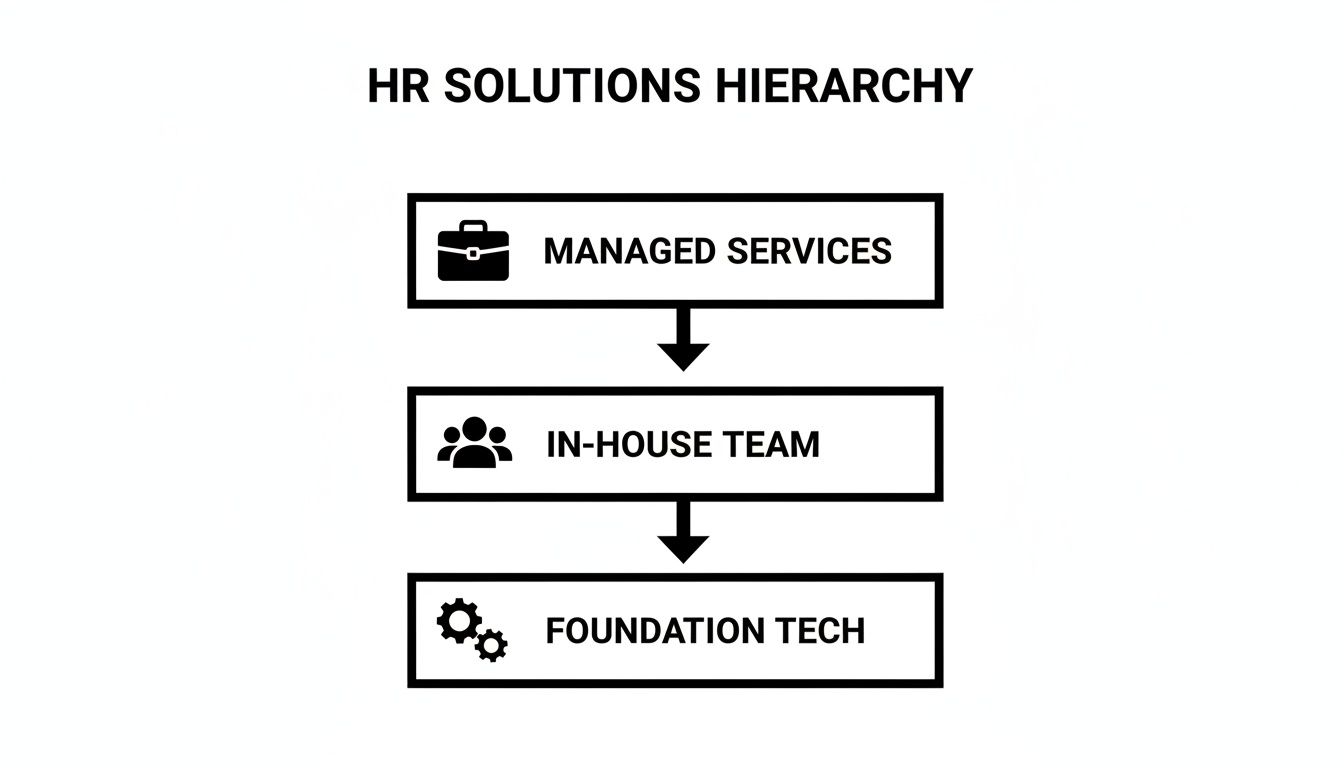
As the visual suggests, managed services deliver their maximum strategic value only when they are built upon a strong technological foundation and a capable in-house team.
Another critical metric is time-to-fill. Every day a key role sits vacant, it’s a drain on the business—lost productivity, missed opportunities, and more pressure on your existing people. RPO providers are built for speed. Their entire model is designed to compress hiring timelines and get productive, talented people into your organisation faster.
The Strategic Value of a Liberated HR Team
Perhaps the most underrated part of the ROI calculation is the strategic freedom it gives back to your internal HR team. When the day-to-day grind of recruiting is handled by an expert partner, your core team is freed from tactical, administrative fire-fighting.
This newfound bandwidth lets them pivot to high-value, strategic work that drives the long-term health of the organisation.
- Talent Management: Focusing on career pathing, skill development, and creating genuine growth opportunities for your current employees.
- Succession Planning: Proactively identifying and grooming the next generation of leaders from within.
- Organisational Development: Driving culture initiatives and making tangible improvements to employee engagement and retention.
By outsourcing the ‘run’ functions of recruitment, you empower your internal HR leaders to become true strategic architects of your workforce. They can finally shape the future of the company instead of just reacting to its present needs.
Quantifying the Full Impact
Ultimately, a comprehensive ROI calculation looks at both direct cost savings and indirect benefits. It’s about combining the hard numbers with the less tangible—but hugely significant—gains in productivity, morale, and strategic agility. To see the full picture, a detailed analysis is essential. You can explore a complete framework by reviewing our guide on how to calculate enterprise RPO ROI.
This holistic view proves that the right RPO partnership isn’t a cost centre. It’s a powerful investment in your organisation’s future success.
How to Choose Your Ideal HR Solutions Partner

Picking the right partner is probably the single most important decision you’ll make when you decide to outsource your recruitment. Get it right, and the firm becomes a natural extension of your own team, driving real business results. Get it wrong, and you’re in for a world of friction, lacklustre candidates, and a damaged employer brand.
This isn’t just about comparing features on a spreadsheet. It’s about finding a partner whose culture, tech, and overall approach genuinely click with your company’s DNA and your long-term goals. Think of it as a strategic alliance, not a simple purchase.
Evaluate Deep Industry Expertise
Your business has its own unique quirks and challenges, so why would you settle for a generic recruitment partner? Look for a provider who has already walked the walk in your industry. They need to speak your language, understand your specific talent headaches, and already have a network of the kind of people you want to hire.
A partner with real sector knowledge does more than just fill jobs; they bring market intelligence to the table. They can give you the inside track on salary benchmarks, what your competitors are up to, and the new skills you should be looking for. That’s when they shift from being just a vendor to a trusted talent advisor.
To get to the bottom of their expertise, ask some direct questions:
- How many clients have you actually worked with in our industry?
- Can you show us case studies with roles similar to ours?
- What specific sourcing strategies do you use that work for our particular talent pool?
Scrutinise the Technology Stack
Today, the power of any HR hiring solution comes down to its technology. A top-tier partner will bring a sophisticated tech stack to the relationship—tools built to make things more efficient, give candidates a better experience, and deliver powerful insights.
This goes way beyond a basic Applicant Tracking System (ATS). You should be looking for partners who use tools to automate sourcing, engage candidates with AI-powered chatbots, and leverage predictive analytics to pinpoint the best talent. A provider that’s behind on technology will always struggle to deliver the speed and quality you need.
A partner’s technology should not be a black box. Demand transparency into their platforms and, more importantly, how their technology integrates with your existing HR systems to create a single, cohesive ecosystem.
Assess Cultural Alignment and Flexibility
This might be the most crucial—and most frequently ignored—factor of all: cultural fit. Remember, your RPO partner is the face of your company to every single candidate. If their communication style, values, and work ethic are out of sync with yours, it creates a jarring experience that can turn off top talent.
As you evaluate them, pay close attention to their people. Are they listening more than they talk? Are they asking smart, insightful questions about your business and its culture? A true partner acts as a consultant, collaborating with you, not just telling you what to do.
Flexibility is just as critical. Your hiring needs are going to change—that’s a given. A great partner offers solutions you can scale up or down as your business evolves, whether you’re in a massive growth phase or tightening the belt. Steer clear of rigid, one-size-fits-all contracts that might feel right today but will handcuff you in six months.
Creating a Successful RPO Implementation Roadmap

A great RPO partnership is built on seamless integration, not just a signed contract. Making the switch to a Recruitment Process Outsourcing (RPO) model is a significant organisational shift, and it absolutely demands a clear, well-managed roadmap to succeed.
Without a structured plan, even the most promising partnership can run into trouble. We’ve seen it happen: misaligned expectations, friction between processes, and resistance from internal teams. A phased approach ensures everyone is perfectly aligned from day one, laying the foundation for a relationship that delivers real, long-term value.
Think of it like bringing in a specialist architect to build a new wing for your headquarters. Your internal team still owns the vision and sets the strategic direction, but the expert partner brings the blueprints, tools, and specialised crew to get the complex build done flawlessly.
Phase 1: Initial Discovery and Process Mapping
The journey kicks off with a deep dive into how you operate right now. Your RPO partner should invest serious time understanding your existing recruitment workflows, your tech stack, and the unique cultural nuances of your organisation. This isn’t a quick glance; it’s a forensic analysis.
This discovery phase means mapping every single step of your current hiring process, from the moment a requisition is approved right through to onboarding. The goal here is to pinpoint the bottlenecks, inefficiencies, and hidden opportunities. It’s a collaborative effort to ensure the final solution is built for your specific pain points, not just a generic template.
Phase 2: Collaborative Solution Design
Once there’s a clear picture of the “as-is” state, the next step is to design the “to-be” model together. This is where the strategic muscle of an RPO partnership really shows. You’ll co-create new, optimised workflows that line up with best practices and, more importantly, your business goals.
Key activities in this stage include:
- Defining SLAs: Setting crystal-clear Service Level Agreements for crucial metrics like time-to-fill, quality of hire, and hiring manager satisfaction.
- Technology Integration: Planning exactly how the RPO provider’s tech will plug into your existing HRIS and ATS for a smooth, unbroken flow of data.
- Establishing Governance: Creating a clear governance structure that defines roles, responsibilities, and the communication rhythm between your team and the RPO provider.
A successful RPO implementation isn’t about handing over the keys; it’s about building a framework for shared accountability. Clear governance ensures both sides are pulling in the same direction towards the same strategic goals with total transparency.
For those who want a closer look at project timelines, we’ve put together a comprehensive guide on the RPO timeline and delivery model. This resource details what to expect at each stage.
Phase 3: Change Management and Strategic Rollout
Honestly, this is the most critical phase. The success of any hr hiring solutions implementation comes down to how well you manage the human side of the change. Your internal Talent Acquisition (TA) team is your most important stakeholder, bar none.
It’s completely natural for your existing team to have concerns about their roles. Proactive communication is vital to get ahead of these worries. The key is to frame the RPO partnership not as a replacement, but as an elevation of their roles.
By outsourcing the high-volume, administrative parts of recruiting, your internal TA professionals are freed up to focus on work that adds more strategic value. Their roles can evolve to become managers of the RPO relationship, focusing on strategic workforce planning, executive searches, and strengthening the employer brand. They shift from tactical doers to strategic thinkers, and that’s a massive win for the business. A carefully managed, phased rollout ensures a smooth transition with minimal disruption and maximum buy-in from the people who matter most.
Measuring Success with the Right KPIs
To make a compelling case for investing in strategic HR hiring solutions, you have to speak the language of the business. And that language is data. Proving the value of a recruitment partner means moving beyond traditional, purely operational metrics like time-to-fill. While that number is important, it simply doesn’t capture the full strategic impact of a strong hiring partnership.
The focus has to shift to Key Performance Indicators (KPIs) that measure the quality and business impact of your hires. This approach creates a powerful, data-driven feedback loop where you can use real insights to continuously refine and improve your entire recruitment process. A truly proactive RPO partner doesn’t just fill roles; they use data to become a strategic consultant for your talent strategy.
Moving Beyond Volume Metrics
The job market has fundamentally changed. It’s no longer about sheer volume; it’s about skill-centric hiring. This is a trend underscored by recent data showing a 23% year-on-year surge in overall hiring. This growth wasn’t just anywhere—it was led by senior management roles (+39%), HR & Admin (+33%), and IT (+30%), signalling a clear return to experience-led hiring where proven capability is everything. You can read more about this skill-focused shift in the latest market analysis.
This context makes tracking strategic KPIs more critical than ever. The goal isn’t just to fill seats anymore; it’s to fill them with the right people who will actively drive the business forward.
So, where should you focus? Start with these:
- Quality of Hire: This is arguably the most important metric you can track. You can measure it through new-hire performance reviews, manager satisfaction surveys after 90 days, and even the success rates of their early-stage projects.
- New Hire Retention: Are your new hires sticking around? Tracking the percentage who remain with the company after 90 days, six months, and one year gives you direct insight into hiring accuracy and, crucially, cultural fit.
- Hiring Manager Satisfaction: Don’t forget your internal customers. Regularly surveying your hiring managers provides invaluable feedback on the entire recruitment process, from candidate quality to the overall performance of your RPO partner.
To give you a clearer picture, here’s a breakdown of the kinds of KPIs a strategic CHRO should be tracking.
Key Performance Indicators for RPO Success
| Metric Category | Example KPI | What It Measures |
|---|---|---|
| Hiring Quality | 90-Day New Hire Performance Rating | The on-the-job performance and initial contribution of new employees. |
| Process Efficiency | Offer Acceptance Rate | The attractiveness of your offers and the effectiveness of the closing process. |
| Candidate Experience | Candidate Net Promoter Score (cNPS) | Overall satisfaction of candidates with the entire recruitment journey. |
| Strategic Impact | First-Year New Hire Attrition Rate | The long-term fit and success of placements, indicating quality of hire. |
| Diversity & Inclusion | Diversity of Candidate Slate | The representation of diverse candidates presented for each open role. |
By focusing on these types of metrics, you get a much richer, more strategic view of your recruitment function’s performance and its contribution to the bottom line.
Gauging the Candidate and Diversity Impact
Never forget that the candidate’s journey is a direct reflection of your employer brand. One poor experience can deter top talent and do real damage to your company’s reputation in a competitive market.
A powerful KPI for this is the Candidate Experience Net Promoter Score (cNPS). It’s simple but effective: it asks candidates, “How likely are you to recommend our hiring process to a friend or colleague?” This gives you a clear, quantifiable measure of their experience.
Finally, diversity metrics are non-negotiable in today’s world. You need to be tracking the diversity of candidates at every single stage of the hiring funnel—from the initial application all the way to the final offer. This data is essential for revealing potential biases in your process and helps your RPO partner implement targeted strategies to build a more inclusive and representative workforce.
To dig deeper into how RPO providers leverage this data, check out our guide on how RPO providers track, report, and improve recruitment KPIs. By tracking these advanced metrics, you transform recruitment from a transactional cost centre into a measurable, strategic asset that demonstrably contributes to organisational success.
Still Have Questions About HR Hiring Solutions?
Stepping into a new hiring model always raises a few questions. As a CHRO, you need straightforward answers to feel confident about your next move. Let’s tackle some of the most common concerns we hear from leaders when they’re considering a strategic partner like an RPO.
This isn’t about glossing over the tough stuff. It’s about getting you the clarity needed to decide if this is the right direction for your organisation. We’ll get right into the big topics: control, cost, and what this all means for your current team.
How is an RPO different from just using a staffing agency?
The biggest difference is the relationship itself: one is a strategic partnership, the other is a transactional service. Think of staffing agencies as tactical suppliers you call when you need to fill a specific, individual role. Their job is usually short-term, focused on getting one person in the door.
An RPO provider, on the other hand, operates as a genuine extension of your company. They aren’t just filling jobs; they take ownership of your entire recruitment process, from the ground up—process design, employer branding, the works.
The real goal of an RPO partnership isn’t just to fill empty seats. It’s about building a sustainable talent machine for your business. The focus shifts to long-term gains like process improvement, tech optimisation, and strengthening your employer brand.
This deep integration means they’re invested in your success, not just cashing in on placement fees.
Will bringing in an RPO make my internal talent team redundant?
Quite the opposite, actually. A well-executed RPO partnership elevates your internal team. By handing off the high-volume, administrative side of recruiting, you free up your people to focus on the high-impact, strategic work that really moves the needle.
Their roles don’t disappear; they evolve. They shift from doing the day-to-day recruiting to providing strategic oversight. This change empowers them to focus on what matters most:
- Relationship Management: Actively guiding the RPO partner to ensure they’re hitting targets and staying aligned with your goals.
- Workforce Planning: Looking ahead to future talent needs and building solid succession plans.
- Executive Recruitment: Keeping the critical senior-level and highly specialised searches in-house.
- Strategic Initiatives: Owning major projects like employer branding and candidate experience.
It’s a powerful shift. Your internal team transforms from recruiters into strategic talent advisors for the whole business.
What does a typical RPO cost structure look like?
RPO pricing is built to be flexible and align with what your business actually needs. There’s no one-size-fits-all answer here. The most common models involve a monthly management fee to oversee the process, a cost-per-hire fee for each placement, or sometimes a hybrid of the two.
The right model for you depends entirely on your hiring volume, the complexity of the roles you need to fill, and the overall scope of the work. A good partner will sit down with you to build a custom pricing model that delivers a clear, predictable, and measurable return on your investment.
Ready to transform your talent acquisition from a cost centre to a strategic driver of growth? At Taggd, we build bespoke RPO solutions that deliver measurable results. Discover how our approach can build your future workforce today.