Hiring an HR leader isn’t just about filling a vacancy anymore. It’s a high-stakes strategic move that directly impacts your competitive edge. Today’s top HR leaders aren’t just administrators; they’re in the boardroom, shaping business outcomes, digital transformation, and talent strategy. This playbook is designed to take you beyond guesswork, giving you a proven, multi-stage process to land this kind of transformational talent.

Why HR Leadership Hiring Is Your New Strategic Imperative
The game has completely changed. Yesterday’s HR manager was focused on keeping the administrative wheels turning. Today, we need a true C-suite partner who directly influences profitability, innovation, and the company’s ability to bounce back from challenges.
Getting this hire right has shifted from a routine recruitment task to a pivotal business decision. The wrong choice can have consequences that ripple across the organisation for years.
The High-Stakes Environment for Modern HR Leaders
As a CHRO, you know the pressure is on. Modern organisations are juggling a host of challenges that land squarely on the HR leader’s desk. The right person can turn these pressures into opportunities, while the wrong one can let them become major risks.
We’re talking about massive, business-critical challenges:
- Digital and AI Integration: HR is at the heart of this shift, ensuring technology actually helps our people do their best work, rather than just replacing them.
- The War for Talent: In this market, you need a sophisticated leader who understands employer branding, data-driven acquisition, and how to build an irresistible value proposition.
- Building a Future-Proof Culture: Your HR leader must cultivate an environment of psychological safety, continuous learning, and agility to keep pace with constant market shifts.
The financial stakes here are enormous. In India’s competitive talent landscape, it’s not uncommon for Heads of HR in large firms to earn up to Rs 4 crore annually. That number reflects the intense demand for leaders who can navigate digital transformation and AI, areas where one bad hire can cost you multiples of their salary in lost momentum and strategic missteps.
A bad hire at the leadership level doesn’t just cost money; it erodes team morale, stalls critical projects, and damages your employer brand. The ripple effect is far greater than the individual’s salary.
This is exactly why a structured, modern approach is non-negotiable. You need a playbook that blends sharp data analytics with deep business acumen and a real understanding of people. It’s about moving past gut-feel decisions to a systematic process that identifies and attracts leaders who will genuinely drive the business forward.
This kind of structured thinking is a cornerstone of effective strategic workforce planning. Consider this playbook your toolkit for building a resilient, future-ready HR function, starting right at the top.
Architecting the Role for Transformational Impact
Let’s be blunt: if you post a generic job description for an HR leader, you’re going to get a generic pool of candidates. To attract a genuine changemaker, you have to stop thinking about filling a role and start architecting a mission. This is the single most important pivot you can make, and it’s where you’ll immediately pull ahead of the competition.
Before you even think about writing a job profile, your first job is to get full-throated consensus from the C-suite and the board. This isn’t a box-ticking exercise. It’s the foundational act that defines the new leader’s mandate and authority within the organisation.
The goal is to get unified agreement on the specific business problems this leader is being hired to solve. Is productivity slumping because of a disengaged workforce? Is a weak leadership pipeline putting future growth at risk? Or are you bleeding talent because your digital HR experience is years behind? Nailing this down ensures your new HR leader walks in with a clear, sponsored mandate for change, not a vague to-do list.
Defining the 18-Month Mission
Top-tier leaders aren’t looking for a “job”; they’re searching for a mission. Instead of a laundry list of day-to-day responsibilities, frame the entire role around a clear 18-month mission. This timeframe is powerful, it’s short enough to create real urgency but long enough to deliver substantial, measurable business outcomes.
Articulate this mission as a series of strategic objectives. For instance, instead of saying the role “oversees talent acquisition,” the mission becomes to “redesign the talent acquisition function to reduce time-to-hire for critical tech roles by 30% and improve quality-of-hire by 15% within 12 months.”
This outcome-focused approach does two critical things:
- It attracts strategic thinkers. High-calibre leaders are energised by clear, impactful challenges, not by administrative duties.
- It builds an immediate evaluation framework. The mission itself becomes the scorecard for the candidate’s first year and a half.
When you define success by the problems solved, you attract candidates who see themselves as problem-solvers. This simple shift in framing moves the conversation from tasks to impact, which is exactly what a transformational leader wants.
Building a Future-Fit Competency Model
Once the mission is crystal clear, you can build a competency framework that directly enables it. This isn’t about dusting off old HR skill lists. Today’s business environment demands a new breed of HR leader with a completely different set of capabilities.
You need to prioritise competencies that reflect modern commercial realities:
- Commercial Acumen: The ability to read a P&L statement, understand market dynamics, and directly link HR initiatives to revenue and profitability.
- Data Fluency: Moving beyond basic reporting to use predictive analytics for workforce planning, retention forecasting, and proving programme ROI.
- Digital Dexterity: Deep fluency in the modern HR tech stack, from AI-powered recruitment tools to employee experience platforms, and the ability to lead a digital transformation of the entire HR function.
- Change Leadership: Proven experience guiding an organisation through major cultural or operational shifts with empathy, resilience, and a steady hand.
These are the non-negotiable building blocks for a modern, effective HR function. By embedding them directly into your role profile, you send a powerful signal that you’re hiring for the future of the business, not just the past of the HR department.
The difference between a tired, traditional job description and a forward-looking strategic role profile is stark. The table below really highlights the shift from focusing on activity to demanding achievement.
Traditional JD vs. Strategic Role Profile for an HR Leader
| Element | Traditional Job Description (What they DO) | Strategic Role Profile (What they ACHIEVE) |
|---|---|---|
| Primary Focus | Manages HR operations, ensures compliance, and administers employee benefits. | Drives business growth by linking talent strategy directly to P&L outcomes. |
| Key Responsibility | “Oversee annual performance review cycle.” | “Redesign performance management to increase employee productivity by 10% in 18 months.” |
| Metric of Success | Low employee turnover rate. | High rate of internal mobility for key roles and measurable impact on business unit KPIs. |
| Required Skill | “Experience with HRIS systems.” | “Proven ability to leverage people analytics to forecast talent gaps and reduce attrition risk.” |
As you can see, the strategic profile is designed to attract leaders who think in terms of business impact. This approach doesn’t just find you a new HR Director; it finds you a strategic partner who will help drive the organisation forward.
Let’s be honest. The kind of game-changing HR leader you’re looking for isn’t polishing their CV. They’re heads-down, driving results and making an impact for someone else. This means your old playbook of posting on job boards and waiting for applications is completely useless. You need to go on the offensive with a proactive, surgical hunt for passive talent.
Your first move is to map the talent market. This isn’t just about searching for “HR Director” on LinkedIn. It’s an intelligence-gathering mission to pinpoint the high-performers who’ve already proven they have the skills you need, whether they’re in your industry or not.
Think like an intelligence analyst. Who just wrapped up a successful, large-scale digital HR transformation? Which leaders are on the conference circuit talking about using people analytics to hit business goals? Who has a reputation for building an incredible leadership pipeline at one of your competitors? This creates your “long list” of targets, a list built on real achievements, not just keywords.
Going Beyond the Obvious Talent Pools
For this level of HR leadership hiring, you can’t put all your eggs in one basket. Relying on a single channel is just asking for a shallow talent pool. Your strategy has to be a smart blend of your own networks, external partners, and deep talent intelligence.
- Executive Search Partners: The right search firm gives you instant access to a vetted network of leaders and can handle the delicate initial outreach. Pick a partner who genuinely gets your business and can be a true ambassador for your brand. They should be challenging your assumptions, not just forwarding CVs.
- Your Internal Network: Your board members and senior executives have incredibly deep professional networks. Don’t just casually ask them for names. Set up structured, confidential briefings to tap into their contacts. Give them the strategic role profile, not a generic job description, so they can spot individuals who match the mission.
- Confidential Referrals: Build a small, trusted circle of industry contacts who can confidentially point you toward high-performers. The best tips often come from people who have seen a leader in action, their former direct reports, peers, or even vendors.
This proactive approach is non-negotiable, especially as the fight for senior talent gets more intense. For instance, India’s hiring intent for 2026 is showing a strong comeback at 11%, with a major focus on experienced professionals. Candidates with 6-15 years of experience are set to account for 55% of all hires, a massive leap from 39% the previous year. This fierce competition means CHROs have to get creative to secure leaders with proven agility, often needing expert partners to find them faster. You can get more details on this trend in this comprehensive report on India’s job market revival.
The Art of the Initial Outreach
Reaching out to a busy, successful, and passive leader requires real finesse. A generic LinkedIn message is a one-way ticket to being ignored. That first contact is your one shot to pique their curiosity, so it has to be personal, strategic, and genuinely intriguing.
Your goal isn’t to “sell” a job. It’s to start a strategic conversation. The entire message should be about them and the unique impact they could make, not about you and your open req.
Your outreach must answer the silent question every top performer asks: “Why would I leave a place where I’m already successful to talk to you?” The answer must be a bigger, more compelling challenge.
Frame the opportunity around that 18-month mission you defined earlier. Instead of saying, “We have an opening for a VP of HR,” try something more powerful: “I’m reaching out because of your recognised expertise in scaling tech organisations. We are embarking on a mission to double our engineering headcount while building a world-class remote culture, and I believe your experience could be central to our success.” This shows you’ve done your homework and presents a challenge worthy of their attention. For more actionable techniques, check out our guide on mastering the art of passive candidate sourcing.
This first touchpoint sets the tone for everything that follows. By proving you’re offering a substantive, strategic conversation not just another job, you instantly stand out from the noise. It signals that this isn’t just a transaction; it’s the beginning of a potential partnership.
Designing an Assessment Process That Reveals True Capability
Let’s be honest: standard interviews are notoriously bad at predicting how a leader will actually perform. A friendly chat and a polished CV might tell you if you like a candidate, but it reveals next to nothing about how they’ll handle a complex business crisis when the pressure is on.
To uncover true capability, you have to move beyond gut feelings and design a multi-faceted assessment process. This means architecting a series of evaluations that test for the specific competencies you laid out in your strategic role profile. The goal is to see the candidate in action, simulating the demands of the role as closely as possible.
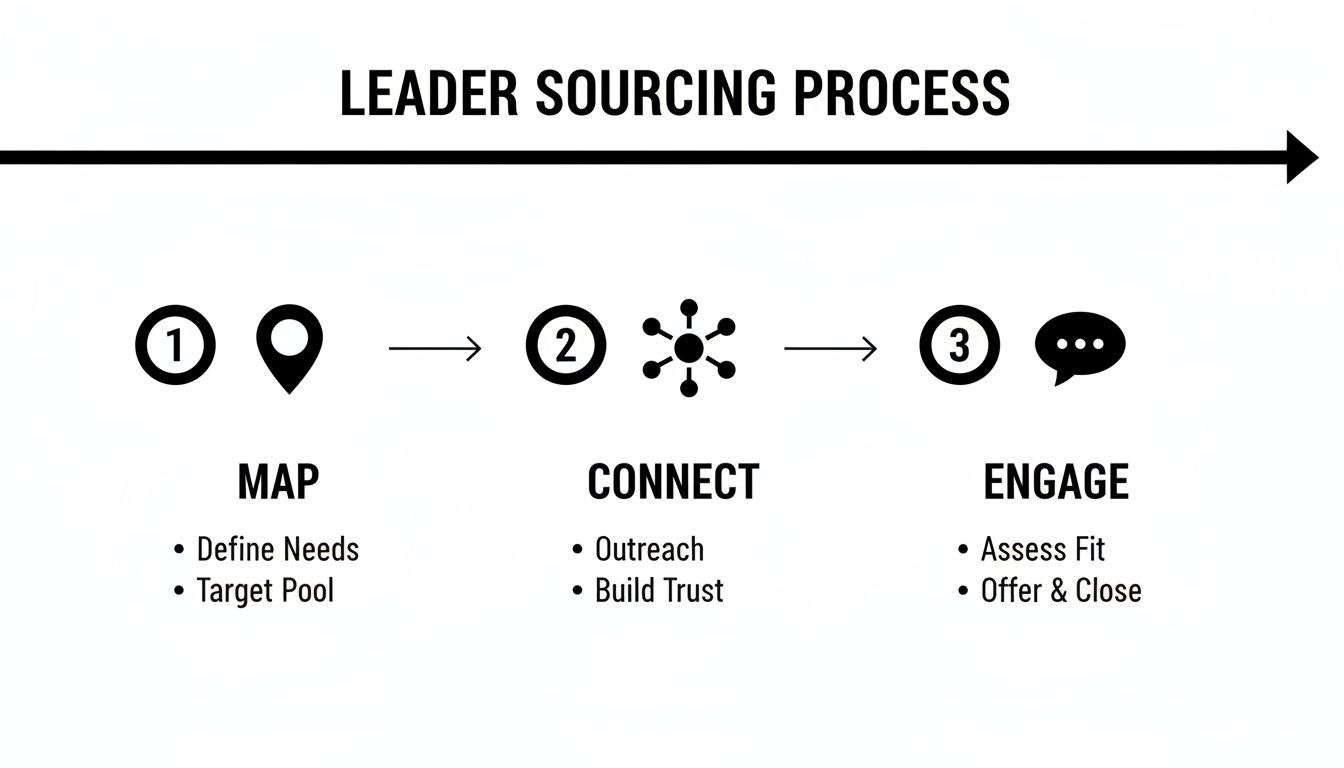
This process isn’t a single event but a journey, moving from broad market mapping to deep, engaging conversations designed to reveal a leader’s real strategic and operational muscle.
Beyond Standard Interview Questions
Your interview process needs to be forensic, digging for hard evidence of past success. This is where behavioural and situational techniques become absolutely invaluable.
- Behavioural Interviews: Use the “STAR” method (Situation, Task, Action, Result) to force candidates to give you specific examples. Don’t ask, “How do you handle change?” Instead, try: “Tell me about a time you led a team through a significant, unpopular operational change. What was the situation, what was your specific role, what actions did you take, and what was the quantifiable business result?”
- Situational Judgement Tests: Present them with realistic, thorny scenarios they’d likely face. For example, “You discover that a popular, high-performing business unit leader has been bypassing the new, centrally mandated hiring process. How do you handle this?” Their answer reveals their judgement, influencing style, and commitment to process all at once.
These structured methods give you a consistent framework for evaluating everyone, allowing for a much fairer and more accurate comparison than an unstructured chat.
A great assessment process doesn’t just verify a candidate’s past; it helps you predict their future. You’re looking for patterns of behaviour that align with the mission you’ve defined for the role.
The Litmus Test: A Custom Business Case
The single most powerful tool in your assessment arsenal is a custom business case study. This isn’t some generic, off-the-shelf exercise. It must be based on a real, current, and complex problem your organisation is wrestling with right now.
For instance, you might present anonymised data on high attrition in a critical department and ask the candidate to:
- Analyse the data to diagnose the root causes.
- Develop a strategic 12-month plan to fix it.
- Outline the key metrics they would use to measure success.
- Present their findings to the interview panel as if they were presenting to the executive board.
This “job audition” is incredibly revealing. It lets you assess their analytical skills, strategic thinking, commercial acumen, and communication style under real pressure. You see firsthand how they think, how they structure a plan, and how they articulate a vision.
Assembling a Diverse and Trained Panel
The people conducting the interviews are just as important as the questions they ask. A common mistake is to pack the panel with like-minded individuals, which almost always leads to confirmation bias.
Instead, assemble a diverse group of stakeholders who will interact with this leader.
- The hiring manager (you, the CHRO).
- A C-suite peer (like the CFO or COO).
- A key business leader they will support.
- A high-potential direct report from the HR team.
Before any interviews happen, you must train the panel. Give them the strategic role profile, the competency framework, and a clear scoring rubric. Their job isn’t to decide if they “like” the candidate, but to assess their capabilities against the pre-defined criteria. This disciplined approach transforms the assessment from a subjective popularity contest into a data-driven decision. For more on this, you can explore our guide on how to assess and hire candidates who fit your culture.
This methodical approach is right in line with a huge trend in the Indian market. Leadership hiring in India for 2026 is seeing a massive shift away from pedigree-focused recruitment towards a skills-centric model. Boards now care more about a leader’s transformation experience, like real revenue turnarounds or culture rebuilds than brand-name resumes. This evolution demands that CHROs use nuanced assessments, often partnering with RPO experts. The right tech-human blend can lead to up to 40% faster fills for these critical roles.
You’ve put in the hard yards. The interviews are done, the case studies are in, and you’ve narrowed it down to a handful of impressive finalists. Now comes the moment of truth: making the final call and sealing the deal.
This is where all your strategic work can either pay off beautifully or fall apart at the last minute. Getting this stage right is about moving from evaluation to a firm decision, and from conversation to a rock-solid commitment.
Securing Your Top Candidate and Crafting the Offer
After all the assessments, it’s tempting for the hiring panel’s feedback to dissolve into a series of subjective “I liked them” conversations. Don’t let that happen. Your first move is to bring your interview panel together for a structured debrief, using your competency framework as the anchor for the entire discussion.
Moving From Gut Feel to a Data-Backed Decision
The goal here is to cut through the personal biases and get to an objective choice. A simple decision matrix is your best friend for this. It’s not about adding bureaucracy; it’s about bringing clarity and objectivity when stakes are high.
For each finalist, score them against the core competencies you defined right at the start, like ‘Commercial Acumen’ or ‘Change Leadership’. Then, list their strengths and potential development areas side-by-side. This creates a powerful visual that makes it so much easier to debate the real trade-offs. Maybe one candidate has world-class data fluency but less experience with union relations, while another is a master of stakeholder management. The matrix forces the team to weigh these realities against the 18-month mission you set for the role.
Your final decision shouldn’t be about finding a perfect candidate, they don’t exist. It’s about choosing the leader whose specific spike of excellence is most aligned with the most critical business problem you need to solve right now.
The Power of Insightful Reference Checks
Once you have a front-runner, it’s time for reference checks. But let’s be clear: this isn’t about just confirming they worked where they said they did. This is your chance to gather behavioural evidence that either backs up or challenges what you saw during the interview process.
Ditch the generic questions. Instead of asking, “Is she a good leader?”, dig deeper. Try something like, “Can you describe a high-stakes situation where she had to influence senior stakeholders who disagreed with her? What was her approach, and what was the outcome?” This kind of open-ended question prompts real stories and gives you a three-dimensional picture of your finalist’s leadership style, resilience, and true impact.
Constructing an Irresistible Offer
With your final choice locked in, it’s time to build an offer they can’t refuse. For a senior HR leader, the offer is far more than a salary. It’s the grand finale of your company’s value proposition, and it needs to land perfectly.
- Benchmark the Compensation: Use reliable, up-to-date market data to benchmark everything—salary, bonus potential, and long-term incentives. For a role this strategic, you want to be at or slightly above the market median. It sends a clear signal that you value this position.
- Articulate the Full Value: The offer letter is a document, but the verbal conversation is where you sell the dream. Reiterate the mission, the massive scope for impact, and the direct line of sight to shaping business outcomes. Frame this as a career-defining move, not just another job.
- Navigate Negotiations with Empathy: If your top candidate negotiates, that’s often a great sign. It shows their commercial savvy. Listen carefully to what they’re asking for, be transparent about what’s possible, and focus on finding a win-win. A positive, respectful negotiation sets the tone for a strong relationship from day one.
Closing the deal is the final, critical hurdle. A well-structured decision, followed by a thoughtful and compelling offer, ensures you don’t just secure your top choice, you kick off their journey on a foundation of mutual respect and genuine excitement.
Implementing a Strategic 90-Day Onboarding Plan
Getting the employment contract signed isn’t the finish line. Frankly, it’s the starting gun for the most critical phase of your new HR leader’s journey. All that hard work you put into recruiting can unravel in a few short months if you fumble the integration.
Effective onboarding is what turns a great hire into a truly high-impact leader who sticks around. It’s far more than handing them a laptop and an org chart. A strategic 90-day plan is a structured immersion designed to get your new leader up to speed on the business, build crucial relationships, and align them with the real challenges from day one. The goal is simple: get them delivering tangible value, fast.
The First 30 Days: The Listening Tour
The first month is all about absorption. Resist the urge to throw major projects at them or ask for immediate fixes. Their one and only job is to learn, to understand the company’s culture, its power dynamics, and all the unwritten rules of the road.
As the CHRO, you’re their chief navigator. Don’t just flood their calendar with back-to-back meetings. Instead, build a strategic stakeholder map that guides them to the people who really matter.
Your map should prioritise introductions to:
- Executive Peers: So they can understand the C-suite’s top business priorities and how departments truly interact.
- Key Business Unit Leaders: To get a ground-level view of their unique talent headaches and opportunities.
- Their Direct Reports: To assess the team’s capabilities and build that essential initial rapport.
- Informal Influencers: Those long-tenured, respected employees who hold the real institutional knowledge.
Every meeting needs a clear purpose: to listen. Arm your new leader with powerful, open-ended questions like, “What is the one thing HR could do right now to make your team more successful?” This approach not only surfaces unfiltered insights but also builds incredible goodwill from the start.
The first 30 days are a ‘listening tour,’ not a ‘fixing tour.’ A new leader’s ability to absorb the landscape is a far better predictor of long-term success than their ability to make rapid, uninformed changes.
Days 31-60: Connecting Dots and Crafting a Strategy
With a month of insights under their belt, the second phase is about moving from absorption to synthesis. This is where your new HR leader starts connecting the dots and shaping what they’ve learned into a coherent strategy.
Now is the time for deep-dive sessions with the C-suite and business leaders to pressure-test their initial hypotheses. For instance, if they noticed high turnover in the sales team during their listening tour, this is their chance to present early thoughts and dig for more data. It’s a period of collaborative problem-solving.
This phase is also the perfect time to identify some quick wins. Help them pinpoint one or two high-visibility, low-complexity problems they can solve in the next 30 days. Successfully fixing a nagging pain point early on is one of the fastest ways for a new leader to build credibility and prove their value to the organisation.
Days 61-90: Firing the First Shots
By the final month of the plan, your new leader should be ready to launch their first key initiatives. This isn’t about trying to boil the ocean. It’s about taking decisive, focused action on the priorities you’ve both agreed upon. That initial 18-month mission you defined during the hiring process should now be broken down into a concrete quarterly roadmap.
The focus here is all on execution and communication. They need to clearly articulate the plan, define what success looks like, and make sure they have the buy-in from the stakeholders they’ve spent the last two months cultivating. Your role as CHRO shifts again, now you’re providing air cover, removing roadblocks, and creating the feedback loops they need to stay on track. This is how you ensure they become a fully integrated, high-impact member of your executive team.
Frequently Asked Questions
Even for a seasoned CHRO, a critical leadership search is full of tough questions. Here are some of the most common challenges we see, with some straightforward advice to help you navigate your next HR leadership hire with total confidence.
How Do I Balance An Internal Promotion With An External Search?
You should always start with a confidential internal talent review. Pit your high-potential people against the strategic role profile you’ve built. This internal-first approach honours your commitment to your existing team and quickly shows you who might be ready to step up.
If you have a strong internal contender, you can map out a tailored development path to get them ready. But if you spot gaps, a quiet external search is a must. It lets you benchmark your internal talent against the best in the market, making sure you make the most informed decision for the business.
The key is transparency. Be crystal clear and respectful about the process with any internal candidates. It’s the only way to maintain trust.
The biggest mistake you can make is hiring for a traditional HR skillset when you really need a strategic business partner. If you over-index on past titles or legacy HR experience instead of proven business acumen, you’ll end up with a functional manager not a leader who can drive real change.
How Involved Should The CEO And Board Be?
Your CEO and key board members need to be deeply involved at two critical moments: the very beginning and the very end.
Their input is non-negotiable right at the start. They need to help define the role’s strategic mandate and the key business outcomes you expect in the first 18 months. Then, they should be part of the final interview round to personally assess for C-suite cultural alignment and strategic fit.
However, the CHRO must own and drive the day-to-day process from sourcing to assessment design. This ensures the search keeps moving forward, while your executive team’s time is saved for maximum impact. You want their energy focused on strategic alignment, not the operational details.
Navigating the complexities of HR leadership hiring requires a strategic partner who truly understands the Indian talent market. Taggd‘s AI-powered RPO solutions and executive search expertise can help you find and secure the transformational leaders your business needs, faster.