An inclusive job description is more than just a list of tasks. It’s a carefully written posting that uses neutral, welcoming language to attract top candidates from every possible background.
This isn’t about ticking boxes. It’s a strategic move to avoid biased terms and zero in on core competencies, making sure the widest possible pool of talent feels seen, respected, and encouraged to apply.
Why Inclusive Job Descriptions Drive Business Results

Let’s get one thing straight: inclusive language isn’t just a “nice-to-have.” In today’s fierce talent market, it’s a powerful business strategy with a clear return on investment.
Think about it. Your job description is often the very first interaction a potential employee has with your company. It’s their first glimpse into your culture, your values, and what you truly prioritise.
When that first impression is clouded by exclusionary jargon, overly aggressive phrasing, or a ridiculously long list of requirements, you’re slamming the door on exceptional candidates without even knowing it. The words you choose directly influence who hits “apply” and who just keeps scrolling. This isn’t about being politically correct; it’s about being effective.
Expanding Your Talent Pipeline
The most immediate benefit of an inclusive job description is its power to dramatically widen your applicant pool. Using gender-coded words like “dominant” or “aggressive” can subtly put women off, while an exhaustive “must-have” list often discourages talented people who meet most, but not all, of the criteria.
The data backs this up. Research has repeatedly shown that women often apply for roles only when they feel they meet 100% of the listed requirements, while men are more likely to apply after meeting just 60%. By simply focusing on what’s essential and using gender-neutral language, you create a much more inviting path for a whole range of skilled professionals.
And this goes way beyond gender. Cringey buzzwords like “ninja” or “rockstar” can alienate older, more experienced candidates or neurodivergent individuals who just don’t connect with that kind of corporate slang. In the same way, demanding a specific degree from a top-tier university can create an unnecessary hurdle for brilliant people from different socioeconomic backgrounds.
The goal is simple: attract the best person for the job, regardless of their background, gender, or how they interpret corporate slang. An inclusive job description achieves this by focusing on what truly matters—skills and potential.
Improving Candidate Quality and Engagement
When you have a wider talent pool, something amazing happens: the quality of your applicants goes up. It’s simple maths. When you remove artificial barriers, you let more highly competent people into your recruitment funnel. This shift has a direct, positive impact on key hiring metrics, from your interview-to-hire ratio to the overall quality of your new team members.
For CHROs in India, this isn’t just a theory; it’s a quantifiable way to boost hiring efficiency. A 2022 LinkedIn India report revealed that job posts explicitly mentioning diversity and inclusion saw up to 25–30% higher engagement from candidates. Taking it a step further, NASSCOM’s 2023 Inclusion & Diversity survey found that Indian IT–BPM companies with formal inclusive hiring policies had an 18–22% higher applicant share from women for mid-career roles compared to their peers.
Ultimately, a thoughtfully worded job post sets a positive and professional tone for the entire candidate experience. It signals that your organisation values fairness, respects individuals, and is genuinely committed to building a team based on merit. This strong first impression can be the deciding factor for top candidates weighing multiple offers. It strengthens your brand and lays the groundwork for creating an inclusive employer brand that not only attracts but also retains the best people.
The Hidden Costs of Biased Language in Recruitment
Biased language in your job descriptions isn’t just a simple communication mistake; it’s a hidden tax on your entire recruitment operation. Think about it. Every gender-coded adjective, piece of corporate jargon, or unnecessary requirement acts as a filter, systematically weeding out qualified, diverse candidates before they even think about applying. This isn’t just a theory—it has real, measurable financial and operational consequences.
The damage starts subtly but adds up quickly. A job ad full of aggressive, masculine-coded words like “dominant,” “driven,” or “assertive” can quietly discourage highly competent women from applying. In the same way, vague calls for a “cultural fit” or buzzwords like “ninja” and “rockstar” can alienate everyone from neurodivergent individuals to seasoned professionals who don’t connect with a narrow, often young, start-up vibe. Each of these small linguistic choices compounds, shrinking your potential applicant pool in a big way.
This isn’t just a diversity problem; it’s a direct blow to your most important recruitment metrics. A smaller talent pool means it takes longer to find the right person, which directly increases your time-to-fill. And with fewer applicants to choose from, you might have to extend your search, spend more on advertising, or lean on expensive agencies—all of which drive up your cost-per-hire.
The Financial Drain of Exclusionary Wording
The financial hit from biased language is becoming impossible to ignore, especially in the Indian market. It puts a real, quantifiable cost on organisations that don’t adapt. For instance, a major 2021–2022 study by JobsForHer and Axis Bank revealed that nearly 45% of women professionals surveyed had deliberately decided not to apply for a role because the job description suggested a non-inclusive culture. On top of that, research from Avtar shows that companies using gender-coded language in their job ads saw 20–30% lower application rates from qualified women for key sales and operations roles compared to similar ads rephrased with neutral language.
The data paints a very clear picture: for every five roles you post with biased language, you could be losing almost half of your potential female applicants right from the start. This self-imposed talent shortage forces your recruitment teams to work harder and spend more to get the same results they could have achieved with more thoughtful wording. It’s a self-inflicted wound that quietly drains your budget and stretches your hiring timelines.
How Jargon and Wish Lists Weaken Your Brand
Beyond the immediate costs, biased job descriptions cause long-term damage to your employer brand. When a candidate sees an endless list of “must-have” qualifications—many of which are really just “nice-to-haves”—it sends a message of inflexibility. This is a classic example of implicit bias in hiring, where hiring managers subconsciously look for an idealised candidate who doesn’t actually exist. In doing so, they discourage perfectly capable people who might have 80% of the skills but 100% of the potential.
Consider this real-world scenario: a company lists “experience with our proprietary CRM” as a mandatory requirement. This instantly disqualifies skilled salespeople who have excelled using other major platforms like Salesforce or HubSpot. The company misses out on top performers over a tool that can be taught in a week.
This kind of thing erodes trust. Candidates start to see your company as unrealistic or, even worse, disorganised. Each confusing or exclusionary job ad adds to a reputation that you’re a difficult place to work for, making all your future recruitment efforts that much harder. Over time, fixing that negative perception can be far more expensive than the immediate cost of a longer hiring cycle. The language you use is either building your brand or actively tearing it down with every job you post.
A Practical Guide to Crafting Inclusive Job Descriptions
Alright, let’s move from theory to action. Crafting an inclusive job description is a skill, and just like any other, it gets better with a clear framework and consistent practice. We’re going to break down the core components of a job post—from the title all the way down to the qualifications—and give you practical, actionable ways to weave inclusivity into every single one.
This isn’t about memorising a long list of “good” and “bad” words. It’s about a fundamental mindset shift. You need to focus on what truly matters: the essential functions of the role and the core skills needed to get the job done. By making small, intentional changes, you can transform your job descriptions from a simple laundry list of duties into a powerful magnet for diverse, high-calibre talent.
The cycle of biased recruitment is a costly one. As the flowchart below shows, even small biases in an ad can quickly lead to a shrinking talent pool and spiralling costs.
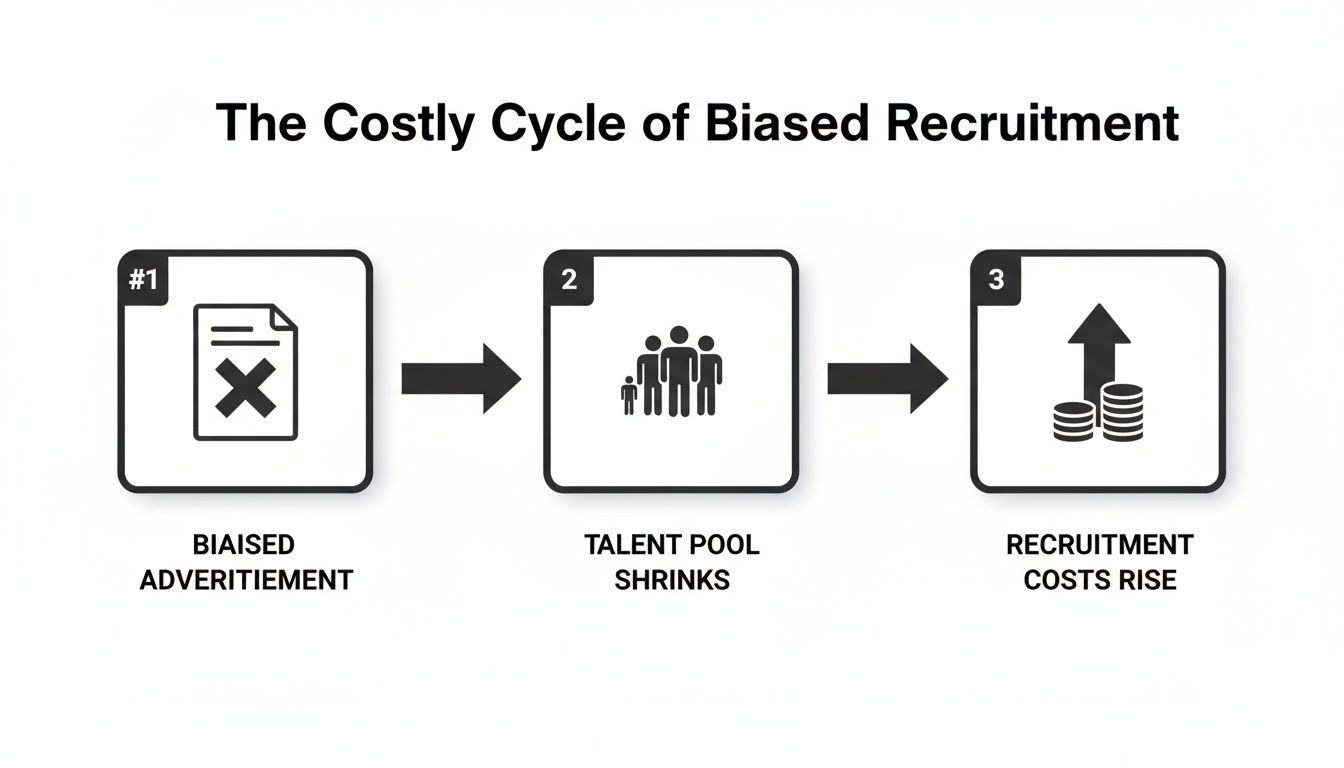
This simple flow makes it clear: the consequences of biased language are direct and expensive, hitting both your talent pipeline and your budget.
Deconstruct and Rebuild Your Job Post
Let’s dissect a typical job description piece by piece. We’ll pinpoint the common pitfalls and highlight the simple, effective improvements you can make today.
The Job Title
The title is your first impression. It has to be clear, universally understood, and completely free of gendered language or exclusionary jargon that might turn people off.
- Before: Salesman or Sales Ninja
- After: Sales Executive or Sales Associate
The “After” versions aren’t just gender-neutral; they’re more professional. They accurately describe the role without alienating great candidates who don’t identify with aggressive or quirky labels. Simple switches like “Chairman” to “Chairperson” or “Fireman” to “Firefighter” make a world of difference.
The Job Summary
This is your hook. Use a conversational, welcoming tone that pulls the reader in. A simple trick is to address the candidate directly using “you” instead of the cold, impersonal “the ideal candidate.” This pronoun shift creates an instant connection and makes the whole description feel more personal and engaging.
Responsibilities and Duties
Focus on the impact and outcomes of the work, not just a dry list of tasks. For example, instead of saying, “Must be able to stand for an entire shift,” rephrase it to focus on the actual function: “Must be able to remain in a stationary position for extended periods.”
This tiny change is huge. It accommodates candidates with disabilities who can perform the core job function, just perhaps in a different way.
By focusing on the what (the outcome) rather than the how (the specific physical action), you open the door to a wider range of qualified individuals who can get the job done.
Rethink Your Qualifications and Requirements
This is where most job descriptions fall flat. We often create an impossibly long wish list that scares off excellent candidates. This is especially true for women, who research shows may not apply unless they meet 100% of the criteria.
Ditch the Laundry List
Be ruthless. Separate the absolute must-haves from the nice-to-haves. If a skill can be taught on the job in a few weeks, it’s probably not a must-have.
- Before: Requires 5-7 years of experience in project management.
- After: Requires experience managing complex projects from conception to completion.
The “After” example focuses on demonstrated competency rather than an arbitrary number of years. This is key because it doesn’t unfairly exclude talented people who are fast learners or have non-traditional career paths. It’s a critical step in building a more inclusive process, and you can learn more by exploring some effective ways for recruiting diverse employees.
Avoid Biased Adjectives
Words carry weight. Masculine-coded words like “dominant,” “assertive,” and “aggressive” can discourage female applicants. On the flip side, feminine-coded words like “nurturing” or “collaborative” might deter men from applying to roles where those skills are genuinely valuable. Always aim for neutral, skill-based language.
- Instead of “assertive,” try “persuasive” or “able to communicate clearly.”
- Instead of “analytical,” use “systematic” or “organised.”
Your Go-To Guide for Inclusive Language
To make this whole process a bit easier, here’s a quick reference table. It compares common exclusionary phrases with their inclusive alternatives and explains exactly why the change matters. Share this with your hiring managers to build consistency across the entire organisation.
Exclusive Language vs. Inclusive Alternatives
| Biased or Exclusive Phrase | Inclusive Alternative | Why It Matters |
|---|---|---|
| “Work hard, play hard” | “A collaborative and results-oriented environment” | This signals a culture that may exclude candidates seeking work-life balance or those with family commitments. |
| “Recent graduates welcome” | “Entry-level candidates are encouraged to apply” | This phrasing avoids potential age discrimination against older candidates who are new to the field. |
| “Native English speaker” | “Proficient in English” or “High level of English fluency” | This includes skilled communicators who may not be native speakers but are fully fluent. |
| “Must have a driver’s licence” | “Ability to travel to various client sites as needed” | This focuses on the job requirement, not the method, accommodating those who use public transport or other means. |
| “Ninja,” “Rockstar,” “Guru” | “Expert,” “Specialist,” “Skilled professional” | These buzzwords can be vague and may alienate candidates who prefer a more professional and straightforward culture. |
| “Cultural fit” | “Values alignment” or “Contributes to our values” | “Cultural fit” can be a code for affinity bias. Focusing on values ensures you hire people who share your core principles, not just your background. |
Keep this table handy. Small adjustments in language lead to big improvements in the diversity and quality of your applicant pool.
Going Beyond Just Words to Embed Inclusion
Polishing the language in your job description is a great start, but it’s really just scratching the surface. A truly inclusive job description is about the whole package. Every single element, from its structure to the fine print, should shout your commitment to equity and belonging. Believe me, candidates—especially those from underrepresented groups—are masters at reading between the lines. They’re looking for real proof that your organisation walks the talk.
Think of your job posting as more than an ad; it’s a window into your company culture. What you choose to include, and just as importantly, what you leave out, sends a very loud message. This is your chance to move beyond buzzwords and show what inclusion really looks like through transparency, support, and genuine accessibility.
The Undeniable Power of Pay Transparency
If there’s one change that makes an immediate impact, it’s putting a clear salary range on the job description. For too long, pay secrecy has been a tool that has disproportionately hurt women and people of colour, feeding into the wage gap. When you put the salary out in the open, you level the playing field for everyone right from the get-go.
This simple act of transparency does a few critical things:
- It builds trust instantly. You’re showing that you’re confident and fair in how you compensate your people.
- It empowers candidates. It gives everyone, especially those who might be hesitant to negotiate hard, a clear understanding of their value from day one.
- It drives equity. It helps prevent personal negotiation skills from creating pay gaps for the exact same role.
When you hide the salary, you’re hinting that pay is more about who can haggle the best, not about the value of the work. Being upfront respects a candidate’s time and shows a real commitment to fair pay.
More Than a Boilerplate Statement
Your Equal Opportunity Employer (EOE) statement is another goldmine of opportunity. All too often, it’s treated like a legal chore—a tiny line of text buried at the very bottom of the page. This is a huge missed opportunity to make a powerful statement about what you stand for.
An EOE statement should be more than a legal checkbox. It should be a prominent, heartfelt commitment to building a workplace where every single person can do their best work.
To make it count, bring it up from the footer. Put it right near the top or weave it into your company introduction. Even better, make it your own. Ditch the generic template and explicitly welcome applicants of all genders, sexual orientations, abilities, ages, and backgrounds. This small shift turns a passive legal notice into an active, enthusiastic invitation.
Detailing Benefits That Genuinely Matter
The benefits you highlight can either attract a diverse pool of talent or send a signal that you’re only looking for one type of person. A generic list talking about “beer on Fridays” or “ping-pong tables” can feel alienating to candidates with different life priorities, like working parents or caregivers.
An inclusive benefits section showcases support for a wide range of life stages and needs.
- Parental and Family Support: Don’t just say you offer it. Detail your parental leave policies for all parents, any childcare support you provide, and flexible work options for family commitments.
- Mental and Physical Wellness: Talk about your mental health resources, wellness stipends, and the quality of your health insurance.
- Flexibility and Work-Life Integration: Be specific about your policies on remote work, flexible hours, or hybrid models.
- Professional Development: Highlight tangible growth opportunities, mentorship programmes, and your budget for continued learning.
Listing these kinds of benefits shows you see and support the whole person, not just an employee who fits a preconceived cultural mould. This approach is gaining serious momentum among India’s top companies. In fact, a NASSCOM 2023 report on diversity in the Indian tech sector found that over 70% of large IT–BPM organisations now use standard job description templates that require gender-neutral language, clearly stated flexible work options, and a prominent equal-opportunity statement. It’s no surprise that these same companies are reporting much higher female hiring rates. You can find out more about how these strategies are working in diversity in government hiring.
Ensuring Digital Accessibility for Everyone
Finally, your commitment to inclusion has to include the job posting itself. A huge slice of the talent pool uses assistive technologies like screen readers to browse the internet. If your job posting isn’t formatted with them in mind, you’re unintentionally slamming the door on fantastic candidates with disabilities.
Make sure your online postings are compatible by following a few simple accessibility rules:
- Use clear headings (H1, H2, H3) to give the document a logical structure.
- Provide descriptive alt text for any images you include.
- Ensure links have clear text (e.g., “Read our 2023 Culture Report”) instead of just “click here.”
- Always post the job description as text on a webpage, not as an image or a PDF. Screen readers often can’t read those formats.
When you weave these structural and informational details into your job description, you create something much more powerful. It becomes a document that doesn’t just say you’re inclusive—it proves it through transparency, meaningful support, and accessibility for all.
How to Measure the ROI of Your Inclusive Hiring Efforts

Shifting to inclusive job descriptions is a smart strategic move, but its true value is only realised when you can actually prove it works. To get and keep buy-in from leadership, you need to show them the real business results. This means moving beyond feel-good stories and into hard, data-backed proof.
Measuring the return on investment (ROI) here isn’t just about ticking a diversity box. It’s about drawing a straight line from inclusive language to better recruitment efficiency and positive business outcomes.
Before you roll out any changes, you need to establish clear baselines. You have to know your starting point to truly appreciate how far you’ve come. By setting up a simple but solid measurement framework, you can turn your inclusive hiring efforts from a nice-to-have project into a quantifiable business case that speaks the language of the bottom line.
Defining Your Key Performance Indicators
To measure success, you first need to define what it looks like. The key is to focus on a mix of quantitative and qualitative metrics that tell the whole story. These Key Performance Indicators (KPIs) will be your guideposts, showing you exactly where your inclusive job descriptions are making the biggest impact.
Start by tracking these essential data points:
- Applicant Pool Demographics: This is the most direct measure. Monitor the demographic makeup of your applicant pool before and after implementing inclusive language. You’re looking for a noticeable increase in applications from previously underrepresented groups.
- Pipeline Diversity at Each Stage: It’s not enough just to attract diverse applicants; they need to move through the hiring funnel. Track diversity metrics at the screening, interview, and offer stages to make sure your process is genuinely equitable.
- Time-to-Fill: This one is a big deal for efficiency. A wider, more qualified talent pool should logically lead to faster hiring. Measure the average number of days it takes to fill a role, comparing the data from before and after your initiative.
- Cost-per-Hire: By reducing your reliance on expensive sourcing channels and shortening hiring cycles, inclusive job descriptions can directly lower recruitment costs. Track this KPI to show clear financial savings.
These metrics give you a clear, data-driven view of your progress. They let you move the conversation from “we think this is working” to “we know this is working because our time-to-fill has dropped by 15%.”
Qualitative Feedback and Hiring Manager Engagement
Numbers tell a huge part of the story, but the qualitative data provides the crucial context behind them. The experiences and perceptions of your hiring teams and new joiners are invaluable for understanding the real-world impact of your changes.
Make a plan to gather this feedback systematically:
- Hiring Manager Surveys: Regularly check in with hiring managers. Are they seeing more qualified, diverse candidates in their interview rounds? Their perception of candidate quality is a powerful indicator.
- New Hire Feedback: During onboarding, make it a point to ask new hires what specifically attracted them to the role and the company. You might be surprised how often the language in the job description was a contributing factor.
- Candidate Experience Surveys: Pop a few questions into your post-application surveys about the clarity and inclusivity of the job posting itself.
This kind of qualitative insight helps you understand the why behind the numbers. A hiring manager reporting a stronger shortlist is a powerful testimonial that beautifully complements a chart showing improved pipeline diversity.
Building Your Implementation Checklist
A successful rollout needs a structured plan. You’re not just rewriting a few job descriptions; you’re aiming to embed this practice into your organisation’s DNA. A clear checklist can guide your implementation and ensure everyone is on the same page.
Here’s a simple plan to get you started:
- Establish Baselines: Before touching a single job post, capture at least three months of data for your chosen KPIs.
- Train Your Teams: Run workshops for hiring managers and recruiters on the principles of inclusive writing. Don’t just tell them what to do—give them the tools and templates to do it well.
- Deploy Technology: Use an AI-powered bias-checking tool to analyse job descriptions before they go live. This adds a helpful, objective layer of quality control.
- Launch a Pilot Programme: Don’t go big bang. Roll out the new approach with a specific department or for a set of roles first. This gives you a chance to test, learn, and fine-tune your process.
- Monitor and Report: Keep a close eye on your KPIs monthly. Prepare quarterly reports for leadership that highlight key wins and identify any areas needing improvement.
By following a structured approach like this, you can systematically drive change and gather the exact data you need to build a compelling business case for your inclusive hiring strategy.
Common Questions About Inclusive Job Descriptions
Even with the best of intentions, making the switch to an inclusive hiring model can bring up some practical questions and a few hurdles. It’s completely normal for teams to have concerns, especially when you’re changing processes that have been in place for years. Let’s tackle some of the most common questions head-on with direct, actionable answers.
Think of this as a quick-reference guide to help you navigate the transition with confidence and address any real-world challenges you might run into.
How Do I Handle Pushback from Hiring Managers?
This is probably the most common challenge we see. Hiring managers are almost always under pressure to fill roles yesterday, so they might see inclusive writing as just another time-consuming step. The trick is to frame the conversation around efficiency and quality, not just diversity.
Bring them the data. Explain how biased language actively shrinks the talent pool, which actually makes their job harder. When a job ad discourages qualified women or neurodivergent candidates from applying, it means fewer top-tier applicants for them to even consider.
Your most powerful argument is positioning inclusive job descriptions as a tool for better, faster hiring. This isn’t about being ‘politically correct’; it’s about tearing down unnecessary barriers to find the absolute best person for the role.
Give them practical tools like simple checklists or language-comparison tables. Once they see it’s a repeatable process that directly improves their candidate pipeline, you’ll find that resistance quickly turns into adoption.
Do Inclusive Job Descriptions Lower the Bar?
Absolutely not. This is a huge misconception that mistakenly equates inclusivity with a lack of standards. If anything, the opposite is true. Writing an inclusive job description forces you to raise the bar because you have to be crystal clear about which skills and competencies are truly essential for success.
- Before: You might have vague requirements like “must be a go-getter” or a rigid “5+ years of experience.”
- After: You get specific, outcome-focused needs like “demonstrated ability to manage complex project timelines” or “proven experience leading a full sales cycle from initial contact to close.”
This process actually clarifies your standards and shifts the focus of the evaluation to pure merit. You stop relying on lazy proxies for skill (like years on the job) and start assessing actual capabilities. The result? You hire a more qualified person, not a less qualified one.
What Is the Best Way to Start This Initiative?
Don’t try to boil the ocean. A gradual, phased rollout is far more effective than dropping a company-wide mandate on everyone overnight. Kick things off with a pilot programme in a single, receptive department or for a specific group of roles.
This approach lets you:
- Gather data on a smaller scale to build a powerful business case.
- Work out any kinks in your training and review process without disrupting the whole organisation.
- Create internal champions who can share their success stories with other teams and build momentum organically.
Once you have clear, positive results from your pilot—say, a 20% increase in applications from women for your technical roles—you can use that success story to drive wider adoption. Starting small makes the change feel manageable and achievable, not overwhelming.
Ready to transform your recruitment strategy with data-driven precision and a genuine commitment to diversity? Taggd specialises in Recruitment Process Outsourcing that embeds inclusive practices into every single step of your hiring journey. Let us help you attract the exceptional, diverse talent your business deserves. Learn more at Taggd.