Not long ago, India’s Global Capability Centres (GCCs) were seen as simple back-office support hubs. Today, they’ve become the strategic heart of global innovation, and this shift is causing an unprecedented demand for specialised digital talent that is completely reshaping India’s hiring landscape.
This isn’t just a trend; it’s a quiet revolution demanding a new kind of professional and making old recruitment playbooks obsolete.
The Unstoppable Rise of India’s Global Capability Centers
What started as a trickle of outsourced tasks has swelled into a flood of high-value work, cementing India as the undisputed epicentre of the global GCC movement. These centres have matured far beyond their initial purpose of cost savings. Now, they are the engines powering everything from AI development and platform engineering to global product management for the world’s biggest corporations.
This is more than just expansion; it’s a total transformation. Think of a company’s nervous system. Previously, India-based centres handled peripheral tasks, like processing data. Now, they are the brain, driving the critical thinking, innovation, and strategic decisions that shape the entire organisation’s future.
This dramatic pivot has ignited a fiercely competitive talent market. The numbers speak for themselves.
India’s GCC Growth at a Glance
The metrics behind India’s GCC boom paint a vivid picture of rapid expansion and growing strategic importance. This table offers a clear snapshot for anyone involved in workforce planning.
| Metric | Current State | Projected Growth |
|---|---|---|
| Number of GCCs | Nearly 1,700 as of FY24 | Expected to cross 1,900 by 2025 |
| Talent Employed | Approximately 1.9 million professionals | Forecasted to reach 2.4 million by 2025 |
| YoY Growth in Talent | A sharp 26% year-over-year increase | Driven heavily by AI and specialised digital roles |
This rapid growth illustrates just how quickly the GCC sector is scaling, putting immense pressure on talent acquisition leaders to find and secure top-tier professionals.
The Scale of the Talent Surge
This infographic captures the sheer scale of the growth story.
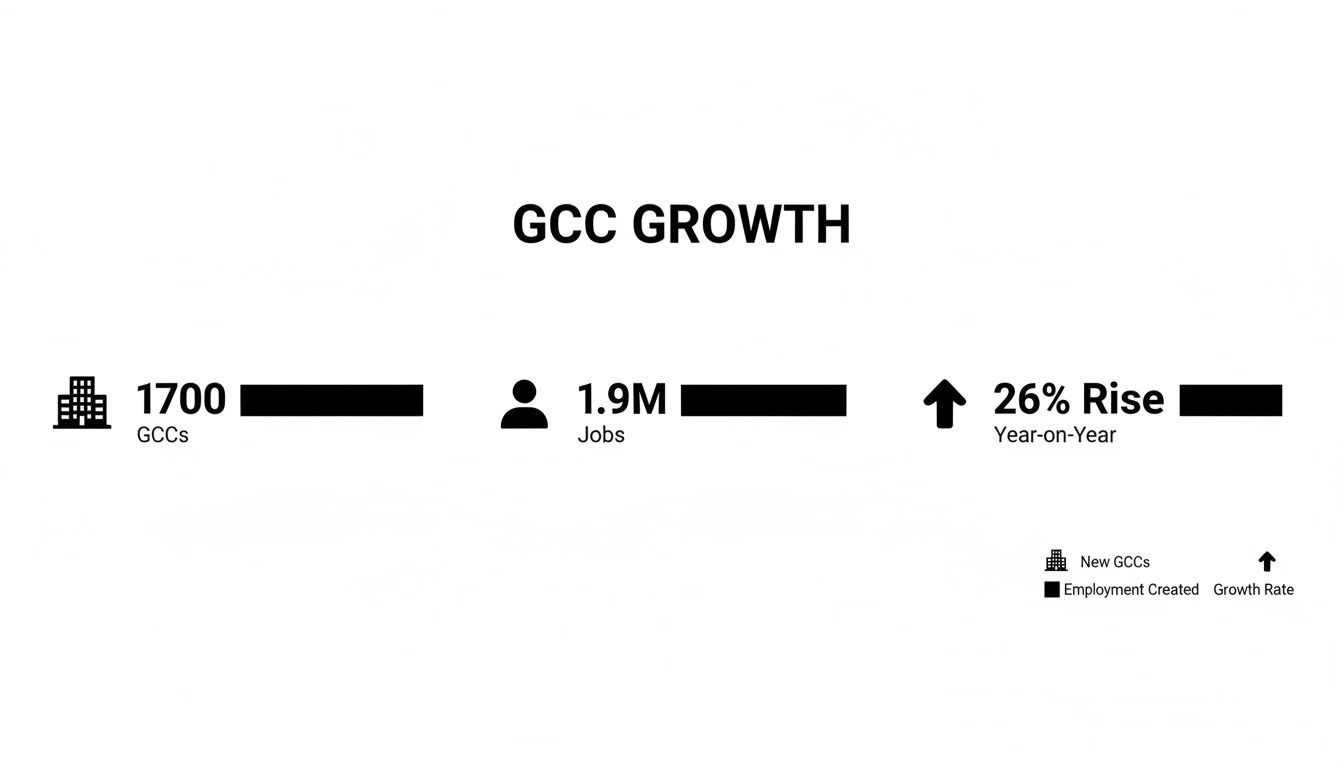
It’s clear the hiring demand is massive. For Chief Human Resources Officers (CHROs), this presents a critical challenge: the supply of high-calibre talent simply isn’t keeping up with the exponential demand.
The core challenge is no longer just finding people, but finding the right people with the sophisticated skills needed to drive innovation. Yesterday’s playbook of volume-based hiring is ill-equipped for today’s demand for value-driven expertise.
This talent crunch means it’s time to fundamentally rethink workforce strategy. Proactive, strategic approaches are now essential for survival, let alone success. Leaders need to be thinking about:
- Strategic Sourcing: Moving beyond the usual recruitment channels to uncover niche talent pools.
- Employer Branding: Building a compelling story that attracts top professionals who are looking for impact, not just another job.
- Talent Development: Creating robust internal upskilling programmes to build the skills you’ll need tomorrow, today.
Navigating this complex market requires more than a standard internal recruitment team. It calls for a strategic partner who brings deep market intelligence and the ability to execute. You can dive deeper by exploring the latest GCC growth trends and talent insights for 2026.
Decoding the New Talent Blueprint for Modern GCCs
The conversation around talent for India’s GCC boom needs to move beyond generic terms like ‘tech professionals’. The reality on the ground is far more specific. Today’s Global Capability Centres aren’t just hiring tech support; they’re building digital dream teams, and the makeup of these teams has fundamentally changed from transactional roles to high-impact, strategic positions.
Think of it like building a high-performance race car. You wouldn’t just ask for ‘car parts’. You’d specify high-tensile alloys, precision-engineered pistons, and advanced aerodynamics. In the same way, building a modern GCC requires a precise blueprint of skills, each one chosen for its specific function in driving global innovation.

The Most In-Demand Digital Competencies
The skills fueling this new era aren’t just technical afterthoughts; they are foundational to creating real business value. These are the competencies that allow a GCC to act less like a support centre and more like a global product powerhouse.
The most sought-after skills right now include:
- Artificial Intelligence and Machine Learning (AI/ML) Engineering: Professionals who can build, deploy, and maintain the intelligent systems – from predictive analytics to generative AI – that are now core to business strategy.
- Advanced Data Analytics and Data Science: Experts who can turn massive datasets into actionable business intelligence, guiding strategic decisions and uncovering new ways to grow revenue.
- Cybersecurity Specialists: With GCCs handling mission-critical operations, the need for talent that can defend digital assets against sophisticated threats has never been higher.
- Cloud FinOps Professionals: These specialists manage and fine-tune cloud spending, making sure the huge investment in cloud infrastructure delivers maximum return without waste.
- Platform Engineering: A discipline focused on creating and maintaining the internal platforms that developer teams use, directly boosting productivity and speeding up the entire software development lifecycle.
These roles don’t exist in a vacuum. They are interconnected cogs in a larger innovation machine, each one vital for building and scaling digital products for a global audience.
The Rise of the Blended Professional
Perhaps the most important shift we’re seeing is the skyrocketing demand for what we can call the ‘blended professional’. This is the new archetype of talent that organisations are scrambling to find.
A blended professional is someone who combines deep technical expertise with sharp business acumen. They aren’t just coders; they are strategic problem-solvers. They understand the ‘why’ behind the ‘what’, connecting their technical work directly to business outcomes.
This new talent archetype can speak the language of both technology and business. They can participate in a deep-dive on cloud architecture in the morning and present a compelling business case to senior leadership in the afternoon.
This dual capability is precisely what makes them so valuable. They close the traditional gap between IT and the business, ensuring that tech development is always locked in with strategic goals. For CHROs, building a pipeline for this new kind of talent isn’t a luxury anymore – it’s a competitive necessity. The focus is shifting from hiring specialists who execute tasks to finding strategic thinkers who can drive innovation.
Responding to a Shifting Market
This transformation in required skills is directly impacting hiring dynamics and, of course, compensation. The market is increasingly rewarding niche, high-impact capabilities. Projections show that by 2026, more than three-fourths of GCCs will be responsible for managing AI platforms, digital products, and cybersecurity.
This has caused the demand for mid-to-senior professionals to jump from 63% in 2023 to an expected 77% by 2025, pushing companies to offer significant premiums to land top-tier talent. Niche skills are already commanding salary hikes up to 1.7x higher than average, a clear signal of their market value. This trend makes it urgent for HR leaders to recalibrate their talent acquisition and compensation strategies to compete effectively.
Navigating the Key Challenges in GCC Talent Acquisition
The sheer intensity of competition for specialised skills within India’s GCC boom has turned talent acquisition into a high-stakes, mission-critical function. For CHROs and hiring leaders, the landscape is riddled with complex hurdles that can easily derail growth plans, stall innovation, and send operational costs spiralling if not handled proactively.
The race for talent is no longer just about filling seats. It’s about securing the strategic thinkers and builders who will define a GCC’s future.
This pressure cooker environment has created what we can call a ‘three-headed challenge’ that most organisations are now wrestling with. These aren’t separate problems but interconnected forces that feed off each other, making old-school, reactive hiring models dangerously ineffective. Getting a handle on these pain points is the first step to building a more resilient talent strategy.

The Problem of Relentless Attrition
Even as the broader market sees attrition rates start to cool down, the churn in critical, high-demand roles remains stubbornly high. Your most valuable players – the AI specialists, platform engineers, and data scientists – are constantly being headhunted by competitors waving very attractive offers. This creates a revolving door for your best people, disrupting project momentum and team morale.
When a key team member walks out the door, it’s not just a vacancy you have to fill. It’s a knowledge gap that can take months to plug. All the time and resources poured into onboarding and training a new hire, only to see them leave a year later, is a massive drain on productivity and a direct hit to the bottom line. This constant churn keeps teams stuck in a reactive loop of hiring and retraining, stealing focus from actual innovation.
Fierce Salary Competition for Niche Skills
The second major hurdle is the cutthroat competition over salaries, especially for niche skills. While overall salary hikes might be stabilising, professionals with hot skills are commanding huge premiums. This forces a tough balancing act for compensation teams: how do you stay competitive without letting your payroll costs get out of control?
The data tells the story. Even with salary increases steadying, niche skills can command premiums up to 1.7 times higher than the average. We’re also seeing lateral hires from competitors becoming more common than bringing in fresh talent. This environment exposes the true cost of hiring too fast; one new GCC, for instance, managed to bring on 300 hires in nine months but later realised half of them might need replacing due to quality issues.
This wage pressure makes budgeting a nightmare and can create serious internal equity problems if you’re not careful. It also proves that throwing money at the problem is no longer a sustainable strategy.
In a market where top candidates are juggling multiple offers, the real game isn’t just about the salary. It’s about building a compelling value proposition – meaningful work, clear career paths, and a culture of innovation that money simply can’t buy.
A Growing Leadership Vacuum
Finally, the explosive growth of GCCs has created a serious leadership vacuum at the mid-to-senior levels. Many centres are finding it incredibly difficult to find experienced leaders who have that perfect mix of deep technical expertise, sharp business acumen, and the people skills needed to guide large, complex teams. This shortage of seasoned leadership is a major bottleneck to growth.
Without strong leaders to mentor junior talent, drive strategic projects, and manage global stakeholder relationships, GCCs risk becoming inefficient and failing to deliver on their promise. The challenge is twofold: you have to find these leaders in a very tight market, and you have to start developing the next generation of leaders from within. Closing this leadership gap is absolutely critical for the long-term health and strategic impact of any GCC.
Adopting Strategic Workforce Planning for the New GCC Era
Trying to keep up with the fierce competition of India’s GCC boom is a losing game. To win, you need a deliberate, forward-thinking workforce plan that shifts your talent strategy from a defensive reaction to an offensive advantage. For CHROs, this means it’s time to ditch the outdated hiring models and put actionable solutions in place to build a resilient, future-ready workforce.
The heart of this shift is moving beyond just filling open roles as they appear. It’s about designing a talent ecosystem that can anticipate future needs, grow skills from within, and pull in the best external candidates. In a market defined by sky-high demand and a limited supply of top-tier professionals, this proactive approach is the only way to build a sustainable advantage.
Diversifying Talent Sourcing Beyond Tier 1 Hubs
The intense hiring pressure in traditional GCC hubs like Bengaluru and Hyderabad has created a serious talent bottleneck. Relying only on these saturated markets is getting more expensive and less effective by the day. The smart move is to look beyond the obvious and start tapping into the rich, often-overlooked talent pools in emerging Tier 2 and Tier 3 cities.
Places like Pune, Chennai, Jaipur, and Coimbatore are quickly becoming powerful GCC hubs in their own right. These cities offer access to a fresh stream of skilled graduates and experienced professionals, often with more reasonable salary expectations and better retention rates. This isn’t just about saving money; it’s a strategic play to de-risk your talent pipeline and build a more distributed and resilient workforce.
To do this, you’ll need a new sourcing playbook:
- Local Partnerships: Build strong relationships with regional universities and technical colleges to create a direct pipeline for entry-level talent.
- Remote-First Policies: Develop flexible work models that let you hire the absolute best person for the job, no matter where they live.
- Targeted Outreach: Launch employer branding campaigns specifically aimed at these emerging talent markets to build your reputation and attract local candidates.
To truly get ahead, CHROs and RPO partners must rethink how they find people. Moving from reactive, traditional methods to proactive, strategic ones is key.
Strategic Sourcing Models for GCC Talent
| Sourcing Strategy | Focus | Key Benefits | Best For |
|---|---|---|---|
| Traditional Sourcing | Reactive role-filling based on immediate open positions. | Quick to initiate for urgent needs. | Start-up GCCs with immediate, short-term hiring goals. |
| Proactive Pipelining | Continuously building relationships with passive candidates. | Reduced time-to-hire, access to high-quality talent. | Growing GCCs needing a steady stream of skilled professionals. |
| Internal Mobility | Prioritising internal talent for open roles and promotions. | Higher retention, lower hiring costs, better employee morale. | Mature GCCs focused on leadership development and retention. |
| Geographic Diversification | Tapping into talent pools in Tier 2 & 3 cities. | Access to new talent, lower costs, reduced market competition. | Established GCCs looking to scale and de-risk their talent supply. |
| Skills-Based Hiring | Focusing on proven capabilities over traditional credentials. | Broader talent pool, improved diversity, better job-fit. | Tech-focused GCCs needing niche, cutting-edge skills. |
Ultimately, a blended approach that combines these models will give your GCC the flexibility and strength it needs to thrive in this competitive market.
Building a Powerful Internal Mobility Engine
In the race to hire external talent, many companies forget about their most valuable asset: their current employees. Creating a robust internal mobility and upskilling engine is one of the smartest ways to close critical skill gaps and develop your next generation of leaders from within.
An “internal-first” mindset sends a clear message to your team that their growth is a top priority. This is a massive booster for employee engagement and retention, helping to stop the constant churn of your best performers. When people see a clear path for advancement and skill development inside the company, they are far less likely to start looking elsewhere.
The most successful GCCs are becoming “talent factories.” They don’t just hire for the skills they need today; they actively build the capabilities they will need tomorrow by investing heavily in continuous learning and internal career progression.
To build this engine, focus on creating transparent career paths and giving your team access to top-notch learning resources. This transforms your organisation from a place where people just have a job to a place where they can build a career. If you’re looking to refine your approach, you can learn more about developing a comprehensive strategic workforce plan that drives talent acquisition.
Crafting a Compelling Employer Value Proposition
In a market where top candidates are juggling multiple offers, a competitive salary is just the price of entry. To really stand out, you need a compelling Employer Value Proposition (EVP) that speaks directly to what modern GCC talent truly wants. This goes way beyond perks and benefits.
Today’s top professionals are looking for impact. They want to work on mission-critical projects that have a real, tangible influence on a global scale. Your EVP must tell a powerful story about the innovative and meaningful work happening inside your GCC. It should shine a light on opportunities for professional growth, exposure to new technology, and a clear career path.
Think about what truly makes you different. Is it your culture of engineering excellence? Your commitment to solving complex global problems? The chance to build products from the ground up? Whatever your unique selling point is, it needs to be the heart and soul of your employer brand. This is the story that will attract candidates who are looking for more than just a paycheque – it will attract the passionate builders and innovators who will drive your success.
Leveraging RPO to Win the GCC Talent War
In a market this competitive, sticking to traditional recruitment methods is like bringing a knife to a gunfight. You need a real strategic offensive to win the war for talent in India’s booming GCC sector. This is precisely where Recruitment Process Outsourcing (RPO) flips the script, transforming your hiring function from a reactive cost centre into a proactive, strategic weapon.
Think of a true RPO partner as the air traffic controller for your entire talent acquisition ecosystem. While you steer the high-level workforce strategy, they expertly manage the complex, day-to-day hiring workflows with precision and scale. This isn’t just about outsourcing a task; it’s about embedding an expert team that acts as a natural extension of your own, armed with the tools, data, and market intelligence to outmanoeuvre the competition.
Scalability on Demand for Aggressive Growth
One of the most powerful advantages of an RPO partnership is immediate, unmatched scalability. Let’s say your GCC needs to hire 300 specialists in nine months. Your internal team would likely be stretched to its breaking point, leading to rushed decisions, recruiter burnout, and a nosedive in hiring quality. An RPO provider is built for exactly this kind of pressure.
They can rapidly deploy experienced sourcing specialists, recruiters, and coordinators to absorb sudden hiring spikes without saddling you with long-term overhead.
- Ramp Up: Instantly scale hiring capacity for new projects or centre expansions.
- Ramp Down: Flexibly scale down recruitment resources once hiring targets are met, keeping costs lean.
This kind of elasticity means you can hit aggressive growth targets without compromising the quality of your hiring process. It’s about having the right amount of firepower, exactly when you need it.
Gaining Access to Specialised Talent Channels
The most sought-after professionals in the GCC space – the AI engineers, cybersecurity gurus, and platform architects – aren’t scrolling through job boards. These are passive candidates, deeply immersed in their work. They need to be found, engaged, and persuaded. This is where RPO partners truly shine, bringing deep access to specialised sourcing channels that most internal teams simply don’t have.
An RPO provider doesn’t just post jobs; they hunt for talent. They meticulously map the market, build relationships within niche tech communities, and cultivate pipelines of passive candidates. This gives you exclusive access to the top 10% of the talent pool that your competitors can’t even find.
Their expertise turns sourcing from a passive waiting game into a proactive, intelligence-led operation. They know where the best talent lives, both online and offline, and understand how to craft the right message to grab their attention. For filling those hard-to-find, high-impact roles that will define your GCC’s success, this specialised knowledge is critical. As you consider this model, you might want to dive deeper into how Recruitment Process Outsourcing can improve hiring results and the specific value it drives.
Enhancing Quality of Hire Through Data and Discipline
In the frantic race to fill roles, quality is often the first casualty. A major pitfall for new GCCs is the “talent quality problem” – headcount targets are met, but a significant chunk of new hires underperform, leading to costly re-hiring and lost productivity. A strategic RPO partner combats this by embedding data and discipline into every single stage of the hiring process.
They implement a structured, consistent approach from day one:
- Standardised Screening: Using calibrated benchmarks ensures every candidate is measured against the same high bar, eliminating bias and inconsistency.
- Data-Driven Decisions: They track key metrics like source-of-hire, pass-through rates, and time-to-fill to continuously refine the process and focus on what works.
- Rigorous Vetting: They conduct thorough technical and cultural assessments to ensure not just a skills match, but a genuine, long-term fit for your organisation.
This disciplined methodology means your hiring decisions are driven by objective data, not gut feelings or the pressure to fill a seat quickly. It’s the difference between truly building a team and just filling a headcount. This focus on quality is absolutely essential for creating a world-class GCC that can deliver on its promise of innovation and global impact.
Building a Magnetic Employer Brand for Your GCC
In the crowded market created by India’s GCC boom, a competitive salary is just table stakes. It’s the ticket to the game, not the way you win. The real differentiator what makes top talent stop scrolling and start applying – is an authentic and powerful employer brand.
The story you tell about the work inside your GCC is now just as crucial as the compensation package you offer. To win, you have to change the conversation. Stop talking about generic perks and start showcasing the mission-critical, innovative projects your teams are driving. That’s what grabs the attention of high-calibre professionals who want to make an impact, not just fill a role.
From Back Office to Global Engine
Your first 50 to 100 hires are everything. They are the architects of your culture and the foundation for your long-term success. Your employer brand has to reflect this reality: your GCC isn’t a support function; it’s a global innovation engine.
This means your messaging needs to be sharp and specific. Forget vague claims about being a “great place to work.” Instead, demonstrate it. Show how your teams in India are leading global product development, pioneering new AI applications, or engineering the next generation of cloud infrastructure. That’s the story that will connect with ambitious, top-tier talent.
Activating Your Brand Ambassadors
Your most powerful storytellers are already on your payroll. Nobody can speak to your culture and your work with more credibility than your current employees. Empowering them to share their experiences isn’t just a tactic; it’s a game-changing strategy.
Here are a few practical ways to bring your brand to life:
- Create ‘Day in the Life’ Content: Get your engineers, data scientists, and project managers on camera. Let them explain, in their own words, the complex problems they’re solving and why their work matters.
- Showcase Internal Growth Stories: Highlight team members who have climbed the ladder within the GCC. This provides tangible proof that you’re serious about career development a massive draw for top candidates.
- Host Tech Talks and Open Houses: Encourage your senior technologists to speak at industry events or host virtual open houses. This doesn’t just showcase expertise; it positions your GCC as a place where the smartest people want to be.
These aren’t just marketing activities. They build a genuine connection with the talent community you’re trying to attract.
In a crowded market, the most compelling employer brands don’t just broadcast messages; they build communities. They create a narrative so powerful that the best candidates don’t just apply for jobs they ask to join a mission.
The New Bottom Line in Talent Attraction
At the end of the day, winning the talent war in India’s GCC boom is about creating a story that cuts through the noise. It’s about building an identity that stands for innovation, impact, and real career growth.
This requires a deliberate strategy. You need to define your story and then tell it everywhere – from your career page and social media to industry forums. When your brand truly reflects the exciting work happening inside your GCC, you stop competing on salary alone and start attracting people who are genuinely invested in your mission.
Answering the Big Questions on India’s GCC Talent Market
As you navigate India’s booming GCC landscape, a few key questions always come up. Here are some straight answers to the most common queries we hear from CHROs and business leaders.
What Are the Biggest Mistakes When Scaling a GCC in India?
The classic mistake is getting fixated on cost arbitrage. Many leaders come in chasing savings but forget that the real prize is long-term value creation.
Other common pitfalls? Underestimating just how fierce the competition is for senior and niche talent, completely neglecting employer branding, and rushing the hiring process without solid quality checks. This toxic mix often leads to a revolving door of early-stage attrition and expensive re-hiring cycles that can cripple your growth plans before they even get off the ground.
How Are Salaries for Key Tech Roles Trending?
It’s a split market right now. While overall salary hikes are starting to stabilise across the board, the devil is in the details. Standard tech roles are seeing moderate, predictable increases.
But for those with niche skills in AI/ML, data science, and cybersecurity, it’s a different story. These specialists can command significant premiums. We’re seeing salary hikes for these in-demand roles hit as high as 1.7 times the average, proving that compensation is now tightly linked to specific, high-impact capabilities.
The takeaway for talent leaders is crystal clear: your compensation strategy has to be surgical. A one-size-fits-all approach is doomed to fail. It simply won’t attract or keep the specialised professionals who are driving the most significant business outcomes.
Which Cities Are the Next Big GCC Hubs?
The map is definitely expanding. Of course, the established centres like Bengaluru, Hyderabad, and Pune are still powerhouses. But you can’t ignore the momentum building in other Tier-1 cities like Chennai and the National Capital Region (NCR).
What’s really interesting, though, is the significant investment pouring into emerging Tier-2 cities. Places like Ahmedabad, Coimbatore, and Jaipur are quickly becoming hotbeds for GCCs, offering access to fresh talent pools and unique operational advantages.
Ready to build a world-class GCC team without the usual friction? Taggd delivers strategic Recruitment Process Outsourcing solutions designed to help you win the war for talent. Discover how we can speed up your hiring and elevate quality.