The insurance sector in India is in the middle of a seismic shift. We’re seeing unprecedented growth, the kind that completely redraws the map for talent acquisition. This isn’t just a minor uptick; it’s a tidal wave of opportunity driven by digital transformation, supportive regulations, and a massive market expansion.
For anyone in HR, this surge means one thing: an urgent, almost insatiable demand for skilled professionals, especially in tech, data analytics, and customer experience. The very DNA of the industry’s workforce is changing before our eyes.
The Talent Tsunami in India’s Insurance Sector
Welcome to the new reality of Indian insurance. If you’re a Chief Human Resources Officer, getting your head around the sheer scale of the talent demand isn’t just a good idea, it’s a matter of survival. We’re witnessing a fundamental market expansion that’s creating a near-constant need for top-tier professionals. This isn’t some far-off prediction; it’s happening right now.
What’s fuelling this? A few powerful forces are converging. The industry is pushing deeper into previously untapped regions, and at the same time, helpful government regulations are clearing the path for growth. Throw in a fresh wave of capital from recent IPOs that’s bankrolling ambitious tech projects, and you’ve got the perfect storm, a massive opportunity, but an equally immense challenge for your recruitment teams.
Understanding the Scale of Growth
The numbers here are genuinely eye-watering. India’s insurance industry is on a trajectory to hit a market size of Rs. 19,30,290 crore (US$ 222 billion) by FY26. This isn’t a slow burn; it’s powered by a blistering CAGR of 17% over the last two decades. It’s no wonder the Banking, Financial Services, and Insurance (BFSI) space is tipped to be the top job creator in 2026.
This growth story brings us to the core challenge this guide is all about. It’s not enough to just fill open positions anymore. The real question is, how do you build a workforce that’s ready for a future that is digital, fast-paced, and fiercely competitive?
The challenge for CHROs isn’t just about the volume of recruitment; it’s about velocity and vision. It’s about finding the right people with the right skills before your competitors do and building a talent pipeline that can keep up the momentum for years to come.
The Strategic Imperative for CHROs
This guide is designed to be a practical roadmap, not just a high-level overview. We’re going to get into the specifics: the digital skills you need right now, the five most critical hires you absolutely have to make, and real strategies for attracting top talent who might have never even considered a career in insurance.
The goal is to give you the insights you need to turn this talent tsunami from a daunting problem into a real strategic advantage. It’s about making sure your organisation rides this massive wave of growth instead of getting pulled under by it.
How Digital Transformation Is Rewriting Every Job Role
The biggest shift happening in insurance hiring right now isn’t about filling more seats, it’s about finding people for entirely different kinds of seats. The wave of digital change is fundamentally redrawing the map of skills your organisation needs to not just survive, but to lead the pack. This isn’t a fleeting trend; it’s a deep, structural change in how insurance is designed, sold, and serviced.
This whole evolution is being accelerated by two major forces: the explosive growth of India’s online insurance marketplace and the disruptive energy of agile Insurtech startups. As core processes like underwriting, claims, and customer service get infused with AI and big data, the old skill sets are quickly becoming outdated. We’re moving from manual processing to automated intelligence and from generalist roles to highly specialised digital functions.
The New Digital-First Landscape
You just have to look at the numbers to see where this is headed. India’s digital insurance sector is expanding at a blistering pace. The online market is expected to hit USD 10.4 billion in 2025 and is on track to double to USD 20.8 billion by 2034. This rocketing growth has positioned India as the second-largest insurtech hub in the Asia-Pacific region, attracting a massive 35% of all venture investments.
This isn’t just an industry statistic; it’s a direct mandate for your recruitment strategy. This flood of capital and customer demand is fuelling the need for tech-savvy professionals who can build, manage, and secure the digital platforms where modern insurance gets done. The talent you hire today will directly determine your market share in this new ecosystem.
The image below breaks down the key drivers powering this incredible growth, from expanding market reach to supportive regulations and fresh IPO funding.
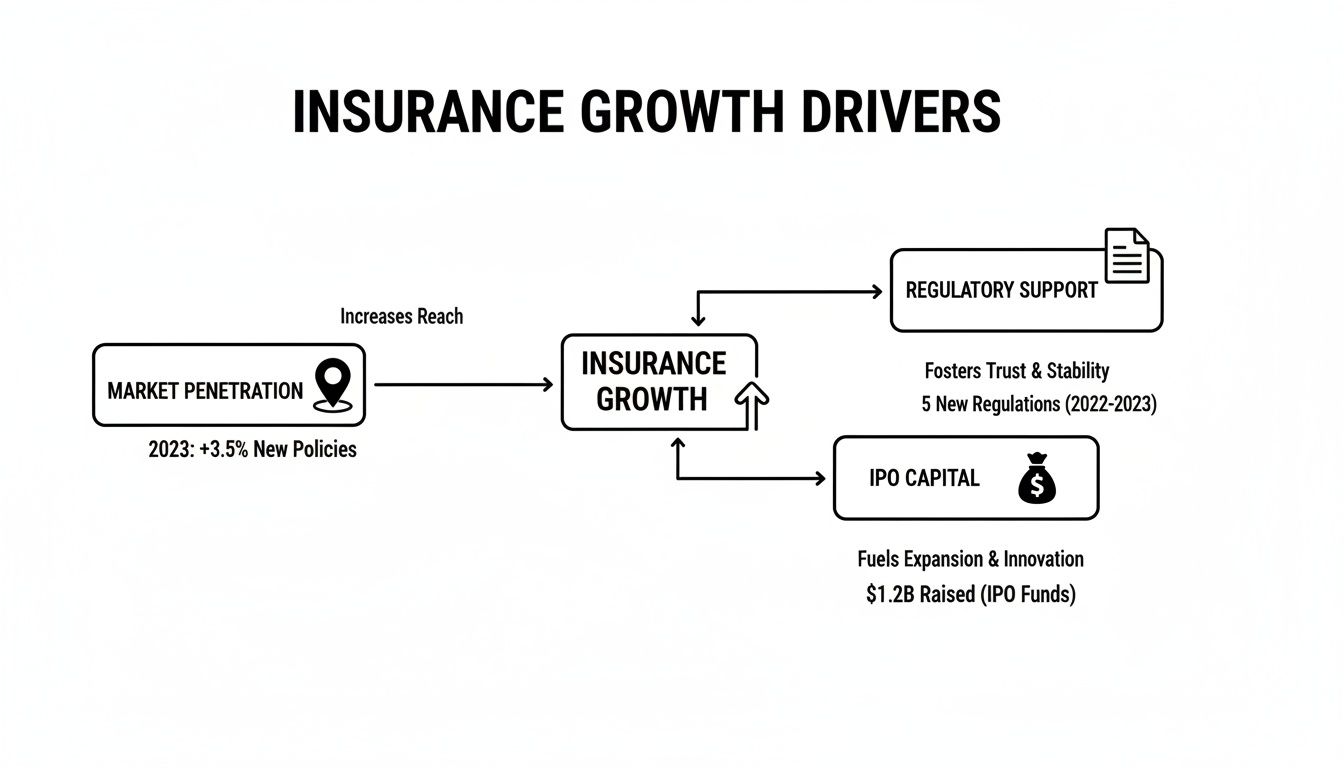
These three forces, market penetration, favourable regulations, and new investment, are creating the perfect storm for digital-first insurance models to thrive. And that, in turn, dictates exactly the kind of talent you need to be hiring.
From Traditional Roles to Digital Experts
For decades, an insurance company operated like a well-oiled factory, with every role designed for maximum efficiency within a predictable, established system. Today, it needs to function more like a technology company, with teams built for agility, constant innovation, and data-driven decisions.
The job descriptions themselves are being rewritten from the ground up. An underwriter who once relied on static actuarial tables now needs to be comfortable interpreting insights from machine learning models. A claims adjuster who spent their days visiting sites now needs to analyse drone footage and AI-powered damage assessments. The game has completely changed.
Here’s a snapshot of how traditional roles are morphing into their digital counterparts.
The Evolution of Insurance Skills from Traditional to Digital
| Traditional Role | Legacy Skillset | Evolved Digital Role | In-Demand Digital Skillset |
|---|---|---|---|
| Actuary | Historical data analysis, financial modelling, risk assessment | Data Scientist | Predictive analytics, machine learning, Python/R, big data platforms |
| Claims Adjuster | On-site investigation, manual documentation, negotiation | Claims Experience Manager | Digital forensics, AI-powered assessment, customer journey mapping |
| Sales Agent | Face-to-face selling, relationship building, policy explanation | Digital Marketing Specialist | SEO/SEM, content marketing, lead generation, social media strategy |
| Policy Administrator | Manual processing, record keeping, customer queries | Digital Product Manager | Agile methodologies, UX/UI principles, data analysis, customer feedback loops |
| Underwriter | Risk evaluation based on static tables, policy issuance | AI & ML Underwriter | Algorithm interpretation, data modelling, automated risk analysis |
This isn’t just a minor update; it’s a complete reinvention of the workforce. To dig deeper into how technology is reshaping HR, check out our guide on the role of digital transformation in HR.
Success is no longer about optimising old roles. It’s about creating entirely new ones that are native to a digital-first business model. This is the new reality of hiring in the insurance industry.
The Five Critical Hires You Must Make in 2026
With the entire industry shifting under your feet, knowing where to focus your recruitment budget is more than a priority, it’s the key to staying competitive. The most pressing insurance hiring trends point not just to more staff, but to fundamentally new kinds of expertise.
These roles are the engine room of a modern insurance company. Getting them right will define your success through 2026 and beyond.
So, where do you begin? Forget casting a wide net. Strategic hiring means focusing your resources on the roles that deliver the biggest business impact. This isn’t about simply filling seats; it’s about building capabilities that will directly support your growth, innovation, and customer retention goals.
Let’s break down the five most critical hires your organisation needs to prioritise right now.

1. Data Scientists and Analysts
They say data is the new oil. In insurance, it’s the bedrock of everything from underwriting to customer personalisation. A Data Scientist is no longer a “nice-to-have” but an essential asset who can turn mountains of raw information into profitable business decisions.
They’re the ones building the predictive models that allow you to price risk more accurately, identify potential fraud before it happens, and create hyper-personalised products that actually resonate with customers. Hiring top-tier data talent directly translates into a stronger bottom line and a massive competitive edge.
It’s no surprise that recent labour market studies consistently show that technology roles, which include data science and analytics, remain the most in-demand category for insurance carriers.
2. Cybersecurity Analysts
As you collect more customer data and shift operations online, your vulnerability to cyber threats multiplies. A single data breach can erase years of customer trust and result in devastating financial and reputational damage.
This is what makes a Cybersecurity Analyst one of the most important hires you can possibly make. Their job is to build a digital fortress around your operations, protecting sensitive policyholder information, securing your payment gateways, and making sure your digital platforms are resilient.
In a market where trust is everything, investing in cybersecurity is a direct investment in your brand’s integrity. It sends a clear message to customers that their data is safe with you.
In the digital-first insurance landscape, your cybersecurity team is as critical as your underwriters. One protects your financial risk; the other protects your entire business from existential threats.
3. Digital Customer Experience (CX) Managers
Today’s customers expect a seamless, intuitive digital journey, whether they’re buying a policy, filing a claim, or just asking a question. A Digital CX Manager is the architect of that experience, ensuring every online interaction is smooth, simple, and satisfying.
This role sits at the intersection of technology, marketing, and customer service. They use data to understand customer behaviour, identify pain points in the digital journey, and implement improvements that drive loyalty and reduce churn.
In an increasingly crowded market, a superior customer experience is often the only thing that sets you apart from the competition.
4. Insurtech Product Innovators
The pace of change is being set by agile Insurtech startups that are constantly launching new, customer-centric products. To keep up, you need people who think like them. An Insurtech Product Innovator is a hybrid talent who understands both the intricacies of insurance and the principles of modern product development.
These individuals are tasked with:
- Identifying unmet customer needs and market gaps.
- Developing new digital-first insurance products, like on-demand or usage-based policies.
- Managing the product lifecycle from idea to launch using agile methodologies.
- Collaborating with tech teams to ensure new products are built on a scalable and secure foundation.
Hiring for this role is your ticket to capturing new market segments and future-proofing your product portfolio against disruption.
5. Governance and Digital Ethics Officers
Finally, as you race to adopt AI and automate decisions, you introduce new and complex risks. A Governance and Digital Ethics Officer ensures that your innovation doesn’t outpace your responsibility. This role is becoming increasingly critical as regulators and customers demand more transparency.
This expert is responsible for creating frameworks to ensure your algorithms are fair and unbiased, your data usage is transparent and ethical, and your operations comply with evolving data privacy laws.
This hire isn’t about slowing down innovation. It’s about enabling sustainable growth by building a foundation of trust and accountability, proving that you’re not just a technology-driven company, but a responsible one.
Winning Talent That Never Considered Insurance

Let’s be honest. The best data scientists, cybersecurity experts, and product innovators aren’t scanning insurance company career pages. They’re looking at tech firms and startups, drawn to their fast-paced, mission-driven cultures. If you want to grab their attention, you can’t just post another job ad. You have to completely change how they see the entire industry.
This is one of the biggest insurance hiring trends right now, the battle for talent outside the traditional candidate pool. To win, you need a new playbook, one borrowed directly from the tech sector. It’s not just about a competitive salary anymore; it’s about selling a fresh vision of what working in insurance can be.
The biggest hurdle is a perception problem. For many young professionals, “insurance” sounds like stability at the expense of excitement, a world of legacy systems, not groundbreaking projects. Your first job is to shatter that stereotype.
Remodelling Your Employer Value Proposition
To attract digitally-native talent, your Employer Value Proposition (EVP) needs a serious overhaul. You need to think less like a financial institution and more like a high-growth tech company. This means shifting your message to focus on what really resonates with Millennials and Gen Z.
They want to see three things, loud and clear:
- Purpose and Impact: Show them how their code will protect families from financial hardship or how their data models will make healthcare more accessible. Connect the dots between their day-to-day tasks and a bigger, more meaningful mission.
- Innovation and Challenge: Don’t talk about insurance as a static industry. Frame it as a sector packed with complex, unsolved problems. Highlight the opportunities to work with AI, machine learning, and big data to build things that have never existed before.
- Growth and Opportunity: Map out clear career paths that reward skill and contribution, not just seniority. Show them how working in Insurtech offers a unique mix of stability and cutting-edge experience.
This change in framing is everything. You’re not just offering a job; you’re offering them a front-row seat to the reinvention of a massive industry.
Your employer brand needs to shout that you are a technology company that just happens to sell insurance, not the other way around. This simple but powerful shift in identity is what attracts the best digital minds.
Building a Tech-Centric Employer Brand
Once your EVP is redefined, you have to get the word out where your target talent actually spends their time. This means looking beyond traditional job boards and building a real presence in the tech community.
Sponsor hackathons. Contribute to open-source projects. Get your tech leaders to speak at industry conferences. Start a tech blog that dives into the interesting engineering and data science challenges your teams are tackling. This kind of authentic engagement builds credibility and shows that you actually “get” their world.
Flexibility is another deal-breaker. A recent study found that 78% of insurance companies now run on a hybrid model. If you don’t offer meaningful remote work options, you’re immediately out of the running for most top tech candidates. To dig deeper into what modern professionals are looking for, it’s worth understanding what candidates want from insurance employers.
Speaking the Right Language in Recruitment
Finally, the recruitment process itself has to match this new identity. Your job descriptions need to be free of corporate jargon and focused on the tech stack, the project’s impact, and the problems the candidate will get to solve.
Your interview panel should include tech leaders who can talk shop with candidates, discussing architectural decisions and development methods on their level. The whole experience should feel agile, respectful of their time, and focused on finding a mutual fit. From the very first email, it has to signal that you are a modern, forward-thinking organisation.
Using RPO to Master High-Stakes Recruitment
The aggressive hiring goals we’re seeing across the insurance industry can quickly swamp even the most capable internal HR teams. As the demand for specialised digital talent gets more intense, how do you scale up recruitment without quality taking a nosedive or your own people burning out?
This is exactly where Recruitment Process Outsourcing (RPO) goes from being a simple service to a powerful strategic partnership. An RPO partner really becomes an extension of your company, bringing the specialised expertise, technology, and sheer recruiting power needed to compete. It’s about much more than just filling empty seats; it’s about building a solid, sustainable talent pipeline. This frees up your internal leaders to focus on what they do best, nurturing the company culture, boosting employee engagement, and driving retention.
When RPO Provides the Winning Edge
Think of your in-house recruitment team as a highly skilled special forces unit, perfect for targeted, strategic missions. An RPO provider, on the other hand, is the full-scale logistical support that helps you win the larger campaign. They bring a level of scale and process efficiency that’s often tough to build and maintain internally, especially when you’re hit with sudden, high-volume hiring needs.
This isn’t a one-size-fits-all solution. It’s a strategic move you make for specific, high-stakes scenarios. Here are a few real-world examples where an RPO partnership becomes a genuine game-changer for an insurance company:
- Rapidly building a new division: Imagine you get the green light to stand up a 50-person data science and analytics unit in just six months. Your internal team can’t just drop everything else. An RPO partner can deploy a dedicated team of recruiters, people with deep connections in the data community, to manage the entire process, from sourcing right through to onboarding.
- Filling niche Insurtech roles: Finding a single cybersecurity analyst with real experience in the insurance sector can take months. A good RPO provider maintains active talent pools of these hard-to-find professionals, which can drastically cut down your time-to-fill for these critical positions.
- Launching digital-first service centres: When you’re opening a new digital service hub that needs hundreds of customer experience and tech support staff, volume is the name of the game. An RPO partner excels at managing these high-volume hiring campaigns, ensuring a steady flow of qualified candidates without disrupting your day-to-day HR operations.
RPO isn’t just about outsourcing recruitment; it’s about insourcing a world-class talent acquisition function on demand. It provides the muscle, market intelligence, and speed you need to execute ambitious growth plans.
This partnership transforms recruitment from a reactive, often chaotic function into a proactive, strategic asset. For a deeper dive into how this model works, you can find a comprehensive explanation in this guide to everything you need to know about RPO.
Deciding Between RPO and Your In-House Team
The decision to bring in an RPO isn’t about replacing your internal team, it’s about augmenting them. The key is understanding which recruitment challenges are best handled by your team’s deep cultural knowledge and which ones need the scale and specialisation of an RPO partner. Knowing when to call for external expertise is a huge part of mastering today’s insurance hiring trends.
The table below offers a practical guide to help you decide on the most effective approach for different hiring scenarios you might face.
Choosing Between RPO and In-House Recruitment
A practical guide helping CHROs decide the most effective approach for different hiring scenarios and business goals.
| Hiring Scenario | Best Suited for In-House Team | Ideal for RPO Partnership |
|---|---|---|
| Executive Leadership Roles | Roles requiring deep cultural fit and long-term strategic alignment, like a new CFO or Head of Innovation. | Not typically used for C-suite hires, which often fall to specialised executive search firms. |
| High-Volume Role Fulfilment | Standard, ongoing hiring for core business roles where processes are well-established. | Mass hiring projects, such as staffing a new call centre or a large-scale entry-level intake. |
| Niche or Hard-to-Fill Skills | Occasional, one-off specialist hires where your team has existing networks. | Sourcing multiple roles with rare skill sets, such as AI ethics officers or blockchain developers. |
| Geographic Expansion | Hiring within your existing city or region where your employer brand is already strong. | Entering a new market where you have no brand recognition or local talent networks. |
| Sudden Hiring Surges | Predictable, seasonal hiring increases that your team can plan for in advance. | Unplanned, project-based hiring spikes that would overwhelm your team’s current capacity. |
At the end of the day, using RPO is a strategic investment. It lets you meet the aggressive demands of the market with agility and precision. By blending your in-house expertise with the scale of an RPO partner, you ensure your talent acquisition capabilities become a driver of business growth, not a bottleneck holding it back.
Your Top Insurance Hiring Questions, Answered
As a CHRO, I know it’s one thing to talk about high-level strategy and another to make it happen on the ground. When it comes to modernising your talent approach, practical questions always come up. So, let’s get into the “how.”
This is where we move from theory to action. From finding those niche digital experts to actually measuring the business impact of your hiring decisions, each answer here is designed to solve a specific challenge and give you something you can use right away.
What are the most effective channels for sourcing digital talent?
Forget relying only on traditional job boards. The best digital talent you’re looking for? They’re probably not even looking for a job. You need to meet them where they already are.
That means going to tech-specific platforms like GitHub and Stack Overflow, building a strong presence on professional networks like LinkedIn where you can pinpoint exact skills, and creating real partnerships with university computer science and data analytics departments.
An RPO partner really shines here because they live in these channels. They’re constantly nurturing relationships with passive candidates, the ones with the exact niche skills you need, who will never see your job ad because they aren’t looking.
The real game-changer is diving into industry-specific forums and virtual hiring events focused on Insurtech and Fintech. This is how you cut through the noise and get direct access to a relevant, pre-vetted talent pipeline of proven experts.
How can we measure the ROI of partnering with an RPO provider?
Thinking about the ROI of an RPO partnership purely in terms of cost-per-hire is missing the bigger picture. The real value shows up in key business metrics that prove you’re hiring faster, better, and smarter.
A proper ROI analysis has to include:
- Time-to-Fill for Critical Roles: Getting a key role filled weeks sooner means projects move forward faster and revenue comes in quicker. That delay has a real, tangible cost.
- Quality-of-Hire: Look at performance reviews after six months and retention rates after the first year. A high-quality hire is productive from the get-go and doesn’t walk out the door, saving you the immense cost of backfilling the role.
- Cost Savings: This is straightforward. Track how much less you’re spending on expensive one-off agency fees and general job advertising. An RPO model should bring economies of scale.
- Scalability Efficiency: How quickly can you ramp hiring up for a new initiative, or scale it down during a quiet period, without touching your fixed overheads? That agility is pure gold.
A good RPO provider won’t shy away from this. They’ll work with you to define these KPIs from day one and give you transparent reports that show you exactly the business impact they’re making.
How can we attract innovative tech talent without a complete overhaul?
You don’t have to completely reinvent your company to become a magnet for tech innovators. The secret is to create and aggressively market “innovation pockets” or “digital labs” inside your organisation. Think of them as internal startups that offer the best of both worlds: the impact of a startup with the stability of an established company.
Your marketing needs to be laser-focused. Position these specific teams as unique, startup-like environments. Talk about their agile workflows, the cool projects they’re working on, and how their work directly impacts the business’s bottom line. It’s a powerful story that lets you show off a forward-thinking culture without having to change everything overnight.
Sweeten the deal with project-based bonuses and map out clear, exciting career paths for these tech specialists. This is another area where an RPO partner can be a huge help, crafting targeted messages that make these unique roles irresistible. You’ll attract the kind of people who are genuinely excited by the challenge of driving change from within a stable, major industry.
At Taggd, we specialise in building the high-impact talent pipelines that insurance leaders need to thrive. Our RPO solutions are designed to deliver the speed, scale, and expertise required to win the war for digital talent. Discover how we can help you meet your most ambitious hiring goals at Taggd.