Logistics recruitment is much more than just filling jobs. It’s the strategic engine for sourcing, assessing, and hiring the talent that powers your entire supply chain, from the warehouse floor to the data analytics team. What used to be a straightforward process has now become a critical business function, essential for navigating huge shifts in technology and ever-growing consumer demands.
Understanding the New Logistics Talent Landscape
Think of your company’s logistics network as its circulatory system. It’s the intricate web of arteries and veins—warehouses, transport routes, and delivery hubs—that keeps the lifeblood of commerce flowing from supplier to customer. In this picture, talent is the oxygen. A blockage in the flow of skilled people doesn’t just slow down a department; it threatens the health of the entire organisation.
For Chief Human Resources Officers (CHROs), the game has completely changed. Logistics recruitment is no longer just about hiring drivers and warehouse staff. Today, it’s about finding specialists who can manage automated sorting systems, data scientists who can predict supply chain disruptions, and optimisation experts who can shave precious minutes off last-mile delivery. This reality calls for a new playbook, one that shifts from reactive hiring to proactive workforce architecture.
The Forces Reshaping Talent Demand
Several powerful market forces are redrawing the map for logistics talent. The explosive, sustained growth of e-commerce has permanently reset customer expectations, making speed and accuracy completely non-negotiable. This pressure demands a far more sophisticated workforce than ever before. At the same time, new national policies and massive infrastructure investments are creating both opportunities and complexities that require specialised expertise to navigate.
The market data tells a clear story. Logistics hiring in India is on the verge of a major expansion, with projections pointing to a 15% rise in staffing needs and the creation of around 500,000 new jobs. We’re already seeing early indicators of this boom, with staffing activities surging by 40%, largely driven by a 25% hiring increase in the e-commerce sector alone.
Let’s break down the key drivers transforming the talent landscape and what they mean for you as a CHRO.
Key Drivers Transforming Logistics Talent Demand
| Market Driver | Impact on Recruitment | Strategic Implication for CHROs |
|---|---|---|
| Explosive E-commerce Growth | Unprecedented demand for last-mile delivery drivers, warehouse automation specialists, and supply chain analysts. | Develop targeted sourcing strategies for tech-savvy operational roles and build a strong employer brand to attract gig workers. |
| Technological Integration | Need for professionals skilled in AI, IoT, robotics, and data analytics to manage smart warehouses and predictive logistics. | Partner with educational institutions to build a talent pipeline and invest in upskilling programs for the existing workforce. |
| National Policy & Infrastructure | New roles emerging in compliance, cross-border logistics, and infrastructure management due to initiatives like the National Logistics Policy. | Stay ahead of policy changes to anticipate new skill requirements and ensure the recruitment strategy aligns with national economic goals. |
| Sustainability Focus | Growing demand for experts in green logistics, EV fleet management, and sustainable packaging to meet corporate ESG goals. | Emphasise the company’s commitment to sustainability in employer branding to attract talent motivated by purpose and social impact. |
These drivers aren’t just creating more jobs; they’re creating different jobs. As a CHRO, recognising this shift is the first step toward building a workforce that can not only cope but thrive.
Your logistics recruitment strategy is no longer a support function; it’s a competitive differentiator. The ability to attract and retain professionals who can manage technology-driven supply chains directly impacts operational efficiency, customer satisfaction, and profitability.
From Tactical Hiring to Strategic Advantage
This new environment demands that CHROs completely redefine their approach. Effective logistics recruitment has become a strategic imperative, the bedrock of a resilient and competitive supply chain. It’s about securing the right people not just for today’s operational grind, but to drive tomorrow’s innovation and growth. This strategic mindset ensures your business is ready for whatever comes next, from seasonal peaks to unexpected global disruptions. For a closer look at the roles in high demand across this dynamic sector, you can learn more about the evolving job landscape in logistics.
Closing the Critical Logistics Skills Gap
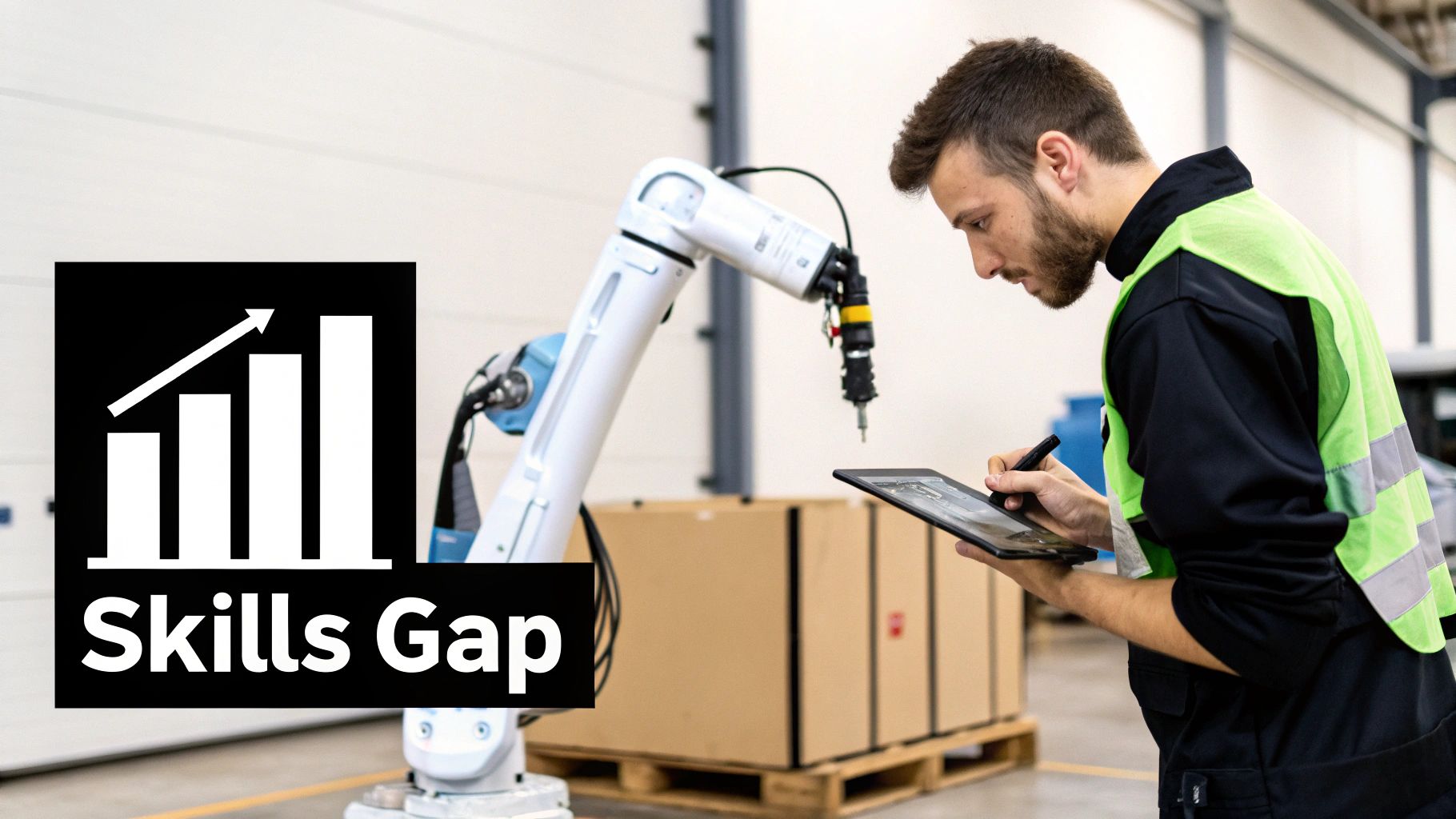
The “skills shortage” in logistics isn’t some far-off problem; it’s here now, and it’s a real threat to your operational stability. For CHROs, tackling this gap head-on is the only way to keep complex supply chains from grinding to a halt.
This means you have to move beyond just filling seats. It’s time for a more diagnostic approach, mapping out the precise skills your organisation needs not just to keep the lights on, but to actually pull ahead of the competition.
The reality is, the logistics roles we used to know are morphing into something entirely new. Yesterday’s Warehouse Manager is today’s Fulfilment Centre Leader, someone who needs to be just as comfortable with robotics and predictive analytics as they are with inventory counts. This shift demands a mix of skills that most traditional talent pools simply don’t have.
The New Profile of Logistics Talent
To win in modern logistics recruitment, you have to get your head around the dual skill sets now in high demand. It’s a delicate balance: you need the hard, technical expertise combined with the softer, nuanced skills that drive real collaboration and innovation.
Put simply, you need people who can run the new tech and work effectively with the teams who rely on it.
In-Demand Hard Skills:
- AI-Driven Optimisation: The know-how to work with software that plans hyper-efficient routes, forecasts vehicle maintenance, and organises warehouse stock on the fly.
- Automation and Robotics Maintenance: Hands-on ability to troubleshoot and maintain the robotic arms, autonomous vehicles, and automated sorting systems that are the new backbone of warehouse operations.
- Supply Chain Analytics: Being able to dive into large datasets to spot bottlenecks, forecast demand more accurately, and model the impact of potential disruptions before they happen.
- Last-Mile Technology Management: Expertise in managing the software and hardware for final delivery, from route planning apps and real-time tracking to electronic proof-of-delivery devices.
Crucial Soft Skills:
- Complex Problem-Solving: The ability to calmly diagnose and fix unexpected issues—like a sudden fleet grounding or a customs nightmare—with speed and clarity.
- Cross-Functional Leadership: The skill to communicate and collaborate seamlessly with teams in IT, finance, sales, and operations to keep the entire supply chain aligned with business goals.
- Adaptability and Resilience: A mindset that thrives on change, whether it’s adopting new software overnight or navigating geopolitical events that suddenly redraw trade routes.
The Emergence of New-Age Logistics Roles
This blend of hard and soft skills is creating entirely new jobs in the logistics sector. These roles were practically unheard of a decade ago, but now they’re becoming non-negotiable for any forward-thinking company. The core challenge for recruiters today is finding people who can fill them.
The biggest shift we’re seeing is from roles focused on moving things to roles focused on optimising the movement of things. This distinction is driven by data, technology, and an intense focus on efficiency and customer experience.
Look at these emerging, high-impact roles that are completely changing the kind of talent you need to be looking for:
- Supply Chain Data Scientist: This isn’t just about analysing past performance. This professional builds predictive models to forecast demand, flag potential risks, and simulate outcomes of big decisions, like opening a new distribution centre. They turn raw data into strategic intelligence.
- Last-Mile Technology Specialist: This person is the expert on the entire tech stack that powers the final delivery. Their job is to implement and fine-tune systems for maximum efficiency—from the mobile apps your drivers use to the notification platforms your customers see.
- Logistics Automation Engineer: Part mechanical engineer, part software developer. This role is responsible for the design, implementation, and maintenance of all the automated systems in a warehouse. They make sure the robotic pickers, conveyors, and autonomous guided vehicles (AGVs) all work together in perfect sync.
Understanding these new roles is the first critical step. The next is building a recruitment engine that can actually find these rare and incredibly valuable professionals.
Mastering High-Volume Talent Sourcing and Assessment

When you’re hiring for logistics, you’re not just filling roles; you’re building an engine that can handle immense volume without compromising on quality. The aggressive hiring targets common in this sector mean that traditional, slow-moving recruitment methods just don’t cut it anymore.
To win, you need a modern sourcing machine running on all cylinders, all the time. Forget relying on a single job board. It’s about creating a blended strategy that meets different talent segments exactly where they are. This is the bedrock of a powerful logistics recruitment pipeline.
This isn’t just a hunch—it’s a reflection of a massive market shift. Across India, the logistics, mobility, and quick commerce sectors are booming, posting over 30% year-over-year growth in delivery, logistics, and fulfilment roles. This explosion, fuelled by e-commerce giants expanding into Tier 1, 2, and 3 cities, makes a high-volume hiring capability an absolute necessity.
Building a Multi-Channel Sourcing Engine
An effective sourcing strategy isn’t a one-size-fits-all template. It’s a carefully orchestrated mix of channels, each one selected for its unique ability to connect with specific candidate profiles—from frontline warehouse staff to senior data scientists.
Your approach should be layered and deliberate.
- Specialised Job Boards: Go straight to the source for pickers, packers, and delivery drivers by using platforms dedicated to frontline and hourly workers. These sites are magnets for a high volume of relevant, work-ready candidates.
- LinkedIn Campaigns: For those harder-to-find technical and leadership roles—like supply chain analysts or automation engineers—deploy targeted campaigns on LinkedIn. This is where you’ll unearth passive candidates with those niche skill sets.
- Employee Referral Programmes: Turn your current workforce into your best recruiters. Incentivising referrals often brings in candidates who are a better cultural fit and stick around longer.
- Community Partnerships: Connect with local community centres, vocational schools, and workforce development agencies. This helps you build a steady, reliable pipeline of entry-level talent right from your own backyard.
This multi-pronged approach guarantees a constant flow of applicants, a critical element for any high-volume hiring operation. To handle this influx, many companies explore smart strategies to handle the bulk hiring process.
Vetting Talent for Real-World Challenges
Getting applications in the door is only half the battle. The real test is assessing candidates effectively at scale, which is where many recruitment processes break down. The trick is to stop scanning résumés and start evaluating practical, on-the-job skills.
The most insightful assessment tool is one that mirrors reality. Ask candidates not what they would do, but what their immediate next steps are in a simulated, high-pressure logistics scenario. Their response reveals more than any resume ever could.
This means using assessment methods that probe for genuine problem-solving ability. For instance, situational judgement tests (SJTs) can throw candidates a realistic curveball: “A critical shipment is delayed by an unexpected storm, threatening a key customer’s production line. What are your next three moves?”
A question like this forces candidates to show their cards—how they prioritise, communicate, and solve problems under pressure. It quickly separates the theorists from the practitioners.
Leveraging Technology for Speed and Precision
Trying to manage thousands of applications by hand is simply not feasible. Technology is your greatest ally in making high-volume recruitment both fast and accurate. Think of an Applicant Tracking System (ATS) as the central nervous system of your entire operation.
Customise your ATS with logistics-specific keywords like “last-mile delivery,” “WMS,” “forklift operation,” or “supply chain optimisation.” This empowers the system to automatically screen and sort applicants, pushing the most promising candidates straight to the top of your team’s list.
AI-powered screening tools can take this even further, analysing applications for key qualifications and even running initial chatbot screenings to handle basic questions. This frees up your recruiters to do what they do best: engage with high-potential candidates and build a talent pipeline that can keep up with your most aggressive growth goals.
Building an Employer Brand That Attracts Top Performers
In the fierce battle for logistics talent, you’re no longer just filling jobs—you’re marketing careers. A powerful employer brand is your single most effective tool in logistics recruitment. It’s what turns your company from just another option into a destination for top performers.
Think about it this way: a strong brand means the difference between constantly chasing candidates and having them actively seek you out.
This requires moving beyond generic promises and crafting a powerful Employer Value Proposition (EVP) that speaks directly to the logistics workforce. Your brand has to answer the one question every candidate is asking: “Why should I work for you?” The answer lies in showing them what makes your organisation a better place to build a career in this demanding field.
Pillars of a Compelling Logistics EVP
To build a brand that truly resonates, you need to focus on what matters most to logistics professionals. These are the foundational pillars that will set you apart from the competition and connect with the talent you need.
- A Visible Commitment to Safety: In an industry built on physical work, a genuine safety-first culture is non-negotiable. Don’t just say it; show it. Showcase your investment in modern, safe equipment, highlight rigorous training programmes, and put forward a management team that clearly prioritises employee well-being above all else.
- Clear and Achievable Career Pathways: Ambitious people want to see a future for themselves. Map out clear progression tracks. Show how a driver can advance to a fleet manager role, or how a warehouse associate can become a fulfilment centre supervisor. Demonstrating internal mobility is concrete proof that you invest in your people’s growth.
- Investment in Modern Technology: Today’s logistics talent is more tech-savvy than ever before. Emphasise how your company uses technology not just for efficiency, but to make employees’ jobs easier and more engaging. This could be anything from intuitive warehouse management systems (WMS) to advanced route optimisation software that takes the guesswork out of deliveries.
These pillars form the core of your recruitment marketing. They aren’t just perks; they are strategic assets that build your reputation as an employer of choice. For a deeper look into crafting this narrative, explore our comprehensive guide on developing a powerful employer branding strategy.
Bringing Your Employer Brand to Life
Once you’ve defined your EVP, you have to bring it to life across every touchpoint. This is where your brand story becomes a tangible reality for potential hires, turning abstract ideas into solid reasons to join your team.
Your job description is often the very first interaction a candidate has with your brand. It should feel less like a checklist and more like an invitation—one that paints a clear picture of the role, the culture, and the career opportunity.
Here’s how to put your brand into action:
1. Revamp Job Descriptions: Ditch the dry list of duties and tell a story instead. For a warehouse role, you could write something like: “Join a team where safety always comes first, and your skills with our state-of-the-art inventory systems will directly help us deliver for our customers every single day.”
2. Enhance Your Career Page: Your website is your showroom. Use video testimonials from current employees. Feature a “day-in-the-life” video of a delivery driver or an interview with a logistics manager who started on the warehouse floor. Show, don’t just tell, what it’s actually like to work for you.
3. Leverage Social Media: Share photos and posts that celebrate team successes, safety milestones, and employee promotions. This provides authentic, behind-the-scenes proof that you have a positive work culture.
By consistently showcasing these elements, you shift from being a transactional recruiter to a strategic brand architect. You build a magnetic employer brand that not only attracts but also retains the high-calibre talent needed to drive your logistics operations forward.
Using RPO as a Strategic Advantage in Logistics
As a CHRO, you know the grind. The relentless pressure of logistics recruitment can feel like you’re stuck on a hamster wheel of sourcing, screening, and onboarding. At some point, the question has to change from “How do we hire faster?” to “Is there a fundamentally better way to do this?” This is usually the moment when bringing in a Recruitment Process Outsourcing (RPO) partner stops being a mere option and becomes a strategic necessity.
Don’t think of an RPO as just another outside vendor. Picture them as a specialised extension of your own HR team—a dedicated unit that plugs directly into your organisation. They bring sophisticated recruitment tools, deep market intelligence, and a vast, pre-vetted talent network that would take you years, and a small fortune, to build from scratch.
When do you know it’s time? The warning signs are usually pretty clear. Maybe you’re opening a new fulfilment centre and need to scale up rapidly, a task your internal team simply isn’t built for. Or perhaps you’re constantly losing the battle for those niche tech-logistics roles, watching valuable time and momentum slip away. Even high attrition can be a signal, pointing to a mismatch in candidate quality or cultural fit that a specialised partner is equipped to solve.
Making this call is about aligning your talent strategy with your business goals, whether that means attracting fresh skills or holding onto the incredible team you already have.
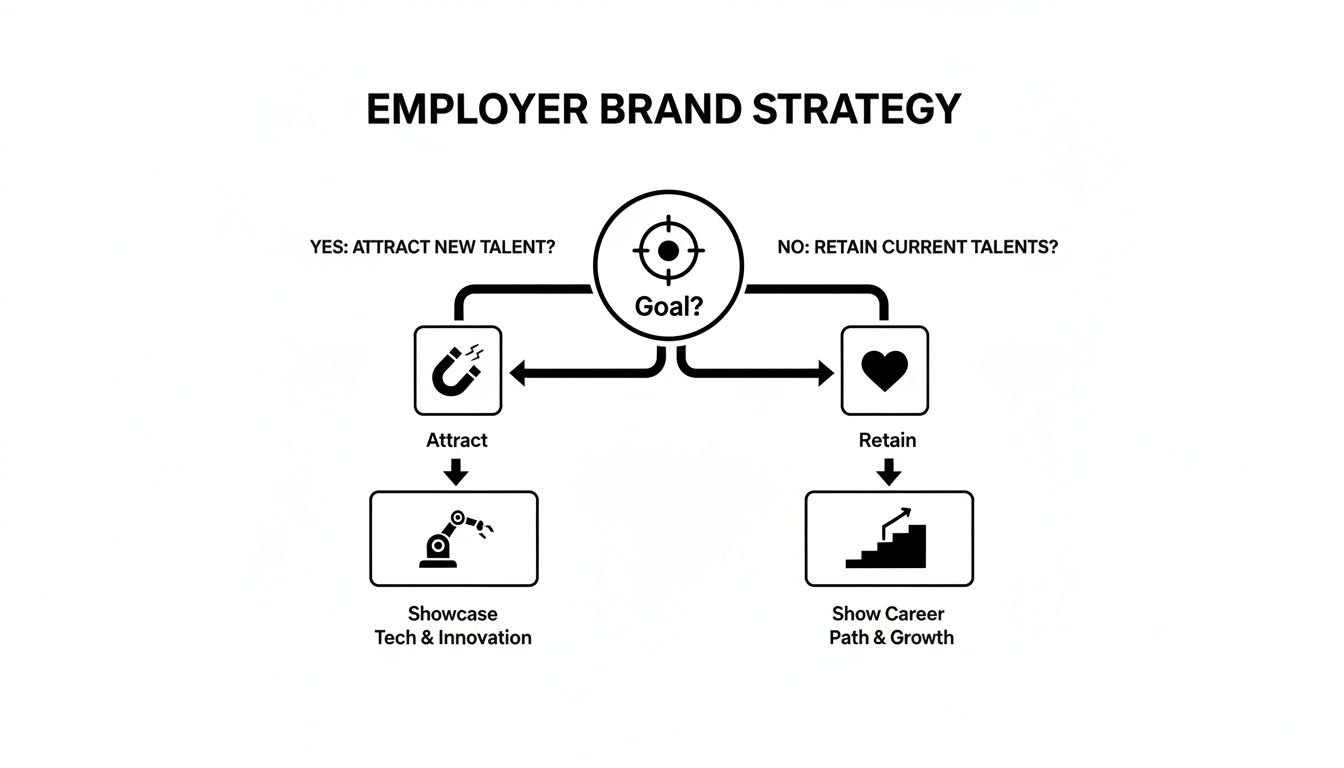
This decision tree shows how an employer brand strategy splits into two critical paths: using technology to attract new talent and showcasing career progression to retain your existing people. The core insight here is that a winning talent strategy demands distinct, targeted approaches for both acquisition and retention.
Defining the Value of a Logistics RPO Partnership
The business case for an RPO isn’t just about filling empty seats. It’s about delivering measurable improvements that hit the bottom line and get the attention of the C-suite. A proper RPO partnership delivers tangible wins across speed, quality, and cost—the holy trinity of talent acquisition.
The sheer scale of the challenge makes this strategic thinking essential. India’s logistics industry, valued at USD 228.4 billion in 2024, is on a trajectory to hit USD 428.7 billion by 2033, growing at a 6.50% CAGR. The sector already provides jobs for over 22 million people, and with the expansion of multimodal networks, millions more roles are on the horizon. This underscores the immense scale of recruitment needed. You can explore more on the growth of India’s logistics industry and its impact on hiring to understand the full picture.
Let’s break down the real-world benefits:
- Drastically Reduced Time-to-Hire: RPO providers live and breathe efficiency. Their optimised processes and dedicated sourcing teams slash the recruitment lifecycle, getting qualified people into mission-critical roles much faster.
- A Higher Calibre of Candidates: With access to wider talent pools and advanced assessment tools, RPOs deliver candidates who aren’t just skilled on paper but are also a much better long-term fit for your company culture.
- Clear Cost Efficiencies: By streamlining processes, cutting down your reliance on costly one-off agency fees, and reducing new-hire turnover, an RPO delivers a strong, undeniable return on investment.
The real power of an RPO in logistics is its ability to elevate recruitment from a reactive, transactional function to a proactive, strategic capability that actively fuels business growth.
To help you weigh your options, here’s a direct comparison of how a typical in-house team operates versus a strategic RPO partner.
| Recruitment Aspect | Typical In-House Approach | Strategic RPO Approach |
|---|---|---|
| Talent Sourcing | Relies on job boards, LinkedIn, and existing networks. | Accesses a vast, proprietary talent pool and uses multi-channel sourcing. |
| Technology Stack | Limited to the company’s Applicant Tracking System (ATS). | Brings a full suite of advanced tools for sourcing, assessment, and analytics. |
| Scalability | Struggles to handle sudden hiring surges or large projects. | Flexibly scales resources up or down based on business demand. |
| Market Intelligence | Has a general understanding of the market. | Provides deep, real-time data on salary benchmarks and competitor activity. |
| Cost Structure | Primarily fixed costs (salaries, overheads). | Variable cost model tied directly to hiring volume and outcomes. |
| Strategic Focus | Team is often bogged down by administrative, day-to-day tasks. | Frees up internal HR to focus on strategic initiatives like employee development. |
This table makes it clear: while an in-house team is invaluable for culture and daily HR functions, an RPO partner brings a level of scale, technology, and strategic focus that’s incredibly difficult to replicate internally. It’s about choosing the right tool for the job.
A Clear Roadmap for RPO Implementation
Bringing an RPO partner on board successfully isn’t an overnight switch. It requires a clear, structured game plan. The process always starts with a deep-dive discovery phase where the RPO provider gets to know your unique challenges, your company culture, and your ultimate business goals. This is a bespoke service, not a one-size-fits-all product.
From that starting point, a solid implementation roadmap typically includes these four steps:
- Defining Success Metrics: Right from the get-go, you and your partner must agree on what success looks like. This means establishing clear Key Performance Indicators (KPIs) like time-to-fill, quality of hire (often measured by 90-day retention), and cost-per-hire.
- Process and Technology Integration: The RPO team will integrate its technology stack with your existing systems (like your ATS). The goal is a seamless flow of data and, most importantly, a consistent and positive experience for every candidate.
- Governance and Communication: A regular rhythm of review meetings and transparent reporting is crucial. This keeps everyone aligned, tracks progress against your KPIs, and ensures both the RPO team and your internal stakeholders are on the same page.
- Continuous Optimisation: A great RPO partner doesn’t just follow orders. They analyse the data, bring you insights, and continuously refine the recruitment process to drive better results over time.
By following this kind of roadmap, you ensure the RPO partnership does far more than just fill roles. It empowers your internal HR team to offload the high-volume, tactical grind and concentrate on bigger-picture initiatives—like leadership development, succession planning, and organisational design—that deliver even greater value to the business.
Measuring Recruitment Success with Business-Focused KPIs
To really demonstrate the value of your logistics hiring, you need to start speaking the language of the C-suite. This means shifting the conversation away from basic recruitment tallies and towards Key Performance Indicators (KPIs) that directly mirror business outcomes. It’s all about drawing a clear, undeniable line from your talent strategy to the company’s bottom line and operational muscle.
This data-first approach is what elevates the HR function from a perceived cost centre to a genuine strategic partner. When you can show a tangible return on investment (ROI) for your recruitment spend, you’re not just asking for a budget; you’re building a compelling business case for investing more in technology, employer branding, or specialised hiring partners.
Moving Beyond Simple Hire Counts
While tracking the ‘number of hires’ is a necessary part of the job, it hardly tells the whole story. A truly strategic approach to logistics recruitment measures what actually matters—connecting hiring activities to real-world performance on the warehouse floor and across the entire supply chain.
Here are the critical, business-focused KPIs that should be on every CHRO’s dashboard:
- Quality of Hire: This is, without a doubt, the most crucial metric. It’s the ultimate measure of the value a new employee brings to the table. You can get a solid read on this by combining a new hire’s 90-day retention rate with their initial performance review score. A high score here proves you aren’t just filling seats—you’re bringing in people who perform well and stick around.
- Time to Productivity: This KPI tracks how long it takes for a new team member to get fully up to speed and start contributing at the expected level. A shorter Time to Productivity is a direct reflection of effective onboarding; it means your new hires are generating value much faster, which has an immediate impact on team output and overall efficiency.
- Sourcing Channel Effectiveness: Don’t just look at where your candidates are coming from. Dig deeper to see which channels deliver the best long-term employees. By analysing the Quality of Hire and retention rates for each source—whether it’s employee referrals, niche job boards, or an RPO partner—you can intelligently put your recruitment budget where it will yield the highest ROI.
Interpreting Data in a Logistics Context
The real magic of these KPIs isn’t just in the numbers themselves, but in how you interpret them. Think of the data as signposts, pointing you towards deeper operational wins or underlying problems in your recruitment process. They offer the kind of diagnostic insight that lets you fine-tune your strategy on the fly.
For instance, a high ‘Time to Fill’ for warehouse supervisor roles might not just signal a talent shortage. It could be an early warning that your compensation package is falling behind the local market, giving you a chance to review it before it starts to seriously impact operations.
In the same way, a consistently low Quality of Hire score from a particular job board could mean your job descriptions are attracting the wrong kind of candidate. This data gives you the power to make precise adjustments, like tweaking your messaging or targeting different platforms, to get better results. This analytical mindset empowers you to back up your strategic decisions with hard evidence, proving HR’s direct contribution to the company’s success.
Answering Your Top Logistics Recruitment Questions
When you’re in the trenches of logistics hiring, a lot of questions come up. We hear them all the time from HR leaders trying to navigate this complex space. Here are some straightforward answers to the most common challenges you’re likely facing.
What’s the Single Biggest Mistake Companies Make in Logistics Hiring Today?
Without a doubt, it’s treating every logistics role like it’s a low-skill, interchangeable position. That mindset is a relic of the past. The supply chain today is a high-tech ecosystem demanding a hugely diverse workforce—from warehouse associates who can manage automated systems to data analysts who can find the hidden efficiencies in a delivery network.
A one-size-fits-all approach just doesn’t work anymore. It fails to attract the specialised people you need to stay competitive and inevitably leads to poor performance and a revolving door of staff.
The real mistake is undervaluing just how technical and analytical modern logistics jobs have become. The only way to win is with a segmented recruitment strategy, targeting different skills with a value proposition that makes sense for each specific role.
How Can We Possibly Attract Talent When We’re Competing with Tech Companies?
You have to change the story you’re telling. Stop advertising a job and start showcasing a career in a mission-critical, high-tech field. Get loud about the sophisticated technology you’re using—whether it’s AI-powered route planning, warehouse robotics, or predictive analytics that keep shelves stocked.
Focus on the real-world problems your team is solving. Highlight the clear paths for professional growth and the massive impact your employees have on the entire economy. When you brand your logistics operation as a tech-forward hub of innovation, you start attracting people who are hungry for a complex challenge, not just another warehousing gig.
If We Bring in an RPO Partner, How Quickly Should We Expect to See a Return?
While every situation is different, most organisations start feeling the positive effects within the first 90 days of working with a logistics RPO partner. The first things you’ll notice are improvements in core metrics like your time-to-fill and the overall quality of candidates coming through the door.
The bigger, more strategic payoff usually becomes clear within six to twelve months. That’s when you’ll see measurable drops in your cost-per-hire, lower employee turnover, and a real lift in productivity because you have the right people in the right seats. The secret is to agree on clear KPIs from day one so you can track the progress against your actual business goals.
What Role Does Employer Branding Really Play in High-Volume Hiring?
In high-volume hiring, your employer brand isn’t just a nice-to-have; it’s your most critical tool for attracting quality people at scale. Think of it as a magnet. It pulls in applicants who are already a good fit for your company culture and the demands of the job, right from the very beginning.
A strong brand that clearly communicates your commitment to safety, career development, and a positive workplace reduces how much you have to spend on job ads. It creates an inbound pipeline of candidates who want to work for you, which is absolutely essential when you have aggressive hiring targets to hit.
Ready to build a world-class logistics team without the operational strain? Taggd specialises in Recruitment Process Outsourcing for the logistics sector, delivering the specialised talent you need to drive growth. Find out how we can help you win the war for talent.