The manufacturing sector is undergoing a seismic shift, driven by the convergence of automation, data, and digital connectivity. Industry 4.0 is no longer a futuristic concept; it is the current operational reality. For Chief Human Resources Officers (CHROs) and talent leaders, this transformation presents both a critical challenge and a significant opportunity. The skills that powered production lines yesterday are rapidly becoming insufficient, replaced by a new set of competencies that blend engineering prowess with digital fluency.
Anticipating the Manufacturing Skills in Demand for 2026 is not just a forecasting exercise; it is a strategic imperative for building a resilient, competitive, and future-ready workforce. Proactive talent planning is essential for maintaining operational excellence and driving innovation. Neglecting to cultivate these capabilities now means facing critical talent shortages and losing ground to more forward-thinking competitors.
This guide provides a detailed roadmap of the ten most critical skills your organisation needs to prioritise. We will move beyond high-level theory to offer practical, actionable strategies for talent acquisition, upskilling, and aligning your people strategy with the technological evolution of the factory floor. Each section will detail:
- Why the skill is critical, supported by current trends.
- Specific roles impacted by the skill demand.
- Concrete hiring and upskilling recommendations.
- Key Performance Indicators (KPIs) to measure success.
- Implications for Recruitment Process Outsourcing (RPO) strategies.
By understanding these shifts now, organisations can proactively build the talent pipelines needed to thrive in an increasingly complex and automated manufacturing environment.
1. Industrial IoT (IIoT) and Connected Systems Management
The ability to implement, manage, and optimise Industrial Internet of Things (IIoT) solutions is rapidly becoming a cornerstone manufacturing skill. IIoT involves a network of interconnected sensors, instruments, and other devices connected with computers’ industrial applications, including manufacturing and energy management. This connectivity allows for the collection, exchange, and analysis of data, enabling unprecedented levels of operational insight and automation. As manufacturers push towards Industry 4.0, proficiency in IIoT is a non-negotiable manufacturing skill in demand for 2026.
Why It’s a Top Skill
According to a report by MarketsandMarkets, the global IIoT market is projected to reach $110.6 billion by 2025, underscoring its massive adoption rate. This skill is critical for implementing predictive maintenance protocols, which can reduce equipment downtime by up to 50% and maintenance costs by nearly 40%. Companies like Siemens with its Mindsphere platform and Bosch with its Connected Industry solutions showcase how integrating IIoT transforms production floors into intelligent, self-optimising ecosystems.
Actionable Plan for CHROs
To build IIoT competency, a multi-faceted approach is necessary.
- Hiring Strategy: Prioritise candidates with a hybrid skill set combining operational technology (OT) and information technology (IT). Look for roles like IIoT Integration Specialist or Connected Systems Analyst.
- Upskilling Initiatives: Launch targeted training programmes for existing engineers and technicians. Focus on data analytics, cybersecurity for connected devices, and sensor technology. Partner with technology providers to offer certifications.
- Recruitment Process Outsourcing (RPO): An RPO partner can tap into specialised talent pools for IIoT experts, which are often scarce. They can design assessment centres to test for both technical and problem-solving skills in a connected factory environment.
Key Performance Indicators (KPIs)
To measure the impact of improved IIoT skills, track metrics such as Overall Equipment Effectiveness (OEE), Mean Time Between Failures (MTBF), and reductions in unplanned downtime. A successful upskilling programme should directly correlate with improvements in these operational benchmarks, demonstrating a clear return on investment.
2. Advanced Robotics and Automation Programming
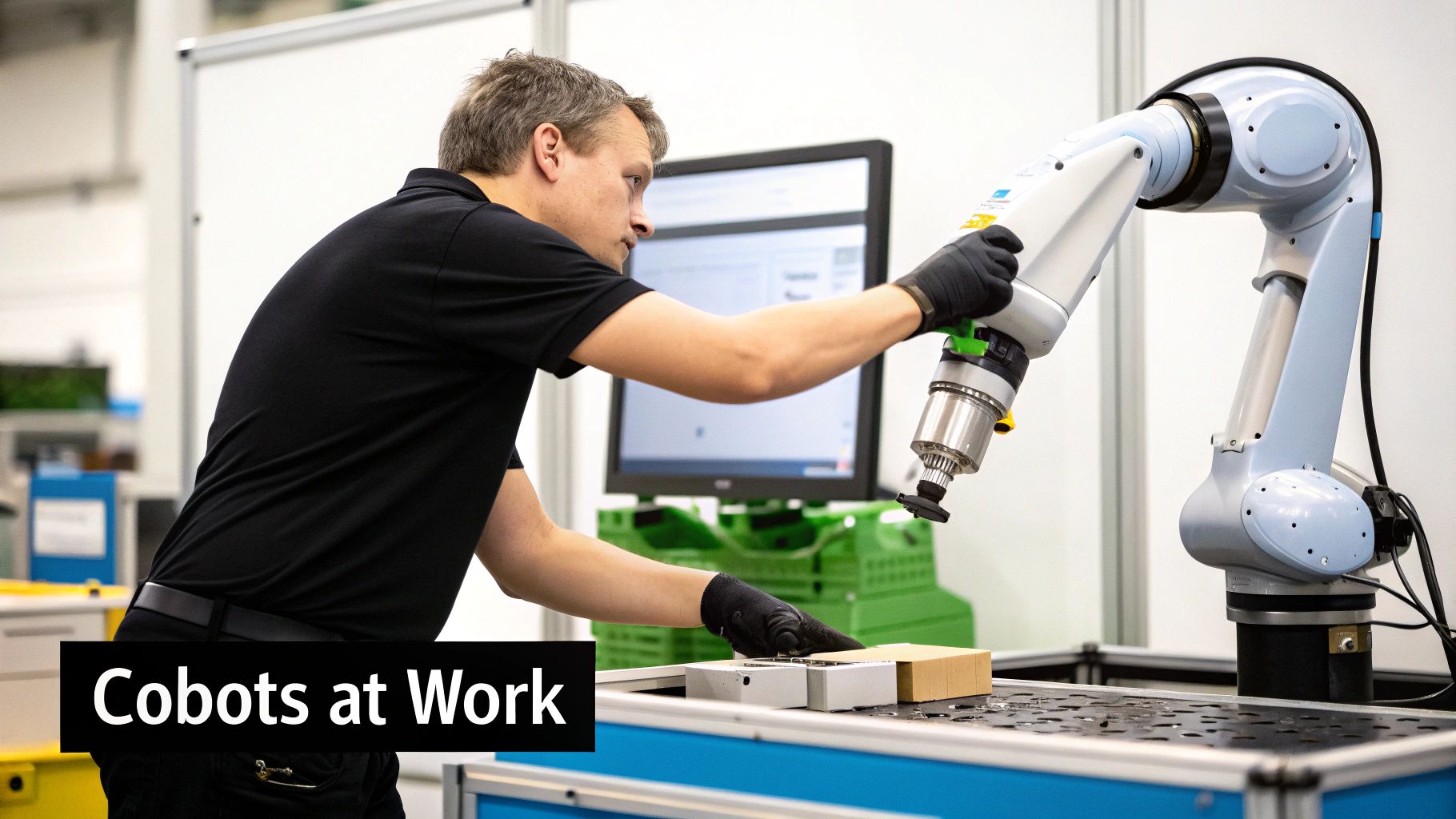
Proficiency in programming, deploying, and maintaining sophisticated robotic systems is a critical manufacturing skill in demand for 2026. This expertise extends beyond traditional industrial robots to include collaborative robots (cobots), autonomous guided vehicles (AGVs), and AI-driven automation. As manufacturers grapple with persistent labour shortages and the need for higher precision, robotics skills enable organisations to automate complex, repetitive, or hazardous tasks, thereby boosting productivity and ensuring operational consistency.
Why It’s a Top Skill
The International Federation of Robotics (IFR) reports that robot installations are hitting new records globally, with a significant surge in sectors like electronics and automotive manufacturing. This skill is paramount for enhancing production flexibility and speed. Companies like ABB Robotics and FANUC demonstrate how integrated automation solutions can slash cycle times and improve product quality. Similarly, the deployment of cobots by SMEs, popularised by firms like Universal Robots, highlights the trend towards human-robot collaboration on the factory floor. You can learn more about the role of automation in revolutionising manufacturing in India.
Actionable Plan for CHROs
Building a workforce proficient in robotics requires a strategic human capital plan.
- Hiring Strategy: Seek out candidates for roles like Automation Engineer, Robotics Technician, and Control Systems Programmer. Focus on individuals with experience in specific robotic platforms (e.g., KUKA, Yaskawa) and programming languages like Python or C++.
- Upskilling Initiatives: Develop career pathways for current machine operators to become robot supervisors or maintenance technicians. Partner with robotics manufacturers for specialised certification programmes and hands-on training labs.
- Recruitment Process Outsourcing (RPO): An RPO provider can identify and attract niche talent from the competitive robotics field. They can also help structure practical assessments that simulate real-world programming and troubleshooting scenarios.
Key Performance Indicators (KPIs)
The effectiveness of advanced robotics skills can be measured through specific metrics. Track improvements in Cycle Time per Unit, reductions in Error or Defect Rates, and an increase in Throughput. A successful talent strategy will result in quantifiable gains in these areas, directly linking robotics competency to enhanced production efficiency and quality.
3. Digital Supply Chain and Logistics Optimisation
Competency in managing supply chains through digital platforms is a vital manufacturing skill in demand for 2026. This involves using visibility tools, advanced demand forecasting, inventory optimisation, and integrated vendor management systems. As manufacturers continue to navigate global disruptions and economic volatility, the ability to build resilient and agile supply chains through real-time intelligence has become a critical competitive differentiator, directly impacting production continuity and profitability.

Why It’s a Top Skill
Recent global events have exposed the fragility of traditional, linear supply chains. A McKinsey report highlights that companies with digitally transformed supply chains can expect to boost annual growth of earnings before interest and taxes by 3.2%. This skill enables organisations to move from a reactive to a predictive operational model. Industry leaders like Flexport with its digital freight forwarding platform and Maersk’s TradeLens blockchain initiative demonstrate how technology creates unprecedented transparency and efficiency, reducing lead times and costs.
Actionable Plan for CHROs
Developing digital supply chain expertise requires a strategic focus on talent and technology.
- Hiring Strategy: Seek candidates for roles like Supply Chain Analyst, Logistics Data Scientist, or Digital Procurement Specialist. Look for professionals who can interpret complex datasets and understand both operational logistics and digital platforms.
- Upskilling Initiatives: Create training programmes focused on predictive analytics, supply chain visibility software, and vendor collaboration tools. Partner with logistics tech firms or academic institutions to offer specialised certifications in digital supply chain management.
- Recruitment Process Outsourcing (RPO): An RPO provider can access a global network of supply chain professionals with niche digital skills. They can also develop customised assessments that simulate real-world supply disruption scenarios to test a candidate’s problem-solving and analytical capabilities.
Key Performance Indicators (KPIs)
To gauge the effectiveness of enhanced digital supply chain skills, monitor metrics like Inventory Turnover Rate, Perfect Order Rate, and Cash-to-Cash Cycle Time. A direct improvement in these KPIs after implementing targeted training or hiring initiatives will confirm a positive impact on operational efficiency and financial health.
4. Data Analytics and Business Intelligence for Manufacturing
The capability to collect, analyse, and interpret vast amounts of manufacturing data is essential for driving operational improvements and strategic decisions. Data analytics and business intelligence (BI) involve using statistical methods and software tools to transform raw operational data into actionable insights. For modern manufacturers, this means optimising processes, enhancing quality assurance, and tracking performance metrics with unprecedented accuracy, making it a critical manufacturing skill in demand for 2026.
Why It’s a Top Skill
According to a Deloitte survey, 90% of manufacturing executives believe digital initiatives, powered by data analytics, will be the primary driver of their competitiveness. This skill allows organisations to identify bottlenecks, predict equipment failures, and optimise supply chains, directly impacting the bottom line. Companies leverage tools like Tableau and Microsoft Power BI to create real-time dashboards that visualise production data, enabling supervisors to make informed decisions on the factory floor, not just in the boardroom.
Actionable Plan for CHROs
To embed data analytics and BI skills, CHROs must champion a data-first culture.
- Hiring Strategy: Recruit for roles like Manufacturing Data Analyst and BI Developer, who possess a blend of statistical knowledge, manufacturing process understanding, and proficiency in BI tools.
- Upskilling Initiatives: Develop training modules for existing staff on data literacy and the use of specific analytics platforms. A key goal is to empower cross-functional teams, from quality engineers to line managers, to interpret data and make data-driven decisions.
- Recruitment Process Outsourcing (RPO): An RPO partner can identify and attract talent with specialised experience in manufacturing analytics. They can also help design competency frameworks and assessments to evaluate a candidate’s ability to translate complex data sets into tangible business outcomes.
Key Performance Indicators (KPIs)
The success of building data analytics skills can be measured through direct improvements in operational KPIs. Track metrics such as First Pass Yield (FPY), reduction in Scrap Rate, and improvements in Cycle Time. A workforce proficient in data analytics should be able to directly influence these metrics, demonstrating a clear link between talent investment and operational excellence.
5. Additive Manufacturing (3D Printing) Technology
Expertise in additive manufacturing, commonly known as 3D printing, is a transformative skill redefining production possibilities. This technology builds three-dimensional objects layer by layer from digital files, enabling the creation of complex geometries that are impossible with traditional subtractive methods. It is moving rapidly from a prototyping tool to a mainstream production process, making it a crucial manufacturing skill in demand for 2026 for creating everything from custom tooling to end-use parts.
Why It’s a Top Skill
The global 3D printing market is projected to reach $83.90 billion by 2029, according to Fortune Business Insights, highlighting its explosive growth. Additive manufacturing significantly shortens development cycles, reduces material waste, and enables on-demand production. For instance, GE Aviation uses additive manufacturing to produce complex fuel nozzle tips for its LEAP jet engines, reducing part count from 20 to one and improving fuel efficiency. Similarly, companies like Siemens are using this technology to rapidly produce spare parts for industrial turbines, drastically cutting downtime.
Actionable Plan for CHROs
Integrating additive manufacturing requires a strategic approach to talent development.
- Hiring Strategy: Seek candidates with a blend of mechanical design, materials science, and digital manufacturing skills. Roles like Additive Manufacturing Engineer, 3D Printing Technician, and Design for Additive Manufacturing (DfAM) Specialist are becoming critical.
- Upskilling Initiatives: Develop training programmes focused on DfAM principles, material qualification, and the operation of industrial 3D printers. Partner with technology providers like Stratasys or EOS to offer hands-on workshops and certifications for your existing workforce.
- Recruitment Process Outsourcing (RPO): An RPO partner can identify and attract talent from niche pools, including aerospace, medical devices, and automotive sectors where additive manufacturing is mature. They can also create customised technical assessments to validate a candidate’s practical 3D printing skills.
Key Performance Indicators (KPIs)
To measure the success of your additive manufacturing skills programme, track metrics like New Product Introduction (NPI) cycle time, reduction in material waste, and cost per part. An effective upskilling initiative should lead to faster prototyping, lower production costs for complex components, and an enhanced ability to produce customised parts on demand.
6. Lean Manufacturing and Continuous Improvement (Kaizen)
Lean manufacturing is a systematic methodology focused on eliminating waste (Muda) within a production system while simultaneously maximising productivity. Its core principle, Kaizen, or continuous improvement, fosters a culture where all employees actively work to streamline processes and enhance quality. As companies navigate economic pressures and supply chain volatility, the ability to optimise operations, reduce costs, and maintain flexibility is paramount, making lean methodologies a crucial manufacturing skill in demand for 2026, especially when integrated with modern digital tools.
Why It’s a Top Skill
Lean principles are proven to deliver substantial results. As reported by the Lean Enterprise Research Centre, companies that fully embrace lean practices can see a 90% reduction in lead times, a 50% improvement in productivity, and a 50% reduction in inventory. The enduring success of the Toyota Production System (TPS) is the quintessential example, but companies like Caterpillar and Harley-Davidson have also leveraged lean transformations to revitalise their manufacturing operations, proving its universal applicability and impact on the bottom line.
Actionable Plan for CHROs
Fostering a lean culture requires a top-down commitment and grassroots engagement.
- Hiring Strategy: Seek candidates for roles like Continuous Improvement Manager or Lean Specialist who possess certifications like a Six Sigma Green or Black Belt. Look for demonstrated experience in value stream mapping and facilitating Kaizen events.
- Upskilling Initiatives: Develop organisation-wide training on the core principles of lean, such as the 5S methodology (Sort, Set in order, Shine, Standardise, Sustain). Empower frontline workers by training them to identify and eliminate waste in their own work areas.
- Recruitment Process Outsourcing (RPO): An RPO partner can identify professionals who not only have technical lean skills but also the crucial soft skills, such as coaching and change management, needed to drive cultural transformation. They can vet candidates for a genuine continuous improvement mindset.
Key Performance Indicators (KPIs)
The effectiveness of lean skills development can be measured through tangible improvements in operational metrics. Key KPIs to monitor include Takt Time (the rate at which you need to complete a product to meet customer demand), Cycle Time, and First Pass Yield (FPY). A successful programme will show a marked decrease in process cycle times and a significant increase in the percentage of units produced without defects.
7. Cybersecurity in Manufacturing (OT Security)
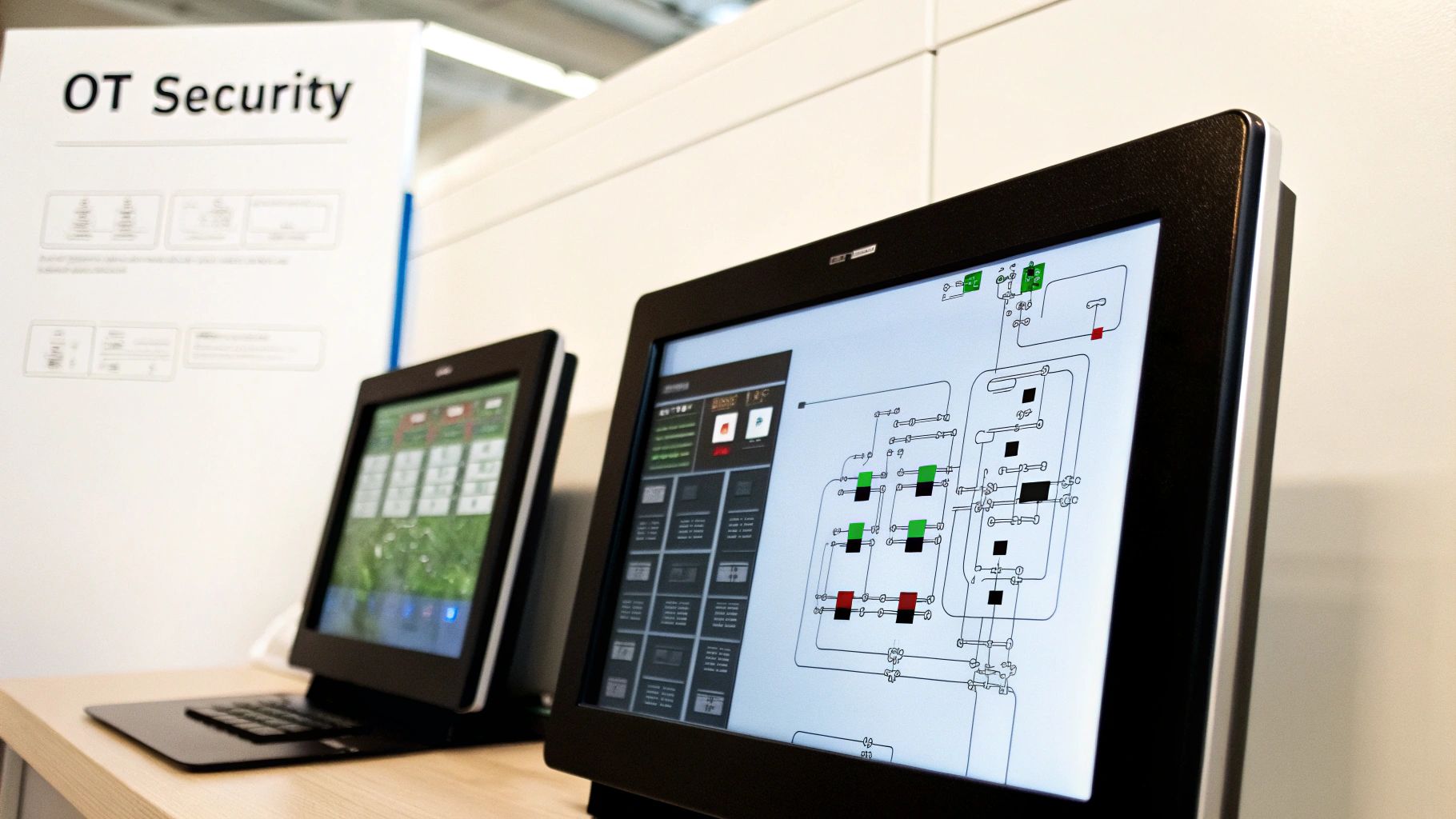
As production floors become increasingly interconnected through IIoT and smart technologies, the ability to protect operational technology (OT) systems from cyber threats has become a paramount manufacturing skill. OT security involves safeguarding industrial control systems (ICS), production equipment, and other hardware and software that monitor and control physical processes. Unlike traditional IT security, OT cybersecurity requires specialised knowledge to defend against threats that can cause production stoppages, equipment damage, or compromise product integrity, making it a critical manufacturing skill in demand for 2026.
Why It’s a Top Skill
The convergence of IT and OT has expanded the attack surface for manufacturers. According to a report from Gartner, by 2025, 30% of critical infrastructure organisations will experience a security breach that will result in the halting of an operations or mission-critical system. This highlights the urgent need for robust security protocols. Companies like Schneider Electric and Claroty offer industrial cybersecurity solutions that provide visibility and protection for OT environments, demonstrating the industry’s shift towards securing these vulnerable, high-value assets.
Actionable Plan for CHROs
Building a resilient OT security posture requires a strategic blend of talent acquisition and development.
- Hiring Strategy: Seek candidates with experience in both cybersecurity and industrial engineering. Target roles like OT Security Engineer, Industrial Control Systems (ICS) Security Analyst, or Manufacturing Cybersecurity Specialist.
- Upskilling Initiatives: Develop training programmes that bridge the gap between IT and OT teams. Focus on OT-specific protocols, threat detection in industrial environments, and incident response for physical systems.
- Recruitment Process Outsourcing (RPO): The talent pool for OT security is highly specialised. An RPO partner can access niche networks of professionals and design rigorous vetting processes that test for hands-on experience in protecting manufacturing infrastructure. To understand the growing landscape, explore the latest trends in cybersecurity jobs in India.
Key Performance Indicators (KPIs)
The effectiveness of OT security skills can be measured through specific metrics. Track the Number of Detected Security Incidents within the OT network, the Mean Time to Respond (MTTR) to a security event, and the Percentage of OT Assets with Security Monitoring. A successful programme will show a reduction in incidents and faster response times, directly safeguarding production continuity.
8. Artificial Intelligence and Machine Learning Applications
The expertise to develop, implement, and manage Artificial Intelligence (AI) and Machine Learning (ML) solutions is becoming a critical differentiator in the manufacturing sector. These technologies leverage complex algorithms to analyse vast datasets, uncover patterns, and automate decision-making processes. From predictive quality control to dynamic supply chain optimisation, AI and ML are enabling factories to become more intelligent, responsive, and efficient. Proficiency in applying these tools is a definitive manufacturing skill in demand for 2026.
Why It’s a Top Skill
The global AI in manufacturing market is set to reach $16.7 billion by 2026, according to MarketsandMarkets, highlighting its rapid integration. This skill is paramount for achieving significant operational gains; for instance, McKinsey found that AI-powered predictive maintenance can increase asset productivity by 20% and reduce maintenance costs by 10%. Major players like Tesla use AI for factory optimisation, while Siemens leverages AI to refine complex industrial processes, demonstrating the technology’s transformative power on the shop floor.
Actionable Plan for CHROs
Integrating AI and ML talent requires a strategic blend of sourcing and development.
- Hiring Strategy: Seek candidates who combine data science acumen with manufacturing domain knowledge. Target roles such as Machine Learning Engineer, AI Specialist, or Manufacturing Data Scientist.
- Upskilling Initiatives: Develop training programmes for engineers and data analysts focused on Python, TensorFlow, and industrial AI platforms. Partner with cloud providers like Google Cloud or Microsoft Azure for specialised manufacturing AI certifications.
- Recruitment Process Outsourcing (RPO): An RPO partner can access niche talent pools for AI and ML experts, who are in high demand across all industries. They can also create specialised technical assessments to validate a candidate’s ability to apply AI models to real-world production challenges.
Key Performance Indicators (KPIs)
The effectiveness of AI and ML skills integration can be measured through tangible outcomes. Key metrics include improvements in First Pass Yield (FPY), reductions in Scrap Rate, and enhanced accuracy of Demand Forecasting. A direct correlation between your talent initiatives and positive movements in these KPIs will validate the ROI of building an AI-ready workforce.
9. Advanced Quality Management and Industry 4.0 Standards
As manufacturing embraces digitalisation, the mastery of modern quality management systems is paramount. This skill involves a deep understanding of frameworks like Six Sigma and Total Quality Management (TQM), integrated with the demands of Industry 4.0. It ensures that products not only meet rigorous ISO standards and customer expectations but also leverage digital tools for proactive quality control. In the connected factory, quality expertise is a critical manufacturing skill in demand for 2026, essential for maintaining consistency across complex automated systems.
Why It’s a Top Skill
The shift towards smart manufacturing amplifies the cost of quality failures. A report from LNS Research indicates that top-performing companies leveraging digital quality management have an 18% higher rate of on-time and complete shipments. This skill transforms quality from a reactive, end-of-line inspection to a predictive, integrated process. Global leaders like General Electric and Philips utilise advanced quality analytics to predict potential defects, significantly reducing rework and scrap costs while safeguarding brand reputation in a competitive market.
Actionable Plan for CHROs
To embed advanced quality management skills, a strategic overhaul of quality roles and training is required.
- Hiring Strategy: Seek out candidates with a T-shaped skill set combining traditional quality principles (e.g., Six Sigma Black Belt) with data science capabilities. Target roles like Digital Quality Engineer or Quality Systems Analyst.
- Upskilling Initiatives: Develop training modules focused on statistical process control (SPC) using real-time data, digital twin for quality simulation, and the application of ISO/IEC 27001 for information security in quality systems.
- Recruitment Process Outsourcing (RPO): An RPO partner can identify professionals experienced in deploying quality management systems (QMS) in a digitised environment. They can also create assessments that simulate real-world quality challenges in an Industry 4.0 context.
Key Performance Indicators (KPIs)
The effectiveness of enhanced quality management skills can be measured through specific metrics. Track the Cost of Poor Quality (COPQ), First Pass Yield (FPY), and reductions in Customer Complaint Rates. A successful talent strategy will result in a measurable decrease in COPQ and a significant improvement in FPY, directly linking quality competency to financial performance.
10. Workforce Reskilling and Digital Transformation Leadership
The capacity to spearhead organisational change, retrain employees for digital environments, and cultivate a culture of innovation is a crucial meta-skill. As technology rapidly reshapes manufacturing, leaders must be adept at talent development, managing resistance to change, and creating agile learning organisations. This skill bridges human resources, operations, and strategic leadership, ensuring that the workforce and operational processes evolve in tandem, making it a pivotal manufacturing skill in demand for 2026.
Why It’s a Top Skill
A successful digital transformation is less about technology and more about people. According to a McKinsey report, the top obstacle to digital transformation is cultural and behavioural challenges, not technological ones. Companies like Siemens, with its Digital Transformation Academy, and GE, through its FastWorks programme, exemplify how structured leadership and reskilling initiatives are essential to navigate technological shifts successfully. Without leaders who can champion this change, even the most advanced technology investments will fail to deliver their full potential.
Actionable Plan for CHROs
Driving this transformation requires a strategic, people-centric approach.
- Hiring Strategy: Seek out leaders with proven change management experience, not just technical expertise. Look for roles like Digital Transformation Lead or Organisational Development Manager with a focus on manufacturing technology.
- Upskilling Initiatives: Develop tiered learning paths that cater to different roles, from shop-floor technicians to senior management. Create mentorship programmes pairing digitally savvy employees with experienced veterans to foster knowledge sharing and bridge generational gaps.
- Recruitment Process Outsourcing (RPO): An RPO partner can identify leaders with the specific soft skills needed for transformation, such as empathy, communication, and resilience. They can use behavioural interviews and situational judgement tests to assess a candidate’s ability to lead through ambiguity and inspire teams.
Key Performance Indicators (KPIs)
The effectiveness of transformation leadership can be measured through Employee Engagement Scores, Change Adoption Rates, and the Time to Proficiency for newly acquired skills. Tracking these metrics provides direct insight into how well the workforce is adapting to new processes and technologies, highlighting the impact of strong leadership and helping to identify and address existing skill gaps to create a high-impact manufacturing workforce.
Top 10 Manufacturing Skills for 2026 — Comparison
| Item | Implementation Complexity | Resource Requirements | Expected Outcomes | Ideal Use Cases | Key Advantages |
|---|---|---|---|---|---|
| Industrial IoT (IIoT) and Connected Systems Management | High, complex OT/IT integration, legacy systems, cybersecurity needs | High, sensors, connectivity, edge/cloud platforms, OT/IT specialists | Real-time visibility, predictive maintenance, reduced unplanned downtime (~45%) | Predictive maintenance, production optimization, supply chain visibility; pilot non-critical systems first | Data-driven decisions, early fault detection, improved asset utilization |
| Advanced Robotics and Automation Programming | High, complex programming, safety/HRC protocols, simulation & commissioning | High — robots/cobots, vision systems, integration engineers, maintenance teams | Higher throughput, consistent quality, 24/7 operations, lower labor dependence | Repetitive, hazardous, or precision tasks (welding, material handling, assembly) | Increased capacity, improved safety, consistent product quality |
| Digital Supply Chain and Logistics Optimization | Medium–High — multi-vendor/system integration, data governance | Medium — SCM platforms, analytics, ERP integration, supply chain analysts | Lower inventory costs (15–30%), better demand planning, faster disruption response | Global sourcing, inventory-heavy operations, procurement and logistics optimization | Cost reduction, enhanced visibility, improved supplier performance |
| Data Analytics and Business Intelligence for Manufacturing | Medium — data integration and governance, tool selection | Medium — BI tools, data engineers/analysts, dashboards | Faster bottleneck identification, quality improvements, informed decisions | Continuous improvement, quality control, capacity planning and KPI tracking | Actionable insights, improved decision speed, measurable KPIs |
| Additive Manufacturing (3D Printing) Technology | Medium — DfAM, material qualification, post-processing workflows | Medium–High — industrial printers, materials, design and materials expertise | Rapid prototyping, material waste reduction, complex/custom geometries, supply resilience | Prototyping, low-volume/custom parts, tooling, aerospace & medical components | Faster iteration, lower tooling cost, design freedom for complexity |
| Lean Manufacturing and Continuous Improvement (Kaizen) | Low–Medium — cultural change, facilitation, sustained management support | Low — training, facilitator time, process mapping tools | Efficiency gains (20–40%), waste reduction, faster cycle times, higher engagement | Broad operational improvement, waste elimination, frontline empowerment | Sustainable cost savings, employee engagement, streamlined processes |
| Cybersecurity in Manufacturing (OT Security) | High — ICS/SCADA protection, legacy constraints, specialized expertise | Medium–High — monitoring, network segmentation, OT security engineers | Reduced risk of shutdowns, protected IP, regulatory compliance | Highly automated/connected plants, critical infrastructure, integrated OT environments | Operational continuity, risk mitigation, secure digital transformation |
| Artificial Intelligence and Machine Learning Applications | High — large data needs, model development, explainability & MLOps | High — data scientists, compute resources, labeled datasets, MLOps tooling | Predictive maintenance, quality prediction, process optimization, anomaly detection | Quality inspection, forecasting, optimization problems with ample data | Automates complex decisions, improves accuracy, drives efficiency gains |
| Advanced Quality Management and Industry 4.0 Standards | Medium — standards implementation, system integration, documentation | Medium — quality systems, auditors, training, digital QC tools | Fewer defects, regulatory compliance, faster product introductions | Regulated industries, high-reliability products, supplier quality oversight | Improved customer trust, lower warranty costs, traceability |
| Workforce Reskilling and Digital Transformation Leadership | Medium — organizational change, cross-functional coordination | Medium — training programs, change management resources, leadership time | Smoother tech adoption, higher retention, internal upskilling pipelines | Organizations adopting automation/digital tech, large-scale transformation programs | Ensures ROI on technology, builds agility, fosters internal talent growth |
Building Your 2026 Workforce: From Blueprint to Reality
Navigating the future of manufacturing is no longer a matter of simply acquiring new machinery; it is about cultivating the human expertise to orchestrate it. The ten critical competencies we have explored, from Industrial IoT management to digital transformation leadership, represent the essential DNA of the 2026 manufacturing workforce. These are not isolated skills but an interconnected ecosystem of capabilities that will define your organisation’s agility, resilience, and competitive edge.
The journey towards 2026 demands a fundamental shift in perspective. The most successful organisations will be those that view their workforce not as a static asset but as a dynamic, evolving talent pool. The focus must pivot from traditional production roles to those centred on strategic oversight, predictive analysis, and continuous optimisation. This evolution highlights a central theme: the true power of Industry 4.0 is unlocked by people, not just platforms.
Synthesising the Blueprint for Talent Strategy
Reflecting on the critical manufacturing skills in demand for 2026, several overarching takeaways emerge for forward-thinking Chief Human Resources Officers:
- The Convergence of IT and OT: The clear distinction between information technology and operational technology is dissolving. Skills like Cybersecurity in Manufacturing (OT Security) and IIoT and Connected Systems Management are prime examples. Your talent strategy must now bridge this gap, seeking or developing professionals who are fluent in both the language of the server room and the shop floor.
- Data as the New Raw Material: Nearly every skill on our list, from Data Analytics and AI/ML Applications to Digital Supply Chain Optimisation, relies on the ability to interpret and act on data. Your hiring and training programmes must prioritise data literacy at all levels, transforming raw information into a strategic asset that drives efficiency and innovation.
- Proactive Defence is Non-Negotiable: As connectivity increases, so does vulnerability. The emphasis on OT cybersecurity underscores a new reality where protecting production lines is as critical as protecting enterprise data. A lapse in this area is no longer just an IT issue; it is a direct threat to operational continuity and business survival.
- The Human Element in Automation: Skills in Advanced Robotics, Additive Manufacturing, and Lean Manufacturing are not about replacing humans but augmenting their capabilities. The future workforce will not just operate machines; they will design, program, maintain, and continuously improve automated systems, elevating human contribution to a more strategic level.
From Strategy to Actionable Implementation
Understanding the required skills is the first step. Building the workforce that possesses them is the critical next phase. This requires a pragmatic, multi-pronged approach that moves beyond traditional recruitment cycles. Your organisation must foster a culture of perpetual learning and adaptation.
To begin this transformation, consider these immediate, actionable steps:
- Conduct a Comprehensive Skills Audit: Map your current workforce’s capabilities against the ten skills identified in this article. This gap analysis is the foundation of your strategic workforce plan, revealing precisely where you need to hire externally and where you can upskill internally.
- Launch Targeted Upskilling Pilots: Instead of a broad, one-size-fits-all training programme, initiate pilot projects focused on high-impact areas. For example, create a cross-functional team to be trained in Lean Manufacturing and Kaizen principles to tackle a specific production bottleneck, using the measurable KPIs outlined earlier to prove ROI.
- Redefine Your Employee Value Proposition (EVP): Attracting talent with niche skills like AI/ML or OT Cybersecurity requires more than a competitive salary. Your EVP must highlight opportunities for innovation, professional development in cutting-edge technologies, and the chance to make a tangible impact on the future of manufacturing.
The road to 2026 is being paved today. By embracing this blueprint and investing decisively in the right blend of technical and strategic skills, you are not merely preparing for a future date on the calendar. You are actively architecting a more intelligent, secure, and highly productive manufacturing enterprise poised for sustained leadership and growth.
Finding, vetting, and securing professionals with this unique blend of manufacturing and digital expertise can be a significant challenge for internal HR teams. Taggd specialises in navigating this complex talent landscape, providing the strategic Recruitment Process Outsourcing (RPO) needed to build your future-ready workforce. Partner with us to accelerate your talent acquisition and secure the critical manufacturing skills in demand for 2026. Learn how Taggd can build your 2026 team