The success of your hunt for a top-tier operations manager all comes down to one thing: defining the role with absolute clarity. This isn’t just about polishing up an old job description. It’s about meticulously crafting a profile that speaks directly to the kind of operational leader who can solve your unique business problems.
Frankly, this is the step that makes the difference between finding just any operations manager and finding the right one.
Architecting the Modern Operations Manager Role

Before a single job ad goes live, the most important work has to happen internally. I’ve seen it time and again: a vague role definition is the number one reason hiring efforts go off the rails, bringing in a flood of unqualified applicants and dragging out the search. Your goal should be to build a detailed blueprint that ties this role directly to your company’s strategic goals.
This initial work is more critical than ever. Recent analyses show that Operations Manager positions are a massive hiring priority in India, making up 8% of all white-collar roles tracked across major cities. That high demand means you’re competing fiercely for talent that can genuinely drive efficiency and manage growth. For more on these trends, you can find some detailed insights into India’s hiring landscape.
Moving Beyond the Standard Job Description
A powerful role profile does more than just list duties; it tells a compelling story about the challenges and opportunities waiting for the right person. Get your leadership team in a room and hammer out the answers to these questions:
- What is the number one business problem this person must solve? Is it about increasing production throughput, slashing supply chain costs, or steering a major digital transformation? Get specific.
- What does a win look like in the first 12 months? Define three to five clear, measurable outcomes. Something like, “Decrease production line downtime by 15% within nine months.”
- What’s their real scope of influence? Will they own a P&L? Manage a team? Wield significant cross-functional authority? Getting this clear from the start prevents mismatched expectations down the line.
Answering these questions shifts your search from a generic need to a targeted mission for a specific kind of problem-solver. For a closer look at the day-to-day realities of the role, our guide on common operations manager roles and responsibilities is a great resource.
A well-defined role profile is your most powerful filter. It not only pulls in candidates with the right skills but also pushes away those who aren’t a fit for your specific operational world.
Defining Core Competencies and Must-Have Skills
With your strategic needs defined, the next step is to translate them into a concrete list of competencies. It’s vital to separate the absolute, non-negotiable requirements from the “nice-to-have” qualifications. This simple act stops you from prematurely disqualifying a fantastic candidate who just happens to lack a minor, teachable skill.
To frame the core competencies you’re looking for, think about what it takes to succeed in an operations role today. It’s a mix of big-picture thinking, hands-on execution, and strong people skills.
Table: Core Competencies For The Modern Operations Manager
| Competency Area | Key Skills | Interview Focus Area |
|---|---|---|
| Strategic Acumen | Business Analysis, Financial Literacy (P&L), Long-Term Planning, Market Awareness | Ask about how they’ve aligned operational goals with broader company objectives in past roles. |
| Tactical Execution | Process Optimisation, Project Management, Data Analysis, WMS/ERP Systems | Probe for specific examples of processes they have improved and the quantifiable results achieved. |
| Leadership & Influence | Team Management, Cross-Functional Collaboration, Conflict Resolution, Vendor Negotiation | Inquire about challenging team situations they’ve navigated or how they’ve secured buy-in from other departments. |
Let’s put this into a real-world context. Imagine a fast-growing e-commerce company needs a new operations manager because the last one couldn’t get a handle on inventory, leading to costly stockouts.
The core competencies would need to reflect this specific pain point:
- Non-negotiable: Proven experience with modern warehouse management systems (WMS) and advanced inventory forecasting.
- Highly Desirable: Background in scaling logistics for a direct-to-consumer brand.
- Nice-to-Have: Certification in Lean Six Sigma.
This kind of prioritisation ensures your screening process laser-focuses on the skills that will deliver immediate business impact. It forces you to clarify what truly matters, which ultimately makes the entire operations manager hiring journey smoother from the start. By investing this time upfront, you create a clear, compelling, and accurate picture of the leader you need to drive your organisation forward.
Finding and Attracting Top Operational Talent
With a crystal-clear role definition in hand, it’s time to get out there and actively find the right people. Just posting a job ad and waiting for applications to roll in is a recipe for mediocrity, especially in a tight market. To find the kind of Operations Manager who can genuinely drive change, you need a proactive, multi-channel approach to uncover both active and passive candidates.
This means looking beyond the usual job boards. You need to dig into the professional ecosystems where top operational leaders live and breathe. The goal isn’t just to fill this one vacancy; it’s about building a sustainable pipeline of talent that can serve your company’s future needs.
This active search is absolutely critical right now. India’s manufacturing and industrial sectors saw a massive 25% jump in hiring demand in the second quarter of 2026, with Operations Manager roles being a key driver of this growth. This surge means the best candidates are almost certainly already employed and won’t be scrolling through job sites. They need to be found and persuaded. You can get more details on this trend and what it means for the leadership hiring landscape in India’s industrial sector.
Go Where the Talent Lives
Exceptional operations leaders aren’t hiding; you just have to know where to look. It’s all about engaging with them in their natural professional habitats, which means targeting industry-specific channels instead of generic platforms.
- Professional Associations: Organisations like the Indian Institute of Materials Management (IIMM) or the CII Institute of Logistics are absolute goldmines. Don’t just look at member lists—attend their events, get involved in forums, and build relationships. This isn’t just for sourcing; it’s for understanding the evolving challenges and skill sets in the sector.
- Industry-Specific Networks: Every industry has its hubs. For manufacturing, this could be networks centred around key industrial corridors like the Delhi-Mumbai Industrial Corridor (DMIC). For logistics, you might find your next star in forums focused on warehousing and supply chain management in cities like Pune or Chennai.
Master Targeted LinkedIn Outreach
A generic LinkedIn InMail is a surefire way to get ignored. A well-crafted, thoughtful message, on the other hand, can be incredibly effective. The trick is to show you’ve done your homework and you’re presenting a relevant, compelling opportunity, not just another job.
Here’s a practical example of an outreach message that actually works:
“Hi [Candidate Name], I came across your profile and was particularly impressed by your work in reducing lead times by 20% at [Current Company]. At our organisation, we are scaling our production capabilities in our new Bengaluru facility and are looking for an operational leader to spearhead that initiative. Given your background in [Specific Skill], I thought this challenge might align with your expertise. Would you be open to a brief, confidential conversation next week?”
See the difference? It’s personalised, it references a specific achievement, and it clearly lays out the opportunity. It shows respect for their time and immediately builds credibility.
Crafting a Compelling Employer Brand Message
Your employer brand isn’t just your logo; it’s the story you tell about what it’s truly like to work at your company. And for top-tier operations managers, that story needs to be about impact and ownership.
These are people driven by solving complex problems and seeing tangible results. Forget the fluff. Your messaging should highlight:
- The Challenge: Clearly articulate the specific operational puzzle they will be tasked with solving.
- The Autonomy: Emphasise the degree of control and decision-making authority they will have.
- The Impact: Connect their work directly to business outcomes, things like improved efficiency, cost savings, or customer satisfaction.
Focusing on the substance of the work is far more appealing to a seasoned professional than generic statements about “great company culture.” For those candidates who aren’t even looking for a new role, you have to be even more strategic. To dig deeper, check out our guide on the art of passive candidate sourcing.
By building a powerful sourcing engine and a compelling narrative, you stop just filling jobs. You start attracting leaders who are looking for a mission.
Crafting an Interview Process That Reveals True Capability
Getting the right people in the pipeline is a great start, but it’s only half the journey. The real test comes during the interview and assessment stage. This is where you cut through the polished CVs and canned answers to find out who can really do the job.
A generic, off-the-shelf interview process just won’t work for a role this critical. We need to move beyond gut feelings and design a structured framework that can genuinely predict how a candidate will perform once they’re on board. That means using a mix of methods to build a complete, 360-degree view of their skills and potential.
Going Deeper Than the Standard Q&A
The cornerstone of any solid interview process has to be the behavioural interview. It’s based on a simple, proven idea: past performance is the best predictor of future success. Instead of asking hypothetical questions like, “What would you do if…?”, you dig into their actual experiences.
Your hiring managers need to be fluent in the STAR method. It’s a straightforward but incredibly effective way to get concrete, evidence-backed answers from candidates.
- Situation: Ask the candidate to set the scene. What specific challenge or situation were they in?
- Task: What was their goal? What were they responsible for achieving?
- Action: What specific steps did they personally take to handle it?
- Result: What was the outcome? Push for measurable results—numbers, percentages, and tangible improvements.
If you get a vague answer, that’s a red flag. A top-tier candidate can walk you through a project they spearheaded, a crisis they navigated, or a process they overhauled, backing it up with clear details and quantifiable data. This tells you exactly how they think, lead, and solve problems when the pressure is on.
A candidate who can’t give you specific examples of their achievements probably doesn’t have the hands-on experience you need. The STAR method is brilliant for separating the theorists from the proven practitioners.
Simulating Your Real-World Challenges
Behavioural interviews tell you what a candidate has done. Practical assessments show you what they can do for you, right now. This is your chance to see them in action and truly separate the great from the good.
Case Studies: Give candidates a brief based on a real operational challenge your business is facing, or has faced in the past. It could be anything from improving warehouse throughput to managing a sudden supply chain disruption or planning a major production increase. Give them the relevant data and 30-45 minutes to prepare a short presentation on their analysis, proposed solutions, and a high-level action plan. You’ll see their analytical skills and strategic thinking unfold in real-time.
Situational Judgement Tests (SJTs): These are quicker, more focused scenarios designed to test their instincts. For example: “You’ve just been told a critical raw material shipment is delayed by 48 hours, which jeopardises a major client’s production schedule. What are your immediate next steps?” Their answer reveals volumes about how they prioritise, communicate, and make decisions under pressure.
The flowchart below shows how different sourcing channels feed into this assessment pipeline.
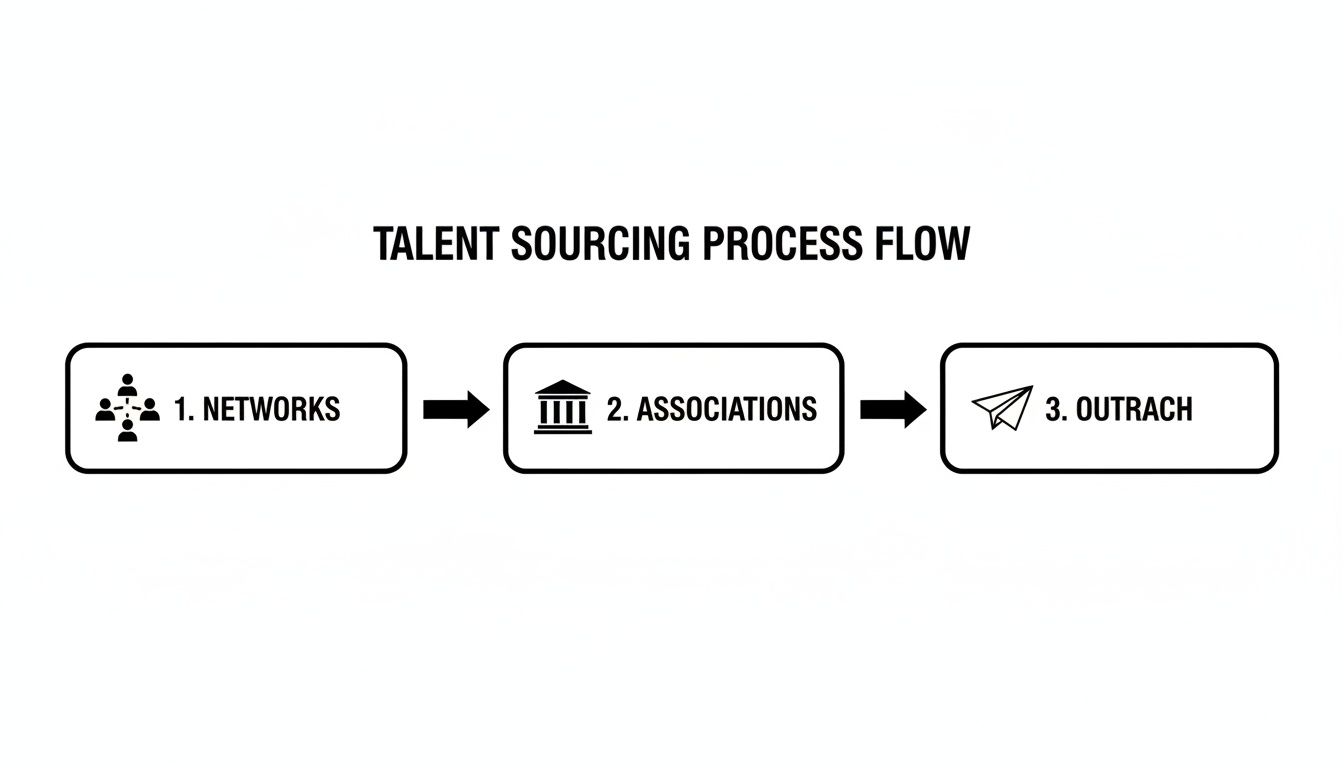
It’s a good visual reminder that a multi-channel approach is key to filling your interview funnel with high-calibre talent from different backgrounds and industries.
Assembling the Right Interview Panel
Hiring an Operations Manager should never be a one-person decision. This role touches nearly every part of the business, and your interview panel needs to reflect that. A well-rounded panel gives you a much more holistic view of the candidate and significantly reduces individual bias.
Your ideal panel should include:
- The Direct Manager: To validate role-specific skills and assess team chemistry.
- A Peer from a Different Function: Someone from finance, sales, or even marketing who will work closely with the new hire. This is a great way to test for a collaborative mindset.
- A Direct Report (if appropriate): A senior member of the operations team can offer a unique perspective on the candidate’s leadership and communication style from the ground up.
- A Senior Leader: To gauge strategic thinking and ensure alignment with the company’s broader vision and culture.
Make sure every panellist has a scorecard built around the core competencies you defined at the start. This simple tool ensures everyone is measuring candidates against the same objective standards, paving the way for a more structured, data-informed decision. This rigorous, multi-faceted approach is how you minimise risk and find an operational leader who can truly make an impact.
You’ve sifted through countless profiles and held some intense interviews. Now for the make-or-break moment: putting together an offer that doesn’t just meet the market, but convinces your top candidate that their future is right here, with you. It’s a common mistake to rush this part, but a weak or poorly presented offer can unravel all your hard work in a heartbeat.
Getting your Operations Manager hire across the finish line hinges on a compensation strategy that’s both smart and data-driven. It’s not just about the base salary. It’s about building a total rewards package that shows you understand the true value of the role and what motivates a top-tier operational leader.
Establishing a Competitive Salary Benchmark
Before a single number is mentioned, you need to get a firm grip on market reality. An offer that seems generous in one city or industry might be completely off the mark in another. Your first move is to pull together solid salary data, specifically for the Indian market.
Several factors will heavily influence the salary benchmark for an Operations Manager:
- Location: It’s no surprise that a role in a Tier-1 metro like Mumbai or Bengaluru will command a much higher salary than one in a Tier-2 city. This reflects not just the cost of living but also the concentration of talent.
- Industry: Compensation in a high-margin tech manufacturing firm will look very different from a traditional logistics or FMCG company. You have to compare apples with apples.
- Scope of Responsibility: Will they own a P&L? Are they leading a team of 10 or 100? Is it a single site or a multi-location setup? The scale of their impact must be directly reflected in their pay.
- Experience Level: There’s a world of difference between a manager with 5-7 years of experience and a senior leader with over 15 years who’s navigated complex, large-scale operations.
Use trusted salary surveys and industry reports to map out a realistic salary band. This data isn’t just a number; it’s your anchor, shifting the conversation from a guess to a strategic, defensible decision.
Building a Holistic Compensation Package
While the base salary grabs the headlines, seasoned operational leaders are always looking at the bigger picture. Your offer needs to tell a compelling story about the total value you bring to the table, and that extends far beyond the monthly payslip.
A winning offer for an Operations Manager should thoughtfully weave together these key elements:
- Performance-Based Bonuses: This is crucial. Tie a significant chunk of their variable pay to the very KPIs you defined when you first designed the role. Think cost-saving targets, improvements in production uptime, or hitting critical project milestones. This creates a direct, tangible link between their performance and financial reward, a powerful motivator for any results-driven leader.
- Long-Term Incentives (LTIs): For more senior roles, don’t shy away from stock options or other equity-based incentives. This aligns their long-term interests squarely with the company’s success and is a massive retention tool. It gives them a real stake in the value they’re helping to create.
- Non-Monetary Benefits: Never, ever underestimate the power of benefits that genuinely improve quality of life. This could be flexible work arrangements, comprehensive health insurance for their family, a generous professional development budget, or wellness programmes. These things show you value them as a whole person, not just a cog in the machine.
The most compelling offers aren’t always the ones with the highest base salary. They’re the ones that paint a complete picture of growth, impact, and a true long-term partnership.
Navigating Negotiations and Closing the Deal
When you’re ready to extend the offer, present it as a complete package. Walk the candidate through every component, base salary, bonus potential, benefits, LTIs, so they see the full value proposition. Go into that conversation prepared to negotiate, with a clear idea of where you have flexibility.
If the candidate comes back with a counter-offer, don’t treat it as a challenge. See it for what it is: a conversation. Dig a little deeper to understand their motivations. Is it really about the base number, or could a non-monetary perk be the thing that seals the deal? A little bit of flexibility at this stage can make all the difference, reinforcing their decision and officially welcoming a vital new leader to your team.
Onboarding for Maximum Impact from Day One

Let’s be clear: the hiring process doesn’t end when your chosen candidate signs the offer letter. In many ways, that’s just the beginning. What you do next—how you bring them into the fold, is arguably the most critical step. A strategic onboarding plan is what turns a great hire into a high-impact leader, protecting the significant investment you’ve just made.
Too many companies treat onboarding like an admin checklist. Laptop? Check. Email account? Check. Office tour? Check. For a role as pivotal as an Operations Manager, this is a surefire way to guarantee a slow start and squandered potential. The real objective is deep, strategic integration that empowers them to add real value within weeks, not months.
The data backs this up. Employees who go through a well-structured onboarding programme are 58% more likely to still be with the company three years later. This isn’t just about making someone feel welcome; it’s about architecting their success from the very start.
Architecting a Strategic 90-Day Plan
A 90-day plan is the perfect tool for this. It serves as a clear roadmap, breaking down what can be an overwhelming new role into digestible, focused phases. It swaps ambiguity for purpose, guiding the new manager from learning, to contributing, and finally to owning their role.
Phase 1: The First 30 Days (Deep Immersion)
The first month is all about absorption. The new manager’s primary job is to listen, learn, and understand the business from the ground up, the people, the processes, and the undocumented challenges.
- Go Beyond the Meet-and-Greet: Set up structured one-on-ones with key leaders across finance, sales, HR, and production. Give your new hire a clear agenda for each meeting: understand their goals, their biggest operational pain points, and how the departments interact.
- Get Their Hands Dirty: Arrange deep dives into your ERP or WMS, but don’t stop there. The real learning happens on the factory floor, in the warehouse, or shadowing customer service calls. They need to see the operation in action, not just on a screen.
- Spot the Quick Wins: Ask them to maintain a running log of their observations. By the end of this phase, they should be able to flag one or two low-risk areas where a small process tweak could make a tangible difference.
Phase 2: Days 31-60 (Analysis and Contribution)
With a foundational understanding in place, the focus now shifts from observation to active analysis. Your new hire starts connecting the dots and forming initial hypotheses about where the biggest opportunities for improvement lie.
- Dive into the Data: Grant them access to historical performance data. Their task is to analyse KPIs related to productivity, cost, quality, and delivery to spot trends and diagnose underlying issues.
- Assess the Landscape: This is the time to evaluate the current team’s structure and skills. They should also begin mapping out critical workflows to identify the real bottlenecks, not just the perceived ones.
- Present Initial Findings: Towards the end of this phase, schedule a checkpoint. They should present their preliminary observations and a high-level plan for their first major initiative to you and other key stakeholders.
Your onboarding plan should be less about a rigid schedule and more about a guided discovery. Give them the framework and the access they need, then empower them to ask the tough questions and find the answers themselves.
Phase 3: Days 61-90 (Ownership and Execution)
In this final phase, the transition is complete. The Operations Manager moves from learning to leading, taking full ownership of their responsibilities and launching their first significant project.
- Launch a Pilot Project: Based on their analysis, they should now kick off a manageable pilot project. This is crucial, it demonstrates their ability to execute and delivers a tangible win that builds credibility and momentum.
- Finalise First-Quarter KPIs: Now, you can work together to refine and finalise their performance objectives. These goals will be far more realistic and impactful because they’re rooted in a genuine, on-the-ground understanding of the business.
This structured approach massively shortens their time-to-impact. To build out your own programme, you can adapt a framework from an effective employee onboarding checklist template and tailor it to the strategic demands of this role. By investing in this kind of deep integration, you ensure your new Operations Manager doesn’t just settle in, they start driving results from day one.
Unpacking Common Questions About Hiring an Operations Manager
Even for a seasoned CHRO, hiring for a role as pivotal as an Operations Manager can bring up some tricky questions. This position is the very heart of your business, the critical link between strategy and execution. That means standard hiring playbooks often don’t quite cut it.
By thinking through these common challenges ahead of time, you can sharpen your hiring strategy and sidestep some expensive mistakes. Let’s tackle the questions that come up most often during this crucial search.
What are the Most Common Hiring Mistakes to Avoid?
One of the biggest pitfalls we see is starting the search with a generic, recycled job description. This approach casts a wide but hopelessly unfocused net. You end up with a flood of candidates who simply can’t solve your specific operational challenges, wasting everyone’s time and signalling to top talent that you haven’t really defined the role’s strategic value.
Another major misstep is underestimating the importance of soft skills. Of course, technical expertise in supply chain or process optimisation is vital, but that’s only half the picture. To truly succeed, an Operations Manager has to be a brilliant communicator, a sharp negotiator, and a natural collaborator. They are the essential glue between the front line, senior leadership, and every other department.
Finally, a disconnected interview process can completely sink your efforts. When the interview panel isn’t aligned on the core competencies or what a great answer even sounds like, the feedback becomes subjective and inconsistent. This lack of a clear evaluation framework often leads to biased decisions and, ultimately, a bad hire.
The single biggest mistake is treating the Operations Manager role as purely tactical. A great OM is a strategic partner who connects day-to-day execution with long-term business goals. Hiring for tactical skills alone is a recipe for mediocrity.
How Can We Really Assess a Candidate’s Ability to Handle Pressure?
An Operations Manager’s world is often a storm of unexpected problems and impossible deadlines. Figuring out if they can handle that pressure is non-negotiable, and just asking hypothetical questions won’t get you there.
The best tools in your arsenal are situational and behavioural interview techniques.
- Go deep with behavioural questions: Ask for a specific, detailed story about a time they managed a major operational crisis. Don’t let them get away with a vague answer. Dig in with follow-ups:
- “How did you first figure out the root cause of the problem?”
- “Walk me through your communication plan. Who needed to know what, and when did you tell them?”
- “What was the final business impact of the solution you put in place?”
- Use a situational assessment: A case study based on a real challenge your company has faced is incredibly insightful. Present them with a scenario—say, a key supplier suddenly goes out of business—and ask them to outline their immediate action plan. This tests their problem-solving process and decision-making in a context that’s directly relevant to your business.
When Should We Bring in an RPO Partner?
Deciding to work with a Recruitment Process Outsourcing (RPO) partner isn’t a sign of failure; it’s a strategic move. It makes perfect sense when you’re up against specific challenges that are stretching your internal team’s capabilities.
Bringing in an RPO partner is especially smart in these situations:
- Specialised Need, Limited Bandwidth: Your internal Talent Acquisition team might be fantastic, but they’re stretched thin or don’t have deep networks within India’s niche manufacturing or logistics sectors. An RPO brings dedicated focus and ready-made talent pipelines to the table.
- Rapid Scaling Requirements: If your business is expanding and you need to fill multiple operations roles across different locations quickly, an RPO provides the horsepower and project management skill to get it done at scale without compromising on quality.
- Access to Passive Talent: Let’s be honest, the best operations leaders are rarely scrolling through job boards. A specialised RPO excels at the kind of headhunting needed to find, engage, and attract high-calibre passive candidates who aren’t actively looking but are open to the right opportunity.
A good RPO becomes a true extension of your team, managing the entire hiring lifecycle with deep, specialised expertise.
At Taggd, we specialise in connecting organisations with the operational leaders who can drive efficiency and growth. If you are looking to build a world-class operations team, we can help you navigate every step of the process.
Discover how our Recruitment Process Outsourcing services can secure the talent you need.