Treating the outsourcing of legal and compliance hiring as simple task delegation is a mistake. It’s a strategic imperative. You need to think of it as partnering with a specialised Recruitment Process Outsourcing (RPO) provider to find niche talent, keep costs in check, and handle risk in a regulatory environment that’s changing faster than ever.
The Strategic Shift to Outsourced Legal Recruitment
The Indian corporate world is going through a massive shake-up. The days when a generalist in-house lawyer could handle everything are disappearing. Now, there’s an urgent need for specialists who can find their way through an increasingly tangled web of regulations. For Chief Human Resources Officers (CHROs), this isn’t just a hiring problem, it’s a critical turning point for the business.
Your traditional internal recruitment teams are likely already stretched thin. They often don’t have the deep domain expertise or the right networks to find, let alone attract, the right talent. Think about trying to hire a data privacy lawyer who is an expert in the new Digital Personal Data Protection (DPDP) Rules, or a regulatory economist who understands the National Green Hydrogen Mission. This is where the case to outsource hiring for legal and compliance roles becomes crystal clear.
Navigating India’s New Regulatory Maze
The regulatory changes we’re seeing aren’t just minor adjustments; they are complete transformations. Recent analysis shows that India’s corporate legal hiring is seeing an 11% increase in aggregate hiring intent for in-house teams. This surge is a direct result of huge shifts like the full rollout of the Bharatiya Nyaya Sanhita (BNS), the new Labour Codes, and the upcoming DPDP Rules 2025.
These regulations are pushing legal roles from being seen as a cost centre to becoming a vital part of the business. You can explore the full corporate legal jobs report and its findings to get a better handle on the market. This shift demands extreme specialisation in fields that barely even existed ten years ago, like experts who operate at the crossroads of law and technology, or those who get the economic impact of new RBI directives. This is the new talent battleground, and most companies are simply not ready.
A specialised RPO partner does more than just fill jobs. They give you market intelligence, access to passive candidates who aren’t actively looking, and the flexibility to scale your legal team up or down as regulations change. This turns your hiring function from a reactive cost centre into a proactive strategic advantage.
From Cost Centre to Competitive Advantage
Bringing in an RPO for these critical roles is about more than just finding people. It’s about managing risk, controlling costs, and gaining a real competitive edge. An expert partner brings a level of focus that an internal team just can’t replicate. They live and breathe the legal talent market, so they know the salary benchmarks, career motivations, and exactly where to find those rare skills.
Let’s look at a straightforward comparison. This table highlights the fundamental differences between relying on your internal team and partnering with an RPO for legal and compliance recruitment.
Traditional In-House vs Outsourced Legal Hiring
| Hiring Aspect | In-House Recruitment | Outsourced RPO Partner |
|---|---|---|
| Talent Access | Relies on active job seekers and limited professional networks. | Taps into a deep, curated database of passive and active candidates. |
| Speed & Efficiency | Slower time-to-hire due to competing priorities and lack of specialisation. | Faster placement cycles driven by focused resources and established processes. |
| Market Expertise | Generalist HR knowledge; may lack deep insight into niche legal roles. | Deep domain expertise in legal and compliance talent trends and compensation. |
| Cost Structure | High hidden costs from prolonged vacancies and mis-hires. | Predictable costs with clear ROI through reduced time-to-fill and higher quality hires. |
By partnering with an RPO, you aren’t just handing off a task. You are embedding a team of specialists directly into your talent acquisition function. This strategic move frees up your internal HR team to focus on what they do best-building culture, improving retention, and focusing on employee development. Meanwhile, your RPO partner makes sure your organisation has the legal and compliance firepower it needs to thrive in India’s dynamic new business world.
Defining Your Legal and Compliance Hiring Needs
Don’t even think about calling a vendor to outsource legal and compliance roles until you’ve mapped out your organisation’s talent gaps with precision. Jumping in without this internal blueprint is like setting sail without a destination, you’ll just burn through resources and end up nowhere. A thorough internal audit is the absolute first step to making sure your outsourcing partnership pays off from day one.
Your first move is to get brutally honest about the specific skills and expertise your current legal and compliance team is missing. This goes way beyond just headcount; it’s about capability. For instance, with the DPDP Rules 2025 looming, do you have an in-house counsel with a proven track record in data privacy implementation, or are you hoping your generalists can figure it out? A proper skills gap analysis will throw these kinds of critical vulnerabilities into sharp relief.
Permanent Hire vs. Project-Based Expert
A classic mistake is to assume every gap needs to be plugged with a full-time, permanent employee. Your analysis should clearly distinguish between long-term strategic needs and short-term, project-specific requirements.
- Permanent Need: If your business is expanding into a new, heavily regulated market or if compliance has woven itself into the fabric of your daily operations, you likely need a permanent leader. A perfect example is hiring a Chief Compliance Officer to build and steer a robust, company-wide compliance framework for the long haul.
- Project-Based Need: On the other hand, if you’re navigating a one-off regulatory challenge, like getting your initial compliance sorted for the new Labour Codes, a project-based expert or a fixed-term contract hire makes far more sense. This gives you immediate access to top-tier expertise without the long-term cost.
Getting this initial diagnosis right is everything. It dictates the kind of talent you’re after and shapes the entire scope of work you’ll eventually hand to a potential RPO partner. Get it wrong, and you could end up hiring a very expensive permanent solution for a six-month problem.
Before you engage any external partner, create a detailed “strategic brief.” This document is your north star. It should spell out the exact roles, the non-negotiable skills, the expected duration, and the business goals this new hire is meant to crush.
The flowchart below shows how market shifts often expose internal hiring weaknesses, making strategic outsourcing the logical next move.
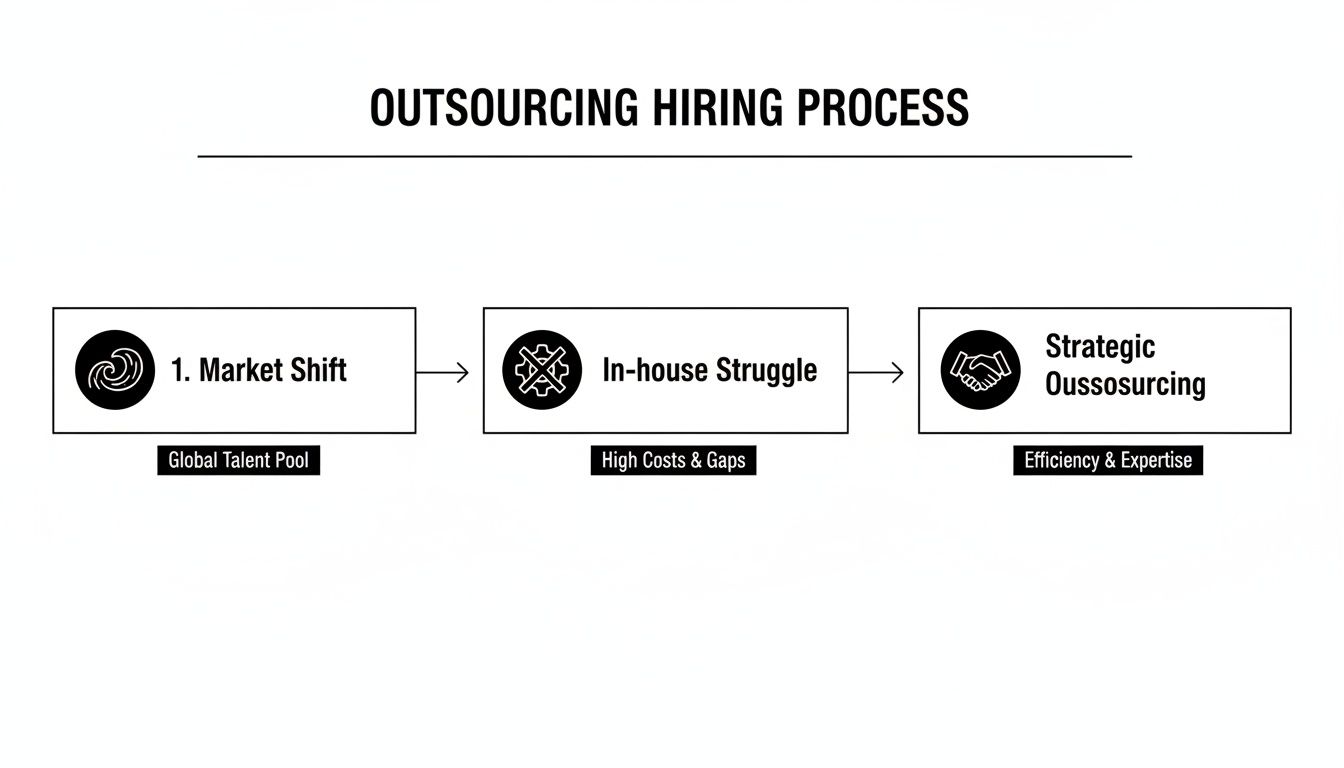
As the market gets more complex, the limits of an in-house team become obvious, paving the way for a more strategic partnership.
Defining the Scope of Work for Your RPO
Once you know what you need, you have to define how an RPO partner will help you get it. This is where you scope the engagement. A crystal-clear scope prevents crossed wires and ensures the RPO’s efforts are perfectly aligned with what you actually expect them to deliver. You need to detail exactly which parts of the recruitment lifecycle you’re handing over.
Here are the elements to nail down in your scope:
- Sourcing: Will the RPO be responsible for actively headhunting passive candidates, or just sifting through inbound applications? For niche legal roles, let’s be clear: active sourcing is a must.
- Screening and Assessment: Define the screening criteria with no room for ambiguity. This includes required qualifications, years of experience with specific regulations (like BNS or DPDP), and any essential soft skills.
- Interview Coordination: Who is handling the logistics? Specify who will be scheduling interviews with your internal hiring managers to keep the process moving.
- Offer Management: Decide the RPO’s role in negotiating offers and managing all candidate communication right through to acceptance.
- Onboarding: Does the RPO’s job end when the offer is signed? Or will they help with pre-boarding and initial onboarding activities to guarantee a seamless start?
A well-defined scope is the bedrock of your Service Level Agreement (SLA). It lets you set achievable targets and measure your partner’s performance against concrete deliverables, ensuring you land the right talent for your legal and compliance functions. By putting in this work upfront, you can approach vendors with clarity and confidence, setting the stage for a partnership that’s truly strategic.
How to Select the Right RPO Partner for Niche Roles
Choosing a partner to outsource hiring for legal and compliance roles isn’t like picking a generalist recruiter. It’s a completely different ball game. A standard RPO provider might be brilliant at filling sales or IT positions, but they will likely stumble when faced with the unique demands of sourcing a Senior Counsel with deep expertise in state-level labour laws or a data privacy officer fluent in the DPDP Rules.
Frankly, the stakes are just too high to get this wrong.
You need a partner with a scalpel, not a sledgehammer. The selection process has to go far beyond a surface-level glance at cost and company size. You’re looking for a strategic ally with proven, deep-domain expertise in the Indian legal and regulatory environment.

Evaluate Deep Domain Expertise
Your very first filter should be a vendor’s real, demonstrable experience in legal and compliance recruitment, specifically within India. Generalist claims of “we can hire anyone” are a major red flag. You have to probe for tangible proof that they truly understand the nuances of the roles you need to fill.
For instance, don’t just ask if they’ve hired lawyers before. That’s too easy. Instead, get specific. Ask them to detail their process for finding a candidate with experience in navigating the complexities of the Bharatiya Nyaya Sanhita (BNS) as it applies to corporate liability.
Their answer will immediately tell you whether they are true specialists or are just planning to search keywords on a job portal.
Here are the kinds of questions that get to the heart of their expertise:
- Case Studies: “Can you walk me through a recent placement you made for a Head of Compliance in the financial services sector? What were the specific challenges, and how did you navigate them?”
- Regulatory Knowledge: “How does your team stay current with constantly evolving regulations like the new Labour Codes and their state-specific implementations?”
- Talent Network: “Describe your network of passive legal and compliance professionals. How do you actually engage with candidates who aren’t actively looking for a new role?”
A partner who can answer these questions with confident, specific examples is one who has been in the trenches. They get the difference between a corporate lawyer and a regulatory affairs specialist, a distinction that many generalist firms completely miss. If you’re new to this kind of partnership, you might find our guide covering everything you need to know about RPO useful for understanding the fundamentals.
Scrutinise Their Technology and Talent Intelligence
In today’s market, the best RPO providers aren’t just people-powered; they’re data-driven. A vendor’s technology stack is a direct indicator of their ability to deliver efficiency, precision, and market insights. You’re looking for a partner who uses technology to augment their human expertise, not replace it.
A critical differentiator is a vendor’s talent intelligence capability. This isn’t just about having a database of CVs. It’s about using data to map the market, predict hiring trends, and identify talent with emerging skills before your competitors even realise they need them.
Ask potential partners how they use technology to your advantage. Do they use AI-powered matching algorithms to find the best-fit candidates based on nuanced skill sets, not just keywords? Can they give you real-time data on salary benchmarks for a niche role like a ‘Regulatory Economist’ in Mumbai versus Bengaluru?
This level of insight transforms your hiring from a reactive necessity into a powerful strategic function.
Differentiating a Generalist from a Strategic Partner
Let’s make this real. Imagine you need to hire a specialist to manage compliance for the RBI’s Regulation of Payment Aggregators.
- A generalist recruiter will post a generic job description and start sifting through the applicants who happen to see it. They’ll present candidates who look okay on paper, but they lack the context to truly vet their experience.
- A strategic RPO partner, on the other hand, will already have a pre-vetted pool of professionals with fintech and regulatory experience. They’ll use their talent intelligence to pinpoint individuals who have navigated similar regulatory shifts in the past, even if they aren’t actively job-seeking. They will advise you on competitive compensation and help you frame your Employee Value Proposition in a way that resonates with this highly specialised audience.
The difference is profound. One fills a seat; the other builds a genuine competitive advantage. When you decide to outsource hiring for legal and compliance roles, your goal is to find the latter.
Structuring Watertight Agreements and Mitigating Risk
Once you’ve zeroed in on a potential RPO partner, the real work begins. A successful partnership for legal and compliance hiring isn’t built on trust alone; it’s forged in the fine print of a rock-solid Service Level Agreement (SLA).
Think of this document as both your shield and your roadmap. It’s what turns friendly promises into legally binding commitments. Without a strong SLA, you’re essentially navigating a high-stakes partnership with no guardrails.
The heart of any good SLA is a set of clear, measurable, and truly relevant Key Performance Indicators (KPIs). For something as specialised as legal and compliance recruitment, generic metrics just won’t do. You have to insist on KPIs that reflect the unique pressures of this niche.
Defining Your Non-Negotiable Metrics
Your SLA has to go way beyond a basic cost-per-hire. The focus must be on metrics that directly protect the business and manage risk. Your RPO partner needs to have their skin in the game, with their success tied directly to these key areas.
- Time-to-Fill for Specialised Roles: This is absolutely critical, but don’t settle for a single number. Your SLA needs tiers based on role complexity. Finding a paralegal is a world away from sourcing a Chief Compliance Officer with deep BNS expertise, and your agreement must reflect that reality.
- Quality of Hire: This is the ultimate test. Don’t just track if a role was filled. You need to measure the new hire’s performance after 12 months, their retention rate, and their actual impact, as rated by the hiring manager. This is the true measure of a successful placement.
- Adherence to Process Compliance: The hiring process itself has to be bulletproof. Your SLA must include a metric that tracks the RPO’s adherence to every single step, from running non-biased interviews to ensuring all candidate data is handled strictly according to DPDP guidelines.
The goal is to create a performance framework where the RPO’s success is inseparable from your company’s strategic goals. When they hit their KPIs, your legal and compliance functions should become demonstrably stronger.
Contractual Safeguards for Risk Mitigation
When you outsource hiring for legal and compliance, you’re handing over the keys to some of your most sensitive information. Your agreement must have explicit, non-negotiable clauses that protect your organisation from every conceivable angle. This is where you stop talking about performance and start enforcing protection.
It’s like building a fortress of contractual obligations. The most critical areas to lock down are confidentiality, data protection, and regulatory pass-through duties. There is zero room for ambiguity here.
For instance, your SLA must spell out the RPO’s responsibilities under the Digital Personal Data Protection (DPDP) Act. This isn’t just a simple confidentiality clause. Demand specifics on encryption methods, access controls, and breach notification protocols. An RPO partner who hesitates on these points is a massive red flag.
Adapting to the Rise of Fixed-Term Employment
The very nature of legal work in India is changing. The old model of hiring purely for permanent roles is giving way to a more agile, blended workforce. This trend is picking up speed, especially with the rollout of new labour codes.
A January 2026 survey revealed that a staggering 75% of Indian companies expect to significantly increase their use of fixed-term employment for legal and compliance roles. This shift is a direct response to the compliance pressures from new regulations like the DPDP Rules 2025 and BNS provisions. Many organisations find it smarter to bring in project-based experts to support their in-house teams. You can read more about how new labour laws are impacting hiring trends.
Your SLA needs to be flexible enough to handle this new reality. It should clearly define the terms for sourcing and managing both permanent and fixed-term contract staff. This means outlining different fee structures, performance metrics, and compliance duties for each type of hire.
By baking this flexibility into your agreement from day one, you ensure your organisation stays agile, protected, and ready for whatever the evolving Indian legal landscape throws at you.
Measuring the ROI of Your Outsourcing Partnership
So, how do you walk into the boardroom and prove that outsourcing your legal and compliance hiring was a game-changing strategic move? A successful RPO partnership isn’t about a vague feeling that things are better; it’s about hard data that shows tangible business impact.
To get this right, you have to look well beyond the old, tired metric of cost-per-hire.
The real proof of value is found in a dashboard of Key Performance Indicators (KPIs) that connect your hiring outcomes directly to the company’s bottom line. This is how you stop defending your RPO partner as a cost and start showcasing them as a driver of your competitive edge.

Building a CHRO Dashboard That Goes Beyond Cost
As a CHRO, your dashboard needs to tell a compelling story of risk mitigation, boosted efficiency, and strategic growth. Think in terms of both cold, hard numbers and the softer, but equally critical, qualitative returns.
Here’s how to build a complete picture of your ROI.
Key Quantitative Metrics:
- Reduction in Compliance Penalties: Track the direct decrease in fines or legal sanctions that came from plugging compliance gaps. This is a straight shot to the bottom line, showing the immediate financial benefit of having the right experts in place.
- Time-to-Productivity: Don’t just stop at time-to-hire. The real metric is how quickly a new specialist starts adding measurable value. This reflects the quality of the candidate your partner sourced, not just the speed.
- Project Deployment Speed: How much time did you save on critical business projects because you hired the right legal and compliance experts faster? This is a powerful metric that business leaders will understand instantly.
If you want to get into the nitty-gritty of the financial side, our guide on how to calculate enterprise RPO ROI provides a much more detailed framework.
Key Qualitative Metrics:
- Improved Risk Posture: This one is huge. Poll your executive team and business unit leaders. How much more confident are they in the company’s ability to handle regulatory curveballs?
- Enhanced Employer Brand: A top-notch RPO partner doesn’t just fill roles; they burnish your reputation among elite legal and compliance talent, making your next hire that much easier. Keep an eye on candidate feedback and your standing in the legal community.
- Strategic Advisory Value: How much is the market intelligence from your partner worth? Their insights into talent trends and predictive hiring advice should be considered a major part of the return.
The Power of Quarterly Business Reviews
Measuring your ROI isn’t something you do once a year. It’s an ongoing, strategic conversation, and the Quarterly Business Review (QBR) is where it happens. This isn’t just a performance check-in. It’s a strategy session to sharpen your processes and realign for what’s coming next.
In your QBRs, you should be poring over the agreed-upon KPIs, dissecting what worked (and what didn’t), and troubleshooting any bottlenecks together. This is your chance to discuss upcoming regulatory shifts, like new interpretations of the DPDP Act, and make sure your RPO partner is already mapping the talent you’ll need to stay ahead.
A strong RPO partnership is dynamic. The QBR is where you move beyond a client-vendor relationship and function as a unified talent team, using data to make smarter decisions and anticipate the company’s future needs.
For instance, if your data shows that the time-to-fill for contract-based data privacy lawyers is creeping up, the QBR is the place to figure out why. Is it a compensation problem? Is the talent pool genuinely shrinking? A true strategic partner won’t just bring you the problem; they’ll show up with data-backed theories and potential solutions.
This continuous feedback loop ensures your outsourcing strategy never gets stale. It evolves right alongside your business and the complex Indian market, cementing the partnership’s role as a direct contributor to your company’s success and resilience.
FAQs
Deciding to outsource hiring for your legal and compliance teams is a big move. It’s completely normal for CHROs and business leaders to have some tough questions. After all, you’re putting trust, cost, and even your brand reputation on the line. Let’s tackle some of the most common concerns head-on with direct, practical answers to help you make this strategic choice with confidence.
How Can We Ensure Confidentiality with an External Partner?
This is almost always the first question, and for good reason. When an outside partner is handling hiring for such sensitive roles, confidentiality isn’t just important, it’s everything. Any RPO provider worth their salt must show you they have rock-solid data security protocols. They should be ready to sign strict non-disclosure agreements (NDAs) that are customised for the engagement.
During your vendor vetting, you need to demand to see their data handling policies and security certifications, like ISO 27001. Ask them to walk you through their exact processes for managing confidential candidate and company data under frameworks like the DPDP Act.
Your SLA is your ultimate line of defence. It must spell out confidentiality obligations, mandatory data breach notification procedures, and crystal-clear data destruction policies for when the engagement is over.
For incredibly sensitive roles, like a new General Counsel, think about a hybrid approach. Let the RPO partner handle the initial sourcing and screening to tap into their network and expertise. Then, you can bring the final interviews and offer stages in-house to keep the circle of information tight. This balanced model really does give you the best of both worlds.
Will Outsourcing Weaken Our Employer Brand?
It’s a valid fear, the idea of losing control over how candidates see you. But a skilled RPO partner should actually strengthen your brand, not weaken it. The best RPO providers today don’t just work for you; they work as you, operating as a seamless extension of your own team. They’ll dive deep to understand your company culture and Employee Value Proposition (EVP).
This deep-dive ensures they’re communicating a consistent and powerful message to every single candidate. For specialised legal and compliance talent, the professional touch of an expert recruiter often makes the candidate experience significantly better. A specialist understands the nuances of the role and can have a much more credible conversation than a generalist internal recruiter might. Your SLA should absolutely include clauses on brand representation and candidate communication standards to guarantee everyone is perfectly aligned.
Is It More Expensive to Outsource Legal Hiring?
If you only look at the direct fee, you might think outsourcing costs more. But a Total Cost of Vacancy analysis nearly always reveals a different truth. You have to factor in the huge hidden costs of trying to hire for these critical roles in-house.
Think about these real-world factors:
- Longer Vacancy Periods: Every single day a key compliance role sits empty, your risk exposure skyrockets. These long vacancies can also stall critical projects and hit your revenue.
- High Advertising Costs: Niche legal job boards and exclusive professional networks charge premium rates.
- Wasted Executive Time: What’s an hour of your senior leaders’ time worth? Every hour they spend sifting through unqualified candidates sourced by a non-specialist team is a major hidden cost.
- The Price of a Bad Hire: The financial and cultural damage from a mis-hire in a key legal or compliance position can be catastrophic.
A good RPO partner brings economies of scale, a pre-vetted talent database, and AI-driven efficiency that dramatically shrinks the time-to-hire. That speed saves you money directly and gets business-critical roles filled faster, making the ROI incredibly compelling.
How Can an External Partner Keep Up with Our Changing Needs?
This is exactly where a strategic RPO partner shines. Your internal team might be slow to react to market shifts, but specialised RPOs are immersed in the talent market every single day. They are actively tracking regulatory changes, like the new Labour Codes or DPDP Rules and are already mapping the talent landscape to find people with those skills.
The top providers use talent intelligence platforms to spot professionals with emerging skills, often before you even realise you need them. The key is to choose a partner who acts as a strategic advisor, not just a transactional recruiter. Regular strategy sessions and Quarterly Business Reviews (QBRs) should be a non-negotiable part of the deal. This ensures their hiring focus evolves right alongside your business strategy and the fast-moving regulatory world.
Ready to transform your legal and compliance hiring from a challenge into a strategic advantage? Taggd leverages AI-powered talent intelligence and deep domain expertise to connect you with India’s top legal professionals. Discover how our RPO solutions can help you build a resilient, compliant, and competitive team.