Project RPO is a highly specialised recruitment solution designed for those big, time-sensitive hiring pushes. Think of it like bringing in a world-class special effects crew for a blockbuster film—you need their unique expertise for a critical phase of the project, but you don’t need them on the payroll forever. This agile model is perfect for tackling major business goals, like launching a new tech hub or rapidly expanding a sales force.
Unpacking Project RPO for the Indian Market

Let’s make this real. Imagine your company is setting up a new Global Capability Centre (GCC) in Bengaluru. The goal? Hire 150 top-tier data scientists within six months. Your internal TA team is already running at full capacity just keeping up with regular hiring.
Instead of permanently bloating your team for this one-off surge, you bring in a specialist recruitment partner just for this “project.” That, right there, is the essence of Project RPO.
It’s a strategic scalpel, not a sledgehammer. It gives you the firepower and niche expertise you need for a critical, time-bound mission, all without the hefty long-term costs of a traditional, full-scale RPO partnership.
The Rise of Agile Talent Solutions in India
India’s business landscape is nothing if not dynamic. Companies here are constantly dealing with explosive growth, breaking into new markets, or pivoting with new technology—all of which demand immediate, specialised talent. This makes it the perfect breeding ground for flexible recruitment models like Project RPO.
The broader Recruitment Process Outsourcing market in India is booming, driven by an incredible talent pool and a thriving IT sector. In fact, the Indian RPO market is on track to hit a valuation of $420 million by 2027, growing at a blistering CAGR of 15.5%. This shows just how much businesses are leaning on external recruitment experts to cut through the hiring noise.
A Project RPO model gives companies a powerful way to juggle speed, cost, and quality. It’s about accessing elite recruitment skills exactly when you need them, effectively turning talent acquisition into a flexible, on-demand expense rather than a fixed overhead.
Why Is This Model Gaining So Much Traction?
So, what’s behind the surge in project-based recruitment partnerships? It boils down to a few key advantages:
- Targeted Expertise: You get immediate access to recruiters who live and breathe your specific niche, whether it’s FinTech or life sciences, for the exact duration you need them.
- Cost Control: You sidestep the long-term expenses tied to hiring, onboarding, and training permanent recruiters for what is ultimately a temporary hiring spike.
- Speed to Market: A dedicated project team lives and breathes your deadline. They can fill roles much faster than an overstretched internal team, helping you hit crucial business milestones on time.
This model perfectly occupies the middle ground between trying to do everything yourself and completely outsourcing your entire recruitment function. You get all the benefits of external expertise without being locked into a multi-year contract. To see where this fits in the bigger picture, explore our comprehensive guide on everything you need to know about RPO.
The Strategic Advantages and Hidden Risks
Jumping into a Project RPO model brings a serious set of benefits to the table, especially when you’re facing time-sensitive, high-stakes hiring drives. Think of it as a specialist solution built for speed and precision, letting your organisation chase major growth goals without throwing your day-to-day talent acquisition rhythm into chaos.
But, like any big strategic move, it’s not without its challenges. You need to navigate it carefully. Understanding both the clear wins and the subtle risks is absolutely critical for any leader thinking about this agile approach. A well-planned partnership can deliver incredible results, while a poorly executed one can end in missed targets and a lot of frustration.
The Upside Driving Project RPO Adoption
When you get it right, a project RPO partnership feels like you’ve just added a specialist commando unit to your team overnight. The most immediate impacts you’ll notice are in speed, cost-effectiveness, and getting access to deep market knowledge that would take you years to build from scratch. This model is gaining so much ground precisely because it solves the most common headaches in high-volume or super-niche recruitment.
Let’s break down the main benefits:
- Accelerated Time-to-Hire: The project team is laser-focused on one thing: your goal. If you’re launching a new Bengaluru tech centre, this means they can slash the average time-to-hire, helping you hit those crucial launch dates.
- Controlled Costs: Forget the long-term financial burden of hiring, training, and keeping permanent recruiters for what might be a temporary surge. This model turns a fixed overhead into a predictable, variable project expense—a huge plus for any budget-conscious leader.
- Access to Niche Talent Pools: Do you suddenly need to hire 50 cybersecurity analysts in Hyderabad? A specialist RPO partner already has the networks and a deep read on that specific talent market. They can get you in front of qualified passive candidates far more efficiently than your in-house team ever could.
Project-based RPO is rapidly growing as organisations seek flexible, short-term solutions to meet immediate hiring needs. It allows them to test new, technology-enabled hiring strategies before committing to a full-scale partnership.
This approach gives you the strategic firepower to hit ambitious targets without needing the long-term structural overhaul that a full end-to-end RPO would demand.
Navigating the Potential Downsides
While the benefits are compelling, you have to go into Project RPO with a clear-eyed view of the potential pitfalls. Thinking about these challenges ahead of time lets you build safety nets directly into your partnership agreement from day one, which makes for a much smoother ride.
A common worry is whether the external team will truly get—and represent—your company’s unique culture and values. Another big one is what happens to all that valuable market intelligence once the project wraps up.
Let’s look at these risks and how you can get ahead of them:
1. Risk of Cultural Mismatch An external team might not fully grasp the subtle nuances of your company culture. This can lead to a poor candidate experience or, worse, new hires who just don’t fit in with your values.
- Mitigation Strategy: Don’t skimp on the onboarding for the RPO team. Insist on a thorough process that includes deep dives into your company’s mission, vision, values, and employer value proposition (EVP). Regular check-ins with key internal leaders are also essential to keep everyone aligned.
2. Loss of Market Knowledge Post-Project Your RPO provider will gather a mountain of data on talent pools, what competitors are doing, and what candidates expect. When the project ends, that knowledge often walks right out the door with them.
- Mitigation Strategy: Structure your contract to include a detailed offboarding and knowledge transfer phase. This isn’t just a quick handover; it should involve comprehensive reports, talent market maps, and a formal transfer of candidate pipelines to your internal team. Make sure you get to keep the intelligence you paid for.
3. Integration and Communication Gaps Without clear rules of engagement, communication between the RPO team, your internal TA function, and the hiring managers can easily break down. This causes delays, frustration, and finger-pointing.
- Mitigation Strategy: Set up a clear governance structure right from the start. Define the communication rhythm (like daily stand-ups and weekly progress reports), name a single point of contact on both sides, and use shared platforms or dashboards for real-time visibility. No one should ever be wondering what’s going on.
Your Playbook for a Winning RPO Project
Rolling out a successful Project RPO engagement isn’t just about handing over a list of vacancies. Think of it as a finely tuned joint operation between your in-house team and your new recruitment partner. Having a clear, structured framework is the difference between hitting your targets and getting lost in the weeds.
This playbook breaks the entire journey down into practical, manageable phases. Following these steps helps you sidestep common traps like scope creep, crossed wires, and blown deadlines. Each phase builds on the one before it, creating a solid foundation to achieve exactly what you set out to do, whether that’s staffing a brand-new facility or assembling a crack product team.
Phase 1: Nailing Down the Scope and Defining Success
This is where it all begins, and honestly, it’s the most crucial part of the whole process. Before you even think about talking to a provider, you need to get incredibly specific about what a “win” looks like. Vague goals like “we need to hire good people, fast” are a surefire recipe for disappointment.
Get granular. Are you aiming to bring on 50 Java developers in Pune within the next three months? Is the real goal to slash the time-to-fill for niche cybersecurity roles by 40%? These kinds of clear, measurable objectives become the North Star for the entire project.
Here’s what this stage involves:
- Defining the Scope: Clearly map out the number of roles, specific job profiles, locations, and the project timeline. No grey areas.
- Setting KPIs: Decide how you’ll measure success. Key performance indicators (KPIs) like time-to-fill, cost-per-hire, and quality of hire are essential.
- Stakeholder Alignment: Get HR, the hiring managers, and senior leadership in a room (virtual or otherwise) and make sure everyone is completely aligned on the project’s goals and budget.
Phase 2: Choosing Your Partner and Getting Them Up to Speed
With your goals set in stone, you can start the hunt for the right Project RPO partner. This decision goes way beyond just comparing quotes. You’re looking for a provider with a proven track record in your specific field and a company culture that clicks with yours.
Once you’ve made your choice, the onboarding process is everything. Don’t just email a bunch of job descriptions and hope for the best. A deep dive into your company culture, your employer value proposition (EVP), and your internal ways of working is non-negotiable. This is how you ensure the RPO team can represent your brand authentically in the talent market. A rushed or shallow onboarding is one of the biggest reasons for cultural mismatches and a poor candidate experience down the line.
Phase 3: The Kickoff and Seamless Integration
The official kickoff meeting is more than just a formality; it’s where the plan becomes reality. This is the critical session where both teams agree on the rules of engagement, finalise the operational workflows, and get on the same page.
A smooth integration is vital to avoid any friction between your internal TA team and the external RPO crew. This means setting up clear communication channels, defining who is responsible for what, and ensuring everyone has access to the same systems for tracking progress.
The aim here is to create a single, unified recruitment machine. Your RPO team should feel less like a vendor and more like an embedded specialist unit, working in perfect sync with your hiring managers and existing HR staff.
Key steps for integration include:
- Setting a Communication Rhythm: Establish a regular schedule for meetings, like quick daily check-ins, weekly progress reviews, and monthly updates for the steering committee.
- Naming a Single Point of Contact: Assign a dedicated project lead on both your side and the partner’s side to keep communication clean and decision-making swift.
- Integrating Technology: Make sure the RPO team has seamless access to your Applicant Tracking System (ATS) and any other recruitment tech you rely on.
Phase 4: Keeping an Eye on Performance and Making Tweaks
Once the project is in full swing, the focus shifts to constant monitoring and improvement. Those KPIs you set back in Phase 1? They now become your dashboard. Regular performance reviews let you track progress against your goals and make smart, data-driven adjustments along the way.
For instance, if you notice the time-to-source is lagging, you can dig in with your partner to figure out why. Is the job description too restrictive? Is the sourcing strategy not hitting the right channels? This cycle of reviewing and adjusting ensures the project stays on course. It’s far better to spot a problem early than to discover it at the finish line.
Phase 5: Wrapping Up and Transferring Knowledge
As you approach a successful finish, this final phase ensures a smooth handover and, crucially, makes sure you hang onto all the valuable insights you’ve gained. A classic mistake is to just end the contract and let all that market intelligence and candidate data walk out the door.
A proper offboarding process is essential. This should include a comprehensive knowledge transfer where the RPO partner hands over talent maps, market analysis, and a pipeline of warm, qualified candidates to your internal team. This way, your organisation holds onto the value that was created, strengthening your own team’s capabilities for whatever comes next. Done right, offboarding turns a one-off project into a long-term strategic win.
How to Choose the Right Project RPO Partner in India
Picking the right partner for your project RPO isn’t just another vendor selection. It’s one of the most critical decisions you’ll make. This isn’t about finding a supplier to fill roles; it’s about bringing on a strategic ally who will operate as a genuine extension of your own team. For a high-stakes hiring push, the success of the entire initiative often comes down to this single choice, especially in the diverse and fast-moving Indian talent market.
You have to look past the glossy brochures and slick sales pitches. What you need is a solid evaluation framework that digs into what they can actually do, their on-the-ground market knowledge, and how they operate day-to-day. A partner who’s brilliant at high-volume IT hiring in Bengaluru might not have the subtle expertise needed for niche pharmaceutical roles in Hyderabad. This is all about finding the perfect fit for your specific project.
Evaluating Core Competencies and Experience
The very first step is to get under the hood and scrutinise a potential partner’s track record. Past performance is, without a doubt, the best predictor of future success. You need to confirm that they haven’t just worked in your industry, but have successfully delivered projects of a similar scale and complexity to yours.
Get ready to ask some pointed questions to really gauge their depth:
- Proven Niche Expertise: Can they show you detailed case studies of similar projects? You’re looking for hard evidence of success in hiring for the specific roles, seniority levels, and locations you need.
- Regional Market Knowledge: How well do they really understand the talent dynamics in key Indian cities? A good partner should be able to discuss salary benchmarks, competitor activity, and local talent pools in Mumbai, Pune, or Chennai with genuine authority.
- Sourcing Methodologies: What does their sourcing strategy look like beyond just posting on job boards? Ask them about their approach to tapping into passive candidate pools, activating professional networks, and using direct, targeted outreach.
The right partner doesn’t just fill vacancies. They bring you valuable market intelligence that can shape your entire talent strategy. Think of them as your eyes and ears on the ground, offering insights you wouldn’t get otherwise.
This initial evaluation is your filter. It helps you sift through the generalists and zero in on the true specialists who understand the unique DNA of your project.
This framework shows the typical flow of a project RPO engagement, from the initial discovery phase right through to the final handover.
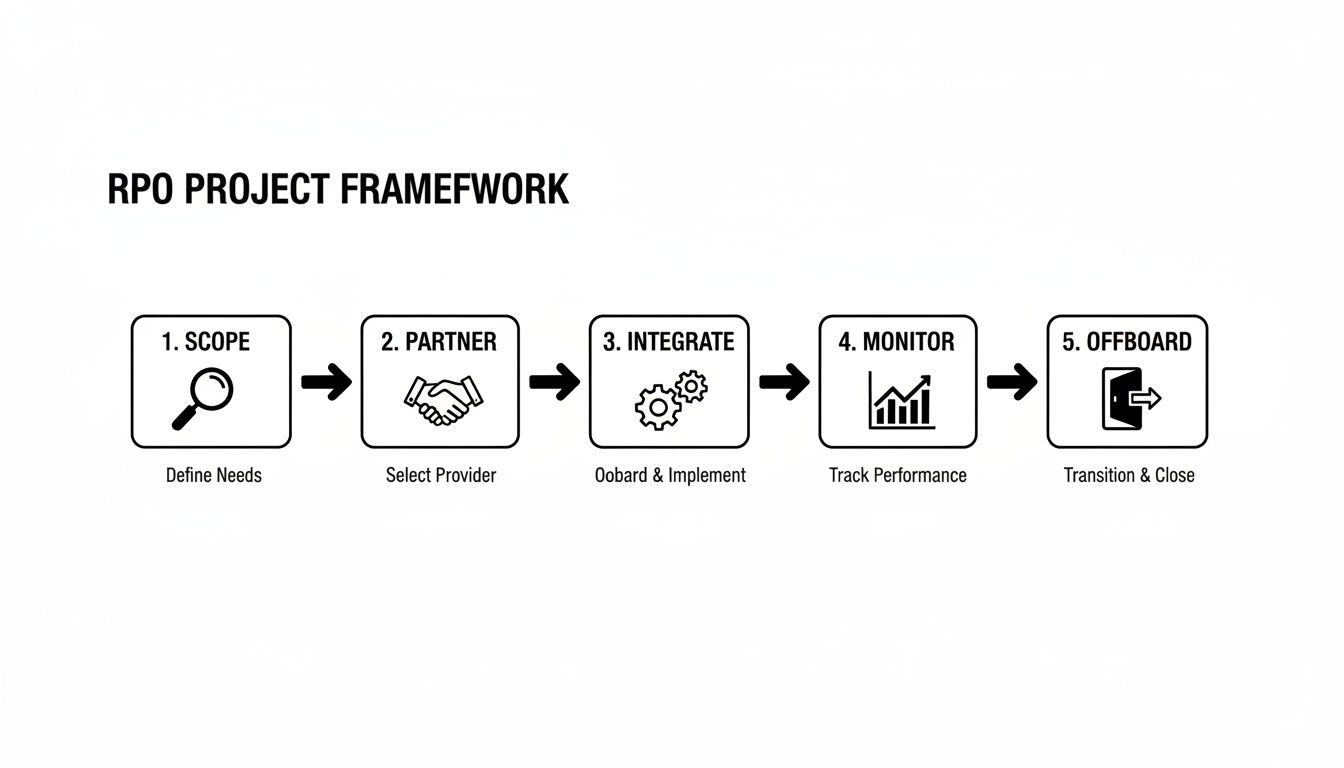
Understanding this process helps you see exactly where a potential partner’s strengths need to be to execute each stage effectively for your business.
Assessing Technology and Cultural Alignment
Once you’ve vetted their recruitment skills, it’s time to look at their operational backbone—their technology and their cultural fit. Outdated tech can create bottlenecks and lead to a poor candidate experience, which ultimately reflects badly on your employer brand.
Just as important is cultural alignment. Remember, this team will be representing your company in the market. If their communication style or core values clash with yours, it can create friction with your hiring managers and a jarring experience for candidates.
Here are the key areas to probe:
- Technology Stack: What Applicant Tracking System (ATS) and other recruitment tools are they using? Ask how they use data and analytics for reporting and making their process better.
- Communication and Transparency: How will they keep you in the loop? Look for a clear commitment to regular reporting, easy-to-read dashboards, and a dedicated point of contact who is always accessible.
- Cultural Fit: As you talk with them, pay attention to their communication style. Do they listen more than they talk? Are they collaborative and open? This “soft” factor is often the glue that holds a successful partnership together.
Finding the right provider is a detailed process, but putting in the effort upfront always pays off. To get a head start, you can explore this curated list of the top RPO companies in India. Ultimately, your goal is to find a partner who not only has the technical chops but also shares your commitment to quality and acts as a true steward of your brand.
Of course. Here is the rewritten section, crafted to sound completely human-written and natural, following the provided style guide and requirements.
Seeing Project RPO in the Real World
Theory is great, but the real test of any strategy is how it performs on the ground. To truly grasp the power of project RPO, let’s step away from the concepts and look at a few practical examples from right here in India. These stories show how businesses, faced with distinct and high-stakes hiring challenges, used a project-based partnership to hit critical goals.
You’ll see the sheer flexibility of Project RPO shine through, whether it’s for the rapid, high-volume hiring needed to launch a new Global Capability Centre (GCC) or for sourcing hyper-specialised talent in a fiercely competitive niche. These scenarios prove the model’s ability to deliver speed, quality, and a strategic edge exactly when and where it’s needed most.
Rapid Scaling for a New Technology GCC
Picture this: a multinational FinTech firm decides to set up a brand-new GCC in Pune. The goal is ambitious, to say the least. They need to hire 400 software developers, QA engineers, and product managers within nine months to get the centre up and running. Their internal talent team is excellent, but they’re already at full capacity managing the day-to-day hiring for the rest of the business.
Trying to handle this massive, one-off hiring spike internally would be a nightmare. It would mean pulling everyone off their regular duties, putting other critical hires at risk. The alternative—quickly hiring and training a new team of temporary recruiters—is just too slow and clunky.
So, they bring in a Project RPO partner who knows the Indian FinTech talent market inside and out. The partner instantly deploys a dedicated crew of specialist tech recruiters whose only job is to hit that target.
This team becomes a seamless extension of the company, rolling out a multi-pronged sourcing strategy:
- Targeted Outreach: They don’t just post ads; they proactively find and connect with top-tier passive candidates working at competitor firms.
- Community Engagement: They organise virtual hiring drives and tech talks, building a powerful talent pipeline almost overnight.
- Data-Driven Sourcing: Using real-time market analytics, they identify talent hotspots and constantly fine-tune their search.
The outcome? The company hires 415 professionals in just eight months. They beat their deadline and launched the GCC right on schedule. The project model gave them the scale and deep expertise they needed without adding a permanent overhead—a perfect example of this agile approach in action.
Sourcing Niche Talent in Life Sciences
Now, let’s look at a completely different kind of challenge. A pharmaceutical company needs to build a new R&D team focused on bioinformatics. These aren’t your average roles. They require a rare blend of skills in genomics, data science, and drug discovery. To make things even trickier, the 25 scientists they need are spread across Bengaluru, Hyderabad, and Mumbai.
The company’s internal HR team just doesn’t have the specialised network or the deep scientific fluency to find and properly assess these candidates. A generalist recruitment agency would likely just drown them in mismatched CVs.
This is where a niche Project RPO becomes invaluable. The company partners with a provider that lives and breathes the life sciences sector. This partner doesn’t just know the keywords; they understand the science. They have spent years building relationships with PhDs, researchers, and specialists.
The true power of a specialised Project RPO provider is their ability to speak the same language as the talent they are pursuing. This credibility allows them to engage top-tier passive candidates who would otherwise ignore a standard recruiter’s outreach.
The provider’s team of scientifically literate recruiters quickly maps out the talent landscape, pinpoints key individuals at universities and rival labs, and starts compelling, technically-rich conversations. This surgical approach dramatically improves the quality of candidates and slashes the time-to-fill for these incredibly hard-to-find roles.
This kind of precision at scale is perfectly illustrated by the work of a major European bank with multiple GCCs across India. To meet a demand for 6,000 positions, including 2,700 tech roles, their partner, AMS, deployed a team of 100 talent acquisition specialists in just 10 weeks to manage the large-scale hiring project. You can explore more about the scale of RPO in India and its advantages.
Measuring Success and Structuring Your Contract

How do you know if your project RPO partnership is actually working? A good engagement goes way beyond just filling roles. It’s about seeing real, measurable improvements and having a solid contract that protects your investment. Without that, you’re essentially flying blind.
It’s time to move past gut feelings and lock in the Key Performance Indicators (KPIs) that truly matter. A strong contract then becomes your rulebook, making sure you and your provider are on the same page about expectations, responsibilities, and what a win looks like. It turns a simple transaction into a transparent, accountable partnership from day one.
Defining Your Project RPO Metrics
Before a single candidate is sourced, you need to agree on a core set of KPIs. These aren’t just for a final report card; they’re your live dashboard, showing you the health of the project in real time. They enable data-driven conversations and allow you to make smart adjustments along the way.
Key metrics to keep an eye on include:
- Time-to-Fill: The classic KPI. This tells you how fast your hiring engine is running, from the moment a role opens to a candidate signing the offer letter. For a time-bound project, this is a direct measure of efficiency.
- Cost-per-Hire: Simple math with big implications. Divide the total project cost by the number of successful hires. This gives you a hard number on the financial value of the RPO compared to doing it in-house or using agencies.
- 90-Day Retention Rate: This is a powerful indicator of hiring quality. A high retention rate means your RPO partner isn’t just finding skilled people; they’re finding the right people who fit your culture and stick around.
- Hiring Manager Satisfaction: Don’t forget the human element. Regular surveys of your hiring managers give you priceless feedback on candidate quality, the smoothness of the process, and how the RPO team is performing on the ground.
For a more detailed look at measurement, check out our guide on how RPO providers track and improve recruitment KPIs.
Structuring a Watertight Contract
A well-crafted contract is your best line of defence against misunderstandings and scope creep. It needs to clearly outline every piece of the partnership, leaving zero room for interpretation. This clarity protects everyone involved and sets the foundation for a collaborative relationship built on trust.
Your contract isn’t a document to sign and forget. It’s a living guide that defines the rules of engagement, sets performance standards, and creates a shared definition of success for the entire project.
Here are the must-haves for a strong project RPO contract:
- Clearly Defined Scope of Work (SOW): Be incredibly specific. Detail the exact number and types of roles, their locations, the project timeline, and the specific services the provider is responsible for delivering.
- Service-Level Agreements (SLAs): These are the teeth behind your KPIs. SLAs are measurable commitments, like an agreement that 90% of shortlisted candidates will meet all core job requirements.
- Pricing Model: Spell out the financial arrangement. Whether it’s a fixed fee for the project, a cost-per-hire model, or a monthly management fee, make sure you understand every potential cost involved.
For example, project RPO has been a game-changer in India’s healthcare technology sector, where finding niche talent is a constant struggle. PeopleScout’s experience hiring senior database administrators and network engineers across Bangalore, Chennai, and Hyderabad shows just how a precise SOW can deliver highly specialised talent where it’s needed most.
Common Questions About Project RPO in India
Even after getting your head around the concept, diving into a project RPO partnership can still feel like a leap. It’s natural to have questions. In fact, we find that business leaders across India often raise the same practical concerns about how this model actually works on the ground.
Getting straight answers to these questions is the final piece of the puzzle. It’s about building the confidence that this strategic approach is genuinely the right move for your company. Let’s tackle some of the most common ones we hear from CHROs and talent leaders.
How Quickly Can a Project RPO Team Actually Get Started?
This is usually the first question people ask, and for good reason. Speed is one of the main attractions of project RPO. While every project is different, a good partner can often have a dedicated team up and running in just a few weeks.
How is that possible? Established providers have a bench of seasoned recruiters who are ready to be deployed. The first step is always a deep-dive discovery session to get completely aligned on your goals, culture, and processes. This ensures the team can hit the ground running with minimal hand-holding from your side.
What’s the Typical Duration for a Project RPO?
There’s no “typical” answer here because flexibility is the whole point. Project RPO engagements are built around your specific initiative, not a rigid contract.
- Short-Term Sprints: We’ve seen projects last as little as three months. Think of a focused hiring push, like staffing a new sales team ahead of a big product launch.
- Longer-Term Initiatives: On the other end, a more complex project, like setting up a new Global Capability Centre from scratch, could easily run for a year or more.
The crucial thing is that the engagement always has a defined start and finish, tied directly to hitting a specific business target.
Will an External Team Really Understand Our Company Culture?
A very fair and important question. A skilled RPO partner doesn’t just learn your job descriptions; they immerse themselves in your company’s mission, values, and what makes it a unique place to work. Cultural fit is everything.
A successful project RPO provider acts as a brand ambassador, not just a recruiter. They invest time to understand the nuances of your workplace so they can authentically represent your culture to candidates, ensuring a strong long-term fit.
To make sure you’re on the same page, insist on a thorough onboarding process for the RPO team and lock in regular check-ins. This collaboration is what turns them into a true extension of your own brand in the talent market.
Ready to tackle your next big hiring challenge with the speed and precision it deserves? Taggd delivers expert project RPO solutions designed specifically for India’s dynamic market. Let’s talk about building the team you need to crush your goals.
Discover how we can help and get started at https://taggd.in.