When you’re launching a new business unit or product, you can’t afford to compromise on the speed or quality of your hires. A project RPO for new business units or product launches is your specialised, agile talent acquisition engine, built to hit aggressive timelines without burning out your core team. Think of it as a strategic partnership that brings in market expertise and scalable resources right when you need them the most.
Why a Project RPO Is Your Secret Weapon for Growth?
Getting a new venture off the ground puts immense pressure on your internal resources. Let’s be honest, your existing talent acquisition (TA) team is probably geared for business-as-usual hiring. They’re not set up for the sudden, high-volume, and often highly specialised demands that come with a new product or business unit.
Stretching your in-house team this thin is a recipe for disaster. It leads to burnout and, more critically, puts the entire launch at risk.
Your traditional recruitment setup just can’t pivot fast enough. The team might not have the niche sourcing skills for these new roles, or simply lack the bandwidth to handle hundreds of applications while keeping other departments happy. This is exactly where a project RPO engagement becomes a game-changer.
Getting Past Internal Hurdles
An RPO partner doesn’t just give you more recruiters. They bring an entire ecosystem to the table—sourcers, technology, and deep market intelligence. It’s not about adding headcount; it’s about embedding a focused, scalable talent engine that’s perfectly aligned with your launch goals.
Imagine your company is launching a new fintech platform. Your internal TA team is great at hiring for corporate roles, but now they suddenly need to find:
- 50 specialised software developers with blockchain experience.
- 30 digital marketing experts who understand financial regulations.
- 20 customer success managers with a SaaS background.
This kind of surge requires a completely different recruiting muscle. A project RPO provider already has talent pools and sourcing strategies ready to go for these exact roles, which dramatically cuts down your time-to-fill.
A strong RPO partnership acts as a force multiplier for your TA function. It allows your core team to maintain operational excellence while the RPO handles the high-intensity project, ensuring neither objective is compromised.
The Indian HR outsourcing market is a perfect example of this capability. By 2024–2025, the ecosystem had grown to a multi-billion-dollar scale, with RPO being one of the fastest-growing segments. For CHROs, this points to a mature local supplier base that can handle sophisticated, large-scale projects, thanks to ongoing investment in technology and domain-specific hiring expertise. You can dive deeper into the global RPO market outlook for 2025-2030 to see how these trends are shaping recruitment worldwide.
By bringing in an RPO provider, you’re not just outsourcing tasks. You’re strategically embedding an agile, expert team dedicated to one critical mission: building the high-performing workforce your new venture needs to win from day one.
Scoping Your RPO Project for Maximum Impact
A successful project RPO doesn’t just happen. It’s built on a foundation of crystal-clear scoping long before you even think about picking a vendor. This is where you translate big business goals into a detailed recruitment blueprint, preventing the costly missteps that can derail a launch.
Think of scoping as your chance to define what success looks like with absolute precision. It’s about much more than a simple headcount; it’s about mapping the exact talent needed to bring a new product or business unit to life, stage by stage.
Asking the Right Questions
Great scoping starts with an honest conversation between HR leaders and the heads of the new business unit. Your role is to get past a basic list of job titles and dig into the real strategic context. Vague requests like “we need 50 engineers” are a recipe for disaster.
Instead, you need to drive a conversation focused on the specifics:
- Role Prioritisation: Which roles are non-negotiable for ‘Day 1’ operations, and which can be hired in wave two or three? A lead product architect for a software launch is critical from the get-go, but a junior marketing analyst can probably wait.
- Skill Specificity: What are the absolute must-have technical skills versus the ‘nice-to-haves’? Knowing this helps your RPO partner focus their energy on the most viable candidates first.
- Geographic Footprint: Where do these people need to be? Are you open to fully remote talent, or do you need a team concentrated in a tech hub like Bengaluru or Hyderabad?
- Hiring Velocity: What’s the real timeline? How does it sync up with the product development roadmap? A phased approach often works best. For example, you might need 10 core developers in month one, followed by 20 sales representatives in month two. You can dive deeper into building a solid delivery model with our detailed guide on the project RPO timeline and delivery model.
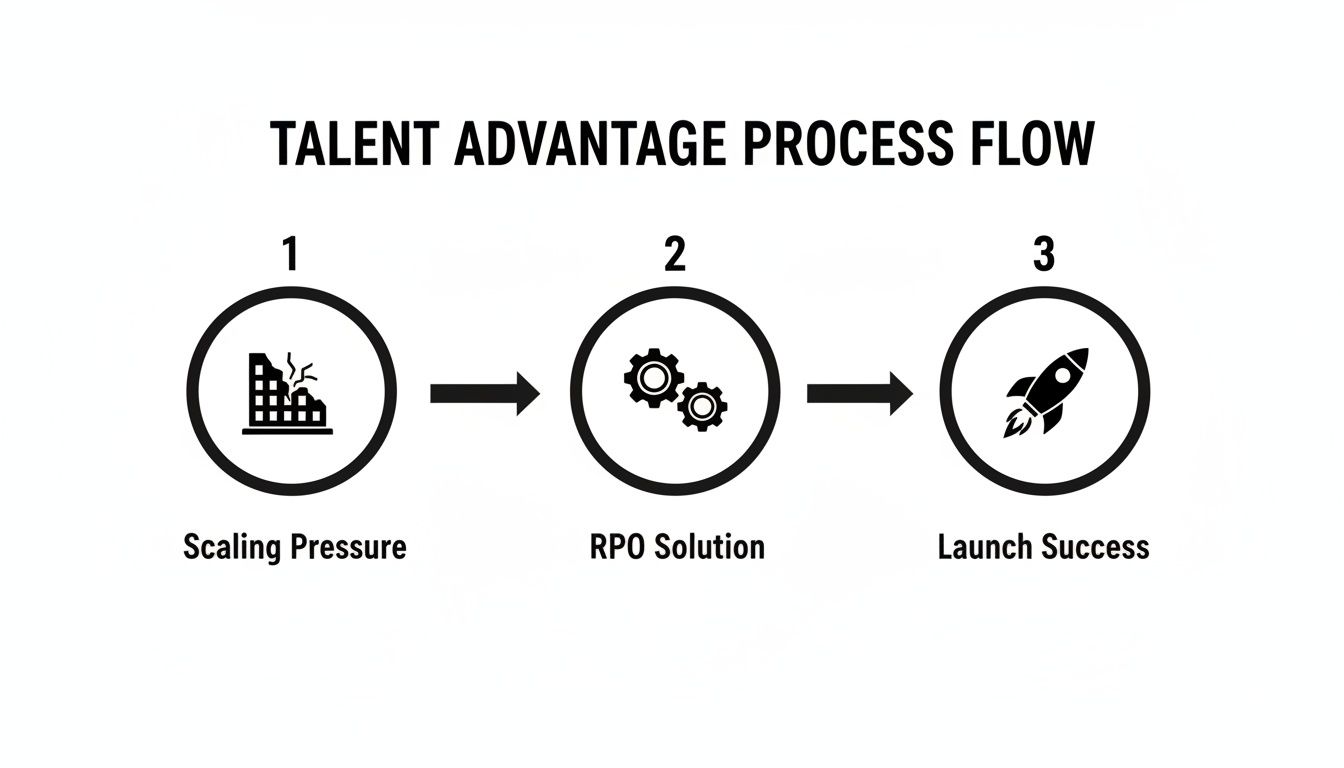
This whole process is about turning the intense pressure of a new venture into a smooth, successful launch, with your RPO partner acting as the operational engine.
Defining Quality Beyond the Job Description
One of the biggest mistakes I see when scoping a project RPO for new business units or product launches is focusing only on technical skills. True quality of hire is so much more than that. It’s not just about what a candidate can do, but how they will do it within your organisation’s unique culture.
To get this right, you have to define performance indicators and cultural fit from day one.
Your RPO partner can’t read minds. If you want them to find people who will thrive, you have to give them a clear picture of what ‘thriving’ looks like in your new business unit.
Work these dimensions into your scope:
- Performance Metrics: What does success look like in the first 90 days for a key role? For a salesperson, it might be booking five new client meetings. For a developer, it could be completing two major feature builds.
- Cultural Alignment: What are the core behaviours you want to see? Is it a fast-paced, highly collaborative environment or one that values deep, independent work? Give your RPO partner concrete examples.
- Long-Term Potential: Are you hiring just for today’s needs, or are you looking for people who can grow into future leaders within this new unit? That single distinction can completely change the sourcing strategy.
To help you get started, here’s a checklist that covers the essential questions you need to answer.
Essential Scoping Checklist for Your Project RPO
This simple table will guide you and your business leaders through defining the critical parameters for your project RPO engagement.
| Scoping Area | Key Questions to Address | Example for a Fintech Product Launch |
|---|---|---|
| Hiring Volume & Roles | How many roles in total? What are the specific job titles and levels? | 45 hires: 20 Backend Developers (Java), 10 Product Managers, 5 UI/UX Designers, 5 QA Engineers, 5 DevOps Specialists. |
| Timelines & Velocity | What is the project duration? What’s the target hires-per-month rate? Are there hiring phases? | 6-month project. Phase 1 (Months 1-2): Hire all PMs & Designers. Phase 2 (Months 2-4): Hire 75% of developers. Phase 3 (Months 4-6): Hire remaining roles. |
| Location Strategy | Are roles on-site, remote, or hybrid? Which cities are in scope? | Hybrid model. Primary hubs are Bengaluru and Pune. Open to 100% remote for senior developer roles with exceptional experience. |
| Skill & Experience Level | What are the must-have technical skills? What’s the required years of experience? | Must-have: Java, Spring Boot, Microservices, and public cloud (AWS/Azure) experience. Target: 4-8 years of experience for most roles. |
| Quality & Culture Fit | What are the key performance indicators (KPIs) for the first 90 days? What are the core cultural values? | KPI for Developer: Successfully deploy first microservice within 60 days. Culture: High-autonomy, fast-paced, strong emphasis on collaborative problem-solving. |
| Budget & Cost Model | What is the total budget for the project? What is the preferred RPO pricing model (e.g., cost-per-hire, management fee)? | Budget allocated for management fees and sourcing costs. Prefer a hybrid model: Monthly management fee plus a bonus per successful hire. |
Using a structured checklist like this ensures no critical detail is missed, setting a clear and aligned direction from the start.
Crafting a Bulletproof Statement of Work
Once you’ve defined all these elements, the final step is to bring them together in a comprehensive Statement of Work (SOW). This document is your contract for success, leaving zero room for ambiguity.
A strong SOW guarantees that your team and your RPO provider are perfectly aligned on deliverables, timelines, and responsibilities. By investing this time upfront, you build the foundation for a seamless partnership ready to conquer the challenges of a high-stakes launch.
Choosing the Right RPO Partner
Picking an RPO provider isn’t just another procurement task. This is about finding a strategic partner who gets the DNA of your new venture and can keep pace with your ambition. A standard RFP process rarely digs deep enough to uncover the nuances that will make or break a high-stakes hiring project like this.
You have to look past the glossy brochures and slick sales pitches to find a team with a proven track record. For a project RPO for new business units or product launches, you need a provider who can show they’ve successfully navigated the kind of high-pressure, rapid-scaling environment you’re about to enter.
Evaluating Experience and Industry Know-How
Your very first filter has to be industry-specific expertise. A provider who’s fantastic at hiring for manufacturing might not have the right networks or sourcing strategies to find niche fintech talent. Ask them for specific case studies from projects that mirror yours in both scale and complexity.
Don’t just ask if they’ve done it before. Ask how. What were the roadblocks? How did they pivot when the client’s needs changed mid-project? The way they answer these questions will tell you everything about their agility and real-world problem-solving skills.
A huge part of an RPO partner’s value is their talent network. A provider with a strong, ready-made network of candidates in your specific domain can slash your time-to-fill by a massive margin—often by 20-40% compared to building one from the ground up.
Assessing Cultural Fit and Communication
While expertise is critical, don’t underestimate the importance of cultural fit. This RPO team is going to be the face of your new business unit to every potential hire. They need to represent your employer brand with genuine passion and authenticity.
As you evaluate potential partners, pay close attention to their communication style.
- Are they proactive and transparent with their updates?
- Do they listen more than they talk, truly seeking to understand your goals?
- Can they clearly and compellingly articulate your unique value proposition?
A great RPO partner feels less like a vendor and more like an extension of your own leadership team. They should challenge your assumptions and bring fresh ideas to the table, not just tick off a list of tasks.
Insist on meeting the actual delivery team who will be assigned to your account, not just the sales reps. The chemistry and expertise of this core team will directly determine your project’s success. Remember, this is a partnership, and their working style must align with that of your hiring managers.
Digging into the Technology Stack
In today’s recruitment world, technology is the backbone of the entire operation. A capable RPO partner will come equipped with a solid tech stack designed for efficiency and deep analytical insights. But the crucial part isn’t just what tech they have, but how seamlessly it integrates with yours.
Ask for a live demo of their Applicant Tracking System (ATS), sourcing tools, and data analytics platforms. How will they guarantee a smooth flow of information with your existing HRIS? A clunky integration can create data headaches and a frustrating experience for candidates and your hiring team.
Nailing Down the Contract and SLAs
The contract is where your partnership becomes official, setting clear and firm expectations for performance. While your legal team will handle the fine print, you need to focus on a few key areas to protect your interests and set the stage for a successful engagement.
Service Level Agreements (SLAs) are absolutely non-negotiable. They must be specific, measurable, and tied directly to the goals you laid out in the initial scoping phase.
Here are a few key contractual clauses to scrutinise:
- Scalability Options: What if you need to ramp up hiring faster than planned, or even hit pause? The contract needs clear terms for scaling the RPO team up or down without hitting you with excessive penalties.
- Data Security and Compliance: How will the provider manage sensitive candidate data? Make sure they comply with all relevant data protection regulations in India.
- Performance Metrics: Go beyond just time-to-fill. Define core KPIs like quality of hire, hiring manager satisfaction, and offer acceptance rates.
- Exit Strategy: A well-defined exit clause outlines the process for winding down the project, ensuring a smooth handover and knowledge transfer back to your internal team when the time comes.
Ultimately, choosing a partner boils down to trust and transparency. For a deeper understanding of how this focused approach differs from broader engagements, you might find it helpful to explore the distinctions between project RPO vs enterprise RPO. This will help clarify why a specialised partner is so critical for a launch.
Designing Your High-Velocity Recruitment Engine
Once you’ve selected your RPO partner, the real work begins. It’s time to shift from planning to building the high-velocity recruitment engine that will power your launch. This is far more than just handing over a stack of job descriptions; it’s a deep, collaborative process to build a system engineered for both speed and quality.
A generic, off-the-shelf hiring process simply won’t cut it for a high-stakes launch. Every single stage needs to be meticulously mapped out to create a seamless experience for candidates and, just as crucially, for your busy hiring managers. This operational blueprint is the very heart of a successful project RPO for new business units or product launches.
Crafting a Magnetic Employer Value Proposition
Think of your new business unit as a startup living within a larger, more established company. It doesn’t have its own reputation yet, which means you need to create a powerful reason for top talent to take a chance on this specific venture. This is where you and your RPO partner get creative and craft a targeted Employer Value Proposition (EVP).
This “micro-EVP” has to highlight what makes this project uniquely appealing:
- Impact: The chance to build something from the ground up and see your work directly shape the business.
- Innovation: Access to the latest tech, agile ways of working, and an opportunity to solve brand-new problems.
- Career Growth: The potential for a fast-tracked career path as the new unit scales.
For example, if you’re launching a new e-commerce division, the EVP can’t just lean on the parent company’s brand. It needs to shout, “Join us to build the future of online retail with cutting-edge AI and a truly customer-obsessed team.” This kind of focused messaging gives your RPO partner’s sourcers a compelling story to tell in a noisy, competitive market.
Optimising the Candidate Journey for Speed
In a race for talent, a clunky, slow-moving hiring process is your greatest liability. The best candidates have options, and they will quickly lose interest in a process that feels disorganised or doesn’t respect their time. You and your RPO provider have to ruthlessly optimise every single touchpoint.
A great candidate experience is your best recruitment tool. It turns applicants into advocates, even if they don’t get the job. For a new venture, this brand-building is invaluable.
Map out the entire journey, from the very first contact to the final offer, and hunt down every potential bottleneck.
- Sourcing and Screening: How quickly can the RPO team present a qualified shortlist after a role is opened? Define a clear SLA, like getting the first slate of candidates within 48-72 hours.
- Interview Stages: Keep interviews to a minimum. Can a technical screen and one final panel interview do the job? Give your hiring managers the autonomy to make decisions quickly.
- Feedback Loops: This is a classic deal-breaker. Mandate a 24-hour feedback turnaround from hiring managers to the RPO team. Delays here are one of the main reasons candidates drop out.
This relentless focus on velocity is where a project RPO truly proves its worth. The right partner can dramatically accelerate hiring when you’re up against the clock. In fact, India-specific analyses show that on-demand RPO models can reduce the average time-to-fill by 20–40% for high-volume projects compared to in-house teams. When you need hundreds of hires in just a few weeks for a product launch, that’s a massive advantage. You can learn more about the effectiveness of Recruitment Process Outsourcing in delivering these kinds of results.
Integrating Technology and Defining Handoffs

Technology is the connective tissue holding your recruitment engine together. A seamless integration between your RPO provider’s Applicant Tracking System (ATS) and your internal Human Resources Information System (HRIS) is non-negotiable. This link is what allows candidate data to flow smoothly, preventing the nightmare of manual, error-prone data entry.
Just as critical is defining crystal-clear handoff points. Everyone involved needs to know exactly who is responsible for what, and when the baton is passed.
Example Handoff Protocol for a New Hire
- Offer Extension: The RPO partner’s recruiter drafts and extends the official offer letter once they have verbal approval from the hiring manager.
- Offer Acceptance: The moment the candidate signs, the RPO recruiter immediately notifies your internal HR coordinator and uploads the signed documents to the shared system.
- Onboarding Initiation: This is the crucial handoff. Your internal HR team officially takes ownership, kicking off the background check process and initiating the onboarding workflow in your HRIS.
- Welcome Communication: Your team sends the official welcome email, provides all the details for the first day, and introduces the new hire to their manager and team.
This kind of structured protocol ensures nothing falls through the cracks. By meticulously designing the process, integrating your tech, and clarifying every handoff, you build a resilient, high-velocity recruitment engine that can handle the pressure of a launch and deliver the talent you need to win.
Managing Performance and Mitigating Risks
Once the recruitment engine is fired up, a successful project RPO partnership really comes down to strong, consistent governance. Your focus has to shift from planning to ongoing performance management and proactively heading off risks. This isn’t about micromanaging your RPO partner; it’s about building a solid rhythm of communication and data analysis that keeps everyone aligned and ensures your investment is actually paying off.
Think of it as the in-flight monitoring for your new venture’s launch. A great flight plan is essential, but you absolutely need real-time data and open dialogue to navigate the inevitable turbulence that comes with any high-stakes hiring push. Without this, even the best-laid plans can quickly go off course.
Establishing a Clear Governance Rhythm
Effective oversight for a project RPO for new business units or product launches needs a two-tiered approach. You need the tactical, on-the-ground check-ins, but you also need the high-level strategic reviews. This dual focus makes sure you’re stamping out small fires while still keeping a firm eye on the big picture.
A well-defined meeting cadence is the backbone of this whole structure.
- Weekly Operational Check-ins: These should be quick, data-driven huddles between your project lead and the RPO delivery manager. The agenda is purely tactical—think pipeline health, candidate feedback, and any immediate roadblocks for specific, critical roles.
- Monthly Strategic Reviews: This is the higher-level meeting where you, the key business unit leaders, and the RPO account leadership get together. Here, the discussion should centre on overall progress against your hiring goals, quality of hire metrics, and any strategic pivots needed based on shifting business priorities.
This kind of structure builds accountability at every level. It gives you the confidence that the day-to-day execution is being handled, freeing you up to focus on the strategic impact of the hiring project.
Moving Beyond Time-to-Fill
While hiring speed feels urgent during a launch, it’s a dangerous metric to obsess over in isolation. A truly successful project is defined by the quality of the talent you bring in, not just how quickly you fill seats. Your performance dashboard has to reflect that balanced perspective.
Your KPIs should tell the whole story of the project’s health. We’re talking about more than just the basics.
To really gauge success, you need a mix of metrics that cover efficiency, quality, and stakeholder experience. Below is a breakdown of the KPIs that matter most when you’re launching a new team from scratch.
Core KPIs for Project RPO Success
| Metric Category | Key Performance Indicator (KPI) | Why It Matters for a Launch |
|---|---|---|
| Talent Quality | Quality of Hire (e.g., 90-day performance reviews, retention rates) | This is your ultimate success metric. It confirms you hired people who can actually deliver and will stick around. |
| Stakeholder Experience | Hiring Manager Satisfaction Score | Keeps your internal leaders engaged and confident in the process. Their buy-in is critical. |
| Candidate Experience | Candidate Net Promoter Score (cNPS) or feedback surveys | A poor experience can tarnish your new unit’s employer brand before it even gets off the ground. |
| Process Efficiency | Source of Hire | Tells you which channels are delivering the best talent, allowing you to double down on what’s working. |
| Speed & Agility | Time-to-Fill/Time-to-Hire | While not the only metric, it’s still vital for getting the team in place on schedule. |
Tracking this balanced scorecard transforms your conversations with the RPO provider from being purely about numbers to being about genuine business impact. To dive deeper into this, check out our guide on how RPO providers can improve key recruitment KPIs.
A partnership focused solely on speed will deliver warm bodies. A partnership focused on quality and experience will deliver the high-performing team your new venture needs to succeed.
Proactively Mitigating Common Risks
Even with a great partner and solid KPIs, things can—and will—go wrong. A huge part of your role is to anticipate and plan for these bumps in the road. The very nature of a new product or business launch is dynamic, so you have to be ready to adapt.
Here are a few common risks I’ve seen derail projects and how you can get ahead of them:
- Misaligned Hiring Manager Expectations: We’ve all seen it—a hiring manager with a “purple squirrel” in mind, a candidate profile that simply doesn’t exist in the real world. Your RPO partner must hold detailed intake meetings for every single role to calibrate expectations around skills, experience, and market realities right from day one.
- Shifting Business Priorities: The product roadmap changes, and suddenly your hiring needs are turned upside down. This is where your contract’s scalability clause becomes your best friend, allowing you to ramp hiring up or down as needed. Constant communication with business leaders is the only way to get early warnings of these shifts.
- Candidate Drop-offs: In a competitive market, you can bet your top candidates are juggling multiple offers. You can mitigate this by ensuring your compensation is on point, but more importantly, by running an exceptionally fast and engaging hiring process. A slow, clunky process is an open invitation for your top choices to accept an offer elsewhere.
By establishing a robust performance rhythm and actively planning for these challenges, you ensure your project RPO delivers on its promise. This proactive approach keeps the partnership agile and responsive, consistently delivering the talent required to make your launch a massive success.
Your Playbook for Agile Talent Acquisition
So, what have we learned? This journey has mapped out a clear path for using a project RPO when you’re launching a new business unit or product. But let’s be clear: this is more than just another way to hire. It’s a strategic framework for building the human foundation of your next big venture with the precision and speed the market demands.
Ultimately, getting this right comes down to a few core principles. First, meticulous scoping is absolutely non-negotiable. This is where you transform a high-level business goal into a detailed, actionable recruitment blueprint. It’s the critical first step that sets the stage for a true partnership, not just another transactional vendor relationship. Cultural alignment and open communication are everything here.
From that solid foundation, you can build a custom-designed recruitment engine that delivers on both velocity and quality.
Think of Project RPO as a powerful, flexible tool in your strategic arsenal. It empowers your organisation to seize market opportunities with confidence, knowing you can build the right team, right when you need it.
Finally, strong, data-driven governance is what holds it all together. This gives you the oversight needed to manage performance effectively and head off risks before they become problems. This agile talent model isn’t just a one-off response to a single project; it’s fast becoming an essential capability for any business trying to keep pace.
It allows you to build, scale, and win in competitive markets without pulling focus from your core operations, ensuring your new venture has the high-performing team it needs to thrive from day one.
Got Questions? We’ve Got Answers
Even the best-laid plans come with questions. When you’re moving fast on a project RPO, it’s natural for a few things to pop up. Here are some of the most common queries we hear from CHROs and what our experience tells us.
How Does Project RPO Pricing Work Compared to the Traditional Model?
This is a big one. The key difference is flexibility. Forget long-term retainers; project RPO pricing is built around the specific scope and timeline of your launch.
You’ll typically see models like a fixed management fee to cover the programme oversight, a simple cost-per-hire fee, or sometimes a hybrid of the two. This setup puts you in the driver’s seat, tying costs directly to your hiring volume. A crucial tip when you get to the contracting stage: always push for scalability clauses. You need the ability to adjust costs if your hiring needs suddenly spike or slow down without being penalised.
What’s a Realistic Timeline to Get a Project RPO Off the Ground?
You’d be surprised how quickly things can move. A well-managed engagement can go from final vendor selection to having recruiters actively sourcing candidates in as little as 2-4 weeks.
Of course, this initial “mobilisation” phase is a sprint, not a marathon. It’s packed with co-designing the recruitment process, sorting out the tech integrations, and getting the RPO team fully briefed on your company culture and the specific roles you need. If you’re in a real time-crunch, an experienced RPO partner can often fast-track this by deploying pre-trained teams and using proven technology templates to hit the ground running.
How Can We Be Sure an RPO Partner Truly Represents Our Culture?
This is probably the most critical piece of the puzzle. The selection and onboarding phases are where you solve this. You absolutely have to treat the RPO team as a seamless extension of your own.
Your RPO partner is the first human connection a candidate has with your new venture. Ensuring they embody your culture isn’t just a ‘nice-to-have’—it’s a fundamental part of building an authentic employer brand from day one.
The best way to do this is through deep-dive cultural immersion sessions. Share your brand guidelines, your detailed Employee Value Proposition (EVP) documents, and everything in between. Get them in a room with the key business leaders who live and breathe the vision for this new venture. It’s also smart to audit their initial candidate emails and messages to make sure the tone and language are a perfect match for your brand’s voice.
Ready to build the high-performing team your new venture needs to succeed? Taggd specialises in project RPO solutions that deliver talent at the speed of your ambition. Discover how we can accelerate your next launch at https://taggd.in.