Project Recruitment Process Outsourcing (RPO) is a specialised talent solution where a business partners with an external provider to manage a specific, time-bound hiring push.
When you’re staring down the barrel of a predictable seasonal peak or an unexpected surge in demand, project RPO for seasonal or surge hiring delivers the exact recruiting firepower you need, precisely when you need it. It’s a strategic move, offering flexibility without the long-term commitment of a full-scale RPO partnership. Think of it as your on-demand, high-volume hiring squad.
Conquering Talent Spikes With Project RPO

As a CHRO, you know the feeling all too well. Those sudden, unpredictable hiring surges can throw your entire talent acquisition team into chaos. It leads to burnout, a drop in candidate quality, and pulls focus from your long-term, strategic HR goals. The problem isn’t a lack of skill on your team; it’s a sheer lack of scalable capacity.
A new project or the annual festive rush forces your core recruiters to abandon their essential duties just to keep up with the flood of applications. It’s a reactive, inefficient scramble that often fails to meet aggressive hiring deadlines. This is precisely where a targeted, project-based RPO engagement can transform a frantic effort into a controlled, strategic operation.
Understanding the Triggers for Surge Hiring
These high-volume scenarios pop up across various industries, and more often than not, you can see them coming. Recognising these triggers is the key to planning proactively instead of just reacting to the fire.
Common examples include:
- Retail and E-commerce: Gearing up for major festive seasons like Diwali or year-end holidays, which demands thousands of temporary staff for logistics, customer service, and in-store support.
- Hospitality: Scaling up the workforce for peak travel seasons, major sporting events, or large conferences.
- New Product Launches: The urgent need to build a sales or support team from the ground up to bring a new offering to market.
- Geographic Expansion: Opening a new office, warehouse, or factory that requires hiring an entire local team from scratch.
How Project RPO Provides the Solution
Instead of treating these hiring spikes like emergencies, project RPO frames them as well-defined initiatives. An RPO partner brings in a dedicated team of specialised recruiters, battle-tested processes, and a powerful technology stack to manage the entire hiring lifecycle for that specific project. It’s an immediate injection of agility and expertise.
The massive scale of seasonal demand in India really underscores the need for this kind of structured approach. During the festive season, projections show that over 2.16 lakh seasonal jobs are created. E-commerce and retail drive this surge, demanding a rapid deployment of quality talent that most internal teams simply can’t handle alone.
A project RPO provider acts as an extension of your own team, but with one critical difference: they are built to scale on demand. They absorb the volume, manage the process, and deliver qualified candidates, allowing your core team to remain focused on its primary objectives.
This model doesn’t just fill roles faster; it also protects your employer brand by ensuring every single candidate—hired or not—has a professional and positive experience. For organisations facing these predictable yet daunting spikes, exploring high-volume hiring RPO solutions is no longer a luxury, but a strategic necessity.
Making the Business Case for Project RPO
Getting your C-suite to say “yes” to project RPO for a big hiring push isn’t just about having a chat. It demands a proper, data-backed business case. The goal is to show this partnership isn’t an HR expense, but a smart investment in how well the business runs, how we protect our brand, and ultimately, our bottom line.
You have to shift the conversation away from the surface-level benefits and really shine a light on the hidden costs of not using this model.
When a hiring surge hits, your internal team often takes the first hit. They’re yanked from their strategic work—like finding our next leaders, planning for the future, and building our culture—to drown in a sea of high-volume, transactional recruiting. This switch has real, significant costs that leaders in finance and operations will immediately understand.
Calculating the Hidden Costs of In-House Surge Recruiting
To build a solid argument, you first need to uncover the true cost of managing a massive hiring spike on your own. These costs are much more than just salaries.
Think about these factors:
- Recruiter Burnout and Overtime: Your team will be pulling long hours, which leads straight to burnout, lower productivity, and maybe even people leaving your HR team. That overtime pay adds up fast, creating a direct, unplanned hit to your budget.
- Opportunity Cost: What important work isn’t getting done? While your best recruiters are busy screening hundreds of temporary roles, they aren’t building relationships with future executives or making our onboarding process better. This neglected work has long-term financial consequences.
- Degraded Quality of Hire: When you rush to fill roles, quality almost always suffers. A bad hire, even a temporary one, can damage team morale, hurt customer service, and drag down productivity. Studies have shown that the cost of a bad hire can be as high as 30% of their first-year earnings.
- Hiring Manager Distraction: Your hiring managers also get sucked into the chaos of endless interviews and paperwork. This pulls them away from their actual jobs, and their time has a direct monetary value that needs to be part of your calculation.
The real conversation isn’t about what an RPO partner costs; it’s about the mounting cost of distraction, inefficiency, and compromised quality that piles up when you push your internal team beyond its limits.
Contrasting In-House Costs With a Clear RPO Model
Once you’ve laid out all the hidden drains on the business, you can present project RPO for seasonal or surge hiring as the obvious, cost-effective solution. The business case becomes a simple choice between unpredictable, chaotic internal costs and a predictable, value-driven partnership.
An RPO provider gives you a transparent cost structure, usually based on a cost-per-hire or a fixed project fee. Right away, this turns a variable, messy expense into a predictable operational cost you can budget for.
Here’s how to frame the direct financial wins:
| Metric | In-House Surge Approach | Project RPO Model |
|---|---|---|
| Cost-per-Hire | Often high due to overtime, agency fees for tough roles, and internal slow-downs. | Lowered through streamlined processes, existing talent pools, and sheer scale. |
| Time-to-Fill | Can drag on as the internal team gets swamped, delaying projects and operations. | Drastically reduced, often by 30-50%, ensuring teams are ready before the peak hits. |
| Team Capacity | Stretched thin, leading to burnout and taking focus off high-value HR work. | Your core team stays focused on strategic goals while the RPO partner manages the volume. |
The Powerful Non-Financial Wins
Beyond the spreadsheets, a project RPO engagement brings powerful qualitative benefits that are just as important to the C-suite. Protecting your employer brand during a huge recruitment drive is non-negotiable. A dedicated RPO team makes sure every single one of the thousands of applicants gets a professional and timely response, protecting your reputation in the talent market.
On top of that, you get instant access to specialised talent networks and modern recruitment technology without having to buy it all yourself. An RPO partner arrives with a pre-built engine for sourcing, screening, and engaging candidates at a scale most in-house teams simply can’t build overnight.
For a closer look at specific scenarios, our guide on when to use project RPO offers more practical insights. This blend of hard savings, risk reduction, and strategic advantage is what earns the green light.
Your Implementation Roadmap for Project RPO
Once the business case gets the green light, the conversation shifts from why to how. Kicking off a project RPO for seasonal or surge hiring isn’t just a matter of handing over a list of open roles. It’s about spinning up a temporary, high-octane recruitment machine that plugs directly into your organisation’s workflow.
A clear roadmap is your best defence against common tripwires like mismatched expectations, hiring managers dragging their feet, or just a plain chaotic launch. Getting from vendor selection to full-scale delivery demands meticulous planning, open communication, and treating your partner like a true extension of your team.
Nailing Down the Project Scope and Forecast
Before you even glance at a vendor proposal, you need to define the mission with crystal clarity. A fuzzy scope is the number one reason these projects go off the rails. It all starts with a realistic forecast of your hiring needs.
Dig into your historical data from previous peak seasons. How many people did you hire? What were the key roles? What was your average time-to-fill? This gives you a solid baseline for the project’s scale and timeline.
Then, add a layer of current business intelligence. Are you expanding into new cities? Is demand for your product expected to be higher this year? This forward-looking analysis ensures your plan is grounded in reality, not just a carbon copy of last year.
Thinking through this process helps connect the dots between your projected costs, the RPO model you choose, and the business wins you’re aiming for.
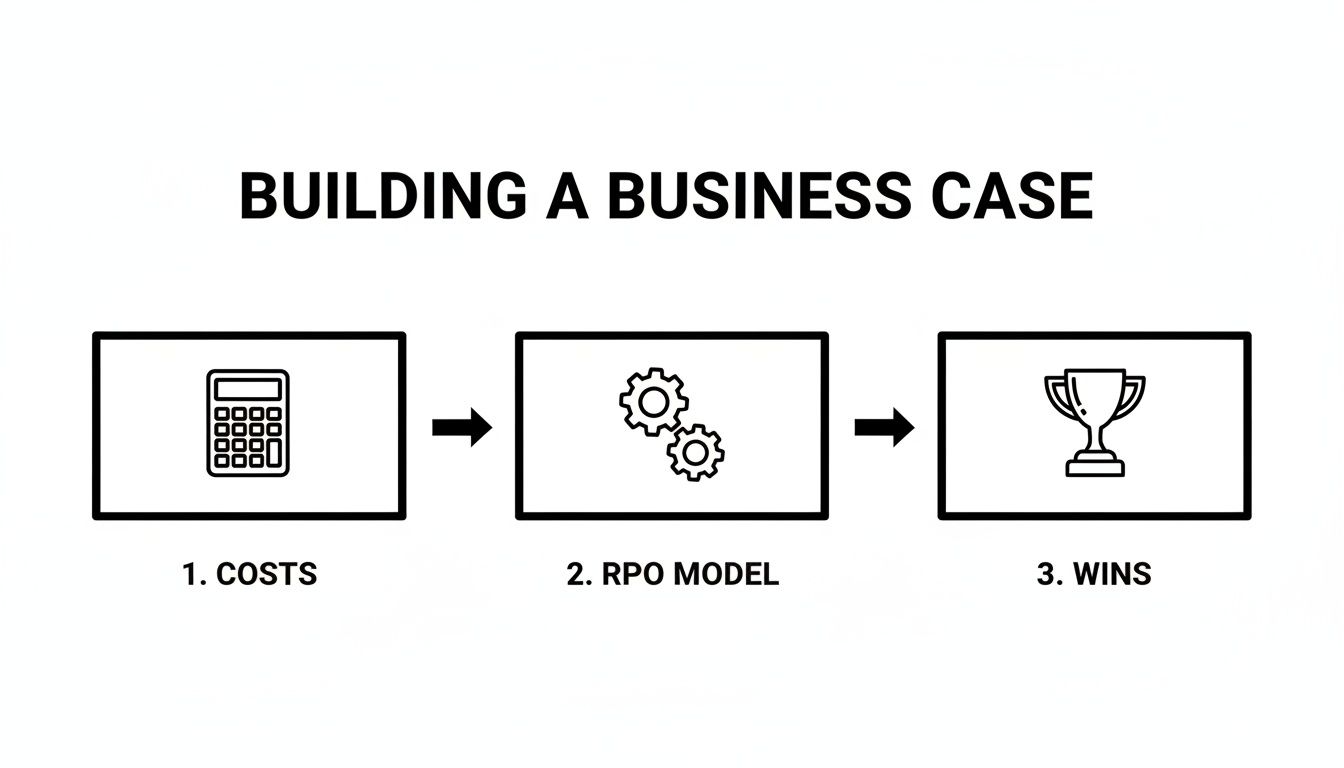
This kind of structured thinking forces you to map every part of the project to a measurable outcome, transforming it from a simple cost centre to a clear return on investment.
Your final scope document needs to be specific:
- Roles and Headcount: Exactly which job titles and the number of hires for each.
- Geographic Locations: Pinpoint the cities or regions where you need boots on the ground.
- Project Timeline: Lock in a clear start date, the peak hiring window, and an end date.
- Key Stakeholders: Identify everyone on your internal team who needs to be in the loop.
Choosing the Right RPO Partner
Picking your provider is hands-down the most critical decision you’ll make. You have to look past the slick sales presentation and really probe their delivery capabilities, especially how they align with your specific needs.
Focus your evaluation on a few core areas. First, their track record. Ask for case studies that look a lot like your project—same industry, similar scale, and the types of roles you’re hiring for. A partner who lives and breathes retail logistics will get your challenges in a way a generalist never could.
Next, get under the hood of their technology stack. A great RPO partner uses automation and AI to actually do something useful, like improve speed and candidate experience, not just as buzzwords. They should be able to show you exactly how their tech helps source, screen, and schedule candidates at the massive scale you need.
One of the most overlooked factors is a provider’s ability to tap into talent markets beyond the major metros. Real agility means finding talent where the demand is, not just where it’s always been.
The talent map is changing fast. For instance, Tier-II cities in India are seeing a massive 42% surge in seasonal hiring demand for the festive season, blowing past the 19% growth in metros. Places like Lucknow, Jaipur, and Nagpur are the new talent battlegrounds. Your RPO partner needs to have established networks in these areas to be effective. You can learn more about the regional trends shaping seasonal hiring in India.
Contracting and Setting Ironclad SLAs
With a partner selected, it’s time to formalise the relationship with a solid contract and meaningful Service Level Agreements (SLAs). Think of this document as your project’s constitution—it defines what success looks like and keeps everyone accountable.
Your contract must clearly spell out the scope of services, the pricing model (e.g., cost-per-hire, management fee), and the payment terms. Don’t forget the important clauses covering data privacy, confidentiality, and liability.
But the SLAs are where the real performance management happens. They need to be specific, measurable, and agreed upon by both sides. For a surge hiring project, you should be looking at metrics like these:
| SLA Category | Example Metric | Target |
|---|---|---|
| Speed | Time-to-Fill | Average of 14 days from requisition to offer acceptance. |
| Quality | 90-Day Retention Rate | Minimum of 90% for all hires made through the project. |
| Efficiency | CVs Submitted to Interview Ratio | 3:1 (Three qualified CVs submitted for every one interview). |
| Satisfaction | Hiring Manager Satisfaction Score | Average score of 4.5/5 on post-hire surveys. |
These numbers ensure the focus stays where it should be: on delivering high-quality hires quickly, not just filling seats. For a closer look at what to expect week by week, check out our guide on the typical project RPO timeline and delivery model.
Onboarding and Going Live
This last phase is all about integration and execution. A smooth “go-live” can make or break the entire engagement. It all starts with a deep onboarding process where the RPO provider’s team gets fully immersed in your company culture, your values, and your employer brand.
They have to understand what makes someone a great fit for your organisation, going far beyond what’s written in the job description. This alignment is crucial for them to act as authentic ambassadors for your brand.
At the same time, you need to prep your internal team, especially the hiring managers. Set up kickoff meetings to introduce the RPO team, walk through the new process, and clarify everyone’s roles. Don’t underestimate change management here. Your managers need to see the RPO team as a strategic partner there to make their lives easier, not some outside vendor creating more work.
The moment of truth is when the first batch of requisitions is released. From day one, lock in a regular communication cadence with daily check-ins and weekly performance reviews. This creates a tight feedback loop, allowing for quick course corrections and ensuring everyone stays aligned as you ramp up toward peak delivery.
Defining and Measuring Real Success
When the stakes are this high, what you measure is what you get. For a project RPO covering seasonal or surge hiring, just relying on the old, superficial metrics is a fast track to disappointment. Real success isn’t simply about filling roles; it’s about the quality of those hires, the efficiency of the whole operation, and the impact on your business.
It’s time to move past vanity metrics like the total number of applications. We need to zero in on Key Performance Indicators (KPIs) that actually show the project’s value. This means looking beyond just the speed of the hire and focusing on lasting quality and the experience you provide to everyone involved.
Key Metrics That Truly Matter
To get a proper sense of performance, you need a balanced view that covers speed, quality, and how happy your stakeholders are. Frankly, any great RPO partner will be keen to be measured against these more meaningful benchmarks.
Here are the essential KPIs you should absolutely be tracking:
- 90-Day Quality of Hire: This is the ultimate acid test. It looks past the interview and measures how a new hire is actually performing in their role after three months. You can track this easily through performance ratings or simple manager feedback surveys.
- Hiring Manager Satisfaction: Let’s be honest, your internal hiring managers are the RPO’s main customers. A quick post-hire survey asking them to rate the quality of candidates, the pace of the process, and the support they got gives you invaluable, real-world feedback.
- Candidate Experience (Net Promoter Score): In a high-volume project, every single interaction shapes your employer brand. Measuring candidate satisfaction—even for those you don’t hire—is non-negotiable. A high score tells you your process is respectful and professional.
- Source of Hire Effectiveness: This metric is pure gold. It shows you exactly which channels are bringing in the best candidates. This allows the RPO team to fine-tune their sourcing strategy on the fly, putting money and effort where it counts.
The best partnerships I’ve seen are built on total transparency. Your RPO partner should be providing a real-time performance dashboard. This gives you instant visibility into these core metrics, allowing for quick course corrections instead of waiting for a stuffy monthly report.
The Performance Dashboard Template
Your RPO partner’s dashboard should be more than just a spreadsheet. It needs to be a visual, easy-to-understand tool that tells the story of the project’s health at a glance. You should insist on a dashboard that includes the following elements.
Before we dive into the data, it’s crucial to establish a shared understanding of what success looks like. The table below outlines the non-negotiable KPIs that should form the core of your performance dashboard, ensuring both you and your RPO partner are aligned on what truly matters during a high-stakes surge.
Essential KPIs for Seasonal Project RPO
| KPI Category | Metric | Why It Matters for Surge Hiring |
|---|---|---|
| Recruitment Funnel | Application to Offer Ratio | Shows how efficient your screening and selection process really is. |
| Project Speed | Time-to-Fill by Role/Location | Helps pinpoint bottlenecks and makes sure you hit your operational deadlines. |
| Hire Quality | 90-Day Retention Rate | This is the big one. It measures the long-term fit of new hires and cuts down on churn costs. |
| Stakeholder Voice | Hiring Manager Satisfaction Score | Guarantees the RPO team is genuinely aligned with what the business needs on the ground. |
Tracking these metrics lays the groundwork for productive governance meetings, turning them from simple status updates into strategic, problem-solving sessions where real progress happens.
Running Effective Governance Meetings
Regular governance meetings are the pulse of a successful RPO engagement. These shouldn’t be long, drawn-out affairs. They need to be sharp, data-driven, and focused on optimising the process, not just reporting what’s already happened. The goal is simple: spot trends, tackle challenges head-on, and find solutions together.
A productive meeting agenda should always include:
- Performance Review: A quick look at the dashboard KPIs against the SLAs you both agreed on. Where are we winning? Where are we falling behind?
- Challenge Deep Dive: Pick one or two key areas that are underperforming. Is time-to-fill dragging in Mumbai? Let’s dig in and figure out why.
- Process Optimisation: Brainstorm and agree on concrete actions. Does the interview process need a tweak? Does a job description need a rewrite to attract the right people?
- Forward-Looking Forecast: What’s coming up? Discuss any changes in hiring needs or potential roadblocks you see on the horizon.
By establishing this rhythm of measurement and collaborative review, you ensure the project RPO isn’t just a service—it becomes a dynamic recruitment engine that continuously improves to deliver exactly what your business needs to win.
Using Project RPO to Boost Inclusive Hiring

High-volume hiring often feels like a race against the clock. When speed is the priority, Diversity, Equity, and Inclusion (DE&I) goals can unintentionally get pushed aside. This isn’t just a shame; it’s a massive missed opportunity.
But what if you could change that? A strategic project RPO for seasonal or surge hiring can turn this exact challenge into a powerful engine for building a more inclusive temporary workforce.
When your internal team is stretched thin, it’s only natural for them to fall back on familiar, and often narrow, talent pools. A seasoned RPO partner, on the other hand, brings a fresh perspective. More importantly, they bring established networks within diverse communities that your team simply might not have the bandwidth to cultivate. They’re specialists in casting a wider net.
Suddenly, your surge hiring transforms from a purely transactional process into a strategic DE&I initiative. It’s about being intentional, even when you’re moving fast.
Embedding DE&I into Your RPO Partnership
The real key here is to shift DE&I from a “nice-to-have” aspiration to a contractual “must-have.” A skilled RPO partner won’t just accept this; they’ll welcome it. It’s their chance to demonstrate their full value beyond just filling seats. This means baking your inclusivity goals directly into the project’s framework from day one.
Here are a few practical ways to do it:
- Mandate Diverse Candidate Slates: Don’t just hope for a diverse shortlist—require it. Specify in your Service Level Agreement (SLA) that for every role, the slate of candidates presented must meet certain diversity criteria. This ensures hiring managers are seeing a broader range of talent right from the start.
- Leverage Bias-Mitigation Tech: Your RPO partner should have access to tools like blind CV screening or AI-powered job description analysers that can strip out biased language. This helps level the playing field before a human ever sees a resume.
- Insist on Targeted Sourcing: Work with your partner to identify and actively source from specific underrepresented groups. This could mean partnerships with community organisations, niche job boards, or highly targeted social media campaigns.
This kind of proactive approach makes building a diverse team a core function of the project, not a lucky accident.
Tapping into the Growing Female Workforce
A perfect example of this strategy in action is tapping into the rapidly growing female gig economy. Many highly skilled women are actively seeking flexible, project-based work that aligns with their personal and professional lives—a perfect match for most seasonal roles.
In fact, women’s participation in India’s seasonal hiring has climbed by 23-35% year-over-year during the festive period alone, fuelled by demand in retail, e-commerce, and logistics. For CHROs, this trend is a golden opportunity to hit diversity targets while accessing a highly motivated, often overlooked, talent pool. You can see more data on the rise of women in seasonal hiring in recent reports.
By partnering with an RPO provider that has deep connections within these talent pools, you can strategically target skilled women for high-demand roles, making your DE&I goals a measurable outcome of your surge hiring project.
Ultimately, using project RPO as a tool for inclusive hiring is about changing the default settings. Instead of sacrificing diversity for speed, you build a process where speed and inclusivity actually drive each other forward. This strengthens not only your temporary workforce but your employer brand as well.
Managing Risks and Nailing the Offboarding
A project RPO for seasonal or surge hiring is a fantastic tool, but let’s be realistic—like any major business move, it has its risks. And just as a strong start is crucial, a successful project needs a strong finish. Thinking about what could go wrong and planning for a smooth wind-down are just as important as the initial ramp-up. The idea is to wrap things up while holding onto the long-term value you’ve created.
Effectively managing risk starts with getting honest about the tricky parts of a temporary workforce. Things like co-employment liabilities, getting brand culture right, and ensuring a positive experience for literally thousands of applicants can turn into huge headaches if you don’t tackle them head-on.
Mitigating Common Project Risks
The biggest risks in a surge hiring project usually pop up when you’re deep in the execution phase. First on the list is always co-employment. It’s absolutely vital to structure your RPO contract so it’s crystal clear that your partner is the employer of record for their recruiters. This draws a clean line in the sand and shields your organisation from legal and compliance trouble.
Another area that needs careful attention is cultural alignment. Temporary staff are the face of your brand, but you don’t have time for a lengthy culture deep-dive. Your RPO partner needs a proven, quick-fire method for getting seasonal hires up to speed on your company’s core values and service standards. This is non-negotiable for a consistent customer experience.
The real test of a great surge project isn’t just hitting your hiring quota. It’s making sure every single one of those thousands of candidates—hired or not—leaves with a positive feeling about your brand.
Finally, managing the candidate experience at this scale is a massive undertaking. A sloppy process can seriously ding your employer brand. You need to be sure your partner is using technology smartly to keep candidates in the loop and that their team treats everyone with respect. It’s a chance to turn a purely transactional process into a brand-building moment.
Mastering the Offboarding Process
How you end the project is what defines its lasting impact. A well-planned offboarding process isn’t an afterthought. It’s a strategic final phase, designed to bring all the valuable knowledge, data, and talent back into your organisation without a hitch.
Your wind-down plan should have a few key elements:
- Data and Analytics Transfer: All the candidate data, performance metrics, and sourcing intelligence collected during the project must be cleanly transferred into your internal systems. This data is gold for planning your next peak season.
- Knowledge Handover Session: Get your RPO partner and internal team leaders in a room for a formal debrief. Talk openly about what went well, what was a struggle, and document every lesson learned. This will make your next project even better.
- Creating a Future Talent Pipeline: The project doesn’t just stop; it should fuel your future hiring. Work with your RPO provider to pinpoint the top-performing seasonal employees. These are the people you want to tag in your ATS and nurture. They become a warm talent pool for upcoming full-time roles or the next seasonal surge.
Following this structured approach turns a temporary hiring push into a sustainable talent strategy. It ensures the benefits of your project RPO for seasonal or surge hiring live on long after the last contract is signed.
Burning Questions About Project RPO
When you’re thinking about a big move like using project RPO for your seasonal or surge hiring, it’s only natural to have a few questions. Let’s tackle the ones we hear most often from CHROs, giving you the straightforward answers you need to decide with confidence.
How Is It Priced? What’s the Typical Cost?
Project RPO is all about flexibility, and the pricing reflects that. You’ll generally come across a few common models:
A fixed management fee paired with a cost-per-hire.
A single, flat project fee for a set number of hires.
A straightforward monthly retainer that covers the entire hiring project.
Which model is right for you? It really boils down to how predictable your hiring numbers are and the complexity of the roles you’re filling. The key is to have an open conversation with any potential partner to figure out a structure that fits your budget and operational needs like a glove.
How Quickly Can a Partner Get Started?
An experienced RPO provider can usually get the ball rolling and start sourcing candidates within two to four weeks. This gives them enough time to handle the important groundwork – things like discovery sessions, mapping out your process, integrating any necessary tech, and training their recruiters on your specific needs.
For really niche roles or massive hiring drives, it’s smarter to plan for a four to six-week lead time. This extra buffer ensures everything launches smoothly, without cutting corners on quality or the candidate experience.
Can Project RPO Handle Niche or Specialised Roles?
Absolutely. Don’t let the “high-volume” association fool you. While project RPO is a powerhouse for large-scale hiring, it’s also incredibly effective for finding specialised talent.
Many top-tier RPO providers have dedicated teams with deep roots in specific sectors like technology, finance, or logistics. This gives you on-demand access to expert recruiters for a specific project, saving you the cost and hassle of bringing on a full-time specialist.
Ready to turn your seasonal hiring chaos into a strategic win? Taggd has the expertise and scale to help you master any talent spike. Discover more about our Project RPO solutions at https://taggd.in.