Imagine you need to build a new wing for your corporate headquarters. You wouldn’t pull your regular maintenance crew off their daily tasks for a massive construction job, right? You’d hire a specialised firm for that specific project. That’s exactly what a Project RPO is for your talent acquisition — a targeted, time-bound recruitment solution built for a specific business initiative, which in turn shapes the project RPO timeline and delivery model.
What Is a Project RPO Framework?
A Project Recruitment Process Outsourcing (RPO) framework isn’t about ongoing, everyday hiring support. Think of it as deploying a special operations team for your talent needs. They come in with a clear mission, execute it with precision, and disengage once the objective is met.
This approach is fundamentally different from a long-term, enterprise-wide RPO partnership. Its temporary and targeted nature makes it the perfect solution for companies facing sudden, large-scale, or specialised recruitment challenges that would overwhelm their internal teams.
When a Project RPO Is the Right Fit?
Organisations usually lean on a Project RPO framework when they see a demanding hiring surge on the horizon. These situations often call for niche skills, high-volume recruitment, or getting a team on board fast—all things that can seriously strain internal resources.
Common triggers for a Project RPO include:
- New Market Entry: You need to quickly build a local team with specific regional knowledge to get a foothold in a new city or country.
- Major Product Launch: You have to assemble a dedicated sales, marketing, and support team to make sure your go-to-market strategy hits the mark.
- Large-Scale Tech Implementation: You’re sourcing dozens, maybe even hundreds, of technical experts for a new ERP system rollout or a big digital transformation push.
- Facility Expansion or Opening: The task is to staff an entire new manufacturing plant, distribution centre, or corporate office from scratch.
In every one of these cases, the hiring need is critical but finite. It’s no surprise that, according to industry analysis, 42% of employers plan to increase their use of temporary hiring to meet these project-based demands. It’s a clear move towards more agile workforce strategies. This model lets businesses tap into specialised skills exactly when they need them, without the long-term cost of permanent hires. You can dive deeper into managing these demands in our complete guide to Project RPO.
A Project RPO gives you the strategic firepower to assemble, expand, or even wind down entire teams in perfect sync with your project timelines. It helps your business stay lean and responsive, turning talent acquisition into a competitive edge instead of a bottleneck.
Ultimately, this framework is built for two things: precision and speed. It aligns your recruitment efforts directly with business goals, making sure your most critical projects have the right people on board to succeed, all without disrupting the day-to-day rhythm of your core HR team. This sharp focus on a single mission is what defines the entire engagement, from mapping the timeline to selecting the final delivery model.
Mapping Your Project RPO Timeline
A successful Project RPO engagement isn’t a chaotic scramble for talent; it’s a well-orchestrated campaign that follows a clear, predictable path. Getting a handle on this journey, phase by phase, gives you a solid roadmap of what to expect from your RPO partner, making sure there are no surprises along the way.
Think of it like constructing a building. Every stage has a distinct purpose, a timeline, and specific deliverables that build upon the last. And just like with any solid structure, the entire process starts with a rock-solid foundation.
Phase 1: Discovery And Scoping
This initial phase is all about getting on the same page. Before a single candidate is contacted, your RPO partner needs to get under the skin of your project—understanding its goals, the specific talent you need, and what success actually looks like for you. It’s a strategic deep-dive where we meticulously analyse your requirements.
Key activities during this phase include:
- Defining Success Metrics: We’ll agree on the crucial Key Performance Indicators (KPIs) that will measure success, from time-to-fill to quality of hire.
- Finalising SLAs: This is where we lock in the Service Level Agreements (SLAs) that clearly outline performance expectations and responsibilities for everyone involved.
- Workforce Planning: We’ll map out the exact number of roles, skill sets, and experience levels needed to hit your project’s objectives.
This foundational work ensures that once the recruitment engine starts, it runs smoothly and efficiently towards the right targets. The timeline below highlights the common business triggers that usually kick off this kind of focused recruitment drive.
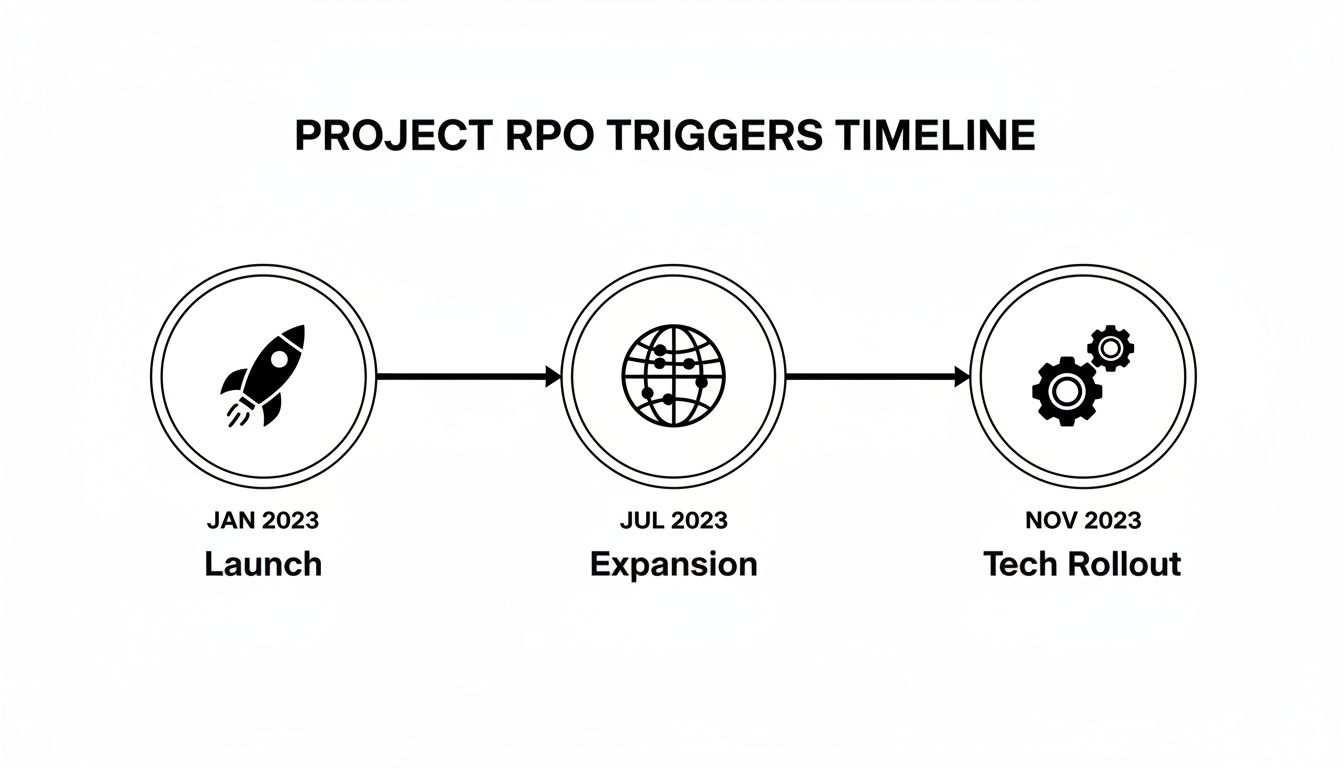
This visual roadmap shows how specific business initiatives—like a new product launch, a big market expansion, or a major tech rollout—directly spark the need for a targeted Project RPO.
Phase 2: Implementation And Ramp-Up
With the strategy locked in, the next phase is all about rapid mobilisation. This is where your RPO provider assembles the dedicated team, technology, and processes needed to deliver on the plan we’ve built together. The goal is to get the recruitment machine up and running as quickly as possible without cutting any corners on quality.
This stage can be surprisingly fast, especially in a mature market like India. For example, many India-based RPO providers can get a fully operational project team on the ground in just 2–10 weeks. In one high-volume project, an RPO partner deployed a 100-person talent acquisition team in 10 weeks to tackle 1,500 open roles, successfully delivering 225 tech hires every single month.
The ramp-up phase is the bridge between strategy and action. It’s about building the engine—assembling recruiters, calibrating technology, and defining workflows—so it’s ready to fire on all cylinders for the main event.
Getting this period right is absolutely critical. You can learn more about the essential steps involved by checking out our guide on achieving a smooth hiring ramp-up.
Phase 3: Execution And Delivery
This is the heart of the project RPO timeline and delivery model. It’s where the day-to-day engine of sourcing, screening, and hiring top talent is in full swing. The dedicated RPO team works as a true extension of your own, managing the entire recruitment lifecycle for all project-related roles.
This is where the results of all that initial planning really shine. Activities include active sourcing across multiple channels, rigorous candidate screening against the criteria we defined, coordinating interviews, and managing the offer process to secure the best people for your project.
Phase 4: Wind-Down And Knowledge Transfer
Unlike a permanent partnership, a Project RPO has a defined finish line. The final phase is designed to ensure a seamless transition as the project wraps up. This involves much more than just shutting down operations; it’s about preserving the value we’ve created together.
Key elements of this phase are:
- Talent Pipelining: We hand over a curated pipeline of vetted, “silver-medallist” candidates for your future needs.
- Data Transfer: All the valuable recruitment data and market intelligence gathered during the project is transferred back to you.
- Process Debrief: We conduct a final review to discuss successes, learnings, and areas for future improvement.
This structured offboarding ensures your organisation retains the strategic assets developed throughout the engagement, providing lasting value long after the last hire is made.
To give you a clearer picture, here’s a sample timeline that breaks down what a typical high-volume Project RPO looks like in practice.
| Phase | Typical Duration (Weeks) | Key Milestones and Deliverables |
|---|---|---|
| Phase 1: Discovery & Scoping | 1-2 | – Finalised Statement of Work (SOW) – Agreed-upon SLAs and KPIs – Detailed workforce and hiring plan |
| Phase 2: Implementation | 2-4 | – Dedicated recruitment team onboarded – Technology stack configured (ATS, sourcing tools) – Sourcing and engagement strategy launched |
| Phase 3: Execution & Delivery | 12-24+ | – Consistent achievement of hiring targets – Weekly/bi-weekly progress reports – Candidate pipeline and market intelligence reports |
| Phase 4: Wind-Down | 2-3 | – Final hiring fulfilment – Transfer of candidate database and project data – Knowledge transfer session and final project review |
This table illustrates the structured, milestone-driven approach that turns a daunting hiring challenge into a manageable and predictable process. It’s this clarity and discipline that ensures your project goals are met on time and on budget.
How to Choose the Right Delivery Model?
Picking the right delivery structure for your Project RPO is a bit like choosing a vehicle for a trip. A sleek sports car is perfect for a quick sprint, but you’ll need a heavy-duty lorry for a cross-country move. In the same way, the best Project RPO model hinges entirely on your specific hiring goals, the scale of the project, and how much flexibility you need.
Understanding these different models is key to aligning the project rpo timeline and delivery model with your actual business objectives. The choice you make directly impacts the project’s cost, speed, and overall success, turning a simple service into a real strategic advantage.

On-Demand RPO: The Flexible Specialist
Think of On-Demand RPO as having a team of expert recruiters on speed dial. This model is all about agility, making it a perfect fit for businesses that face unpredictable or fluctuating hiring needs. You simply engage the RPO provider for a specific number of roles or a set timeframe, scaling their support up or down as your project dictates.
This model is ideal when you’re dealing with:
- Sudden Hiring Spikes: You’ve just landed a big contract and need to staff up fast.
- Short-Term Projects: You’re filling seasonal roles or staffing a six-month initiative without any long-term strings attached.
- Specialised Skill Gaps: You need a handful of hard-to-find experts for one critical phase of a project.
The biggest win here is maximum flexibility. You pay for exactly what you need, only when you need it, and avoid the overhead of a permanent recruitment team. This approach has quickly become a favourite in India, where its scalability and low commitment are highly valued. In fact, on-demand RPO is the fastest-growing segment in the country, with over 60% of Indian tech companies exploring it to stay nimble.
Function-Based RPO: Building an Entire Team
If On-Demand is for surgical hiring strikes, Function-Based RPO is for assembling an entire platoon. This model is designed for when you need to build out a complete business function from scratch—like the entire IT development team for a new software launch or the full sales force for a new regional office.
The RPO provider takes complete ownership of recruitment for that specific department, becoming deep experts in the roles, culture, and success profiles required. This ensures consistency and quality across every single hire, making it a powerful way to build specialised, high-performing teams from the ground up.
Blended RPO: The Collaborative Partnership
The Blended RPO model truly offers the best of both worlds. It strategically combines your in-house talent acquisition team with the external expertise and resources of an RPO partner. This isn’t about replacing your team; it’s about reinforcing it.
In a Blended model, your team might handle the initial screening or cultural fit interviews, while the RPO partner does the heavy lifting of sourcing, market mapping, and engaging passive candidates for those really hard-to-fill roles.
This collaborative approach is perfect for organisations that already have a solid internal team but need extra muscle for a large-scale project. It keeps your brand and culture at the heart of the hiring process while giving you the reach and speed of a dedicated external partner. Deciding between a focused project and a broader partnership can be tricky; our guide on Project RPO vs Enterprise RPO can help you explore the nuances.
To make the choice clearer, here’s a quick breakdown of how these models stack up against each other.
Comparison of Project RPO Delivery Models
| Delivery Model | Best For | Pros | Cons |
|---|---|---|---|
| On-Demand RPO | Sudden hiring spikes, short-term projects, and filling specialised skill gaps. | High flexibility and scalability; cost-effective for unpredictable needs. | Less integration with company culture; may have a longer ramp-up time per project. |
| Function-Based RPO | Building entire departments or teams from the ground up with specialised skill sets. | Deep functional expertise; consistent quality and process for a whole team. | Less flexible for needs outside the defined function; higher initial commitment. |
| Blended RPO | Large-scale projects where internal teams need support for specific tasks like sourcing or screening. | Combines internal cultural knowledge with external sourcing power; highly customisable. | Requires strong coordination and clear communication between internal and external teams. |
Ultimately, the right delivery model isn’t a one-size-fits-all solution. It’s about carefully assessing your project’s unique demands—its scale, urgency, and complexity—and choosing the structure that gives your organisation the best possible strategic advantage.
Setting KPIs to Measure Real Success
How do you really know if your Project RPO engagement is paying off? Just filling roles isn’t the whole story. Real success is measured by the tangible business impact that new talent brings. To see the full picture, you need to move beyond simple vanity metrics and establish a balanced scorecard of Key Performance Indicators (KPIs) that track not just speed and cost, but the most crucial element: quality.
Think of it like building a high-performance engine. Sure, you can measure how fast it was assembled (Time-to-Fill) and what it cost (Cost-per-Hire). But the real test is its horsepower and reliability on the track (Quality of Hire). A solid KPI framework makes sure your project RPO timeline and delivery model is tuned for genuine performance, not just busywork.

Core Efficiency Metrics
Efficiency KPIs are the nuts and bolts—the foundational metrics that measure the speed and cost-effectiveness of your recruitment engine. They give you a clear, immediate view of operational health and are essential for showing a quick return on investment. While they seem straightforward, they form the baseline for assessing the entire project’s financial and time performance.
Your scorecard should always include:
- Time-to-Fill: This is the number of calendar days from when a job requisition is approved to the moment an offer is accepted. It’s a vital sign of your RPO partner’s ability to move at pace and hit project deadlines.
- Cost-per-Hire: This simply calculates the total project cost divided by the number of successful hires. It gives you a clear, bottom-line figure for the investment needed to bring on each new team member, directly proving the model’s financial sense.
In the Indian market, the impact of a well-run Project RPO on these numbers is massive. Provider case studies consistently show that Project RPOs in India can slash time-to-hire by 40–55% and cut cost-per-hire by 20–50%, depending on the roles’ scale and complexity. For more on these benchmarks, you can find great insights about RPO effectiveness in India.
Essential Quality and Satisfaction Metrics
Efficiency is important, but quality is what truly builds long-term success. These metrics go beyond the spreadsheet to gauge the actual value and impact of the people you’ve hired. They answer the most critical question: did we hire the right people?
An RPO partnership that only focuses on speed and cost is like a delivery service that prioritises fast arrival over the condition of the package. True success means delivering high-quality, impactful talent that arrives ready to contribute from day one.
To get the complete picture, you must track:
- Quality of Hire: Many consider this the ultimate recruitment metric. It can be measured through first-year performance review scores, feedback from managers on new hire productivity, or by tracking early attrition rates (hires who leave within the first 6-12 months). A low attrition rate is a powerful signal of a great fit.
- Hiring Manager Satisfaction: Regular pulse surveys sent to hiring managers are non-negotiable. A simple rating scale asking them to score the quality of candidates, the smoothness of the process, and the RPO team’s communication provides direct, honest feedback on service delivery. A score consistently above 85-90% shows a healthy partnership.
- Candidate Experience (Net Promoter Score): Every single candidate, hired or not, is a potential customer or future applicant. Measuring their experience with a simple Net Promoter Score (NPS) survey helps protect your employer brand and ensures the RPO partner is acting as a true brand ambassador. Top-tier providers often achieve candidate satisfaction scores exceeding 95%.
By blending these efficiency and quality KPIs, you create a holistic view of your Project RPO’s performance. This balanced scorecard doesn’t just track activity; it demonstrates how your talent strategy is directly fuelling your project’s success and delivering a real return on investment.
Building a Strong Governance and Risk Plan
A Project RPO partnership isn’t something you can “set and forget.” Think of it like any other high-stakes business initiative—it needs a solid governance framework and a proactive risk management plan to keep it on track and delivering real value. This structure is what makes the engagement resilient, adaptable, and laser-focused on your project’s goals.
Without clear rules of engagement, even the most brilliant plans can go sideways. A strong governance model is the partnership’s operating system, defining how everyone communicates, makes decisions, and tracks progress. It’s what stops small misunderstandings from snowballing into major headaches down the road.
Establishing a Cadence for Communication
Good governance starts with a predictable rhythm of communication. This isn’t about scheduling endless meetings for the sake of it; it’s about creating structured touchpoints that keep everyone aligned and in the loop. A well-defined communication plan is absolutely vital for maintaining momentum throughout the project RPO timeline and delivery model.
A typical communication cadence might look something like this:
- Weekly Tactical Check-ins: These are quick, operational huddles. The focus is on reviewing the candidate pipeline, tackling immediate roadblocks, and setting short-term priorities. They keep the day-to-day execution sharp.
- Bi-weekly or Monthly Performance Reviews: Here, you zoom out a bit to review progress against key metrics like Time-to-Fill and Hiring Manager Satisfaction. This is where data, not just gut feeling, drives the conversation.
- Quarterly Strategic Business Reviews (QBRs): This is the big-picture meeting with senior leaders from both sides. You’ll talk about the overall health of the partnership, strategic alignment, and what’s next for the project.
Strong governance isn’t about control; it’s about creating clarity. It provides a shared language and a predictable structure that enables both your team and your RPO partner to focus on what truly matters—hiring exceptional talent.
To make roles even clearer and sidestep confusion, many companies use a RACI chart (Responsible, Accountable, Consulted, Informed). It’s a simple but powerful tool that spells out exactly who does what for key steps like approving a job requisition, screening candidates, or extending an offer. This nips ambiguity in the bud before it can cause delays.
Identifying and Mitigating Common Risks
Beyond just governance, you need to be proactive about risk management. When you anticipate potential pitfalls, you can build solutions right into your project plan. This turns potential crises into manageable bumps in the road. A partnership that spots risks together is one built on a foundation of trust and transparency.
Here are a few common risks in a Project RPO and how to get ahead of them:
| Potential Risk | Description | Mitigation Strategy |
|---|---|---|
| Scope Creep | The number or type of roles suddenly balloons beyond the original agreement. | Build a formal change request process into the SOW. Any new roles must be officially approved and scoped before the team starts working on them. |
| Inconsistent Candidate Quality | Candidates being presented just aren’t hitting the mark with hiring managers. | Hold regular calibration sessions between recruiters and hiring managers. This helps refine the ideal candidate profile and tighten the screening criteria. |
| Employer Brand Dilution | The RPO partner’s communication style feels off-brand and doesn’t reflect your company’s voice. | Equip the RPO team with a full brand toolkit, complete with communication templates. It’s also wise to run joint training sessions on your Employer Value Proposition (EVP). |
By putting this dual framework of clear governance and forward-thinking risk planning in place, you create an environment where your Project RPO partnership can truly excel. This structure drives accountability, encourages collaboration, and ultimately ensures your recruitment engine is powerfully and reliably hitting your most critical business goals from day one.
Actionable Insights for C-Level Leaders
As a CHRO, it’s easy to see a Project RPO as a quick fix for a sudden hiring surge. But that’s selling it short. Think of it less as a tactical solution and more as a strategic lever you can pull to accelerate the entire business. Whether you’re launching in a new market or rolling out a massive tech platform, the decision to launch a Project RPO is about enabling those critical initiatives to succeed, faster.
We’ve walked through the mechanics, but your role is to connect the dots. You need to draw a straight line from the project’s goals, through the right Project RPO timeline and delivery model, and all the way to the bottom line. This means getting everyone on board with a data-first mindset from day one.
Forging a True Strategic Partnership
Here’s where many initiatives stumble: treating an RPO provider like just another transactional vendor. This approach throttles their potential, reducing their role to simply filling seats. What you need is a genuine strategic partner, one who gets your business objectives as clearly as you do.
When you’re choosing a partner, your criteria should go much deeper than cost. Prioritise these areas:
- Proven Industry Expertise: They have to speak your language. A partner who already understands the nuances and talent challenges of your sector is invaluable.
- Cultural Alignment: This is non-negotiable. The provider’s team will be the face of your employer brand. They must operate as a seamless, authentic extension of your company, protecting and even enhancing your reputation with every candidate they speak to.
- A Consultative Approach: You don’t want an order-taker. Look for a partner who brings fresh market intelligence to the table, challenges your assumptions, and isn’t afraid to tell you if your timelines are unrealistic.
A real partner gets involved in workforce planning and helps you spot risks before they blow up. This is how the engagement shifts from being a cost centre to a real source of competitive advantage.
Choosing the right RPO partner is the single most critical decision in this process. A transactional vendor fills roles; a strategic partner builds the teams that achieve your most ambitious business goals.
Building a Compelling Business Case
To get the rest of the C-suite on board, you need a business case built on solid, measurable ROI, not just operational convenience. It’s your job to connect the investment in a Project RPO directly to tangible business outcomes. Frame the entire conversation around three things: speed, quality, and risk mitigation.
For example, don’t just say it will be faster. Show how accelerating the hiring timeline by 40% directly shaves months off a new product’s time-to-market, impacting revenue. Don’t just talk about better candidates; show how a higher quality of hire, measured by first-year performance, slashes long-term costs tied to turnover and retraining.
And don’t forget to highlight the opportunity cost of not using a Project RPO. What’s the real price of project delays, a burnt-out internal team, and the poor-quality hires that inevitably get made under intense pressure? When you reframe the discussion from a simple recruitment expense to a strategic investment in project success, the value is impossible to ignore.
Ultimately, this is where your leadership makes the difference. By picking the right moment, choosing the best delivery model, and championing a partnership built on shared success, you can deploy a Project RPO that delivers a powerful, measurable impact on the business.
Frequently Asked Questions
When you’re exploring a Project RPO, a few key questions always come up. It’s natural to want to understand exactly how it works before diving in. Let’s tackle some of the most common queries to give you a clearer picture of the project rpo timeline and delivery model.
How Does a Project RPO Differ From a Traditional RPO?
The biggest difference comes down to scope and timeline. A traditional, or enterprise, RPO is the long game—it’s a continuous partnership where a provider takes over most, if not all, of your recruitment function indefinitely. Think of it as outsourcing your entire talent acquisition department for the foreseeable future.
Project RPO, on the other hand, is a targeted, short-term solution. It’s designed to tackle a specific, finite hiring challenge. Imagine you’re building a new factory; you’d hire a specialist construction crew for that single project, not outsource your entire facilities management forever. Project RPO is built for sprints, not marathons.
What Is the Typical Cost Structure for a Project RPO?
Flexibility is the name of the game here. The pricing is designed to align directly with your project’s unique demands. Most often, you’ll see one of these financial arrangements:
Cost-per-Hire Fee: Simple and direct. You pay an agreed-upon fee for each candidate who successfully joins your team.
Fixed Management Fee: This is a recurring fee, usually monthly, that covers the project’s management for its entire duration.
Hybrid Model: A popular choice that blends the best of both worlds. It combines a lower monthly management fee with a reduced cost-per-hire, giving you predictable costs while still incentivising performance.
The right structure really depends on your hiring volume, the complexity of the roles you’re filling, and how predictable the project timeline is. This is something you’ll want to iron out in detail during the initial discovery phase to ensure there are no surprises down the line.
How Do You Ensure the RPO Provider Understands Your Company Culture?
Getting the culture fit right is non-negotiable, and it has to be a priority from day one. Any top-tier RPO partner will invest significant time upfront during the discovery phase to truly immerse themselves in your company’s values and work environment.
This isn’t just a quick chat. It involves in-depth sessions with your key leaders, a deep dive into your employer value proposition (EVP), and conversations with your current high-performing employees. These insights are then baked directly into how they screen and assess every single candidate.
A great RPO partner doesn’t just learn your culture; they become a fluent ambassador for it. They ensure every candidate interaction, whether successful or not, reinforces your employer brand in the talent market.
Can a Project RPO Be Scaled Up or Down if Our Needs Change?
Absolutely. In fact, this scalability is one of the biggest advantages of a Project RPO. Business needs are rarely set in stone, and a well-designed partnership is built to adapt. Your Statement of Work (SOW) should always have clear clauses spelling out how changes in hiring volume will be handled.
If you suddenly need to speed up hiring to meet an earlier deadline, your provider can quickly bring in more recruiters and resources. On the flip side, if project timelines get pushed out or priorities shift, the engagement can be scaled back. This agility is a huge benefit, saving you from the cost of maintaining a large internal team during slower periods.
Ready to accelerate your project with the right talent, right now? Taggd specialises in crafting bespoke Project RPO solutions that align perfectly with your business goals. Learn more and get started today.