At first glance, project RPO and staffing agencies might seem similar, but they operate on fundamentally different principles. The real difference is in the approach: Project RPO is a strategic partnership, where a provider acts as an extension of your team to manage a specific hiring goal from start to finish. On the other hand, a staffing agency offers a transactional service, focusing on filling one-off roles as quickly as possible from their existing talent pool.
Deciding between them boils down to a simple question: Do you need a dedicated partner to build out a team, or do you just need to fill a seat quickly?
Defining the Core Talent Models
Before we pit them against each other, let’s get clear on what each model actually is. Both connect you with talent, sure, but their methods, goals, and the impact they have on your business couldn’t be more different. Getting these distinctions right is the first step to making a smart hiring decision that actually fits what your organisation needs.
What Is a Staffing Agency?
Think of a staffing agency as an intermediary. They match candidates from their database to your specific, and often urgent, job openings. The process is almost always reactive and transactional. You have a vacancy, you send over the job description, and they dig into their network to find a match.
- Primary Focus: Filling individual roles, either on a contingent or permanent basis.
- Relationship: A straightforward vendor-client relationship.
- Best For: Putting out fires—addressing urgent, short-term, or one-off hiring needs.
What Is Project RPO?
Project Recruitment Process Outsourcing (RPO) is a much deeper, more integrated solution. Here, a provider takes full ownership of the recruitment cycle for a specific business initiative. This could be anything from launching a new department and scaling a sales team to staffing an entirely new facility.
The RPO provider becomes a genuine extension of your internal HR team. They work under your brand, adopt your processes, and are fully invested in the project’s success.
- Primary Focus: Managing a defined, multi-role hiring project from beginning to end.
- Relationship: A true strategic partnership, deeply embedded in your day-to-day operations.
- Best For: Handling high-volume hiring surges, breaking into new markets, or building highly specialised teams from the ground up.
The table below breaks down their fundamental differences side-by-side.
| Feature | Project RPO | Staffing Agency |
|---|---|---|
| Model | Strategic Partnership | Transactional Service |
| Scope | End-to-end process for a specific project | Filling individual, ad-hoc vacancies |
| Process Ownership | Full ownership of the recruitment lifecycle | Sourcing and submitting candidates |
| Integration | Acts as an extension of your internal team | Operates as an external third-party vendor |
| Employer Branding | Promotes and represents your brand to candidates | Represents their own agency brand primarily |
| Candidate Sourcing | Proactive, dedicated sourcing for your project | Reactive sourcing from an existing candidate pool |
A Detailed Comparison of RPO and Staffing Models
To really get to the heart of the difference between Project RPO and staffing agencies, we need to look past the basic definitions and dig into how each model actually works on the ground. This choice isn’t just about filling a vacancy; it’s about how you build your teams, manage your budget, and ultimately, shape your company’s future. The fundamental distinction boils down to one thing: partnership versus transaction.
A Project RPO provider essentially becomes part of your organisation for a specific hiring project, working as a true extension of your own talent acquisition team. On the other hand, a staffing agency is an external supplier, laser-focused on placing a candidate from their pre-existing network into your open role. This core difference sends ripples through every part of the hiring process.
This visual breaks down the key operational differences between the strategic partnership you get with Project RPO and the straightforward service of a staffing agency.
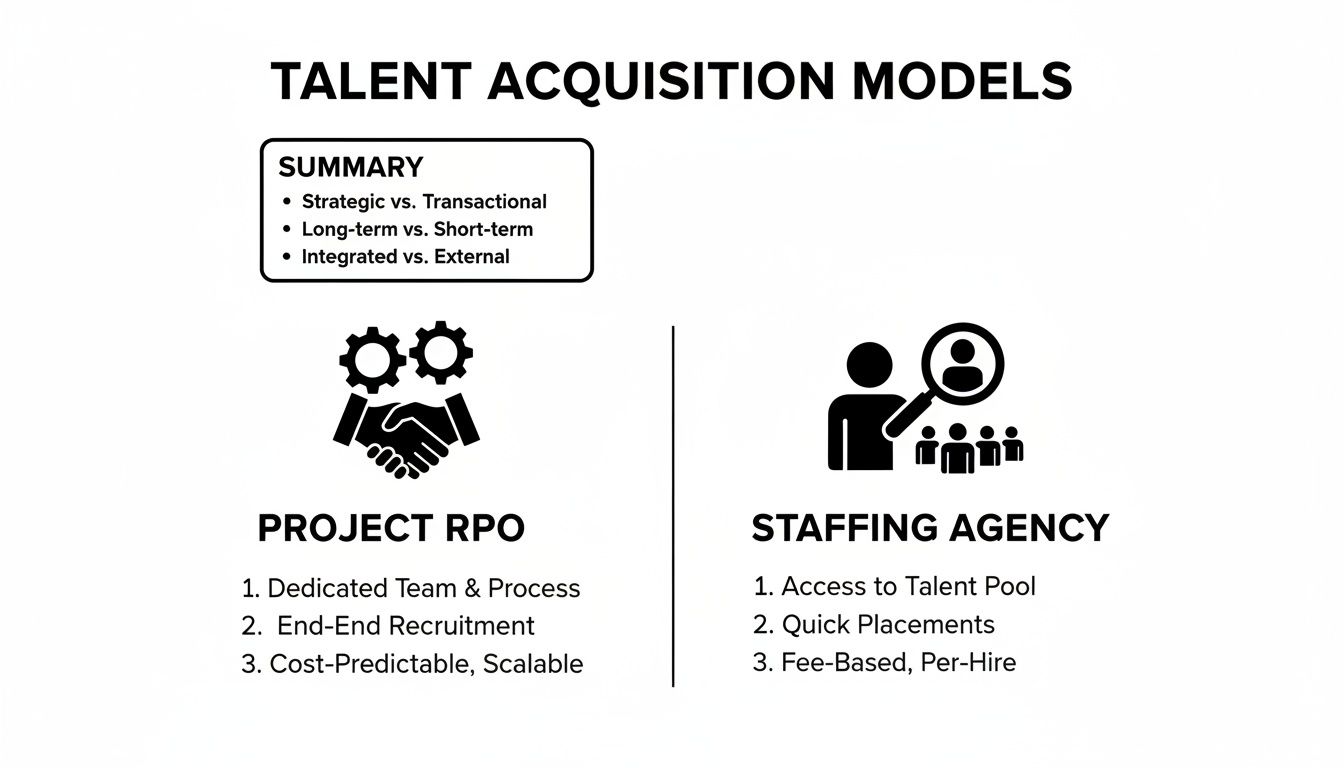
As the infographic shows, RPO’s integrated, process-driven model is a world away from an agency’s immediate, placement-focused approach. This impacts everything from how your brand is represented in the market to your long-term talent strategy.
Strategic Alignment and Business Integration
One of the biggest differentiators is strategic alignment. A Project RPO partner doesn’t just jump into sourcing; they take the time upfront to truly understand your business objectives, your unique company culture, and the specific goals for the project. They become genuine brand ambassadors, making sure every single candidate interaction reinforces your value as an employer.
Staffing agencies, by their very nature, keep a more transactional distance. Their primary objective is to match keywords from your job description with CVs in their database. While that can be quick, it often misses the subtle cultural nuances and long-term performance indicators that are the real predictors of a successful hire.
An RPO provider takes ownership of the entire recruitment lifecycle, from initial sourcing right through to onboarding. This end-to-end accountability ensures a cohesive strategy that is completely aligned with your project’s specific outcomes and broader business goals.
Talent Sourcing and Pipeline Development
The way candidates are found reveals another massive gap between the two models. Staffing agencies are generally working with a shared pool of active job seekers. When you give them a requirement, they are likely showing the very same candidates to your direct competitors.
Project RPO is a different game entirely. It focuses on building a dedicated, exclusive talent pipeline just for your project. Sourcing is proactive and taps into multiple channels, targeting not just active job seekers but also the passive candidates—the high-performers who aren’t even looking but are the perfect fit for your team. This strategic depth is absolutely crucial in competitive talent markets.
This proactive approach is what sets RPO apart from staffing agencies in India. An RPO partner becomes an extension of your internal team, building exclusive talent pools and providing analytics that agencies simply don’t offer. While agencies reactively fill jobs from shared databases, RPO creates pipelines specific to your company, filled with both active and passive talent. This can dramatically speed up hiring—in some cases, we’ve seen time-to-fill for critical roles drop from 45 to just 24 days.
This long-term partnership ensures cultural alignment and process consistency, moving far beyond the transactional nature of agencies. For a deeper dive into these models, you can explore our in-depth guide on the key distinctions.
To make the differences crystal clear, let’s break them down side-by-side.
Key Differentiators: RPO Partnership vs. Agency Transaction
| Feature | Project RPO | Staffing Agency |
|---|---|---|
| Relationship | Strategic Partner | External Vendor |
| Model | Consultative, process-driven | Transactional, placement-focused |
| Candidate Pool | Dedicated, exclusive talent pipeline | Shared pool of active candidates |
| Accountability | End-to-end ownership (sourcing to onboarding) | Limited to candidate placement |
| Brand Representation | Acts as a brand ambassador | Represents multiple clients |
| Metrics (KPIs) | Quality of Hire, Cost-Per-Hire, Candidate Experience | Time-to-Fill, Number of Placements |
| Focus | Long-term value & business impact | Short-term vacancy filling |
This table highlights the shift from a simple service provider to an integrated partner who is invested in your long-term success.
Accountability and Performance Metrics
So, how do you measure success? With a staffing agency, the main metric is transactional: how quickly was the role filled or how many placements were made? Accountability usually ends the moment a candidate signs the offer and the invoice is paid.
In a Project RPO engagement, success is measured by a much broader and more meaningful set of key performance indicators (KPIs).
- Quality of Hire: We’re talking about tracking the actual performance and retention of new employees over time.
- Cost-Per-Hire: This involves analysing the total investment to secure talent, not just the agency fee.
- Candidate Experience: We measure candidate satisfaction scores to protect and even enhance your employer brand.
- Source Effectiveness: You get hard data on which channels are delivering the best long-term talent.
This data-driven accountability fuels continuous improvement, something a traditional agency model just isn’t built for. An RPO partnership isn’t measured on filling seats, but on the tangible business impact of the talent you bring on board. This is the defining factor for any organisation serious about sustainable growth.
Analysing the True Cost and Return on Investment

When you’re weighing up project RPO vs staffing agencies, the financial conversation needs to go much deeper than just the initial fees. A staffing agency’s commission-based model might seem simple on the surface, but it often conceals significant downstream costs. The real value is found when you look at the total cost of talent acquisition and the long-term return on that investment.
A typical agency will charge a hefty percentage of a candidate’s first-year salary—a one-off transaction. Project RPO, on the other hand, runs on a far more predictable model, like a fixed project management fee or a lower cost-per-hire. This fundamental difference is just the start of the financial story.
The Predictable Costs of Project RPO
With Project RPO, you get financial clarity right from the beginning. The cost structure is transparent and directly linked to the project’s scope and what needs to be delivered, not just individual placements. This predictability is a game-changer for budgeting, putting an end to surprise invoices that often follow a successful hiring spree with an agency.
This model brings a few key financial advantages to the table:
- Economies of Scale: As you hire more people within the project, your average cost-per-hire naturally drops. This offers substantial savings compared to the high, fixed percentage an agency charges for every single role, regardless of volume.
- Bundled Services: The project fee often wraps in services that you’d otherwise pay extra for, such as technology management, employer branding initiatives, and detailed analytics reporting.
- Strategic Budgeting: Knowing the costs upfront means you can allocate your resources much more effectively across your entire talent acquisition strategy.
The Hidden Costs of Staffing Agencies
The simplicity of an agency’s commission fee can be misleading. The real cost often stretches well beyond that initial invoice, revealing hidden expenses that eat into your bottom line over time. These aren’t just about the money you pay out; they’re about the long-term impact on your organisation.
Think about the financial ripple effects:
- Higher Cost of a Bad Hire: Agencies are driven by speed and placement numbers. This can sometimes lead to candidates who aren’t the right cultural fit, which means higher turnover and the headache of hiring for the same role all over again, effectively doubling your acquisition cost.
- Productivity Loss: Every day a role stays vacant, it costs you money. While an agency will eventually fill the position, their reactive approach often means the role stays open longer, leading to lost productivity and putting a strain on your existing teams.
- Lower Retention Rates: When candidates are sourced for a quick fit rather than for long-term alignment with your company, they’re simply less likely to stick around. Replacing an employee can cost as much as 1.5 to 2 times their annual salary—a recurring expense that the transactional model conveniently overlooks.
In the highly competitive Indian job market, where a staggering 74% of organisations grapple with talent scarcity, Recruitment Process Outsourcing (RPO) is a clear winner over staffing agencies. RPO partners are not just filling roles; they’re slashing hiring timelines and costs. We’ve seen top RPO providers achieve a 55% reduction in time-to-hire, turning the average 42-day vacancy into a swift 24-day fill. For high-volume hiring, some industries have even seen RPO cut the cost-per-hire by 40%. In a talent-starved economy, that’s more than an advantage—it’s a strategic necessity.
Calculating the True Return on Investment
The real ROI in recruitment isn’t just about saving money; it’s about the value that high-quality talent brings to your business. This is where Project RPO is built to excel. By focusing on cultural fit, long-term potential, and strategic alignment, RPO delivers hires who contribute more and stay longer. This focus has a direct, positive impact on team stability, innovation, and your company’s overall performance.
Ultimately, the return from Project RPO shows up in tangible business outcomes. It’s about building a stronger, more engaged workforce that drives growth—not just filling empty chairs. To really see the difference, it’s vital to track and analyse the ROI of your recruiting efforts with a holistic view. This strategic approach ensures your talent acquisition function becomes a powerful driver of business success, not just another cost centre.
Evaluating Candidate Quality and Cultural Alignment

The real difference between project RPO vs staffing agencies becomes crystal clear when you start talking about candidate quality and cultural alignment. Both models will get you candidates, sure. But their methods and end goals are worlds apart, and that creates a huge gap in the kind of talent that actually joins your team.
It’s the classic difference between just filling a seat and genuinely building a team.
Sourcing Philosophy: Proactive vs Reactive
A staffing agency’s success is almost always measured by speed. Their main job is to quickly match keywords from a CV to your job description, pulling from a database of people already looking for work. This is a transactional, reactive process, which means cultural fit often becomes an afterthought, if it’s considered at all.
This is where the paths of RPO and agencies truly fork. An agency is typically dipping into the same pool of active job seekers as everyone else. While that might get you a fast placement, you’re competing for a limited, and very public, talent pool.
Project RPO, on the other hand, runs on a proactive and strategic sourcing model. Your RPO partner invests serious time upfront to get under the skin of your company—your values, team dynamics, and where you’re headed long-term. They aren’t just looking for skills; they’re hunting for the right mindset.
This means building a talent pipeline specifically for your project, which involves:
- Passive Candidate Engagement: Going after high-performers who aren’t actively job hunting but are a perfect fit for you.
- Market Mapping: Figuring out where the best talent is currently working and creating targeted campaigns to get their attention.
- Referral Programmes: Building networks that bring in qualified candidates who come pre-vetted by people you trust.
This proactive approach creates a curated, exclusive group of people who are not only skilled but are also genuinely bought into your company’s mission.
Cultural Vetting and Brand Ambassadorship
A Project RPO partner operates as a true extension of your company. They become your brand ambassador in the talent market. Every single interaction, from the first message to the final interview, is crafted to reflect your company’s culture and values. This deep integration means candidates are being vetted for cultural fit from the very first conversation.
Staffing agencies just can’t offer this. They’re juggling multiple clients at once, so their focus naturally stays on a candidate’s technical skills and experience. The tricky, and crucial, task of assessing cultural fit is often left entirely to your internal managers, much later in the game.
A Project RPO partner is accountable for finding candidates who will actually thrive in your specific work environment. This focus on cultural alignment directly translates to higher employee engagement, better team cohesion, and significantly improved long-term retention rates.
Enhancing the Candidate Experience
The journey a candidate takes is another key point of difference. A clunky or impersonal hiring process, which is common with high-volume agency models, can seriously damage your employer brand. In fact, a bad candidate experience can put 60% of applicants off from ever applying to your company again.
A Project RPO provider takes full ownership of the entire candidate experience. They make sure communication is clear, feedback is timely, and every single applicant is treated with the professionalism your brand deserves. This positive experience doesn’t just boost your offer acceptance rates; it strengthens your reputation as an employer of choice, even among the candidates you don’t end up hiring.
By embedding themselves in your culture, RPO partners ensure that the talent they bring on board is set up for success from day one, turning recruitment from a simple transaction into a strategic advantage for your business.
When to Choose Project RPO Practical Use Cases
Knowing the difference between project RPO and a staffing agency on paper is one thing. Knowing exactly when to deploy each solution in the real world is another game entirely. The decision usually comes down to specific business triggers that need more than just filling a few open roles.
Project RPO truly comes into its own when your hiring needs are strategic, high-stakes, and directly tied to a measurable business outcome. These aren’t situations for a quick, transactional fix. They demand a dedicated, embedded partner who can manage complexity, scale up quickly, and make sure every single hire aligns with the project’s big-picture goals.
Let’s break down the practical scenarios where choosing Project RPO gives you a clear strategic edge over the standard staffing agency route.
Rapid Team Scaling for a Product Launch
Imagine your company is gearing up to launch a flagship software product. You need to build a new team of 50+ specialised engineers, product managers, and marketing experts, and you need them within a tight six-month window. Your internal HR team is already swamped with day-to-day work and doesn’t have the niche sourcing expertise for these roles.
This is a textbook case for Project RPO.
- The Challenge: High-volume, specialised hiring on a non-negotiable deadline.
- Agency Limitation: Juggling multiple staffing agencies would create chaos. You’d be dealing with inconsistent candidate quality, mixed brand messaging, and a deluge of duplicate CVs that would completely overwhelm your hiring managers.
- Project RPO Solution: An RPO provider steps in and takes full ownership. They design a dedicated sourcing strategy, build a talent pipeline exclusively for your project, manage the entire interview process, and ensure a consistent, positive candidate experience. This protects your employer brand during a crucial phase of growth.
A Project RPO partner effectively becomes the command centre for your hiring surge. They bring the process, technology, and expert recruiters needed to build an entire team from the ground up, guaranteeing quality and consistency at scale.
High-Volume Hiring for a New Facility Opening
Picture a manufacturing firm opening a brand-new production plant in a different state. The company has to hire 200 skilled technicians, supervisors, and administrative staff before the facility can go live. This is about more than just filling seats; it’s about building a cohesive workforce and setting a positive company culture from the very first day.
A staffing agency might be able to fill some of the general labour positions, but they lack the strategic oversight to build an entire organisational structure. Project RPO, on the other hand, is built for exactly this kind of large-scale initiative. The RPO partner will handle everything from local market analysis and targeted recruitment marketing to running assessment centres and coordinating onboarding logistics, making sure the facility is staffed and ready for action right on schedule.
To see more real-world scenarios, explore these detailed recruitment process outsourcing examples that showcase its versatility.
Sourcing Specialised Talent for a Digital Transformation
Let’s say a legacy financial services firm is in the middle of a massive digital transformation. This initiative means hiring a new department of 30 data scientists, cybersecurity analysts, and cloud architects. These are notoriously hard-to-fill, highly competitive roles. The company’s current recruitment channels simply aren’t equipped to find this level of specialised, passive talent.
This is where the proactive, strategic sourcing of Project RPO makes a world of difference.
- The Challenge: Finding highly specialised talent where demand is high and supply is low.
- Agency Limitation: Most agencies work from their existing database of active job seekers, which is often very thin for these elite roles. Their ability to tap into the passive candidate market is limited.
- Project RPO Solution: The RPO provider deploys expert tech recruiters who meticulously map the market, identify top performers at competing firms, and engage them with a compelling story about your transformation journey. They build a sustainable pipeline, ensuring a steady stream of top-tier candidates who have the precise niche skills needed for the project to succeed.
Making the Right Choice for Your Business
Figuring out whether to go with project RPO or a staffing agency really boils down to what your business needs right now and where you want it to go. Both have their place, but they solve very different hiring problems. The real question is: do you need a quick, tactical fix or a strategic, long-term partner to hit a major business milestone?
Staffing agencies are champions of speed and efficiency. They are your go-to when you need to fill a single, critical role fast, cover for someone on leave, or handle a predictable, short-term spike in work. Their strength lies in a ready-made network of candidates they can tap into immediately.
Project RPO, on the other hand, is built for bigger, more complex hiring drives tied directly to growth. It’s not just about filling an empty seat; it’s about strategically building an entire team.
A Framework for Your Decision
To find the right path, you need to ask some honest questions about your hiring goals. Your answers will quickly tell you whether the deep partnership of Project RPO or the transactional speed of a staffing agency makes more sense.
- What is your hiring volume? If you’re scaling a new department and need to fill 10, 20, or even 50+ roles for one big push, Project RPO delivers the structure and cost-effectiveness that an agency just can’t match. For one or two random hires, an agency is far more practical.
- How important is cultural alignment? When finding people who truly get your company’s vision and values is non-negotiable, the deep-dive approach of Project RPO is invaluable. An agency’s main job is to match skills on a CV to a job description.
- Do you need to build an employer brand? For projects where you need to make a name for yourself in the talent market, an RPO partner essentially becomes your brand ambassador. A staffing agency, by nature, promotes its own brand first.
- How urgent is the need? While a Project RPO can get up and running quickly, it starts with strategic planning. If you needed someone in the door yesterday, a staffing agency’s reactive model is designed for exactly that kind of immediate fire-fighting.
The core difference is the outcome you’re buying. A staffing agency delivers a candidate. A Project RPO partner delivers a fully-formed, high-performing team that’s wired into your strategic goals.
Ultimately, your choice depends on your timeline. Staffing agencies are brilliant for solving the problems of “now” with a quick, effective fix for immediate openings. Project RPO is the strategic move for building your “next,” giving you the partnership and process needed to pull off large-scale talent initiatives that will propel your business forward. Once you assess your goals, the right path becomes much clearer.
Frequently Asked Questions
Choosing between Project RPO and a staffing agency always sparks a few questions. We get it. Here are some straight answers to the most common queries we hear from CHROs and hiring managers.
Can We Use Both Models Simultaneously?
Yes, and in many cases, you absolutely should. Think of it this way: you might use a staffing agency to get a temp administrative assistant in the door by tomorrow, while at the same time, engaging a Project RPO partner for a six-month push to build out your new data science team.
It’s all about matching the tool to the task. Use agencies for that immediate, tactical speed and RPO for the more strategic, project-based team building where quality and cultural fit are paramount.
How Long Does a Project RPO Implementation Take?
This isn’t like calling an agency and getting CVs in a few hours. A proper Project RPO setup is more involved because it’s designed for a bigger impact. The initial discovery and strategy phase typically takes one to four weeks.
This upfront time is non-negotiable for success. It’s where we map out your processes and align the entire project with your core business goals, which is precisely what leads to better hires and stronger long-term results.
Is Project RPO Suitable for Smaller Businesses?
Definitely. Project RPO isn’t just a game for large corporations. We’ve seen small and medium-sized enterprises (SMEs) get incredible value from it, especially when they’re hitting a rapid growth spurt, launching a new product, or needing to build a very specialised team from scratch.
The model gives you access to top-tier recruitment expertise and scalable processes without the heavy cost of hiring a full-blown internal talent acquisition team. It’s a smart, cost-effective way to fuel targeted growth.
Ready to build your next great team with a strategic, project-based approach? Taggd delivers expert RPO solutions designed for your specific business goals. Learn how we can help you scale effectively.