In today’s fiercely competitive talent market, rapid recruitment solutions in India aren’t just a nice-to-have; they’re essential for survival and growth. For CHROs, this means it’s time to move on from slow, traditional hiring methods. We need to embrace agile, tech-driven strategies that can keep up with the incredible pace of the Indian economy.
Why Rapid Recruitment Is Now Mission-Critical in India

As a CHRO, you’re not just managing hiring anymore. You’re navigating a high-stakes talent economy where speed is the ultimate competitive advantage. Those traditional hiring timelines, often stretching for weeks or even months, are now a serious liability.
While your team is carefully sifting through resumes and trying to coordinate interviews, your top candidates are already getting offers from more agile competitors—and accepting them.
Think of your talent pipeline as a high-speed rail network. Without the right infrastructure, your company is stuck on a slow-moving local train. Meanwhile, competitors are racing ahead on an express route, snapping up the best talent before you’ve even left the station. This delay isn’t just about a vacant role; it translates directly into lost productivity, delayed projects, and missed opportunities in the market.
The Accelerating Pace of India’s Job Market
The Indian job market isn’t just growing; it’s accelerating at a rate we’ve never seen before. This explosive growth has created a candidate-driven market where skilled professionals have plenty of options and very little patience for a long, drawn-out recruitment process.
Recent analyses show just how massive this expansion is. India’s recruitment industry is seeing incredible growth, with a projected 15-20% increase in job opportunities, especially in the booming IT and technology sectors. Forecasts predict the creation of around 500,000 new opportunities across key industries, backed by a 19% rise in hiring intent compared to last year.
This surge means that adopting rapid recruitment solutions in India is the only way to keep pace. You can read more insights about India’s recruitment outlook and see how these trends are shaking up talent acquisition.
For CHROs, this data paints a clear picture: the ‘wait and see’ approach is over. The organisations that can identify, engage, and onboard top talent with maximum speed and efficiency will be the ones that win.
Moving Beyond Vendor Relationships to Strategic Partnerships
To rise to this challenge, forward-thinking leaders are turning to strategic partnerships like Recruitment Process Outsourcing (RPO). An RPO provider isn’t just another vendor sourcing candidates; they become a fully integrated extension of your talent acquisition team.
They bring the specialised technology, market intelligence, and scalable processes you need to operate at the speed today’s market demands.
This strategic shift lets your internal HR team focus on the bigger picture—culture, retention, and employee development—while your RPO partner handles the operational engine of high-speed hiring. This is the new imperative for thriving in India’s dynamic talent landscape.
Understanding How RPO Powers Rapid Recruitment

So, what does rapid recruitment actually look like when the rubber meets the road? It’s much more than just pushing the same old hiring process to go faster. Real speed comes from completely re-engineering how you hire, and the engine driving modern rapid recruitment solutions in India is Recruitment Process Outsourcing (RPO).
An RPO partner isn’t just another vendor; they become a seamless extension of your talent acquisition team. Imagine your in-house recruiters having to build a custom race car from scratch for every single open role. It might be precise, but it’s incredibly slow and drains resources.
Now, picture an RPO provider giving you the keys to an entire fleet of high-performance vehicles. Each one is already tuned and specialised for a different kind of race—whether you need to hire 50 software developers or find one niche senior leader. You get to deploy the perfect hiring engine exactly when you need it, without any delay.
The Core Components of an RPO Engine
A true RPO partnership brings together specialised recruiters, advanced technology, and battle-tested workflows that operate in perfect sync. This synergy is what dramatically cuts down your time-to-hire while, at the same time, improving the quality of candidates you meet.
This powerful system is built on a few key pillars that fundamentally change your hiring game.
- Advanced Talent Sourcing: RPO teams use sophisticated tools and deep market intelligence to find and engage passive candidates—those high-performers who aren’t looking for a job but are open to the right conversation.
- Predictive Analytics: By looking at your historical hiring data, an RPO partner can spot the key traits of your most successful employees, making the screening process smarter and far more accurate.
- Scalable Processes: RPO providers have perfected workflows to manage a high volume of applicants without letting quality slip. This ensures no top candidate ever gets lost in the noise.
An effective RPO solution doesn’t just fill roles faster; it builds a predictable talent pipeline. It turns recruitment from a reactive fire-drill into a strategic, data-driven function that anticipates what your business will need next.
From Manual Effort to Automated Excellence
The biggest difference between old-school in-house hiring and an RPO-powered model is the jump from manual, often inconsistent tasks to a standardised, tech-driven system. This is where you gain real velocity. For a closer look, you can explore how Recruiting Process Outsourcing (RPO) can improve hiring results and see the direct impact on your most important metrics.
To paint a clearer picture, let’s compare the two approaches side-by-side.
Comparing In-House Recruitment with RPO
This table breaks down how a traditional in-house setup stacks up against a modern RPO partnership when it comes to speed, scale, and sophistication.
| Feature | Traditional In-House Recruitment | Rapid Recruitment via RPO |
|---|---|---|
| Technology Stack | Often fragmented or limited by budget. | Access to enterprise-grade ATS, AI sourcing tools, and analytics platforms. |
| Talent Pools | Primarily relies on active job seekers and existing networks. | Taps into vast, passive candidate pools and specialised talent communities. |
| Process Speed | Prone to bottlenecks in screening, scheduling, and feedback. | Streamlined, automated workflows that significantly reduce administrative delays. |
| Scalability | Difficult to scale up or down quickly for project-based hiring needs. | Inherently flexible, allowing for rapid scaling to meet fluctuating demand. |
| Market Insights | Limited to the internal team’s knowledge and experience. | Provides real-time market data on salary benchmarks and competitor activity. |
As you can see, the differences are stark.
Ultimately, partnering for rapid recruitment solutions in India is about using external expertise to build a stronger internal capability—one that is faster, smarter, and more agile. It frees your core HR team from the tactical grind, allowing them to focus on strategic work like employee development and retention, knowing the talent engine is running at full throttle.
Choosing the Right RPO Model for Your Business Goals
Bringing an RPO partner on board is a great first step. But the real game-changer is picking a model that clicks perfectly with your company’s immediate challenges and long-term vision. A powerful RPO strategy isn’t a one-size-fits-all solution; it’s a bespoke toolkit, giving you the exact resources you need, right when you need them.
Think about it like building a house. You wouldn’t use the same crew and equipment for laying the foundation as you would for finishing the intricate interior woodwork. In the same way, your talent acquisition approach has to be flexible, whether you’re staffing a new technology centre, launching a new product, or just future-proofing your talent pipeline for steady growth.
The secret is to match the RPO model to the mission. Let’s break down the main options to help you make this crucial decision.
End-to-End RPO for Sustained Growth
Picture End-to-End RPO as commissioning your own dedicated, outsourced talent acquisition department. It’s the most immersive of all rapid recruitment solutions in India, where your RPO partner takes complete ownership of the entire hiring journey—from the moment a role is approved right through to onboarding.
This model is a perfect fit for companies gearing up for consistent, long-term expansion or those who need to completely overhaul their hiring engine. It seamlessly integrates into your HR function, becoming a permanent extension of your team.
An End-to-End partnership shines when you have:
- Continuous Hiring Needs: A predictable and steady flow of open positions across different departments.
- The Need to Build Scalable Infrastructure: If your current hiring processes are creaking at the seams and you need a modern, robust system built from the ground up.
- A Focus on Quality and Consistency: To guarantee a standardised, high-calibre candidate experience and hiring outcome across the board.
Project-Based RPO for Time-Sensitive Missions
Project-Based RPO is your special operations team, deployed for a critical, time-bound mission. It’s designed for high-stakes hiring drives that have a clear start and finish line. Your RPO partner assembles a specialist team to hit a specific goal, and once the project’s done, they disengage.
A classic example? A fintech company needing to hire 75 blockchain developers in just six months to get a new product off the ground. That’s a perfect scenario for Project-Based RPO.
This model offers the agility and deep expertise to execute high-impact hiring sprints without the long-term overhead of a full partnership. It delivers speed and precision exactly when you need it most.
This targeted approach is your go-to solution for:
- Rapidly expanding into new markets or launching new business units.
- Sudden hiring surges after winning a large contract or project.
- Quickly filling roles that demand highly specialised or niche skill sets.
Selective RPO for Targeted Support
Selective RPO, often called On-Demand RPO, gives you a flexible, unbundled way to get help. This model lets you outsource just the parts of the recruitment process where your in-house team is stretched thin. It’s like hiring a specialist plumber for your house renovation while your own crew handles the rest.
Maybe your team excels at final interviews and making offers but struggles with sourcing top talent. A Selective RPO model lets you bring in an expert sourcing team to flood your pipeline with qualified candidates. This frees up your recruiters to focus on what they do best. To see how this works in practice, you can explore the flexibility that different RPO models offer and how they can be customised to fit your needs.
The current job market in India, with its explosive growth, makes these flexible models incredibly valuable. Small and medium businesses are creating 1 million new jobs, with large enterprises adding another 400,000. With job applications jumping by 29% to over 90 million, the sheer volume is staggering. This makes targeted RPO support not just a nice-to-have, but a necessity. You can discover more insights about these Indian hiring trends to grasp the full scale of the challenge.
By understanding these different models, you can elevate your approach from simply buying a service to architecting a truly strategic talent acquisition solution that propels your business forward.
How to Select the Right RPO Partner in India

As a CHRO, choosing a Recruitment Process Outsourcing (RPO) partner is one of the most consequential talent decisions you’ll make. This isn’t just about handing over requisitions to a vendor; it’s about finding a strategic ally who will operate as a genuine extension of your team.
Get it right, and you’ll accelerate growth. Get it wrong, and you’re looking at a significant operational drag.
To find the perfect match in the dynamic Indian market, you have to look past the slick brochures and confident sales pitches. The real evaluation is a deep dive into what truly counts: their tech capabilities, their ground-level knowledge of regional talent pools, and, crucially, a genuine cultural fit with your organisation. This is about moving from a simple service agreement to a shared-success partnership.
Evaluating Technological and Sourcing Prowess
Modern rapid recruitment solutions in India run on powerful technology. Your potential partner needs a sophisticated tech stack that’s more than just a basic Applicant Tracking System (ATS). Their entire ability to find, engage, and screen candidates at speed hinges on these tools.
Start asking sharp questions about their technology. Do they use AI-powered sourcing tools to unearth passive candidates from unexpected corners of the web? How easily does their system plug into your existing HR tech to create a seamless data flow and a smooth candidate journey?
A great RPO partner won’t just tell you they use technology; they’ll show you. Insist on a demo. Watch how they use data analytics to pinpoint high-potential candidates and prove which sourcing channels are actually working.
Gauging Regional Expertise and Compliance Knowledge
India’s talent market isn’t a single entity. It’s a complex tapestry of regional hubs, each with its own talent dynamics, cultural quirks, and legal intricacies. A partner with a generic, one-size-fits-all playbook is going to fail. You need to confirm they have deep-rooted expertise in the specific geographies and sectors that matter to your business.
Probe their understanding of local talent markets. For instance, can they clearly explain the difference between hiring tech talent in Bengaluru versus Pune? Even more critically, they need an ironclad grasp of India’s complex labour laws and compliance mandates, from the Digital Personal Data Protection (DPDP) Act to state-specific hiring rules.
Here’s how you validate their claims—ask for concrete examples:
- “Walk me through a time you navigated a tricky legal hiring situation for a client in our industry.”
- “Show me your standard operating procedure for ensuring compliance across five different states during a high-volume hiring drive.”
Ensuring Cultural Alignment and Strategic Fit
When all is said and done, the best RPO partnerships are built on shared values. This isn’t a soft skill; it’s a hard requirement. Your partner’s team will be your brand ambassadors in the talent market, so their approach has to reflect your company’s mission and DNA.
During the evaluation, push past the purely functional questions. Get your senior leaders in a room with their delivery team, not just the sales reps. This is where you’ll get a real feel for their communication style, how they tackle problems, and whether they truly feel like an extension of your own team.
Ask questions that reveal their strategic thinking:
- “How do you measure quality-of-hire beyond the first 90 days?”
- “What’s your plan for building a proactive talent pipeline for our most critical future roles?”
A partner who can answer these questions with confidence is one who offers more than just transactional rapid recruitment solutions in India—they deliver lasting strategic value.
To make this evaluation more structured, a scorecard can be an invaluable tool. It helps you compare partners objectively and ensures all stakeholders are evaluating based on the same criteria.
Vendor Selection Scorecard for RPO Partners
| Evaluation Criterion | Weighting (1-5) | Vendor A Score | Vendor B Score | Notes |
|---|---|---|---|---|
| Technology Stack (ATS, AI Sourcing) | 5 | How modern and integrable is their tech? | ||
| Regional Sourcing Expertise (e.g., Tier-2/3 cities) | 4 | Do they have proven success in our key locations? | ||
| Legal & Compliance Knowledge (DPDP Act, Labour Laws) | 5 | How strong is their compliance framework? | ||
| Cultural Fit & Communication Style | 4 | Does their team feel like an extension of ours? | ||
| Strategic Capability (Talent Pipelining, Analytics) | 4 | Can they think beyond filling immediate roles? | ||
| Scalability & Flexibility of Model | 3 | Can they scale up or down with our needs? | ||
| Client References & Case Studies (Relevant Industry) | 5 | Do they have happy clients in our sector? | ||
| Costing Model & Transparency | 3 | Is the pricing clear, fair, and value-driven? | ||
| Total Score |
Using a scorecard like this moves your decision from a ‘gut feeling’ to a data-backed choice. It provides a clear, defensible rationale for selecting the partner who is truly equipped to help you achieve your talent acquisition goals.
Measuring the True Impact of Your RPO Investment
Getting the board to sign off on a strategic investment in rapid recruitment solutions in India isn’t about making big promises or relying on gut feelings. It’s about hard data. To really show the return on investment (ROI), you need to dig deeper than surface-level stats and connect your RPO partnership to actual business results.
Think of it this way: if you were upgrading your company’s entire logistics network, you wouldn’t just tell the board, “Our deliveries will get faster.” You’d come armed with data showing reduced shipping times, lower fuel costs, and better customer satisfaction scores. Your RPO investment deserves that same level of rigour.
This means changing the conversation. Instead of just talking about how fast you can hire, you need to present a sophisticated analysis of recruitment quality, efficiency, and the bottom-line financial impact. A data-driven approach is what turns your talent acquisition function from a cost centre into a powerhouse of value creation.
Moving Beyond Time-to-Hire
While cutting down the time-to-hire is a great initial win, it’s only one piece of the puzzle. The real measure of success is the long-term value that new hires bring to your organisation. The most effective CHROs use a balanced scorecard of Key Performance Indicators (KPIs) to get a complete picture of their RPO’s performance.
Here are the KPIs that truly matter:
- Quality-of-Hire: This is the ultimate metric. You can track it through first-year performance reviews, surveys on manager satisfaction, and promotion rates. A top-tier RPO partner should directly contribute to an increase in high-performing employees.
- Offer Acceptance Rate: A high acceptance rate, ideally between 85-95%, shows that your RPO partner isn’t just finding candidates. They’re also masterfully selling your employer value proposition and winning against the competition.
- Sourcing Channel Effectiveness: Where are your best people actually coming from? Your RPO partner should give you detailed analytics that pinpoint which channels deliver the highest quality candidates, so you can invest your sourcing budget more intelligently.
- Candidate Net Promoter Score (cNPS): This KPI measures the candidate experience from start to finish. A positive cNPS means your partner is creating brand ambassadors—even out of candidates who weren’t hired—which significantly boosts your employer brand in the market.
By tracking these metrics, you can lead data-driven conversations that connect your RPO investment directly to improved workforce productivity, stronger leadership pipelines, and a more competitive employer brand in the Indian talent market.
Aligning RPO Pricing Models with Business Goals
The way you structure the finances of your RPO partnership is just as important as the operational metrics. Different pricing models are built for different business goals, and picking the right one ensures that your objectives and your partner’s incentives are perfectly in sync.
Let’s break down the most common structures:
- Management Fee Model: This is a fixed monthly retainer, typically used in End-to-End RPO partnerships. It’s the best fit for companies looking for a long-term, strategic partner to manage the entire recruitment lifecycle and build a sustainable talent infrastructure.
- Cost-Per-Hire Model: In this transactional model, you pay a specific fee for each person successfully hired. This works perfectly for project-based hiring sprees or when you have predictable hiring volumes for certain roles.
- Hybrid Model: This increasingly popular option blends a lower management fee with performance-based bonuses tied to hitting specific KPIs, like quality-of-hire or diversity goals. It creates a powerful shared-risk, shared-reward partnership that’s laser-focused on results.
Understanding these models is a crucial step in choosing the right provider. For a closer look at leading firms and how they operate, you might find our guide on the top RPO companies in India helpful.
India’s recruitment scene is moving fast, with the country ranking 2nd globally in hiring intent. The big trends are all about AI-powered screening, sourcing talent from tier-2 and tier-3 cities, and an intense focus on quality hires to fight attrition. A well-designed RPO partnership is the perfect way to tap into these trends, especially with an expected 40% jump in early-year hiring and a 30-35% growth in demand for specialised roles. Discover more insights about India’s hiring trends and digital transformation. Picking the right RPO model and metrics ensures you’re ready to capitalise on this momentum.
A CHRO’s Roadmap to RPO Implementation
Moving from picking an RPO partner to a successful launch requires a clear, well-thought-out plan. It’s this roadmap that transforms a promising partnership into a high-impact reality, making sure your investment in rapid recruitment solutions in India delivers solid results right from the start.
Trying to navigate this journey without a map is a surefire way to end up with mismatched expectations and a stalled rollout. A structured approach, on the other hand, makes sure every stakeholder knows their role and every step moves the organisation closer to its talent goals.
Phase 1: Foundational Alignment
This first phase is all about building a rock-solid foundation for the partnership. It goes far beyond just signing a contract. We’re talking about deep integration and a shared understanding between your internal team and the RPO provider. Success here isn’t about speed; it’s about clarity and alignment.
Start by getting buy-in from all the key players internally—from your hiring managers right up to the finance leaders. You need to clearly explain the ‘why’ behind bringing in an RPO partner, focusing on the specific business outcomes you’re aiming for. At the same time, work closely with your RPO partner to hammer out a precise scope of work (SOW) that leaves zero room for misinterpretation.
- Stakeholder Workshops: Get everyone in a room (virtual or otherwise) to align on goals, KPIs, and how you’ll all communicate.
- Process Mapping: Carefully document your current recruitment workflows. This helps pinpoint areas for quick wins and smooth integration.
- Technology Audit: Figure out how the RPO provider’s tech stack will mesh with your existing HR systems.
Phase 2: Technology Integration and Process Kickoff
With a solid foundation in place, the focus now shifts to getting the partnership up and running. This is the technical heart of the implementation, where systems get connected and new workflows are introduced. A smooth technology handover is absolutely critical to avoid data getting stuck in silos or creating process bottlenecks.
Your RPO partner should take the lead here, integrating their Applicant Tracking System (ATS) and other recruitment tools with your HRIS. This phase also involves training your internal teams so they understand the new way of working and how to collaborate effectively with their RPO counterparts.
The goal isn’t to replace your team, but to supercharge it. A successful tech integration should feel like giving your existing team a massive upgrade, arming them with better tools and simpler processes.
Phase 3: Go-Live and Performance Calibration
The go-live phase is the official launch of your RPO solution, but the work is far from over. Think of the first 90 days as a crucial calibration period. This is where processes are stress-tested in the real world, and performance is meticulously tracked against the benchmarks you set.
Set up a strong communication rhythm, like weekly check-ins and monthly business reviews, to talk about what’s working and what needs tweaking. This agile approach ensures the solution is always being optimised. Honest, early communication is the key to navigating any initial bumps in the road and building long-term trust.
This process flow shows how a well-implemented RPO partnership directly boosts key recruitment outcomes, creating a virtuous cycle of improvement.
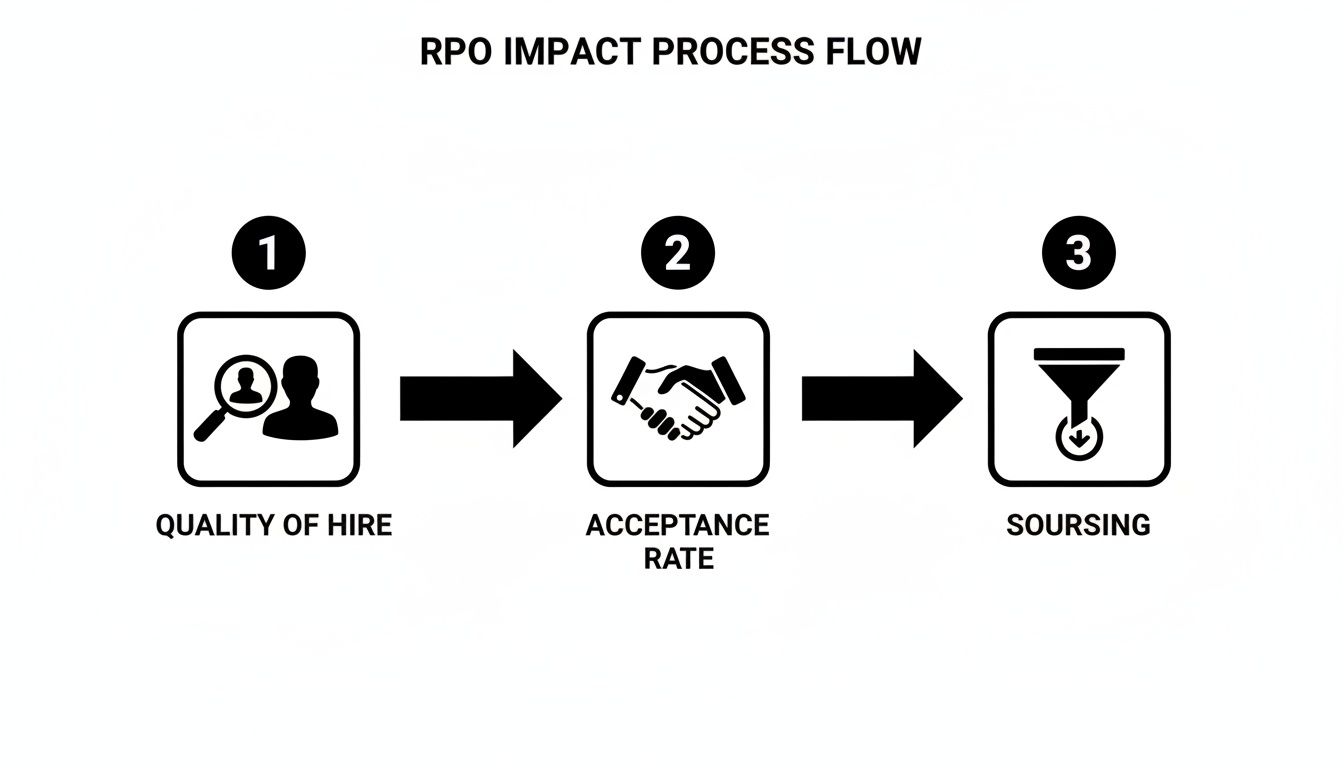
As the visual highlights, better sourcing and engagement naturally lead to higher acceptance rates and, ultimately, a better quality of hire for the organisation. Following this roadmap helps embed your RPO partner as a sustainable, high-impact part of your talent strategy. You’re not just buying a service; you’re building a lasting capability.
Burning Questions for CHROs
Stepping into the world of Recruitment Process Outsourcing (RPO) naturally brings up a few crucial questions. As a CHRO, you need straight answers to make a smart call on bringing rapid recruitment solutions in India into your strategy. Let’s tackle the most common concerns head-on.
How Quickly Can We Actually See Results?
This is the big one, isn’t it? While you’ll likely notice an improved flow of candidates within the first few weeks, the real, game-changing results take a little more time. You can expect to see metrics like a significant drop in time-to-hire and a measurable jump in quality-of-hire materialise within the first 3-6 months.
Think of the initial phase as a deep dive. It’s all about knowledge transfer, getting processes in sync, and calibrating expectations between your team and the RPO partner. A good partner will set clear baseline metrics from day one and show you steady, progressive improvements against them, so you’re never in the dark about the value they’re adding. For those urgent hiring pushes, a project-based RPO can often deliver even faster results.
Will We Lose Control Over Our Hiring Decisions?
Quite the opposite, actually. A well-executed RPO partnership sharpens your control. It pulls your internal team out of the day-to-day operational grind and frees them up to focus on what really matters: final interviews, assessing cultural fit, and strategic workforce planning.
You always have the final say on every single hire. Your RPO partner acts as a true extension of your team, managing the sourcing, screening, and scheduling based on your exact standards and cultural DNA. The trick is to pick a partner who genuinely invests the time upfront to understand your employer value proposition inside and out.
Isn’t RPO Only for Mass Hiring?
That’s a common myth. While RPO is an absolute powerhouse for volume hiring, its specialised models are incredibly effective for those tricky niche and senior-level roles. It’s far more adaptable than people think.
For those hard-to-fill positions, a selective or project-based RPO model gives you access to deep market intelligence and exclusive talent networks that your in-house team might not have. It brings the precision of an executive search firm but with better integration and cost-efficiency.
What Are the Real Compliance Risks with RPO in India?
Partnering with an RPO provider in India means navigating a specific and complex legal landscape. This isn’t something to take lightly. Your partner must have airtight expertise in Indian labour laws, data privacy rules like the Digital Personal Data Protection (DPDP) Act, and all statutory hiring compliance.
Your partnership agreement needs to spell out, in no uncertain terms, the responsibilities for data handling, background checks, and adherence to equal opportunity principles. A reputable partner will have robust, transparent processes to ensure every recruitment action is fully compliant with both central and state-level laws, shielding your organisation from legal headaches. This is a non-negotiable when choosing a firm for rapid recruitment solutions in India.
Ready to stop reacting and start building a world-class talent pipeline? Taggd delivers bespoke RPO solutions crafted for the unique demands of the Indian market. Learn more about how we can transform your talent acquisition strategy.