Let’s be blunt thinking of safety compliance as just another legal hurdle is an outdated, and frankly, dangerous view. In India’s fast-paced industrial environment, mastering safety compliance and regulatory skills has become a cornerstone of business resilience, brand reputation, and even your ability to attract and keep the best people.
It’s no longer a line item for the legal team; it’s a strategic imperative for the C-suite.
Why Safety Compliance Is Your New Strategic Imperative
For far too long, many of us in leadership have seen safety through the narrow lens of a cost centre, a necessary evil managed by a department tucked away in a corner. As a CHRO, it’s time to flip that script. A proactive safety culture isn’t an expense; it’s a high-return investment that builds trust from the ground up.
The true cost of getting it wrong is staggering. An accident isn’t just about the immediate fines or medical bills. The real damage comes from the fallout: operational shutdowns, wrecked equipment, soaring insurance premiums, and a tarnished reputation that can take years to rebuild.
On the other hand, organisations that get this right see a direct, positive impact on the bottom line. It’s simple: a safe workplace is a productive workplace. When your people feel secure and genuinely cared for, their morale and engagement climb. You’ll see absenteeism drop and retention rates improve.
This creates a powerful feedback loop. Your reputation as a safe employer becomes one of your most effective tools for attracting top-tier talent in a market that’s more competitive than ever.
The market is already reflecting this shift. In India, the workplace safety solutions market hit USD 811.5 million in 2024. But the real story is its growth, it’s projected to explode to USD 2,598.5 million by 2030, riding a massive compound annual growth rate (CAGR) of 22.1%. This isn’t just a trend; it’s a clear signal of the urgent demand for people who can navigate this new reality.
This diagram perfectly illustrates how safety evolves from a basic requirement to a source of competitive advantage.
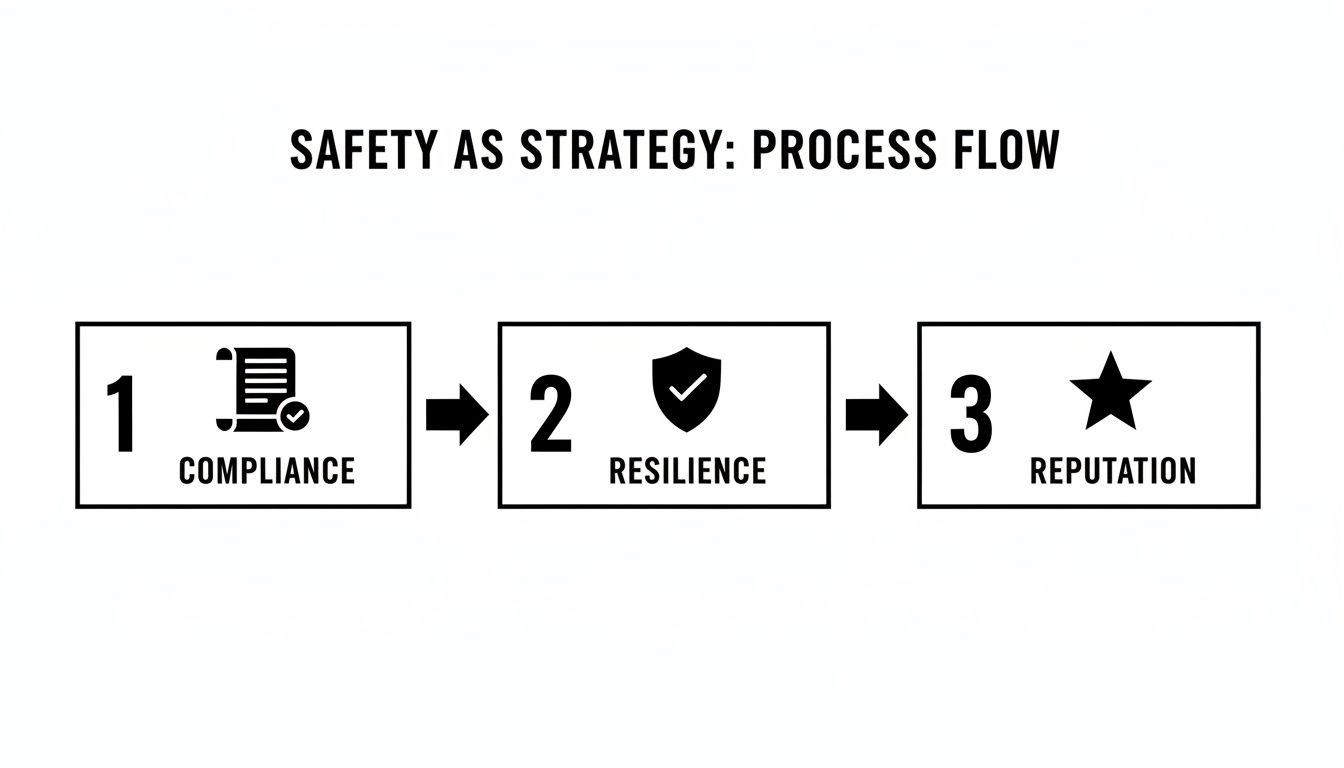
As you can see, just meeting the minimum standards is only the beginning. The real value is unlocked when safety strengthens your operational resilience and, ultimately, polishes your brand.
The Pillars of a Modern Safety Compliance Framework
To move safety from a checkbox to a core strategic function, you need a structured approach. The framework below outlines the key pillars that every modern organisation should build upon.
| Pillar | Focus Area | Key Outcome for the Business |
|---|---|---|
| Governance & Leadership | Executive sponsorship, clear policies, and defined roles. | Establishes accountability and signals commitment from the top. |
| Competency & Skills | Identifying, developing, and assessing safety skills across all levels. | Builds a capable workforce that can manage risks proactively. |
| Technology & Systems | Implementing modern tools for training, reporting, and analytics. | Improves efficiency, data accuracy, and predictive insights. |
| Culture & Engagement | Fostering psychological safety and employee participation. | Creates a vigilant, empowered organisation where everyone owns safety. |
| Measurement & Improvement | Tracking leading indicators (not just lagging) and iterating. | Drives continuous improvement and demonstrates tangible ROI. |
These pillars aren’t isolated; they work together to create a resilient system that protects both your people and your performance.
From Cost Centre to Value Driver
Making this transition requires a fundamental mindset shift, especially in the boardroom. We have to stop asking, “How much will this safety programme cost us?” and start asking, “What is the value of preventing our next major incident?”
Think about it in real terms. A manufacturing company invests in an advanced training programme for machine guarding and lockout/tagout procedures. Yes, there’s an upfront cost. But that investment prevents a single severe injury that would have triggered massive regulatory fines, a week of production halts, and a PR nightmare.
Suddenly, the return on that investment isn’t just clear, it’s enormous.
A proactive safety culture does more than prevent accidents; it builds a foundation of psychological safety where employees are empowered to speak up, innovate, and perform at their best. It’s a direct investment in your people and your performance.
Future-Proofing Your Organisation
At the end of the day, embedding strong safety compliance and regulatory skills is about future-proofing your business. The regulatory landscape is a moving target, and expectations from employees, customers, and investors are only getting higher.
By building a robust safety framework now, you’re creating a more agile and resilient organisation that can adapt to whatever comes next. It’s a clear signal to everyone that you are a responsible, forward-thinking leader in your industry.
Designing Your Safety Competency Framework
Saying “safety is our priority” is easy. Actually embedding that priority into your organisation’s DNA? That’s a whole different challenge. This is where a robust competency framework becomes your blueprint for what ‘good’ truly looks like, not just on paper, but in practice.
A well-crafted framework translates your broad safety goals into the specific, measurable behaviours you expect from your people. It’s the tool that helps you differentiate between the baseline safety awareness everyone needs and the advanced safety compliance and regulatory skills your leaders and specialists must master.
Think of it less as rewriting job descriptions and more as mapping out the precise knowledge, skills, and attitudes required to manage risk at every level. A frontline worker, for instance, needs to be brilliant at spotting and reporting hazards. A safety manager, on the other hand, must be able to dissect complex OSH regulations and influence senior leaders.
When you get this right, the framework clarifies career paths and ensures your training budget is spent where it will have the most impact. It becomes the bedrock for hiring, performance management, and succession planning.
Defining Core and Technical Competencies
The first thing to do is separate the universal skills from the specialised ones. Every single person in your organisation, from the CEO down to the newest intern, needs a foundational grasp of safety. These are your core, non-negotiable competencies.
Then, you need to pinpoint the technical competencies tied to specific roles. These are the deep, functional skills required by those who navigate the intricate world of modern safety and regulatory demands.
Here’s a practical way to break it down:
- Core Competencies (For Everyone)
- Hazard Recognition and Reporting: The ability to spot a potential danger during the workday and know exactly how to report it without any fear of reprisal.
- Emergency Response: Knowing the basics, evacuation routes, emergency procedures, and who to call when a crisis hits.
- Personal Accountability: A real, demonstrated commitment to following the safety rules and actively looking out for colleagues.
- Technical Competencies (For Specialised Roles)
- Regulatory Interpretation: The skill to not just read, but truly understand and apply dense legal texts (like the OSH Code) to your specific operations.
- Incident Investigation: The analytical mind to conduct a proper root cause analysis (RCA), digging past the immediate cause to find the systemic failures that allowed an incident to happen.
- Risk Assessment Methodologies: Proficiency with tools like Job Hazard Analysis (JHA) or Failure Mode and Effects Analysis (FMEA) to proactively get ahead of risks.
- Safety Auditing: The expertise to run thorough internal audits against established standards and regulations, leaving no stone unturned.
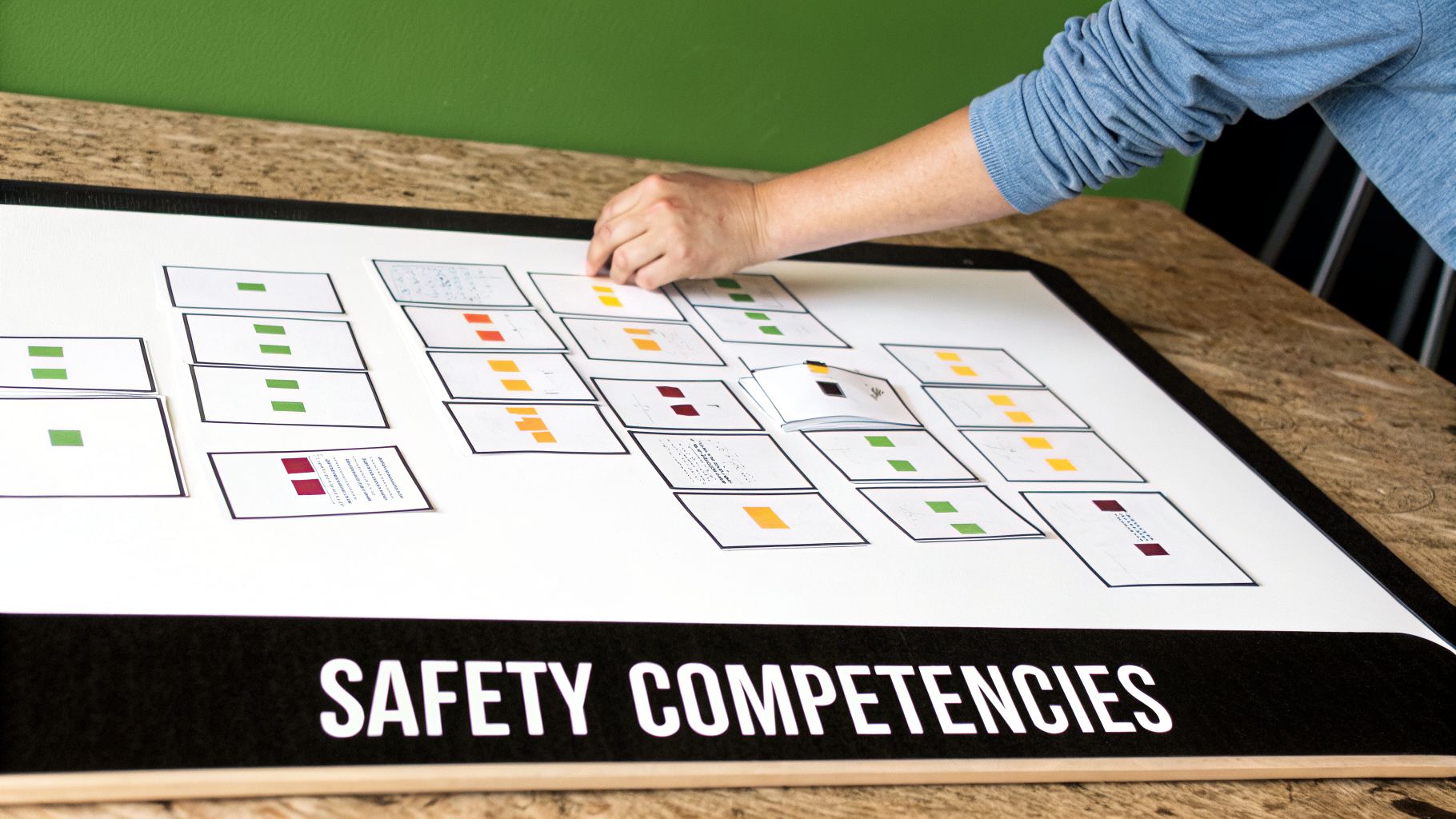
Visually organising competencies like this helps HR leaders and managers pinpoint specific strengths and development opportunities across their teams. It makes a complex concept much more tangible.
Integrating Soft Skills for Maximum Impact
Let’s be honest: technical knowledge is only half the battle. The most effective safety leaders I’ve seen are those who pair their regulatory expertise with exceptional soft skills. A brilliant safety strategy will fall flat if the person driving it can’t communicate, influence, and lead.
A safety manager who can quote regulations chapter and verse but can’t persuade a sceptical line manager to adopt a new procedure is, ultimately, ineffective. Real competence is the fusion of knowledge and influence.
Imagine this scenario: A new safety protocol will add two minutes to a task on the assembly line. The operations manager is pushing back, worried about productivity taking a hit. A technically proficient safety professional will present the data on risk reduction. But an expert safety leader does that and listens to the manager’s concerns, collaborates on a phased rollout, and frames the change as a long-term investment in operational stability. See the difference?
Key soft skills to build into your framework include:
- Influential Communication: Being able to explain the “why” behind safety rules in a way that connects with everyone, from the shop floor to the boardroom.
- Conflict Resolution: The skill to navigate disagreements over safety priorities and find practical, common-ground solutions.
- Leadership and Mentoring: Inspiring others to become safety champions and coaching junior team members to grow their own skills.
If you’re looking to formalise this structure, it’s worth exploring what goes into building a comprehensive compliance framework.
Mapping Competencies to Roles and Levels
Once you’ve defined your core, technical, and soft skills, the final piece of the puzzle is to map them across the organisation. Create a simple matrix that shows which skills are needed for which roles and what level of proficiency is expected. This creates incredible clarity for everyone.
For example, “Level 1” proficiency in risk assessment might mean participating in a team-based JHA. “Level 4” proficiency, however, would require leading complex risk assessments for major new projects.
This tiered approach turns your framework from a static document into a dynamic tool for career growth. It shows employees exactly what they need to learn to get to the next level, which is a powerful motivator for building deep safety compliance and regulatory skills throughout your entire workforce.
Here is the rewritten section, adopting a human-written, expert tone and following all the specified formatting and style requirements.
Winning the Hunt for Regulatory Talent
In a market where real safety expertise is both rare and in high demand, just posting a generic job advert and hoping for the best is a strategy that’s doomed to fail. If you want to attract top-tier professionals with proven safety compliance and regulatory skills, your entire recruitment approach needs to be as deliberate and sharp as your safety policies.
The stakes couldn’t be higher. India’s industrial boom has sadly outstripped its safety infrastructure, creating a genuine crisis. Between 2019 and 2025, a staggering 2.3 lakh workplace accidents were reported, resulting in over 22,000 preventable deaths. These numbers, as detailed in this in-depth analysis of workplace safety gaps, point to a systemic problem driven by lax enforcement and a severe shortage of OSH professionals.
This means you’re not just trying to fill a vacancy. You’re recruiting a guardian for your organisation’s future.
Crafting Job Descriptions That Attract Experts
Think of your job description as your first, and most critical, sales pitch. Vague lines about “ensuring a safe workplace” will only bring in generic applicants. To truly cut through the noise, you need to get specific and show that you know what genuine expertise looks like.
Forget about listing vague duties; spell out the real-world challenges the right candidate will get to solve.
- Mention Specific Regulations: Don’t just say “knowledge of regulations.” Explicitly state the need for experience with new labour codes like the Occupational Safety, Health and Working Conditions (OSH) Code, 2020. This immediately filters for candidates who are up to date.
- Use Action-Oriented Language: Swap out passive phrases like “responsible for” with dynamic verbs. Instead of “Responsible for safety audits,” try “Lead internal and external safety audits, developing corrective action plans to guarantee full compliance with IS 14489 standards.”
- Showcase the Impact: Connect the role directly to what matters for the business. Explain how their work will directly influence operational efficiency, boost employee morale, and protect the company’s reputation.
This kind of detail signals to serious professionals that you are a serious employer.
Your job description shouldn’t just be a list of tasks; it should tell a story. It needs to paint a picture of a challenging, high-impact role where a true safety expert can make a visible difference.
Probing Beyond Theory in Interviews
Once you’ve got a shortlist, the interview is where you separate the theorists from the practitioners. A CV can list certifications, but it can’t show you someone’s judgement or leadership when the pressure is on. Your questions have to be designed to dig into their practical, problem-solving skills.
Go deeper than the standard, “Tell me about a time you handled a safety issue.” Get more specific.
Scenario-Based Questions to Ask:
- “Imagine a senior production manager is pushing back on a new lockout/tagout procedure because it slows down equipment changeovers. How would you approach this to get their buy-in while still upholding the safety standard?”
- “You’ve just wrapped up a root cause analysis for a near-miss incident. The findings point to a systemic failure in our training process, not just one person’s mistake. Walk me through the first three steps you’d take to present this to leadership and propose a solution.”
- “The new OSH Code introduces the role of an ‘Inspector-cum-Facilitator.’ How does this shift in perspective change how you would prepare for and manage a regulatory inspection compared to the old model?”
These questions force candidates to draw from real experience. They reveal not just what they know, but how they think, influence, and communicate.
Unconventional Sourcing for a Competitive Edge
Let’s be honest: the best candidates are often passive. They aren’t actively scrolling through job portals. You have to go out and find them. Waiting for applications to land in your inbox is a passive strategy that will only give you passive results.
Think about these proactive sourcing channels:
- Build Relationships with Professional Bodies: Get involved with organisations like the National Safety Council (NSC) or other regional safety professional groups. Attend their meetings, sponsor an event, or offer to have one of your leaders speak on a panel. Be visible where the experts are.
- Partner with Educational Institutions: Connect with universities and technical institutes that run specialised programmes in Environmental, Health, and Safety (EHS). This isn’t just for immediate hires; it’s about building a long-term pipeline of fresh, knowledgeable talent.
- Leverage Niche Recruiters: Work with recruitment firms that live and breathe EHS and regulatory roles. They have established networks and can often introduce you to high-calibre candidates who aren’t even on the open market.
By expanding your search beyond the usual methods, you dramatically increase your odds of finding and hiring the kind of regulatory talent that becomes a genuine asset to your organisation.
Cultivating Safety Skills Across Your Organisation
Hiring top-tier regulatory talent is a fantastic start, but it’s really just the first square on the board. The real, challenging work starts when you begin weaving these crucial safety skills into the very fabric of your company culture. Let’s be honest, one-off training sessions and yearly compliance refreshers just don’t cut it anymore. They might create a temporary blip of awareness, but they don’t build lasting capability.
To build a genuinely resilient organisation, you have to move from event-based training to creating continuous learning pathways. This means building a system where picking up and sharpening safety compliance and regulatory skills is an ongoing, natural part of the job, not some separate chore. It’s all about making safety knowledge easy to find, practical, and directly relevant to everyone’s role.
Moving Beyond One-Off Training Days
The old model of herding everyone into a conference room for the annual safety PowerPoint is dead. People simply forget most of what they’re told within days. A modern approach is far more dynamic, engaging, and, most importantly, continuous.
Think about using a mix of learning methods to keep those skills sharp and top-of-mind:
- Micro-learning Modules: Short, snappy digital lessons (think 5-10 minutes) that employees can pull up on their phones or computers. These are perfect for quick refreshers on specific topics like Personal Protective Equipment (PPE) use or new hazard reporting procedures.
- Immersive Simulations: Why not use virtual or augmented reality to create realistic, hands-on practice for high-risk tasks? This lets workers experience and learn from potential dangers in a completely safe, controlled setting.
- Mentorship Programmes: Pair your seasoned safety veterans with up-and-coming talent. This kind of knowledge transfer is invaluable, passing on not just the technical how-tos but the nuanced judgement that only comes from years of experience.
This blended approach makes sure learning isn’t just about passively receiving information; it becomes an active, engaging process. To dive deeper, you can learn about the power of continuous learning in the workplace and how to put it into action.
Tailoring Training for Every Level
A one-size-fits-all approach to safety training is a surefire way to get a room full of disengaged employees. The safety information your board members need is worlds away from what a frontline machine operator requires day-to-day. For training to stick, it must be tailored to the specific roles and responsibilities of your people.
For example, your training plan could be broken down like this:
| Audience | Training Focus | Example Activity |
|---|---|---|
| Executive Leadership | Safety governance, strategic risk, and brand reputation. | A workshop on linking safety performance metrics to overall business goals. |
| Mid-Level Managers | Leading safety culture, incident investigation, and coaching teams. | A practical training session on conducting effective root cause analysis. |
| Frontline Workers | Hazard identification, emergency procedures, and safe work practices. | Hands-on drills for specific tasks, like lockout/tagout procedures. |
| Safety Specialists | Advanced regulatory interpretation and safety auditing techniques. | A deep-dive seminar on the nuances of new legal standards. |
This tiered structure ensures every single person gets relevant, actionable information they can use straight away. It reinforces their unique part in the company’s overall safety ecosystem.
Adapting to New Regulatory Realities
The regulatory world never stands still, and your training has to keep pace in real-time. A perfect example is the nationwide rollout of India’s four consolidated Labour Codes on November 21, 2025. This was a huge moment, consolidating 29 old laws into a single framework that dramatically raised the bar for occupational safety expertise. As you can discover more about India’s new labour codes, the now fully effective OSH Code, 2020, brought in major changes like mandatory health check-ups and new safety committee rules.
A key shift is the introduction of the ‘Inspector-cum-Facilitator’ role. This moves regulatory interactions away from a purely punitive model towards a more collaborative one focused on guidance and improvement.
This isn’t just a minor tweak; it demands a profound shift in mindset and skills. Your training must now equip managers and safety leaders to work with inspectors as partners in a continuous improvement journey. This means building stronger communication, problem-solving, and negotiation skills. It’s about transforming compliance from a defensive chore into a proactive, collaborative tool for building a safer and more productive workplace.
If you really want the C-suite to sit up, take notice, and invest properly in safety, you have to speak their language. That language is data, ROI, and undeniable strategic value. Demonstrating the worth of your investment in safety compliance and regulatory skills is about so much more than just tracking incident rates. It’s about building a compelling narrative with numbers that proves a safe workplace is a profitable one.
The old way of thinking about safety metrics was almost entirely reactive. It focused on lagging indicators—things like the number of on-site incidents or the soaring cost of workers’ compensation claims. While you need to know this information to understand past failures, it does nothing to help you predict what’s coming next. It’s like driving by only looking in the rearview mirror.
A modern, data-driven approach is much smarter. It balances these backward-looking metrics with powerful leading indicators. These are the proactive, forward-looking numbers that truly measure the health of your safety culture and processes. They’re the early warning system that tells you if your efforts are paying off, giving you the chance to make changes before something goes wrong.

Shifting Focus to Predictive Metrics
To build a genuinely preventative safety culture, your attention has to shift. You need to start measuring the positive, proactive steps your people are taking every day. These are the metrics that reveal the true strength of your safety systems and how engaged your employees actually are.
Consider putting these powerful leading indicators at the centre of your reporting:
- Near-Miss Reporting Rates: A high number of near-miss reports isn’t a red flag for a dangerous workplace. Quite the opposite, it’s the sign of a healthy, transparent culture where people feel psychologically safe to flag potential issues without fear of blame. This data is pure gold for preventing future incidents.
- Safety Audit and Inspection Scores: When you conduct regular, rigorous audits against clear standards, you get a tangible score. Tracking how these scores improve over time is a direct measure of your progress in closing critical compliance gaps.
- Percentage of Safety Training Completed on Time: This simple metric speaks volumes. It tells you exactly how seriously the organisation is taking its commitment to building safety skills. A 95% on-time completion rate sends a very different message to the board than a 60% rate.
- Corrective Actions Closed on Time: Identifying a hazard is one thing; fixing it is another. This KPI measures your organisation’s agility and commitment to resolving known risks before they can cause harm.
These numbers give you tangible proof that your strategy is working. They help you show that the investment in training and new systems is leading to real, concrete improvements in how people behave and follow safety processes.
Building Your Safety KPI Dashboard
To tell this story effectively to your leadership team, you need to present the data in a way that’s clear, concise, and compelling. A balanced KPI dashboard is the perfect tool for the job, offering a holistic view of performance by blending both leading and lagging indicators.
This shouldn’t be a dusty, static report. Think of it as a living document that gets reviewed regularly, sparking discussion and driving decisions at the highest levels.
Your KPI dashboard is the bridge between the day-to-day reality of your safety programmes and the strategic priorities of the boardroom. It translates your efforts into the language of risk management and business performance.
A good dashboard gives a balanced view. Here’s a sample structure you can adapt for your organisation, showing how to blend different types of metrics for a complete picture.
Sample Safety Compliance KPI Dashboard
A balanced set of leading and lagging indicators to measure the effectiveness of your safety program.
| Metric Category | Key Performance Indicator (KPI) | Measurement Frequency | Target Example |
|---|---|---|---|
| Culture & Engagement | Near-Miss Reports Submitted | Monthly | >20 reports/month |
| Culture & Engagement | Employee Safety Perception Survey Score | Quarterly | >85% Favourable |
| Compliance & Process | % of Corrective Actions Closed on Time | Monthly | 95% within 30 days |
| Compliance & Process | Average Safety Audit Score (out of 100) | Quarterly | >90 |
| Outcomes (Lagging) | Total Recordable Incident Rate (TRIR) | Monthly | <1.0 |
| Outcomes (Lagging) | Lost Time Injury Frequency Rate (LTIFR) | Monthly | <0.5 |
By presenting your data this way, you make the connection between proactive effort and positive outcomes impossible to ignore. It becomes a powerful tool for storytelling and securing investment.
Communicating the Strategic Value
With this data dashboard in hand, you can walk into any leadership meeting with confidence and completely change the conversation. You’re no longer just talking about safety as a cost centre.
You can now show a clear, undeniable correlation: as our near-miss reporting and audit scores go up, our incident rates and their associated costs go down.
For instance, you can point to the data and say, “Our 15% increase in the timely closure of corrective actions last quarter directly prevented two potential high-risk incidents. Based on our models, that saved the business an estimated ₹50 lakhs in potential fines and operational downtime.”
This is how you prove the tangible ROI of safety. You’re no longer just asking for a budget for a “nice-to-have.” You’re presenting a data-backed business case for an investment that protects your people, safeguards the brand, and delivers measurable value straight to the bottom line. It proves, without a shadow of a doubt, that strong safety compliance and regulatory skills are a direct driver of business success.
Building a Lasting Culture of Safety
Creating a genuine culture of safety isn’t about ticking boxes or launching a new initiative. It’s a long-term commitment that has to become a core part of your company’s DNA. This process fundamentally shifts the CHRO’s role from a compliance officer to a strategic partner who actively protects people and, in doing so, drives real business value.
The ultimate aim is to weave safety so deeply into your organisation’s fabric that it’s no longer just a policy—it’s a shared value. This means moving far beyond simple checklists. It’s about creating a resilient and reputable workplace where every single employee feels a personal sense of ownership over keeping themselves and their colleagues safe.
From Strategy to Shared Value
All the strategies we’ve discussed from designing competency frameworks to tracking leading indicators—are the tools in your arsenal. They give you a practical roadmap for assessing, recruiting for, developing, and measuring the safety compliance and regulatory skills your organisation needs to thrive.
Think of it like building a muscle. You can’t go to the gym once and expect results. It takes consistent training, clear feedback, and strong leadership to develop the collective strength needed to manage risks before they become incidents.
As a CHRO, your legacy isn’t just in the policies you write, but in the culture you build. A culture where every person goes home safe, every single day, is the truest measure of success.
This vision is what transforms safety from a top-down mandate into a bottom-up reality. It’s the point where your people, equipped with the right skills and feeling psychologically safe become the true guardians of your workplace. They ensure safety is something that is lived, not just documented.
Of course. Here is the rewritten section, crafted to sound like a human expert and match the provided style guide.
Common Questions from CHROs on Safety Strategy
As a CHRO, rolling out a modern safety strategy brings up a lot of practical questions. You need clear, straightforward answers to guide your organisation. Let’s tackle some of the most common hurdles you’re likely to face when embedding safety compliance and regulatory skills.
How Do I Secure the Budget for a Proactive Safety Programme?
Getting budget approval nearly always comes down to speaking the language of the C-suite: ROI. You have to stop framing safety as a cost centre and present it as a strategic investment with a tangible financial upside.
Instead of just saying, “We need funds for new training,” build a compelling business case. Show them exactly how an investment of ₹X in advanced training simulations can prevent a single serious incident, which might cost the company ₹10X in fines, lost production, and brand damage. Pull the data from your KPI dashboard—use your leading and lagging indicators to draw a direct line between proactive spending and the reduction of costly accidents.
Our Line Managers Think Safety is HR’s Job. How Do I Get Their Buy-in?
This is a classic and critical challenge. The only way to win is to shift their perspective. They need to stop seeing safety as another box to tick and start seeing it as a powerful tool for better operational management.
Begin by bringing them into the tent. Ask for their direct input when you’re developing new safety procedures or conducting risk assessments for their specific teams. Then, connect the dots for them. Show them the hard data proving how a strong safety record in their department directly correlates with lower absenteeism, higher team morale, and better overall performance.
When a manager finally realises that championing safety actually makes their own job easier and their team more effective, their mindset flips from compliance to true ownership. This is the turning point every world-class safety culture is built on.
What’s the First Step in Using Technology for Safety?
Don’t try to boil the ocean. If you attempt to implement a massive, all-encompassing system at once, you’re setting yourself up for failure. The key is to start with a single, high-impact area.
A great first move is often rolling out a mobile-friendly incident and near-miss reporting system. It solves a huge pain point for everyone by making it incredibly easy for any employee to report a hazard the moment they see it on their phone.
This delivers a quick, visible win, gives you invaluable real-time data, and shows your workforce you’re serious about listening. Once that’s established and people are using it, you can build from there, expanding into digital training modules or more advanced analytics.
Ready to build a world-class team with unmatched safety expertise? Taggd specialises in recruiting top-tier professionals with the precise regulatory skills your organisation needs to thrive. Partner with us to find the leaders who will drive your safety culture forward.