At its core, a sales hiring solution is a specialised strategy for finding, attracting, and locking down top-performing sales talent. These aren’t just your standard recruitment services; they go much deeper, using data-driven processes, deep industry knowledge, and advanced tech to build teams that actually drive revenue. For a CHRO, this is a powerful lever for business growth.
Transforming Sales Recruitment From a Cost Centre to a Growth Engine
Imagine trying to win a Grand Prix with a standard family car. It gets you from A to B, but it just doesn’t have the specialised engineering to compete at a high-performance level. It’s a similar story with many internal HR teams. They’re fantastic at general recruitment, but they often aren’t equipped for the high-stakes, fast-paced race for elite sales talent.

When traditional methods fall short, you end up with long hiring cycles and costly mis-hires that hit the bottom line hard.
This is where modern sales hiring solutions come in. Think of them as your dedicated pit crew and engineering team, all rolled into one. They bring a razor-sharp focus that treats sales recruitment not as an administrative task, but as a critical driver of revenue. For CHROs looking to tie their talent strategy directly to business goals, this shift in perspective is everything.
The Strategic Partnership Model
This isn’t about a simple vendor relationship. Advanced solutions like Recruitment Process Outsourcing (RPO) operate as a true extension of your own team. They get under the skin of your company culture, your sales methodology, and your growth targets. This deep integration allows them to move with the speed and market intelligence needed to beat the competition in the war for talent.
The most successful firms aren’t just filling jobs; they’re solving workforce problems. By viewing recruitment through a strategic lens, you move from being a vendor to becoming an indispensable workforce partner.
This partnership approach offers some clear advantages:
- Deep Market Insight: Specialised recruiters live and breathe the sales talent landscape. They know the compensation benchmarks, what competitors are up to, and where the real talent is hiding.
- Access to Passive Talent: The best salespeople often aren’t actively job hunting. These partners have networks of high-performers who are open to the right opportunity if it comes knocking.
- Scalability: Need to build a whole team for a new product launch? Or find one crucial sales leader? These solutions can scale up or down to match your exact needs, instantly.
Ultimately, embracing these approaches reframes the entire process. You can learn more about these powerful approaches in our guide to modern recruitment methods. By tapping into specialised expertise, you build a consistent, predictable pipeline of top-tier sales candidates. Your hiring function transforms into a powerful engine for sustained business growth and market leadership, ensuring every new hire is a direct contributor to your most ambitious revenue goals.
When It’s Time to Bring in a Specialist Sales Hiring Partner
Deciding to move from an in-house hiring model to a specialist partner is a massive strategic call for any CHRO. But let’s be clear: it’s not a sign of failure. It’s a mark of ambition. Think of it like a business health check; certain symptoms pop up that tell you the current approach just can’t keep up with your growth plans.
Catching these signs early stops small hiring hiccups from turning into major roadblocks that stall your revenue. When your internal team is stretched to its limits, the first casualties are always the speed and quality of hires—and that hits your sales pipeline and bottom line directly.
Telltale Signs You Need a Change
Several business scenarios are clear red flags that it’s time to look at dedicated sales hiring solutions. These aren’t just minor annoyances; they’re persistent problems showing a real gap between your talent strategy and your business goals. If you find yourself nodding along to any of these, it’s a strong signal your company is ready for a new approach.
You might be grappling with one or more of these common pain points:
- You’re Constantly Missing Hiring Deadlines: Your time-to-fill for crucial sales roles is creeping up. Every empty seat is a lost revenue opportunity, and long vacancies can burn out the rest of the team who have to pick up the slack.
- Your Sales Team is a Revolving Door: Are you constantly backfilling the same positions? This “leaky bucket” problem often points to deeper issues with candidate screening and cultural fit—exactly the kind of puzzle a specialist partner is built to solve by focusing on long-term retention.
- You’re Expanding—Fast: Whether you’re launching a new product or breaking into a new region, you need a skilled sales team on the ground, fast. Your internal HR might not have the bandwidth or the specific market knowledge to make that happen at the speed you need.
- You Need a Very Specific Skill Set: The hunt for salespeople with niche expertise—think enterprise SaaS, MedTech, or renewable energy—is incredibly competitive. Generalist internal recruiters often find it tough to source and properly vet candidates with these highly specialised backgrounds.
If these situations feel a bit too familiar, it might be time to ask if you’ve outgrown your current setup. You can explore more of these warning signs in our detailed guide on knowing when you’ve outgrown in-house hiring.
Why Today’s Talent Market Demands a Specialist
The recruitment world is buzzing with activity. A massive 500,000 new jobs are expected to open up across key sectors, reflecting a 19% jump in hiring intent. This surge is particularly intense for sales roles in booming industries like manufacturing, which is leading the pack with a 25% increase in hiring plans, thanks to industrial growth and new policies.
This fierce competition for top talent makes it nearly impossible for a generalist HR team to keep pace. Specialised partners, on the other hand, are in their element here. They have the dedicated resources, established networks, and market intelligence to cut through the noise and find the right people.
An RPO partner isn’t just filling a role; they’re solving a strategic business problem. They draw a straight line from your revenue goals to your talent strategy, making sure every hire is a smart investment in your company’s growth.
In-House vs Outsourced Sales Hiring: A Strategic Comparison
For CHROs at a crossroads, seeing the differences side-by-side can be incredibly clarifying. It’s not just about cost; it’s about speed, quality, and strategic alignment. This table breaks down what you can expect from each approach.
| Metric | In-House Recruitment | Outsourced Sales Hiring Solution (RPO) |
|---|---|---|
| Time-to-Fill | Often longer due to limited bandwidth and competing priorities. | Significantly shorter, with access to pre-vetted talent pools. |
| Quality of Hire | Can be inconsistent; depends on the recruiter’s sales expertise. | Higher, with specialist recruiters who understand sales nuances. |
| Access to Talent | Limited to the team’s network and standard job boards. | Broad access to passive candidates and niche talent networks. |
| Scalability | Difficult to scale up or down quickly for major projects. | Highly flexible; can scale resources to meet aggressive hiring goals. |
| Cost Per Hire | Appears lower upfront, but hidden costs (vacancy, turnover) add up. | More predictable costs; often lower total cost due to efficiency. |
| Strategic Focus | Team is often reactive, focused on filling immediate openings. | Proactive and strategic, aligning hiring with long-term business goals. |
Ultimately, the choice depends on your organisation’s maturity and growth ambitions. While in-house teams are invaluable, an RPO partner brings a level of focus and market expertise that’s hard to replicate internally, especially when the stakes are high.
By spotting the symptoms early—whether it’s slow hiring, high turnover, or the need for unique skills—you can get the right solution in place. A dedicated RPO partner can slash your hiring time, elevate the quality of your candidates, and build a more resilient and high-performing sales engine. This proactive move turns recruitment from a reactive chore into a powerful strategic advantage for your business.
A Roadmap for Implementing a Sales RPO Solution
Bringing a Recruitment Process Outsourcing (RPO) partner into the fold isn’t about just handing over the keys to hiring. Think of it as a strategic alliance, a partnership built on shared goals and deep-seated collaboration. To make it work, you need a structured plan.
This roadmap breaks that journey down into four distinct phases. It’s a repeatable framework you can use to turn a new vendor relationship into a powerful, high-performance hiring engine that’s set up for success from day one.
Phase 1: Defining the Win
Before a single call is made, you have to define what a successful partnership actually looks like. Vague goals like “better hiring” simply won’t cut it. This first phase is all about locking in the concrete, measurable key performance indicators (KPIs) that will steer the entire engagement and, more importantly, prove its value to the C-suite.
Your RPO partner needs a clear target to aim for. Sit down with them and set benchmarks that are ambitious but achievable.
- Reduce Time-to-Hire: Aim for a specific, meaningful reduction. For instance, cutting the average time-to-fill for an Account Executive role from 60 days down to 40 days.
- Increase Quota Attainment: Target a measurable lift in the performance of new hires. A great goal is increasing the percentage of reps who hit their first-year sales quota from 65% to 80%.
- Lower Cost-Per-Hire: Set a clear financial target, like reducing the total cost to acquire a new sales team member by 15% within the first year.
- Improve Candidate Quality: Track metrics that prove you’re seeing better talent. A key one is the interview-to-offer ratio; improving it shows that a higher percentage of presented candidates are worth hiring.
Phase 2: The Strategic Kick-Off
With clear goals in place, the next phase is a deep-dive immersion. Your new RPO partner needs to get under the skin of your organisation—they need to understand not just what your company does, but who you are. This is where they learn about your culture, your unique sales methodology, and those intangible traits that make your top performers tick. A shallow understanding here is a recipe for poor candidate fit down the line.
This kick-off should be a series of in-depth meetings with your key stakeholders.
A great RPO partner doesn’t just learn your job descriptions; they learn your company’s DNA. They need to understand the stories, the wins, and the challenges to find people who will truly belong and succeed.
Get them time with sales leadership, your absolute best sales reps, and the HR business partners who support them. This is how the RPO team builds a rich, three-dimensional picture of the ideal candidate profile, going far beyond what’s written on a piece of paper.
This is often the point where companies realise they need a partner in the first place. The triggers are usually the same: high turnover leads to slow hiring, which directly results in missed revenue.
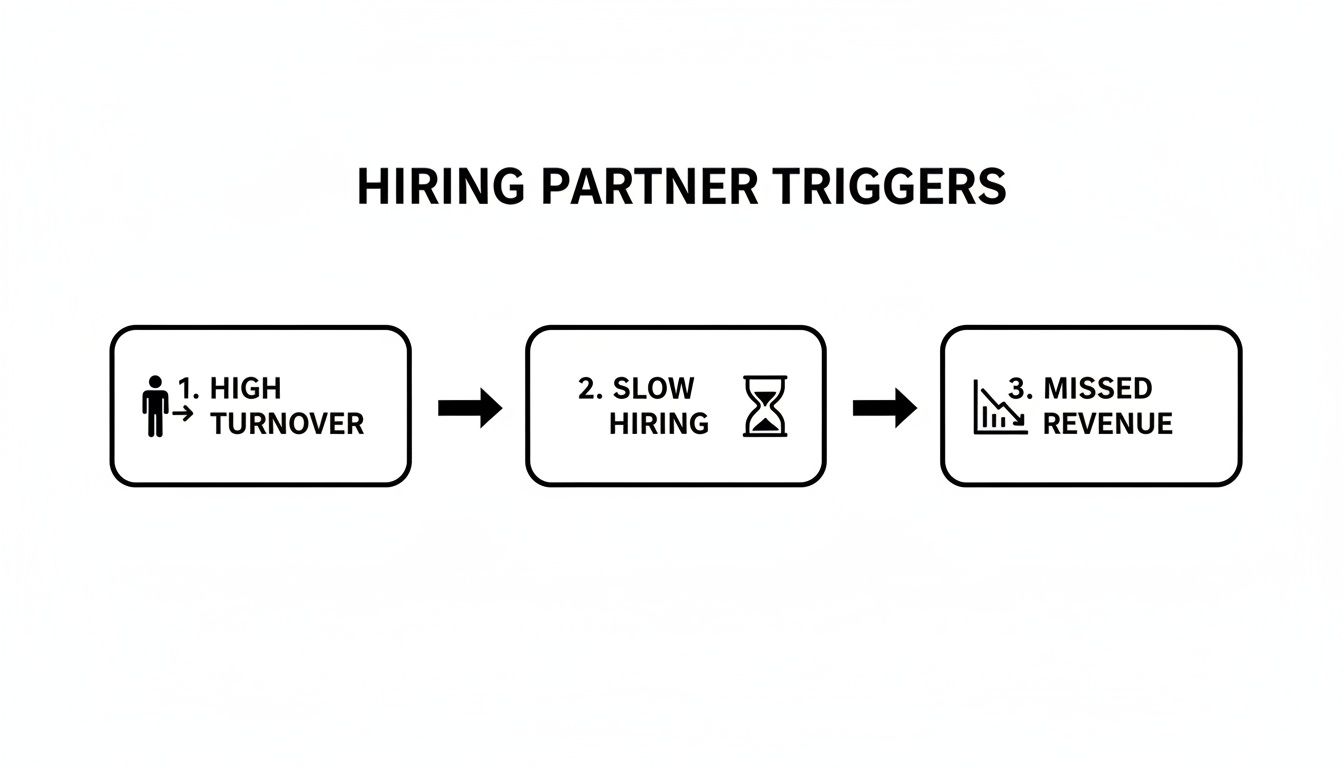
As you can see, these operational challenges in hiring create a straight line to negative financial impact, which makes the case for a strategic solution crystal clear.
Phase 3: Seamless Technology Integration
In any modern RPO partnership, efficiency lives and dies by its technology. This phase is all about making sure your partner’s systems and your existing HR tech stack talk to each other perfectly. A clunky, disconnected setup creates friction, slows everything down, and frustrates candidates and hiring managers alike.
The goal here is a seamless flow of data. The RPO provider’s Applicant Tracking System (ATS) must integrate cleanly with your Human Resource Information System (HRIS). This creates a single source of truth for all recruitment activity, ensuring candidate information, interview feedback, and hiring data are centralised and always accessible. For CHROs wanting to get into the nuts and bolts, exploring a detailed Project RPO timeline and delivery model can shed light on how these complex integrations are managed.
Phase 4: Continuous Performance Optimisation
The launch isn’t the finish line; it’s the starting pistol. The final—and ongoing—phase is all about using data and feedback to constantly fine-tune the hiring process. The best sales hiring solutions are never static; they evolve right alongside your business. This requires a solid commitment to regular communication and a data-first approach to performance.
Set up weekly check-ins and more formal monthly or quarterly business reviews to track progress against the KPIs you established back in Phase 1. Use that time to double down on what’s working, pinpoint bottlenecks, and adjust your strategy. This constant cycle of review and refinement is what ensures the partnership doesn’t just meet the initial goals but delivers compounding value over time, ultimately transforming your sales hiring function into a true competitive advantage.
Why Skill-Based Hiring Is Key to Sales Success
The old playbook for hiring salespeople is officially broken. For years, we’ve relied on résumés stacked with years of experience, but in today’s market, that’s no longer a reliable predictor of success. What truly matters isn’t tenure, but a specific and measurable skill set. The best sales teams are being built by focusing on what candidates can do, not just where they’ve been.
This marks a massive shift in recruitment strategy. Proficiency with modern tools like CRM platforms, data analysis software, and AI-powered sales assistants isn’t just a nice-to-have anymore; it’s a fundamental requirement for driving revenue. Frankly, a candidate with two years of solid experience who has mastered these technologies is often far more valuable than a ten-year veteran clinging to outdated methods.
For CHROs, this isn’t just a trend—it’s the new foundation for building a sales force that can win today and adapt for whatever comes next.
Moving Beyond General Sales Acumen
Every industry speaks its own language, and a one-size-fits-all approach to sales hiring just doesn’t cut it. Imagine you’re hiring for a company in the renewable energy sector. Your salespeople need more than just a firm handshake and good closing skills. They need to navigate complex government policies, intricate financing models, and the nitty-gritty technical details of your products.
It’s this deep, contextual knowledge that builds trust and closes deals. In this scenario, a candidate’s proven expertise in the energy sector is a much better indicator of future success than a long history selling something completely unrelated. This is exactly where specialised sales hiring solutions prove their value.
A skill-based hiring model takes the guesswork out of recruitment. When you focus on verifiable competencies, you build a team that can execute your sales strategy with precision from day one.
How Specialised Partners Validate Skills
This is where expert RPO partners really make a difference. They don’t just glance at a CV; they build an entire talent pipeline around the specific competencies your business needs to win. Using sophisticated assessment tools, real-world simulations, and structured technical interviews, they go deep to validate that a candidate’s skills are real.
This rigorous process has a huge impact on new hire ramp-up time. Instead of spending months getting new team members up to speed on the basics of your industry or tech stack, you onboard professionals who are ready to contribute to revenue goals almost immediately.
This isn’t just theory. Here’s what it looks like in practice:
- Technical Proficiency Assessments: Testing a candidate’s fluency with essential tools like Salesforce, HubSpot, or specific sales analytics platforms.
- Role-Playing Scenarios: Simulating challenging client interactions to see how they think on their feet and solve real problems.
- Case Study Presentations: Asking candidates to develop a sales plan for a target account to assess their market knowledge and strategic planning.
By the time a candidate reaches your final interview stage, you know they’ve already been vetted for the core skills needed to excel.
The entire recruitment landscape is shifting in this direction. In fact, a whopping 60% of recruiters are now prioritising candidates skilled in technology, data science, and sales analytics. This comes at a time when hiring intent is up 19% overall, with sectors like renewable energy (20% growth) and healthcare (18%) aggressively building out their teams. You can explore more of India’s evolving hiring trends at India Briefing.
By putting skills front and centre, you’re building a more agile, knowledgeable, and effective sales organisation. It’s a strategic pivot that ensures your team isn’t just meeting today’s targets, but is fully equipped to tackle tomorrow’s challenges.
A CHRO’s Checklist for Evaluating Sales Hiring Partners
Picking the right Recruitment Process Outsourcing (RPO) partner is one of the most critical calls a Chief Human Resources Officer can make. Let’s be clear: this isn’t just another vendor selection. It’s a strategic alliance that plugs directly into your company’s revenue engine.
A thorough, thoughtful evaluation is the only way to tell a true partner from a simple service provider. To help you navigate this decision, we’ve built a checklist around four core pillars. Each one is packed with the kind of strategic questions that cut through the sales pitch and get to the heart of a partner’s real capabilities, cultural fit, and long-term value.
Proven Industry Expertise
A generalist recruiter simply can’t compete with the precision of a specialist who lives and breathes your industry. Deep vertical knowledge isn’t a nice-to-have; it’s non-negotiable. It directly impacts the quality of your hires and how quickly you can get them on board.
Your partner has to get the unique challenges, the compensation benchmarks, and the competitive chess moves happening in your sector.
Use these prompts to really test their expertise:
- Track Record: “Show me case studies of successful sales team builds in our specific space, like enterprise SaaS or MedTech.”
- Market Insight: “How are you staying ahead of talent trends, competitor hiring plays, and salary benchmarks in our market?”
- Niche Networks: “Tell me about your network of passive candidates for those hard-to-fill, specialised roles. How do you actually engage talent that isn’t looking for a job?”
Technological and Analytical Edge
Modern recruitment runs on data. The right partner uses a sophisticated tech stack not just to be efficient, but to pull out actionable insights that make the entire hiring process smarter over time. They need to show you exactly how their tools and analytics sharpen candidate sourcing, improve assessments, and lead to better decisions.
Dig into their tech capabilities with these questions:
- Sourcing Tools: “What sourcing tech are you using beyond the usual platforms like LinkedIn to find top-tier talent?”
- Assessment Methods: “How do you scientifically assess a candidate’s skills and potential? Can we see your assessment frameworks?”
- Data Reporting: “What are the key metrics you track? What do your client dashboards look like, and what’s your reporting rhythm?”
This is especially vital in high-growth industries. For instance, while general sales hiring in IT and tech is pegged for 15-20% growth, specialised roles in AI, machine learning, and cloud are seeing a massive 30-35% surge in demand. A partner without the right analytical tools is going to get left behind. You can find more data on this trend in the foundit Insights Tracker.
Cultural Alignment and Partnership Model
Even the most technically skilled partner will fall flat if they don’t click with your company’s culture and way of working. This has to be a partnership, not a transaction. You need a team that feels like an extension of your own—one that genuinely understands and champions your employer brand out in the market.
The best RPO partnerships are built on a foundation of shared values and transparent communication. A partner who deeply understands your culture becomes a powerful ambassador for your brand, attracting candidates who will not just perform, but thrive.
Assess the cultural fit by asking:
- Immersion Process: “What’s your process for getting under the skin of a new client’s culture, values, and the intangible traits of their top performers?”
- Collaboration Style: “How do you set up communication and feedback loops with our hiring managers to make sure the experience is seamless?”
- Flexibility: “Tell me about a time you had to pivot from your standard process to meet a client’s unique needs or an unexpected curveball.”
Scalability and Agility
Your hiring needs will change. That’s a given. You might need to ramp up fast for a big product launch or dial back during a market downturn. A truly valuable partner has the agility to flex with these changes without any drop in quality.
Evaluate their ability to adapt:
- Scaling Up: “What’s your capacity to handle a sudden hiring surge? What resources can you deploy at a moment’s notice?”
- Project-Based Needs: “How do you handle smaller, project-based needs for just a few critical, hard-to-fill roles versus a high-volume recruitment drive?”
- Future-Proofing: “How does your model support our bigger picture—our long-term talent strategy, including internal mobility and succession planning?”
Measuring the True ROI of Your Hiring Solution
At the end of the day, any big investment has to prove its worth. For CHROs, showing the real business impact of a sales hiring solution is how you get the C-suite on board and demonstrate the power of a modern talent strategy. It’s about moving past the basic numbers to paint a full picture that includes hard financial wins and the softer, but equally important, cultural improvements.
Think of it like this: you don’t judge a high-performance engine just on its horsepower. You look at its fuel efficiency, its reliability, and how many races it helps win. It’s the same with a hiring partner. The real return on your investment goes way beyond just filling empty seats; it’s about boosting the overall health and performance of your entire sales organisation.

This approach gives you the language and the data to show leadership exactly how a world-class hiring process fuels the company’s bottom line.
Calculating the Quantitative Impact
Hard numbers don’t lie. They tell a powerful story. These straightforward formulas help turn recruitment activities into clear financial results, showing exactly where your investment is making a difference. They are the core metrics that draw a straight line from your talent efforts to revenue and efficiency.
Start by getting a handle on these key performance indicators:
- Cost-Per-Hire Reduction: This one is fundamental. Tally up all your recruitment costs—both internal and external—before and after you bring in a solution. A noticeable drop, often in the ballpark of 15-20%, is a clear sign that you’re working smarter.
- Decreased Time-to-Fill: Every day a sales role sits empty, you’re leaving money on the table. Track the average time from opening a job to getting an offer accepted. Shaving that down from, say, 60 to 40 days means you gain an entire month of productivity from every new hire.
- Higher First-Year Quota Attainment: This might just be the most important metric of all. Measure the percentage of new reps who hit their quota in their first 12 months. When this number goes up, it proves you aren’t just hiring faster; you’re hiring better people who get up to speed quickly.
Assessing the Qualitative Value
Of course, not everything that counts can be counted on a spreadsheet. The qualitative benefits of a great hiring partnership are just as crucial, contributing to long-term stability and giving you an edge in the talent market. These are the factors that build a more resilient and attractive sales organisation.
A great hiring solution doesn’t just deliver candidates; it enhances your employer brand. Every positive interaction with a recruiter strengthens your reputation, making it easier to attract elite talent in the future.
Focus on tracking these vital, but often overlooked, areas:
- Improved Hiring Manager Satisfaction: Make a point to regularly survey your sales leaders. Are they spending less time bogged down in interviews? Do they have more confidence in the candidates they’re seeing? Higher satisfaction scores mean your managers are free to do what they do best: coach their teams and drive revenue.
- A Stronger Employer Brand: A professional, efficient, and respectful hiring process creates a positive ripple effect that you can’t buy. Candidates talk. A great experience positions your company as a top place for sales talent, creating a massive advantage in a competitive market.
Common Questions About Sales Hiring Solutions
Deciding to bring in a sales hiring partner is a big move, and it’s only natural to have a few questions. For any CHRO, getting clear on the practicalities—things like control, scope, and cultural fit—is non-negotiable before signing on the dotted line. Let’s tackle some of the most common concerns head-on to clear up any lingering doubts.
Will We Lose Control Over Our Hiring Process?
This is probably the number one question we hear, and it’s a valid concern. But the truth is, modern RPO is a partnership, not a hostile takeover. You are always in the driver’s seat. You set the strategy, you define what a great candidate looks like, and you make every single final hiring decision.
Think of your RPO partner as a highly specialised extension of your own team. Their job is to handle the heavy lifting—the sourcing, screening, scheduling, and admin—while giving you complete transparency. This frees up your internal team to focus on bigger-picture initiatives instead of getting bogged down in the operational weeds.
Are Sales RPO Solutions Only for High-Volume Hiring?
That’s a common myth, but it’s definitely not the reality. While Recruitment Process Outsourcing is brilliant for scaling up quickly, its real superpower often lies in precision hiring. These solutions are incredibly powerful for tracking down those niche, senior, or hard-to-find sales leaders where a deep network and market insight are everything.
So, whether you’re looking to build an entire sales division from the ground up or you just need that one perfect enterprise SaaS leader, a flexible RPO model can be shaped to fit your project. The best sales hiring solutions are built to adapt to your specific needs, not the other way around.
“A top-tier RPO partner begins with a deep cultural immersion. They translate your company’s DNA into their screening process, ensuring candidates don’t just have the right skills on paper but are also a genuine fit who will thrive in your environment.”
How Can an External Partner Understand Our Unique Culture?
This is the make-or-break question, and the best providers have this down to a science. It all starts with a deep, immersive dive into your company culture. A great RPO partner won’t just read your mission statement; they’ll sit down with your executives, sales managers, and top performers to really understand the unwritten rules and intangible qualities that make someone successful on your team.
They learn your company’s DNA through real conversations and observation, not just from a webpage. That understanding is then baked directly into their screening and assessment process. The result? You see candidates who not only have the right experience on their CVs but who are also a genuine cultural fit, ready to contribute from day one.
Ready to build a high-performing sales team that drives real growth? Taggd provides specialised RPO solutions designed to find and secure the elite talent you need. Discover how our partnership model can transform your recruitment process at https://taggd.in.