Let’s get one thing straight: hiring your next sales manager isn’t just another box to tick on your to-do list. It’s the single most important decision you can make for your revenue engine.
A great sales manager acts as a force multiplier, lifting the performance of the entire team. But a bad hire? They can bring your growth to a grinding halt, with consequences that ripple through your company for years. Getting this right demands a sharp, strategic, and data-backed approach.
Why Your Next Sales Manager Hire Is a Critical Decision

The sales manager role has been completely redefined. The days of just managing people and tracking activity are long gone. Today’s leaders are master orchestrators of a complex sales machine, navigating a world where digital and physical sales channels are completely intertwined. They need to be just as skilled at coaching human behaviour as they are at decoding AI-powered analytics to drive results.
This evolution has seriously raised the stakes. The right leader doesn’t just manage a team; they engineer a predictable revenue engine. The wrong one, however, can trigger high team attrition, torpedo your forecasts, and foster a toxic culture that’s incredibly difficult to undo. The effort you put into a meticulous hiring process directly maps to your company’s future growth.
The Shift in Market Dynamics
Finding elite sales managers has become tougher than ever. During the recent boom, many companies promoted their top-performing reps into management. This created a new class of leaders who are now settling in and establishing their track records. They aren’t interested in jumping ship for a minor salary bump; they value stability.
What this means for you is that you’re no longer just competing against other job offers. You’re competing against the comfort and security of a candidate’s current role. Simply posting a job and waiting for the applications to roll in is a surefire way to attract only the active, and often less desirable, candidates.
The hard truth is that the best sales managers aren’t looking for a new job. They’re busy hitting targets and building great teams. To even get on their radar, you need a proactive, strategic approach to engage this passive talent pool.
The High Cost of Getting It Wrong
In India’s hyper-competitive market, the demand for skilled sales leaders is through the roof. High-growth sectors are placing a massive premium on managers who have mastered modern sales strategies, and their paycheques reflect it.
For example, looking ahead to India’s job market in 2026, sales heads in the FMCG sector from top business schools can command salaries anywhere from ₹150-350 lakhs annually. That’s a 25-30% premium over mid-level managers, a clear signal of their value in a world of phygital sales and AI-driven engagement. You can dive deeper into these trends in this detailed report on India’s 2026 job market.
Failing to land the right talent at this level isn’t just a recruitment blunder; it’s a huge financial setback. The real costs stack up quickly:
- Lost revenue from an underperforming team.
- The high cost of recruiting a replacement.
- Plummeting morale and higher turnover among your sales reps.
In this climate, a robust hiring strategy for sales managers, often executed with a specialised RPO partner, is no longer a luxury. It’s a core business necessity for any company serious about sustained growth.
Defining the Modern Sales Leader Profile
Before you even think about your sales manager hiring process, you need a crystal-clear picture of who you’re actually looking for. Let’s be honest, grabbing a generic job description from a template is a surefire way to attract, well, a generic manager. To find a leader who can genuinely move the needle on revenue, you have to define a profile that reflects the real-world demands of today’s market.
This means getting past vague wishes like “strong leader” or “results-oriented.” The modern sales leader is a far more complex professional, blending old-school coaching with a sharp, analytical mind. They are architects of process, masters of data, and motivators of people, often juggling it all in a hybrid work environment.
Your first move should be anchoring the role directly to your business goals. Are you trying to slash your sales cycle? Boost your average deal size? Or maybe get a better handle on forecast accuracy? The answers will tell you exactly which competencies to prioritise in your search.
Moving Beyond the Standard Job Description
One of the most common mistakes I see is companies recycling an old job description, filled with outdated tasks. A powerful profile doesn’t list tasks; it focuses on outcomes. Instead of saying “manage a team of sales representatives,” a far better description is “coach, develop, and lead a team of 10 account executives to achieve a 20% year-over-year increase in annual recurring revenue.”
This outcome-first approach does two things for you:
- It forces your team to get incredibly clear on what success in the role actually looks like.
- It attracts high-performers who are genuinely motivated by specific challenges and measurable goals.
Think of your job description as a marketing document. Its job is to sell top talent on the opportunity. It needs to be compelling and specific, showcasing the impact the new hire will have on the business. For a deeper dive into structuring this role, you can find some great insights in our detailed guide on sales manager roles and responsibilities.
Core Competencies vs Future-Fit Differentiators
The very best sales managers have a unique blend of timeless leadership qualities and modern, tech-driven skills. Foundational abilities like building relationships are still critical, of course, but they’re now just the price of entry. The leaders who will truly drive your business forward are the ones who have mastered the skills of tomorrow.
A great sales manager today isn’t just a coach; they’re a data scientist in disguise. They don’t just inspect the pipeline; they analyse it to find and fix systemic issues that are holding the team back.
Think about the difference between a manager who simply uses the CRM and one who actively optimises it. The first one ensures data entry happens. The second uses the platform to uncover hidden insights, automate low-value tasks, and build a more efficient sales motion for the entire team. This is the gap between a standard manager and a game-changing leader.
To help you see the difference, let’s compare the standard skills you should expect against the future-fit abilities that really set a candidate apart in 2026 and beyond.
Core vs Future-Fit Sales Manager Competencies
| Competency Area | Core Skill (The Standard) | Future-Fit Skill (The Differentiator) |
|---|---|---|
| Team Management | Manages daily activities and runs weekly meetings. | Develops structured coaching cadences and personalised development plans. |
| Data & Analytics | Reviews basic sales dashboards and reports on quota attainment. | Uses data to diagnose root causes of performance issues and predict outcomes. |
| Sales Process | Enforces the existing sales process and methodology. | Actively optimises the sales process based on performance data and market feedback. |
| Technology Use | Ensures CRM data is entered correctly and consistently. | Masters the full sales tech stack to drive efficiency and uncover new opportunities. |
| Forecasting | Collects and reports on individual rep forecasts. | Builds and refines a data-driven forecasting model for greater accuracy and predictability. |
Prioritising these future-fit skills in your ideal candidate profile is the first and most critical step in any successful sales manager hiring initiative. By clearly defining what “great” looks like for your organisation, you create a North Star that will guide your entire sourcing, screening, and selection process. This clarity ensures you find a leader built for the future, not just the present, and helps you avoid the classic trap of promoting a top salesperson who simply lacks the distinct skill set needed for management.
Building a Proactive Sourcing and Screening Engine
Let’s be honest. The absolute best sales managers aren’t polishing their résumés or scrolling through job boards. They’re too busy hitting their numbers, coaching their teams, and building their careers. This means a reactive “post and pray” approach to your sales manager hiring will only ever attract candidates who are actively looking—a pool that’s often limited and far from the best talent out there.
To find genuine A-players, you have to shift your entire mindset to proactive sourcing. This is about actively hunting for top talent, not just waiting for it to show up at your door. The real goal is to build a solid pipeline of high-potential, passive candidates, those stars who are killing it in their current roles but could be tempted by a truly exceptional opportunity.
Mapping the Talent Landscape
Your first move is to become an expert in market intelligence. This means getting a crystal-clear picture of where top-tier sales management talent is hiding. Start by mapping out your key competitors. Who consistently overperforms in your market? Which companies have a reputation for a strong sales culture and effective training programmes? These organisations are your primary hunting grounds.
But don’t stop there. Look beyond the usual suspects and start identifying talent in adjacent industries or emerging tier-2 city hubs. A great sales leader from a slightly different but complex B2B sector often brings transferable skills in process building and coaching that are far more valuable than direct industry experience alone.
This is where your RPO partner can be invaluable. Using talent intelligence platforms, they can deliver detailed market maps that show you:
- Organisations with a high concentration of top-performing sales managers.
- The typical career paths and tenure of these leaders.
- Compensation benchmarks to make sure your offers are genuinely competitive.
This data-driven approach turns sourcing from a guessing game into a targeted search operation, focusing your energy where it will deliver the best results.
Engaging Passive Candidates
Once you’ve identified potential candidates, the next hurdle is crafting an outreach message that actually gets a response. High-performers are bombarded with generic LinkedIn messages, so yours absolutely must stand out. Ditch the templates and focus on genuine personalisation.
Your message needs to show you’ve done your homework. Mention a specific achievement of theirs, a connection you both share, or something you admire about their company’s sales team. Frame the entire conversation around their career and what’s possible, not just your open role.
Don’t lead with the job description. Lead with a compelling vision for what they could achieve with your organisation. Your goal is to start a conversation, not to conduct an interview via InMail.
For an even more effective approach, it’s worth exploring advanced techniques for finding and engaging these hidden gems. Learning more about proven passive candidate sourcing strategies can give you a massive edge in a tough market.
Smart Screening for Leadership Potential
An initial screening call for a sales manager needs to feel completely different from one for a salesperson. You aren’t just checking if they can sell; you’re probing for their ability to lead. The focus has to shift from individual achievement to team enablement and strategic thinking.
The following infographic highlights the key differences between the standard skills many managers have and the future-fit skills that define truly exceptional leaders.
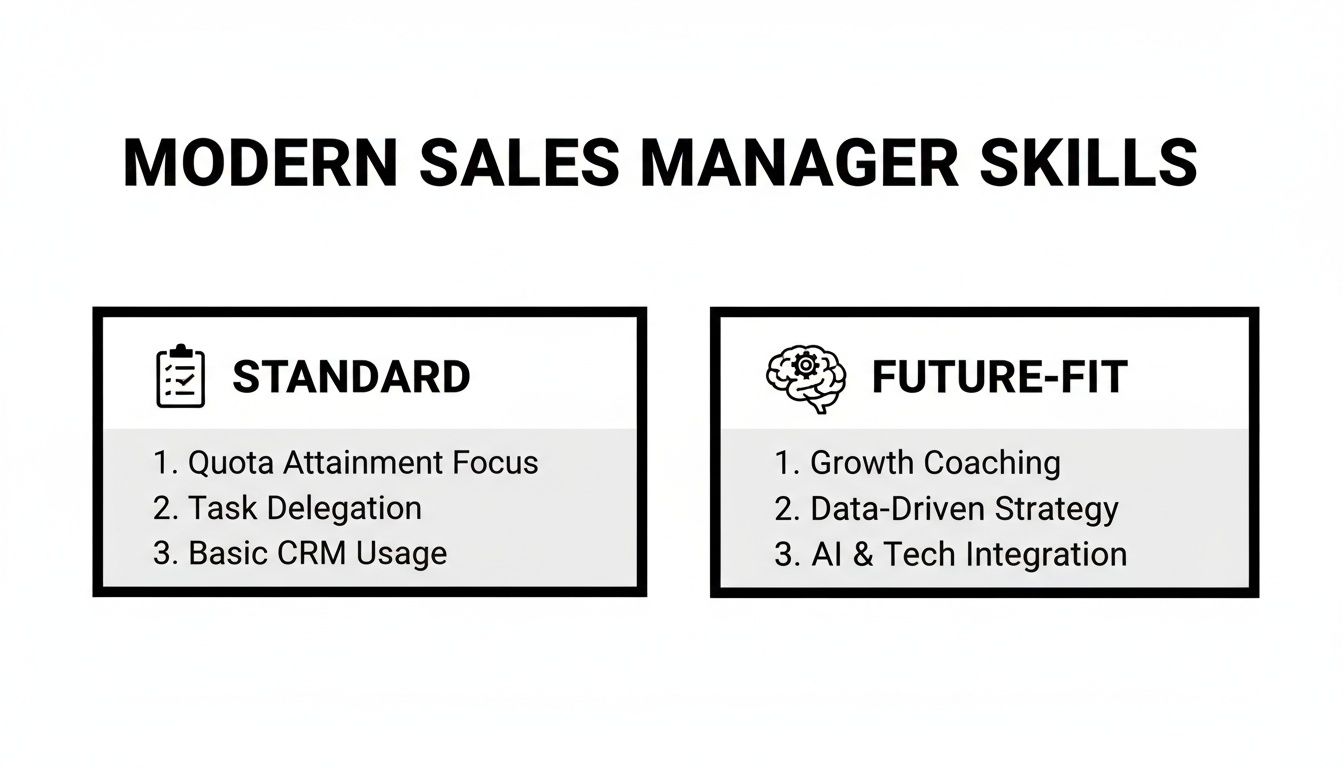
This visual really hammers home the shift from simply managing tasks to strategically developing people and processes. Your screening process has to be designed to uncover these deeper “future-fit” capabilities.
During these initial calls, use targeted questions to quickly gauge their potential. Ask about a time they had to turn around an underperforming rep, how they approach forecast accuracy, or how they’ve used data to change their team’s sales approach. Their answers will quickly tell you whether they are a tactical manager or a strategic leader, allowing you to filter effectively and dedicate valuable interview time only to those with genuine leadership DNA.
Running an Interview Process That Predicts Performance

A well-designed interview process is the single best predictor of how a sales manager will perform on the job. This is where you cut through the polished résumés and see their leadership, coaching, and strategic thinking in action.
The goal isn’t just to talk about their past experience. It’s to simulate the real-world challenges they’ll face. A rigorous process is the only way to separate the candidates who just talk a good game from the leaders who can actually build a high-performing sales team.
Designing a Multi-Stage Assessment Framework
A solid interview process needs multiple stages, each designed to peel back another layer of the candidate’s abilities. Think of it as a funnel. The first stage screens for basic qualifications, while the later stages put their leadership philosophy and problem-solving skills to the test.
A proven structure usually includes:
- A behavioural interview to dig into their past performance and leadership style.
- A practical case study to see their analytical and strategic skills in action.
- A panel interview with key leaders to check for cultural alignment and communication skills.
This phased approach gives you a complete picture of each candidate, helping you make a data-backed decision instead of just going with your gut.
Behavioural Questions That Uncover True Leadership
Generic questions get you rehearsed, generic answers. To get to the truth, you have to use behavioural questions that force candidates to give you specific examples of how they’ve handled real situations.
So, instead of asking something bland like, “How do you motivate a team?”, get specific. Try this: “Tell me about a time you had a talented but underperforming salesperson. Walk me through the exact steps you took over 30 and 60 days to address the issue, and what was the outcome?”
Here are a few more powerful questions to have in your back pocket:
- Describe your process for a pipeline review. How do you spot risk, and what actions do you take?
- Walk me through your most accurate and your least accurate quarterly forecast. What did you learn from the one you got wrong?
- Tell me about a time you had to let a salesperson go. How did you handle the process and the impact on team morale?
These kinds of questions push candidates past theory. Their answers show you their real management style and how they actually solve problems under pressure.
The quality of a sales manager is best revealed not by how they describe their successes, but by how they diagnose and learn from their failures. Focus your questions on challenges, tough decisions, and moments of adversity.
The Power of a Practical Case Study
If there’s one tool you must have in your sales manager hiring toolkit, it’s the practical case study. This is where the rubber meets the road. It shifts the assessment from a conversation to a real performance test and can give you more insight in 60 minutes than you’ll get from hours of interviews.
The best case studies give the candidate an anonymised but realistic sales dashboard or performance report. Give them a couple of days to analyse it, then have them present their findings to the interview panel.
Example Case Study Assignment:
- The Data: Provide a dashboard showing key metrics for a sales team over the last two quarters: quota attainment, average deal size, sales cycle length, and activity levels. Make sure to include data for 8-10 fictional reps.
- The Task: Ask the candidate to prepare a 20-minute presentation that covers three key areas:
- Diagnosis: What are the top two or three performance issues you see in this data? What are your initial hypotheses for the root causes?
- Priorities: As the new manager, what are the most urgent problems you would tackle first?
- Action Plan: Outline your 30-60-90 day plan for addressing these issues and getting the team on track.
This one exercise tests everything at once: their analytical skills, strategic thinking, communication style, and their ability to build a clear, actionable plan. It shows you exactly how they’d approach the job from day one.
Assembling a Balanced Interview Panel
The final stage should always be a panel interview with key stakeholders. This isn’t just a formality, it’s a crucial step for evaluating cultural fit and getting buy-in from other leaders who will be working with the new manager.
A well-rounded panel should include:
- The Head of Sales or CRO (the hiring manager)
- A peer sales manager
- A leader from a partner team, like Marketing or Customer Success
- A representative from HR or Talent Acquisition
Each person brings a unique perspective, helping you build a 360-degree view of the candidate. The key is to arm everyone with a structured scorecard based on the competencies you defined at the start. This data-driven approach minimises “gut feeling” hires that so often fail, ensuring your final decision is based on objective evidence gathered throughout the entire process.
Securing Your Top Hire for Day-One Success
Getting that verbal ‘yes’ from your top candidate is a great feeling, but the hiring process is far from over. In fact, what comes next, the offer and the onboarding is where you truly secure your new sales manager and set them up for success.
A weak offer or a messy first few weeks can make a star candidate second-guess their decision. All your hard work can unravel in an instant, leading to a costly mis-hire. This is the final mile where you lock in your investment and pave the way for immediate impact.
Crafting an Irresistible and Competitive Offer
In this market, your offer has to be more than just a number on a page. It’s a powerful message about how much you value the candidate and the role they’re about to step into. While the base salary is obviously important, top-tier sales leaders are looking at the whole picture, especially long-term potential and performance-based rewards.
A compelling offer needs to hit on several key points:
- A strong base salary that’s competitive for your industry, location, and the manager’s experience level.
- A clear, achievable performance bonus tied directly to measurable outcomes like team quota attainment.
- Long-term incentives, such as stock options or RSUs, that directly align the manager’s success with the company’s long-term growth.
- A sign-on bonus to cover any bonuses they’re leaving on the table at their old job. This removes a huge, and very common, obstacle.
This is especially critical right now. The demand for skilled leaders is only growing. Projections for sales manager hiring in India for 2026 show major growth in sectors like media and healthcare, with a projected 11% hiring growth. This surge is creating massive demand for digitally-savvy sales talent, with average salaries for top-tier profiles in consumer electronics and pharma hitting ₹65-130 lakhs. You can dig into more of this data on the hiring trends in India for 2026 on ciiskills.in.
When you present the offer, treat it like a partnership. Don’t just send an email. Get on a call, walk them through each part of the package, and explain the “why” behind the numbers. This kind of transparency builds immediate trust and shows you’re invested in their success from day one.
Designing a Structured 90-Day Onboarding Plan
The moment your new sales manager signs that offer, the onboarding clock starts ticking. A well-structured onboarding plan is the single biggest factor in making sure they hit the ground running. A chaotic start, on the other hand, leaves them feeling lost, isolated, and ineffective.
The goal of the first 90 days isn’t for the manager to generate revenue. It’s for them to learn your business, build relationships, and earn the trust of their new team. Success here is the foundation for all future results.
A great plan breaks the first three months down into clear, achievable milestones. This structured approach prevents them from feeling overwhelmed and gives them a clear path to follow. To help you build a robust programme, check out our comprehensive guide and download a free onboarding checklist template.
Key Milestones for Manager Onboarding
A strong plan ensures your new hire focuses on the right activities at the right time. Here’s what a phased approach should look like:
First 30 Days: Listen, Learn, and Diagnose
The first month is all about soaking it all in. The manager’s primary job is to understand the people, processes, and products.
- Meet the Team: They should be having one-on-ones with every single direct report to understand their strengths, challenges, and career goals.
- Understand the Business: This means scheduled sit-downs with leaders from Marketing, Customer Success, and Product to learn how the different parts of the machine work together.
- Review the Data: They need to live in the CRM, sales reports, and call recordings to get a data-driven view of what’s really happening on the ground.
Days 31-60: Formulate and Align
With a month of insights under their belt, the manager now shifts from listening to building a plan. This is all about strategy and getting buy-in.
- Develop a Go-Forward Plan: They should create a presentation that outlines their diagnosis of the team’s challenges and a clear, proposed action plan.
- Align with Leadership: This plan gets presented to you and other key stakeholders. This ensures everyone is aligned and the manager has the resources they need.
- Begin Coaching: Now, they can start joining team calls and pipeline reviews, focusing on coaching and providing initial feedback without taking over.
Days 61-90: Execute and Iterate
In the final phase, the manager starts to put their plan into action and drive change.
- Implement New Processes: This is the time to roll out any new cadences, reporting structures, or coaching frameworks they’ve designed.
- Establish a Feedback Loop: They should be setting up a regular rhythm for performance feedback and one-on-ones with the team.
- Measure Early Wins: It’s time to identify and track leading indicators of success, like improved forecast accuracy or higher activity levels, to show early momentum.
This structured onboarding transforms a risky transition into a predictable ramp-up, ensuring your new sales manager is fully equipped to start delivering results and driving your team forward.
FAQs
Hiring a great sales manager brings up some tough questions. We get it. The stakes are incredibly high, the best candidates are discerning, and a few common missteps can derail your entire search. Let’s tackle the most critical questions CHROs and talent leaders ask us, with clear, practical answers to guide your strategy.
What Is the Biggest Mistake Companies Make?
The most common and damaging mistake we see is promoting a top-performing salesperson into a management role without checking if they can actually lead. It’s an easy trap to fall into. But exceptional sales skills and effective leadership are two completely different things. One is about personal wins; the other is about making everyone else win.
This promotion path often backfires spectacularly. The company loses its best individual contributor and gets a subpar manager who struggles to coach, think strategically, or motivate their team. This single error can kick off a downward spiral of poor morale, missed targets, and people heading for the door.
The fix is to separate sales performance from leadership potential. You need a proper internal assessment process with situational exercises and behavioural interviews built specifically to test for management competencies. Never, ever assume a great seller will automatically be a great coach.
How Can a Recruitment Partner Accelerate the Process?
A strategic recruitment partner, especially an RPO provider, can slash your sales manager hiring timeline. They do this not just by sourcing faster, but by being smarter and more efficient at every single stage. The speed comes from three key areas.
First, they bring deep Talent Intelligence. Instead of starting from a blank slate, they use detailed market maps to pinpoint exactly where top-tier, passive sales manager talent is working right now—often at your direct competitors or in high-growth adjacent industries. This turns a wide, hopeful search into a targeted mission.
Second, they have a pre-vetted talent database. Top RPO firms are always talking to high-calibre, passive candidates. This means they can often introduce you to qualified, interested managers in days, not weeks, shrinking the sourcing phase dramatically.
Finally, they bring technology and specialised expertise to the table. AI-powered screening tools and seasoned recruiters handle the high-volume, time-sucking tasks of sourcing, initial screening, and scheduling. This frees up your internal team to pour their energy into what matters most: high-value, final-stage interviews. This powerful combination can cut the overall time-to-hire by 25-40%.
What KPIs Should We Use for a New Sales Manager?
Measuring a new sales manager’s success in their first six months needs a balanced scorecard that looks beyond just the revenue numbers. You need a mix of leading and lagging indicators to see if they’re building the right foundation for long-term success.
Focus on these key performance indicators (KPIs) to get the full picture:
- Team Adoption Rate: How consistently is the team using the CRM and other core sales tools? This is a primary sign of the manager’s ability to drive discipline and operational rigour.
- Forecast Accuracy: Look at the variance between the manager’s forecast and the actual results. Improvement here shows they’re getting a real grip on the pipeline and coaching reps effectively on deal qualification.
- Coaching Cadence: Quantify the number of structured coaching sessions and deal reviews they’re conducting. This measures activity, ensuring they are actively involved in developing their people.
- Team Engagement Score: Use a simple pulse survey to check on team morale and how they feel about the new manager’s leadership. This is a crucial early warning system for any cultural problems.
- Pipeline Velocity: Analyse how quickly deals are moving through the sales cycle. An uptick in velocity suggests the manager is successfully removing friction and improving the sales process.
While lagging indicators like the percentage of the team hitting quota are important, these leading KPIs will tell you if your new hire is on the right track long before the quarter ends.
Is Industry Experience More Important Than Leadership Talent?
This is a classic hiring dilemma, but for a sales manager role, the answer is almost always the same: raw leadership talent is more critical for long-term success.
Sure, specific industry experience gives someone a head start in understanding market nuances, customer profiles, and the competitive landscape. But these are things a smart, adaptable person can learn relatively quickly. True leadership ability the gift of coaching, motivating, building processes, and developing people is far more innate and much harder to teach.
A candidate with a proven track record of building and inspiring teams in a completely different industry can often learn your market faster than an industry veteran with poor leadership skills can learn how to be a great manager. Prioritise screening for exceptional coaching ability, strategic thinking, and emotional intelligence first. Then, use secondary criteria to test for high learning agility. Unless your industry is exceptionally technical or regulated, always bet on the superior leader.
Ready to stop searching and start hiring the sales leaders who will drive your growth? Taggd‘s AI-powered RPO solutions combine deep market intelligence with a pre-vetted database of top-tier talent, reducing your time-to-hire and ensuring you land a manager built for success. Connect with us and discover how we can build your winning sales team.