A talent acquisition model is the strategic framework an organisation uses to find, attract, and hire the talent it needs to hit its business goals. It’s much more than just a hiring process; think of it as a comprehensive blueprint that connects every single recruitment activity back to the company’s long-term vision and culture. This structure is what turns hiring from a reactive necessity into a proactive, strategic advantage.
Understanding Your Hiring Blueprint
Picture your talent acquisition model as the architectural plans for your company’s future workforce. You wouldn’t build a skyscraper without a detailed blueprint, right? In the same way, you shouldn’t build your team without a deliberate framework in place.
A generic, one-size-fits-all approach to hiring simply doesn’t cut it in today’s competitive talent market. What you really need is a clear, organised system for making those critical decisions about people.
This strategic framework pushes your organisation beyond just filling open roles. It forces you to grapple with the deeper questions that have a direct impact on business success:
- Strategic Alignment: How does our hiring strategy actually support our three-year business plan and revenue targets?
- Cultural Fit: What processes do we have to make sure we’re hiring people who will not only fit in but actively contribute to our unique company culture?
- Operational Efficiency: Are our recruitment efforts consistent, scalable, and cost-effective across every department and location?
- Candidate Experience: How do we guarantee that every applicant has a positive interaction with our brand, whether they get the job or not?
By asking and answering these questions, the model elevates recruitment from a simple administrative task to a core strategic function of the business.
From Reactive to Proactive
Without a formal talent acquisition model, hiring often descends into a chaotic scramble. A department flags a vacancy, and the recruitment team rushes to fill it. This approach is not only inefficient but rarely delivers the best long-term results, leading to inconsistent candidate experiences, higher costs, and a constant feeling of being one step behind.
A well-designed talent acquisition model flips this dynamic on its head. It empowers a Chief Human Resources Officer (CHRO) to proactively build talent pipelines, anticipate future hiring needs, and position the recruitment function as a true strategic partner to the business. It’s about building the team you’ll need tomorrow, not just filling the seats that are empty today.
This forward-thinking approach is what truly separates high-performing organisations from the pack. It ensures that every single hire is a strategic investment in the company’s future, directly influencing innovation, market position, and ultimately, the bottom line.
Comparing the Five Core Talent Acquisition Models
Choosing the right talent acquisition model is a lot like picking an operational strategy for a factory. Each one offers a different way to organise your people, manage workflows, and hit specific targets. Getting to grips with these core frameworks is the first step towards building a recruitment function that actively drives business growth, rather than just reacting to open roles.
Let’s break down the five primary models. Each has its own distinct philosophy, structure, and ideal use case, giving you a menu of strategic options to consider.
This visual map shows the core functions—Attracting, Engaging, and Hiring—that every single talent acquisition model, no matter its shape or size, must successfully manage.
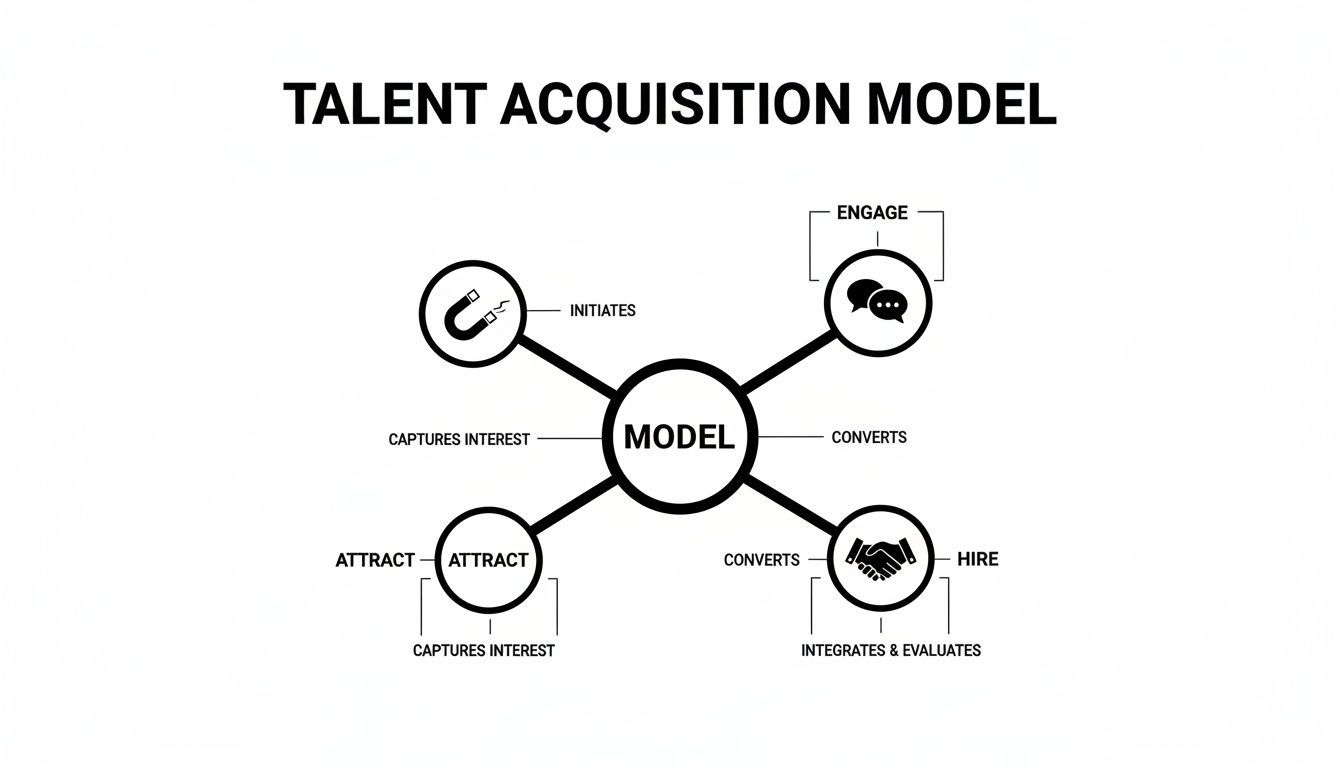
The image drives home a key point: regardless of the structure you choose, these fundamental pillars are the engine of your hiring success.
1. The Centralised Model
A centralised talent acquisition model operates from a single, unified hub. All recruitment activities, from sourcing candidates to sending out final offers, are managed by one corporate team. Think of it as a powerful command centre that ensures total consistency across the entire organisation.
- Best For: Organisations where brand consistency, compliance, and standardised processes are non-negotiable, like in finance, healthcare, or large-scale manufacturing.
- Key Benefit: Exceptional control over the candidate experience and hiring policies.
- Primary Risk: It can become a bottleneck, slowing down hiring for specialised roles in different business units. It may lack the agility to react to unique local market needs.
2. The Decentralised Model
In direct contrast, the decentralised model empowers individual business units or regional offices to run their own hiring. Each department or location has its own recruitment team, giving them the autonomy to hire based on their specific, immediate needs.
Imagine a global tech firm that needs to hire a machine learning expert in Bengaluru and a sales director in London. A decentralised approach lets the local teams use their market knowledge and networks to find the best people, fast.
This model champions speed and local relevance. It trusts that the people closest to the work know best who to hire, freeing them from the constraints of a rigid, top-down process.
This is especially critical in fast-moving sectors. For instance, the AI-ML sector in India is exploding, with hiring projected to surge by 25% year-on-year. Roles like machine learning engineers have seen an incredible 88% YoY growth, forcing CHROs to adopt nimble models that can secure this kind of hyper-specialised talent. You can discover more insights about India’s hiring trends and how they are shaping the future.
3. The Centre of Excellence (CoE) Model
The Centre of Excellence (CoE) model is a sophisticated blend of centralised strategy and decentralised execution. A central CoE team focuses on the big picture: strategy, technology, analytics, and best practices. They act as internal consultants, arming decentralised recruiters with the tools and insights they need to win.
- Strategic Hub: The CoE looks after employer branding, recruitment tech, and data analytics.
- Local Execution: Recruiters embedded in business units handle the day-to-day sourcing and hiring.
This structure is perfect for large, complex organisations that need both strategic oversight and on-the-ground flexibility.
4. Recruitment Process Outsourcing (RPO)
Recruitment Process Outsourcing (RPO) involves bringing in an external partner to manage all or part of your recruitment function. This is far more than just handing off tasks; it’s a genuine strategic partnership. The RPO provider becomes an extension of your team, embedding in your culture and using their expertise to deliver results.
An RPO model is a great fit for companies needing to scale rapidly, enter new markets, or tap into specialised talent pools without building a massive in-house team. It gives you instant access to advanced technology and deep market intelligence.
5. The Hybrid Model
The hybrid model is the most flexible of the lot, borrowing elements from the other frameworks to create a custom-fit solution. An organisation might centralise its executive hiring while letting individual sites handle entry-level roles. Another might use an RPO partner for high-volume tech recruitment while keeping sales hiring in-house.
The name of the game is customisation. This model allows a company to design a talent acquisition model that perfectly aligns with its unique structure, culture, and business goals. For many organisations, a hybrid approach truly offers the best of all worlds—balancing control, speed, and strategic focus.
Comparative Analysis of Talent Acquisition Models
To help you see how these models stack up at a glance, the table below provides a high-level comparison across key attributes. This can help you quickly assess which approach might be the best starting point for your organisation.
| Model | Key Benefit | Best For | Primary Risk |
|---|---|---|---|
| Centralised | Consistency and control | Organisations needing strong brand and process standardisation. | Can be slow and lack local market responsiveness. |
| Decentralised | Speed and local relevance | Diverse, global companies with unique regional needs. | Inconsistent candidate experience and brand dilution. |
| Centre of Excellence (CoE) | Strategic oversight with local agility | Large, complex businesses needing both structure and flexibility. | Requires significant investment and strong leadership to align CoE and local teams. |
| Recruitment Process Outsourcing (RPO) | Scalability and expertise | Companies in high-growth phases or needing specialised talent pools. | Potential loss of direct control and risk of cultural mismatch with partner. |
| Hybrid | Maximum flexibility | Businesses with varied hiring needs across different functions or levels. | Can become overly complex to manage if not designed clearly. |
Ultimately, the right model depends entirely on your business context. There’s no single “best” answer, only the one that best supports your strategic objectives, organisational structure, and growth ambitions.
The Strategic Value of Recruitment Process Outsourcing
It’s easy to think of Recruitment Process Outsourcing (RPO) as just another way to cut costs. But that’s a narrow view. A modern RPO isn’t a simple vendor relationship; it’s a deep, strategic partnership designed to seriously upgrade your company’s ability to attract and keep the people who will drive its future.
For any organisation facing the pressures of rapid growth, fierce competition for niche skills, or the challenge of breaking into new markets, the business case for RPO is incredibly strong. The value goes far beyond the balance sheet. It’s about getting instant access to rich talent pools and sophisticated recruitment tech that would otherwise take years and a mountain of capital to build from the ground up.
An RPO partner doesn’t just work for you; they become an embedded part of your team. They dive deep into your culture, get to grips with your business goals, and represent your employer brand with the same care and passion as your own people. This seamless integration is where the real strategic magic happens.
Beyond Cost Cutting to Strategic Impact
While you’ll certainly see cost efficiencies, the true power of an RPO lies in its ability to deliver tangible improvements across the hiring metrics that matter most. For any CHRO needing to prove a clear return on investment to the C-suite, this is the crucial point. A great RPO partner brings market intelligence and operational excellence that directly fuels better business outcomes.
This partnership is especially vital in a hot job market. Take India’s recruitment landscape, for instance. Projections show a massive surge on the horizon, with an expected 500,000 new job opportunities and a 19% jump in hiring intent heading into 2025. This kind of momentum means you need a recruitment engine that’s both scalable and expert-driven just to keep up. You can learn more about India’s recruitment industry outlook for 2025 and the opportunities it holds.
So, what are the core advantages?
- Enhanced Scalability: RPO gives you the agility to ramp your recruitment capacity up or down almost instantly, reacting to business needs without the fixed overhead of a large in-house team.
- Access to Expertise: You’re not just hiring recruiters; you’re gaining a dedicated team of specialists who live and breathe talent acquisition. They bring best practices from across industries right into your organisation.
- Improved Quality of Hire: RPO providers use advanced sourcing methods and rigorous screening to find candidates who don’t just have the right skills, but who also genuinely fit your company culture. The result? Better long-term retention.
- Advanced Technology Stack: Top RPO firms come equipped with a suite of recruitment technologies, from AI-powered sourcing tools to powerful analytics platforms, saving you from making that hefty direct investment yourself.
Proving the ROI of an RPO Partnership
As a CHRO, you have to frame the value of an RPO partnership in business terms. The conversation needs to shift from cost per hire to the strategic value each new employee brings. It’s all about showing how this talent acquisition model solves specific business problems and delivers real results.
An RPO partner’s success is measured by your success. Their incentives are aligned with yours—to slash your time-to-fill, boost hiring manager satisfaction, and increase new hire performance. These are the metrics that get the attention of executive leadership.
Think about the direct line between smart hiring and business goals. When you fill critical roles faster, you accelerate project timelines and product launches. When you improve the quality of your hires, you see a direct lift in innovation, sales figures, and customer satisfaction. This is where an RPO model really proves its worth, transforming the recruitment function from a cost centre into a strategic engine for growth. For a deeper dive, check out our guide on how RPO aligns hiring directly with business goals.
Ultimately, bringing on an RPO partner is a strategic move to professionalise and supercharge your hiring capabilities. It frees up your internal HR team to focus on bigger-picture initiatives like leadership development and succession planning, giving them peace of mind that the talent pipeline is in the hands of world-class experts.
How to Design and Implement Your Ideal Model
Knowing the different types of talent acquisition models is one thing; building your own is another beast entirely. The shift from theory to practice needs a deliberate, step-by-step approach. Think of it like drawing up the architectural plans for a new building—it requires a clear vision, a solid foundation, and a detailed roadmap to ensure everything comes together perfectly. This process is what turns your strategy into a hiring engine built for purpose.

But the journey doesn’t start with a solution. It begins with a deep and honest look at where you stand today. Without that clarity, any new model you build will be on shaky ground.
Start With a Thorough Needs Analysis
Before you can build the future, you have to get real about the present. A comprehensive needs analysis is your non-negotiable first step. This means doing a deep dive into your current recruitment processes, uncovering the real pain points, and looking at the hard numbers.
Your goal here is simple: identify exactly where the current system is letting you down. Are you struggling with a sky-high time-to-fill for critical roles? Is the quality of candidates a mixed bag across different departments? Are your hiring managers pulling their hair out over the process?
To get these answers, you’ll need to attack it from a few angles:
- Stakeholder Interviews: Get on the phone or in a room with hiring managers, new hires, and senior leaders. Ask them about their experiences and what frustrates them most.
- Data Audit: Dive into your existing recruitment data. Look for patterns in your cost-per-hire, which sourcing channels actually work, and where candidates are dropping out of the funnel.
- Process Mapping: Grab a whiteboard and visually map your current hiring journey, from the moment a job requisition is raised to the first day of onboarding. This will make bottlenecks and inefficiencies glaringly obvious.
This initial fact-finding mission gives you the evidence you need to build a compelling case for change and ensures your new model is designed to solve actual, documented problems.
Secure Executive Buy-In and Define Roles
With your analysis in hand, your next stop is the C-suite. Don’t present your findings as HR problems. Frame them as business challenges that directly hit revenue, innovation, and growth. Position the new talent acquisition model as a strategic investment that will deliver a measurable return.
Gaining executive support is more than just getting a budget approved. It’s about creating a coalition of leaders who will champion the change, communicate its importance, and help dismantle organisational silos that stand in the way of progress.
Once you have that top-level backing, you can start defining the roles and responsibilities within the new structure. Whether you’re building a centralised team, a Centre of Excellence, or a hybrid model, absolute clarity is key. Everyone involved needs to know their exact duties, who they report to, and how their performance will be measured.
Build Your Technology Stack and Governance
Your talent acquisition model is only as good as the tech that powers it. Modern recruiting demands a tech stack that drives efficiency, gives you useful data, and creates a stellar candidate experience. While an Applicant Tracking System (ATS) is the heart of it all, you should also consider tools for:
- Candidate Relationship Management (CRM): Essential for nurturing pipelines of passive talent.
- AI-Powered Sourcing: To find high-fit candidates much faster.
- Interview Scheduling Automation: To slash the admin burden and speed things up.
Hand-in-hand with technology, you need a strong governance framework. This is the rulebook that keeps your model running smoothly and holds everyone accountable. It should spell out performance standards, who has the authority to make which decisions, and the process for resolving issues. Solid governance makes sure your model stays aligned with business strategy and runs efficiently for the long haul, no matter its structure. For a practical guide, you can use a well-structured talent acquisition strategy template to map this out.
Finally, wrap the entire rollout in a robust change management plan. Communicate early and often, provide plenty of training, and celebrate early wins to build momentum. A successful launch isn’t just about flipping a switch; it’s about bringing your people along for the ride and making sure the new model is adopted with real enthusiasm.
Measuring the Success of Your Hiring Model
A great talent acquisition model looks good on paper, but its real worth is proven by the results it delivers. To get the C-suite to buy in, you need to go beyond the usual recruitment stats and focus on what really matters: business impact. It’s all about showing a clear line from smart hiring to organisational growth.
This means changing the conversation. We need to move from tracking simple activities to measuring real outcomes. A powerful model doesn’t just fill seats faster; it fills them with the right people who stick around and make a difference. And proving that requires a data-first approach in your TA function.
Moving Beyond Vanity Metrics
Too many recruitment teams get bogged down in “vanity metrics” – things like the number of applications or interviews held. Sure, these numbers can look impressive on a dashboard, but they tell you very little about how effective your hiring strategy actually is. They’re often more noise than signal.
To really measure success, you have to connect your TA model to tangible business results. That means zeroing in on the KPIs that senior leadership actually understands and cares about—metrics that speak to efficiency, quality, and strategic alignment.
The ultimate goal is to prove that your hiring model isn’t a cost centre, but a strategic engine for growth. With the right data, you can clearly show how your team’s efforts are reducing business risks, getting projects off the ground faster, and improving the bottom line.
To build this data-driven story, you need to start with a few core strategic metrics that paint a full picture of your performance.
Key Strategic KPIs to Track
A solid measurement framework should balance operational efficiency with strategic impact. Here are the essential metrics that will help you prove the value of your chosen talent acquisition model. For a deeper dive, check out our complete guide on the most important talent acquisition metrics you should be monitoring.
- Quality of Hire: This is arguably the most important metric of all. It measures the value a new employee brings to the table, usually assessed through their performance reviews, productivity levels, and whether they’re still with you after a year. A high Quality of Hire score is direct proof that your model is bringing in top-tier talent that drives the business forward.
- Time to Fill and Time to Hire: These two are often mixed up, but they measure different things. Time to Fill tracks the number of days a role stays open, which directly reflects the business cost of that vacancy. Time to Hire, on the other hand, measures the time from a candidate’s first contact to their offer acceptance, showing how efficient your recruitment process is. You need both to spot bottlenecks and speed things up.
- Source of Hire Effectiveness: This KPI is about more than just knowing where your candidates came from. It’s about analysing the performance of hires from different channels, like referrals, job boards, or direct sourcing. For instance, if you find that employee referrals consistently lead to top performers who stay longer, you’ve got a clear business case for investing more in that program.
Tracking the right KPIs is fundamental, but the story isn’t complete without looking at the strategic business impact. Let’s break down how to connect operational metrics to the outcomes that matter most to leadership.
Strategic KPIs for Talent Acquisition Models
| Metric | What It Measures | Why It Matters to a CHRO |
|---|---|---|
| Quality of Hire | New hire performance, productivity, and retention within the first 12 months. | This is the ultimate proof of value, directly linking TA efforts to business performance and long-term success. |
| New Hire Retention Rate | The percentage of new hires who remain with the company after one year. | High retention is a strong indicator of a good cultural fit and a successful onboarding process, saving significant replacement costs. |
| Cost Per Hire | Total recruitment costs (internal and external) divided by the number of hires. | Provides a clear view of the financial efficiency of the TA function, helping to justify budget and resource allocation. |
| Time to Productivity | The time it takes for a new hire to become fully productive in their role. | A shorter time to productivity means a faster return on investment for each new hire, accelerating business impact. |
| Hiring Manager Satisfaction | Feedback from internal stakeholders on the quality and speed of the hiring process. | High satisfaction signals strong alignment between the TA team and business needs, proving the model is a true business partner. |
| Candidate Net Promoter Score (cNPS) | Candidates’ willingness to recommend applying to the company to others. | A crucial measure of employer brand health and the candidate experience, impacting the ability to attract top talent in the future. |
By focusing on these metrics, a CHRO can shift the narrative from “how many people we hired” to “how our hiring strategy drove business growth.”
Gauging Experience and Brand Perception
Your talent acquisition model has a huge effect on your employer brand. How candidates and hiring managers feel about the process can have a ripple effect, making these experience-based metrics non-negotiable.
- Candidate Net Promoter Score (cNPS): This simple but powerful metric asks applicants how likely they are to recommend your company as a place to apply. A low cNPS is a major red flag, signalling problems in your process that could be damaging your reputation in the talent market.
- Hiring Manager Satisfaction: At the end of the day, a successful TA model has to work for its internal clients. Regularly surveying hiring managers gives you crucial feedback on everything from the quality of candidates to the smoothness of the entire process. High satisfaction scores show that your TA team is truly aligned with the business.
When you build dashboards that shine a spotlight on these strategic KPIs, you can tell a powerful story. You’ll be able to pinpoint inefficiencies, forecast hiring needs with greater accuracy, and show, without a doubt, how your talent acquisition model is delivering a measurable and significant return on investment.
Future-Proofing Your Talent Acquisition Strategy

A truly successful talent acquisition model is never a “set it and forget it” project; it has to be built for change. The forces shaping how we work are relentless, and your hiring framework needs to be agile enough to keep pace. Staying ahead of the curve means looking at the trends redefining how we find and hire people and getting ready for them now.
The biggest shift, without a doubt, is the rise of artificial intelligence in recruitment. AI isn’t some far-off concept anymore—it’s a practical tool that teams are using today. When implemented thoughtfully, AI-driven systems can seriously reduce bias. In fact, some studies show they can assess female candidates up to 39% more fairly and racial minority candidates up to 45% more fairly than human screeners alone.
But jumping on the tech bandwagon without a clear plan is a recipe for trouble.
Adapting to New Workforce Dynamics
Beyond the tech, the very nature of work itself is transforming. Your talent acquisition model must evolve to handle several major shifts happening right now:
- The Contingent Workforce: Freelancers, contractors, and gig workers aren’t just for temporary gaps anymore. They’re a core part of strategic workforce planning. Your model needs the flexibility to source, engage, and manage this talent just as effectively as your permanent staff.
- Skills-Based Hiring: The game is shifting away from traditional qualifications and career histories toward verifiable skills and potential. This demands a complete rethink of job descriptions, screening processes, and interviews to spot what someone can do, not just where they’ve been.
- Diversity, Equity, and Inclusion (DE&I): DE&I can’t be a side project; it has to be a foundational pillar of your entire talent strategy. A modern, effective model embeds DE&I principles at every single stage, from writing inclusive job ads to ensuring unbiased interview panels.
These aren’t just optional extras. They are essential components for building a resilient and competitive workforce that’s ready for whatever comes next.
An agile talent acquisition model is your organisation’s competitive edge. It’s a living framework that responds to market shifts, embraces new technologies responsibly, and puts people and skills at the very centre of your growth strategy.
Building a Learning Culture in Your TA Team
To navigate all this change, your talent acquisition team can’t stand still. Fostering a culture of continuous learning and curiosity is non-negotiable. Push your recruiters to build new muscles in areas like data analysis, AI literacy, and strategic talent advising. They need to become true consultants to the business.
Ultimately, future-proofing your talent model is about weaving flexibility into its very DNA. By staying informed, embracing change, and building a culture of constant improvement, you ensure your organisation can do more than just survive the war for talent—it can win it.
Frequently Asked Questions
When you’re thinking about changing or implementing a talent acquisition model, a lot of questions pop up. It’s a big move. To help clear things up, we’ve tackled some of the most common queries we hear from CHROs and HR leaders like you.
Our goal here is to help you pinpoint problems with your current setup, get a real feel for how different structures work on the ground, and make sure whatever you choose is built to last.
When Is It Time to Change Our Talent Acquisition Model?
The classic red flags are usually the most obvious ones. Are you consistently missing your hiring targets? Is there a revolving door of new hires leaving within their first year? Is the feedback from candidates or hiring managers overwhelmingly negative? These are practical failures you just can’t ignore.
Another huge tell is a lack of agility. If your hiring function can’t quickly scale up for a growth spurt or dial back during leaner times, it’s probably not fit for purpose anymore.
But the ultimate warning sign? It’s all about perception. When your own company sees talent acquisition as a reactive cost centre—just filling seats—instead of a strategic partner driving business growth, that’s your signal. A fundamental change is needed.
What Is the Biggest Challenge When Moving to an RPO Model?
Interestingly, the toughest hurdle with adopting a Recruitment Process Outsourcing (RPO) model isn’t operational; it’s cultural. Getting your internal teams on board and building a genuine partnership with your RPO provider is, without a doubt, the most critical piece of the puzzle.
Your internal recruiters might worry their jobs are on the line, which can lead to resistance. At the same time, hiring managers could be wary of bringing in an external partner, fearing they’ll lose control or that the provider won’t “get” their specific needs.
To get past this, you need strong, clear communication from the top that lays out the strategic wins. Success really hinges on setting crystal-clear roles and picking an RPO partner who takes the time to truly understand your company culture and can operate as a seamless extension of your brand.
Can a Smaller Business Benefit from a Formal Model?
Absolutely. A smaller company doesn’t need some sprawling, multi-layered framework, but putting a simple, structured approach in place—like a basic hybrid model—can work wonders. It creates much-needed consistency and massively improves hiring outcomes.
This structure helps level the playing field. It allows smaller organisations to punch above their weight and compete for top talent by delivering a stellar candidate experience and making decisions based on data, not just gut feelings.
RPO can be a game-changer here too. It gives smaller businesses instant access to specialised recruiting expertise and sophisticated tech that would otherwise be completely out of reach.
Ready to transform your hiring from a cost centre into a strategic growth engine? Taggd specialises in building bespoke RPO solutions that deliver measurable results. Discover how we can design the perfect talent acquisition model for your business at https://taggd.in.